
Sell or Auction Your Vilfredo Pareto Autograph Letter Signed for up to Over $1,000 or More at Nate D. Sanders Auctions
FREE VALUATION. To buy, auction, sell or consign your Vilfredo Pareto Autograph Letter Signed that is for sale, please email your description and photos to [email protected] of Nate D. Sanders Auctions (http://www.NateDSanders.com).
Sell Your Vilfredo Pareto Autograph Letter Signed
Vilfredo Federico Damaso Pareto (UK: /pæˈreɪtoʊ, -ˈriːt-/ pa-RAY-toh, -EE-, US: /pəˈreɪtoʊ/ pə-RAY-toh, Italian: [vilˈfreːdo paˈreːto], Ligurian: [paˈɾeːtu]; born Wilfried Fritz Pareto; 15 July 1848 – 19 August 1923) was an Italian civil engineer, sociologist, economist, political scientist, and philosopher. He made several important contributions to economics, particularly in the study of income distribution and in the analysis of individuals’ choices. He was also responsible for popularising the use of the term “elite” in social analysis.
Below are some recent realized price for an Vilfredo Pareto Autograph Letter Signed item. We at Nate D. Sanders Auctions can obtain up to this amount or more for you:
Vilfredo Pareto Autograph Letter Signed. Sold for over $1,000.

Nate D. Sanders Auctions has sold the following Civil War memorabilia:
The 1963 Nobel Prize in Physiology or Medicine, awarded to physiologist Alan Lloyd Hodgkin for establishing the propagation mechanism of nerve impulses called action potentials — consequently helping to understand the mechanism behind disorders such as multiple sclerosis, seizures and Parkinson’s disease. Hodgkin is also responsible for identifying the Hodgkin Cycle and, along with colleagues Andrew Fielding Huxley and John Carew Eccles, hypothesized the existence of ion channels on cell membranes, a concept which took over 20 years to confirm; that confirmation earned Erwin Neher and Bert Sakmann the 1991 Nobel Prize. This Nobel Prize medal is made of 23k gold and features the relief portrait of Alfred Nobel, with his name and the years of his birth and death. Verso features the words, ”INVENTAS VITAM JUVAT EXCOLUISSE PER ARTES”, which translates from Latin to, ”Inventions enhance life which is beautified through art”. A.L. Hodgkin’s name and the year 1963 in Roman numerals are engraved on a plaque below the relief, framed by the words, ”REG. UNIVERSITAS MED-CHIR-CAROL”. On the right side is the name ”E LINDBERG”, who designed the prize. Comes with 6 original photographs of Hodgkin (at least 4 of which are from the ceremony in Oslo on 10 December 1963), a New York Times article on Hodgkin dated 18 October 1963, a portion of a 1976 issue of ”The Journal of Physiology” featuring an essay by Hodgkin, and the official 1963 English edition of the Nobel Prize publication, featuring Hodgkin and partner Huxley on the cover. Medal is housed in the maroon leather presentation box with a white satin lining and Hodgkin’s name printed on the front. Box measures 5.5” x 5.5” x 1”. Medal measures 6.5 cm or 2.56” in diameter, and weighs 196 g or 6.9 oz, consistent with the original Nobel Prizes awarded in 1963. Presented in near fine condition. With an LOA from the daughter of Dr. Alan Hodgkin. Sold for $795,614.


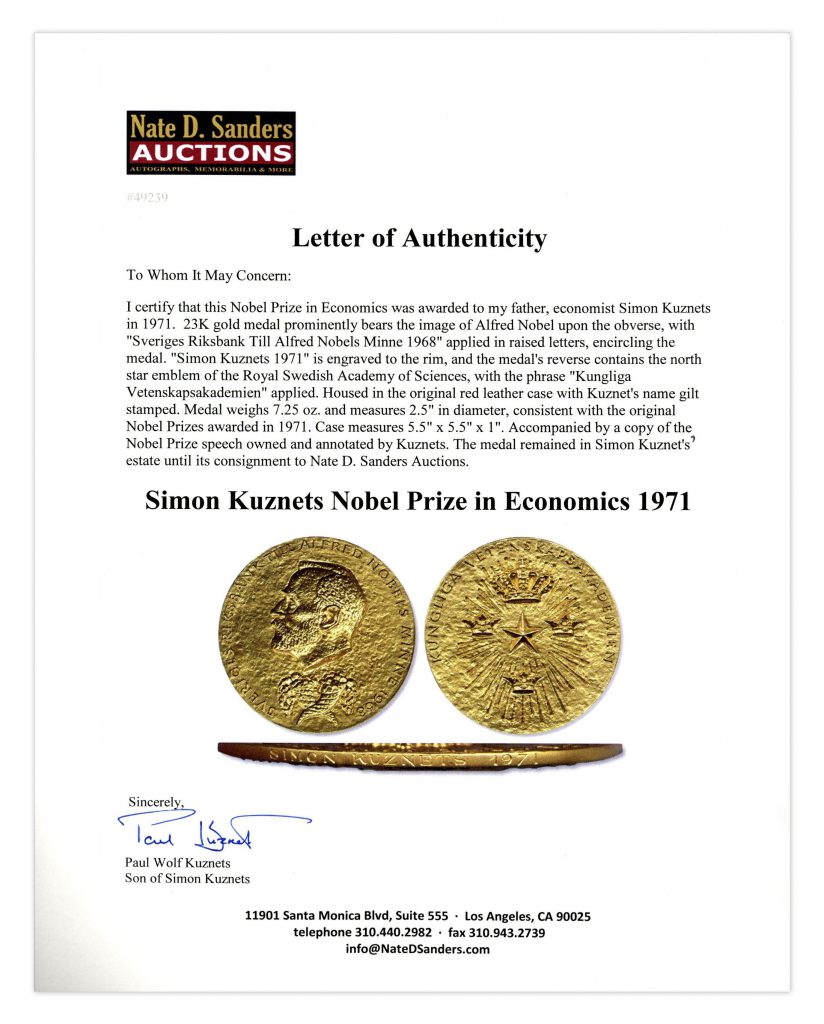
The Nobel Prize in Economic Sciences, awarded in 1971 to influential economist Simon Kuznets, inventor of the Kuznets Curve in 1955. Kuznets is credited with inventing a quantitative method for correlating per capita income to economic inequality over time, as a country’s economic growth matures. In the ceremony on 11 December 1971, the Nobel Prize committee awarded Kuznets the Nobel Prize for his ”empirically founded interpretation of economic growth which has led to new and deepened insight into the economic and social structure and process of development”. 23K gold medal prominently bears the image of Alfred Nobel upon the obverse, with ”Sveriges Riksbank Till Alfred Nobels Minne 1968” applied in raised letters, encircling the medal. ”Simon Kuznets 1971” is engraved to the rim, and the medal’s reverse contains the north star emblem of the Royal Swedish Academy of Sciences, with the phrase ”Kungliga Vetenskapsakademien” applied. Housed in the original red leather case with Kuznets’ name gilt stamped. Medal weighs 7.25 oz. and measures 2.5” in diameter, consistent with the original Nobel Prizes awarded in 1971. Case measures 5.5” x 5.5” x 1”. Accompanied by a copy of the Nobel Prize speech owned and annotated by Kuznets. This is the sixth Nobel Prize ever sold at auction, and the first in the category of Economic Sciences. Presented in near fine condition. With an LOA from the consignor, Simon Kuznets’ son. Sold for $390,848.

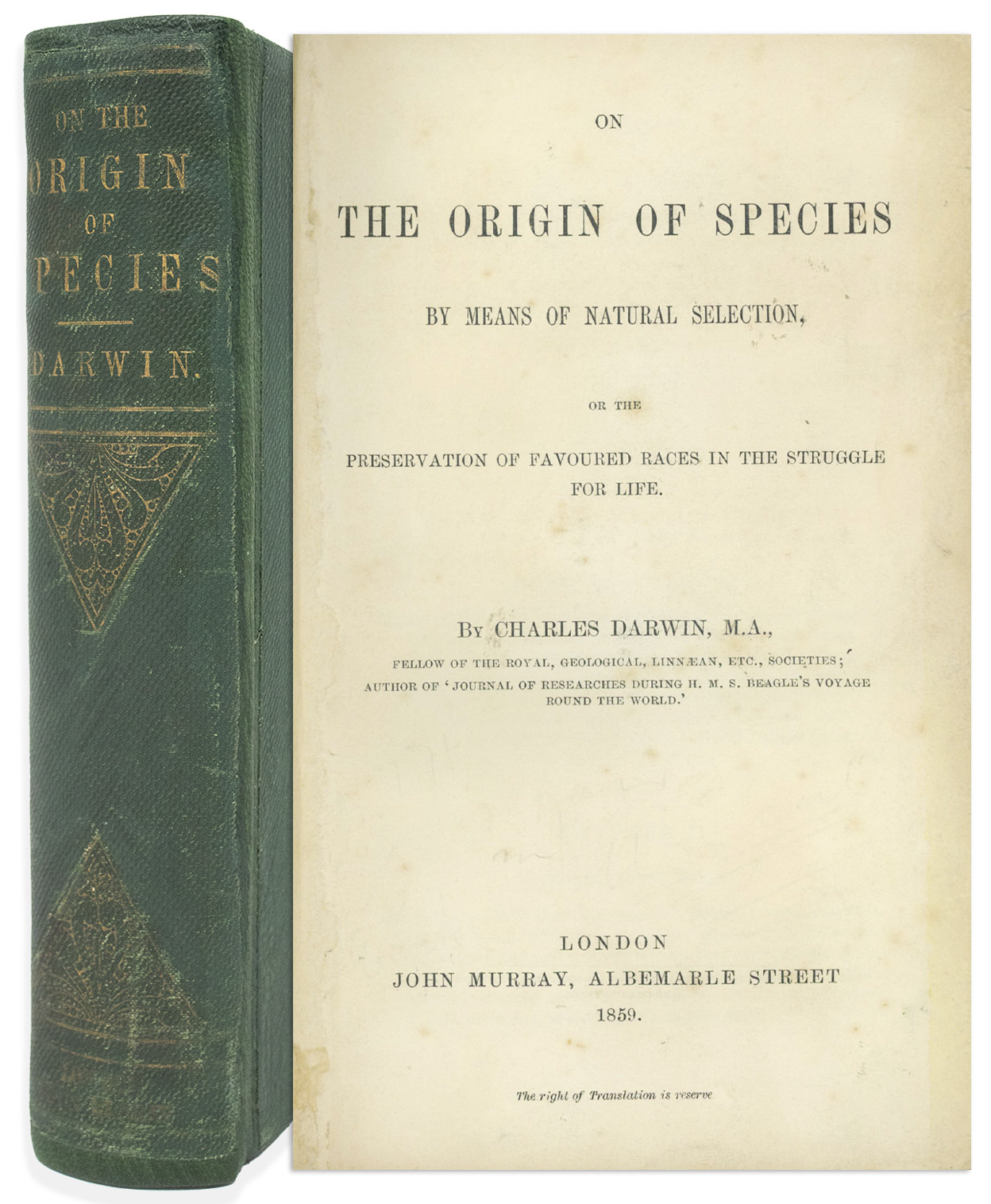
Charles Darwin On the Origin of Species 1st Edition
All first printing points are present, including original binding, variant B, title page with copyright information on verso, Table of Contents (pages v-ix) with binder instructions to verso, complete pages 1-502, and folding table present between pages 116-117. Bound in publisher’s full green boards, stamped and lettered in gilt. Overall in very good condition; ads at back of volume have been removed as has half-title page, and endpapers have been replaced. Volume is rebacked using morocco, with original spine laid down. Some shelf wear to boards. Light foxing throughout book, with some chipping, small closed tears with repairs to a few pages, and a few dogeared pages. One small mark on page 109, otherwise no internal writing or marks. Housed in a custom quarter-leather clamshell box. Overall in very good condition, a handsome, presentable copy of this scarce first printing. Sold for $68,250.
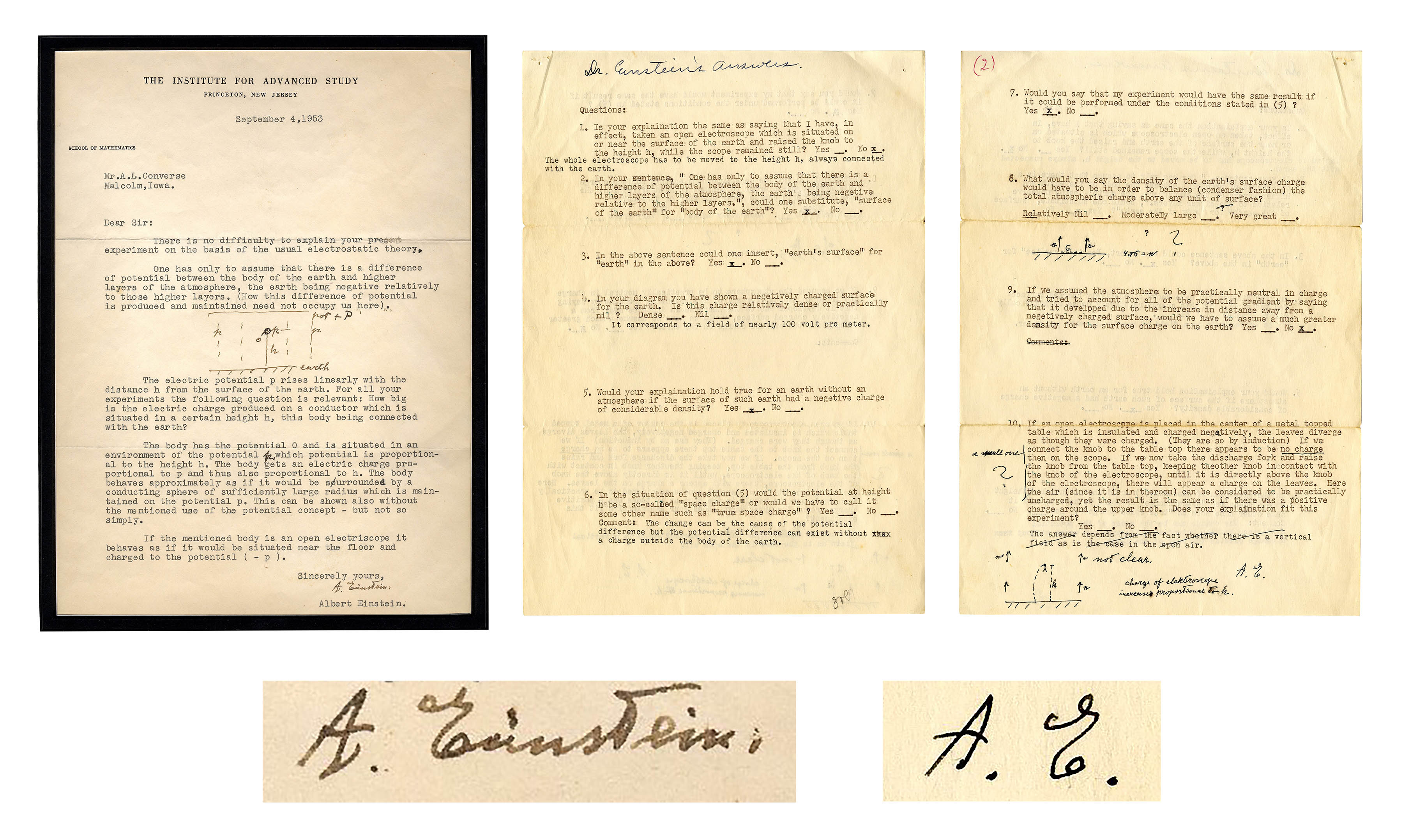
Remarkable Albert Einstein Autograph Letter Signed, Along With His Initialed Drawings — Explaining the Science Behind His Groundbreaking Work on Electrostatic Theory and Special Relativity
Albert Einstein autograph letter signed with his hand drawings, elegantly explaining his electrostatic theory of special relativity to a physics teacher struggling to reconcile it with experiments he was conducting. In addition to the letter, which is new to the market, Einstein generously replies to a series of questions the teacher asks him on a questionnaire, providing additional drawings and calculations, initialed ”A.E.” at the conclusion. Dated 4 September 1953 on Princeton’s Institute for Advanced Study letterhead, Einstein writes to Arthur L. Converse, the teacher from Malcolm, Iowa, in part, ”There is no difficulty to explain your present experiment on the basis of the usual electrostatic theory. One has only to assume that there is a difference of potential between the body of the earth and higher layers of the atmosphere, the earth being negative relatively to those higher layers…[Einstein then draws Earth and the atmosphere, referring to it for clarification] The electric potential p rises linearly with the distance h from the surface of the earth…For all your experiments the following question is relevant: How big is the electric charge produced on a conductor which is situated in a certain height h, this body being connected with the earth…” Einstein then answers Converse’s questions on a two-page questionnaire. In one answer, Einstein seems to disagree with the question, providing both a diagram and mathematical equation and then a ”?” to try to aid understanding. He later writes ”not clear” to one answer along with a question mark and additional diagram with the notation ”charge of elektroscope increased proportional to h”. An extraordinary lot by Einstein showing the generosity of his time, with rare content on his theory of special relativity. Single page letter and two-page questionnaire each measures 8.5” x 11”. Also included is Einstein’s original mailing envelope from ”Room 115” of the Institute for Advanced Study, postmarked 7 September 1953 from Princeton. Folds and very light toning to letter, otherwise near fine. Questionnaire has folds, light toning and staple mark, otherwise near fine with bold handwriting by Einstein. Dark Albert Einstein autograph. With an LOA from the nephew of Arthur Converse and new to the market.Sold for $53,504.
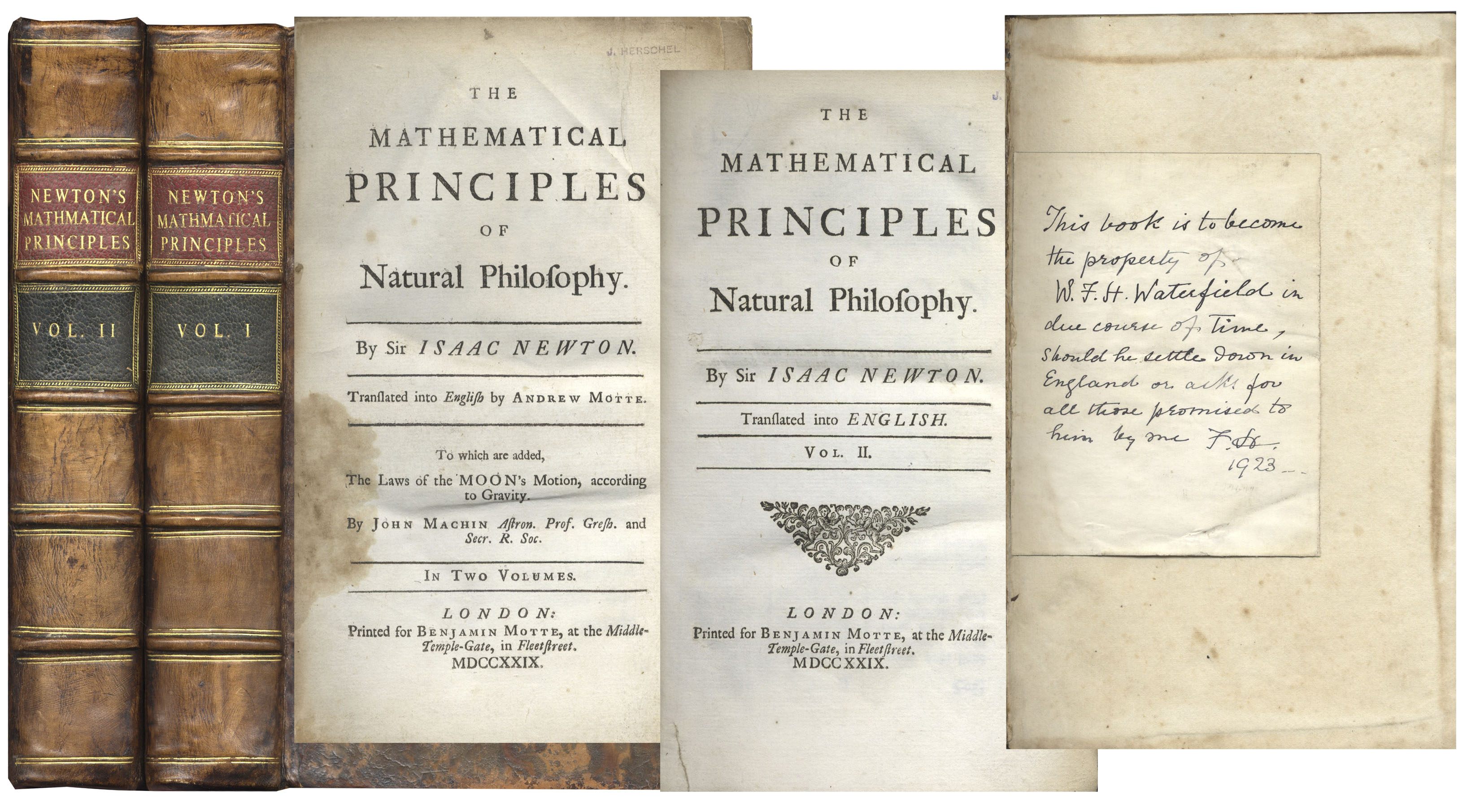
First edition of Sir Isaac Newton’s ”The Mathematical Principles of Natural Philosophy” in two volumes. London: Benjamin Motte, 1729. One of the most important works by the leading mind of the 18th century scientific revolution. Bound in contemporary tree calf, sympathetically rebacked, with gilt tooling to spines. Two octavo volumes measure 5.5” x 8.5” each. Volumes contain two folding letterpress tables and 47 folding engraved plates; the two frontispieces and pp. 385-393 and first 7pp. of index are replaced in facsimile, but hardly distinguishable from the original. The ”Laws of Moon’s Motion” usually found in Vol. II are here bound at end of Vol. I, and with errata for both volumes on verso of E4. Small stain to inner part of title in Vol. I, short tear to lower margin of G1, small section missing from lower margin of M3 and with lower corner cut away of A8 and C4 of ”Laws of Moon’s Motion” (no loss of text). Some marginal dampstaining and occasional soiling and spotting, overall in very good, clean condition with most edges untrimmed. Sold for $22,500.
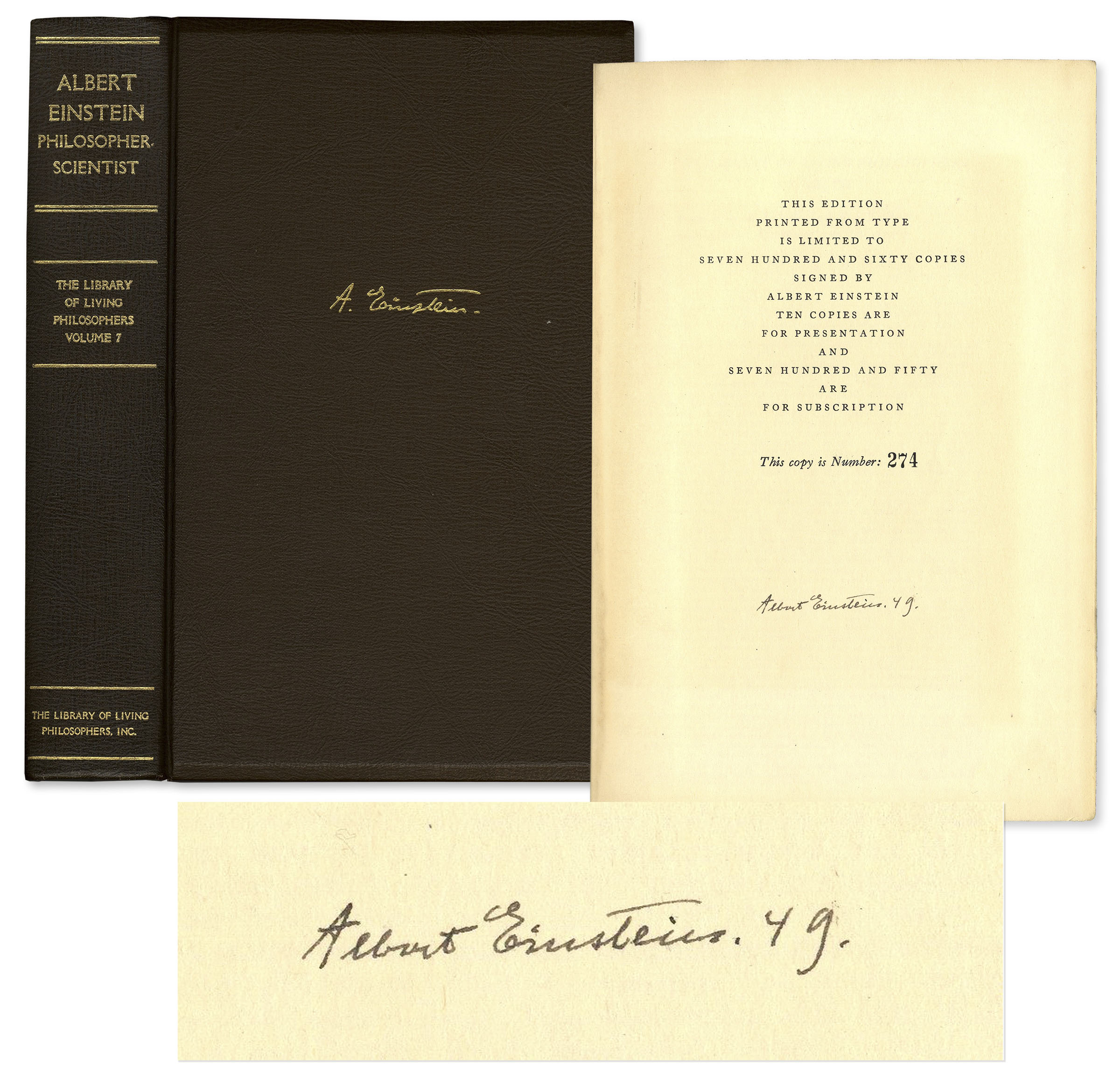
Albert Einstein signed limited edition of ”Albert Einstein: Philosopher Scientist”. Published by The Library of Living Philosophers Inc: Evanston, Illinois: 1949. Einstein signs ”Albert Einstein. 49.” upon the limitation page, underneath its identification as #274 of 760 copies. Bound in brown leather boards, with a gold facsimile of Einstein’s signature on the front. Runs 781pp. and measures 6.5” x 9.5”. Very slight toning. Near fine. Sold for $4,688.
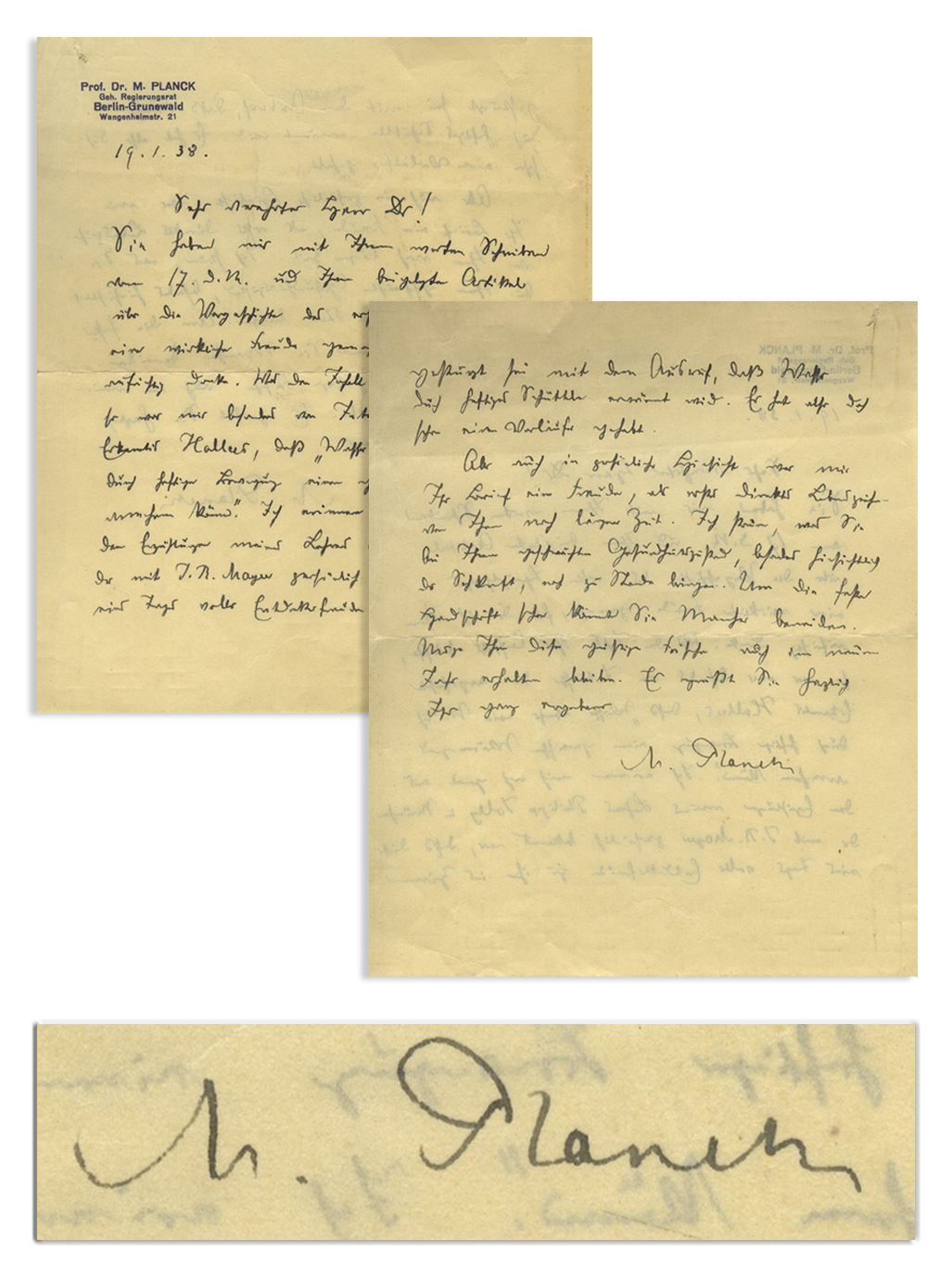
Max Planck Autograph Letter Signed, Musing on the First Law of Thermodynamics — ”…Mayer had burst into his room exclaiming…that water could be warmed by means of vigorous shaking…”
Lively autograph letter signed by Nobel winning quantum physicist pioneer Max Planck, who writes to fellow physicist Paul Epstein. Dated 19 January 1938, Planck muses on the first law of thermodynamics (before it was recognized as such), responding to Epstein’s mention of the 18th century scientist Albrecht von Haller learning that liquid warms by shaking. On Planck’s personal stationery, letter in German reads in full, ”Dear Doctor! / Your kind letter of the 17th of this month and the attached article on the background of the first fundamental theorem gave me great pleasure, for which I thank you sincerely. Concerning the content of your essay, your mentioning of [Albrecht von] Haller’s finding that ‘water, as well as milk, when moved vigorously, could reach a certain degree of warmth,’ was of particular interest to me. I remember exactly one of the stories told by my teacher in Munich, Philipp [von] Jolly, who was personally acquainted with J. R. [Julius Robert von] Mayer, relating that one day Mayer had burst into his room exclaiming, full of a discoverer’s joy, that water could be warmed by means of vigorous shaking. So someone else had already arrived there first after all. / But your letter made me happy in personal terms as well, since it was the first direct sign of life from you after some time. I am in awe about how much, considering your weakened physical condition, particularly with respect to your vision, you are still able to achieve. Many would envy even your firm handwriting. May this mental acuity remain with you during the new year as well. Very warm regards. / Yours respectfully, / M. Planck”. Two page letter on a single sheet measures 5.875” x 7”. Single fold, staple puncture and light toning. Very good condition. Sold for $2,500.
FREE APPRAISAL. To buy, auction, sell or consign your Vilfredo Pareto Autograph Letter Signed that is for sale, please email your description and photos to [email protected] of Nate D. Sanders Auctions (http://www.NateDSanders.com).