
Sell or Auction Your Twelve United Colonies Congress 1775 4 Leaves for up to Nearly $25,000 or More at Nate D. Sanders Auctions
FREE APPRAISAL. To buy, auction, sell or consign your Twelve United Colonies Congress 1775 4 leaves that are for sale, please email your description and photos to [email protected] of Nate D. Sanders Auctions (http://www.NateDSanders.com).
Sell Your Twelve United Colonies Congress 1775 4 Leaves
Below is a recent realized price for 4 leaves of The Twelve United Colonies by their Delegates in Congress. We at Nate D. Sanders Auctions can obtain up to this amount or more for you:
Twelve United Colonies Congress 1775 4 Leaves. Sold for Nearly $25,000.
Here are some related items we have sold:
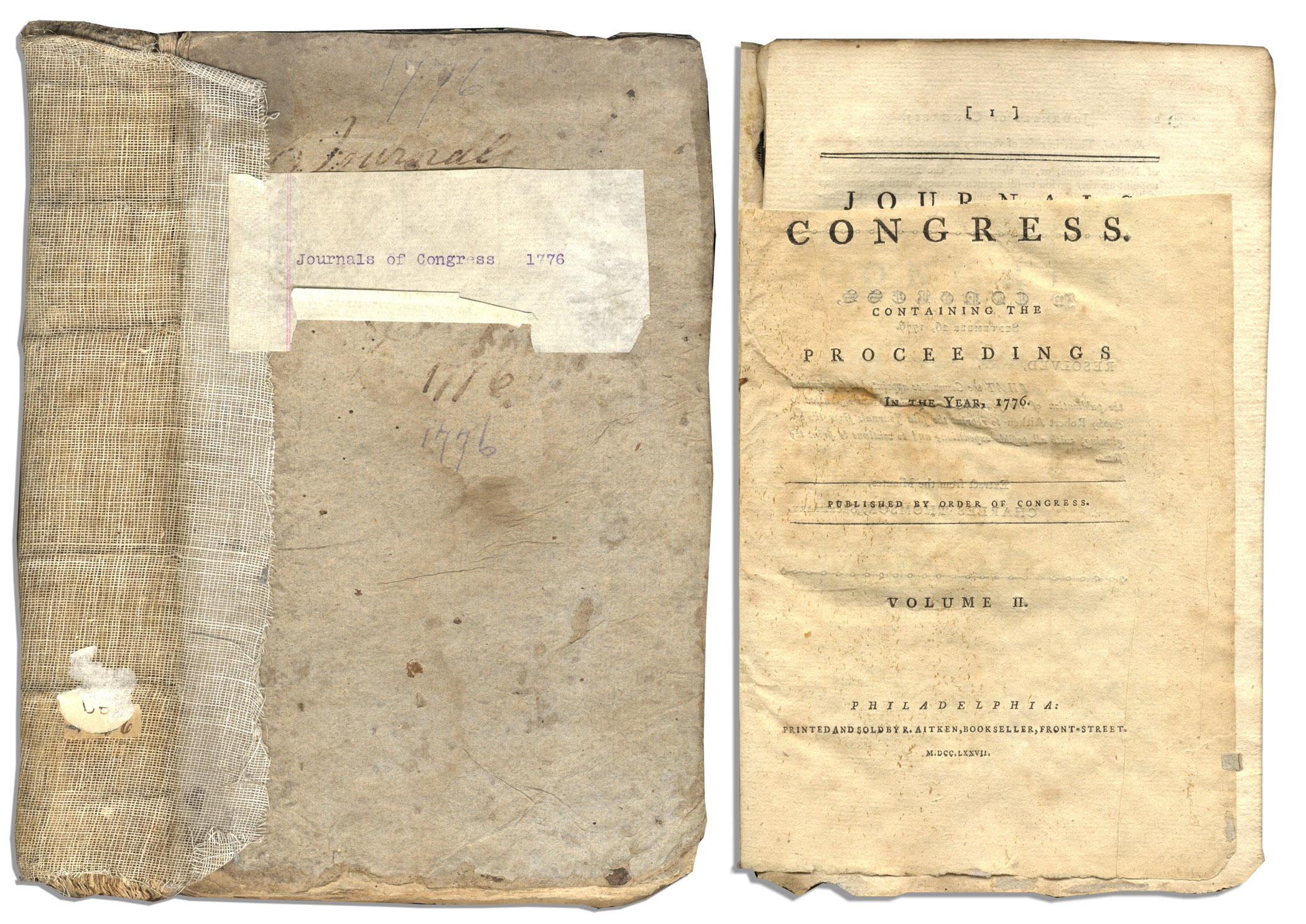
The activities of the Continental Congress for the watershed year of 1776 are recorded comprehensively here in this first edition, first printing of ”Journals of Congress Containing The Proceedings In The Year, 1776.” Published by Order of Congress, by Robert Aitken: Philadelphia: 1777. This is one of just 532 copies which were printed in 1776, with substantially less than that available today, and is complete with the original printing of the Declaration of Independence on pages 241-246. According to text upon the title page, these records of the nation’s fledgling government were taken directly from the minutes of the Continental Congress. In addition to the Declaration of Independence, this volume chronicles the preparation for the Revolutionary War, as well as Richard Henry Lee’s 15 May proposal of independence. The book reads as a diary, with each day’s activities noted, including letters from ”General Washington” and resolutions such as one from 14 August 1776, in part, ”…his British majesty, in order to destroy our freedom and happiness has commenced against us a cruel and unprovoked war; and unable to engage Briton’s sufficient to execute his sanguinary measures has applied for aid to foreign princes, who are in the habit of selling the blood of their people for money…” Volume runs 512pp. plus index and measures 5.5” x 8.5”. Deckled-edge leaves are bound in paper boards, not original calf binding. Loss of backstrip reveals a thin layer of fabric affixed over a ribbed spine. Title page is missing the top 1.5”. Chipping to bottom edge of front board and a stamp of the previous owner on the front pastedown. In very good condition considering age. A precious record codifying the founding of the United States of America. Sold for $6,083.
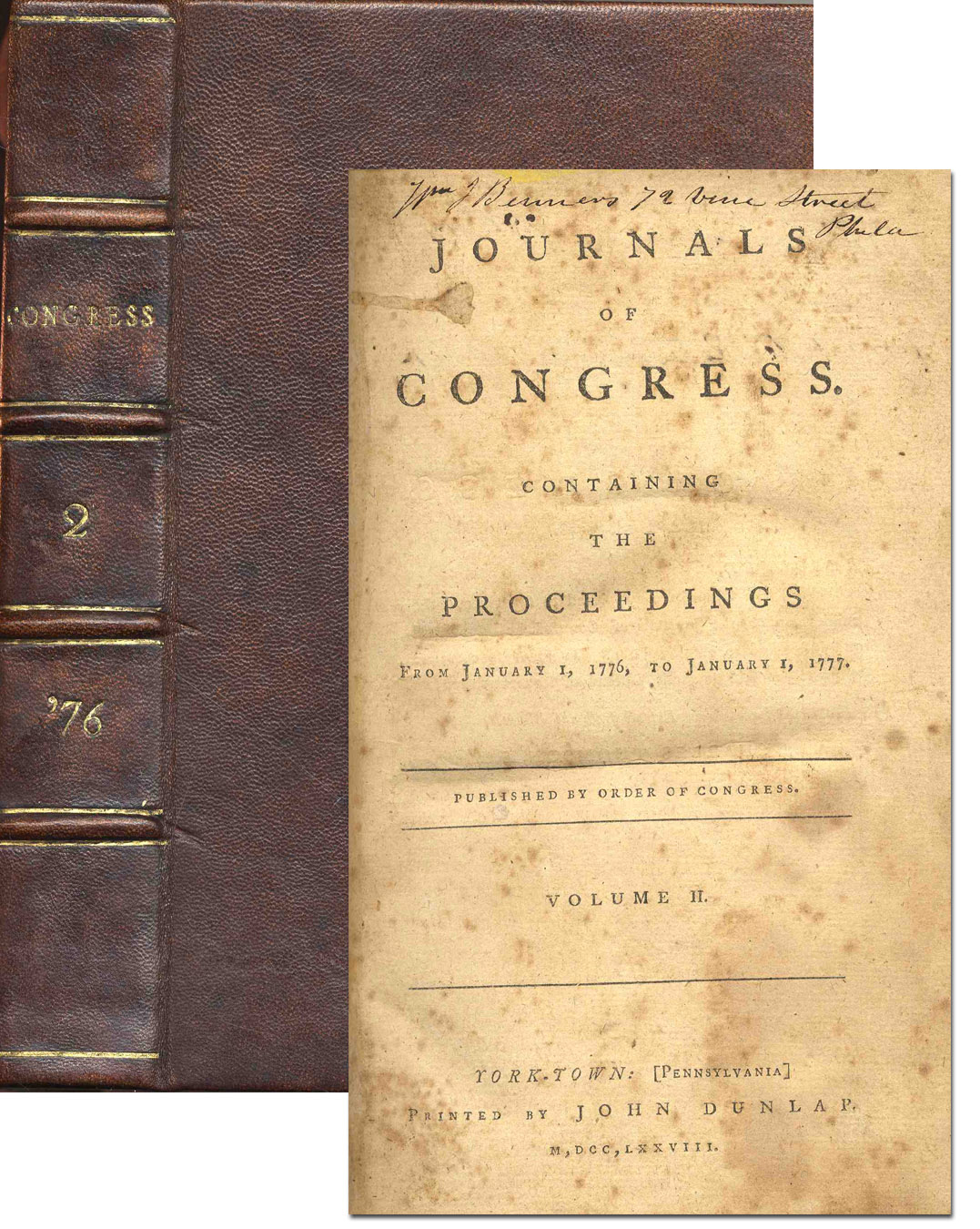
Journals of Congress Containing The Proceedings From January 1, 1776 to January 1, 1777
“Journals of Congress Containing The Proceedings From January 1, 1776 to January 1, 1777.” Published by Order of Congress. York-Town, Pennsylvania: John Dunlap: 1778. A record of the proceedings of the Congress for the year 1776 including a complete text of the Declaration of Independence with all of the signers’ names in type. Scarce second Dunlap printing, printed in York-Town after the evacuation of Philadelphia by Congress due to British occupation of the city. 520pp. plus index. Bound in quarter calf leather with gilt titling to backstrip. Some bumping to corners. Light to heavy foxing throughout, mostly to upper margins. Ink inscription to side cover and top of title page. One of the scarcest book printings of The Declaration of Independence in very good condition. Sold for $5,012.
Extremely Rare ”Journals of Congress, Volume III” — Covering 1777 Continental Congress Sessions
The proceedings of the Continental Congress for the year of 1777 are recorded comprehensively here, in this scarce first edition, first printing of ”Journals of Congress Containing The Proceedings In The Year, 1777.” Published by Order of Congress by John Dunlap: Philadelphia: 1778. This record of the new nation’s fledgling government, in the thick of the Revolutionary War, was taken directly from the Congressional minutes and reads as a diary, with the activities for each day noted. This volume contains war-related resolutions, as well as a half dozen mentions of Benedict Arnold, including a record of the Congress’ ”enquiry into his conduct”. It deals with specific cases of mistreatment of prisoners of war, funding the war by issuing credit, caring for the troops and approving the actions of General Washington. Journal runs 603pp. plus index. Deckled-edge leaves are bound in paper boards with unfinished surface. Loss of backstrip reveals a thin layer of fabric affixed over a ribbed spine, not in original leather binding. Measures 5.5” x 8.25”. Previous owner’s stamp to front pastedown. In very good condition considering age. A precious record of the earliest history of the United States of America. Sold for $2,520.

Volume I of the ”Journals of Congress,” the official record of the First and Second Continental Congresses which met from 1774-1775. Published in Philadelphia: R. Aitken: 1777. The First Continental Congress met in Philadelphia as a reaction to the ”Intolerable Acts” imposed by Great Britain after the Boston Tea Party. This Journal reflects the growing tension and independence of the colonists with its first entry, on 5 September 1774: ”…This House …being deeply affected with unhappy differences, which have long subsisted and are increasing, between Great-Britain and the American Colonies, do Resolve…to deliberate and determine upon wise and proper Measures…for the recovery and establishment of their just Rights and Liberties…” The representatives to the Congress would subsequently boycott British goods, establish an Army (with Washington as General) and Navy, appoint ambassadors, issue currency and obtain loans. It also records the order to print the proceedings of the Congress, of which this Journal is the result; on 26 September 1776, Congress authorized the printer Robert Aitken to produce a uniform edition of their Journals. Aitken combined the Journals of the First and Second Continental Congresses of 1774 and 1775 (originally published by Bradford in two separate volumes) into one volume, to form Volume I of this series. 310 deckled-edge leaves plus 12 pages of index are bound in 5.5” x 8.5” paper boards with unfinished surface, not in original leather biding. A 1.75” strip has been removed from the top of the title page and previous owner’s stamp is on front pastedown and once again in the book. Moderate toning and chipping to pages and boards with some paper loss to pages. In very good condition considering age. Sold for $2,384.

”Journals of Congress, Volume VI” — From the Year 1780
The proceedings of the Continental Congress for the year of 1780 are recorded in this scarce first edition, first printing of ”Journals of Congress, From January 1st, 1780, to January 1st, 1781.” This is the sixth volume in the series of annual Journals chronicling the proceedings of the new nation’s fledgling government, taken directly from the Congressional minutes. Published by Order of Congress, by David C. Claypoole: Philadelphia: 1781. This Journal deals primarily with Congress’ management of the Revolutionary War, including communications with General Washington, Governor Jefferson and diplomats from France, its most important ally. It also chronicles the payment of war debts as well as treatment of soldiers in the military hospitals. Journal runs 403pp. plus index and measures 5.25” x 8.25”. Deckled-edge leaves are bound in paper boards with unfinished surface, not in original leather binding. Loss of backstrip reveals a thin layer of fabric affixed over a ribbed spine. Previous owner’s stamp on front pastedown and once in interior. In very good condition considering age. A precious record of the earliest days of the United States of America. Sold for $1,420.

Thomas Jefferson Scarce Signed 1st Edition of the First U.S. Census — One of Only a Handful Signed & Ratified by Jefferson
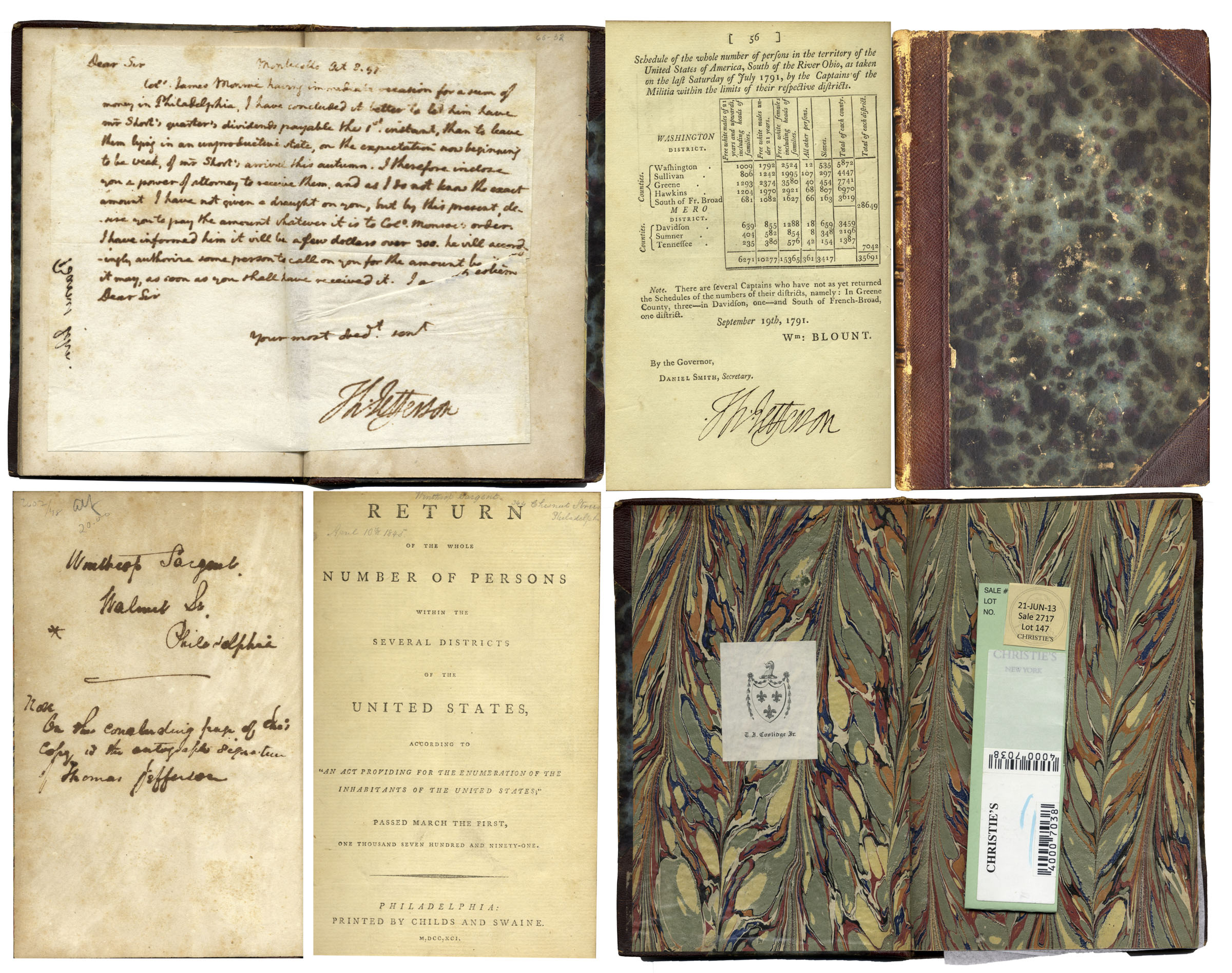
Extremely rare Thomas Jefferson signed first edition of the first U.S. census, one of only a handful of Jefferson signed copies sold at auction in the last 40 years. As Secretary of State, Jefferson called for the first official census, and ratified the results of only a handful, this being one of them, signed boldly ”Th: Jefferson” on page 56. Published in Philadelphia: Childs and Swaine, 1791. Full title reads, ”Return of the Whole Number of Persons Within the Several Districts of the United States, According to ‘An Act Providing for the Enumeration of the Inhabitants of the Unites States’. Printed in a small number for distribution by Thomas Jefferson as Secretary of State, and from his direct descendant, Thomas Jefferson Coolidge Jr., with Mr. Coolidge’s crested label to front pastedown. Bound in 19th century half-morocco and marbled boards, book measures 5” x 7.25”. This copy appears to be one of the very first printings of the first edition, as it lacks the tipped-in late-returning results from South Carolina often found on page 54. The lower margins of pages 34, 42 and 43 have been shaved by binder, otherwise copy is near fine with a touch of toning and foxing. Volume also includes a press copy of an autograph letter signed by Jefferson, affixed to rear endpaper, dated 8 October 1797, measuring 6.5” x 7.75”. Letter concerns a quarterly dividend of ”a few dollars over 300”, payable to Col. James Monroe. A rare opportunity for the very first census of the United States, signed by its 3rd President, with other such copies selling for approx. $100,000. Sold for $66,435.
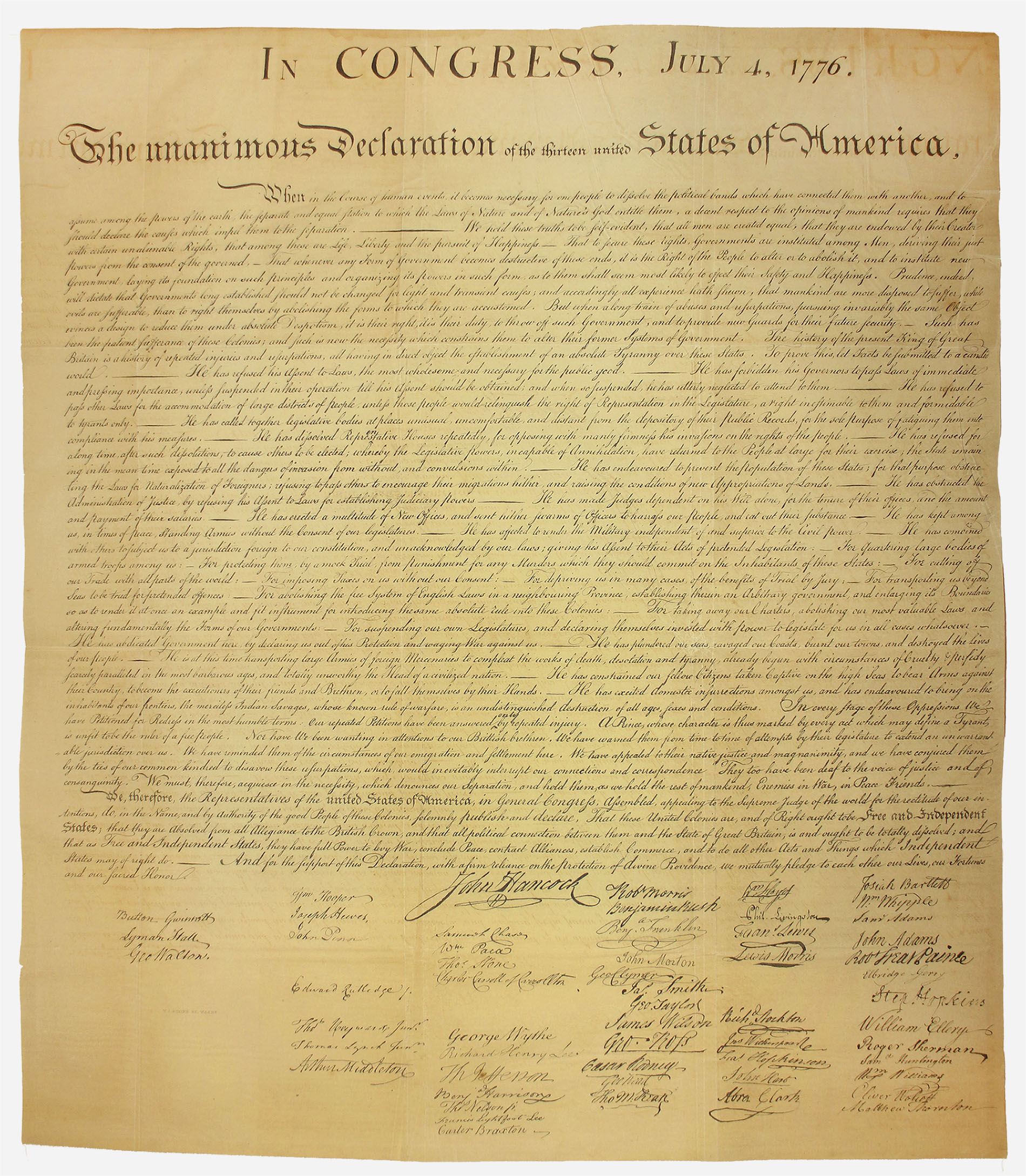
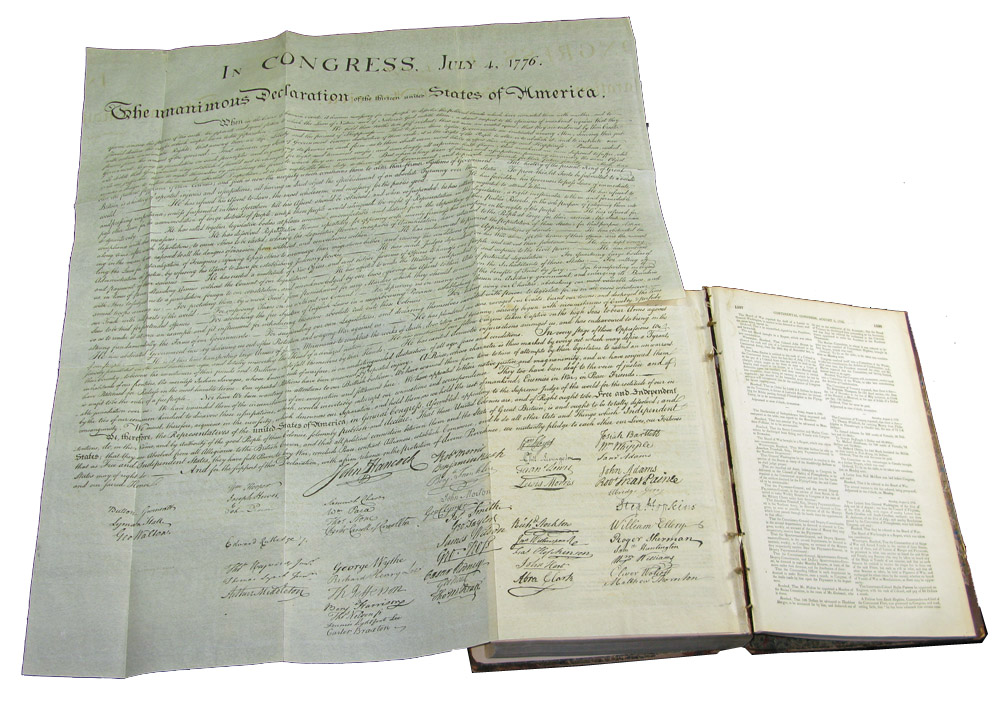
1833 copy of the Declaration of Independence from the original copper plate by William J. Stone, who created the earliest copies of the Declaration of Independence in 1823. John Quincy Adams, then Secretary of State, oversaw the 1823 project and commissioned Stone to reproduce the document for the upcoming 50th anniversary of the signing. Stone used a new wet-ink transfer process to create a copper plate from which copies were made. By wetting the original document, some of the original ink was transferred to the copper plate, which was then used for printing 201 vellum copies, nearly all of which now reside in permanent collections.
Ten years later, in 1833, the same copper plate was used to print additional copies of the Declaration of Independence on rice paper for inclusion in Peter Force’s book, ”American Archives”. The series was to total 20 volumes, but the cost of the set was prohibitive for most Americans and printing was stopped short at nine volumes. It’s unknown how many Declarations were printed but it’s believed that most were destroyed, apart from the small number that were printed and sold. This 1833 Force Declaration is the oldest Declaration apart from the original and the 1823 copies.
This copy of the Force Declaration is still within ”American Archives”, which is unusual as most copies have since been cut out; copies in the book are considered more desirable. Declaration bears the ”W.J. STONE SC. WASHN.” watermark at lower left from the original copper plate. Declaration measures 25” x 29”. A very bright copy as expected since it hasn’t been exposed to light. Folds as issued, light staining along top edge, small spot of foxing under Hancock’s signature and two small closed tears on right side as noted, the largest approximately 2”. Overall in very good plus condition.
Declaration is accompanied by almost the entire ”American Archives” series, comprising eight volumes: volumes 1 and 3-6 of the 4th series and volumes 1-3 of the 5th series, lacking only volume 2 of the 4th series. ”American Archives” is nine volumes in total, published from 1837 to 1853, comprising the most important documents of colonial American and the American Revolution. In addition to the Declaration, volumes also include reproductions of the King’s Message to Parliament, the Treaty with Great Britain, numerous maps and other documents. Ex-libris volumes are bound in contemporary blue cloth. Minor discoloration to some pages in the 5th series, overall very good. Sold for $22,813.

1843 Force Declaration of Independence From Original Copper Plate — Beautiful Copy
1843 Force Declaration of Independence from the original copper plate by William Stone, one of the earliest copies of the Declaration of Independence. In 1823, Congress authorized the production of facsimile copies of the Declaration of Independence for two reasons: the original was deteriorating rapidly and many of the aging original Signers sought copies. John Quincy Adams, then Secretary of State, oversaw the project and commissioned noted engraver William J. Stone to reproduce the document. Stone used a new Wet-Ink transfer process to create a copper plate from which facsimile copies were made. By wetting the original document, some of the original ink was transferred to the copperplate, which was then used for printing. Stone printed 201 copies on vellum, keeping one copy for himself (now residing in the Smithsonian) and distributing other copies to Thomas Jefferson, President James Monroe, members of Congress, surviving original Signers, various colleges and universities, and others. Of the original 201 copies, only 31 examples are currently known to exist, 19 of which are permanently housed in museums. In 1843, Peter Force used the original Stone copperplate to print additional copies of the Declaration of Independence on rice paper for inclusion in his book, ”American Archives”. Congress authorized up to 1,500 copies of the book to be printed, and while the actual number of copies printed is unknown, it’s generally estimated at 500. The Stone and Force copies represent an irony: certainly, they allowed additional people and institutions to obtain an identical facsimile of this most beloved of all historic American documents, but Stone’s Wet-Ink transfer process contributed to the deterioration of the original signed copy of the Declaration. The parchment did not respond well to water, with the unfortunate result being that the original Declaration of Independence, on display in our nation’s capitol, is in a rather sad state of preservation. This Force Declaration measures approximately 24.75” x 29.5” on rice paper. Folded for its original purpose of inclusion in Force’s book. A very good to near fine copy except for archival tape repairs on verso, and some creasing to front. The paper quality is very good, without as much brittleness as we usually see. A visually stunning example of one of America’s most beloved documents. Sold for $21,963.
Rare 1843 Declaration of Independence Print — Peter Force Printing From the Original William Stone Copper Plate — In the Original Book — With Complete Set of Volumes
Extremely rare fold-out Force print of William J. Stone’s official engraving of the Declaration of Independence from “American Archives,” Volume I of the Fifth Series. With complete set of nine volumes edited by Peter Force. Washington, D.C.: M. St. Clair Clarke and Peter Force: 1843. Folio Volume I with marbled boards and endpapers runs 951pp. Most extant copies of this volume are missing the highly sought after fold-out rice paper Declaration of Independence. When Congress commissioned Peter Force to compile the nine-volume, 15,500pp. “American Archives” series documenting the nation’s history in 1843, it was determined that a copy of the Declaration would be included in the volume covering 1776. Twenty-three years earlier, as the original document was rapidly deteriorating, Secretary of State John Quincy Adams had authorized engraver William J. Stone to create a copperplate of the Declaration via painstaking wet-ink transfer. It took Stone three years to create a plate with absolute fidelity to the original, although the process caused additional deterioration to the original document, now exhibited in the Capitol Rotunda in Washington, D.C. Stone printed 201 copies on vellum. He kept one copy for himself, now residing in the Smithsonian, and the other copies were distributed to Thomas Jefferson, President James Monroe, members of Congress, surviving original Signers, various colleges and universities, and others. Of the original 201 copies, only 31 examples are currently known to exist, 19 of which are permanently housed in museums. The remaining dozen vellum examples are rarely offered for sale. The “American Archives” copies were made from Stone’s plate, now housed in the National Archives. Congress authorized up to 1,500 copies of the book to be printed, but subscriptions fell far short of that number. The actual number of copies of the book printed is unknown, with estimates ranging at around 500 copies. Fewer than half are believed to have survived, in varying states of preservation, most missing the Declaration. This is an extremely rare opportunity to find the book with the Declaration still intact and in such pristine condition. The fold-out document measures 26″ x 29″ and is stamped at lower left, “W.J. Stone S.C. Washn.” Document shows minor ink transfer from being folded and has a horizontal split approximately 3″ towards the middle of the right edge from folding, as well as two other small tears and along folds affecting words in the center of the document. Very good condition. All other American Archives volumes present as a set. Boards on several books show separation and wear. Books are in good condition. Sold for $20,000.
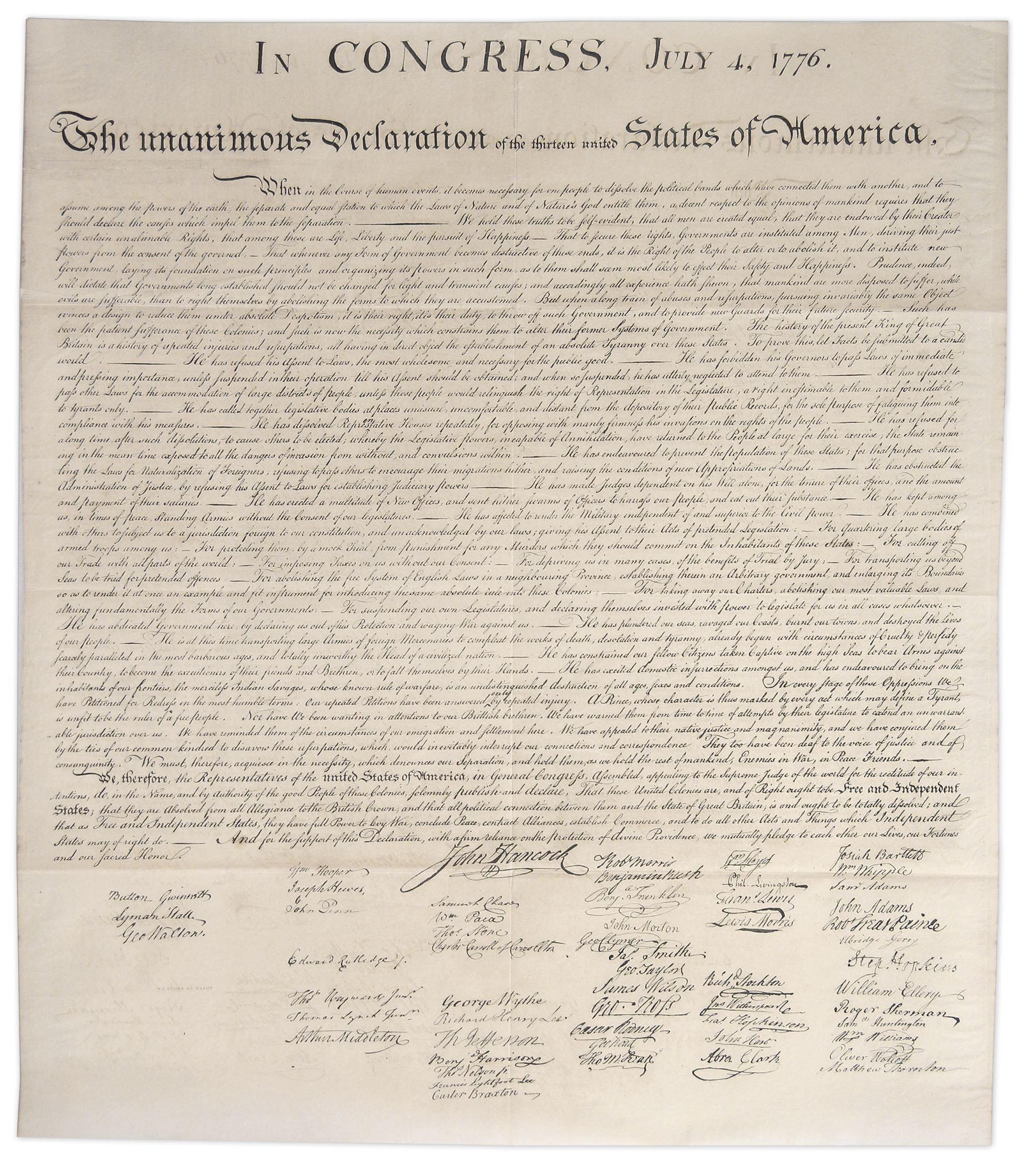
1843 Force Declaration of Independence From Original Copper Plate — Beautiful Copy
1843 Force Declaration of Independence from the original copper plate by William Stone, one of the earliest copies of the Declaration of Independence. In 1823, Congress authorized the production of facsimile copies of the Declaration of Independence for two reasons: the original was deteriorating rapidly and many of the aging original Signers sought copies. John Quincy Adams, then Secretary of State, oversaw the project and commissioned noted engraver William J. Stone to reproduce the document. Stone used a new Wet-Ink transfer process to create a copper plate from which facsimile copies were made. By wetting the original document, some of the original ink was transferred to the copperplate, which was then used for printing. Stone printed 201 copies on vellum, keeping one copy for himself (now residing in the Smithsonian) and distributing other copies to Thomas Jefferson, President James Monroe, members of Congress, surviving original Signers, various colleges and universities, and others. Of the original 201 copies, only 31 examples are currently known to exist, 19 of which are permanently housed in museums. In 1843, Peter Force used the original Stone copperplate to print additional copies of the Declaration of Independence on rice paper for inclusion in his book, ”American Archives”. Congress authorized up to 1,500 copies of the book to be printed, and while the actual number of copies printed is unknown, it’s generally estimated at 500. The Stone and Force copies represent an irony: certainly, they allowed additional people and institutions to obtain an identical facsimile of this most beloved of all historic American documents, but Stone’s Wet-Ink transfer process contributed to the deterioration of the original signed copy of the Declaration. The parchment did not respond well to water, with the unfortunate result being that the original Declaration of Independence, on display in our nation’s capitol, is in a rather sad state of preservation. This Force Declaration measures approximately 25.5” x 29” on rice paper. Folded for its original purpose of inclusion in Force’s book. A near fine copy except for some archival tape repairs on verso, so subtle as not to be noticed even upon close examination. A visually stunning example of one of America’s most beloved documents. Sold for $18,750.
1843 Force Declaration of Independence From Original Copper Plate
1843 Force Declaration of Independence from the original copper plate by William Stone, one of the earliest copies of the Declaration of Independence. In 1823, Congress authorized the production of facsimile copies of the Declaration of Independence for two reasons: the original was deteriorating rapidly and many of the aging original Signers sought copies. John Quincy Adams, then Secretary of State, oversaw the project and commissioned noted engraver William J. Stone to reproduce the document. Stone used a new Wet-Ink transfer process to create a copper plate from which facsimile copies were made. By wetting the original document, some of the original ink was transferred to the copperplate, which was then used for printing. Stone printed 201 copies on vellum, keeping one copy for himself (now residing in the Smithsonian) and distributing other copies to Thomas Jefferson, President James Monroe, members of Congress, surviving original Signers, various colleges and universities, and others. Of the original 201 copies, only 31 examples are currently known to exist, 19 of which are permanently housed in museums. In 1843, Peter Force used the original Stone copperplate to print additional copies of the Declaration of Independence on rice paper for inclusion in his book, ”American Archives”. Congress authorized up to 1,500 copies of the book to be printed, and while the actual number of copies printed is unknown, it’s generally estimated at 500; it is the oldest Declaration apart from the original and the Stone copies. Declaration measures approximately 25.25” x 29.5”. Folded for its original purpose of inclusion in Force’s book. A very good to near fine copy with foxing at bottom affecting some signatures and discreet archival repairs on verso. A bright copy with virtually no toning. Sold for $18,750.

1843 Force Declaration of Independence From Original Copper Plate — Near Fine Condition
1843 Force Declaration of Independence from the original copper plate by William Stone, one of the earliest copies of the Declaration of Independence. In 1823, Congress authorized the production of facsimile copies of the Declaration of Independence for two reasons: the original was deteriorating rapidly and many of the aging original Signers sought copies. John Quincy Adams, then Secretary of State, oversaw the project and commissioned noted engraver William J. Stone to reproduce the document. Stone used a new Wet-Ink transfer process to create a copper plate from which facsimile copies were made. By wetting the original document, some of the original ink was transferred to the copperplate, which was then used for printing. Stone printed 201 copies on vellum, keeping one copy for himself (now residing in the Smithsonian) and distributing other copies to Thomas Jefferson, President James Monroe, members of Congress, surviving original Signers, various colleges and universities, and others. Of the original 201 copies, only 31 examples are currently known to exist, 19 of which are permanently housed in museums. Sold for $18,750.

Rare and Beautiful 1843 Force Declaration of Independence From Original Copper Plate
1843 Force Declaration of Independence from the original copper plate by William Stone, one of the earliest copies of the Declaration of Independence. In 1823, Congress authorized the production of facsimile copies of the Declaration of Independence for two reasons: the original was deteriorating rapidly and many of the aging original Signers sought copies. John Quincy Adams, then Secretary of State, oversaw the project and commissioned noted engraver William J. Stone to reproduce the document. Stone used a new Wet-Ink transfer process to create a copper plate from which facsimile copies were made. By wetting the original document, some of the original ink was transferred to the copperplate, which was then used for printing. Stone printed 201 copies on vellum, keeping one copy for himself (now residing in the Smithsonian) and distributing other copies to Thomas Jefferson, President James Monroe, members of Congress, surviving original Signers, various colleges and universities, and others. Of the original 201 copies, only 31 examples are currently known to exist, 19 of which are permanently housed in museums. In 1843, Peter Force used the original Stone copperplate to print additional copies of the Declaration of Independence on rice paper for inclusion in his book, ”American Archives”. Congress authorized up to 1,500 copies of the book to be printed, and while the actual number of copies printed is unknown, it’s generally estimated at 500. The Stone and Force copies represent an irony: certainly, they allowed additional people and institutions to obtain an identical facsimile of this most beloved of all historic American documents, but Stone’s Wet-Ink transfer process contributed to the deterioration of the original signed copy of the Declaration. The parchment did not respond well to water, with the unfortunate result being that the original Declaration of Independence, on display in our nation’s capitol, is in a rather sad state of preservation. This Force Declaration measures approximately 25.5” x 29” on rice paper. Folded for its original purpose of inclusion in Force’s book. Separation starting along folds, especially along lowermost horizontal fold, otherwise in near fine condition. The points of separation can be repaired with archival tape to be almost indiscernible when framed. A visually stunning example of one of America’s most beloved documents. Sold for $15,625.

1843 Force Declaration of Independence From Original Copper Plate — Beautiful Copy
1843 Force Declaration of Independence from the original copper plate by William Stone, one of the earliest copies of the Declaration of Independence. In 1823, Congress authorized the production of facsimile copies of the Declaration of Independence for two reasons: the original was deteriorating rapidly and many of the aging original Signers sought copies. John Quincy Adams, then Secretary of State, oversaw the project and commissioned noted engraver William J. Stone to reproduce the document. Stone used a new Wet-Ink transfer process to create a copper plate from which facsimile copies were made. By wetting the original document, some of the original ink was transferred to the copperplate, which was then used for printing. Stone printed 201 copies on vellum, keeping one copy for himself (now residing in the Smithsonian) and distributing other copies to Thomas Jefferson, President James Monroe, members of Congress, surviving original Signers, various colleges and universities, and others. Of the original 201 copies, only 31 examples are currently known to exist, 19 of which are permanently housed in museums. In 1843, Peter Force used the original Stone copperplate to print additional copies of the Declaration of Independence on rice paper for inclusion in his book, ”American Archives”. Congress authorized up to 1,500 copies of the book to be printed, and while the actual number of copies printed is unknown, it’s generally estimated at 500. The Stone and Force copies represent an irony: certainly, they allowed additional people and institutions to obtain an identical facsimile of this most beloved of all historic American documents, but Stone’s Wet-Ink transfer process contributed to the deterioration of the original signed copy of the Declaration. The parchment did not respond well to water, with the unfortunate result being that the original Declaration of Independence, on display in our nation’s capitol, is in a rather sad state of preservation. This Force Declaration measures approximately 24.75” x 29.5” on rice paper. Folded for its original purpose of inclusion in Force’s book. A near fine copy except for some archival tape repairs on verso, so subtle as not to be noticed even upon close examination. A visually stunning example of one of America’s most beloved documents. Sold for $15,000.

Exceptionally Beautiful Force 1843 Copper Plate Engraving of the Declaration
1843 Force Declaration of Independence from the original copper plate by William Stone. Measures approximately 25.5” x 29” on rice paper. This offering represents an opportunity to obtain one of the earliest copies of the Declaration of Independence. In 1823, Congress authorized the production of facsimile copies of the Declaration of Independence for two reasons: the original was deteriorating rapidly and many of the aging original Signers sought copies. John Quincy Adams, then Secretary of State, oversaw the project and commissioned noted engraver William J. Stone to reproduce the document. Stone used a new Wet-Ink transfer process to create a copper plate from which facsimile copies were made. By wetting the original document, some of the original ink was transferred to the copperplate, which was then used for printing. Stone printed 201 copies on vellum, keeping one copy for himself (now residing in the Smithsonian) and distributing other copies to Thomas Jefferson, President James Monroe, members of Congress, surviving original Signers, various colleges and universities, and others. Of the original 201 copies, only 31 examples are currently known to exist, 19 of which are permanently housed in museums. The remaining dozen vellum examples are rarely offered for sale and today typically bring $200,000 or so. In 1843, Peter Force used the original Stone copperplate to print additional copies of the Declaration of Independence on rice paper for inclusion in Volume I of his multi-volume book, ”American Archives.” Congress authorized up to 1,500 copies of the book to be printed, and while the actual number of copies printed is unknown, it’s generally estimated at 500. It is believed that fewer than half of the rice paper copies still exist (of which this is an example) in varying states of preservation. The Stone and Force copies represent an irony: certainly, they allowed additional people and institutions to obtain an identical facsimile of this most beloved of all historic American documents, but Stone’s Wet-Ink transfer process contributed to the deterioration of the original signed copy of the Declaration. The parchment did not respond well to water, with the unfortunate result being that the original Declaration of Independence, on display in our nation’s capitol, is in a rather sad state of preservation. This Declaration has been folded for its original purpose of inclusion in Force’s book and is in overall near fine condition. Document is repaired to verso using archival tape along previous foldlines. A visually stunning example of one of America’s most beloved documents. Sold for $14,032.

FREE APPRAISAL. To buy, auction, sell or consign your Twelve United Colonies Congress 1775 4 leaves that are for sale, please email your description and photos to [email protected] of Nate D. Sanders Auctions (http://www.NateDSanders.com).
We offer the following services for your Twelve United Colonies Congress 1775 4 leaves:
- Appraise Twelve United Colonies Congress 1775 4 leaves.
- Auction Twelve United Colonies Congress 1775 4 leaves.
- Consign Twelve United Colonies Congress 1775 4 leaves.
- Estimate Twelve United Colonies Congress 1775 4 leaves.
- Sell Twelve United Colonies Congress 1775 4 leaves.