
Sell or Auction Your Thomas Hobbes Leviathan 1st Issue 1651 for up to Nearly $20,000 or More at Nate D. Sanders Auctions
FREE APPRAISAL. To buy, auction, sell or consign your Thomas Hobbes Leviathan 1st issue 1651 that is for sale, please email your description and photos to [email protected] of Nate D. Sanders Auctions (http://www.NateDSanders.com).
Free Appraisal, Auction or Sell Your Thomas Hobbes Leviathan 1st Issue 1651
Thomas Hobbes (/hɒbz/ HOBZ; 5/15 April 1588 – 4/14 December 1679) was an English philosopher, considered to be one of the founders of modern political philosophy. Hobbes is best known for his 1651 book Leviathan, in which he expounds an influential formulation of social contract theory. In addition to political philosophy, Hobbes contributed to a diverse array of other fields, including history, jurisprudence, geometry, theology, and ethics, as well as philosophy in general.
Below is a recent realized price for a Thomas Hobbes Leviathan 1st issue 1651 item. We at Nate D. Sanders Auctions can obtain up to this amount or more for you:
Thomas Hobbes Leviathan 1st Issue 1651. Sold for Nearly $20,000.

The following are some prices we have realized for related memorabilia:
Gutenberg Bible Leaf — Scarce Leaf From the 15th Century Bible Made From Moveable Type That Ushered in the Age of Enlightenment
Scarce leaf from the Gutenberg Bible, one of the earliest major books printed from moveable metal type, the invention that ushered in the Age of Enlightenment by democratizing knowledge through mass production of literature. Printed by Johannes Gutenberg in Mainz, Germany from 1450-1455, less than 50 complete or near-complete copies of the Gutenberg Bible are now extant, with nearly all those housed in public institutions. Singular leaves are also scarce, with the leaf presented here having been acquired by bookseller Gabriel Wells, whose purchase of an incomplete Bible in 1920 gave way to selling the individual leaves alongside an essay by A. Edward Newton entitled “A Noble Fragment”. Leaf is number 193 of the full Latin Bible, with the recto being the Prologue to 1 Chronicles of the Old Testament, and the verso the first part of Chapter 1 of 1 Chronicles. Each page features two columns of 42 lines in dark black Gothic type, accented by red and blue rubrication. Each copy of the Gutenberg Bible differs in its rubrication and illumination, with buyers at the time deciding upon these embellishments after the Bible was printed. The six-line rubricated letters of this leaf were likely added later, restored to match the original style. Leaf measures 11.125″ x 15.375″, bound on edge to portfolio measuring 11.75″ x 16″. Paper quality is still bright with very little foxing or discoloration compared to other examples. A stunning example from the book that changed the course of history. Sold for $136,500.

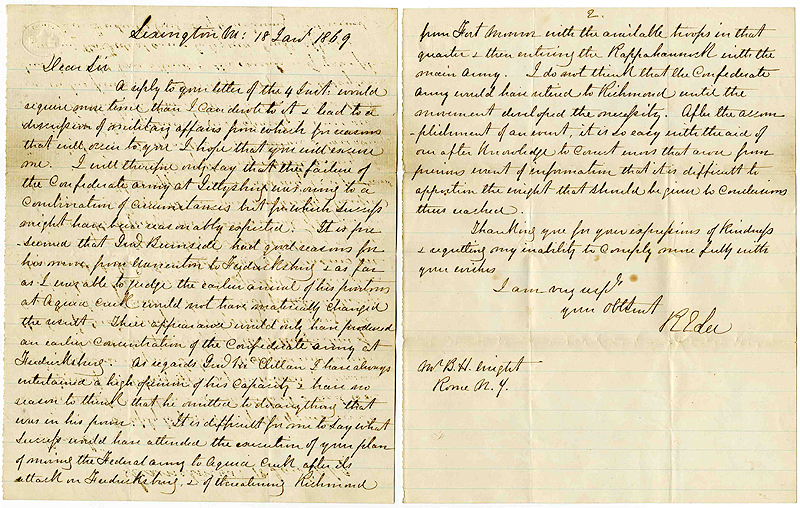
Robert E Lee Gettysburg Autograph Letter Signed
Robert E. Lee autograph letter signed to B.H. Wright on 18 January 1869. Lee responds to a letter from Wright who, in hindsight, criticizes the Confederate Civil War strategy for the most famous battles including Gettysburg and Fredericksburg; letter from Wright included. Excerpt from Lee: “this failure of the Confederate army at Gettysburg was owing to a combination of circumstances but for which success might have been reasonably expected. It…seemed that Genl Burnside had good reasons for his move…to Fredericksburg & as far as I was able to judge the earlier arrival of his troops…would not have materially changed the result…all would only have produced an earlier concentration of the Confederate army at Fredericksburg. As regards Gen McClellan I have always entertained a high opinion of his capacity & have no reason to think that he omitted to do anything that was in his power. It is difficult for me to say what success would have attended the execution of your plan of moving the Federal army to Aquia Creek after its attack of Fredericksburg, & of threatening Richmond…& then entering the Rapahannock with the Main army. I do not think that the Confederate army would have retired to Richmond until the movement developed the necesity. After the accomplishment of an event, it is so easy with the aid of our after knowledge to correct moves that are from previous events…” Runs 2pp., 7″x 9″. The historic marvel is accompanied by Wright’s previous letter to Lee. In good condition. A true gem. Sold for $32,500.
Scarce 1493 First Edition of “Nuremberg Chronicle”, the Lavishly Illustrated High Point of Printing in the Age of Incunable, Published Shortly After the Gutenberg Bible
Scarce first edition, first printing of “Liber Chronicarum” or “Nuremberg Chronicle”, the 15th century illustrated history of the world, widely considered the high point of printed books in the post-Gutenberg incunable era. Nuremberg: Anton Koberger for Sebald Schreyer and Sebastian Kammermeister, 12 July 1493. Written by the Nuremberg doctor and humanist Hartmann Schedel, and largely illustrated by Michael Wolgemut’s workshop, with many views reportedly completed by Albrecht Durer, who apprenticed with Wolgemut at the time. Sold for $31,500.

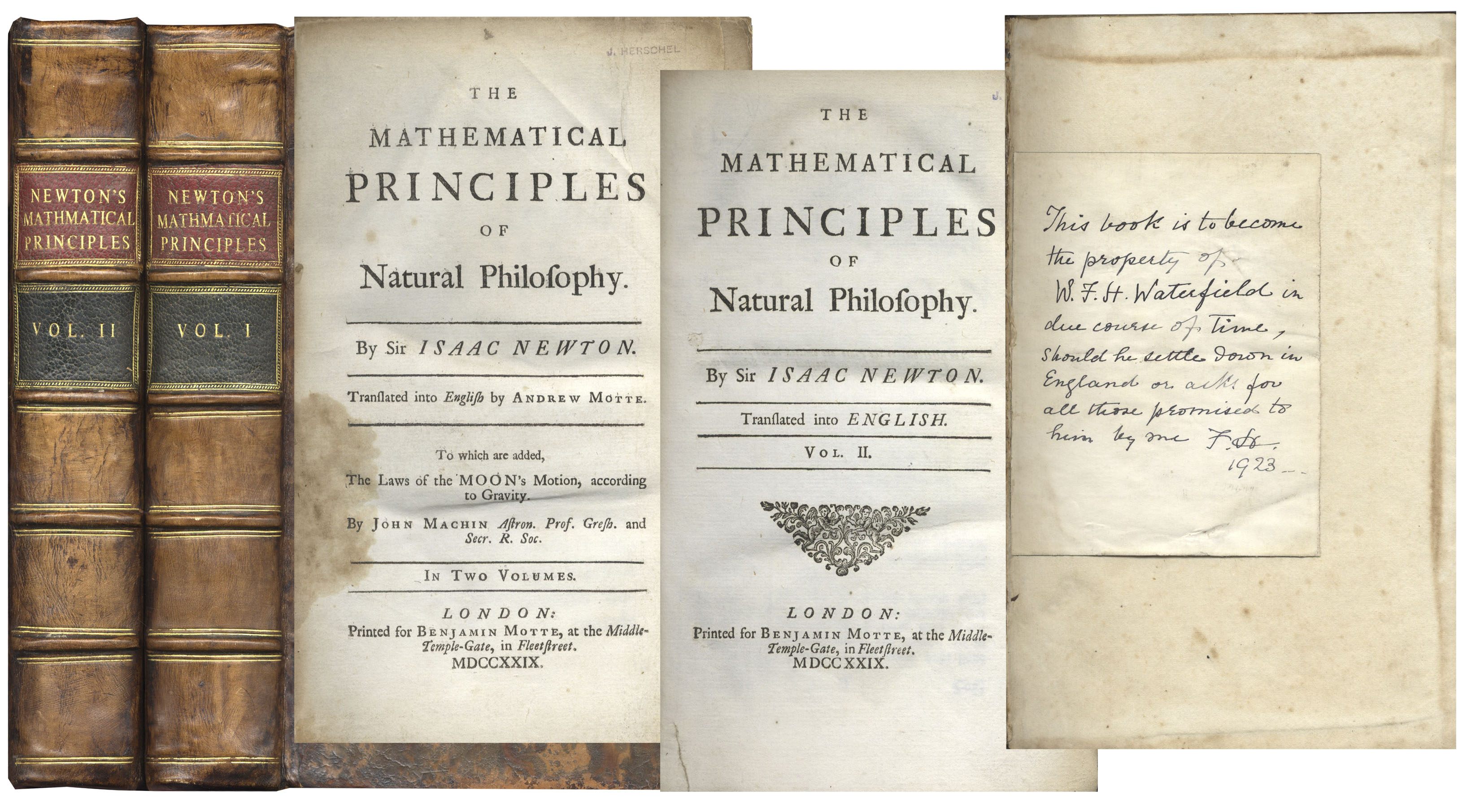
First edition of Sir Isaac Newton’s ”The Mathematical Principles of Natural Philosophy” in two volumes. London: Benjamin Motte, 1729. One of the most important works by the leading mind of the 18th century scientific revolution. Bound in contemporary tree calf, sympathetically rebacked, with gilt tooling to spines. Two octavo volumes measure 5.5” x 8.5” each. Volumes contain two folding letterpress tables and 47 folding engraved plates; the two frontispieces and pp. 385-393 and first 7pp. of index are replaced in facsimile, but hardly distinguishable from the original. The ”Laws of Moon’s Motion” usually found in Vol. II are here bound at end of Vol. I, and with errata for both volumes on verso of E4. Small stain to inner part of title in Vol. I, short tear to lower margin of G1, small section missing from lower margin of M3 and with lower corner cut away of A8 and C4 of ”Laws of Moon’s Motion” (no loss of text). Some marginal dampstaining and occasional soiling and spotting, overall in very good, clean condition with most edges untrimmed. Sold for $22,500.
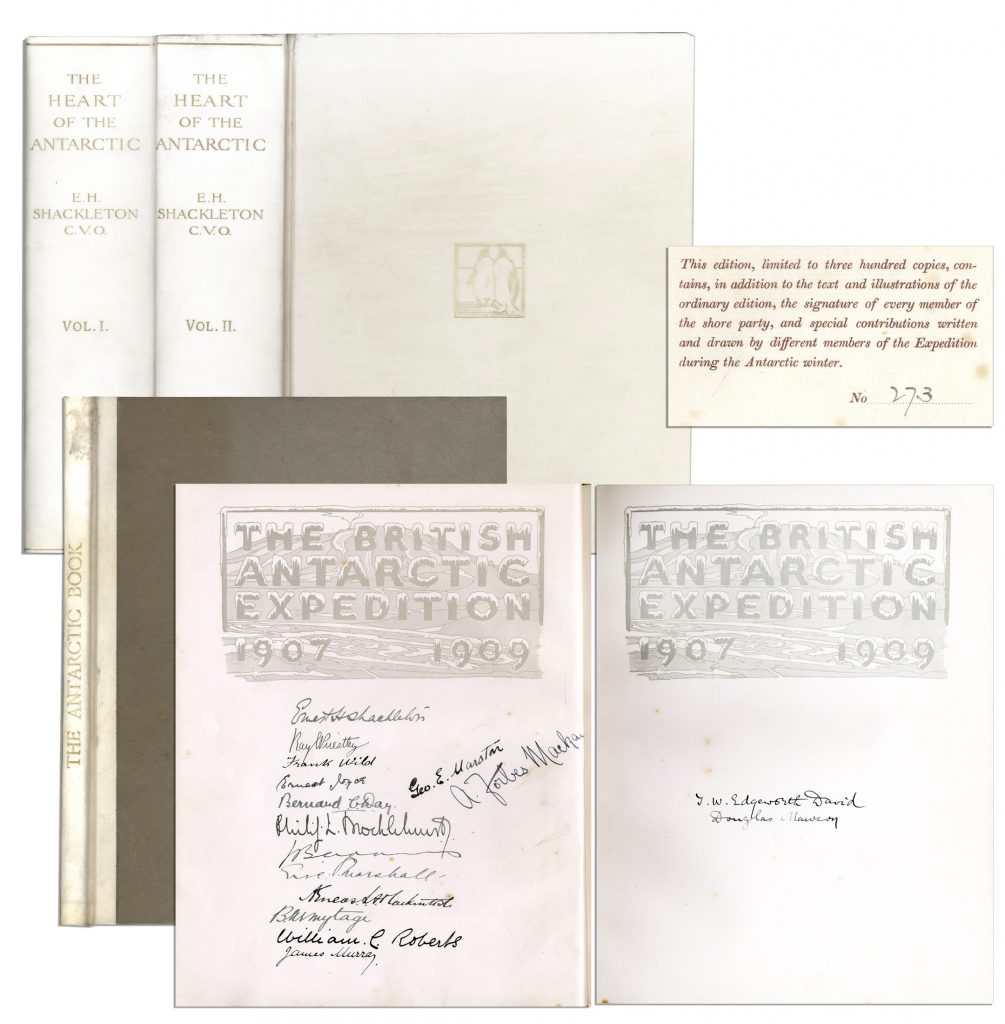
Ernest Shackleton & Crew Signed “The Heart of the Antarctic. Being the Story of the British Antarctic Expedition 1907-1909” Limited to Just 300 Copies, This Being All Three Volumes — Scarce
Ernest Shackleton’s signed copy of “The Heart of the Antarctic. Being the Story of the British Antarctic Expedition 1907-1909, 3 volumes (including “The Antarctic Book Winter Quarters 1907-09”), limited to 300 copies (here #273), also with signatures of the entire Shore party. Photogravure frontispiece, numerous plates (including 6 etched plates by George Marston, 16 tipped-in color after George Marston, others mostly photographic), one folding panorama and three folding lithographed maps in pocket at the end of volume three, illustrations and diagrams in the text. In publisher’s vellum, blocked in gilt with design of two penguins and top edges gilt. Occasional light spotting and small tear on cover of volume two. Overall in very good to near fine condition, signed by the Nimrod Shore Party crew. Sold for $12,718.
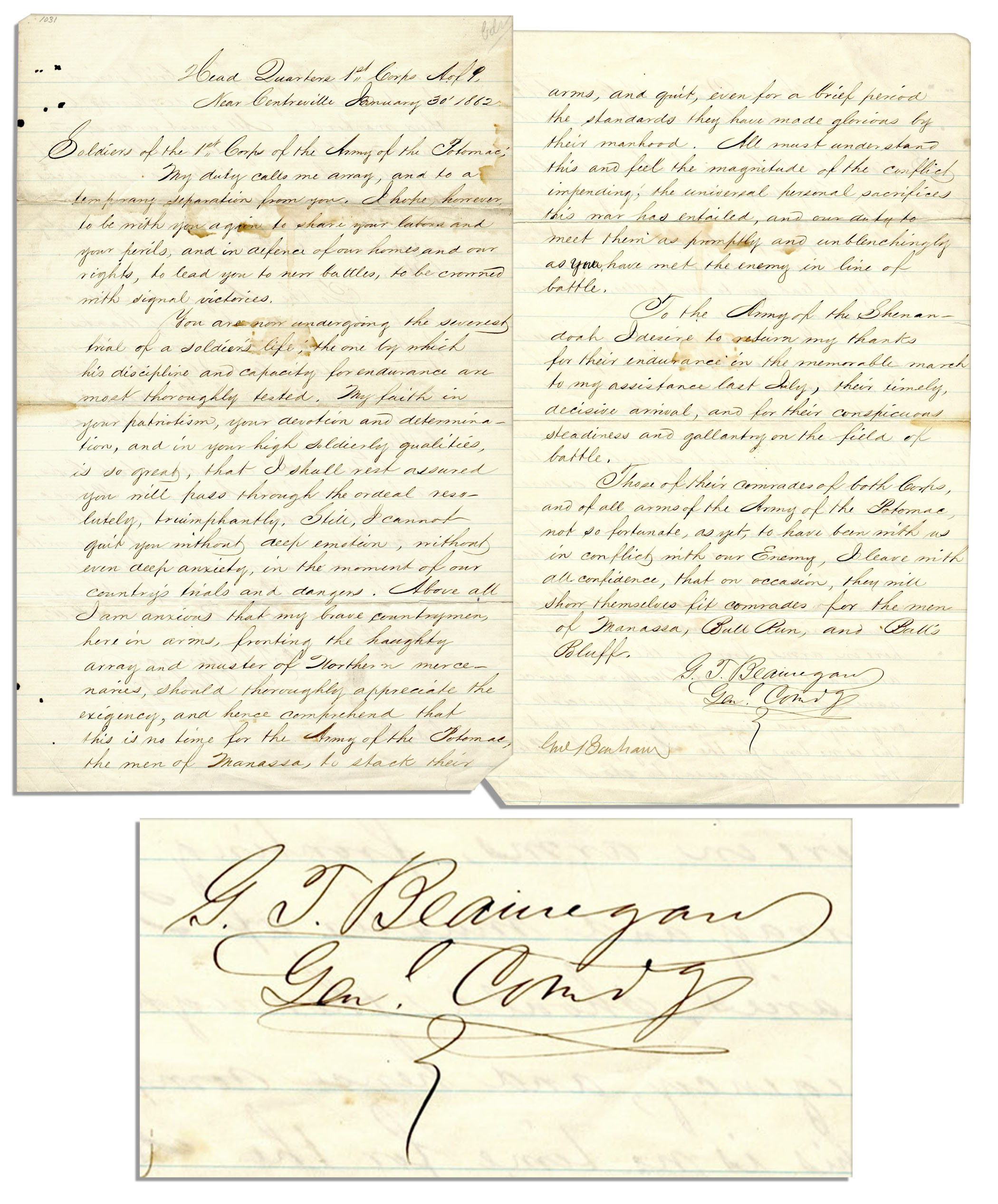
Civil War Confederate General G.T. Beauregard autograph manuscript signed, leaving his Army of the Potomac, the first established Army of the Confederacy whom Beauregard — the Confederacy’s first Brigadier General — led at First Bull Run. Having been transferred to the Army of the Tennessee, Beauregard writes from “Head Quarters 1st Corps A of P Near Centreville” on 30 January 1862: “…You are now undergoing the severest trial of a soldier’s life…My faith in your patriotism, your devotion and determination, and in your high soldierly qualities is so great, that I shall rest assured you will pass through the ordeal resolutely…Still, I cannot quit you without…deep anxiety, in the moment of our country’s trials and dangers…[T]his is no time for the army of the Potomac – the men of Manassas – to stack their arms and quit…To the army of Shenandoah, I desire to return my thanks for their assistance, last July, their timely, decisive arrival…Those…not so fortunate as yet to have been with us in conflict with our enemy, I leave with all confidence that on occasion they will show themselves fit comrades for the men of Manassas, Bull Run, and Ball’s Bluff…” G.T. Beauregard / Gen’l Com’dg”. 2pp. measures 8″ x 12.5″. Foxing, toning minor separation at folds and paper loss to corners. Very good condition. Recently sold for $21,600 as lot 202 in Swann’s April 2012 sale. Sold for $12,500.
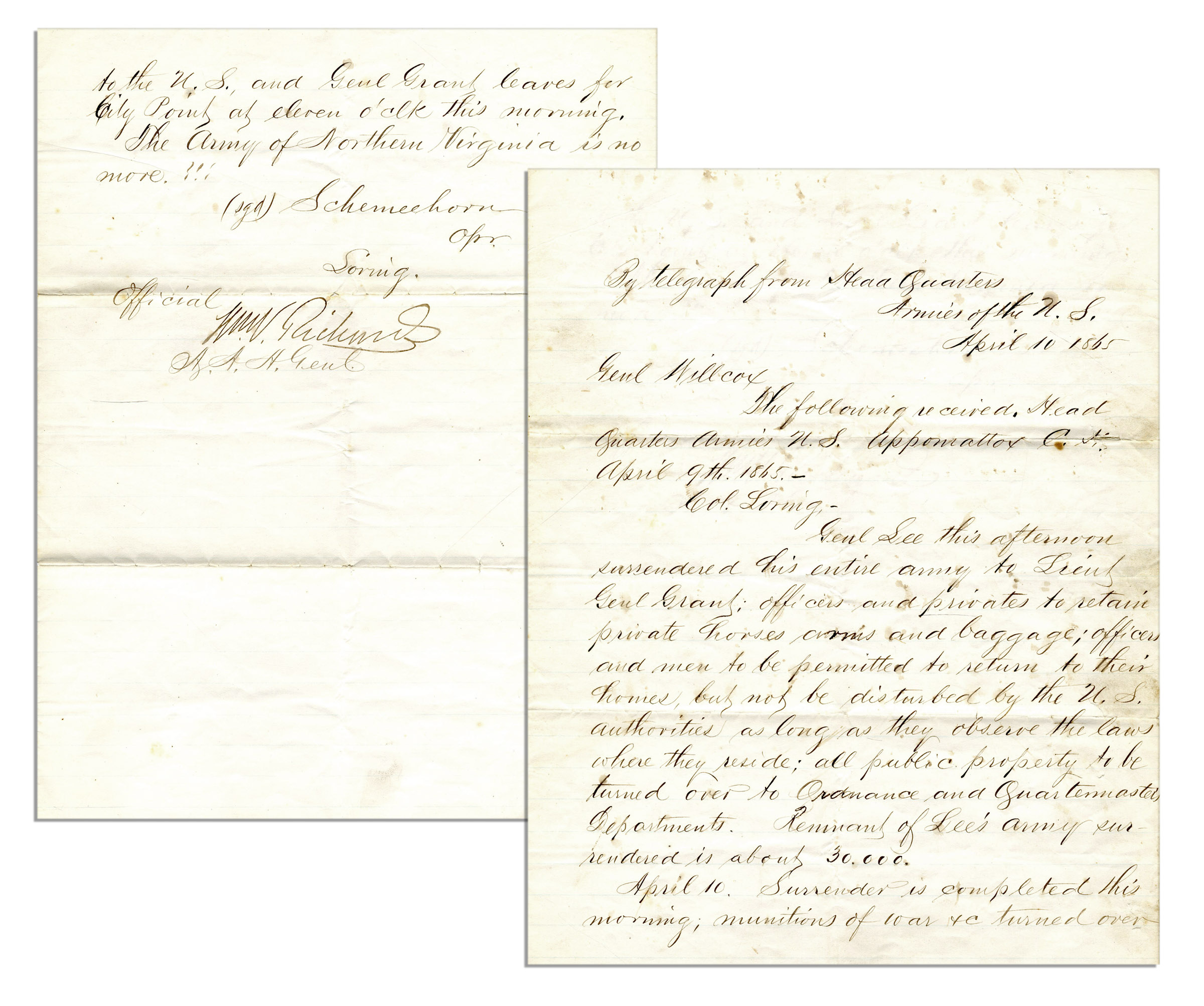
Civil War-dated handwritten letter serving as an official notice of General Lee’s resignation, and ultimately the end of the war, dated 9 April 1865. Sent by telegraph from the ”Head Quarters Armies of the U.S.”, letter is addressed to Confederate General Cadmus Wilcox from Confederate General William Loring and is signed by an aide to Loring. Letter reads in full: ”Genl. Willcox — The following received Head Quarters Armies U.S. Appomattox C.H. April 9th, 1865 — Genl Lee this afternoon surrendered his entire army to Lieut. Genl. Grant; officers and privates to retain private horses, arms and baggage; officers and men to be permitted to return to their homes, but not be disturbed by the U.S. authorities as long as they observe the laws where they reside; all public property to be turned over to Ordinance and Quartermasters Departments. Remnant of Lee’s Army surrendered is about 30,000. – April 10, surrender is complete this morning; munitions of war turned over to the U.S. and Genl. Grant leaves for City Point at eleven o’clk this morning. The Army of Northern Virginia is no more!!! (sgd) Schemerhorn”. Card-style 2pp. letter has handwriting on pages 1 and 3. Some toning, foxing and two 1” tears along a horizontal fold. Very good condition overall. Scarce. Sold for $10,780.
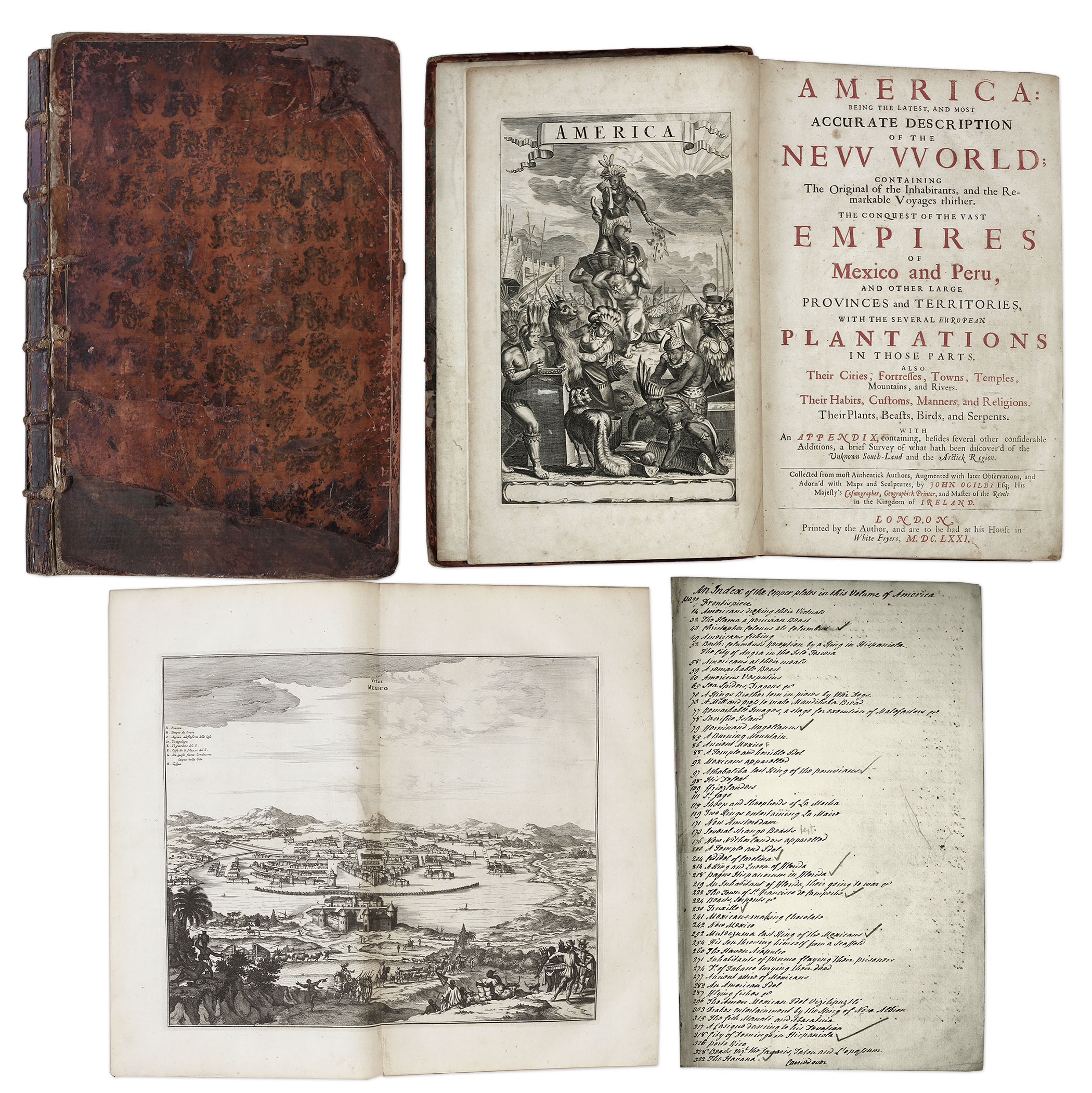
One of the most important books on the history of America (cited by Borba de Moraes, Howes, Sabin and Wing), the 1671 first edition of ”America: Being the Latest and Most Accurate Description of the New World”. Privately printed in London by the author, Arnoldus Montanus, and edited by John Ogilby. In ”America” Montanus goes into great detail of the new continents, with dozens of engravings of Native Americans, species of animals and reptiles, and the landscapes and settlements in the new world, accompanied by text. The book covers speculation regarding the earliest voyages to America, along with later recorded voyages and the settlements of New Netherlands/New York, New England, Hudson’s Bay, Labrador, Canada, Nova Scotia, Maryland, Virginia, (including Captain Smith’s capture and rescue by Pocahontas), Carolinas, Florida and California, plus accounts of Mexico and nearby islands, even including Australia and New Zealand. 674pp. book contains 75 original engravings (64 copper plates within the text and 9 plates throughout), lacking the maps and 28 engravings, which is typical as this edition is almost never found with all plates intact. All text is complete except for missing pages 445-446. Large format book measures 10” x 15”. Bound in original full leather boards, with some loss of leather to covers, cracking along spine and front board detached. Interior text is near fine and very readable. An important and fascinating addition to early knowledge of the American continent. Sold for $9,375.
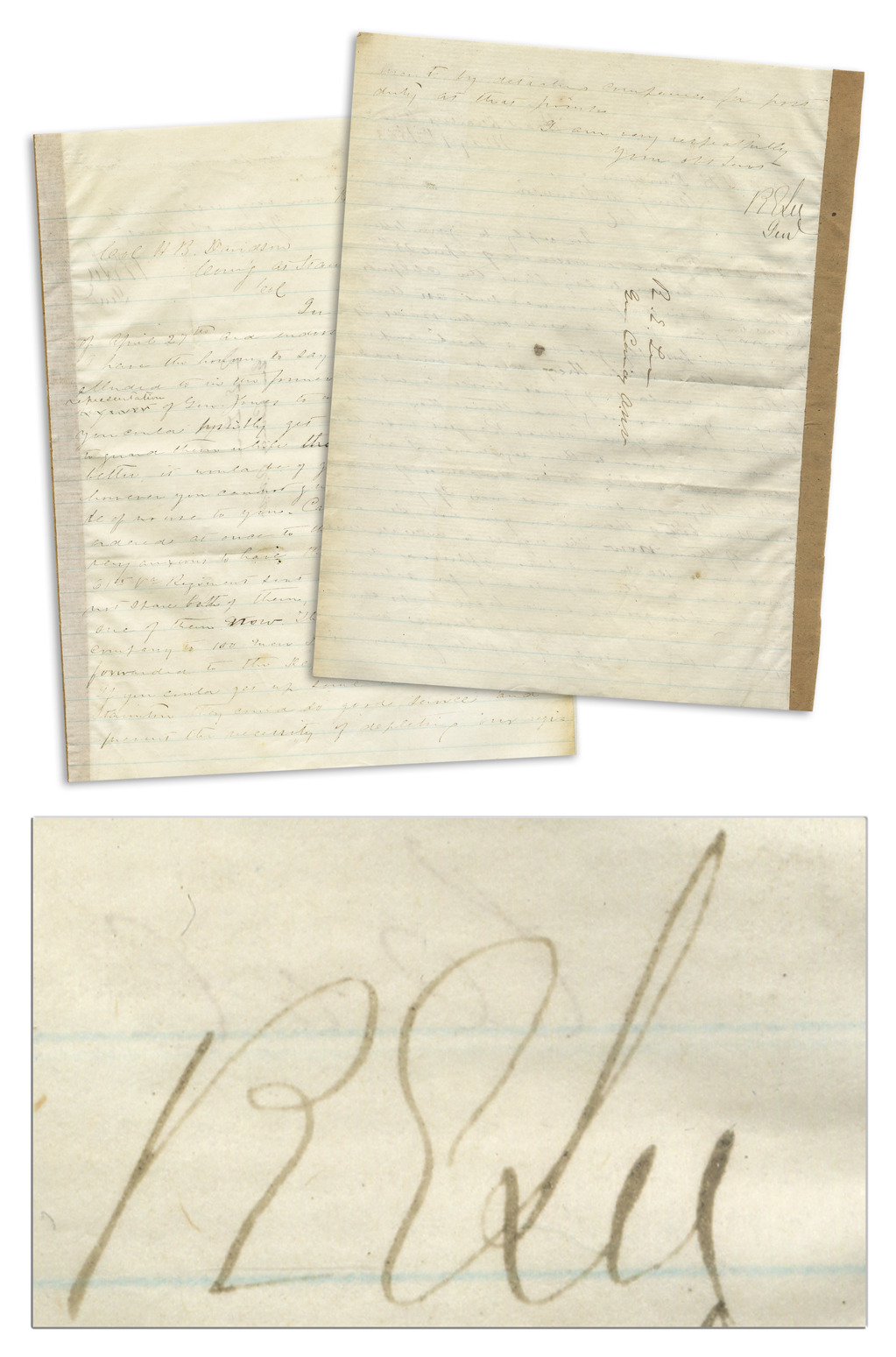
General Robert E. Lee Letter Signed Regarding Troop Replenishment After the Battle of Chancellorsville — Dated 9 May 1863 After Lee Made the Audacious Decision to Split His Army & Bluff the Union
General Robert E. Lee letter signed, composed a week after Lee executed his “perfect battle” plan at Chancellorsville. In the face of overwhelming Union forces, Lee made the bold decision on 1 May 1863 to split his army, pitting a small force to defend Fredericksburg against the advance of Union General John Sedgwick, and using the remainder of his army to attack Union General Joseph Hooker’s forces. The strategy was so effective that Lee divided his army a second time on 2 May, allowing General Stonewall Jackson to rout the Union’s XI Corps, and causing Hooker to hesitate before ultimately withdrawing his forces. Indeed, the battle was so perfectly executed that many believe it led to Lee’s hubristic decision to pursue the Union army north, leading to the Battle of Gettysburg, which completely altered the course of the Civil War. Sold for $7,873.
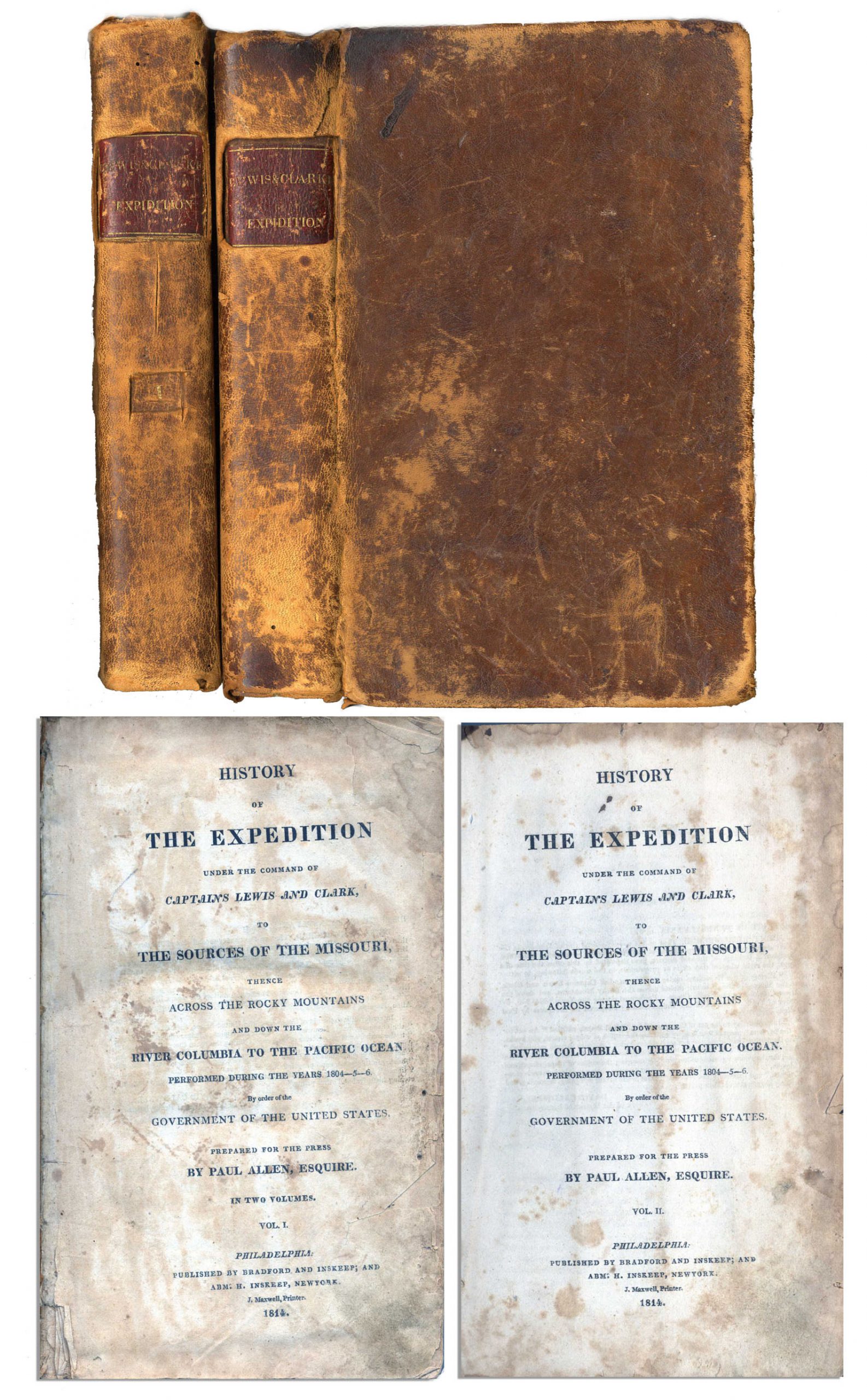
First edition, two-volume set of ”History of the Expedition under the Command of Captains Lewis and Clark to the source of the Missouri thence across the Rocky Mountains and down the river Columbia to the Pacific Ocean performed during the years 1804-05-06 by Meriwether Lewis and William Clark”. Published by Bradford and Inskeep: New York: 1814. Regarded as the definitive account of the first exhaustive, and most important Western exploration of America, which covered some eight thousand miles in slightly more than twenty-eight months. Lewis and Clark brought back the first reliable information about much of the area they traversed, made contact with the Native Americans as a prelude to the expansion of the fur trade, and advanced the geographical knowledge of the continent. This official account of the expedition is as much a landmark in Americana as the trip itself. Books, each measuring 5.5” x 8.75”, are bound in original marble-patterned leather boards and have five engraved, bound-in maps, missing the fold-out map found in some copies. Covers are worn and scuffed and the inside of covers have insect channels. Vol. I, 470pp., is missing the front free endpaper and has a chip out of the title page. Volume II runs 522pp. Light foxing and dampstaining throughout both volumes and some paper loss not affecting text. Overall in very good condition. An attractive set of America’s most important exploration narrative. Sold for $6,544.
Scarce First Edition, First Printing Map of London Just After the Great Fire in 1666, by Wenceslaus Hollar
A very rare first printing of the post-Great Fire map of London by noted artist and engraver to the King, Wenceslaus Hollar. After the Great Fire swept across London in September 1666, destroying nearly 90% of the homes, Hollar almost immediately produced this map, titled “A MAP or GROUNDPLOT of the Citty of London”, noted for its accuracy and attention to detail. Printed in London by John Overton, 1666. Appointed by King Charles II to document the destruction, Hollar was able to quickly plot the map based on his previous but failed passion project – to produce the greatest map of London that ever existed. Hollar used those previous drawings as the basis for his post-Great Fire map, adding detail for areas that survived the fire, and foregoing details for the destroyed areas. The result was an immensely popular and well-received map that grounded Hollar’s reputation as engraver and cartographer. In this first printing – distinguished by the placement of the legend, inset map and scale of the city, Hollar documents the destruction of London, from Lincoln’s Inn Fields in the west to East Smith’s Field in the east, including the Great Tower of London, and from just south of the Thames River in the south to Bunhill Fields Burial Ground in the north. An inset to churches throughout the city “and other remarkable places” is present, as is a scale for the map. Finally, an inset map showing a larger portion of London is found at lower left, including Westminster which narrowly missed the fire’s path. Map is astonishingly complete and detailed given the speed that Hollar produced it, with printed signature appearing at bottom of inset map, “W. Hollar fecit [Latin, ‘he made’] 1666″. Map measures 14.5″ x 12”. Light toning and faint creasing, small quarter-inch closed tear at lower left margin, and spot of discoloration at mid-right margin. Mounting remnants on verso. Overall near fine condition given age. Sold for $4,383.

FREE APPRAISAL. To buy, auction, sell or consign your Thomas Hobbes Leviathan 1st issue 1651 that is for sale, please email your description and photos to [email protected] of Nate D. Sanders Auctions (http://www.NateDSanders.com).
Thomas Hobbes Leviathan 1st issue 1651