
Sell or Auction Your The Democrat Boston Saturday March 16 1805 for up to Over $2,000 or More at Nate D. Sanders Auctions
FREE APPRAISAL. To buy, auction, sell or consign your The Democrat Boston Saturday March 16 1805 that is for sale, please email your description and photos to [email protected] of Nate D. Sanders Auctions (http://www.NateDSanders.com).
Free Appraisal, Auction or Sell Your The Democrat Boston Saturday March 16 1805
Below is a recent realized price for a copy of The Democrat. Boston Saturday March 16 1805. We at Nate D. Sanders Auctions can obtain up to this amount or more for you:
The Democrat Boston Saturday March 16 1805. Sold for Over $2,000.
The following are some related items we have sold:
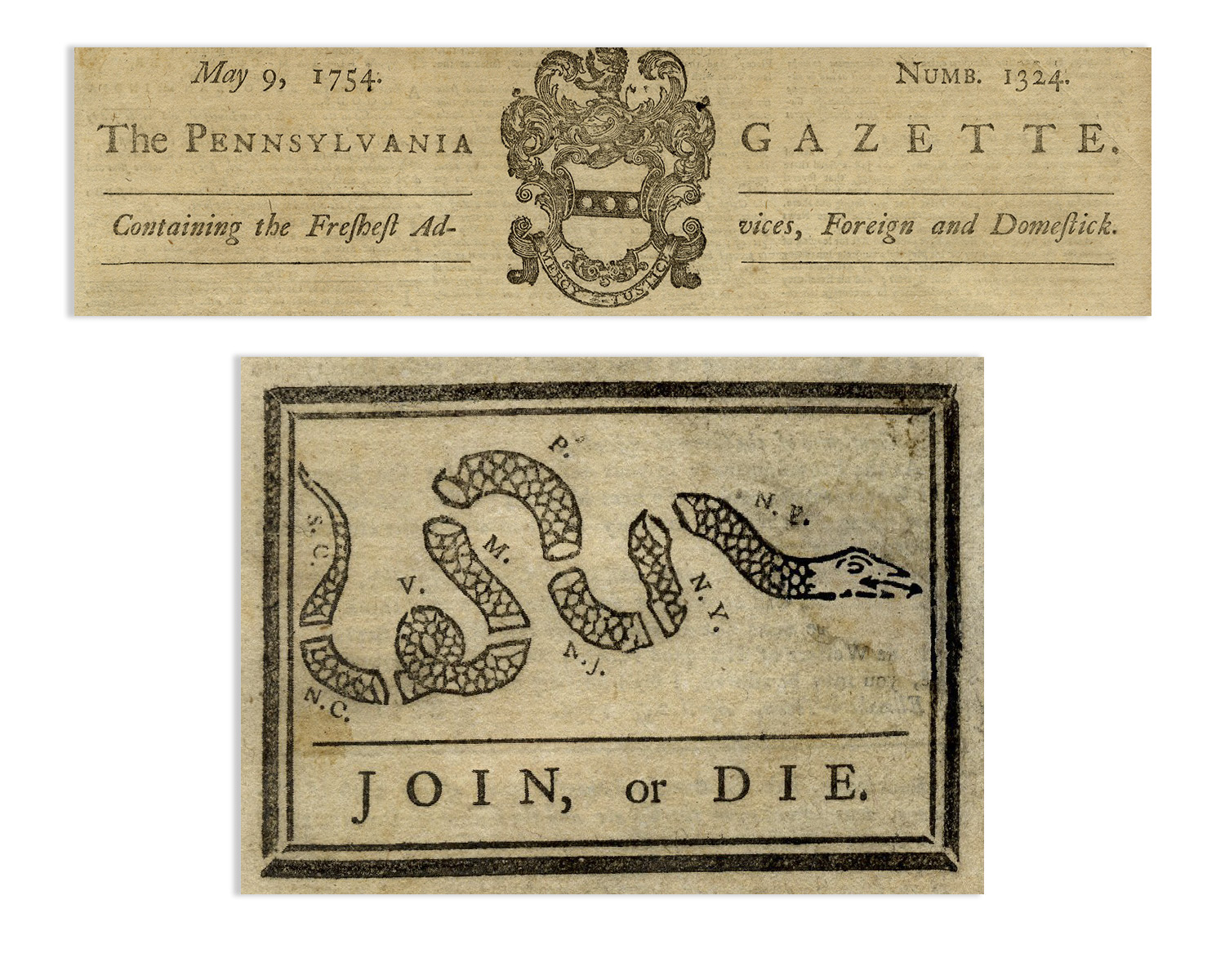
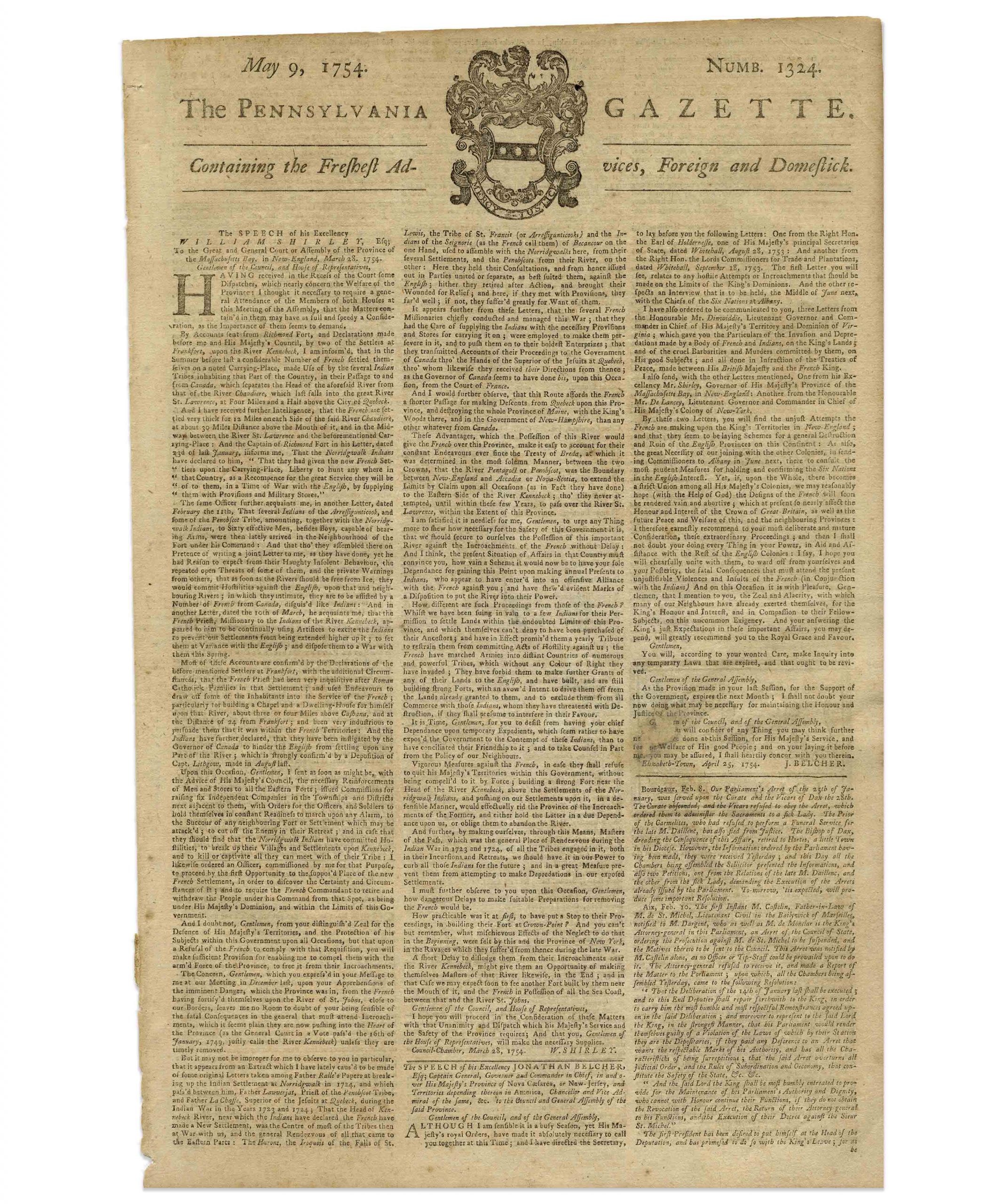
The most influential political cartoon in the history of America, the ”JOIN, or DIE” severed rattlesnake designed by Benjamin Franklin and published in his ”Pennsylvania Gazette” on 9 May 1754. This incredibly scarce newspaper is the very first printing of the ”JOIN, or DIE” cartoon, and the only known copy apart from one other housed in the permanent collection at the Library of Congress.
Frustrated by the colonists’ inability to join forces against westward expansion by the French, Franklin created this cartoon of a rattlesnake, cut into 8 pieces symbolizing the American colonies, to dramatically impart the effective message: join together as one cohesive body, or die. Along with the cartoon, Franklin published an editorial in the newspaper, urging the colonists to work together, reading in part, ”…The Confidence of the French in this Undertaking seems well-grounded on the present disunited State of the British Colonies…while our Enemies have the very great Advantage of being under one Direction, with one Council, and one Purse…”
Little did Franklin know at the time that his symbol of the dis-united rattlesnake would echo over twenty years later to inspire the colonists to unite against the British – Paul Revere added the ”JOIN, or DIE” cartoon to the nameplate of his paper, the ”Massachusetts Spy”, and even later, with the ”Don’t Tread on Me” flag, any individual or group whose personal liberty is threatened. The phrasing has also proved highly enduring, likely influencing John Stark, the Revolutionary War General from New Hampshire whose toast, ”Live free or die: Death is not the worst of evils”, inspired New Hampshire’s motto, and again suggests that personal liberty is one of the highest human values, and a founding tenet of the United States.
Franklin’s choice of a rattlesnake is curious for several reasons: as the timber rattlesnake was found throughout the colonies but not England, Franklin argued in an earlier 1751 editorial that the colonists should ship rattlesnakes to England in exchange for the criminals that England was sending to America. Franklin now, however, seems to fully embrace the rattlesnake as metaphor, and would argue, during the American Revolution, its virtues. Using a pseudonym to conceal his identity, he wrote in 1775, ”…she has no eye-lids-She may therefore be esteemed an emblem of vigilance.-She never begins an attack, nor, when once engaged, ever surrenders…to those who are unacquainted with her, she appears to be a most defenseless animal; and even when those weapons are shown and extended for her defense, they appear weak and contemptible; but their wounds however small, are decisive and fatal:-Conscious of this, she never wounds till she has generously given notice, even to her enemy, and cautioned him against the danger of stepping on her.-Was I wrong, Sir, in thinking this a strong picture of the temper and conduct of America?”
While the British loyalists played upon Franklin’s symbolism of the rattlesnake, arguing that the colonists were deceptive and cunning, Franklin turned the characterization on its head, skilled and interested as he was in the art of propaganda. Ultimately, the symbolism would prove highly enduring and compelling: both the idea of uniting to fight a greater, more powerful enemy, and the power of a sudden, deadly attack by an underestimated opponent.
Four page newspaper (without advertising) measures 9.75” x approximately 15”, with an irregularly trimmed top edge. Expert restoration to head of snake, and light uniform toning, consistent with age. Newspaper has been well-preserved, in very good to near fine condition. One of the most important newspapers in America’s colonial history and a cornerstone of her philosophical underpinnings. Sold for $50,000.

Revolutionary War Broadside 1775
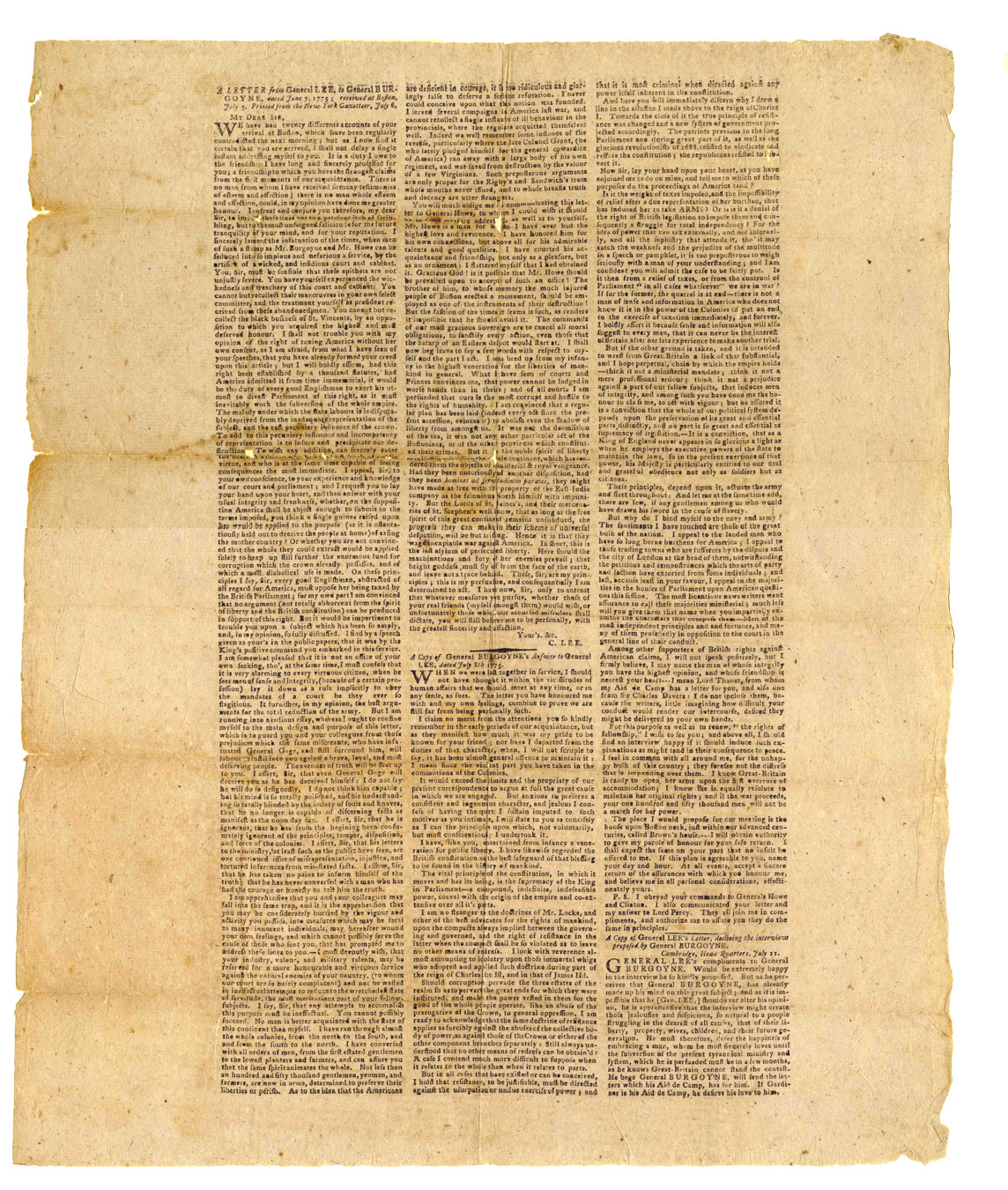
Revolutionary War broadside, “A Letter From General Lee, To General Burgoyne, Dated June 7, 1775″ A broadside containing a spate of correspondence between former colleagues Lee and Burgoyne, including a defense of Lee’s support of the American colonies. Likely published in New York, as it seems unlikely this would have been published in British-occupied Boston. Measures 14″ x 17”. Docketed in contemporary manuscript on verso. Light fold lines, minor separations at folds with partial loss to some letters. Extremely rare. Sold for $5,250.
Revolutionary War Broadside From Boston in 1775, With Loyalists Bidding Farewell to Colonial Governor Thomas Gage, the First British Commander-in-Chief — “…dark Contrivances of ambitious Men…”
Scarce Revolutionary War broadside, datelined Boston, 6 October 1775, after the commencement of fighting at Lexington & Concord, and Bunker Hill. Broadside consists of three letters by Tories in America, thanking Massachusetts Bay Governor and British Commander-in-Chief Thomas Gage for his service following his resignation. Each letter is answered, in turn, by Gage. As the first British Commander during the Revolutionary War, Gage was perhaps a scapegoat for the heavy losses sustained by the British at Bunker Hill. After the battle, he wrote to the English Secretary of War, “…They are now spirited up by a rage and enthusiasm as great as ever people were possessed of and you must proceed in earnest or give the business up…” Gage was then promptly relieved of his command and replaced by William Howe, although his reputation improved after the war’s end. Sold for $4,600.

American Army Establishment Broadside
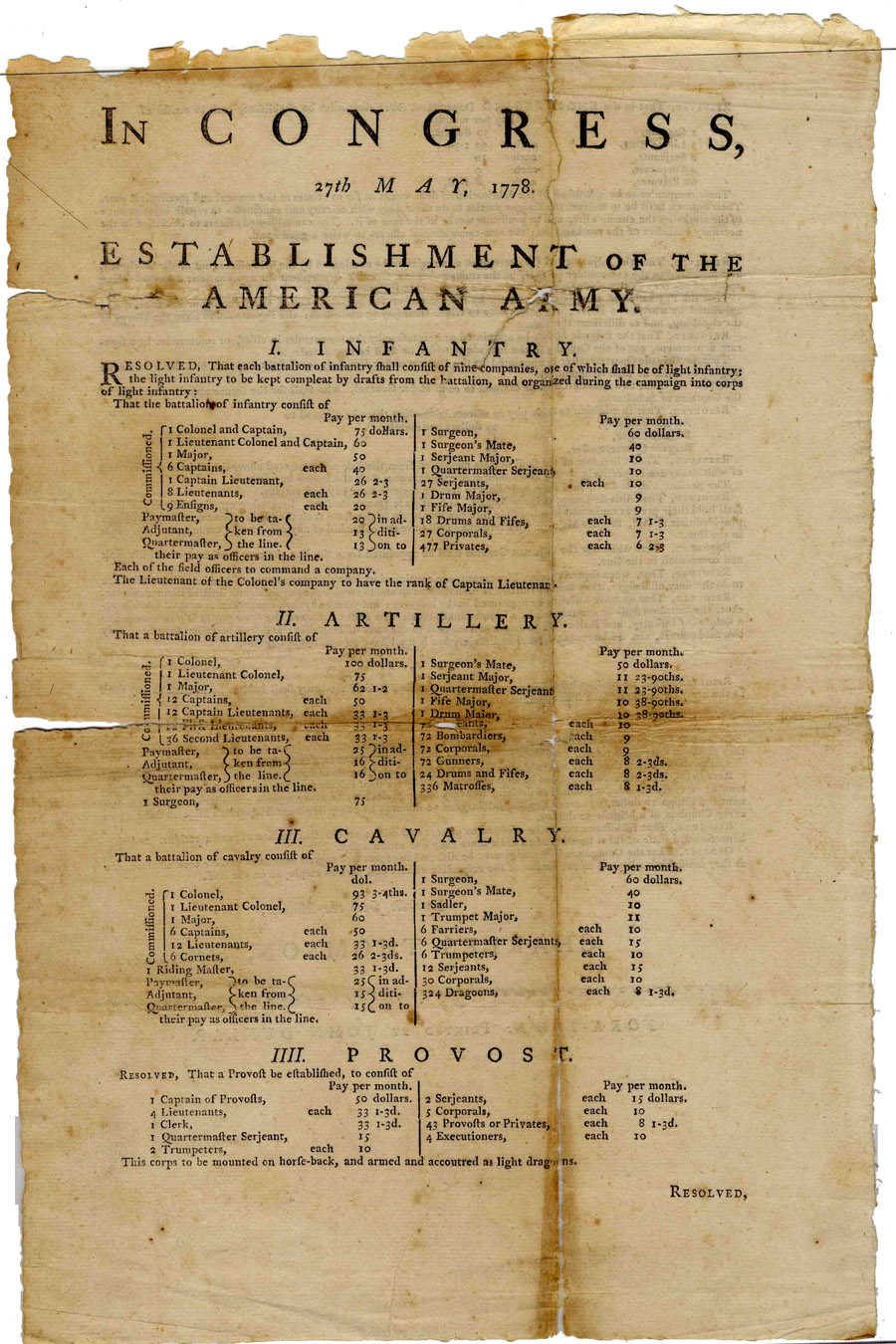
Scarce Revolutionary War “In Congress” broadside entitled, “Establishment of the American Army.” Printed by John Dunlap: York-Town. Dated 27 May 1778 document divides the American army into four parts; infantry, artillery, cavalry and provost and details positions and payments within each department. Further resolutions dated 29 May and 2nd June detail compensation and rations. In part, “…Resolved, That each battalion of infantry shall consist of nine-companies, one of which shall be of light infantry; the light infantry to be kept compleat by drafts from the battalion, and organized during the campaign into corps of light infantry: That the battalion of infantry consist of…Colonel and Captain [etc]…” 2pp. front and verso. Measures approximately 9.25″ x 14″. Fragile paper shows chipping and paper loss to edges and near complete separation at folds. Overall toning, wear and soiling, else good condition. Sold for $4,200.
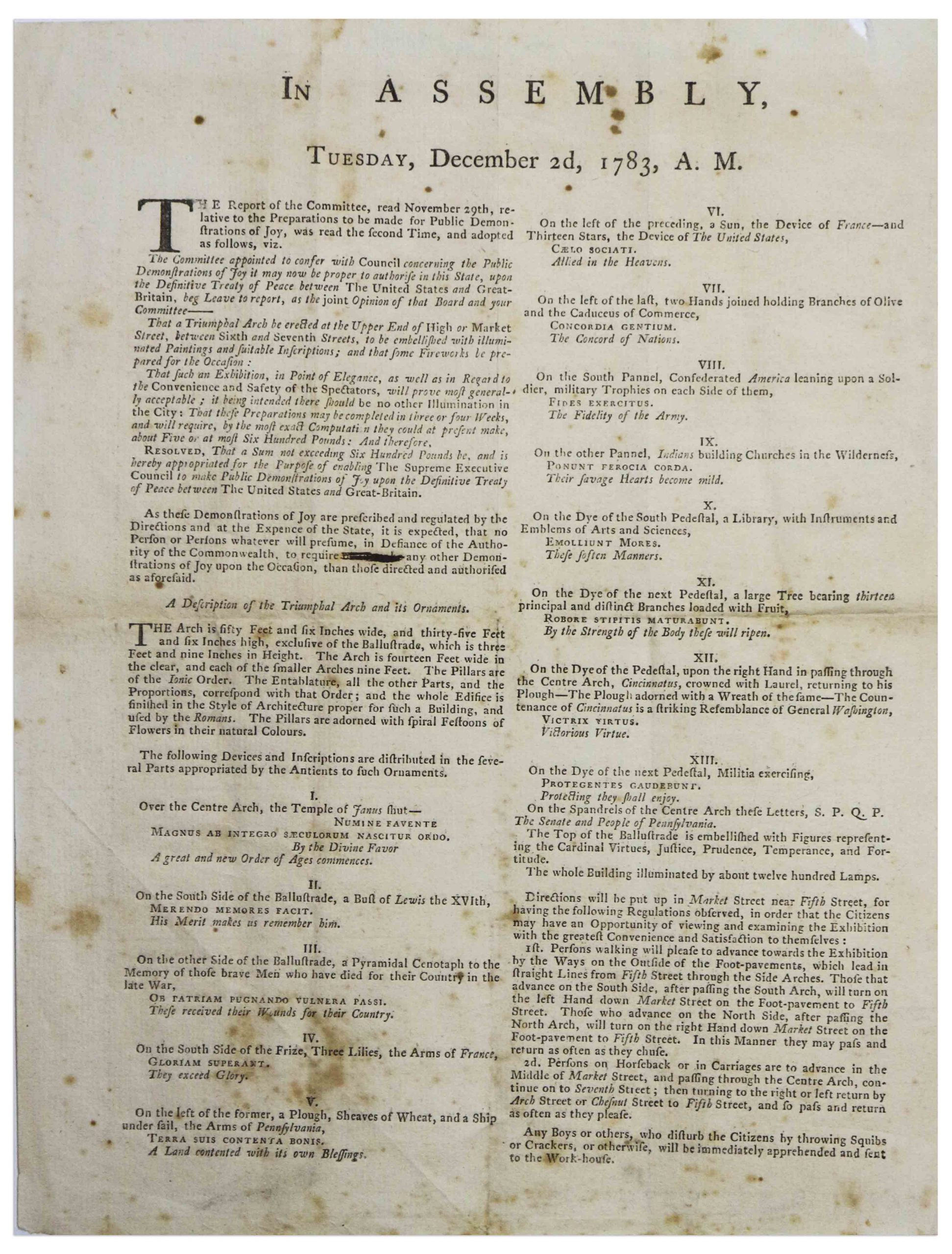
Revolutionary War Broadside Regarding “Demonstrations of Joy” to Mark the War’s End — With Details on the Infamous “Triumphal Arch” in Philadelphia, Which Erupted in Flames the Night of Its Debut
Superb and rare broadside from Philadelphia dated 2 December 1783 shortly after the Treaty of Paris officially ended the Revolutionary War, with details of the “Triumphal Arch” to be constructed in the city. To celebrate the war’s end, carefully planned celebrations – termed “Demonstrations of Joy” – were scheduled in each state to unite the new country in a communal patriotic experience. The celebration in Philadelphia centered around this “Triumphal Arch”, a grand wooden structure over 35 feet tall, to be “illuminated by about twelve hundred Lamps” and “embellished with illuminated Paintings…and that some Fireworks be prepared for the Occasion”. Sold for $3,600.
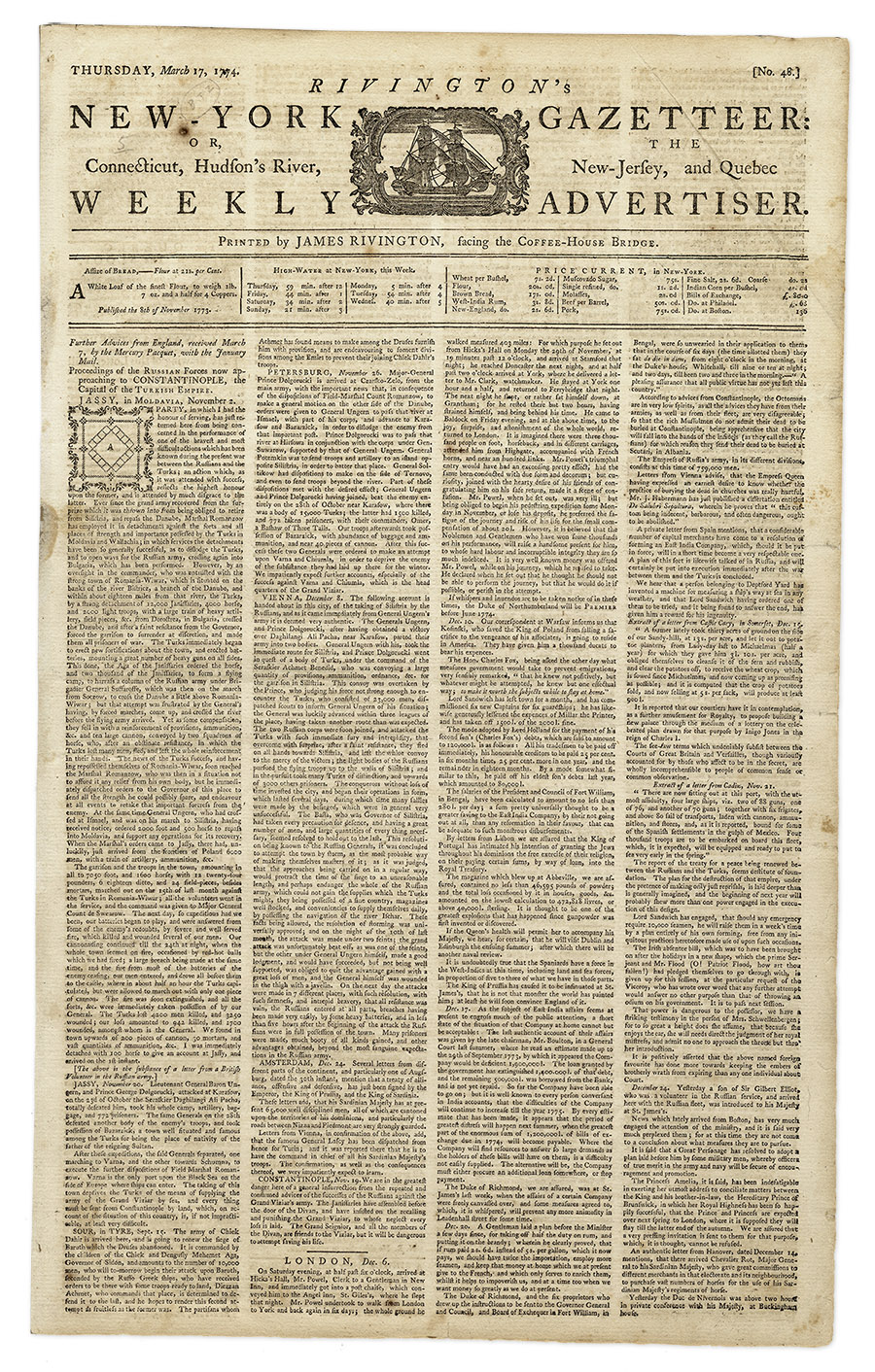
Rare colonial newspaper with content on the Boston Tea Party and a second seizure and dumping of tea that occurred on 7 March 1774. Little is known of this second Tea Party except what has been recorded in a few colonial newspapers, such as this one, and by John Adams who wrote about it in his diary. In this 17 March 1774 edition of ”Rivington’s New-York Gazetteer” (also called the ”Connecticut, Hudson’s River, New-Jersey, and Quebec Weekly Advertiser”), London’s response to the first Boston Tea Party is discussed, as well as details of the second Tea Party aboard the ship of Captain Gorham, who recounts to the paper the following information: ”BOSTON, March 10 / By Capt. Gorham, arrived here in nine weeks from London, we are informed, that…that Governor Pownal [previous Massachusetts Bay Governor Thomas Pownall, sent to Boston to quell the colonists after the Tea Party] will positively go over to Boston early in the spring, in order to take the management of that quarter under his care; that orders have been dispatched, in the courte of the last week, to Ireland, for the immediate embarkation of three regiments to be sent to Boston and New-York; that the Board of Trade had also come to several resolutions relative to American affairs, to be recommended at the same time; and that the latter end of December some advices were received at Lord Darmouth’s office [William Legge, 2nd Earl of Dartmouth, Secretary of State for the Colonies], from Boston, in New-England, which were kept a profound secret…”
The paper continues, ”Capt. Gorham, we are told, has about thirty chests of tea on board, said to be private property, and consigned to some persons here; but what will be the fate thereof, a short time will discover – Certainly not suffered to be landed in Boston! Lord Temple [Richard Grenville-Temple, 2nd Earl Temple], though he has totally declined taking any part in administration means, in conjunction with his noble brother-in-law, Lord Chatham [William Pitt, 1st Earl of Chatham; both men were sympathetic to the colonists], to attend closely to his duty in Parliament the ensuring sessions, in order to defend the liberties, and to watch over the interests, of his much injured countrymen…”
The paper goes onto discuss possible replacements of politicians and also the removal of Peter Oliver, Chief Justice of the Superior Court of Massachusetts Bay, whose salary was dependent upon the taxes levied against the Colonies from tea. The reporting continues, ”…Monday evening [7 March 1774] the tea that arrived in Captain Gorham, from London, belonging to some private persons, was thrown into the sea, in the same manner with that of the East India Company in December last [16 December 1773]…” Coverage appears on the second page of 4pp. paper, measuring 11.25” x 18.25”. Light toning and reinforced fold, otherwise in near fine condition given age. Very rare reporting on the second Tea Party and the beginning of the oppressive measures taken against the colonies as a result. Sold for $3,125.
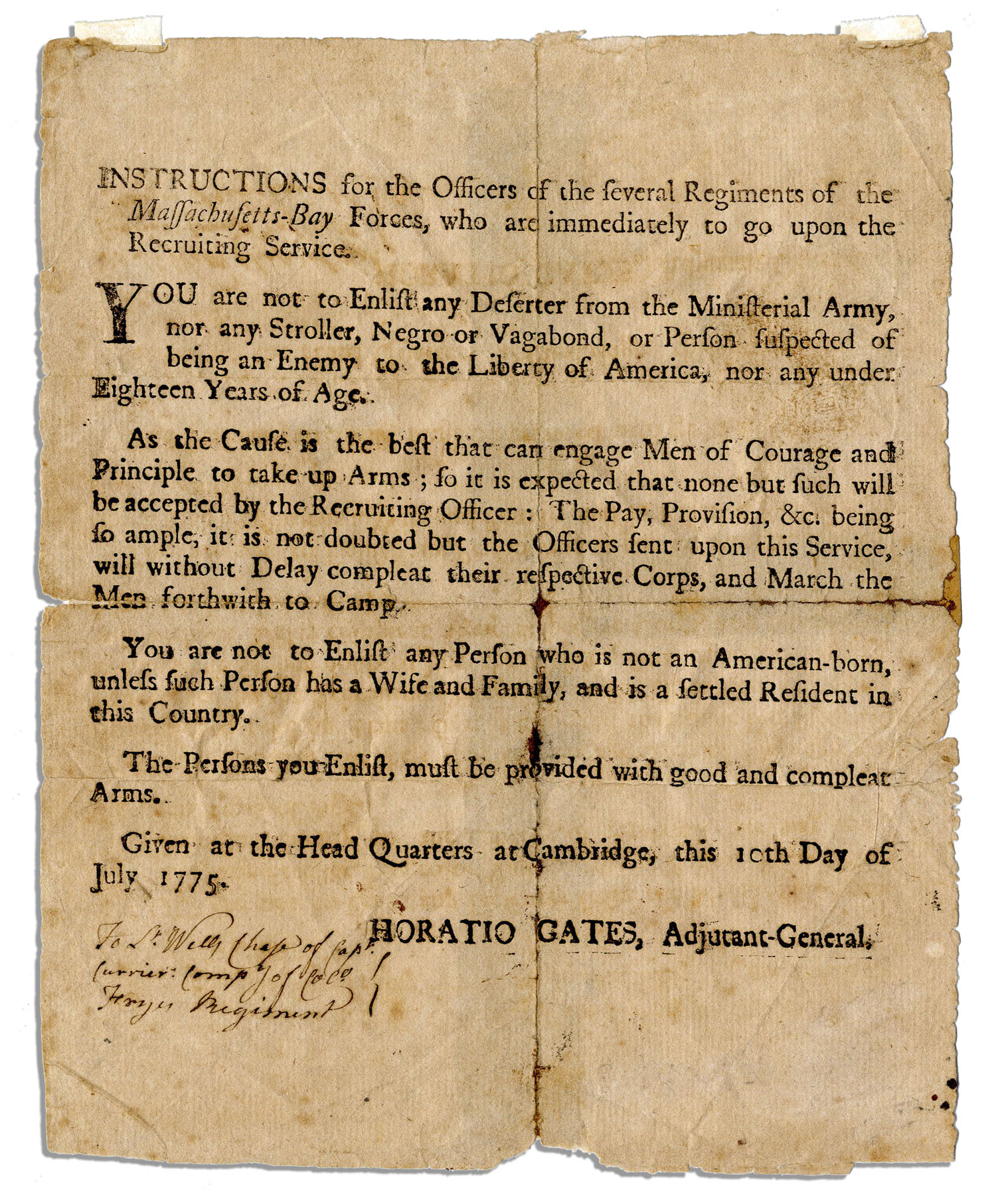
Broadside announces the recruitment of soldiers for the American Revolutionary War. The document, dated 1775 and signed in type by Horatio Gates as Adjutant General reads in full: ”Instructions for the Officers of the several Regiments of the Massachusetts Bay Forces, who are immediately to go upon the Recruiting Services. You are not to Enlist any Deserter from the Ministerial Army, nor any Stroller, Negro or Vagabond, or Person suspected of being an enemy to the Liberty of America, nor any under Eighteen Years of Age. As the cause is the best that can engage Men of Courage and Principle to take up Arms; so it is expected that non but such will be accepted by the Recruiting Officer: The Pay, Provision, etc. being so ample, it is not doubted but the Officers sent upon this Service will without Delay compleat their respective Corps, and March the Men forthwith to Camp. You are not to enlist any Person who is not American-born, unless such Person has a wife and Family, and is a settled Resident in this Country. The Persons you Enlist must be provided with good and compleat Arms. Given at the Head Quarters at Cambridge, this 10th Day of July, 1775. / Horatio Gates, Adjutant General”. Single-page broadside measures 6.5” x 8.25”. Toning, chipping and minor tears along edges, with separation to fold intersection from the left edge. Very good condition. Sold for $2,886.
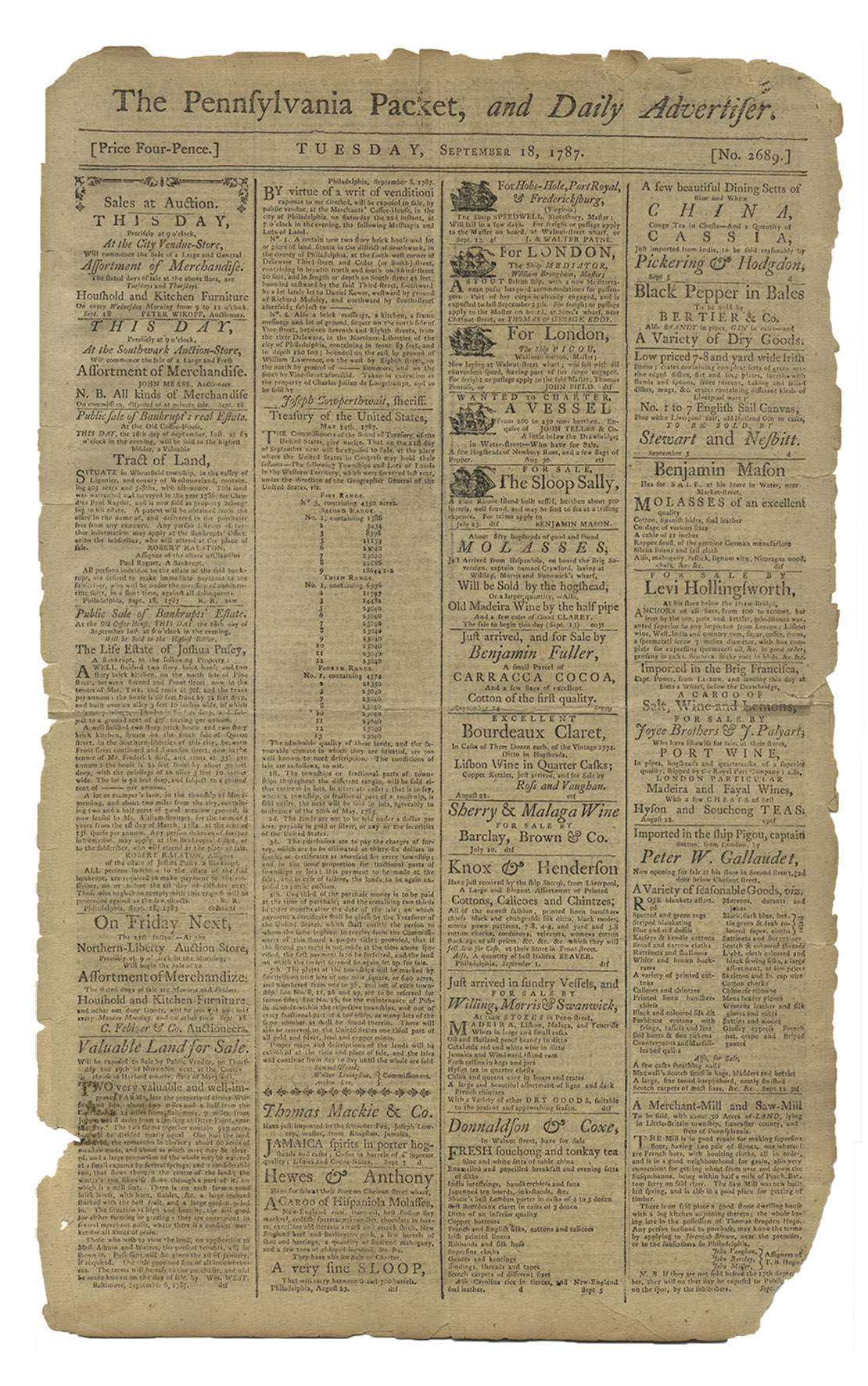
Philadelphia Newspaper From 18 September 1787, Reporting on the Constitutional Convention That Ended a Day Earlier on 17 September, When the U.S. Constitution Was Signed
Important newspaper reporting on the conclusion of the Constitutional Convention, the body that drafted, deliberated and finally signed the U.S. Constitution on 17 September 1787. Based in Philadelphia, where the Convention deliberated from 25 May to 17 September, “The Pennsylvania Packet, and Daily Advertiser” reports on 18 September 1787 the following: “We have the heart-felt pleasure to inform our fellow citizens that the Federal Convention adjourned yesterday, having completed the object of their deliberations-And we hear that Major W. Jackson, the secretary of that honorable body, leaves this city for New York, this morning, in order to lay the great result of their proceedings before the United States in Congress.” Sold for $2,500.
FREE APPRAISAL. To buy, auction, sell or consign your The Democrat Boston Saturday March 16 1805 that is for sale, please email your description and photos to [email protected] of Nate D. Sanders Auctions (http://www.NateDSanders.com).
We offer the following services for your The Democrat Boston Saturday March 16 1805:
- Appraise The Democrat Boston Saturday March 16 1805.
- Auction The Democrat Boston Saturday March 16 1805.
- Consign The Democrat Boston Saturday March 16 1805.
- Estimate The Democrat Boston Saturday March 16 1805.
- Sell The Democrat Boston Saturday March 16 1805.