
Sell or Auction Your Stamp from The Stamp Act of 1765 for up to Over $10,000 or More at Nate D. Sanders Auctions
FREE APPRAISAL. To buy, auction, sell or consign your Stamp from the Stamp Act of 1765 that is for sale, please email your description and photos to [email protected] of Nate D. Sanders Auctions (http://www.NateDSanders.com).
Sell Your Stamp from The Stamp Act of 1765
The Stamp Act of 1765 (short title: Duties in American Colonies Act 1765; 5 George III, c. 12) was an Act of the Parliament of Great Britain which imposed a direct tax on the British colonies in America and required that many printed materials in the colonies be produced on stamped paper produced in London, carrying an embossed revenue stamp. Printed materials included legal documents, magazines, playing cards, newspapers, and many other types of paper used throughout the colonies, and it had to be paid in British currency, not in colonial paper money.
Below is a recent realized price for a Stamp from the Stamp Act of 1765. We at Nate D. Sanders Auctions can obtain up to these amounts or more for you:
Stamp from The Stamp Act of 1765. Sold for over $10,000.
Consign your item at Nate D. Sanders Auctions. Send a description and images to us at [email protected].
Here are some recent items that our auction house, Nate D. Sanders (http://www.NateDSanders.com) has sold:
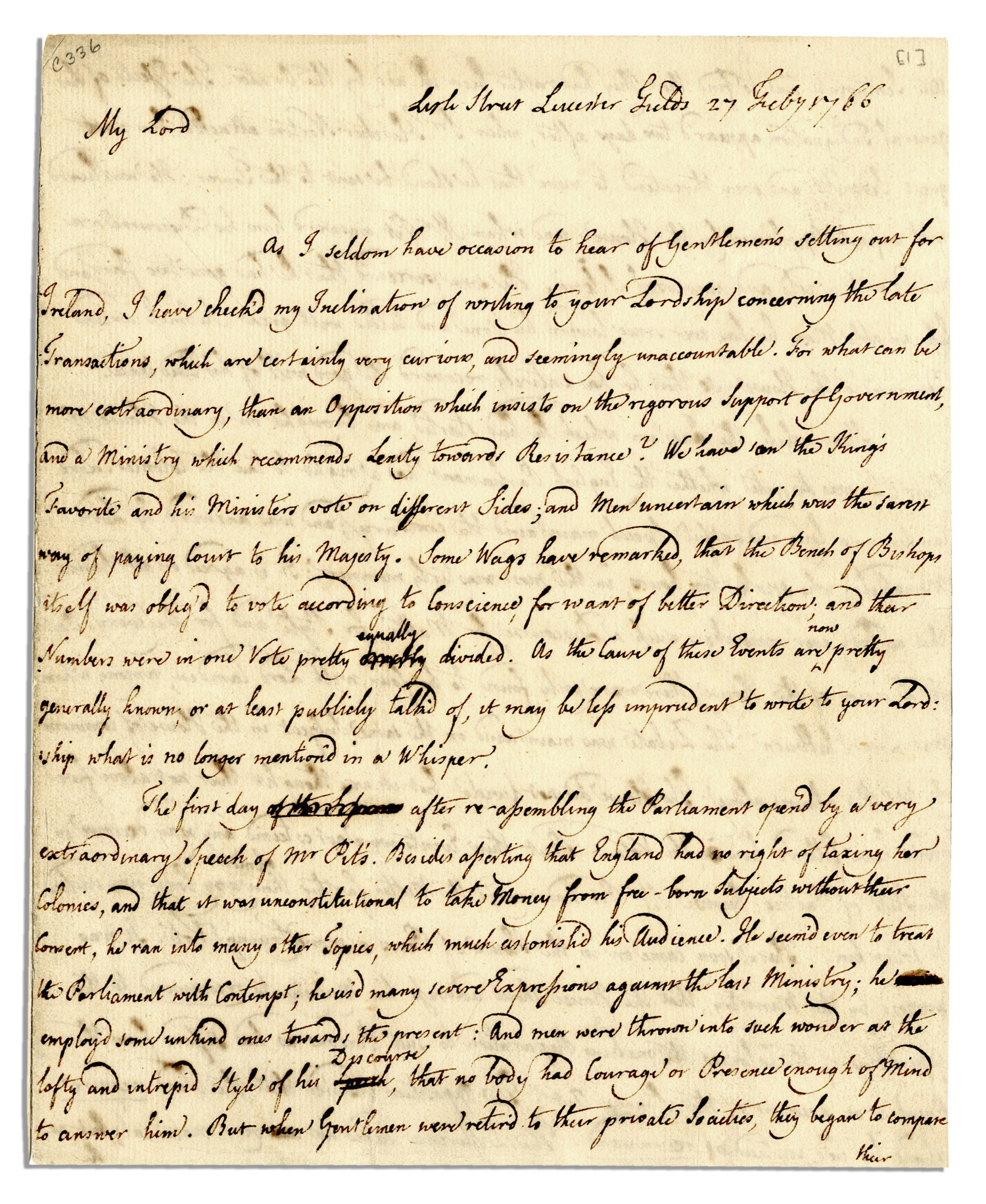
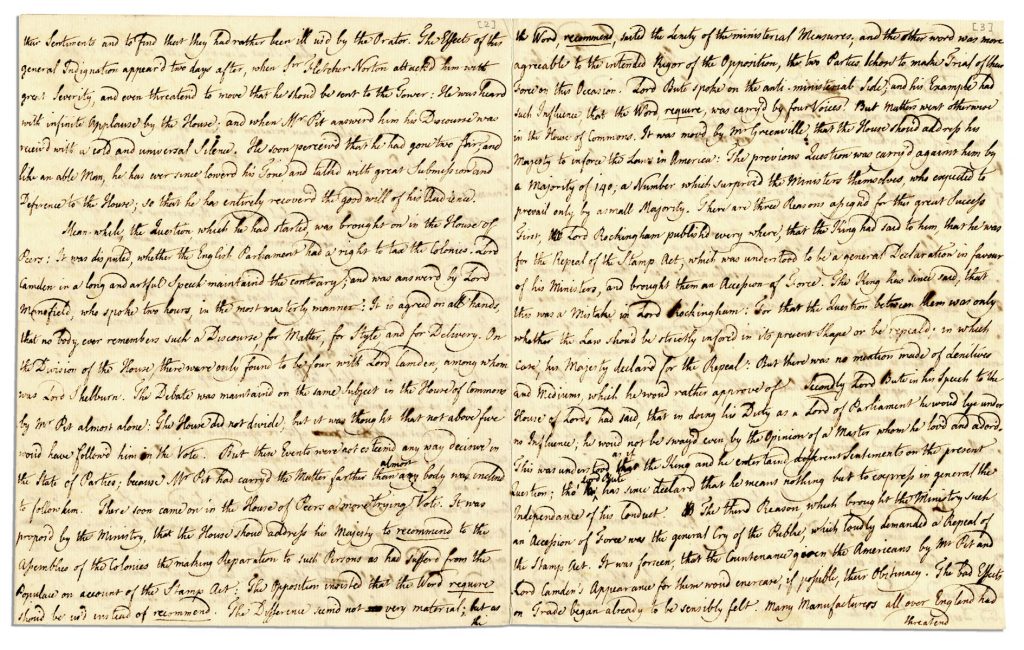
Enlightenment Philosopher David Hume Autograph Letter Signed on Vociferous Debate on the Stamp Act — “…the King had said…he was for the repeal of the Stamp Act…The King has since said, that this was a mistake…”
Historically important David Hume autograph letter signed, discussing the contentious debate in Parliament on the Stamp Act, led by Prime Minister William Pitt who questions the moral authority to tax “free-born subjects without their consent”. Here, Hume writes to the Earl of Hertford, Ambassador to France, after witnessing Parliamentary debate in which Prime Minister William Pitt defends America’s opposition to the Stamp Act. Dated 27 February 1766 from Lisle Street, Leicester Fields, the letter reads in part, “…[T]he Parliament opened by a very extraordinary speech of Mr. Pit’s [William Pitt]. Besides asserting that England had no right to her Colonies, and that it was unconstitutional to take money from free-born subjects without their consent, he…much astonished his audience. He seemed even to treat the Parliament with contempt…and men were thrown into such wonder at the lofty and intrepid style of his discourse, that nobody had courage or presence enough of mind to answer him…Meanwhile the question which he had started, was brought on in the House of Peers; it was disputed, whether the English Parliament had a right to tax the colonies…Mr. Pit had carry’d the matter farther than almost anybody was inclined to follow him…It was moved by Mr. Grenville that the house should address his Majesty to inforce the laws in America. The…question was carried against him by a majority of 140; a number which surprised the Ministers themselves…Lord Rockingham published everywhere that the King had said to him that he was for the repeal of the Stamp Act…The King has since said, that this was a mistake…It was foreseen, that the countenance given the Americans by Mr. Pit and Lord Camden’s appearance for them would increase, if possible, their obstinacy. The bad effects on trade began already to be sensibly felt. Many manufacturers all over England had threatened to dismiss a half or two-thirds of their tradesmen, which must have produced infinite confusion…I am persuaded no one voted against the repeal but from party and in full hopes and confidence of being out-voted…” Hume, here serving on the staff of the British Embassy in Paris, also references the rumor that the lack of opposition to the repeal of the Stamp Act was partly due to Lord Bute’s having plotted to overthrow the Ministry. Letter runs six pages on two folded sheets. Measures 7.25″ x 9″. Reinforced along vertical folds, else near fine. This letter, found in “Letters of David Hume” has been called by William Knight, Hume’s biographer as “a long, minute, and singularly graphic account of the transactions of Parliament on its first day of its assembling that year.” Published in Grieg, “Letters of David Hume,” 2:18-23. Provenance: Sotheby’s John Young sale, 26 April 1869, lot 500; Alfred Morrison catalogue, 1897; Parke-Bernet sale, 26 November 1941, lot 269. Sold for $57,000.
click to enlarge
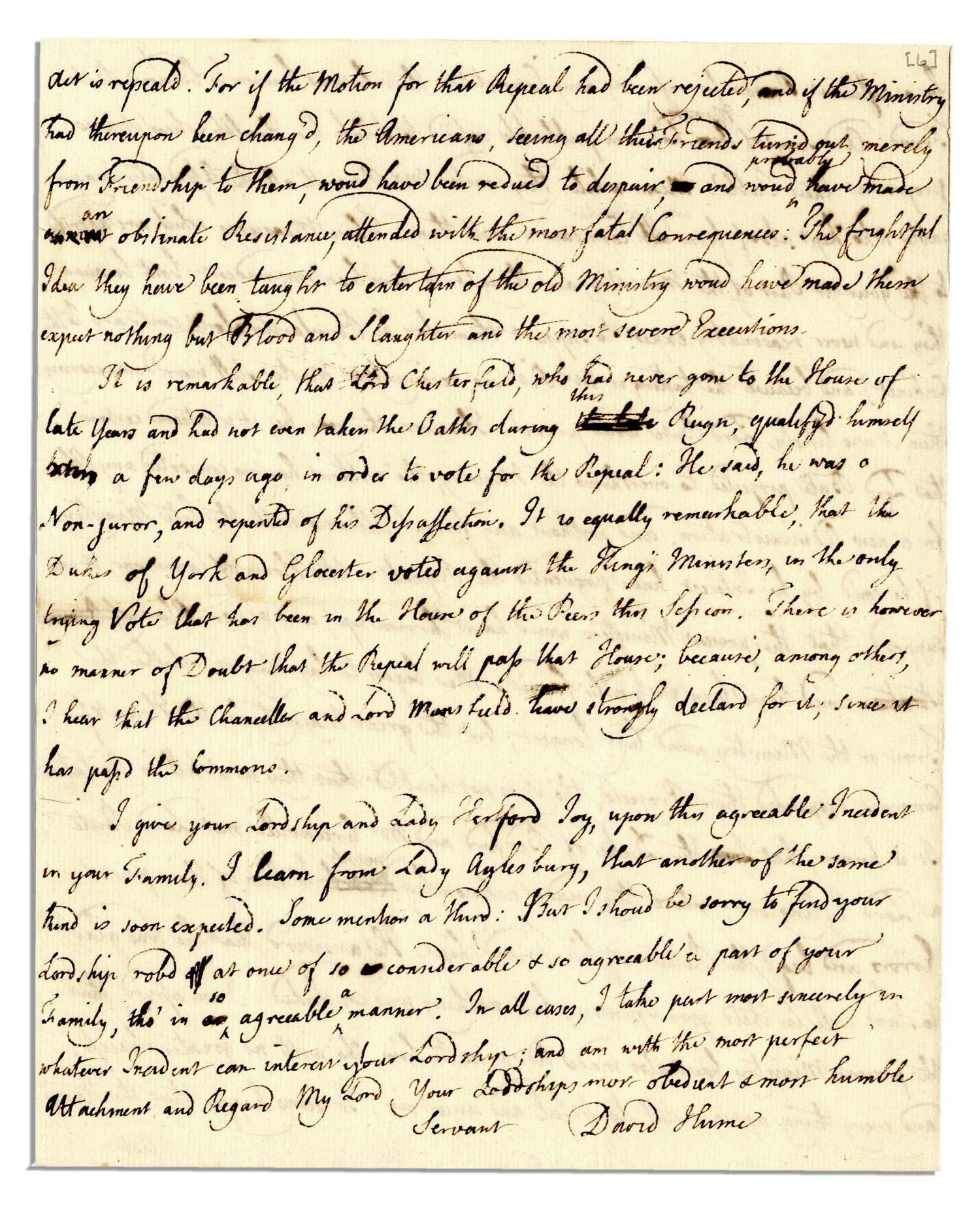
The most influential political cartoon in the history of America, the ”JOIN, or DIE” severed rattlesnake designed by Benjamin Franklin and published in his ”Pennsylvania Gazette” on 9 May 1754. This incredibly scarce newspaper is the very first printing of the ”JOIN, or DIE” cartoon, and the only known copy apart from one other housed in the permanent collection at the Library of Congress.
Frustrated by the colonists’ inability to join forces against westward expansion by the French, Franklin created this cartoon of a rattlesnake, cut into 8 pieces symbolizing the American colonies, to dramatically impart the effective message: join together as one cohesive body, or die. Along with the cartoon, Franklin published an editorial in the newspaper, urging the colonists to work together, reading in part, ”…The Confidence of the French in this Undertaking seems well-grounded on the present disunited State of the British Colonies…while our Enemies have the very great Advantage of being under one Direction, with one Council, and one Purse…”
Little did Franklin know at the time that his symbol of the dis-united rattlesnake would echo over twenty years later to inspire the colonists to unite against the British – Paul Revere added the ”JOIN, or DIE” cartoon to the nameplate of his paper, the ”Massachusetts Spy”, and even later, with the ”Don’t Tread on Me” flag, any individual or group whose personal liberty is threatened. The phrasing has also proved highly enduring, likely influencing John Stark, the Revolutionary War General from New Hampshire whose toast, ”Live free or die: Death is not the worst of evils”, inspired New Hampshire’s motto, and again suggests that personal liberty is one of the highest human values, and a founding tenet of the United States.
Franklin’s choice of a rattlesnake is curious for several reasons: as the timber rattlesnake was found throughout the colonies but not England, Franklin argued in an earlier 1751 editorial that the colonists should ship rattlesnakes to England in exchange for the criminals that England was sending to America. Franklin now, however, seems to fully embrace the rattlesnake as metaphor, and would argue, during the American Revolution, its virtues. Using a pseudonym to conceal his identity, he wrote in 1775, ”…she has no eye-lids-She may therefore be esteemed an emblem of vigilance.-She never begins an attack, nor, when once engaged, ever surrenders…to those who are unacquainted with her, she appears to be a most defenseless animal; and even when those weapons are shown and extended for her defense, they appear weak and contemptible; but their wounds however small, are decisive and fatal:-Conscious of this, she never wounds till she has generously given notice, even to her enemy, and cautioned him against the danger of stepping on her.-Was I wrong, Sir, in thinking this a strong picture of the temper and conduct of America?”
While the British loyalists played upon Franklin’s symbolism of the rattlesnake, arguing that the colonists were deceptive and cunning, Franklin turned the characterization on its head, skilled and interested as he was in the art of propaganda. Ultimately, the symbolism would prove highly enduring and compelling: both the idea of uniting to fight a greater, more powerful enemy, and the power of a sudden, deadly attack by an underestimated opponent.
Four page newspaper (without advertising) measures 9.75” x approximately 15”, with an irregularly trimmed top edge. Expert restoration to head of snake, and light uniform toning, consistent with age. Newspaper has been well-preserved, in very good to near fine condition. One of the most important newspapers in America’s colonial history and a cornerstone of her philosophical underpinnings. Sold for $50,000.

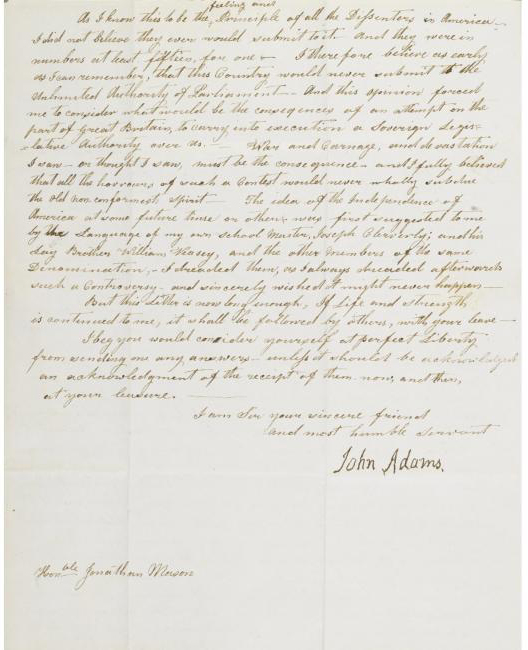
John Adams Reflects Upon the Real Causes of the American Revolution — “…what would be the consequences of an attempt on the part of Great Britain, to carry into…Authority over Us…War and Carnage, and devastation I saw – or thought I saw must be the consequence – and I fully believed that all the horrours of such a Contest would never wholly subdue the old non-conformist Spirit…” — Extraordinary and Moving Letter on the Indefatigable Spirit of the American Colonists
Exceptionally stirring and important letter signed by John Adams almost 50 years after the American Revolution, after which enough time had passed that Adams felt compelled to correct the record about the true causes of the American Revolution. Addressed to Jonathan Mason of Boston, letter is dated 31 August 1820 from “Montezillo”, Adams’ playful comparison to Jefferson’s larger estate at Monticello. In this letter, Adams posits that the fear and hatred of heirarchy, especially in matters of religion by The Church of England, were the wellspring of revolution, rather than simple economic or social issues. In part, “…The real principles, Motives, and feelings which gave rise to the Revolution have been very superficially and imperfectly investigated. For one example among many, The dread of the Hierarchy; and of the high principles in Religion and government; which then prevailed in the Church of England and which were more openly and dogmatically professed and asserted in America than in England itself – Are not sufficiently known, and have not been sufficiently considered. – Indeed it is almost impossible to convince at this day, any young Man; or even any middle aged Man of the extravagance to which those high doctrines were carried before the Revolution…And of the Authority of the Church in matters of Religion – yet these Doctrines, I heard asserted almost every day – The idea that such a Church, and such doctrines and such Hierarchy where [sic] to be established by Act of Parliament appeared to me worse than Death – As I know this to be the feeling and Principle of all the Dissenters in America – I did not believe they would submit to it…I therefore believe as early as I can remember, that this Country would never submit to the Unlimited Authority of Parliament – And this opinion forced me to consider what would be the consequences of an attempt on the part of Great Britain, to carry into execution a Soverign Legislative Authority over Us. – War and Carnage, and devastation I saw – or thought I saw must be the consequence – and I fully believed that all the horrours of such a Contest would never wholly subdue the old non-conformist Spirit…” Signed boldly and clearly “John Adams”. Two page letter with integral franked address leaf measures 8″ x 10″. Minor loss from seal tear on address leaf, else near fine. Housed in a light blue cloth folding case, with the blue morocco spine lettered gilt. Sold for $45,000.
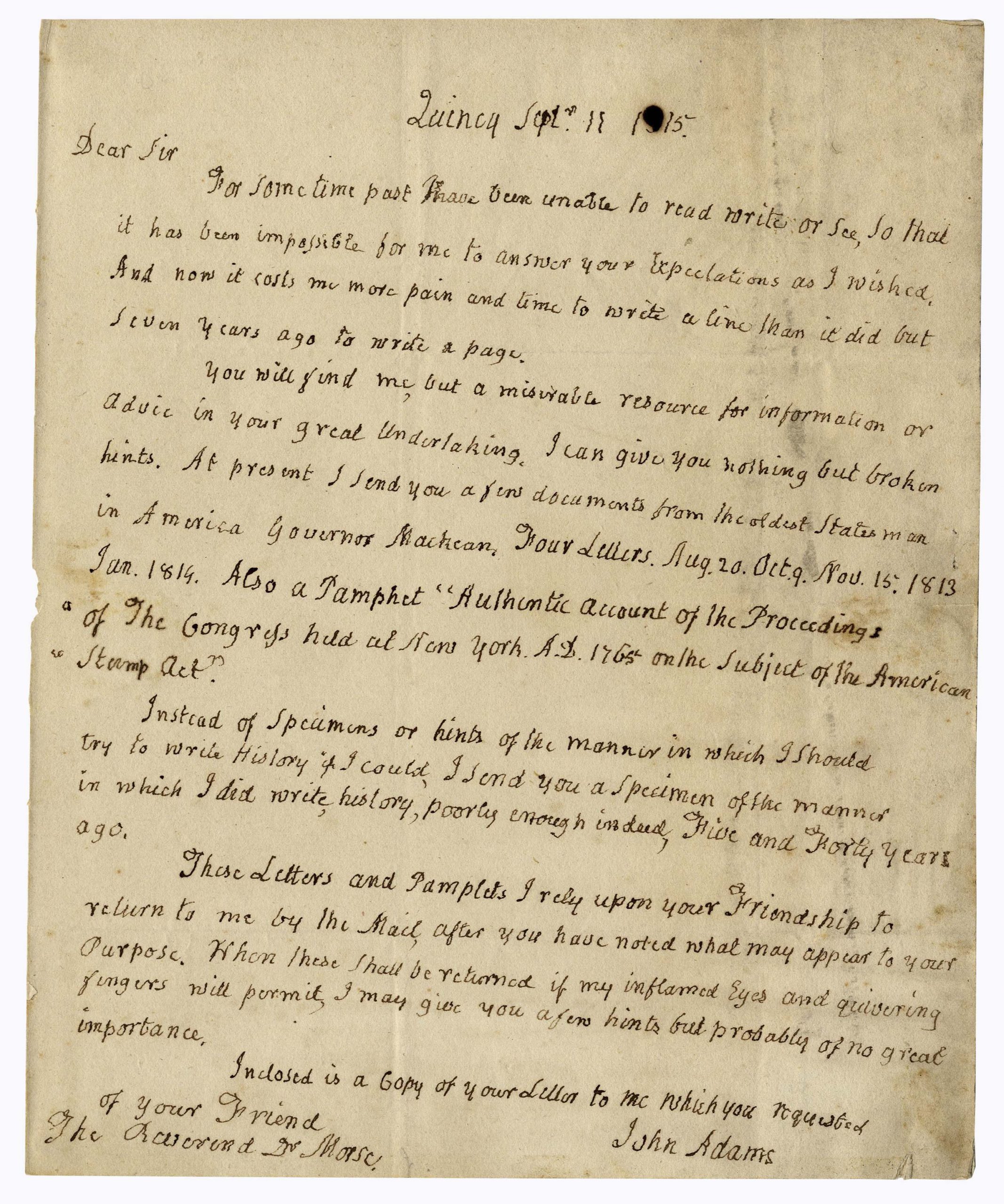
John Adams Autograph Letter Signed Re the Stamp Act
John Adams autograph letter signed “John Adams”, regarding the Stamp Act Congress, the colonists’ response to the infamous Stamp Act of 1765. This Act was one of the first legislative measures passed by Great Britain that taxed the colonists, an act which set in motion events leading to the Revolutionary War 10 years later. Adams writes to Jedidiah Morse regarding Morse’s work, “Annals Of The American Revolution”, an important record of the Revolution published in 1824, and refers to his role in the Revolution, “Five and Forty years ago”. From his home in Quincy, Massachusetts on 11 September 1815, Adams writes, “For some time past I have been unable to read or write or see, so that it has been impossible for me to answer your Expectations as I wished. And now it costs me more pain and time to write a line than it did but seven years ago to write a page. You will find me but a miserable resource for information or advice in your great Undertaking. I can give you nothing but broken hints. At present I send you a few documents from the oldest States man in America Governor Mackean, Four Letters Aug. 20. Oct. 9. Nov. 15, 1813 Jan. 1814. Also a Pamphet [sic] ‘Authentic account of the Proceedings of The Congress held at New York. A.D. 1765 on the Subject of the American Stamp Act.’ Instead of Specimens or hints of the manner in which I should try History if I could, I send you a Specimen of the manner in which I did write, history, poorly enough indeed, Five and Forty years ago. These Letters and Pamphlets I rely upon your Friendship to return to me by the Mail, after you have noted what may appear to your Purpose. When these shall be returned if my inflamed Eyes and quivering fingers will permit, I may give you a few hints but probably of no great importance…John Adams”. Single page letter measures 8″ x 9.75″. With integral address leaf written in another hand. Light soiling and small paper loss from seal, otherwise near fine condition given age. Accompanied by an engraving of Adams for framing, and housed in attractive custom clamshell case lettered in gilt on the front. Sold for $10,200.

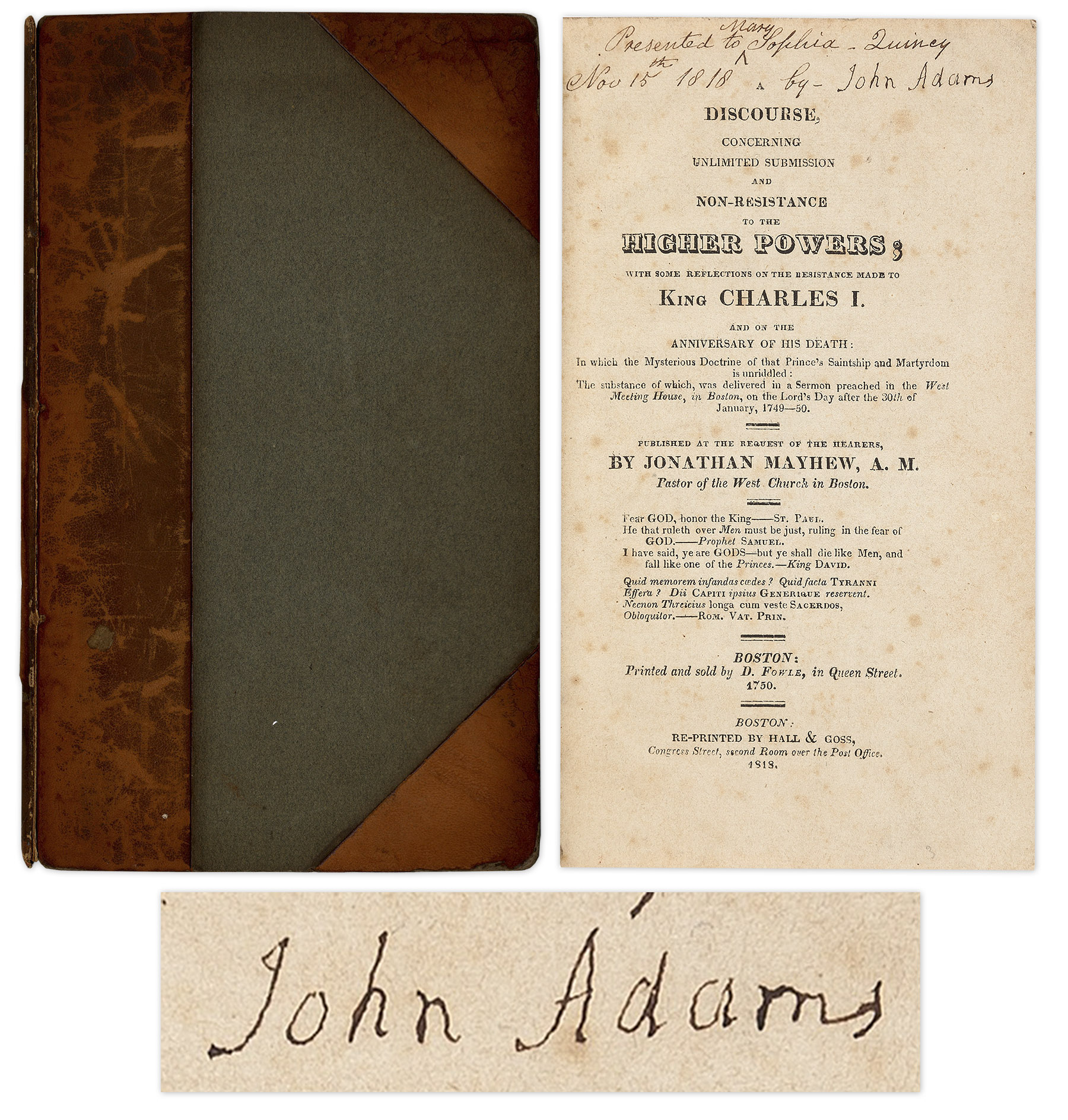
John Adams Signed Copy of “A Discourse” — The Powerful Pro-American Independence Book Called “The Morning Gun of the Revolution”
John Adams signed copy of “A Discourse, Concerning Unlimited Submission and Non-Resistance to the Higher Powers”. Boston: Hall & Goss, 1818. Signed “John Adams” on 15 November 1818 to Mary Sophia Quincy, the daughter of Josiah Quincy III, mayor of Boston and President of Harvard University, and a relation of Adams on his wife’s side.
Written by minister Jonathan Mayhew who coined the phrase “No taxation without representation,” “A Discourse” was one of the central publications advocating for American independence from Great Britain. Originally published as a sermon in 1749 on the 100th anniversary of King Charles I’s execution, Mayhew argues that recent revisionist history of Charles as martyr was misguided and that execution of the King was just if the monarchy infringed upon the essential liberties of its citizens. John Adams stated that Mayhew’s sermon was “read by everybody” at the time America declared her independence; it was also called “the morning gun of the Revolution,” providing the moral rationale for armed resistance.
Inscribed in another hand on the title page, reading, “Presented to Mary Sophia Quincy / Nov 15th 1818 by -” after which Adams signs his name, “John Adams’. Bound in three-quarter leather with gilt titling to spine. Measures 5″ x 8.5”. Some scuffing to leather, professional repair to boards, and foxing to signature page. Overall very good plus condition. One of the most important books underpinning the American Revolution, signed by one of its most important patriots. Sold for $8,400.
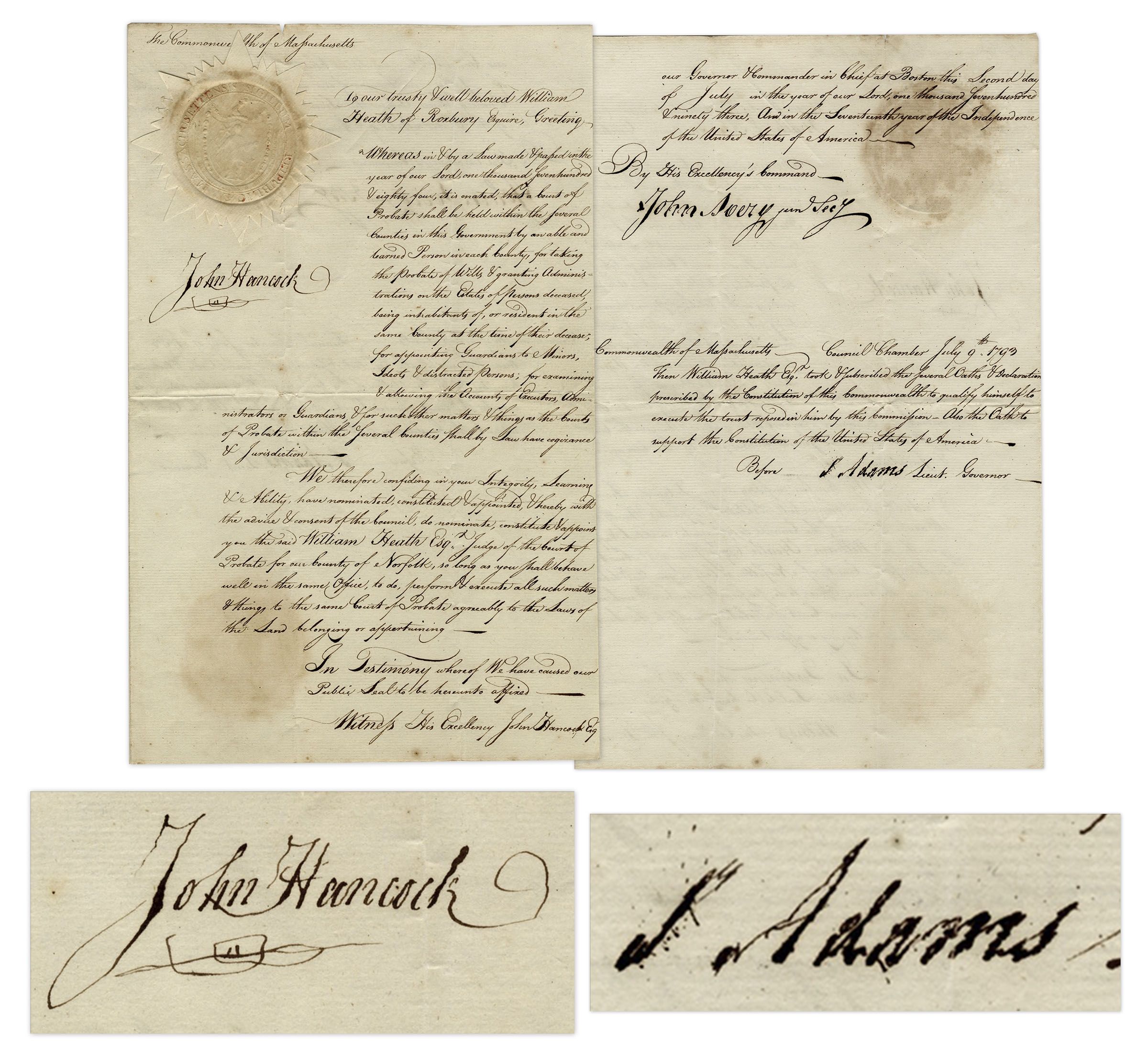
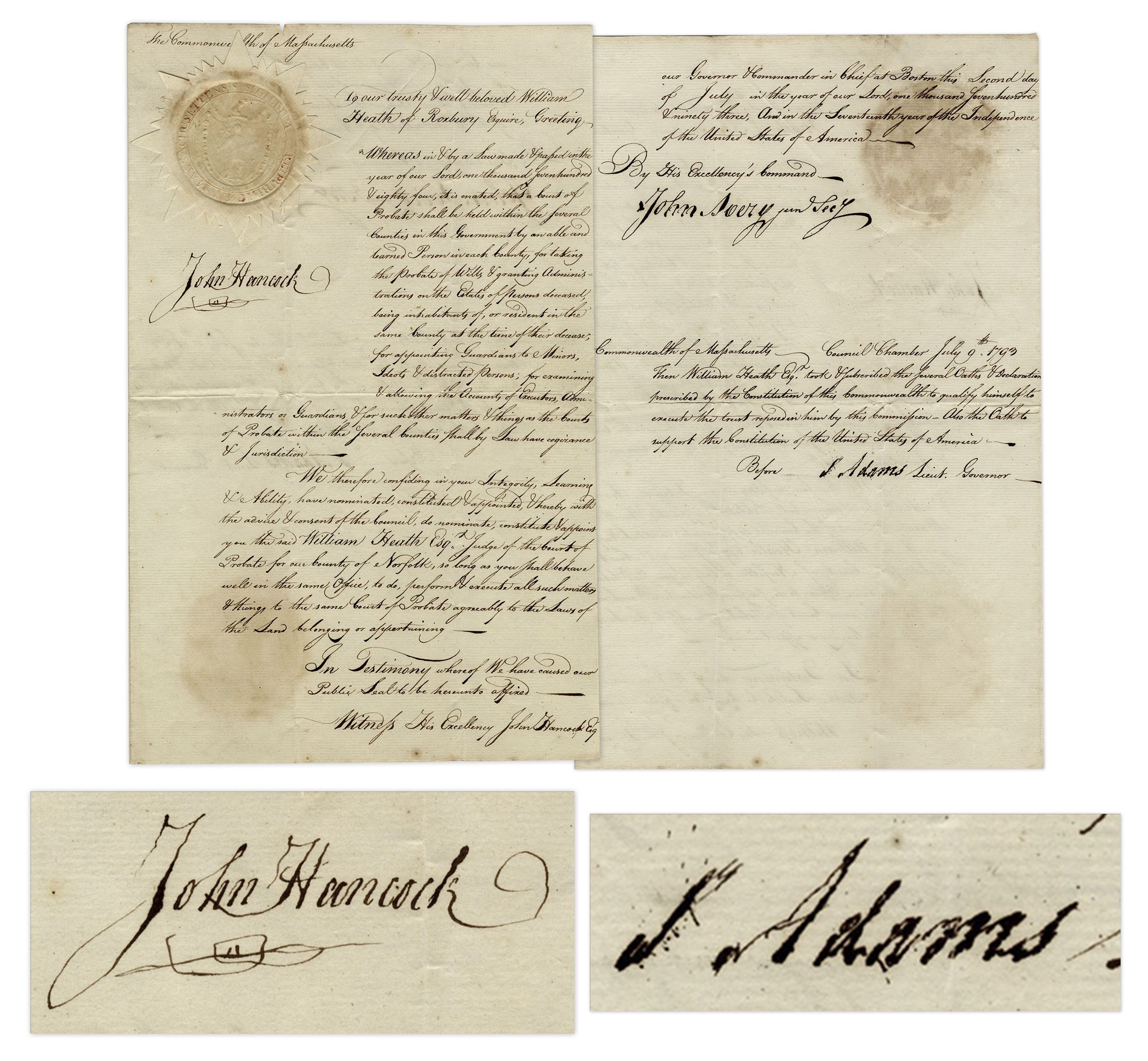
John Hancock & Samuel Adams Signed Judicial Appointment From 1793
John Hancock and Samuel Adams dual-signed judicial appointment, signed as Massachusetts Governor and Lieutenant Governor, respectively. Document appoints William Heath Esq. as Judge of the Court of Probate for Norfolk County, Massachusetts on 9 July 1793. Hancock boldly signs ”John Hancock” underneath seal, with his familiar paraph below signature. Adams signs ”S Adams” to verso of document. Measures 8” x 12.5” on one sheet. Folds, light toning and spotting. Ink remains very bold and legible. In very good to near fine condition given age. Sold for $6,250.
Samuel Adams Signed Military Appointment From 1794
Samuel Adams military document signed as Governor of Massachusetts, dated 11 September 1794. Adams appoints Abiah Bliss Jr. as Lieutenant in the Militia of the Massachusetts Commonwealth. Elegantly signed ”Samuel Adams” below the seal on the left side, countersigned by John Avery, Jr. as Massachusetts Secretary. Measures 15.75” x 12.25”. Separation starting along folds and small chips to margin. Overall very good condition. Sold for $3,000.


Samuel Adams 1795 Document Signed as Governor of Massachusetts
Document signed ”Samuel Adams” as governor of Massachusetts, dated 16 June 1795. Partially printed ”Commonwealth of Massachusetts” document appoints a Joshua Thomas a Justice of the Court in the county of Plymouth. Document is signed ”Samuel Adams” clearly along the left side. Measures 9.5” x 15.5” with splitting at folds and some closed tears throughout. Good condition overall which will frame very nicely. Sold for $1,934.


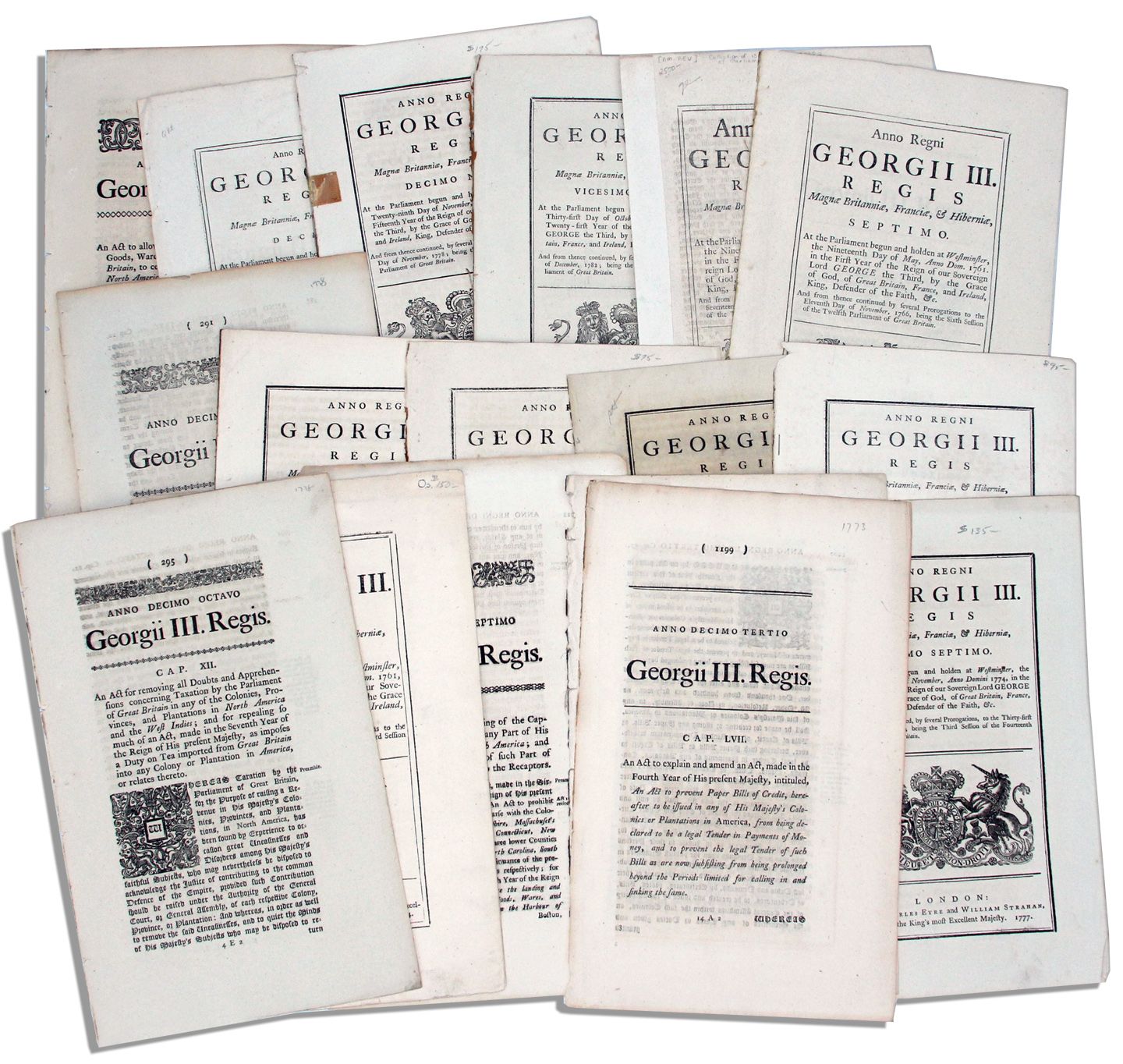
Extensive collection of 21 British Acts of Parliament spanning the American Revolution from start to finish, all pertaining to policy toward the dissenting American colonies. Acts were published by Charles Eyre and William Strahan: Printers to the King’s Most Excellent Majesty: London 1766-1783, and are quite rare, as they were only printed for members of Parliament, officers of state, and the judiciary. In chronological order, collection includes: (1) Stamp Tax Act of 1766 running 4pp.; (2) 1767 Act governing duties in the plantations of America running 14pp.; (3) 1770 Act enabling New York to pass an act of assembly, 2pp.; (4) 1771 Act creating a bounty upon the importation of White Oak casks running 7pp.; (5) 1773 Act to explain and amend a previous act concerning paper bills of credit, 4pp.; (6) 1773 Act for importing salted beef, pork, bacon and butter from America, 2pp. The acts take a dramatic turn once bullets were fired at Lexington and Concord in 1775: (7) 1775 Act to restrain trade and commerce between the Colonies and Great Britain, 9pp.; (8) 1776 Act granting His Majesty a certain sum of money running 24pp.; (9) 1776 Act limiting the liberty to carry rice throughout America, 7pp.; (10) 1777 Act to continue allowing exportation of wheat, 2pp.; (11) 1777 Act to authorize the carrying of captives, 4pp.; (12) 1778 Act to repeal an earlier act for regulating the government of Massachusetts, 2pp.; (13) 1778 Act to amend earlier act relating to American sugar plantations, 4pp.; (14) 1778 Act removing all doubts concerning taxation in the Colonies, 2pp.; (15) 1779 Act concerning various dealings with the United States of America, 5pp.; (16) 1780 Act allowing exportation of goods, wares and merchandise to North America, 6pp.; (17) 1781 Act to explain a previous act, 2pp.; (18) 1782 Act to prevent enemies from being supplied with ships from Great Britain, 5pp.; (19) 1783 Act to continue laws relating to regulating fees, 4pp.; (20) 1782 Act concerning prize and bounty money not claimed, 4pp.; and finally, (21) 1783 Act to enable His Majesty to conclude a peace or truce with the America Colonies. Acts are printed on sheets measuring 7.5” x 11.5”. Mild foxing, toning and staining, and some contemporary stapling, else near fine. Sold for $916.
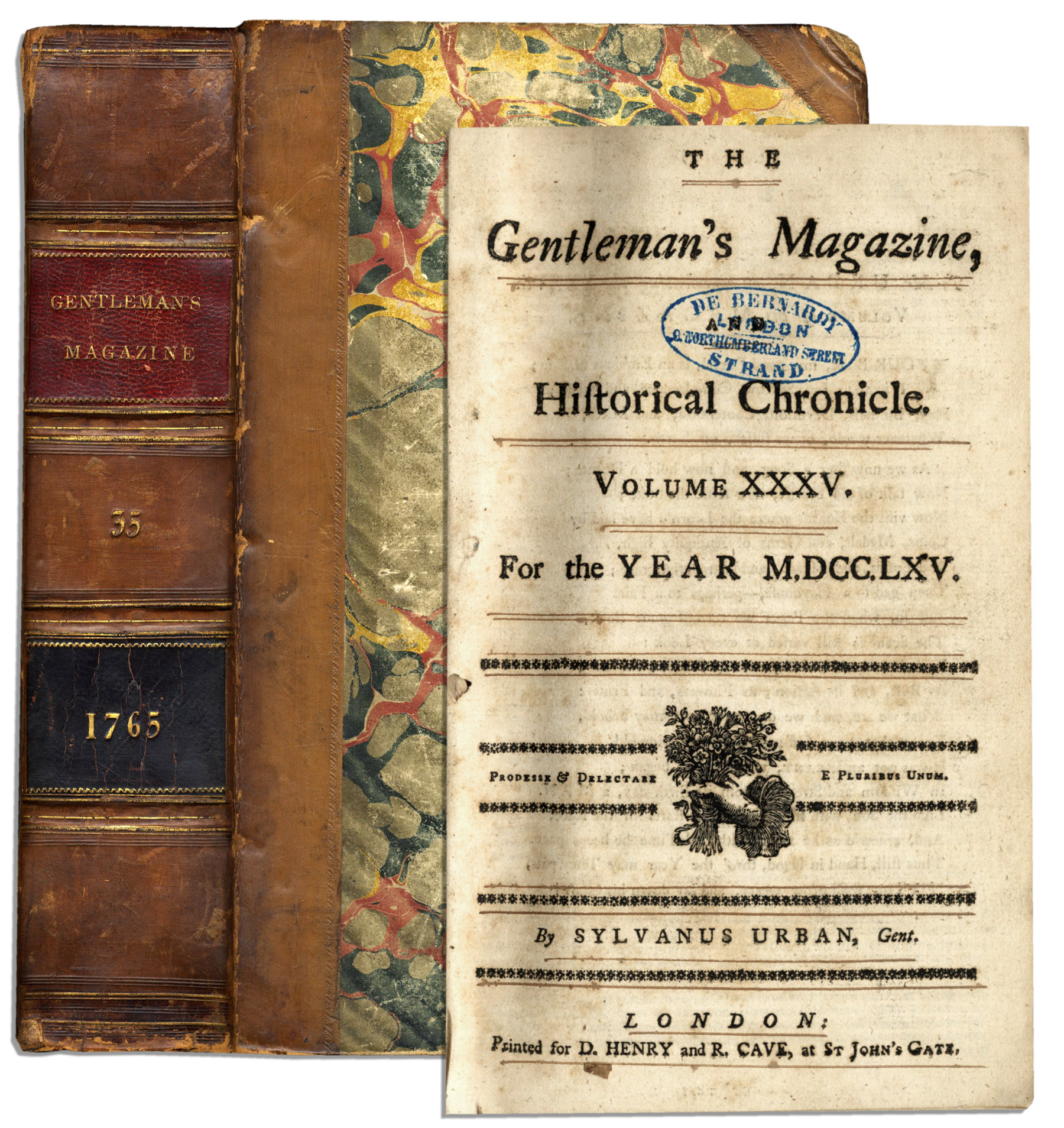
‘Gentleman’s Magazine, Historical Chronicle” 1765 hardcover compilation of all twelve issues from that year. The first to use the term magazine, the monthly publication of the ”Gentleman’s Magazine” had originally debuted in 1731 and was an important source of news during the American Revolution. The preface to this 1765 collection states, ”…There is…scarce any Period of Time in which the Prerogative of the Crown, the Privileges of Parliament, and the Liberties of the People, have been more full discussed…” Tensions between Great Britain and the American colonies were high at this time, due in large part to Parliament’s continued attempts to tax the colonies. Already opposed to the 1764 sugar tax, colonists were united in their resistance to the Stamp Act, passed in March 1765 and announced in the March issue. ”…Lord Mansfield, as Speaker, and the Earls Gower and Marchmant, by virtue of a commission of his majesty, gave the royal assent…for laying a stamp duty in the British colonies in America…” The coordinated resistance to these taxes was a major step toward revolution. Growing discontent is palpable in later issues, especially December, which contains: ”The Grievances of the American Colonies candidly examined” and ”The Importance of the N. American Colonies considered”. Other news includes advances in agriculture, medicine and science, religious controversy, stories of crime and writings of Voltaire, with illustrations of British homes, mechanical drawings of the centrifugal engine and maps. Moderate edge wear to 5.5” x 8.25” marble boards, bound with a leather spine lettered in gilt. Binding loosened from volume; foxing and toning to some pages but generally bright. Overall very good condition. Sold for $550.
Consign your item at Nate D. Sanders Auctions. Send a description and images to us at [email protected].
FREE APPRAISAL. To appraise, auction, buy, consign or sell your Stamp from the Stamp Act of 1765 that is for sale, please email your description and photos of your Journal of a Stamp from the Stamp Act of 1765 to [email protected] of Nate D. Sanders Auctions (http://www.NateDSanders.com).