
Sell or Auction Your Scourged Back CDV C Seaver Jr Boston for up to Over $25,000 or More at Nate D. Sanders Auctions
FREE VALUATION. To buy, auction, sell or consign your The Scourged Back CDV C Seaver Jr Boston that is for sale, please email your description and photos to [email protected] of Nate D. Sanders Auctions (http://www.NateDSanders.com).
Sell Your The Scourged Back CDV C Seaver Jr Boston


Below is a recent realized price for a Scourged Back CDV published by C Seaver Jr Boston. We at Nate D. Sanders Auctions can obtain up to this amount or more for you:
The Scourged back CDV C Seaver Jr Boston. Sold for Over $25,000.
Here are some related items we’ve sold:
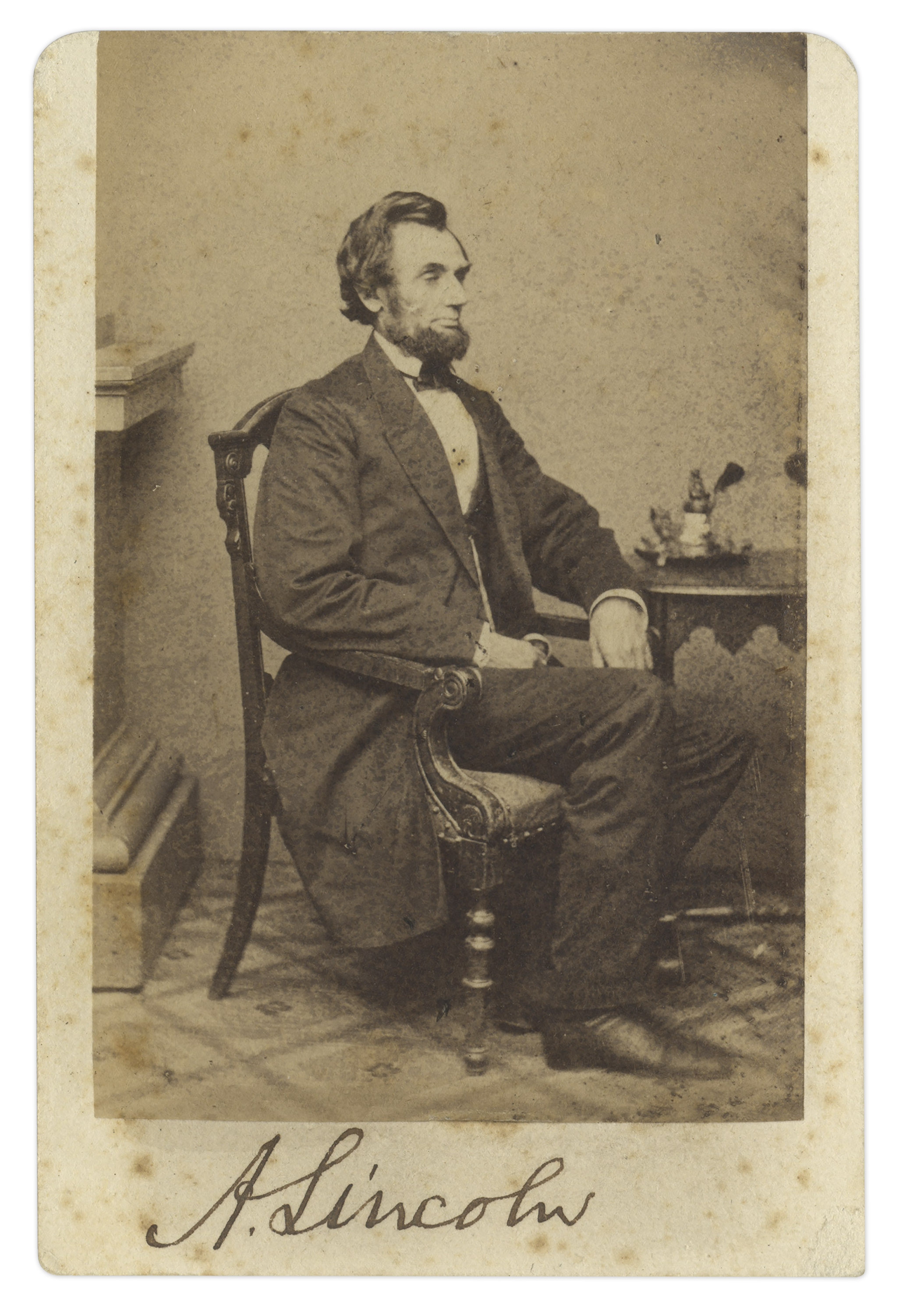
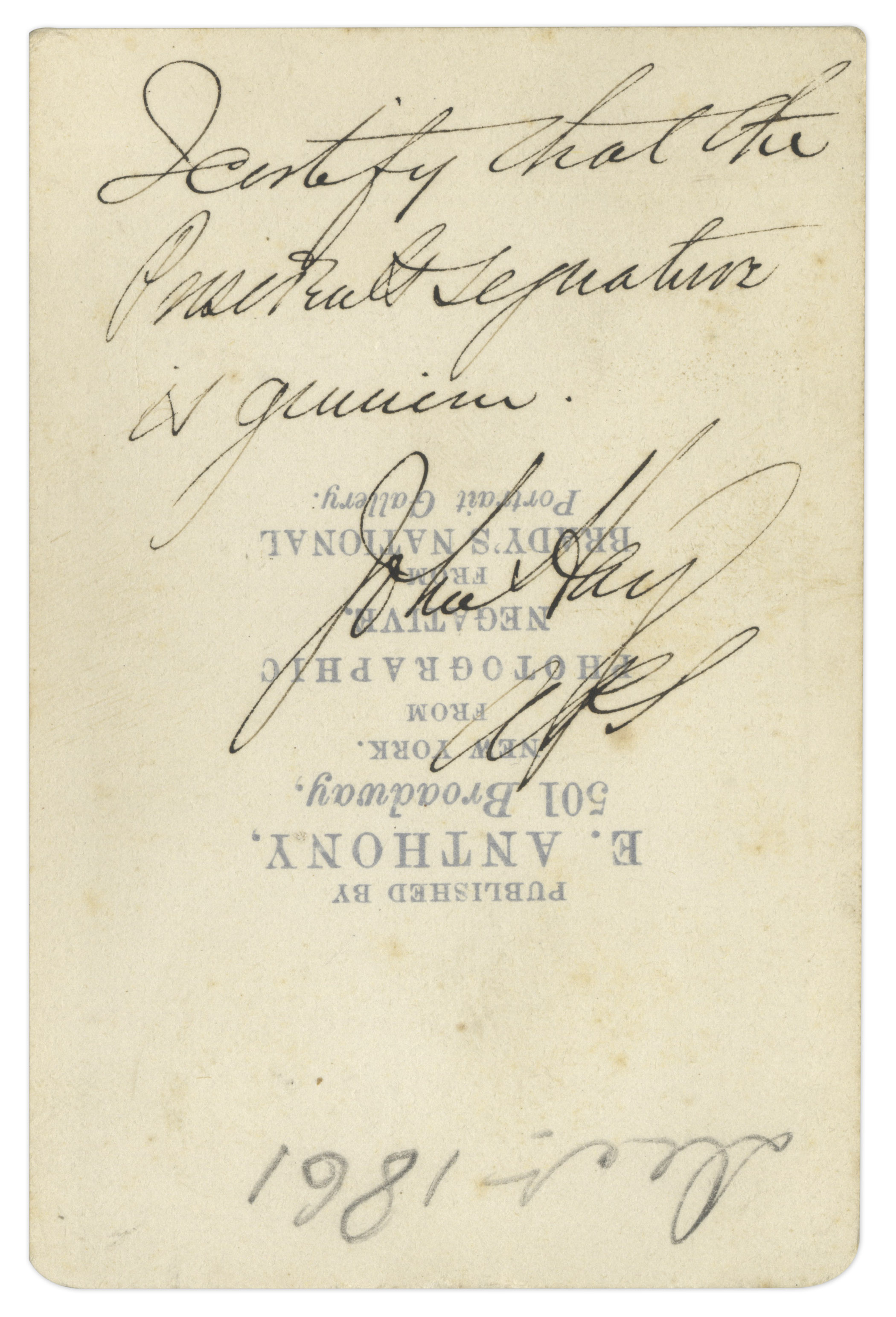
Abraham Lincoln Signed CDV as President — John Hay Certifies Signature as Authentic on Verso
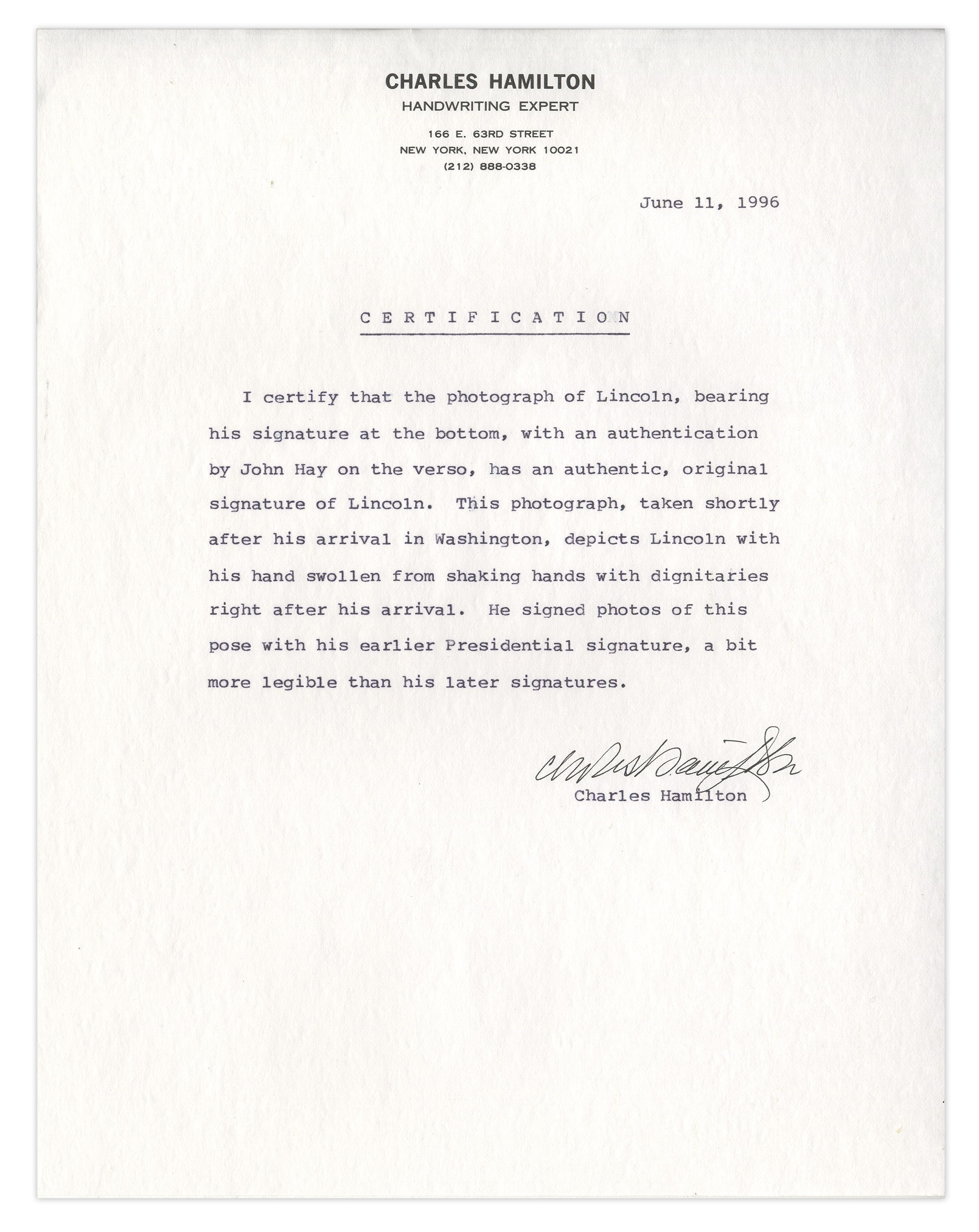
Exceptionally rare Abraham Lincoln signed carte-de-visite photograph, taken by Alexander Gardner in 1861 and signed as President. Signed ”A. Lincoln” below the seated portrait of Lincoln. John Hay, Lincoln’s private secretary, authenticates the signature upon the verso by writing, ”I certify that the President’s signature is genuine / John Hay”. With ”Brady’s National Portrait Gallery” backstamp. Measures 2.5” x 3.75”. Very good with some foxing and wear, but with a strong signature by Lincoln. With provenance from Profiles in History and with a COA from Charles Hamilton. Sold for $49,913.
Extraordinary collectible from the Presidency of Abraham Lincoln, a personally owned and used pen by Lincoln, given to him during his service as President. Steel-nib fountain pen, lightly worn from use, is evocative and notable for the gold-colored star pattern upon its barrel, calling forth the patriotic Union sentiment at the heart of the Civil War, clearly intended to inspire the President and reminding him of the War’s noble and patriotic purpose.
Pen (not including ink cartridge) measures 7.25” long. Light scratching to the nib from use, and some light rubbing to the barrel. Overall in near fine condition, an evocative piece from Abraham Lincoln, likely used for importance during the Civil War. Sold for $41,250.


Important Civil War letter signed by President Abraham Lincoln, exactly one week after the disastrous Battle of Fredericksburg that left Lincoln in ”a worse place than hell” upon hearing the results of the ”butchery” of Union forces. The hope of taking the Confederacy’s capital of Richmond had been stymied yet again, and criticism of Lincoln’s handling of the war reached such a pitch that there was even serious consideration of removing him as Commander-in-Chief. In this letter, written to Major Generals William B. Franklin and William F. Smith, Lincoln responds to another possible plan of how to approach the city, presented by the Generals (see lot 135 for Franklin and Smith’s plan). General Franklin, in particular, was likely trying to fix the problem of capturing Richmond, as his command of the Left Grand Division during the Battle of Fredericksburg had been criticized in some quarters; Lincoln, however, views this new plan with skepticism and even issues a mild rebuke at the end of the letter, for what seems to be an inconsistency in Franklin’s recommended strategy. Single page letter is written in the hand of Lincoln’s secretary John G. Nicolay, boldly signed by Lincoln at the conclusion. On bifolium stationery measuring 7.875” x 9.875”. Fold lines, else near fine condition. Sold for $40,000.

Abraham Lincoln Autograph Letter
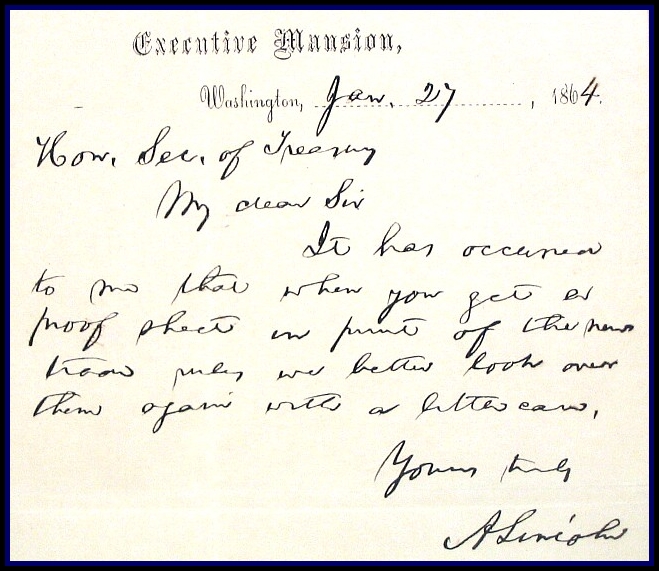
Abraham Lincoln signed autograph letter to Salmon P. Chase, the Secretary of the Treasury. Written the year Lincoln’s second term began, the letter refers to the “Reconstruction” plan Lincoln was in the process of executing. The plan called for protectionism, arguably a more immediate cause of the American Civil War than the abolition of slavery. In 1864, before the war ended, Abraham Lincoln raised trade taxes to the highest level they had ever reached to cripple the South, while the southern states were pro-free trade. On 8 December 1863, Lincoln announced his reconstruction program during his Annual Message to Congress. The only person who objected to this message was Sec. Chase. Here, Lincoln mentions looking over the trade rules again with Chase to hurt the Confederacy. Reads in full: “Executive Mansion, Washington, Jan. 27, 1864/ Hon. Sec. Of Treasury/ My dear Sir/ It has occurred to me that when you get a proof sheet in print of the new trade rules we better look over them again with a little care/ Yours truly / A(braham) Lincoln (signed).” Folds showing, two small spots on right margin, otherwise nicely matted in 10.5″ x 13.5″ frame. Mint. An excellent Abraham Lincoln signed autograph letter. Sold for $32,548.
Fascinating autograph letter signed by Abraham Lincoln in 1859, an unpublished letter written to Lincoln’s close associate Norman B. Judd, the Republican State Chairman of Illinois at the time. Lincoln discusses a plan to reach German voters in the state via the purchase of a printing press that would ostensibly print literature in German, saying he’s in favor of the plan if it would cost no more than $400 – ”we seem to be gaining with the Germans; and perhaps it is right to press our own luck while it runs favorably”.
From Springfield on 29 April 1859, Lincoln writes in full, ”Dear Judd / The letter on the other half of the sheet comes to me, as you see, from Shawneetown, and I suppose I know who wrote it, although it is not [?] I confess the scheme does not strike me favorably; but as I suppose the author of it to be true friends, they are entitled to a respectful hearing and consideration – Think of it, and write me what you think – Another matter you remember it was said last winter that the press and type for a German paper was here, and could be bought for four hundred dollars, and Gov. [Gustav Philip] Koerner and one or two other German friends were deputed to enquire and decide whether it would be [in] our interest to buy them. – I believe they decided in the affirmative. – Dr. Canissius resides here now, and this morning he showed me a letter from Gov. Koerner, expressing a wish that the thing may be done. – If the thing can be started for four hundred dollars, and then kept going without more, I too think it ought to be done. By our recent elections here, we seem to be gaining with the Germans; and perhaps it is right to press our own luck while it runs favorably.- But I suppose it would be better done by the Central Committee; and if they think proper to do it, I suppose the money could be raised here, on their checks.- I will pay fifty dollars any day you draw. Think of this too. Yours &, A. Lincoln”.
As evidenced by this letter, Lincoln and Judd were close allies at this time. It was a year earlier that Judd had proposed the idea that Lincoln should debate Stephen Douglas on the issue of slavery, catapulting Lincoln to national prominence. And it would be Judd who, a year later, nominated Lincoln for President at the Republican National Convention in Chicago – the city selected by Judd so that Lincoln would have an advantage over the other contenders, even going so far as arranging the seating chart so that anti-Lincoln men were in the back of the convention hall. Single page letter measures 7.75” x 9.875”. Mounting remnant to one corner on verso, and restoration along fold on verso. Also an ink blot at bottom in what looks to be a fingerprint. Writing remains bold, overall very good plus condition. Sold for $25,000.

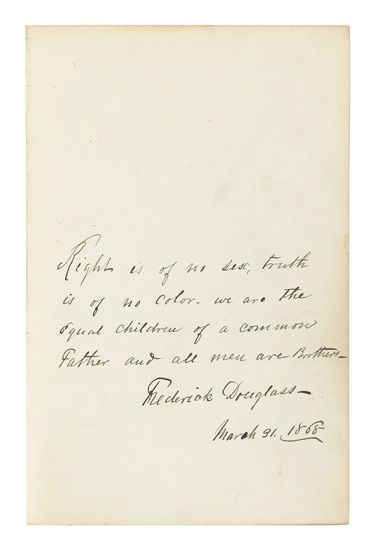
Frederick Douglass Autograph Quotation Signed — “Right is of no sex, truth is of no color. We are the equal children of a common Father and all men are Brothers” — With 30+ Signatures of 19th Century Abolitionists
Inspiring collection of signatures by 19th century abolitionists, with the crown jewel being an autograph quotation signed by Frederick Douglass, “Right is of no sex, truth is of no color. We are the equal children of a common Father and all men are Brothers – Frederick Douglass – March 31, 1868”. Album contains about 35 other signatures. Album is very worn with front board detached and backstrip missing. Some dampstaining present on front and rear blank pages. Page signed by Douglass is near fine with only toning to margins. Sold for $8,800.
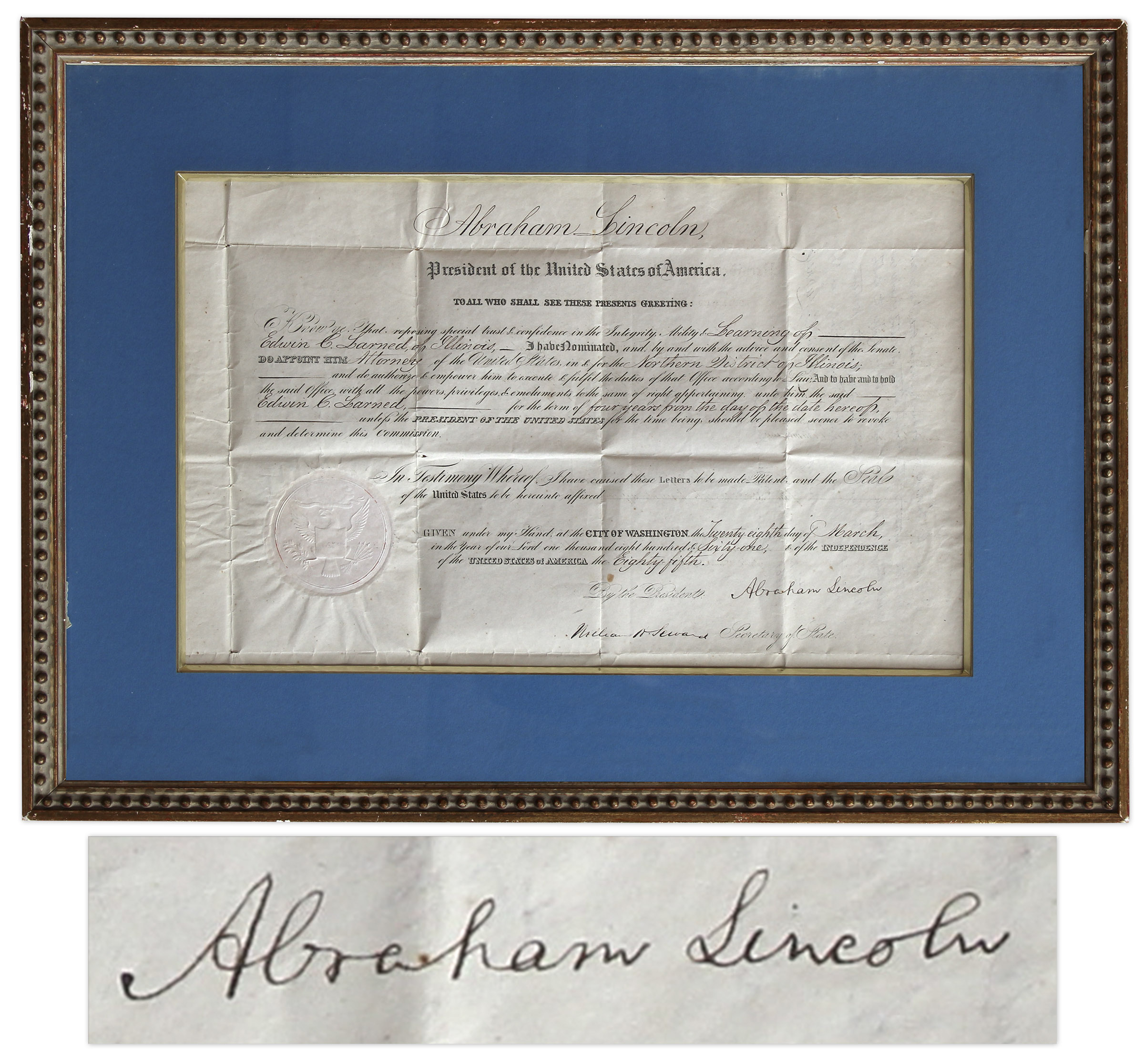
As President, Abraham Lincoln signs his full name in black ink to a document, appointing Edwin C. Larned as ”Attorney of the United States in & for the Northern District of Illinois” on 28 March 1861. Lincoln entered office just 24 days prior, on 4 March 1861, and the Civil War would break out 15 days later. Larned was an anti-slavery public speaker and personal friend of Lincoln. Document is co-signed by William H. Seward, Secretary of State, and retains its Presidential paper seal at lower left. Document measures 15.5” x 9.5”, framed to 20.5” x 15.5”. Minor holing at fold intersections, otherwise near fine with a bold signature by Lincoln. Sold for $7,500.
Three Former Slaves Ask to be Discharged From Civil War Service — Extremely Rare Letter
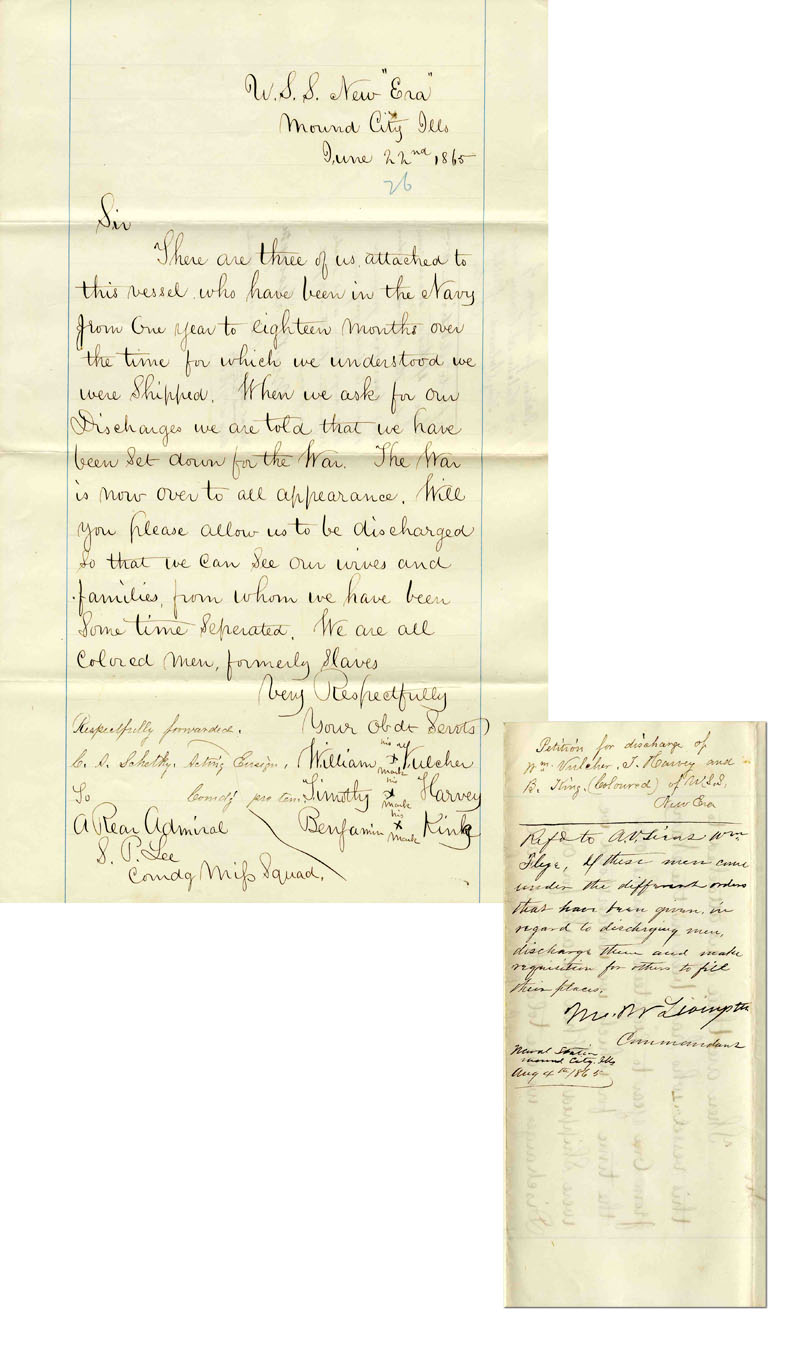
Very good 1865 letter signed with an “X” mark by three former slaves, asking to be emancipated now from service in the U.S. Navy during the Civil War. Letter dated 22 June 1865 reads in full, “U.S.S. New ‘Era’ / Mound City Ills / June 22nd 1865 / Sir, There are three of us attached to this vessel who have been in the Navy from one year to eighteen months over the time for which we understood we were shipped. When we ask for our discharges we are told that we have been set down for the war. The war is now over to all appearance. Will you please allow us to be discharged so that we can see our wives and families from whom we have been some time separated. We are all colored men and formerly slaves. / Very Respectfully / Your Obdt Servants / William Vulcher / Timothy Harvey / Benjamin King”. Letter is signed by what looks like Acting Ensign Schelky, who forwards the letter to Admiral S.P. Lee. With docketing on verso granting their request, “petition for discharge of Vulcher, Harvey and King (coloured) of USS New Era / Refd to lt Wm Flye (previous officer and captain off USS Monitor) if these men came under different orders that have been given in regard to discharging men. Discharge them and make requisition for others to fill their places. Livingston Commander Naval station Mound City Ills Aug 4th 1865”. Letter has toning and folds, else near fine. Sold for $5,910.
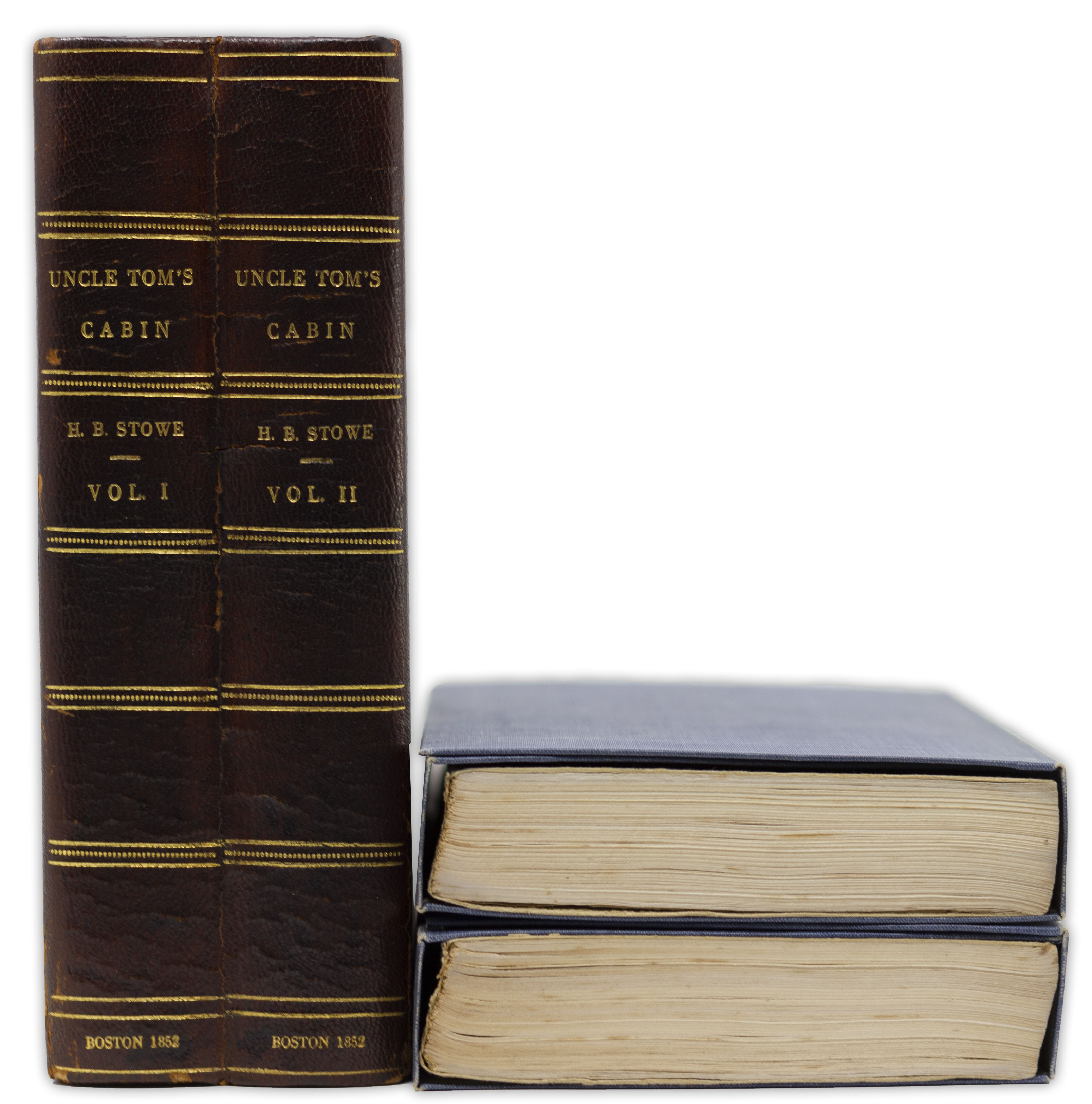
First Edition, First Printing of “Uncle Tom’s Cabin”
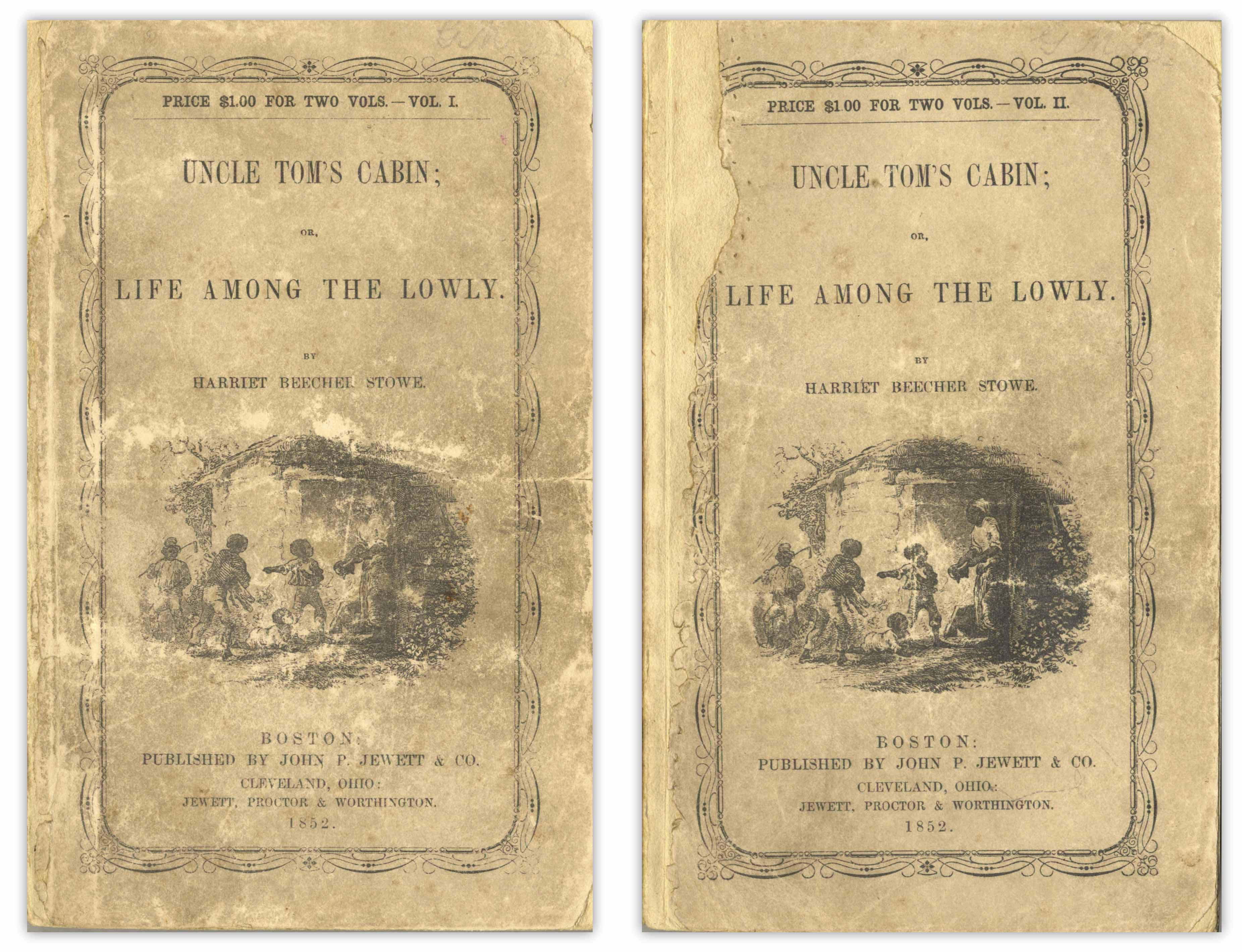
Extraordinarily scarce first edition, first printing of Harriet Beecher Stowe’s ”Uncle Tom’s Cabin”, in the publisher’s wrappers binding ”A”, the rarest of the three variants of the first printing. Boston: John P. Jewett, 1852. Two volumes, as issued, with three plates in each volume by Hammett Billings, priced at $1.00 for both volumes. All other first printing points are present: ”spilt” instead of ”spiled” on page 42, line 1 of Vol. I; ”cathecism” instead of ”catechism” on page 74, line 5 of Vol. II; no attribution to Billings for the engravings; no other printings designated on the title page of either volume; with the following statements on the copyright page: ”Entered according to Act of Congress, in the year 1851, by Harriet Beecher Stowe” and ”Stereotyped by Hobart & Robbins”.
Published on 20 March 1852 after first appearing in serialized form, the first printing of 5,000 copies of ”Uncle Tom’s Cabin” sold out within a few days, and the second printing by the end of March. Included in ”Books That Changed America”, the author Robert Downs stated of it, ”Within a decade after its publication Uncle Tom’s Cabin had become the most popular novel ever written by an American…there is substantial evidence that the book precipitated the American Civil War.” And from PMM, the catalog of the most influential books ever written: ”In the emotion charged atmosphere of mid-19th century America Uncle Tom’s Cabin exploded like a bombshell. To those engaged in fighting slavery it appeared as an indictment of all the evils inherent in the system they opposed; to the pro-slavery forces it was a slanderous attack on ‘the Southern way of life’…the social impact of on the United States was greater than that of any book before or since.”
Volumes measure 4.625” x 7.375” housed in blue clamshell cases and a custom slipcase. With provenance from famed dermatologist and collector Paul E. Bechet, with his library labels, causing shadowing to title pages. Spines of both volumes repaired, with some paper loss, more so on Vol. II with that back cover replaced. Light toning, wear and soiling. Overall a very good set. Sold for $5,750.
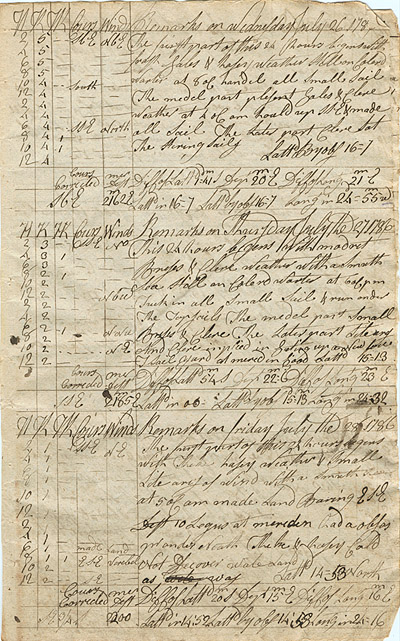
Slave Ship Log Triangle Trade 1784-89
Ships’ log for slave vessels out of Newport, Rhode Island during the Triangle Trade. 68pp. log for voyages in December 1784, July 1786, June 1787 and Feb. to April 1789. The voyages were complete, although the logs themselves are not. A record for the ships Louis, Louisa Ware, Betsey Ware and Calsey all under different masters. These ships sailed from Newport, Rhode Island to Africa to the West Indies. The ships were part of the Triangle Trade. Ships from Europe brought manufactured goods to Africa and the goods were traded for slaves. The slaves were brought back to the Americas and traded for raw materials molasses, timber, and later, tobacco and cotton. The raw materials were then shipped to Europe where they would be processed into manufactured goods. It was called a Triangle Trade because it followed a triangular route between Africa, the Caribbean and North America, and Europe. Eventually the trading route also distributed Virginia tobacco, New England rum, and indigo and rice crops from South Carolina and Georgia. A majority of the journal details weather, latitude and speed. There are minimal references to slaves but a more thorough reading may reveal more. The entries also place the boats in the areas of trade. “…on bord of the good ship called the Louisa Ware of is Master Robert Champling….Dep. From the Latt of 14:27 and Lang of 17:20 bound round the shores of Grandey for Cape mount so God send the good ships in safely…” “A jurnel or a log by Gods permishon on bord of good ship called the Louisa. Robert Champling master bound from the coast of Afraica towards the West Indes begun Dec. the 28, 1786 …” “A jurnel or a log by Gods permishon on bord of the good ship called the Louisa. Rob’t Champling master bound from the island of St. Tomas towards the West Indes Monday, January the 25th 1789 at 8 of pm track my dep’t from the island of St Thomas baring SSE Drift…” “Thursday, February 8, 1787…New Obj for this day one man slave died belonging to cargo being therein.” The Middle Passage was the most famous route of the triangular trade. This voyage carried Africans across the Atlantic Ocean. Captains of slave ships were known as either “loose packers” or “tight packers,” depending on how many slaves they housed in the space they had. However, most ships were “tight packers” (especially those in the 18th century) and life for the slaves on these ships was extremely uncomfortable. Slaves were taken from the holding forts, shackled together with leg-irons and carried to the ships in the dugout canoes. Once they were aboard, they were branded to show who owned them and their clothes removed. Slaves were housed in the ships as if they were cargo. Men were kept in chains while women and children were allowed to go free. It was common for about a third of the number on a ship to die before they reached the Americas. Fascinating log book in very good condition. Sold for $5,514.
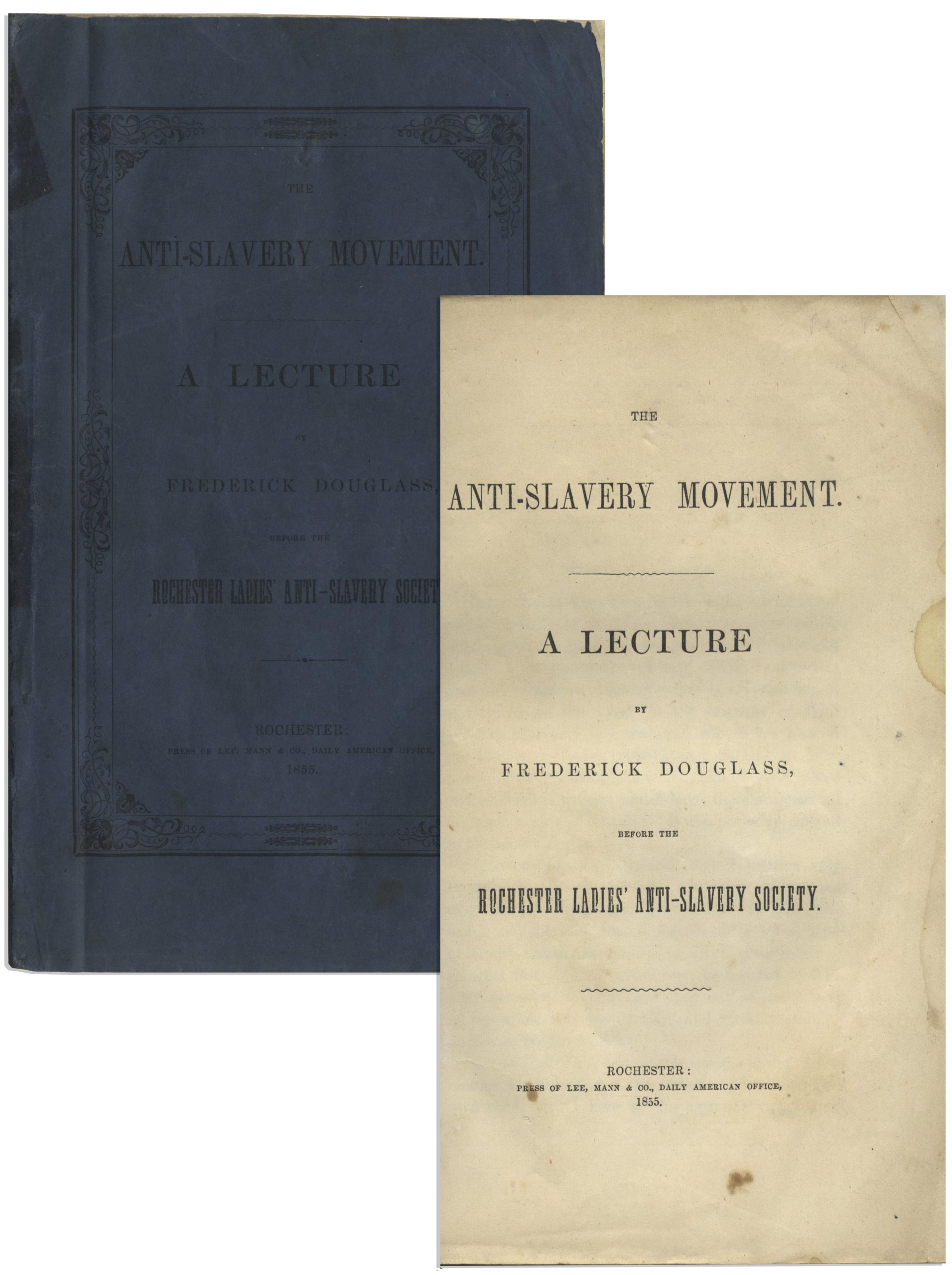
Anti-Slavery Movement, A Lecture, By Frederick Douglass
“The Anti-Slavery Movement, A Lecture, By Frederick Douglass, Before The Rochester Ladies Anti-Slavery Society.” Printed in 1855 in Rochester, New York, by the Press of Lee, Mann, and Co., Daily American Office. A name is written on the top of page 44. Measures 5 1/2″ x 8 13/16″. 48 pages. Restoration work on spine. Minor wear, foxing and staining on cover and interior pages and minor paper loss on the bottom of four pages. Very Good. Rare. Sold for $3,600.
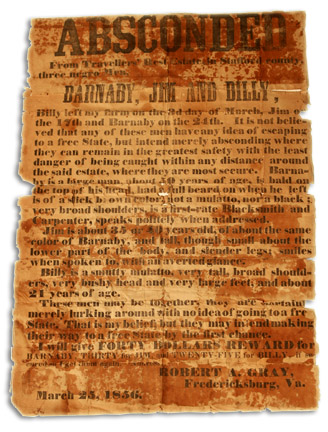
Very Scarce, Original 1856 Runaway Slave Poster — Large Broadside Measures 9″ x 12.75″
Original runaway slave poster, dated 25 March 1856 from Fredericksburg, Virginia. Poster reads in full: “Absconded from Traveller’s Rest Estate in Stafford county, three negro Men, Barnaby, Jim and Dilly…Billy left my farm on the 3d day of March, Jim on the 17th and Barnaby on the 24th. It is not believed that any of these men have any idea of escaping to a free State, but instead merely absconding where they can remain in the greatest safety with the least danger of being caught within any distance around the said estate, where they are most secure. Barnaby is a large man, about 50 years of age, is bald on the top of his head, had a full beard on when he left, is of a slick brown color, not a mulatto, nor a black; very broad shoulders, is a first-rate Blacksmith and Carpenter, speaks politely when addressed. Jim is about 35 or 40 years old, of about the same color of Barnaby, and tall, though small about the lower part of the body, and slender legs; smiles when spoken to with an averted glance. Billy is a…mulatto, very tall, broad shoulders, very bushy head and very large feet, and about 21 years of age. These men may be together, they are certainly merely lurking around with no idea of going to a free State. That is my belief, but they may in end making [sic] their way to a free state by the first chance. I will give forty dollars reward for Barnaby, thirty for Jim, and twenty-five for Billy…Robert A. Gray, Fredericksburg, Va.” Incidentally, Robert Gray’s estate, “Eastwood,” still stands in Fredericksburg and was used as a hospital during the Civil War. Poster has folding throughout, though expertly reinforced on verso. Fully intact poster, measuring 9″ x 12.75″, is in fair condition, typical of publicly displayed posters and broadsides from the time period. Very scarce. Sold for $3,000.
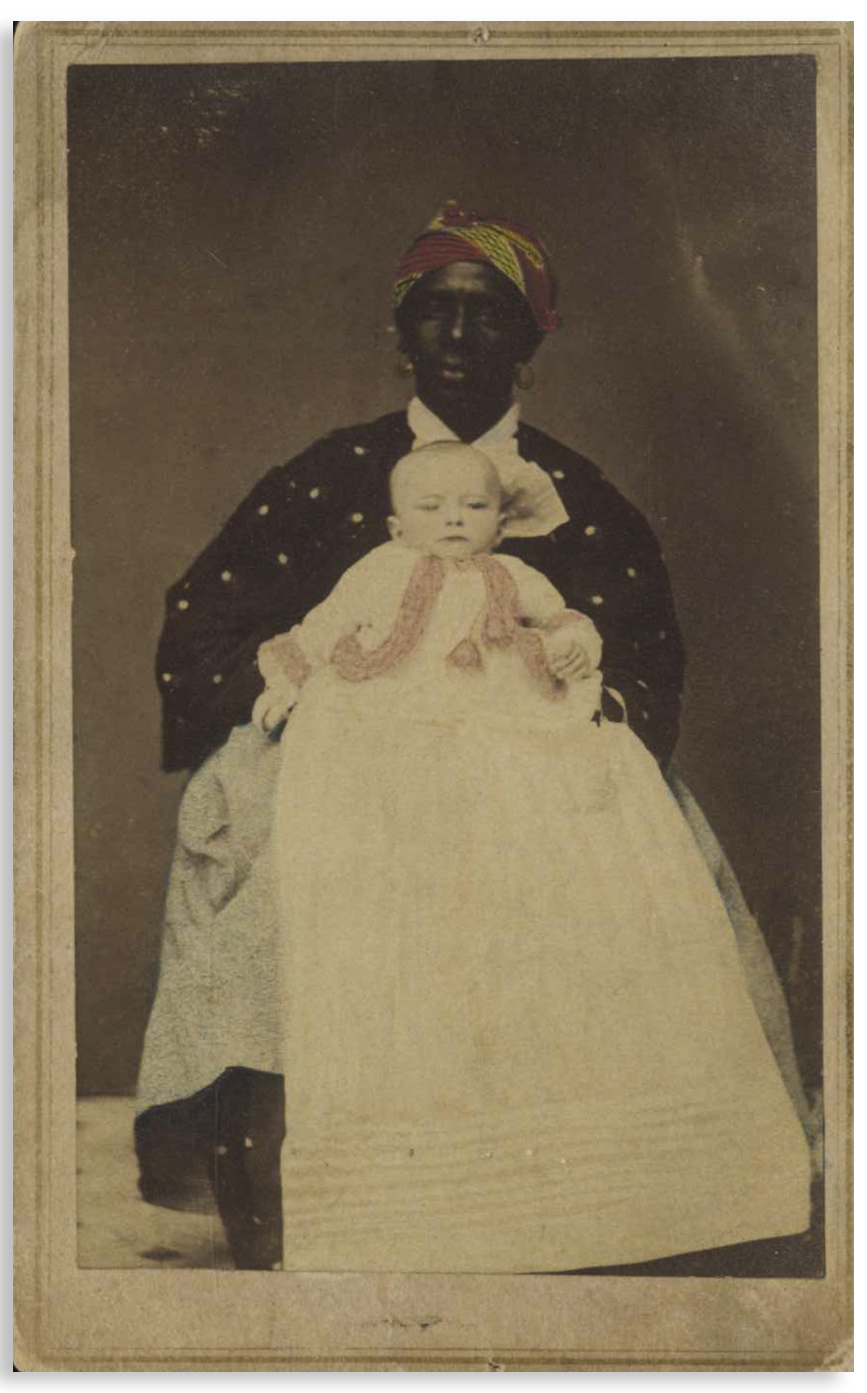
CDV Photograph of an 19th Century African American Wet Nurse From Savannah, Georgia
Rare CDV photograph of an African American wet nurse, posing with the child she cared for. With backstamp of J.N Wilson photography studio in Savannah Georgia on verso, who established his studio shortly before the Civil War; this photo is likely from the 1860s, evidenced by a light colored mount, square corners on the photo, and coloring to the photograph which was popular in the 1860s. CDVs such as this are uncommon, with wealthy families sometimes choosing to document the relationship between the African American wet nurse and her Causacian baby. With CDV number 2083 handwritten in pencil on verso. CDV measures 2.5″ x 4″. Mild wear and rubbing to mount, overall very good condition. Sold for $2,439.
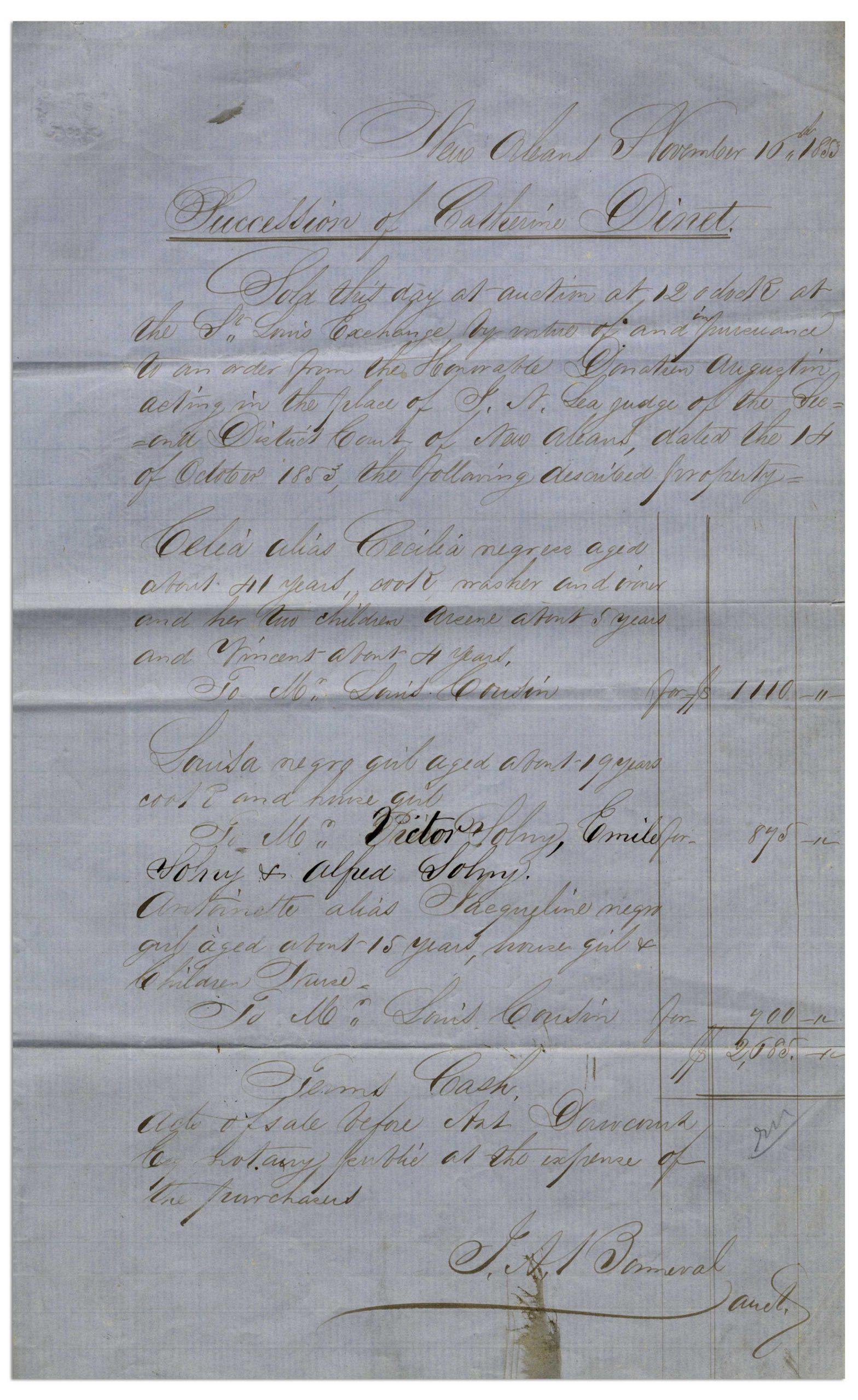
New Orleans Detailed Slave Auction Receipt From 1853
Bill of sale for several slaves purchased at an auction in New Orleans on 16 November 1853 at the St. Louis Exchange Hotel, a well-known spot for slave auctions at the time. Disturbing receipt lists the human beings sold, with their sale price, content contrasting the elegant penmanship displayed by the auctioneer, who signs the document, “J.A. Bonneval / auct.” Entitled “Succession of Catherine Dinet”, document reads in part, “Sold this day at auction at 12 o clock at the St. Louis Exchange…the following described property: Celia alias Cecilia negress aged about 41 years, cook, washer and ironer and her two children Areene about 5 years and Vincent about 4 years. / To Mr. Louis Cousin for $1110.00 / Louisa negro girl aged about 19 years cook and house girl / To Mr. Victor Emile for 875.00…Antoinette alias Jacqueline negro girl aged about 15 years, house girl & children nurse / To Mr. Louis Cousin for 700.00…” Document totals the purchase, listing the “Terms Cash”. Second sheet of bifolium document appears to document payment to the auctioneer, and verso shows handwritten calculations. Document on blue laid paper measures 7.75″ x 12.5″ as folded. Mounting remnant to top of second sheet, folds, and light wear including small hole on second sheet. Very good condition. Sold for $1,250.
FREE VALUATION. To buy, auction, sell or consign your The Scourged back CDV C Seaver Jr Boston that is for sale, please email your description and photos to [email protected] of Nate D. Sanders Auctions (http://www.NateDSanders.com).
We offer the following services for your Scourged back CDV C Seaver Jr Boston:
- Appraise Scourged back CDV C Seaver Jr Boston.
- Auction Scourged back CDV C Seaver Jr Boston.
- Consign Scourged back CDV C Seaver Jr Boston.
- Estimate Scourged back CDV C Seaver Jr Boston.
- Sell Scourged back CDV C Seaver Jr Boston.