
Sell or Auction Your Richard Glynn Silver Compass Sundial for up to Over $40,000 or More at Nate D. Sanders Auctions
FREE ESTIMATE. To buy, auction, sell or consign your Richard Glynn silver compass sundial that is for sale, please email your description and photos to [email protected] of Nate D. Sanders Auctions (http://www.NateDSanders.com).
Sell Your Richard Glynn Silver Compass Sundial
Below is a recent realized price for a silver compass sundial crafted by London-based instrument maker Richard Glynn. We at Nate D. Sanders Auctions can obtain up to this amount or more for you:
Richard Glynn Silver Compass Sundial Circa 1710s. Sold for Over $40,000.
Nate D. Sanders Auctions has sold the following memorabilia:
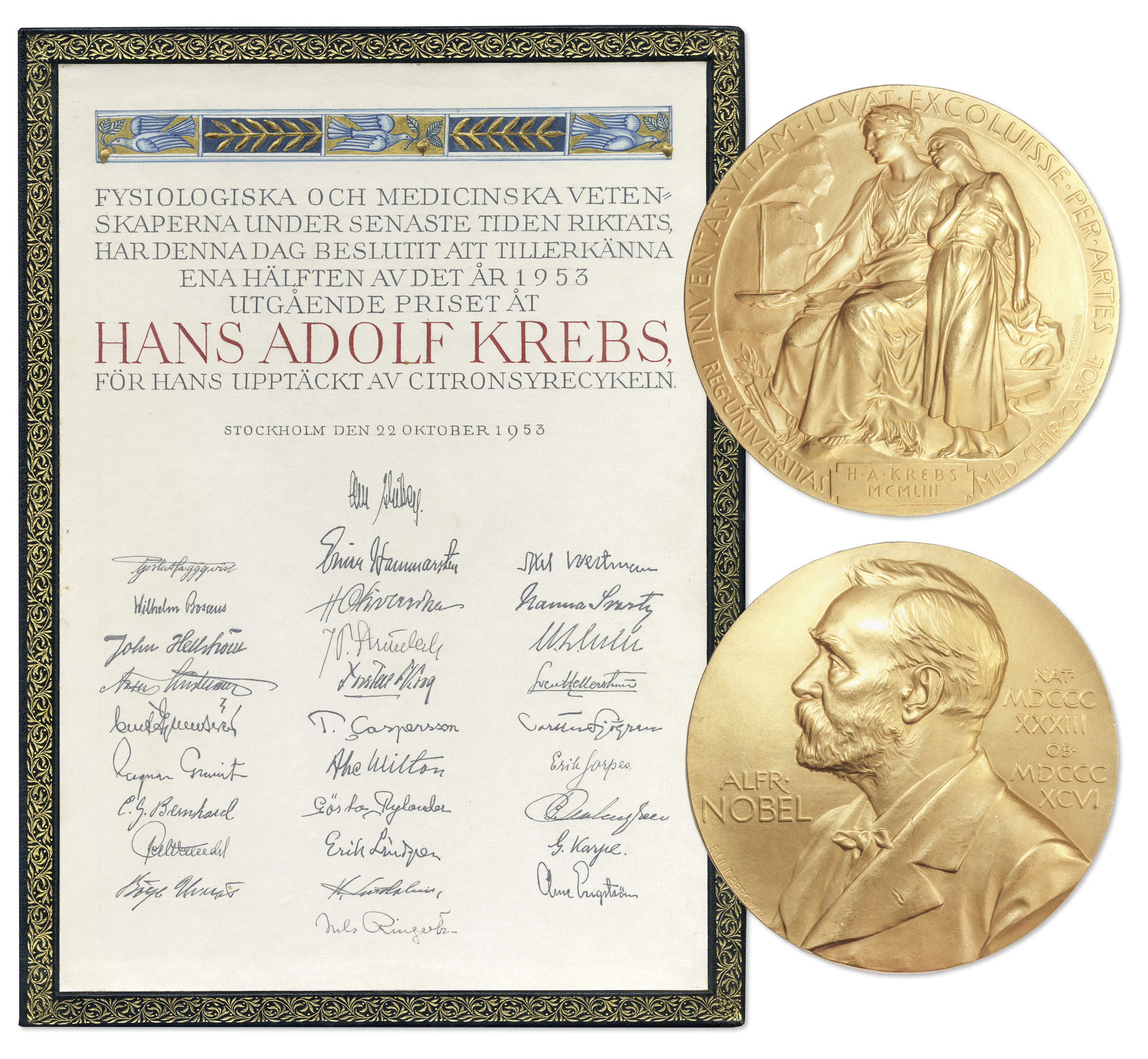
The 1953 Nobel Prize in Physiology or Medicine, awarded to physician and biochemist Hans Krebs for the discovery of the citric acid cycle (later named the Krebs cycle) and the urea cycle, the metabolic process by which all multi-cellular organisms convert food into energy. This Nobel Prize medal is made of 23k gold and features the relief portrait of Alfred Nobel, with his name and the years of his birth and death. Verso features the words, ”INVENTAS VITAM JUVAT EXCOLUISSE PER ARTES”, which translates from Latin to, ”Inventions enhance life which is beautified through art”. H.A. Krebs’ name and the year 1953 in Roman numerals are engraved on a plaque below the relief, framed by the words, ”REG. UNIVERSITAS MED-CHIR-CAROL”. On the right side is the name ”E LINDBERG”, who designed the prize. Comes with the Nobel Prize diploma which contains calligraphy printed on 2 vellum sheets, with signatures from 29 members of the Royal Swedish Academy of Science, housed in a beautiful blue case with Krebs’ initials “HAK” printed in gilt; sheets each measure 13.5″ x 19.5″. Medal is housed in the 5.5″ square red leather presentation box with Krebs’ name printed on the front. Medal measures 6.5 cm or 2.56” in diameter, and weighs 196 g or 6.9 oz, consistent with the original Nobel Prizes awarded in 1953. Presented in near fine condition. Sold for $269,000.
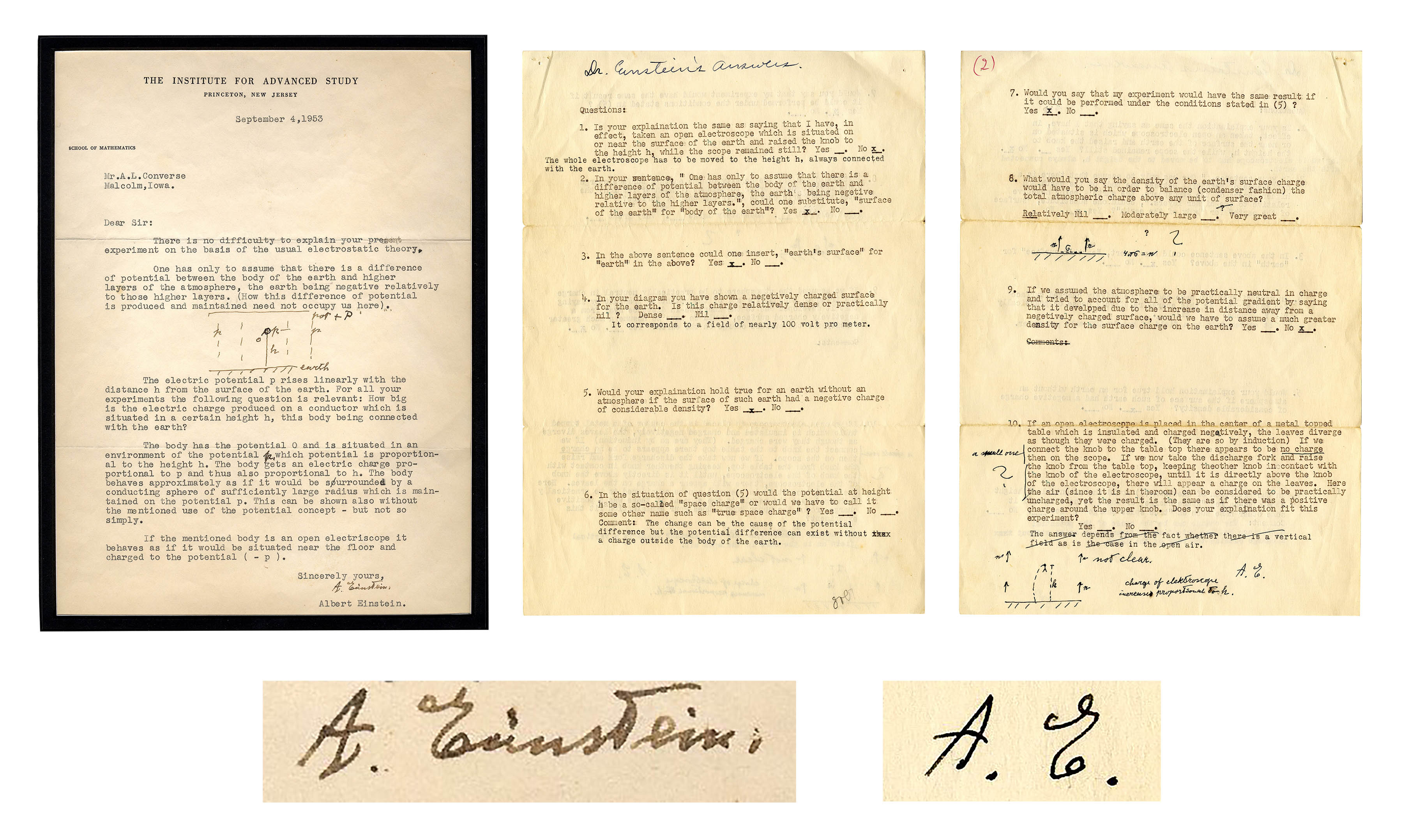
Albert Einstein letter signed with his hand drawings, elegantly explaining his electrostatic theory of special relativity to a physics teacher struggling to reconcile it with experiments he was conducting. In addition to the letter, which is new to the market, Einstein generously replies to a series of questions the teacher asks him on a questionnaire, providing additional drawings and calculations, initialed ”A.E.” at the conclusion. Dated 4 September 1953 on Princeton’s Institute for Advanced Study letterhead, Einstein writes to Arthur L. Converse, the teacher from Malcolm, Iowa, in part, ”There is no difficulty to explain your present experiment on the basis of the usual electrostatic theory. One has only to assume that there is a difference of potential between the body of the earth and higher layers of the atmosphere, the earth being negative relatively to those higher layers…[Einstein then draws Earth and the atmosphere, referring to it for clarification] The electric potential p rises linearly with the distance h from the surface of the earth…For all your experiments the following question is relevant: How big is the electric charge produced on a conductor which is situated in a certain height h, this body being connected with the earth…” Einstein then answers Converse’s questions on a two-page questionnaire. In one answer, Einstein seems to disagree with the question, providing both a diagram and mathematical equation and then a ”?” to try to aid understanding. He later writes ”not clear” to one answer along with a question mark and additional diagram with the notation ”charge of elektroscope increased proportional to h”. An extraordinary lot by Einstein showing the generosity of his time, with rare content on his theory of special relativity. Single page letter and two-page questionnaire each measures 8.5” x 11”. Also included is Einstein’s original mailing envelope from ”Room 115” of the Institute for Advanced Study, postmarked 7 September 1953 from Princeton. Folds and very light toning to letter, otherwise near fine. Questionnaire has folds, light toning and staple mark, otherwise near fine with bold handwriting by Einstein. With an LOA from the nephew of Arthur Converse and new to the market. Sold for $53,504.
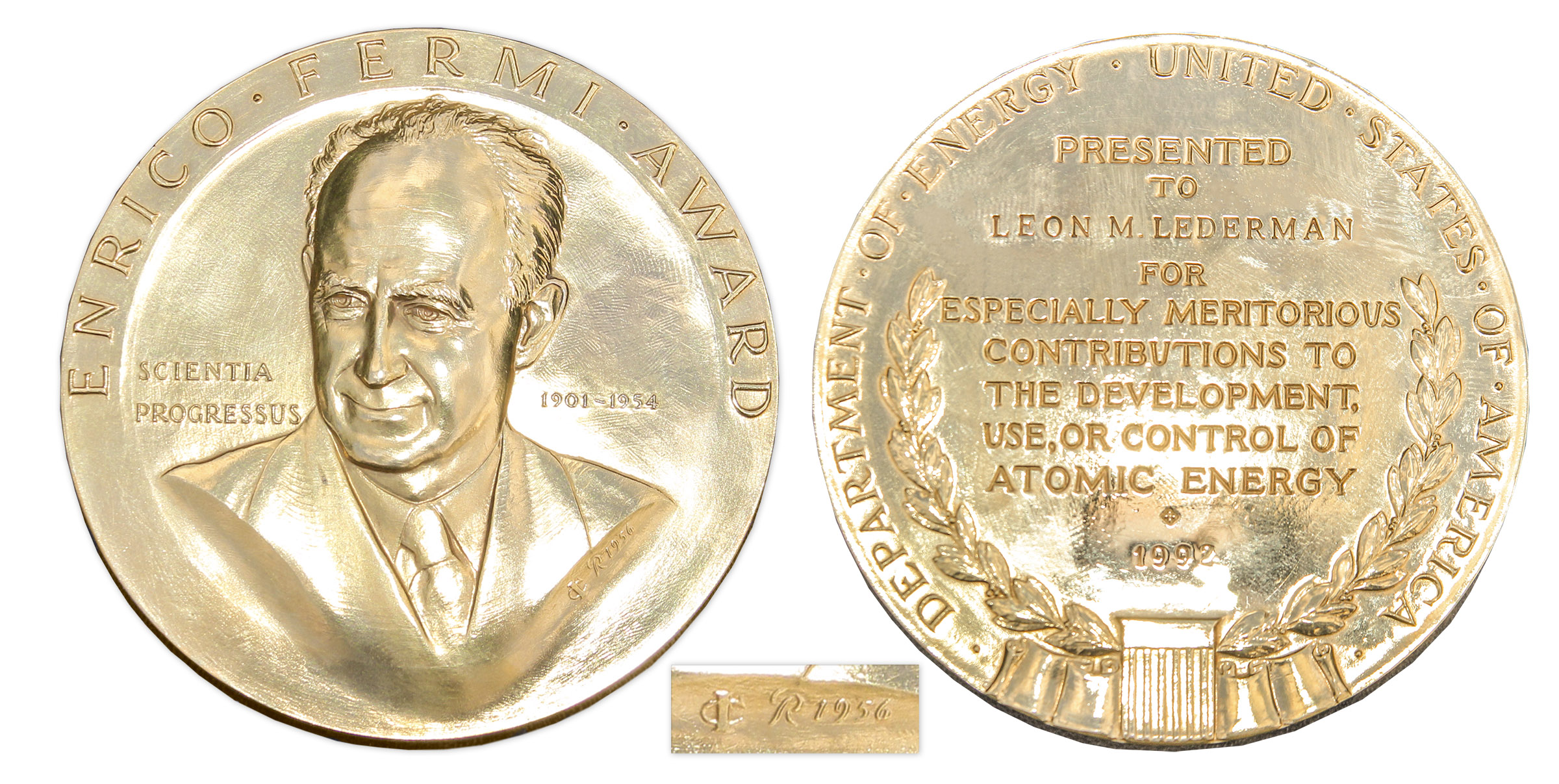
The Enrico Fermi Award presented to Nobel Prize-winning physicist Leon Lederman in 1992. The Fermi Award, first given in 1956, honors scientists from around the world for their lifetime achievements, with many of the recipients also winning Nobel Prizes. Medal features a relief portrait of Enrico Fermi, with his name and the years of his birth and death. ”SCIENTIA PROGRESSUS” is also engraved on front, which translates from Latin to ”the progress of science”. Verso reads: ”PRESENTED TO / LEON LEDERMAN / FOR ESPECIALLY MERITORIOUS CONTRIBUTIONS TO THE DEVELOPMENT, USE, OR CONTROL OF ATOMIC ENERGY / 1992” and is framed by the words, ”DEPARTMENT OF ENERGY / UNITED STATES OF AMERICA”. Gold-plated medal weighs 324 grams or 11.4 ounces, and measures 3” in diameter. Case measures 5.25” x 5.25” x 1.5”. Very small mark on front of medal on Fermi’s lapel. Near fine condition. With an LOA by Leon Lederman. Sold for $25,000.
FREE ESTIMATE. To buy, auction, sell or consign your Richard Glynn silver compass sundial that is for sale, please email your description and photos to [email protected] of Nate D. Sanders Auctions (http://www.NateDSanders.com).
We offer the following services for your Richard Glynn silver compass sundial:
- Appraise Richard Glynn silver compass sundial.
- Auction Richard Glynn silver compass sundial.
- Consign Richard Glynn silver compass sundial.
- Sell Richard Glynn silver compass sundial.
- Estimate Richard Glynn silver compass sundial.
- Richard Glynn silver compass sundial valuation.