
Sell or Auction Your Representation Terrible Nouvelle Yorck Etching for up to Over $2,000 or More at Nate D. Sanders Auctions
FREE APPRAISAL. To buy, auction, sell or consign your Representation terrible Nouvelle Yorck etching that is for sale, please email your description and photos to [email protected] of Nate D. Sanders Auctions (http://www.NateDSanders.com).
Free Appraisal, Auction or Sell Your Representation Terrible Nouvelle Yorck Etching
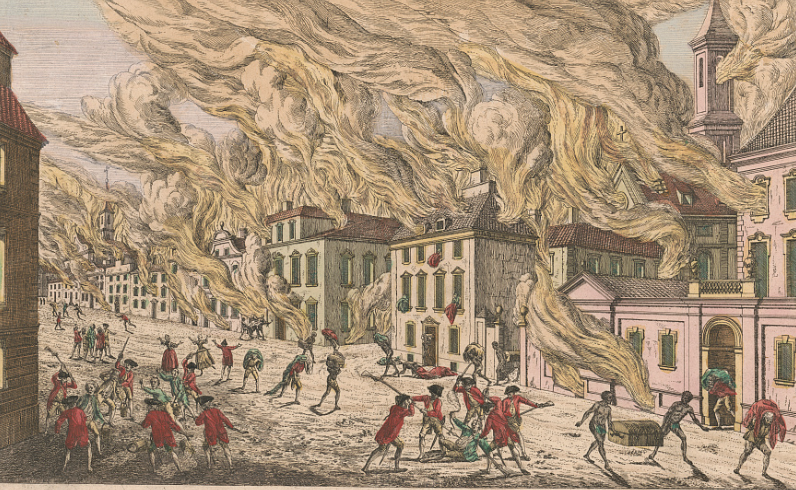
Below is a recent realized price for a Representation terrible Nouvelle Yorck etching. We at Nate D. Sanders Auctions can obtain up to these amounts or more for you:
Representation Terrible Nouvelle Yorck Etching. Sold for over $2,000.
Here are some items that our auction house, Nate D. Sanders (http://www.NateDSanders.com), has sold:
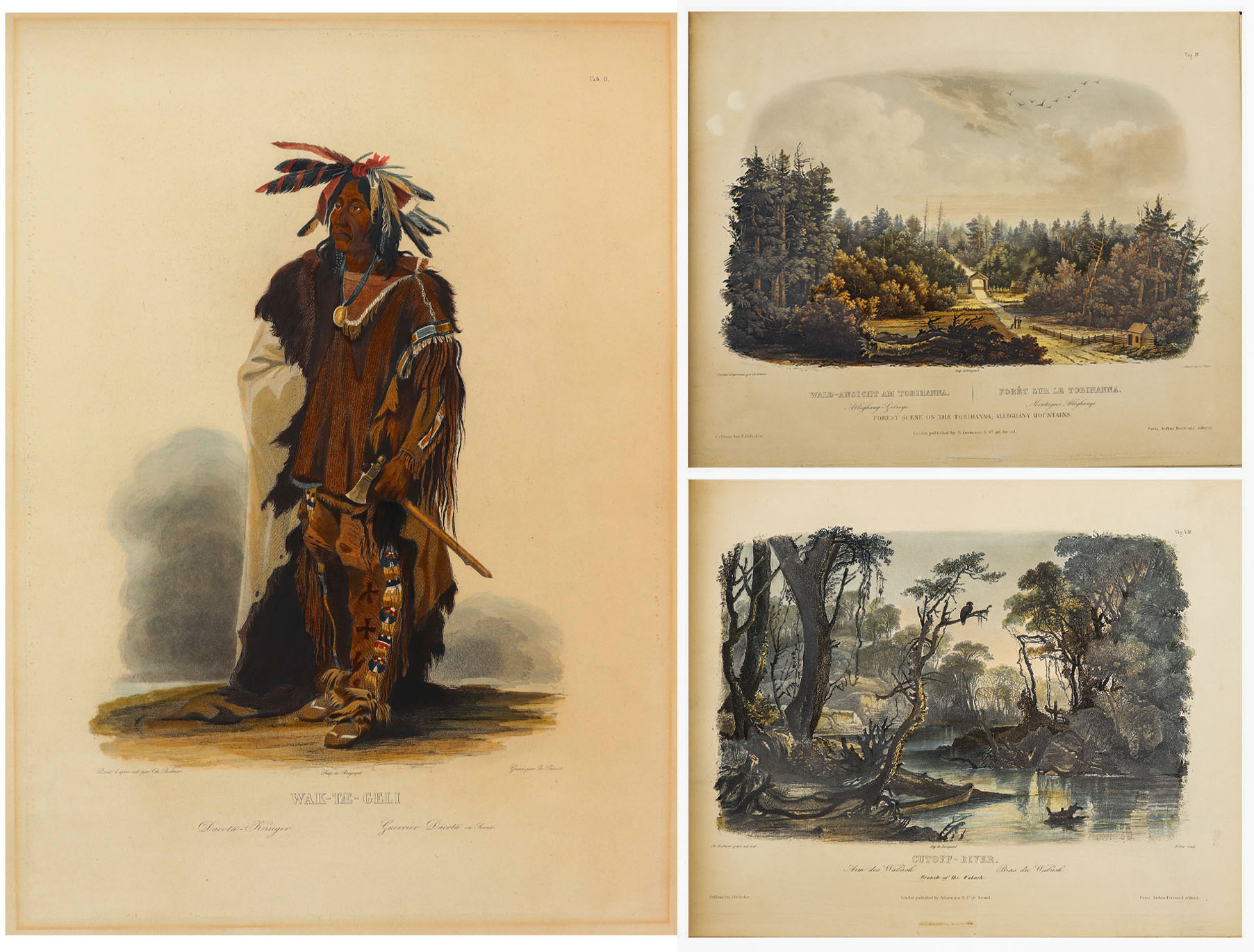
81 Beautiful Hand-Colored Aquatints by Karl Bodmer Depicting the American Frontier in the 1830s — Contained in the Illustrated Travelogue “Prince of Wied’s Travels in the Interior of North America”
Stunningly beautiful collection of 81 hand-colored aquatints by the Swiss artist Karl Bodmer, a complete collection from the illustrated travelogue, “Prince of Wied’s Travels in the Interior of North America”. Bodmer, who journeyed with the German Prince Maximilian of Wied-Neuwied from 1833-34 along the Missouri River, produced what is considered the best depictions of the indigenous peoples and landscapes during the frontier era, an America then still unspoiled by western migration. Of the Native American tribes of the Great Plains that they encountered, Bodmer’s depictions of the Blackfeet and Mandan tribes are especially important as the populations of these tribes were greatly affected by the smallpox epidemic of 1837, thus making Bodmer’s work the last visual testament to their culture.
Prince Max, as he was called, chose Bodmer to accompany him on the expedition along the Missouri River to visually depict the scenes that the Prince would write about. The result is this collection: three volumes of text by the Prince and two volumes of aquatints by Bodmer, in the first Paris edition published by Chez Arthus Bertrand, 1840-43 (“Voyage dans l’interieur de l’Amerique du Nord”). Text volumes in French also include 37 wood-engraved illustrations, only lacking the map in completeness. The two complete volumes of illustrations include the large folio volume with 48 oversized hand-colored aquatints measuring approximately 24.5″ x 18″, and the quarto volume with 33 hand-colored aquatints measuring approximately 12.5″ x 10.25″. The complete set of 81 aquatints is magnificent in their display, a time capsule with their hand-coloring evoking the sense of awe and discovery of the expedition. All volumes are bound in half black morocco and blue paper-covered boards with gilt accenting, and with black morocco labels to illustrated volumes. Minor handling wear to volumes, with a few small repaired tears to plates, some plates supplied with variance to margins, minute toning and foxing, a few plates beginning to separate from binding. Overall a very good plus set with excellent display quality. Sold for $175,000.


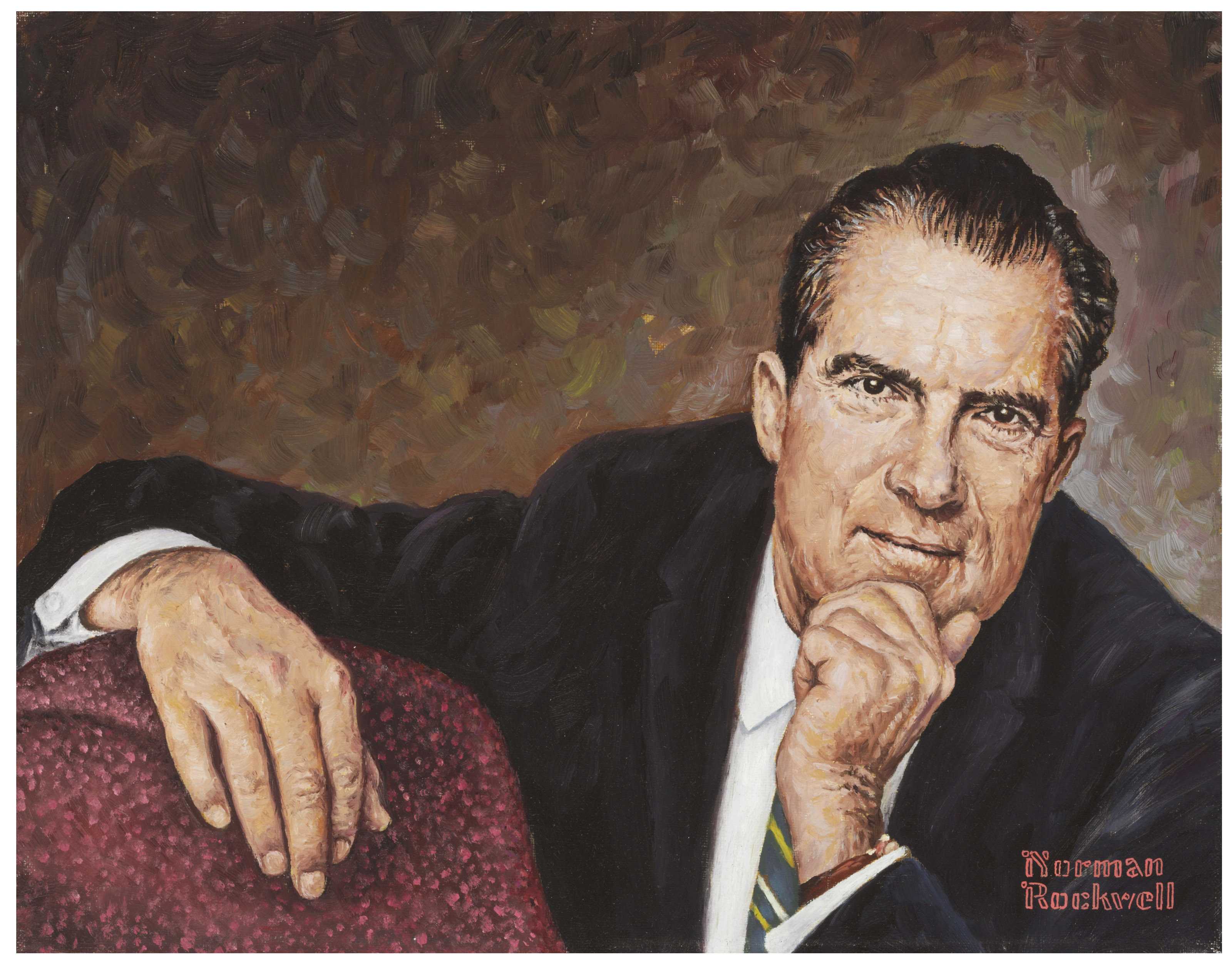
Norman Rockwell oil on canvas painting of Richard Nixon, signed ”Norman / Rockwell” at lower right. Painting is the study for ”Mr. President (Richard Nixon)”, which resides in the National Portrait Gallery, Smithsonian Institution, and was published in the 4 February 1969 issue of ”Look” magazine, captioned ”Weighed, yet buoyed, by the American past and present, Richard M. Nixon, 37th President, faces the future in this Rockwell portrait”.
Rockwell painted this study in late 1968 of then President-Elect Richard Nixon, a man whose portrait he found ”elusive” but whose features here are unmistakenly Nixon, revealing at the same time both the guardedness and warmth of the 37th President. As the premiere portraitist of the 20th century, one would expect no less from Rockwell. Oil on canvas measures 14” x 11”. Provenance is from Judy Goffman Fine Art of New York, and then subsequently the Charles E. Sigety Collection. Exhibited at the Mississippi Museum of Art in ”Norman Rockwell: The Great American Storyteller” from 2 March-15 May 1988, no. 64. Painting is in very good condition, with a stretcher bar mark along upper edge. Wax lined, with no inpainting. Sold for $125,000.
Scarce collection of 63 photographs from Carleton Watkins’ groundbreaking publication, ”Yosemite Valley: Photographic Views of the Falls and Valley of Yosemite in Mariposa County, California”. San Francisco, 1863. One of the most complete collections, lot comprises a total of 63 photographs, with two of the title page and map, and 61 of the Yosemite Valley, each measuring 11.625” x 7.5”. Scarce as such.
Lured out to California for the Gold Rush, Watkins soon turned his pursuits to photography, a calling for which he was naturally gifted. In 1861, he traveled to Yosemite outfitted with both mammoth-plate and stereoscopic cameras to make the first photographic narrative of the majestic valley, with these photographs the result. They were so impactful, after having been shared amongst Congressmen and Abraham Lincoln, that the Yosemite Grant Act was passed in 1864, a precursor to the creation of the U.S. National Park System in 1872.
Interestingly, no complete accounting of Watkins’ Yosemite photos from 1863 is documented, but next to a collection of 65 photographs, this grouping is the most complete at 63 photographs. Only a handful of other collections even claim more than 50 photographs. The views are exquisite, capturing the rock formations, foliage and natural water sources of the Valley as they appeared in 1861, yet unspoiled by overcrowding. Watkins’ ability to capture the depth of the images – with distant mountains hovering over meadows and streams, is particularly beautiful, aided by the use of his two camera systems.
Photographs retain superb contrast and tonality, all disbound in a period brown morocco gilt slipcase, tooled in gilt on the cover, ”Watkins’ Yosemite Gallery.” Overall in very good to near fine condition. Sold for $112,500.

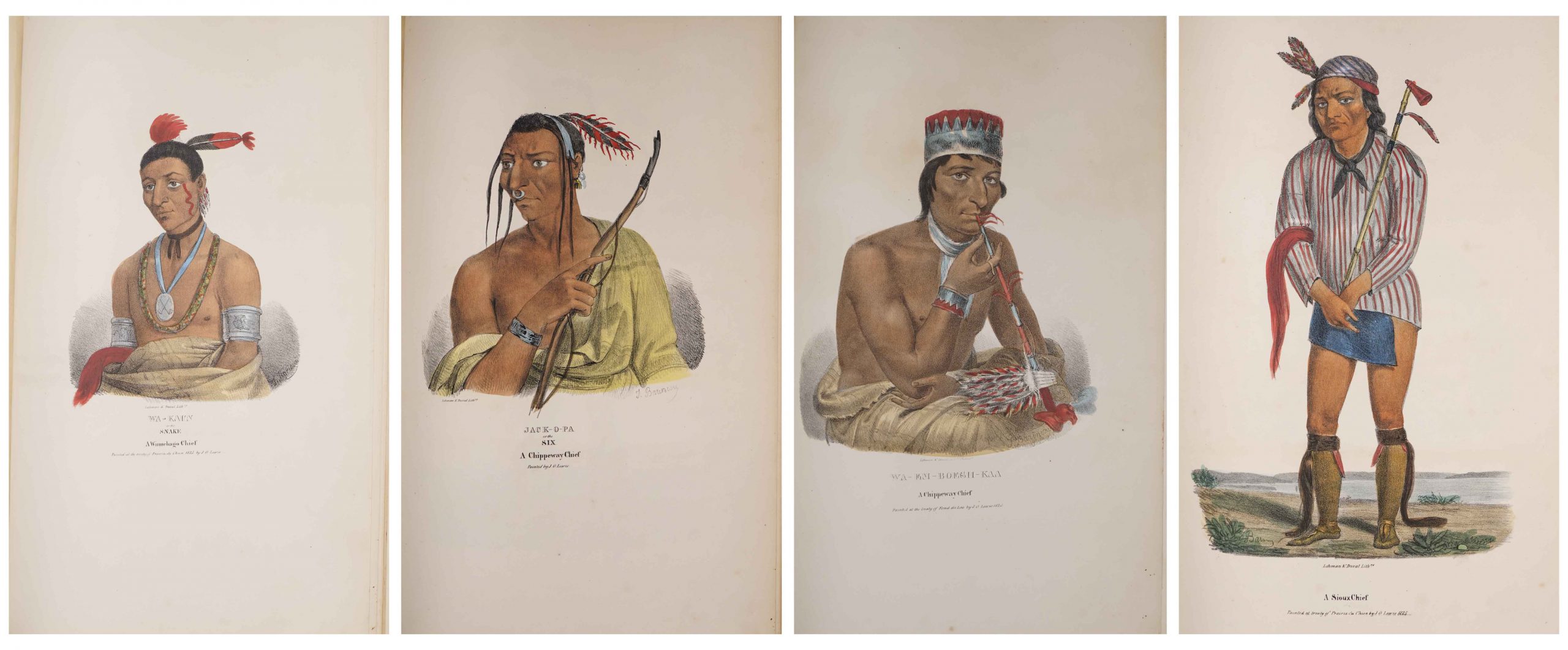
Complete Set of 80 Hand-Colored Lithographs of “The Aboriginal Port Folio” by James Otto Lewis From 1835-1838 — Extremely Scarce Complete Set
Very scarce complete set of the “Aboriginal Port Folio”, containing 80 hand-colored lithographs by Native American visual chronicler James Otto Lewis, whose travels to various treaty ceremonies during the early 19th century produced lasting portraits of Native American leaders and customs. Lewis was the first to create such artwork, preceding McKenney & Hall by several years. Philadelphia: George Lehman and Peter S. Duvall, 1835-1838.
After painting portraits of members from the Sioux, Potawatomi, Winnebago, Fox, Shawnee, Miami, and Iowa tribes, Lewis brought his paintings to Philadelphia for lithography, releasing them by subscription in 10 installments of 8 lithographs apiece. Each installment grew more scarce as subscriptions trailed off with the impending publication of the more comprehensive (and more formally posed) “History of the Indian Tribes of North America” by McKenney & Hall, whose portrait artist Charles Bird King even copied some of Lewis’ paintings. As a result, the full collection of 80 lithographs of “The Aboriginal Port Folio” is so scarce that only five to ten copies are known to exist. To make matters worse, Lewis’ original paintings were destroyed in the Smithsonian fire in 1865.
This set is in very good to near fine condition, with only minor scattered foxing affecting some sheets. In addition to the 80 pictorial lithographs, set also includes the lithograph title page and three leaves of advertisements, making it a truly complete set. Lithographs each measure 11.5″ x 18.125″, housed in three-quarter red morocco clamshell case with custom lettering to spine. One of the few visual remembrances of this important collection preserved for history. Sold for $84,000.

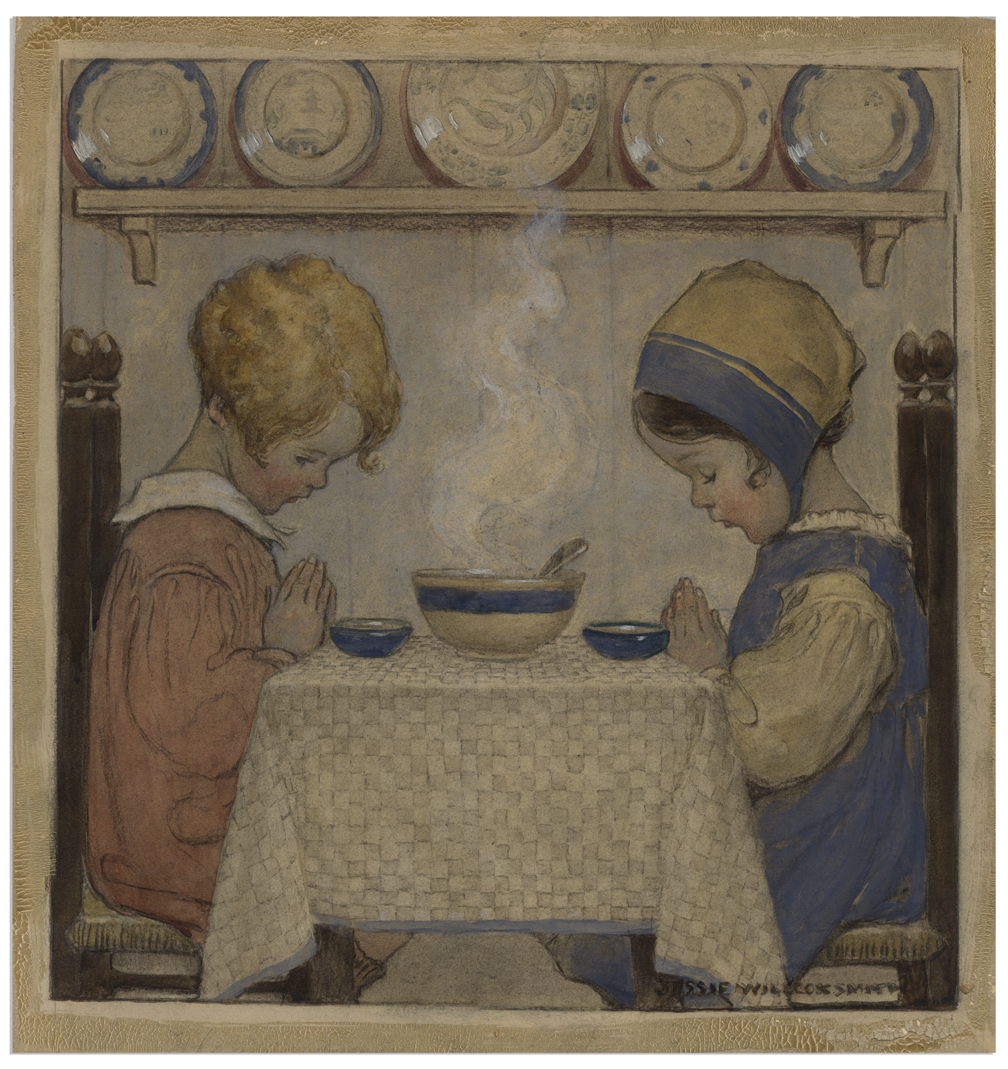
Jessie Willcox Smith Original Cover Art for ”Good Housekeeping” From November 1920 Entitled ”We Give Thee Thanks”
Beloved American illustrator, Jessie Willcox Smith original cover art for the November 1920 issue of ”Good Housekeeping” as well as the April 1922 issue of the UK edition, entitled ”We Give Thee Thanks”. Mixed media on illustration board measures 18.25” x 19”, showing two children praying before their meal. Signed ”Jessie Willcox Smith” at lower right. Artwork is one of Willcox Smith’s most memorable pieces, with limited edition lithographs even being made of it, a quintessential example of her work featuring two gently postured children in a moment of gratitude and familial warmth.
Jessie Willcox Smith was the exclusive cover artist for ”Good Housekeeping” from 1917-1933, and was the second woman inducted into the Society of Illustrators Hall of Fame, followed shortly thereafter by Elizabeth Shippen Green and Violet Oakley, fellow members of the Red Rose Girls, a group of female artists who flourished during the Golden Age of Illustration. Very good condition with no restoration apparent under blacklight. Artwork was given to Anne Champe Orr, the needlework editor for ”Good Housekeeping”, and then by descent to consignor. Sold for $82,500.
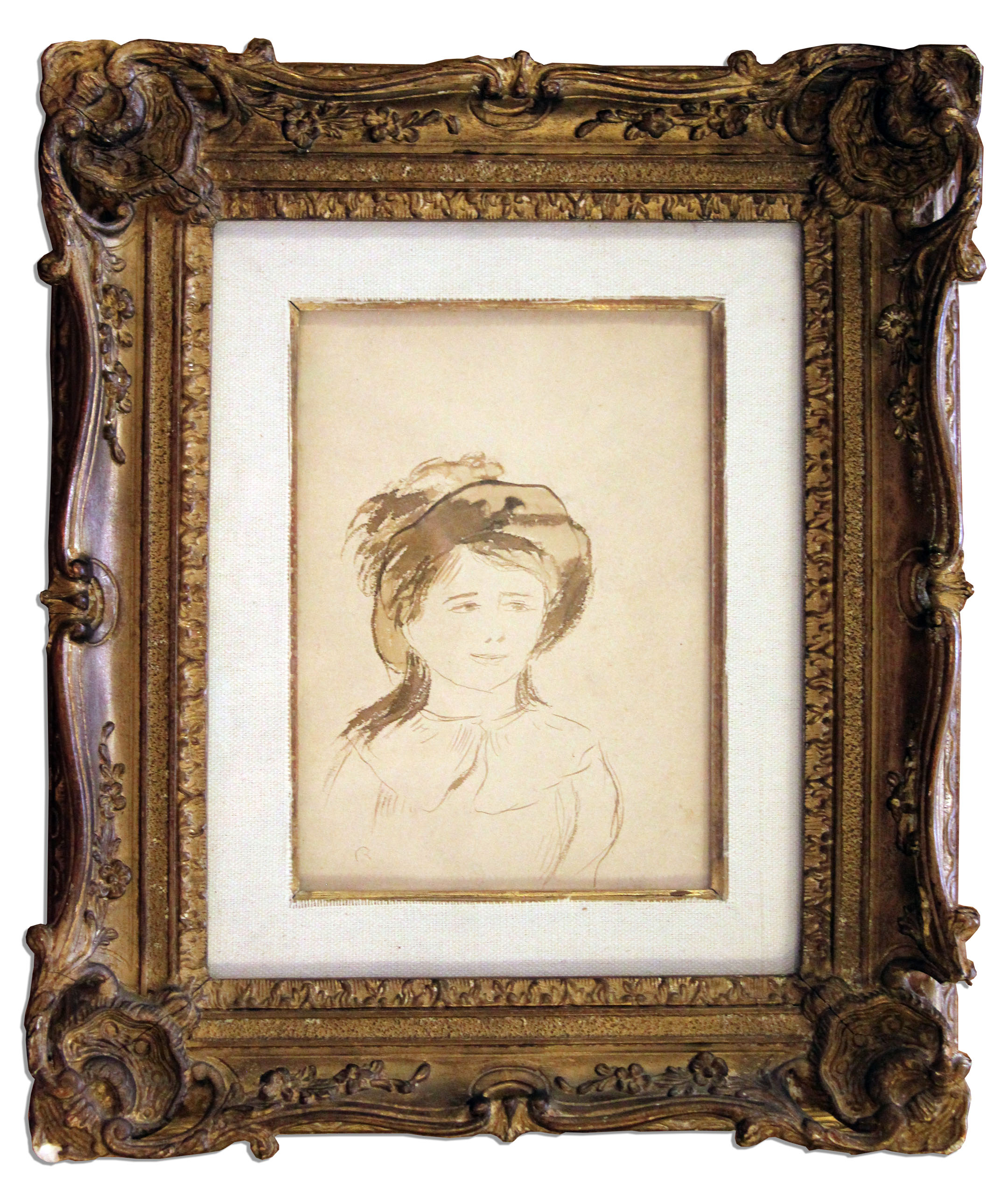
Pierre-Auguste Renoir Drawing — Portrait of a Young Girl ”Fillette”
French Impressionist master Pierre-Auguste Renoir drawing, pen and ink with ink wash of a young girl with a hat, entitled ”Fillette”. The drawing, created circa 1882, is signed with the initial, ”R”. Renoir, who had been painting Parisian scenes for many years, saw his fame take off when, along with other Impressionist painters, including Monet, Degas and Cezanne, his work was represented in the first Impressionist Exhibition in 1874. He painted scenes of people at work and play, often painting women and girls. He was known for his free brush strokes and the warm sensuality present in the light and color of his palette. Two of Renoir’s most famous paintings, ”Luncheon of the Boating Party” and ”Girl With a Hoop”, were completed during the early 1880’s when this drawing was made. The drawing, measuring 5.5” x 7.75”, is in fine condition. With provenance from Sotheby’s. Also featured in: (1) page 171, Vol. II of ”Pastels & Drawings of Pierre-Auguste Renoir” by Ambroise Vollard. Paris: 1918; (2) page 568, Vol. II of ”Renoir. Catalogue Raisonne of the Paintings, Pastels, Drawings and Watercolours 1882-1894” by Guy-Patrice & Michel Dauberville. Paris: 2009. Superb Renoir drawing. Sold for $65,959.
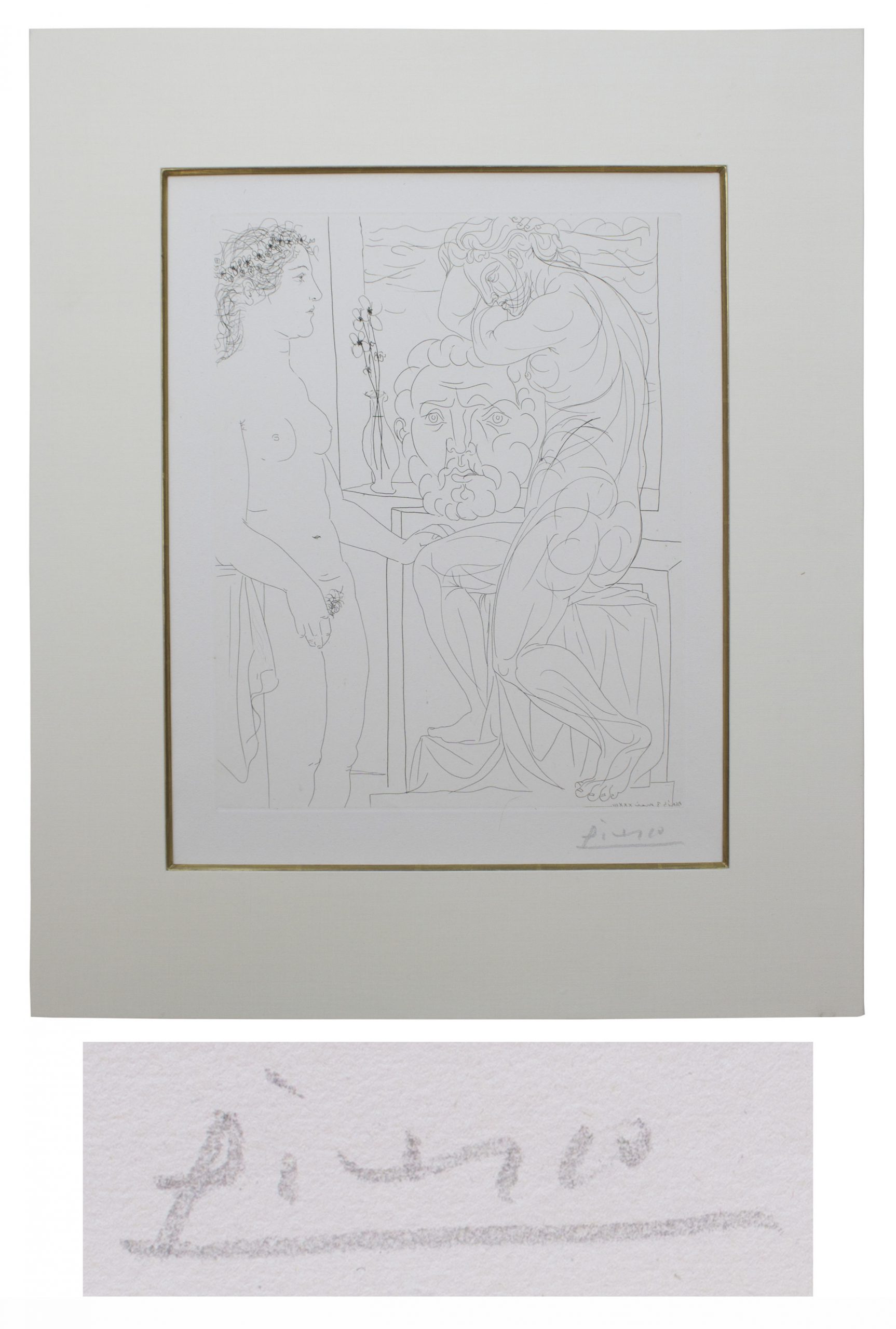
Pablo Picasso Signed “Modele nu et Sculptures” Etching — From the Desirable Vollard Suite of Etchings
Pablo Picasso “Modele nu et Sculptures” etching, signed by Picasso in pencil on the lower margin. Created in May 1933 in Paris, etching is plate 72 of the desirable Vollard Suite, a set of neoclassical etchings commissioned by dealer Ambroise Vollard. From an edition of 250, on Montval laid paper with the Galatea watermark just underneath Picasso’s signature. Paper measures 15.25″ x 19.75″, framed to 24.25″ x 28″. In very good to near fine condition with two imperceptible spots of foxing at edge of image. Catalog raisonne reference: Bloch 185 and Baer 344. Sold for $11,550.
“Baltimore From Federal Hill” Hand-Colored Folio Aquatint From 1831 by William James Bennett — “…Pronounced by judges to be the best print of the kind ever published in the United States…”
Stunning hand-colored aquatint of “Baltimore From Federal Hill” by the “master of the aquatint view”, William James Bennett. During the 1830s, Bennett produced a series of 19 large, folio-sized aquatints of American cities, of which has been said, “constitute the crowning point of his career as an artist and printmaker…The aquatints, rightfully considered the finest collection of folio views of American cities, provide abundant evocation of nineteenth-century America with particular emphasis on cities that owed their existence and prosperity to the presence of water…Bennett’s Baltimore view, declared the Baltimore American on September 28, 1831, has been ‘pronounced by judges to be the best print of the kind ever published in the United States'”. Measuring 26.25″ x 20″, aquatint published by Henry I. Megarey in 1831 is the second state with printer’s name listed. Some closed tears at center of sky have been professionally repaired, barely visible upon close inspection, and some repair to trimmed margins. Mounted on a sheet of wove paper. Overall in very good plus condition with virtually no toning and still exceptionally bright colors. Sold for $6,825.

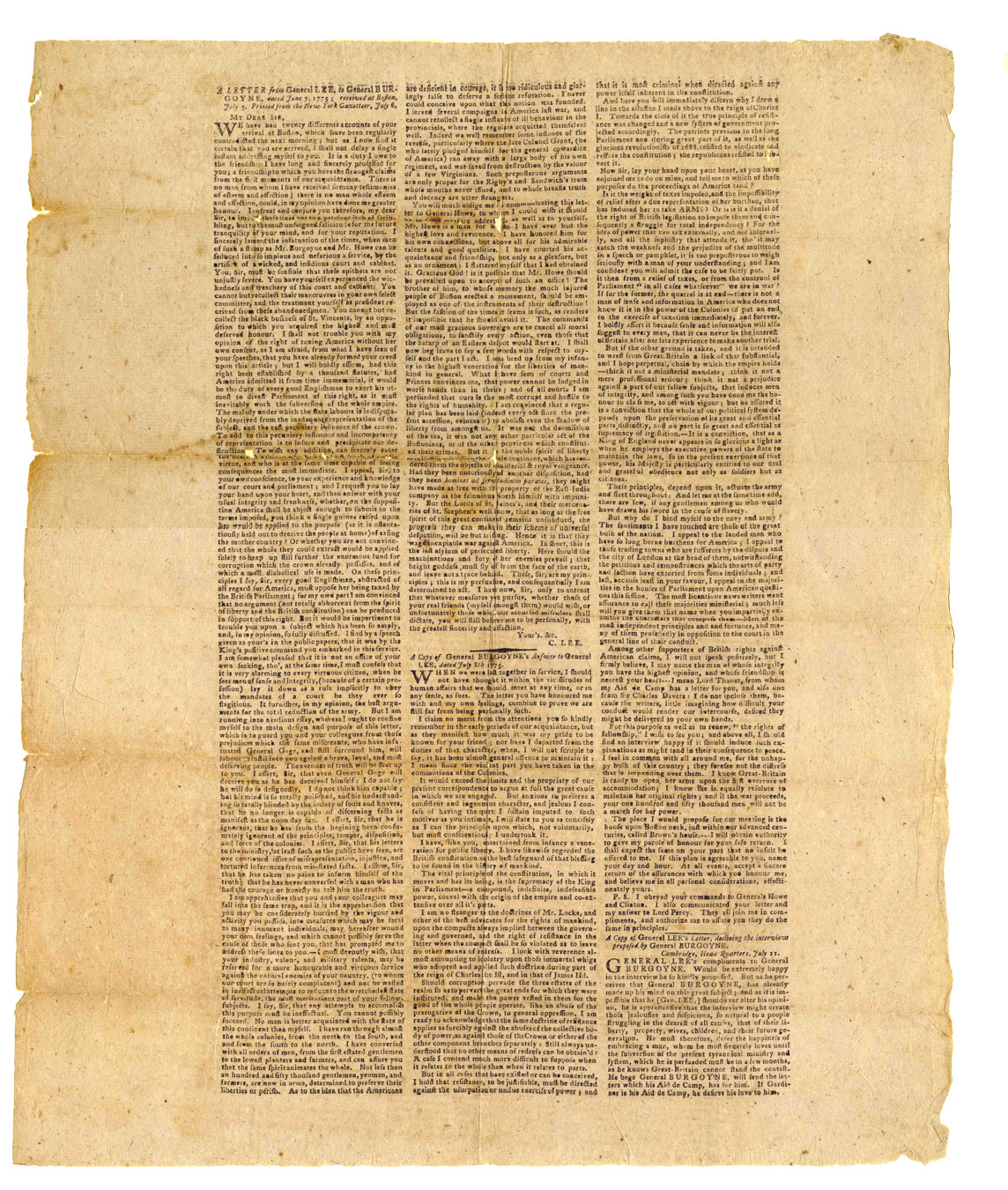
Revolutionary War Broadside 1775
Revolutionary War broadside, “A Letter From General Lee, To General Burgoyne, Dated June 7, 1775″ A broadside containing a spate of correspondence between former colleagues Lee and Burgoyne, including a defense of Lee’s support of the American colonies. Likely published in New York, as it seems unlikely this would have been published in British-occupied Boston. Measures 14″ x 17”. Docketed in contemporary manuscript on verso. Light fold lines, minor separations at folds with partial loss to some letters. Extremely rare. Sold for $5,250.
Revolutionary War Broadside From Boston in 1775, With Loyalists Bidding Farewell to Colonial Governor Thomas Gage, the First British Commander-in-Chief — “…dark Contrivances of ambitious Men…”
General Thomas Gage (10 March 1718/19 – 2 April 1787) was a British Army general officer and colonial official best known for his many years of service in North America, including his role as British commander-in-chief in the early days of the American Revolution.
Scarce Revolutionary War broadside, datelined Boston, 6 October 1775, after the commencement of fighting at Lexington & Concord, and Bunker Hill. Broadside consists of three letters by Tories in America, thanking Massachusetts Bay Governor and British Commander-in-Chief Thomas Gage for his service following his resignation. Each letter is answered, in turn, by Gage. As the first British Commander during the Revolutionary War, Gage was perhaps a scapegoat for the heavy losses sustained by the British at Bunker Hill. After the battle, he wrote to the English Secretary of War, “…They are now spirited up by a rage and enthusiasm as great as ever people were possessed of and you must proceed in earnest or give the business up…” Gage was then promptly relieved of his command and replaced by William Howe, although his reputation improved after the war’s end. Sold for $4,600.

American Army Establishment Broadside
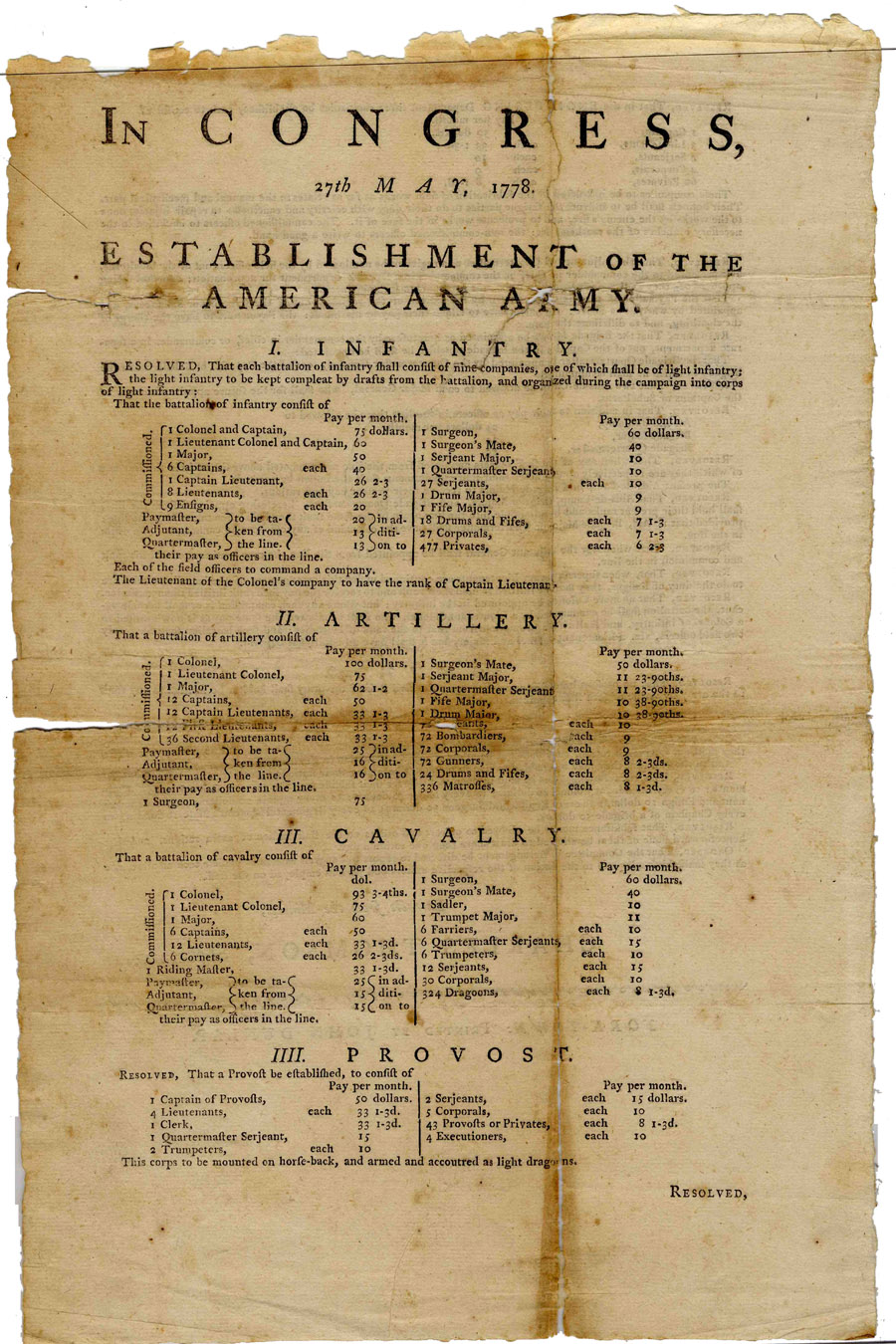
Scarce Revolutionary War “In Congress” broadside entitled, “Establishment of the American Army.” Printed by John Dunlap: York-Town. Dated 27 May 1778 document divides the American army into four parts; infantry, artillery, cavalry and provost and details positions and payments within each department. Further resolutions dated 29 May and 2nd June detail compensation and rations. In part, “…Resolved, That each battalion of infantry shall consist of nine-companies, one of which shall be of light infantry; the light infantry to be kept complete by drafts from the battalion, and organized during the campaign into corps of light infantry: That the battalion of infantry consist of…Colonel and Captain [etc]…” 2pp. front and verso. Measures approximately 9.25″ x 14″. Fragile paper shows chipping and paper loss to edges and near complete separation at folds. Overall toning, wear and soiling, else good condition. Sold for $4,200.
Revolutionary War Broadside Regarding “Demonstrations of Joy” to Mark the War’s End — With Details on the Infamous “Triumphal Arch” in Philadelphia, Which Erupted in Flames the Night of Its Debut
Superb and rare broadside from Philadelphia dated 2 December 1783 shortly after the Treaty of Paris officially ended the Revolutionary War, with details of the “Triumphal Arch” to be constructed in the city. To celebrate the war’s end, carefully planned celebrations – termed “Demonstrations of Joy” – were scheduled in each state to unite the new country in a communal patriotic experience. The celebration in Philadelphia centered around this “Triumphal Arch”, a grand wooden structure over 35 feet tall, to be “illuminated by about twelve hundred Lamps” and “embellished with illuminated Paintings…and that some Fireworks be prepared for the Occasion”. Sold for $3,600.

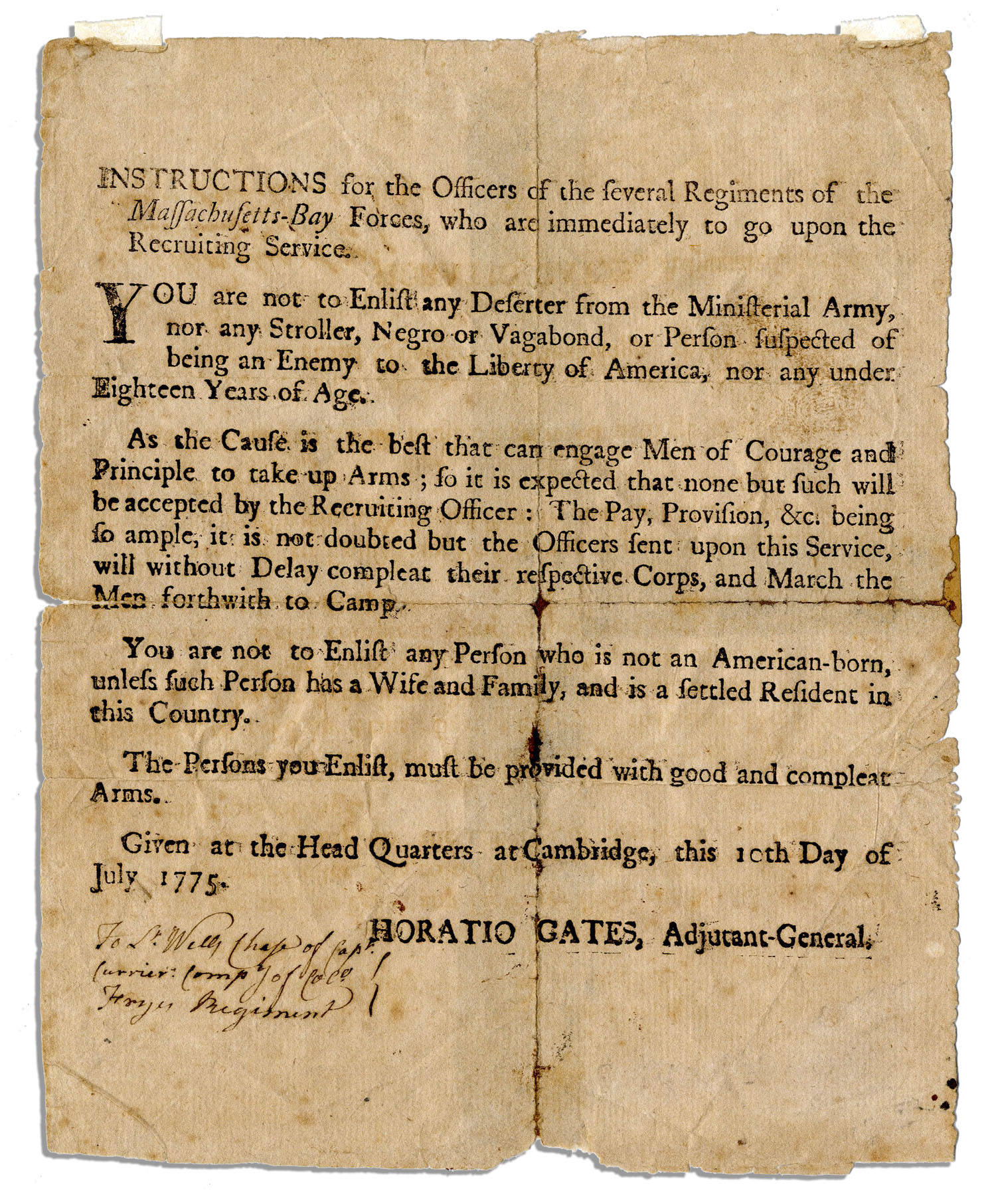
Broadside announces the recruitment of soldiers for the American Revolutionary War. The document, dated 1775 and signed in type by Horatio Gates as Adjutant General reads in full: ”Instructions for the Officers of the several Regiments of the Massachusetts Bay Forces, who are immediately to go upon the Recruiting Services. You are not to Enlist any Deserter from the Ministerial Army, nor any Stroller, Negro or Vagabond, or Person suspected of being an enemy to the Liberty of America, nor any under Eighteen Years of Age. As the cause is the best that can engage Men of Courage and Principle to take up Arms; so it is expected that non but such will be accepted by the Recruiting Officer: The Pay, Provision, etc. being so ample, it is not doubted but the Officers sent upon this Service will without Delay compleat their respective Corps, and March the Men forthwith to Camp. You are not to enlist any Person who is not American-born, unless such Person has a wife and Family, and is a settled Resident in this Country. The Persons you Enlist must be provided with good and compleat Arms. Given at the Head Quarters at Cambridge, this 10th Day of July, 1775. / Horatio Gates, Adjutant General”. Single-page broadside measures 6.5” x 8.25”. Toning, chipping and minor tears along edges, with separation to fold intersection from the left edge. Very good condition. Sold for $2,886.
Revolutionary War Document Regarding Siege of Boston
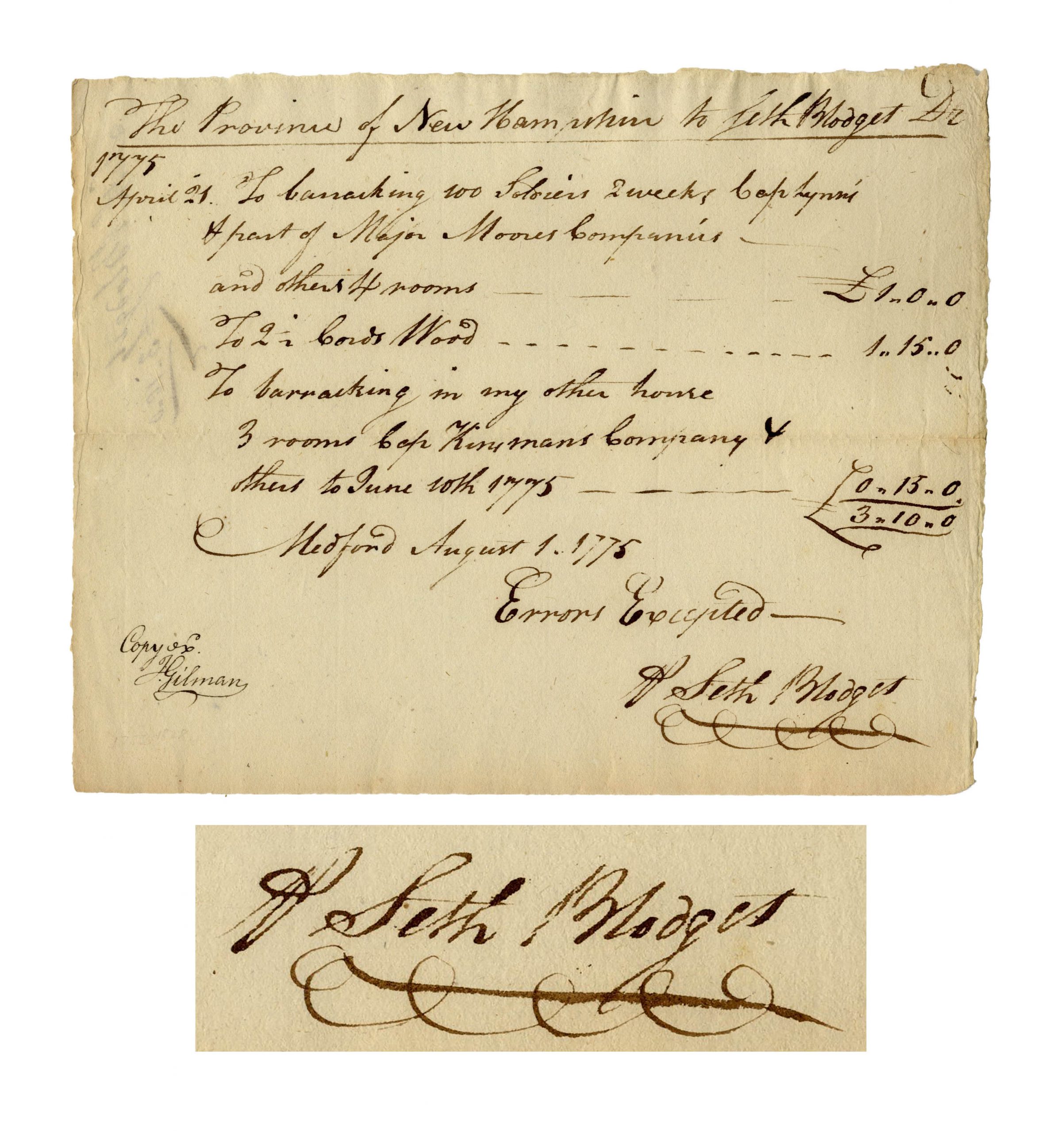
Revolutionary War document regarding the Battle of Bunker Hill, one of the first battles in the Revolutionary War during the Siege of Boston. Datelined 1 August 1775 from Medford, Massachusetts, document serves as a reimbursement receipt to Seth Blodget of Medford, who quartered soldiers who fought at Bunker Hill. Reads in part: “barracking 100 Soldiers [for] 2 weeks” beginning 21 April 1775 (two days after Lexington & Concord) for “Cap Lynn’s & part of Major Moore’s Companies”, as well as “3 rooms Cap Kinsman’s Company & others to June 10th 1775″. On 17 June 1775, the 1st New Hampshire Regiment companies of Captains John Moore and Aaron Kinsman — referenced in this document, fought at Bunker Hill, one week after Kingsman’s company left the residence of Seth Blodget. In fact, in this document dated approximately two weeks after Bunker Hill, Moore is referenced as Major, a promotion he received on 18 June to replace Major McClary who was killed during the Battle. Although the British were able to capture the Charlestown Peninsula as a result of Bunker Hill, it was a pyrrhic victory, as they lost 1,000 men in killed and wounded, including almost 100 officers. After Bunker Hill, the British declined to attack again until they ultimately retreated to Nova Scotia in March 1776, thereby ending the Siege of Boston. Document is signed by J. Gilman, likely John T. Gilman of New Hampshire, who later served as the state’s Treasurer and Governor. Measures 8.25″ x 6.5”. In well-preserved, near fine condition given age. Sold for $1,006.
Consign your item at Nate D. Sanders Auctions. Send a description and images of your item to us at [email protected].
FREE APPRAISAL. To buy, auction, sell or consign your Representation terrible Nouvelle Yorck etching that is for sale, please email your description and photos to [email protected] of Nate D. Sanders Auctions (http://www.NateDSanders.com).