
Sell or Auction Your Prodigiorum Ac Ostentorum Chronicon 1557 for Over $10,000 or More at Nate D. Sanders Auctions
FREE APPRAISAL. To buy, auction, sell or consign your Prodigiorum Ac Ostentorum Chronicon 1557 that is for sale, please email your description and photos to [email protected] of Nate D. Sanders Auctions (http://www.NateDSanders.com).
Free Appraisal, Auction or Sell Your Prodigiorum Ac Ostentorum Chronicon 1557
Conrad Lycosthenes (born Conrad Wolffhart) (8 August 1518 — 25 March 1561) was an Alsatian humanist and encyclopedist. Deacon of Saint Leonard in Basel, professor of grammar and dialectics, Lycosthenes had a passion for the study of nature and geophysics.
Below is a recent realized price for a Prodigiorum Ac Ostentorum Chronicon 1557 item. We at Nate D. Sanders Auctions can obtain up to these amounts or more for you:
Prodigiorum Ac Ostentorum Chronicon 1557. Sold for over $10,000.

Here are some recent items that our auction house, Nate D. Sanders (http://www.NateDSanders.com) has sold:
The 1963 Nobel Prize in Physiology or Medicine, awarded to physiologist Alan Lloyd Hodgkin for establishing the propagation mechanism of nerve impulses called action potentials — consequently helping to understand the mechanism behind disorders such as multiple sclerosis, seizures and Parkinson’s disease. Hodgkin is also responsible for identifying the Hodgkin Cycle and, along with colleagues Andrew Fielding Huxley and John Carew Eccles, hypothesized the existence of ion channels on cell membranes, a concept which took over 20 years to confirm; that confirmation earned Erwin Neher and Bert Sakmann the 1991 Nobel Prize. This Nobel Prize medal is made of 23k gold and features the relief portrait of Alfred Nobel, with his name and the years of his birth and death. Verso features the words, ”INVENTAS VITAM JUVAT EXCOLUISSE PER ARTES”, which translates from Latin to, ”Inventions enhance life which is beautified through art”. A.L. Hodgkin’s name and the year 1963 in Roman numerals are engraved on a plaque below the relief, framed by the words, ”REG. UNIVERSITAS MED-CHIR-CAROL”. On the right side is the name ”E LINDBERG”, who designed the prize. Comes with 6 original photographs of Hodgkin (at least 4 of which are from the ceremony in Oslo on 10 December 1963), a New York Times article on Hodgkin dated 18 October 1963, a portion of a 1976 issue of ”The Journal of Physiology” featuring an essay by Hodgkin, and the official 1963 English edition of the Nobel Prize publication, featuring Hodgkin and partner Huxley on the cover. Medal is housed in the maroon leather presentation box with a white satin lining and Hodgkin’s name printed on the front. Box measures 5.5” x 5.5” x 1”. Medal measures 6.5 cm or 2.56” in diameter, and weighs 196 g or 6.9 oz, consistent with the original Nobel Prizes awarded in 1963. Presented in near fine condition. With an LOA from the daughter of Dr. Alan Hodgkin. Sold for $795,614.


The 1988 Nobel Prize in Physics, awarded to particle physicist Leon Lederman for his discovery of the muon neutrino, a particle 200 times the size of an electron. Lederman, along with colleagues Melvin Schwartz and Jack Steinberger, found the muon neutrino in 1962 while using a high energy particle accelerator. They discovered that in some cases a muon (rather than an electron) was produced, illuminating the existence of a new atomic particle. Lederman was also instrumental in the discovery of the bottom quark in 1977, and was the champion of the Superconducting Super Collider. His popular 1993 book ”The God Particle: If the Universe is The Answer, What is The Question” was released to critical acclaim. This Nobel Prize is made of 18kt gold, plated in 24k gold, as were all Nobel Prize medals awarded after 1980. Medal features the relief portrait of Alfred Nobel to front, with his name and the years of his birth and death. Verso features a relief of the Goddess Isis, whose veil is held up by a woman who represents the genius of science. Encircling the medal are the words ”Inventas vitam juvat excoluisse per artes”, translating to ”And they who bettered life on earth by their newly found mastery”. Lederman’s name and 1988 in Roman numerals are engraved on a plaque below the relief of the two women, with ”Reg. Acad. Scient. Suec.” also written, an abbreviation for The Royal Swedish Academy of Sciences. Etched upon the medal is the name of Erik Lindberg, designer of the Nobel medal. Housed in the original red leather case with Leon Lederman’s name gilt stamped. Medal weighs 173 grams or just over 6 oz. and measures 2.5” in diameter, consistent with the original Nobel Prize awarded in 1988. Case measures 5.5” x 5.5” x 1”. Presented in near fine condition, and with an LOA from Leon Lederman. Sold for $765,002.


Nobel Prize Won by Walter Kohn, One of the Children Saved by Kindertransport During World War II
Nobel Prize in Chemistry won by Walter Kohn in 1998, unique not only for the scientific impact of Kohn’s work, but also for his life experience as one of the children rescued from Nazi-occupied territories in World War II through the Kindertransport program. Kindertransport was established by the United Kingdom in 1938 immediately after the ”Night of Broken Glass” pogrom in Germany, authorizing the safe passage of almost 10,000 children into the UK. The children were placed in homes throughout the British empire, with Kohn ultimately finding a home in Canada after both his parents were killed in the Holocaust. In addition to his Nobel Prize, lot also includes three science books that Kohn purchased at the temporary internment camp in Canada, all still housed in their well-worn homemade dust jackets: ”A Course of Pure Mathematics”, ”Dent’s Modern Science Series”, and ”Properties of Matter”.
The books are a foreshadowing to the incredible achievements that Kohn made to the world through his Nobel Prize-winning work. As the architect of density functional theory (DFT), Kohn devised the computational quantum mechanical modelling system that has allowed scientists to understand the nuclear structure of microscopic matter. Though the underlying structure of NFT is complex, the actual equations are now commonplace among scientists, with countless practical results deriving from it – from discovering trace impurities in chemicals to modeling planetary systems.
Nobel Prize is made of 18kt gold, plated in 24kt gold, consistent with the 1998 medals. Medal features the relief portrait of Alfred Nobel to front, with his name and the years of his birth and death. Reverse features a relief of the Goddess Isis, whose veil is held up by a woman who represents the genius of science. Encircling the medal are the words ”Inventas vitam juvat excoluisse per artes”, translating to ”And they who bettered life on earth by their newly found mastery”. Kohn’s name and 1998 in Roman numerals are engraved on a plaque below the relief of the two women, with ”Reg. Acad. Scient. Suec.” also written, an abbreviation for The Royal Swedish Academy of Sciences. Etched upon the medal is the name of Erik Lindberg, who designed the Nobel medal. Medal weighs 173 grams or just over 6 oz. and measures 2.5” in diameter. Near fine condition. With an LOA from the Kohn family. Sold for $457,531.

The 1927 Nobel Prize in Chemistry, awarded to Dr. Heinrich Otto Wieland, considered the father of modern biochemistry. This Nobel is the only Prize in Chemistry to ever be auctioned. Wieland spent his life’s work investigating the oxidation processes in living cells, and has been credited with unifying the disciplines of organic chemistry and biochemistry, which had been split since the work of chemist Justus von Liebig in the 1870’s. Wieland’s research into bile acid was used as the basis for the manufacture of drugs for the treatment of a wide variety of cardiovascular diseases, underpinning his recognition as the founder of modern biochemistry. As a result of his groundbreaking work in the field of chemistry, the Heinrich Wieland Prize was established and endowed in his honor in 1964, awarded to leading scientists for their work in the fields of biochemistry, chemistry and physiology, and counting four Nobel Laureates among its recipients. Wieland was also a strident opponent of the Nazi party; he employed and hid several Jews and supporters of the White Rose Nazi resistance movement in his laboratory at the University of Munich, which was given the nickname ”The Ghetto Room”. Wieland even courageously defended his student Hans Leipelt in court, who was convicted for collecting money for the widow of Kurt Huber, Wieland’s colleague who moonlighted as a White Rose resistance leader. Huber and Leipelt were both tried and executed in 1943. This Nobel Prize is made of 23kt gold and features the relief portrait of Alfred Nobel to front, with his name and the years of his birth and death. Verso features a relief of the Goddess Isis, whose veil is held up by a woman who represents the genius of science. Encircling the medal are the words ”Inventas vitam juvat excoluisse per artes”, translating to ”And they who bettered life on earth by their newly found mastery”. Wieland’s name and 1928 in Roman numerals are engraved on a plaque below the relief of the two women, with ”Reg. Acad. Scient. Suec.” also written, an abbreviation for The Royal Swedish Academy of Sciences. Etched upon the medal is the name of Erik Lindberg, who designed the Nobel medal. Medal is housed in a green leather box with a pale blue felt bottom and white satin lining. Box measures 5” x 5”. Medal measures 66 mm or 2.5” in diameter, and weighs 206 g or 7.25 oz, consistent with the original Nobel Prizes awarded in 1928. Presented in near fine condition. With an LOA from the consignor, Dr. Heinrich Wieland’s grandson. Sold for $395,000.


Gutenberg Bible Leaf 193 Chronicles of Old Testament
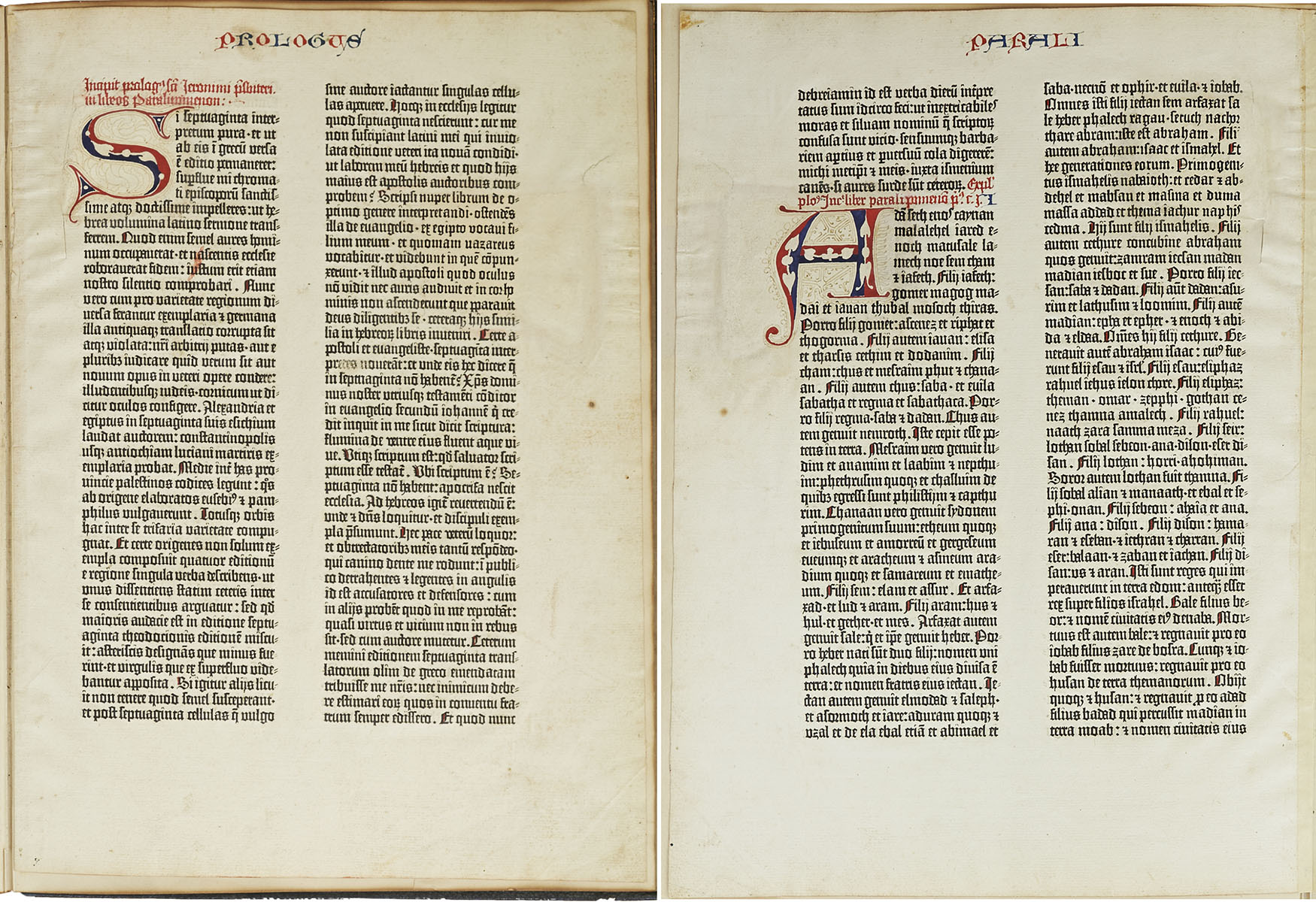
Scarce leaf from the Gutenberg Bible, one of the earliest major books printed from moveable metal type, the invention that ushered in the Age of Enlightenment by democratizing knowledge through mass production of literature. Printed by Johannes Gutenberg in Mainz, Germany from 1450-1455, less than 50 complete or near-complete copies of the Gutenberg Bible are now extant, with nearly all those housed in public institutions. Singular leaves are also scarce, with the leaf presented here having been acquired by bookseller Gabriel Wells, whose purchase of an incomplete Bible in 1920 gave way to selling the individual leaves alongside an essay by A. Edward Newton entitled “A Noble Fragment”. Leaf is number 193 of the full Latin Bible, with the recto being the Prologue to 1 Chronicles of the Old Testament, and the verso the first part of Chapter 1 of 1 Chronicles. Each page features two columns of 42 lines in dark black Gothic type, accented by red and blue rubrication. Each copy of the Gutenberg Bible differs in its rubrication and illumination, with buyers at the time deciding upon these embellishments after the Bible was printed. The six-line rubricated letters of this leaf were likely added later, restored to match the original style. Leaf measures 11.125″ x 15.375″, bound on edge to portfolio measuring 11.75″ x 16″. Paper quality is still bright with very little foxing or discoloration compared to other examples. A stunning example from the book that changed the course of history. Sold for $136,500.
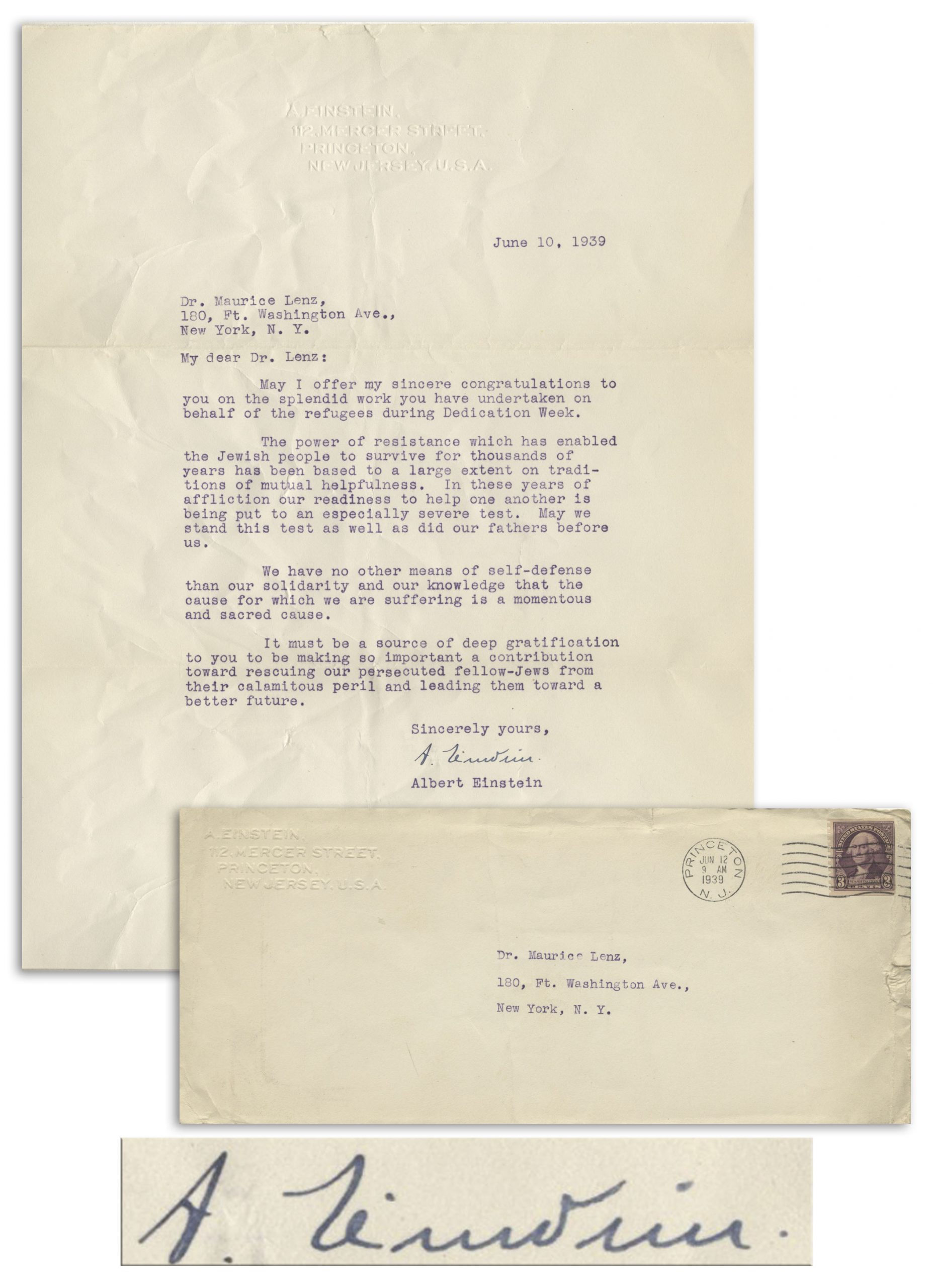
Albert Einstein typed letter signed during World War II, with moving content regarding helping Jewish refugees. Dated 10 June 1939 on his personal embossed letterhead from Princeton, Einstein writes to Dr. Maurice Lenz who worked on ”behalf of the refugees during Dedication Week.” Einstein continues, ”…The power of resistance which has enabled the Jewish people to survive for thousands of years has been based to a large extent on traditions of mutual helpfulness. In these years of affliction our readiness to help one another is being put to an especially severe test. May we stand this test as well as did our fathers before us.
We have no other means of self-defense than our solidarity and our knowledge that the cause for which we are suffering is a momentous and sacred cause.
It must be a source of deep gratification to you to be making so important a contribution toward rescuing our persecuted fellow-Jews from their calamitous peril and leading them toward a better future…[signed] A. Einstein”.
Single page letter measures 8.5” x 11”. Folds and light creasing, otherwise near fine condition. Accompanied by Einstein’s embossed mailing envelope, postmarked Princeton on 12 June 1939. Sold for $134,344.
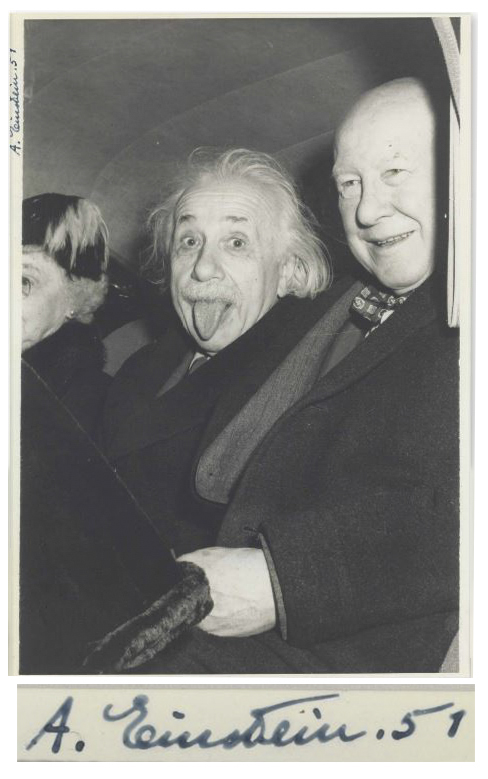
The Most Famous Photo of Albert Einstein, Playfully Sticking Out His Tongue — Extraordinarily Rare as Signed by Einstein
Very rare photo signed by Albert Einstein, on the occasion of the Nobel Prize winner playfully sticking out his tongue to a group of photographers on his 72nd birthday. Photo was snapped on 14 March 1951 by Arthur Sasse, a UPI photographer whose employers were at first hesitant about publishing the iconoclastic image of Einstein; when they did, Einstein was so amused by it that he ordered several prints to give out to close friends. This image is unlike most which crop the photo to show only Einstein. Here, the photo is shown in its full context with Einstein seated between Dr. Frank Aydelotte, head of the Institute of Advanced Study in Princeton, and Aydelotte’s wife, after celebrating his birthday at the Princeton Club. Photo is signed along the left margin ”A. Einstein .51”, indicating he signed the image shortly after it was taken. Photo measures 7” x 10”. Very good to near fine condition. Extraordinarily rare photo signed by Einstein, the most famous and beloved image of him. Sold for $125,000.
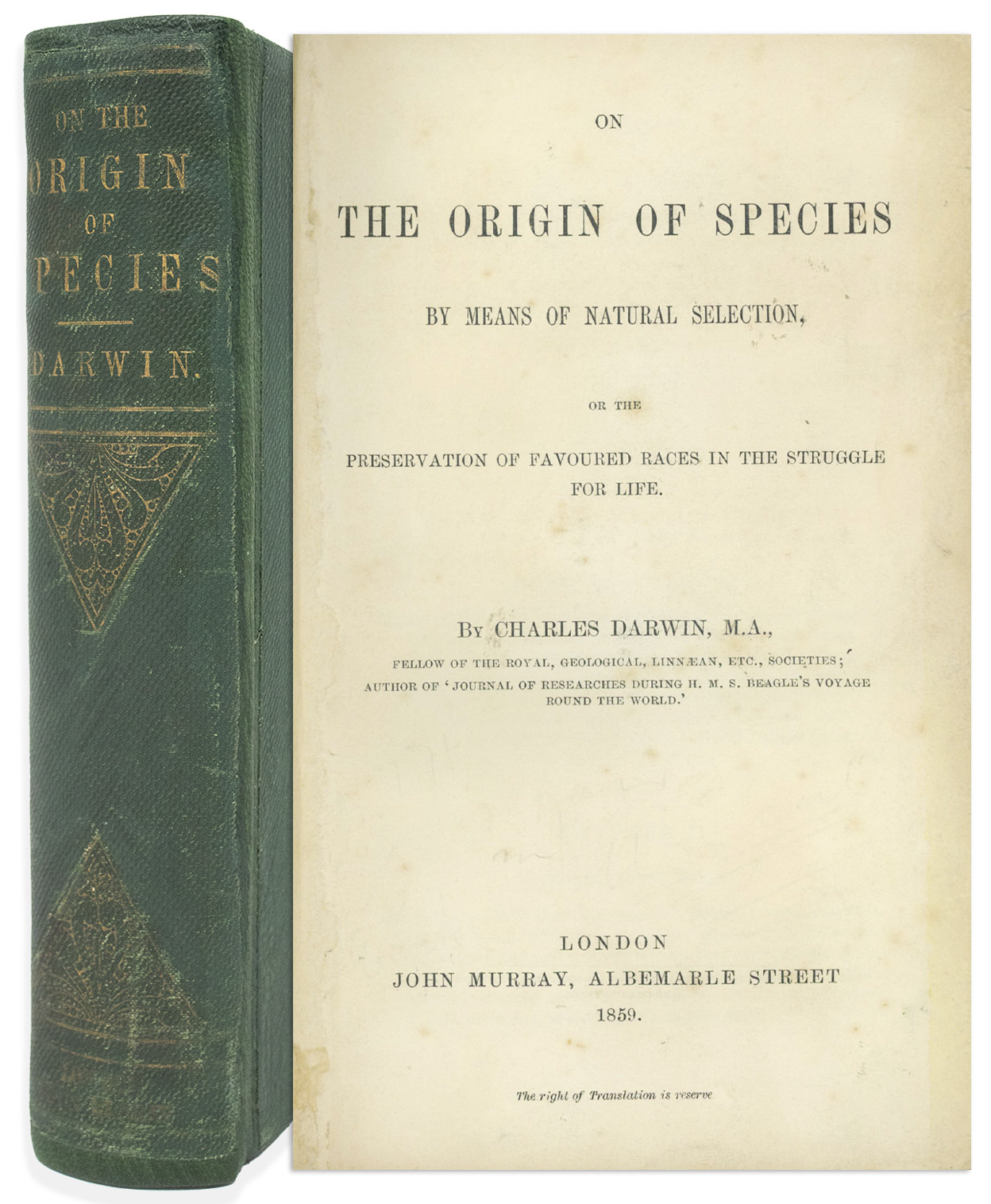
Charles Darwin On the Origin of Species 1st Edition
First edition, first printing of “On the Origin of Species” by Charles Darwin, one of the most important books in the scientific canon. London: John Murray, 1859. In this revolutionary book that upended man’s own view of himself, Darwin posits natural selection as the engine driving species’ evolution, an argument so persuasive that even 19th century religious leaders adjusted their teachings to allow for evolution to work in concert with divine planning. Its importance has only grown in the 150+ years since publication, with Freeman concluding it to be “the most important biological book ever written”. First released on 24 November 1859, its scarcity nearly matches its importance, with the first printing consisting of only 1,250 copies, and the number of extant copies now significantly fewer.
All first printing points are present, including original binding, variant B, title page with copyright information on verso, Table of Contents (pages v-ix) with binder instructions to verso, complete pages 1-502, and folding table present between pages 116-117. Bound in publisher’s full green boards, stamped and lettered in gilt. Overall in very good condition; ads at back of volume have been removed as has half-title page, and endpapers have been replaced. Volume is rebacked using morocco, with original spine laid down. Some shelf wear to boards. Light foxing throughout book, with some chipping, small closed tears with repairs to a few pages, and a few dogeared pages. One small mark on page 109, otherwise no internal writing or marks. Housed in a custom quarter-leather clamshell box. Overall in very good condition, a handsome, presentable copy of this scarce first printing. Sold for $68,250.
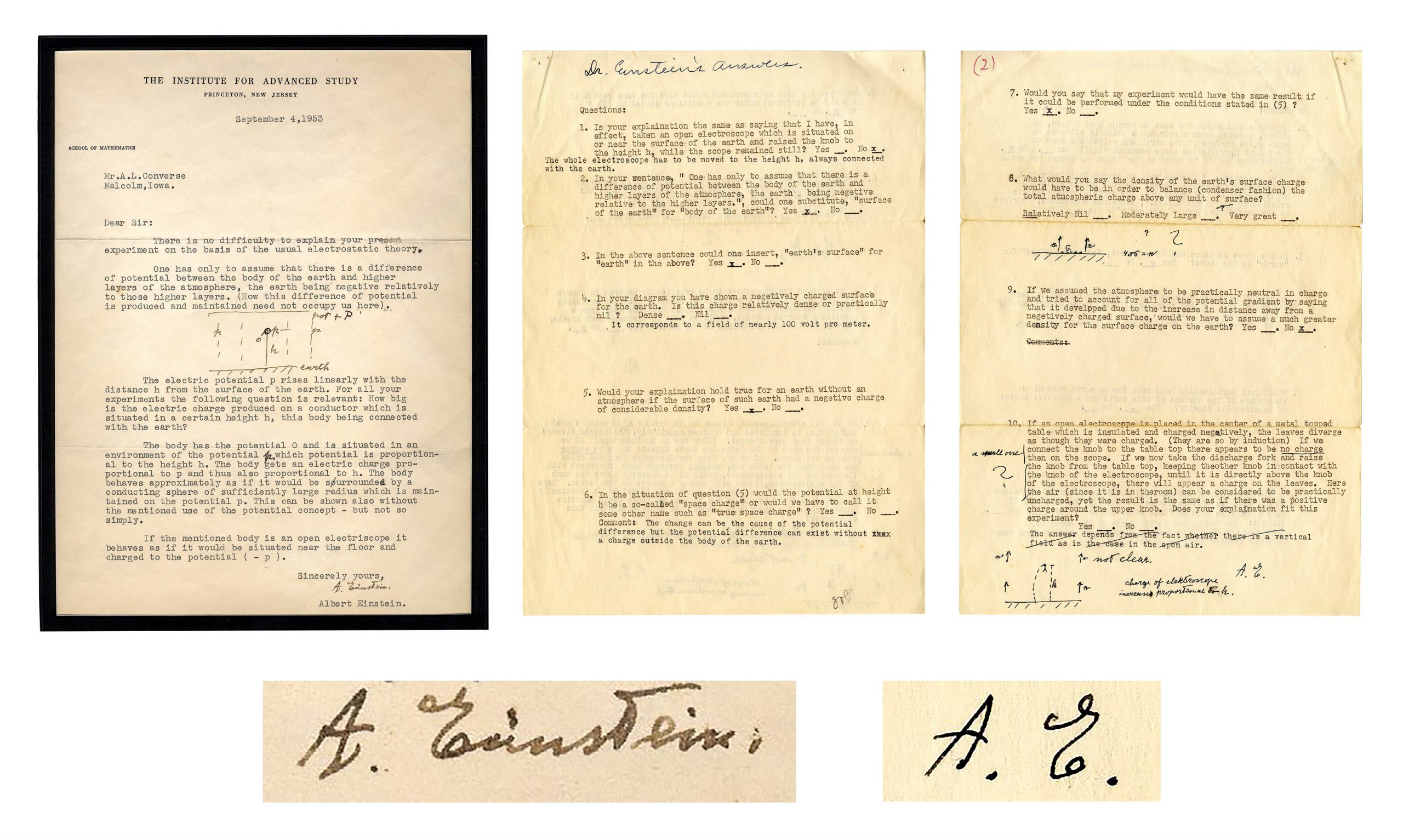
Albert Einstein letter signed with his hand drawings, elegantly explaining his electrostatic theory of special relativity to a physics teacher struggling to reconcile it with experiments he was conducting. In addition to the letter, which is new to the market, Einstein generously replies to a series of questions the teacher asks him on a questionnaire, providing additional drawings and calculations, initialed ”A.E.” at the conclusion. Dated 4 September 1953 on Princeton’s Institute for Advanced Study letterhead, Einstein writes to Arthur L. Converse, the teacher from Malcolm, Iowa, in part, ”There is no difficulty to explain your present experiment on the basis of the usual electrostatic theory. One has only to assume that there is a difference of potential between the body of the earth and higher layers of the atmosphere, the earth being negative relatively to those higher layers…[Einstein then draws Earth and the atmosphere, referring to it for clarification] The electric potential p rises linearly with the distance h from the surface of the earth…For all your experiments the following question is relevant: How big is the electric charge produced on a conductor which is situated in a certain height h, this body being connected with the earth…” Einstein then answers Converse’s questions on a two-page questionnaire. In one answer, Einstein seems to disagree with the question, providing both a diagram and mathematical equation and then a ”?” to try to aid understanding. He later writes ”not clear” to one answer along with a question mark and additional diagram with the notation ”charge of elektroscope increased proportional to h”. An extraordinary lot by Einstein showing the generosity of his time, with rare content on his theory of special relativity. Single page letter and two-page questionnaire each measures 8.5” x 11”. Also included is Einstein’s original mailing envelope from ”Room 115” of the Institute for Advanced Study, postmarked 7 September 1953 from Princeton. Folds and very light toning to letter, otherwise near fine. Questionnaire has folds, light toning and staple mark, otherwise near fine with bold handwriting by Einstein. With an LOA from the nephew of Arthur Converse and new to the market. Sold for $53,504.
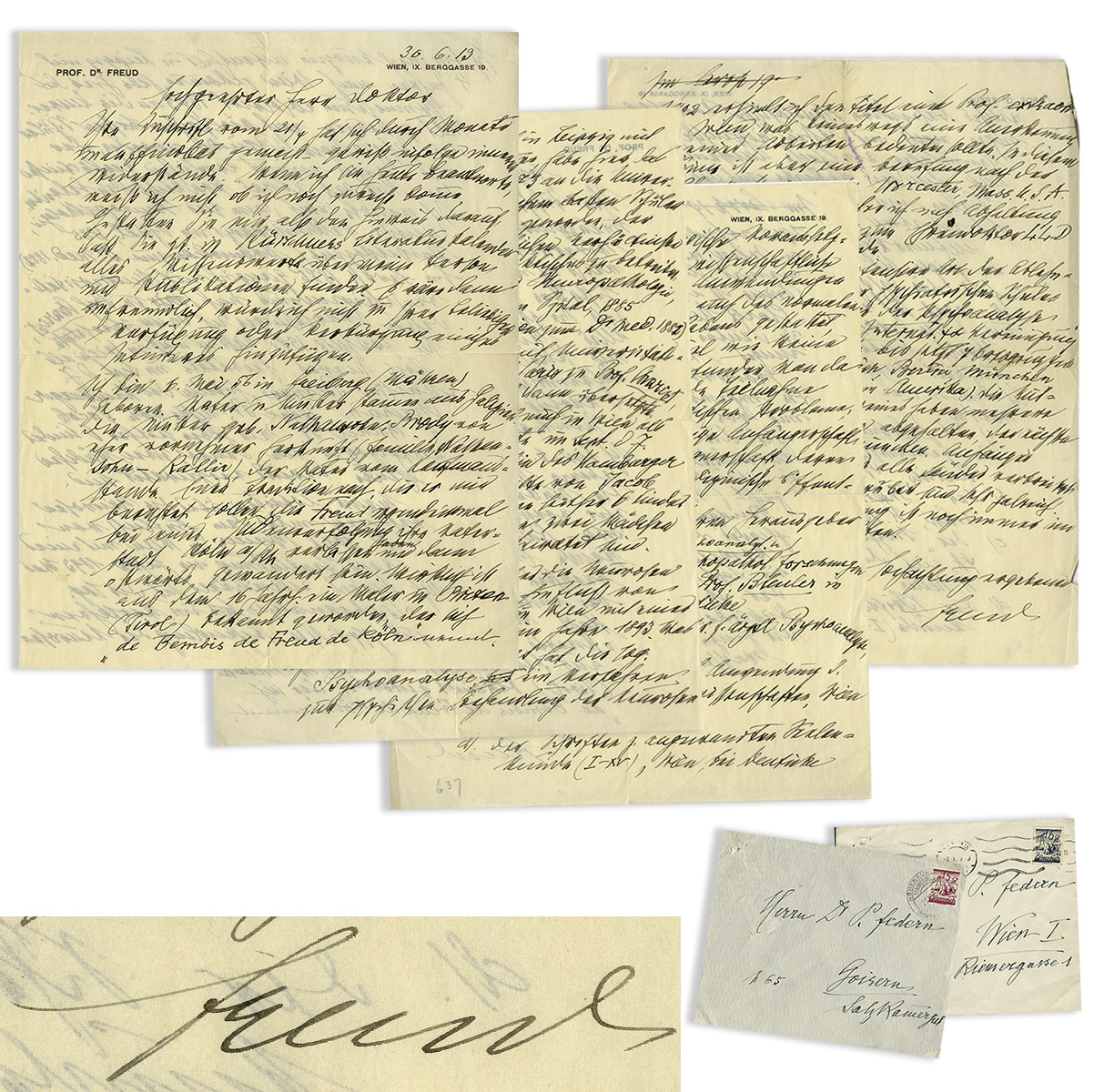
Unusually personal and autobiographical Sigmund Freud autograph letter signed, with content on Freud’s Jewish heritage and ancestry, the growth of psychoanalysis and the ”intense type of rejection” of it by psychiatrists, his marriage and children, and his professional writings and honorary degree; in essence, the whole of Freud’s life and career, as told in his own words. The content is especially important and unusual as Freud kept tight control over his autobiography, with this letter likely the most comprehensive detailing of it. He writes to fellow psychoanalyst Dr. Paul Federn, one of Freud’s earliest proteges, with Freud even dryly commenting in the beginning of his letter that his reluctance to answer Federn’s correspondence (by misplacing it) was ”most likely as a consequence of my resistance”. Dated 30 June 1913 upon his personal stationery from his home in Vienna, four-page letter reads in part,
”For several months, your communication of 04/21 had made itself untraceable – most likely as a consequence of my resistance…I was born on the 6th of May [18]56 in Freiberg /Moravia. My father and mother came from Galicia. My mother, nee Nathansohn, from Brody, of very distinguished ancestry (the Nathansohn – Kallir family), my father of the merchant class. According to tradition, as he once reported to me, the Freud family is said to sometime have left their hometown of Köln [Cologne] during a period of persecution of Jews and then to have migrated eastward…
Four page letter on two sheets, in German, measures 8.25” x 10.75”. Separations starting along folds and small amount of chipping to edges. Overall in very good condition. With full translation, and with two transmittal envelopes to Dr. Federn, both in Freud’s hand. Sold for $25,000.
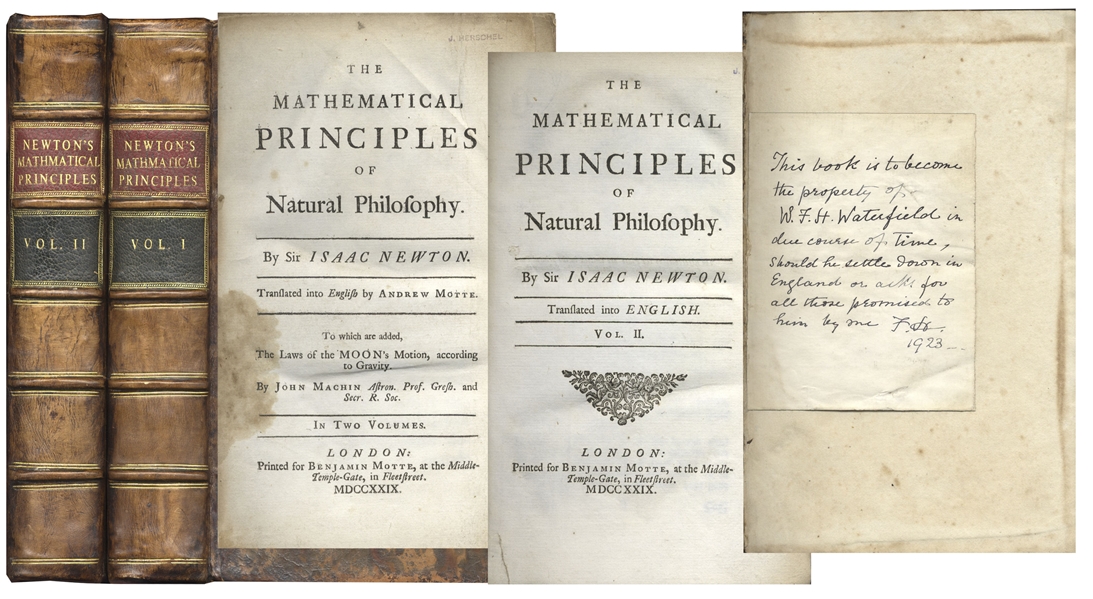
Rare First Edition of Sir Isaac Newton’s ”The Mathematical Principles of Natural Philosophy” — Two Volume Set From 1729
Rare Sir Isaac Newton first edition ”The Mathematical Principles of Natural Philosophy” in two volumes. London: Benjamin Motte, 1729. One of the most important works by the leading mind of the 18th century scientific revolution. Bound in contemporary tree calf, sympathetically rebacked, with gilt tooling to spines. Two octavo volumes measure 5.5” x 8.5” each. Volumes contain two folding letterpress tables and 47 folding engraved plates; the two frontispieces and pp. 385-393 and first 7pp. of index are replaced in facsimile, but hardly distinguishable from the original. The ”Laws of Moon’s Motion” usually found in Vol. II are here bound at end of Vol. I, and with errata for both volumes on verso of E4. Small stain to inner part of title in Vol. I, short tear to lower margin of G1, small section missing from lower margin of M3 and with lower corner cut away of A8 and C4 of ”Laws of Moon’s Motion” (no loss of text). Some marginal dampstaining and occasional soiling and spotting, overall in very good, clean condition with most edges untrimmed. Excellent Isaac Newton first edition. Sold for $22,500.
Auction your Paul Ehrlich signed letter at Nate D. Sanders Auctions. Send a description and images of yourPaul Ehrlich signed letter to us at [email protected].
Charles Darwin autograph letter signed with evolution related content written shortly after ”On the Origin of Species” was published. Dated 16 August (1860 or 1861), Darwin writes to his second cousin William Darwin Fox, who introduced Charles Darwin to entomology. Upon Down, Kent stationery, Darwin writes in part, ”…you had seen a dozen instances of white cats with blue eyes being deaf: how can you by an extraordinary chance remember the sex of any of them…C. Darwin”. Fox’s reply to Darwin, giving additional details on the white, blue-eyed, blind cats, is archived in the Darwin Correspondence Project. Single page letter measures 5” x 8”, with an engraving of Darwin measuring 5.5” x 8”. Uniform toning, mounting tape remnants and writing at top not in Darwin’s hand, overall very good condition. Sold for $15,000.

Tractado de las drogas, y medicinas de las Indias Orien
Cristóvão da Costa or Cristóbal Acosta and Latinized as Christophorus Acosta Africanus (c. 1525 – c. 1594) was a Portuguese doctor and natural historian. He is considered a pioneer in the study of plants from the Orient, especially their use in pharmacology. Together with the apothecary Tomé Pires and the physician Garcia de Orta he was one of the pioneers of Indo-Portuguese medicine.
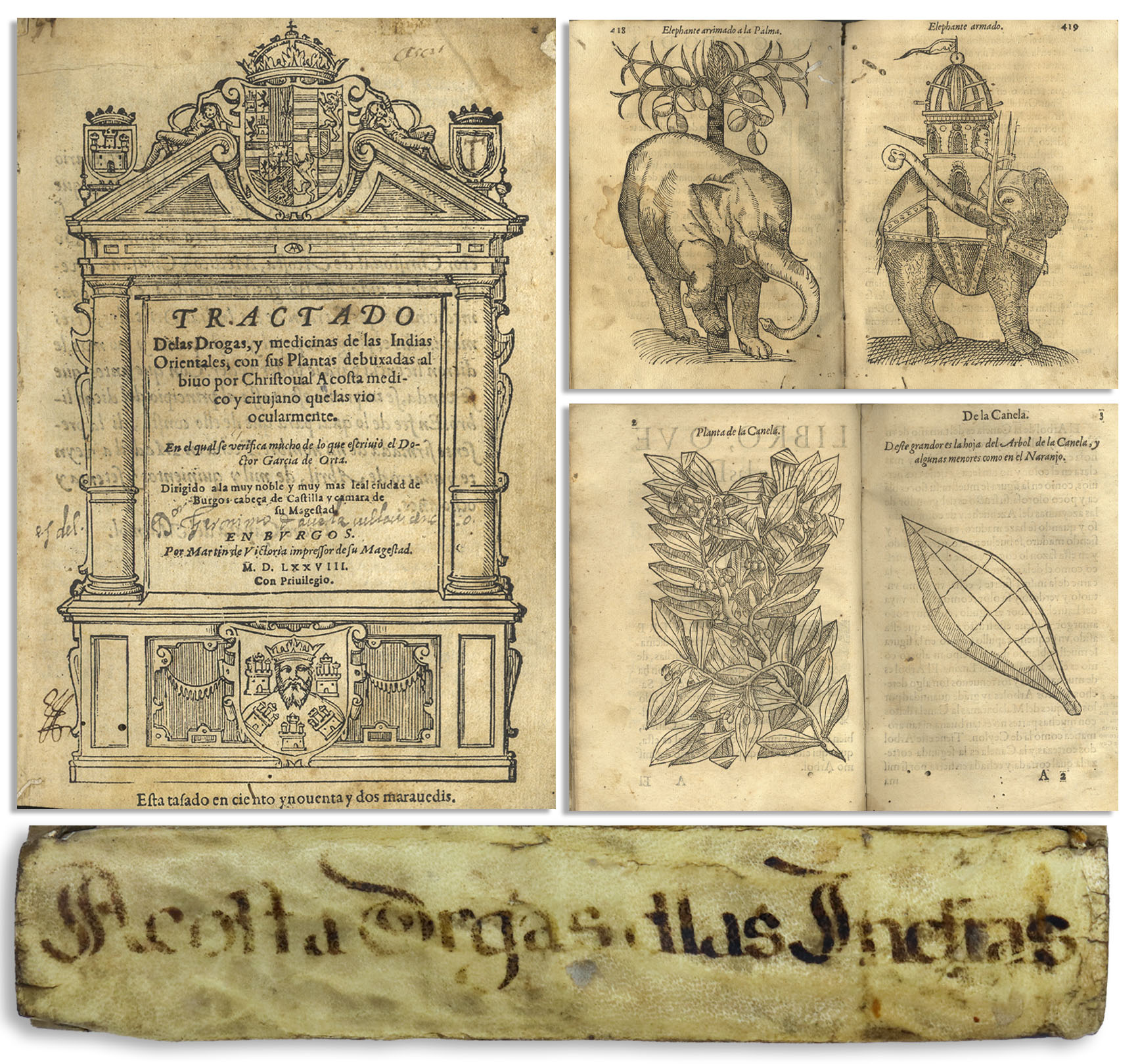
Rare 1578 first edition of “Tractado de las drogas, y medicinas de las Indias Orientales” (“Treatise of the drugs and medicines of the East Indies”) by physician and naturalist Cristobal Acosta. Burgos, Spain: Martin de Victoria, 1578. Bound in original vellum boards with leather ties, rare volume is complete with all woodcuts: title page featuring a portrait of the author, 45 pages of medicinal plants and herbs, and two pages of Asian elephants. Book also features woodcut initials heading each chapter. Acosta’s tomb of therapeutic botany was highly important in its day, giving illustration to exotic plants, animals, herbs and spices from the East Indies during the Age of Exploration, including cinnamon, garlic, nutmeg, coconut, sandalwood, and pineapple, all relatively unknown to Europe at the time. There is even a chapter on opium (“muy usual, y necessaria”), and a chapter on Asian elephants, then described for the first time in a scientific publication. Book measures 5.5″ x 7.375″. Some faint dampstaining, worming to several pages towards the end, and expected age wear. Overall very good plus condition. Sold for $3,900.
Consign your item at Nate D. Sanders Auctions. Send a description and images of your item to us at [email protected].
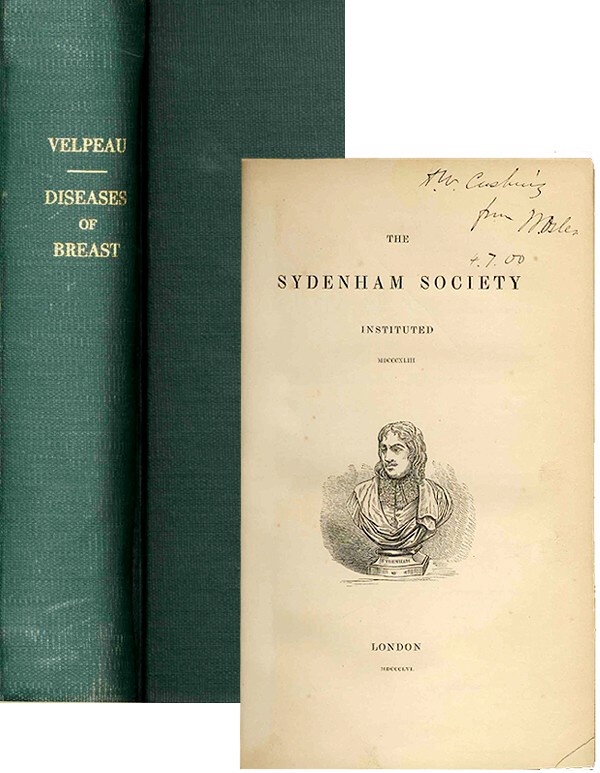
Harvey Cushing / W. Osler Signed Rare Book
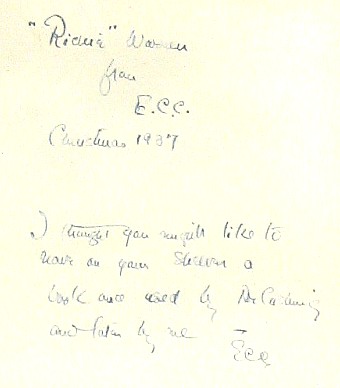
Well-known 19th century French surgeon, Alfred-Armand-Louis-Marie Velpeau’s, “A Treatise on The Diseases of the Breast and Mammory Region.” London: Printed for the Sydenham Society: 1756. Rare book translated from French by Mitchell Henry. Dedicated from esteemed diagnostician Sir William Osler to Harvey Cushing. Cushing, mentored by Osler, won the 1926 Pulitzer Prize for his book on Osler. He passed the edition onto successor Elliot Cutler, who forwarded it to Richard Warren. All were Harvard doctors. Rare Osler-to-Cushing dedication. Sold for $1,353.
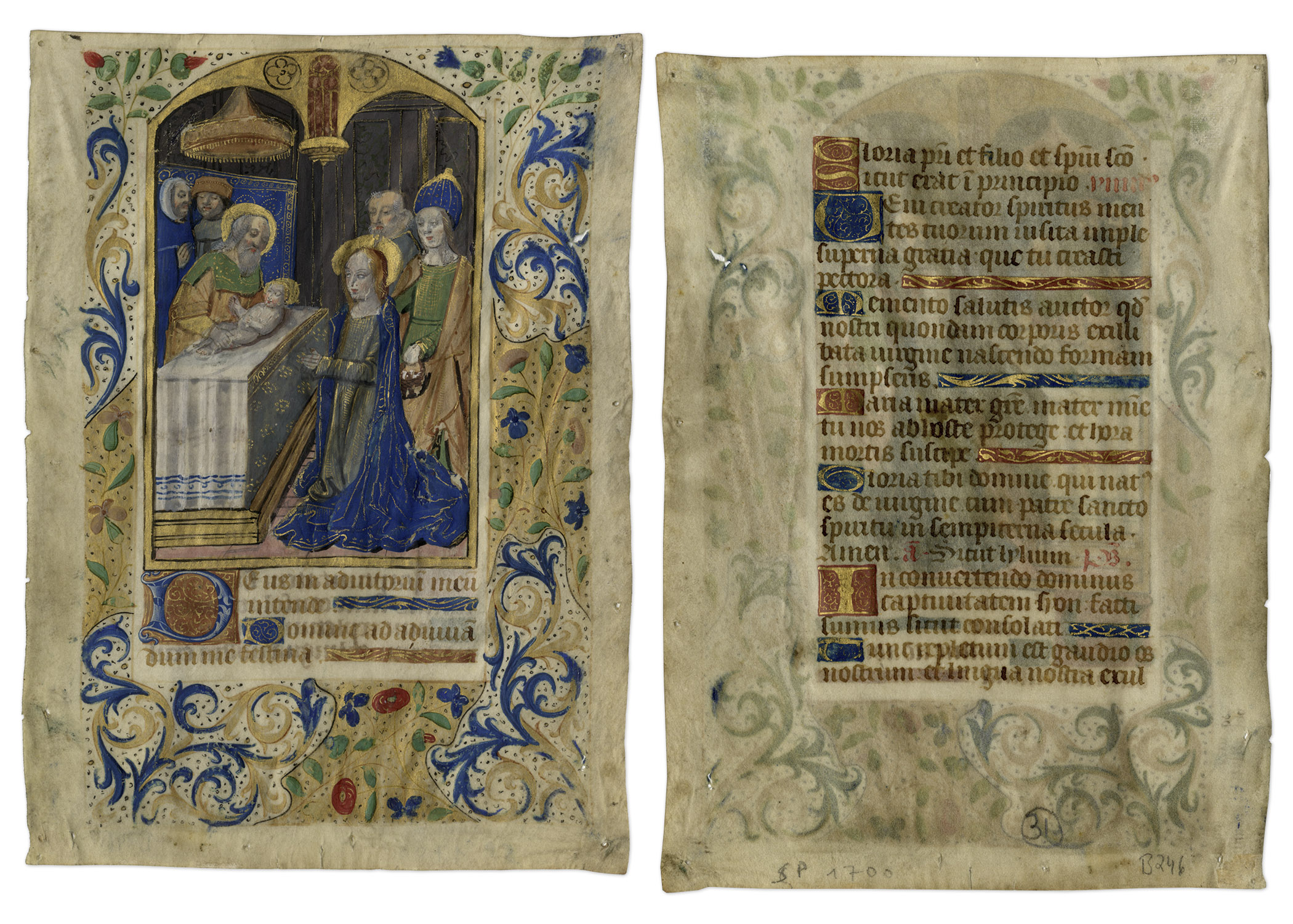
15th Century Hand-Painted Manuscript Page From “Book of Hours” — Illustrates Presentation of Jesus Christ
Hand-painted manuscript page from the liturgical text “Book of Hours”, from Paris, circa 1490. Front of double-sided page illustrates a scene from the presentation of Jesus Christ, who was circumcised on the 8th day after his birth. Includes 3/4 colored acanthus and floral border. Verso has single column with 22 lines of Latin text. Page is made of virgin-vellum and measures 4.25″ x 6″. Near fine condition given age. Sold for $1,469.
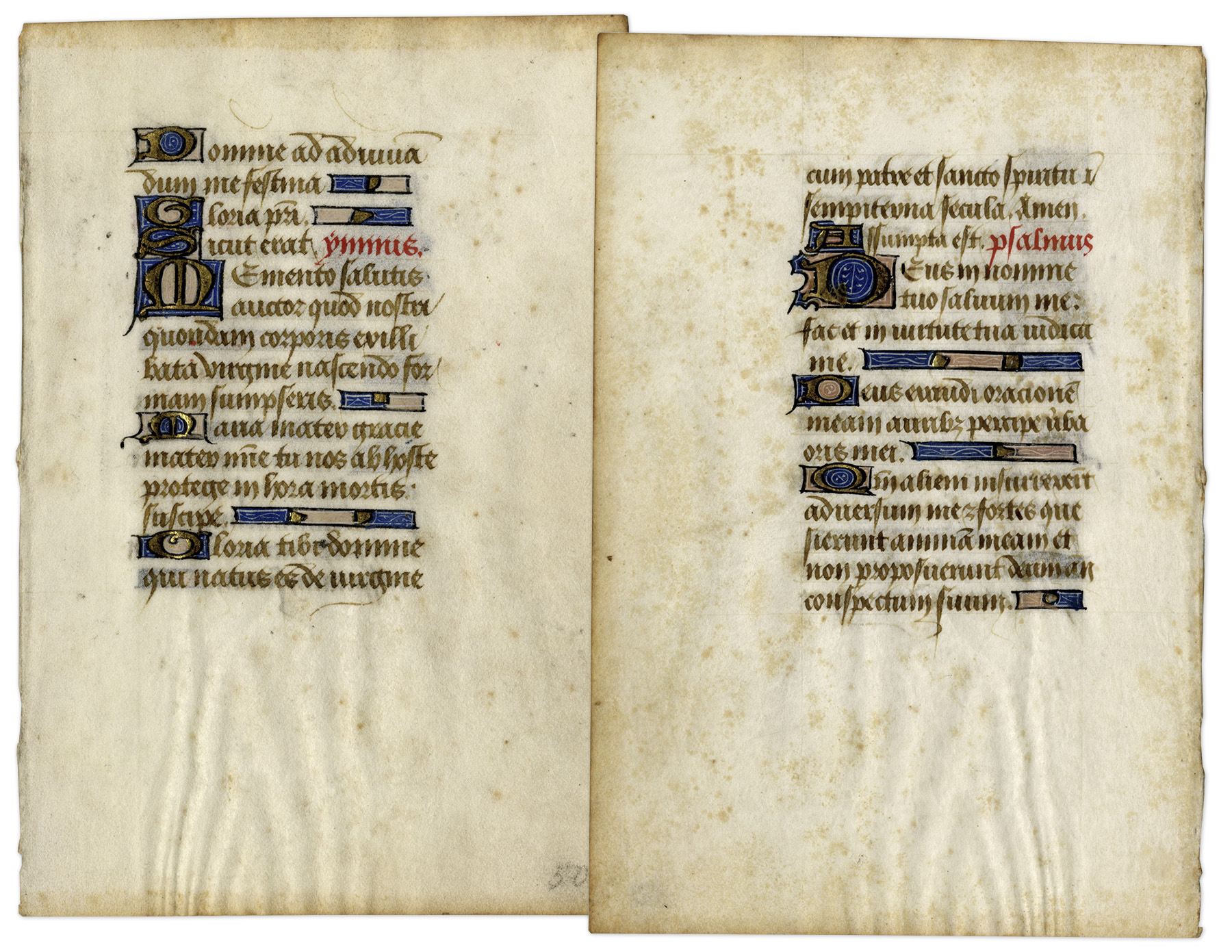
12th Century Hand-Painted Manuscript From ”Book of Hours”
Hand-painted manuscript page from the liturgical text ”Book of Hours”, from Tours in northern France, circa 1250. Double-sided page is beautifully rubricated in bright gold, blue and red. Single columns on each side contain 15 lines of Latin text. Page is made of virgin-vellum and measures 3.5” x 5”. Some rippling to bottom center, minor discoloration to edges and some foxing. Near fine given age. Sold for $1,250.
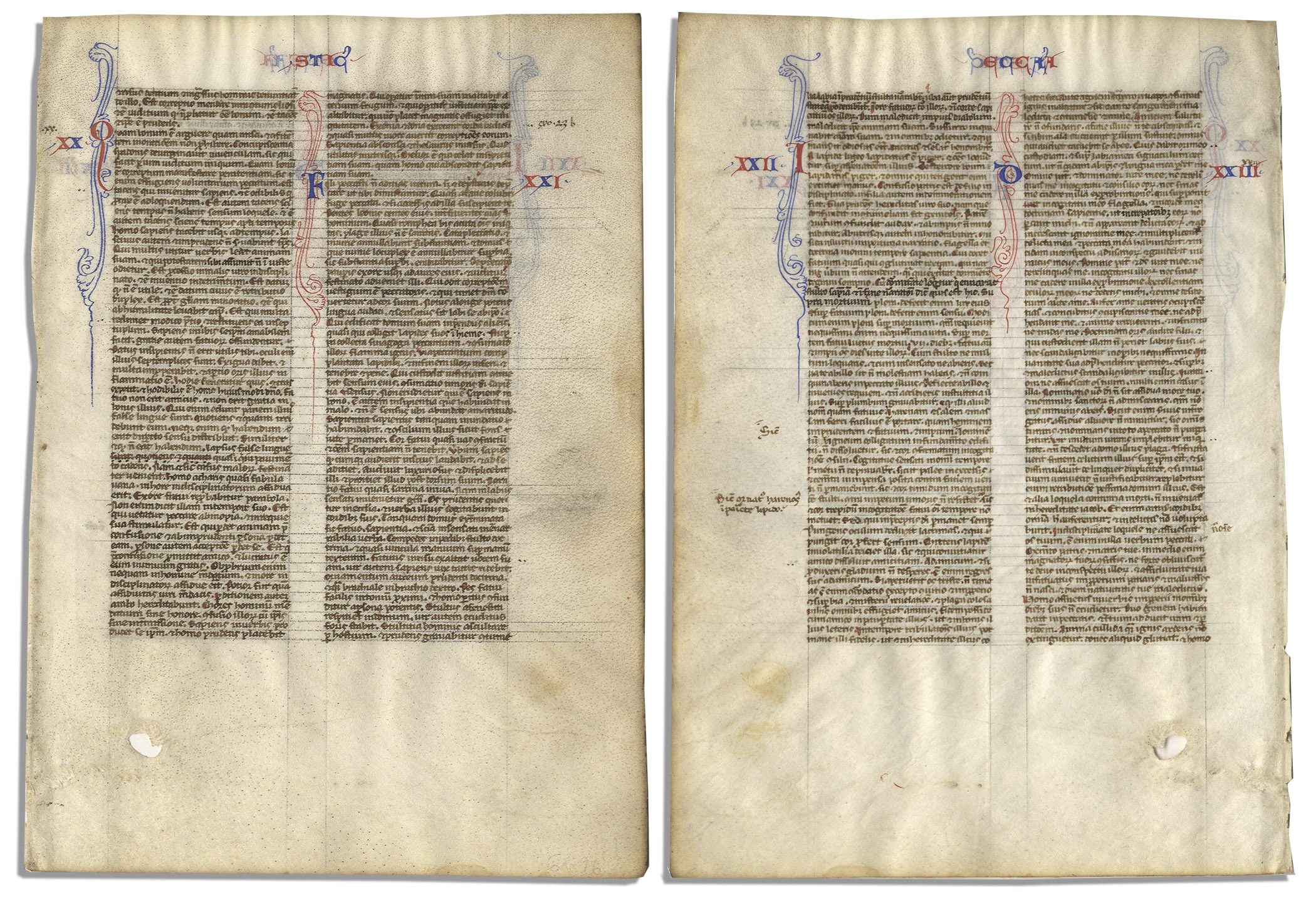
Bible Leaf From the Medieval Age, Circa 1250-1275 — Crusades Era Document on Vellum
Miniature medieval Bible page. Illuminated manuscript Bible page on vellum dates to the mid 13th century when pocket size Bibles were a common means of spreading Christianity to remote areas. Tiny Gothic script in Latin appears in brown ink with red and blue rubrication. Features a total of 56 lines of text, beginning with Ecclesiasticus (Sirach) 20:1 and running through 23:22. Translates in part, ”How much better is it to reprove, than to be angry, and not to hinder him that confesseth in prayer…The slipping of a false tongue is as one that falleth on the pavement: so the fall of the wicked shall come speedily…Flee from sins as from the face of a serpent: for if thou comest near them, they will take hold of thee. The teeth thereof are the teeth of a lion, killing the souls of men…The mourning for the dead is seven days: but for a fool and an ungodly man all the days of their life…” Thin sheet features text on both sides. Measures 4.25” x 6”. Hole in the margin at lower right is likely from original stretching. Very slight buckling to top edge. Near fine given age. Sold for $1,100.
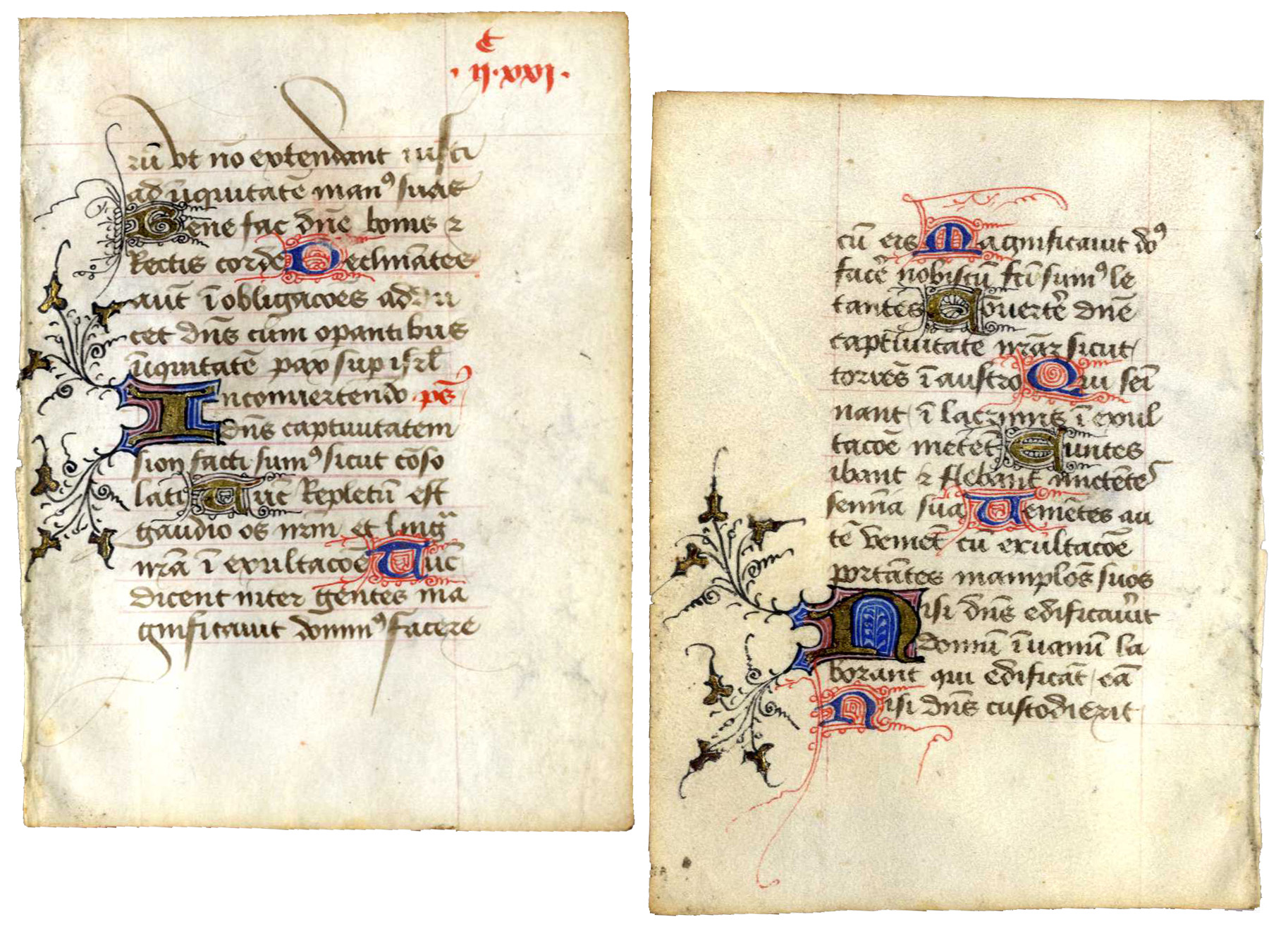
Illuminated Leaf From 15th Century French Psalm Book
Beautiful leaf from a 15th century French Book of Psalms. Fifteen lines of rubricated and gilt text appear on each side of the vellum leaf, written in a Gothic script. These illuminated leaves were created in the middle ages by artist scribes, who wrote in extraordinary detail, embellishing the text with gold, red and blue dyes. Because of the labor involved, the books were quite expensive at the time, and individual leaves have since been collected as works of art. Leaf measures approximately 3″ x 4″. Light toning, else near fine. Sold for $756.
Consign your Prodigiorum Ac Ostentorum Chronicon 1557 at Nate D. Sanders Auctions. Send a description and images of your Prodigiorum Ac Ostentorum Chronicon 1557 to us at [email protected].