
Sell or Auction Your Pierre de Coubertin Autograph Letter Signed for up to About $2,000 or More at Nate D. Sanders Auctions
FREE ESTIMATE. To buy, auction, sell or consign your Pierre de Coubertin autograph letter signed that is for sale, please email your description and photos to [email protected] of Nate D. Sanders Auctions (http://www.NateDSanders.com).
Sell Your Pierre de Coubertin Autograph Letter Signed
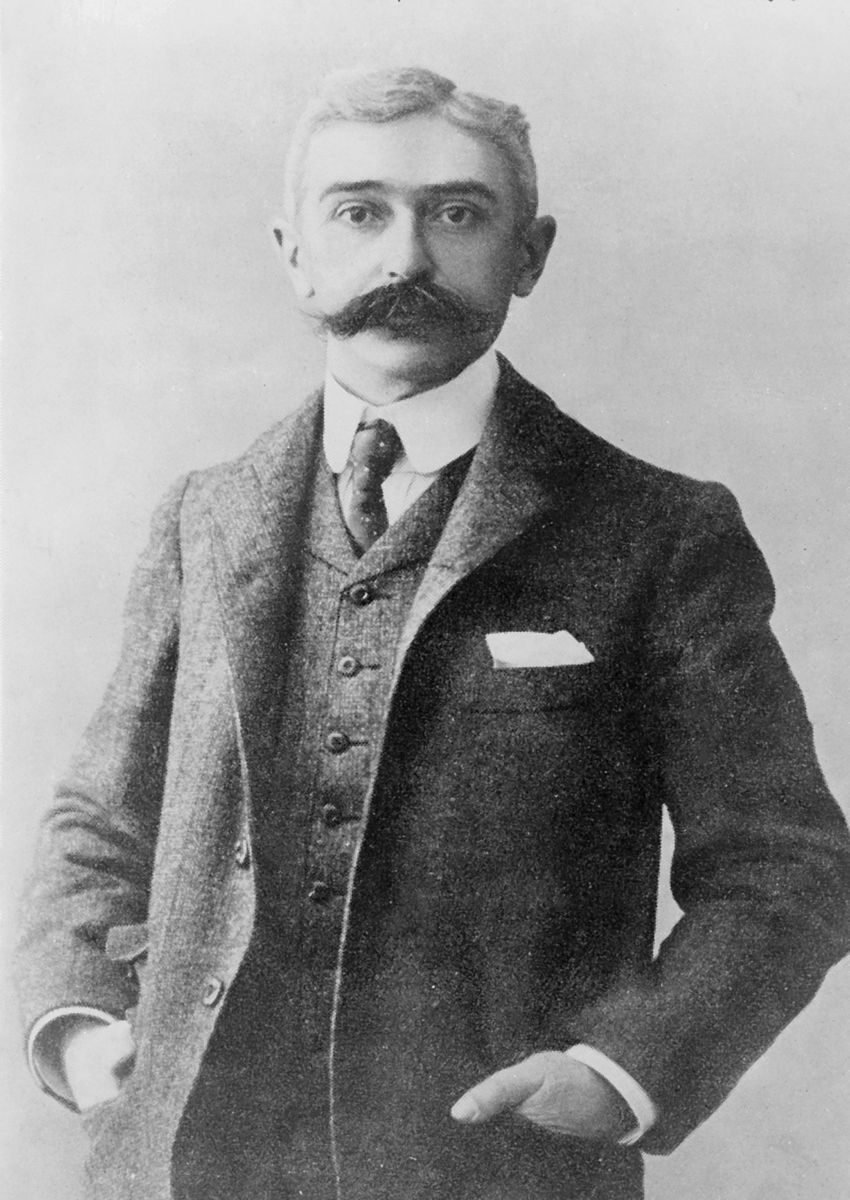

Below is a recent realized price for an autograph letter signed by French educator, Pierre de Coubertin, who is known as the father of the modern Olympic Games. We at Nate D. Sanders Auctions can obtain up to this amount or more for you:
Pierre de Coubertin Autograph Letter Signed. Sold for About $2,000.
Here is some memorabilia related to the modern Olympic Games that we have sold:
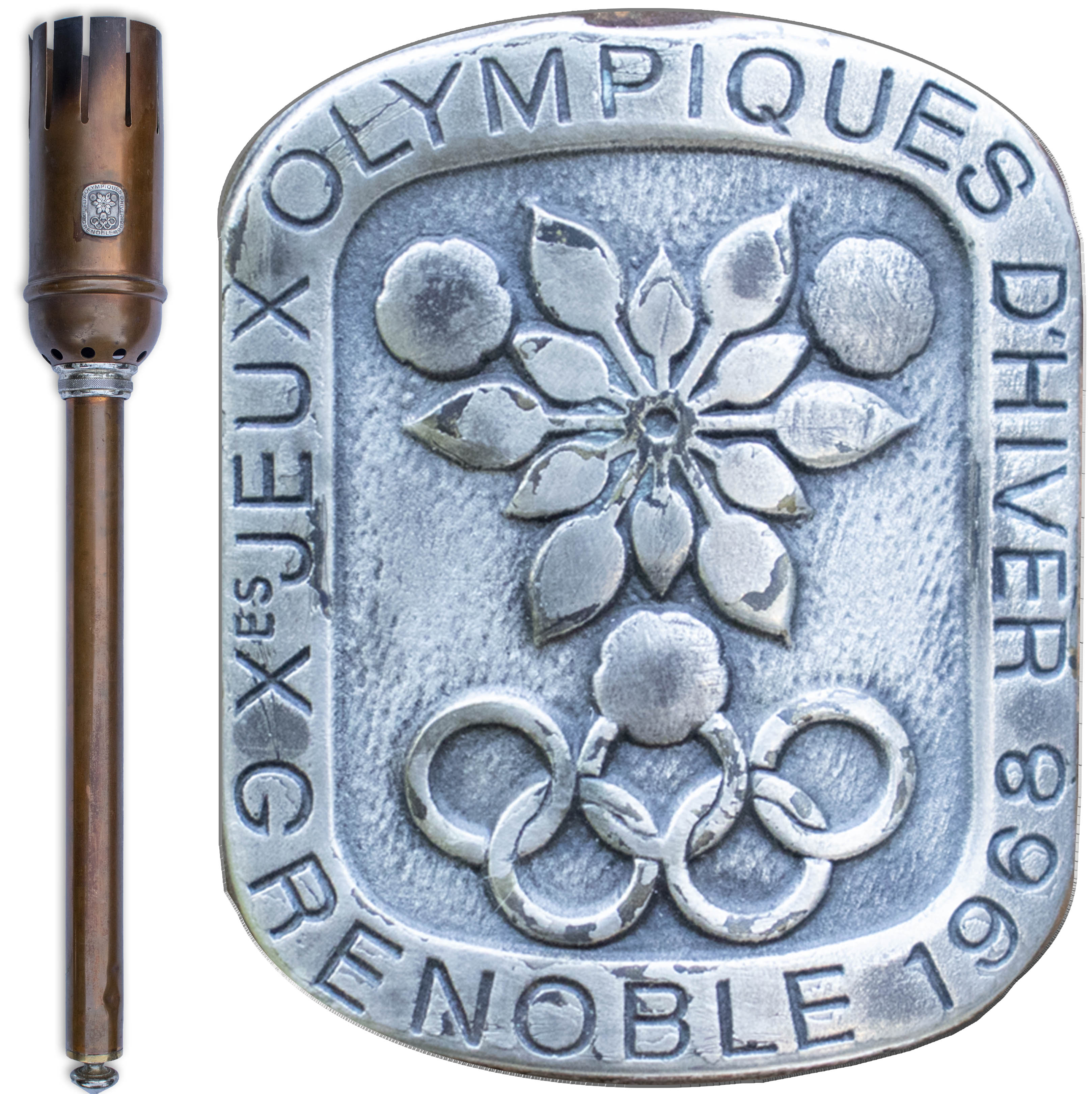
Olympic relay torch used in the 1968 Winter Games in Grenoble, France, one of only 33 produced by the Societe Technique d’Equipement et de Fournitures Industrielle (STEFI), the scarcest of all Olympic torches. The Torch Relay tradition began in 1928, and transports a spark – ignited by the sun using a parabolic mirror, from the parent flame in Olympia, Greece to the host city in time for the Opening Ceremonies. In this case, the flame was carried by over 5,000 torchbearers, ending at Grenoble on 6 February 1968 to launch the Games. Copper plate torch features a crenellated design at top, resembling the Olympic flame and also serving as its wind shield. The long handle segues to the top portion that holds the burner, distinguished by a silver plate featuring the official emblem of the Games designed by Roger Excoffonan. Torch measures 30” long and 3.75” wide at top. Burning apparatus is no longer present, as is often the case, and torch has only one silver plate rather than three. Small dent at bottom of handle. Remnants of soot from its use during the Games. One of the finest Olympic torches offered for sale, part of a select group of 33, all individually manufactured before mass production of Olympic torches became standard. Displays beautifully. Sold for $178,500.
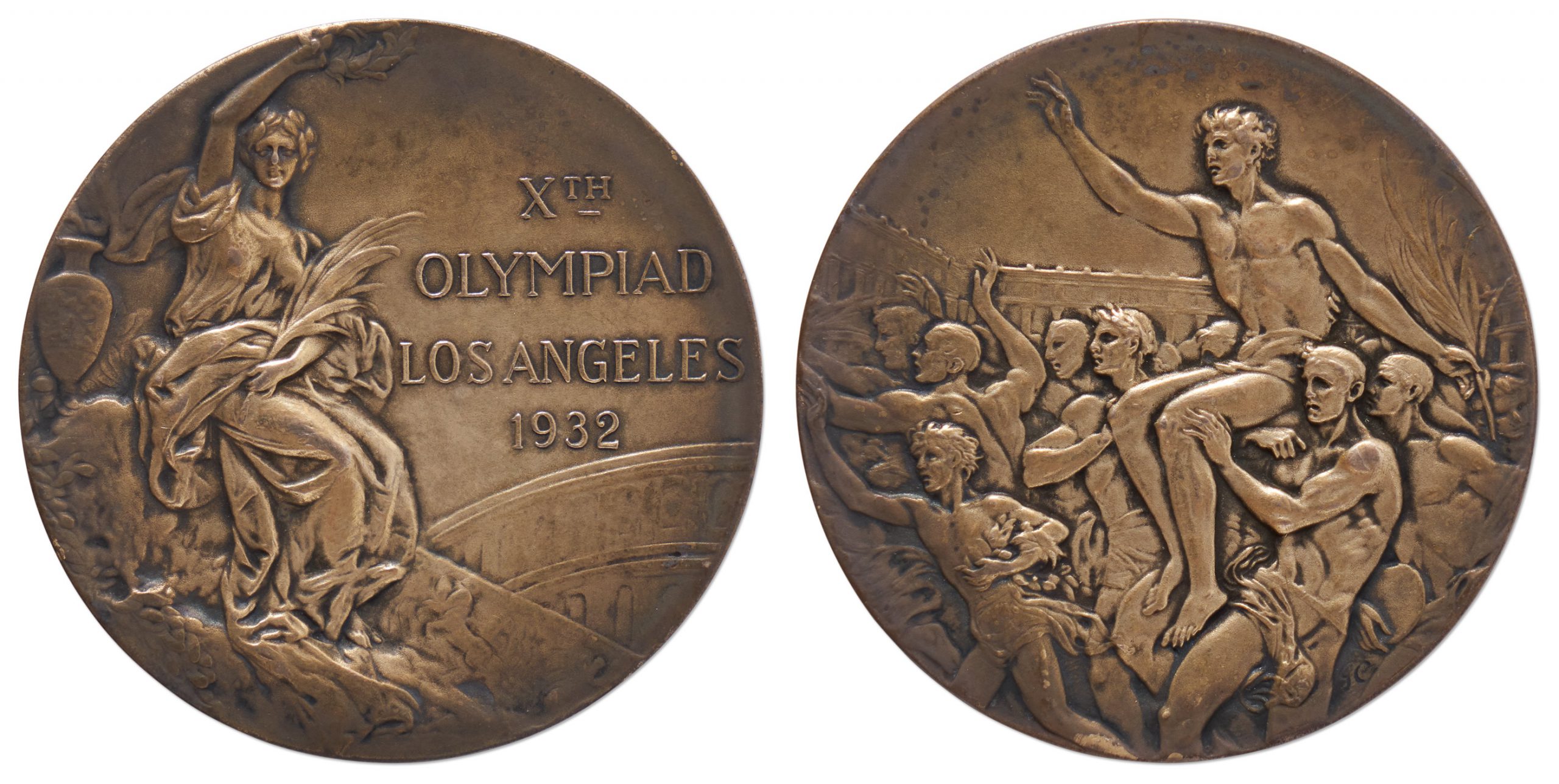
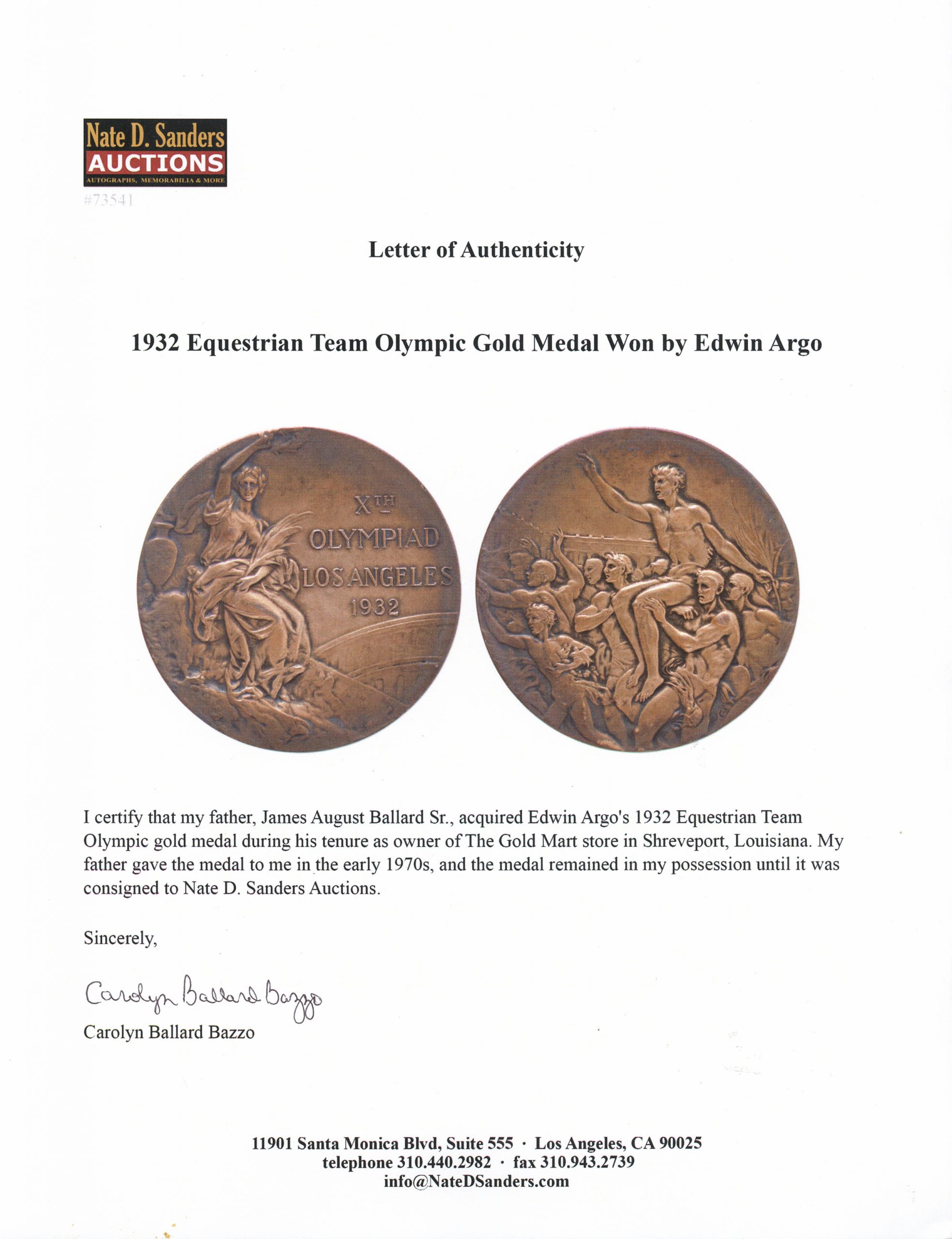
Gold Medal Awarded in the 1932 Summer Olympics, Awarded to U.S. Equestrian Team Member Edwin Argo
Extraordinary rare Olympic gold medal awarded in the 1932 Summer Games, won by American Edwin Argo in the Equestrian Team Event. Riding his horse Honolulu Tomboy, Argo was the only rider with no faults in the jumping portion of the three-day event that won gold for the United States. He was also the only field artillery officer in the competition, having attended West Point before dropping out to fight in World War I.
Designed by Giuseppe Cassioli, front of medal bears a relief of the traditional goddess of victory holding a winner’s crown, with the words ”Xth Olympiad Los Angeles 1932”. Reverse features an Olympic champion carried in triumph by the crowd. Measures 55 mm in diameter, and weighs 97 grams. Some tarnishing and spotting to top of obverse. Very good condition. Accompanied by an LOA from the consignor, whose parents owned a gold store in Shreveport, Louisiana where this medal was sold in the 1970s. Argo passed away in Shreveport in 1962. Sold for $36,875.
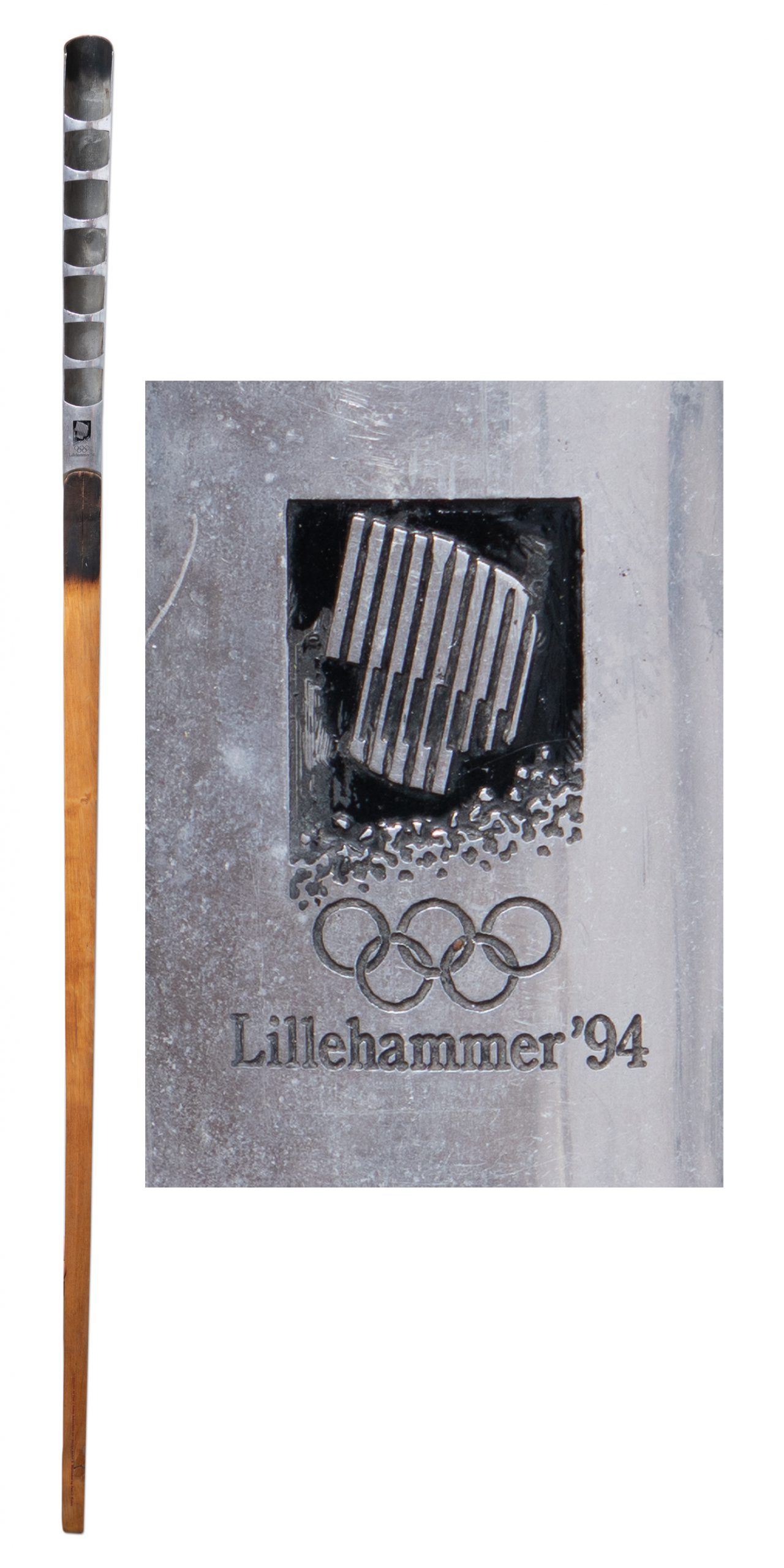
Scarce Lillehammer Olympic Torch Used in the Relay for the 1994 Games
One of the rarest Olympic torches, the Lillehammer torch used in the relay leading up to the 1994 games, which traveled from Olympia, Greece to Lillehammer, Norway, even extending up into the Arctic Circle. The Lillehammer torch is also the longest of all Olympic torches, measuring 60″, called the “Noble” by its designers for its long, regal appearance, made to appear harmonious with its torchbearer.
The Lillehammer torch was designed by Andre Steenbuch Marandon and Paal Christian Kahrs, whose inclusion of birchwood in the design pays homage to Norway’s birchwood forests, and the aluminum and copper elements symbolizing Norway’s modernity. Manufactured by Paal J. Kahrs Arkitekter AS. Polished aluminum blade has the Lillehammer Olympic emblem at base, with torch designer and manufacturer printed in red at base of birchwood handle. The number 8 also appears in black on bottom of handle. Torch lacks copper burner, otherwise very good condition, with a small crack in the birchwood at the bottom of the handle, and singeing to wood near top as expected. Scarce. Sold for $27,000.
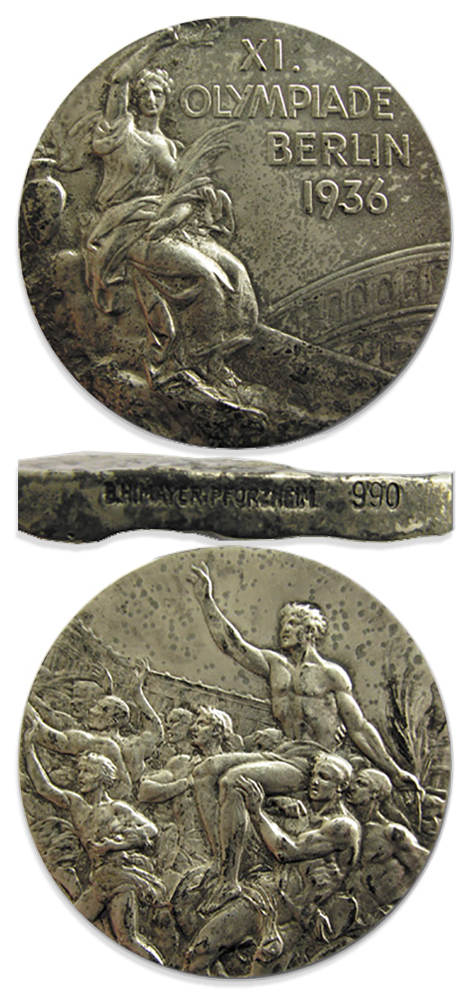
Silver Medal From the 1936 Summer Olympics, Held in Berlin, Germany
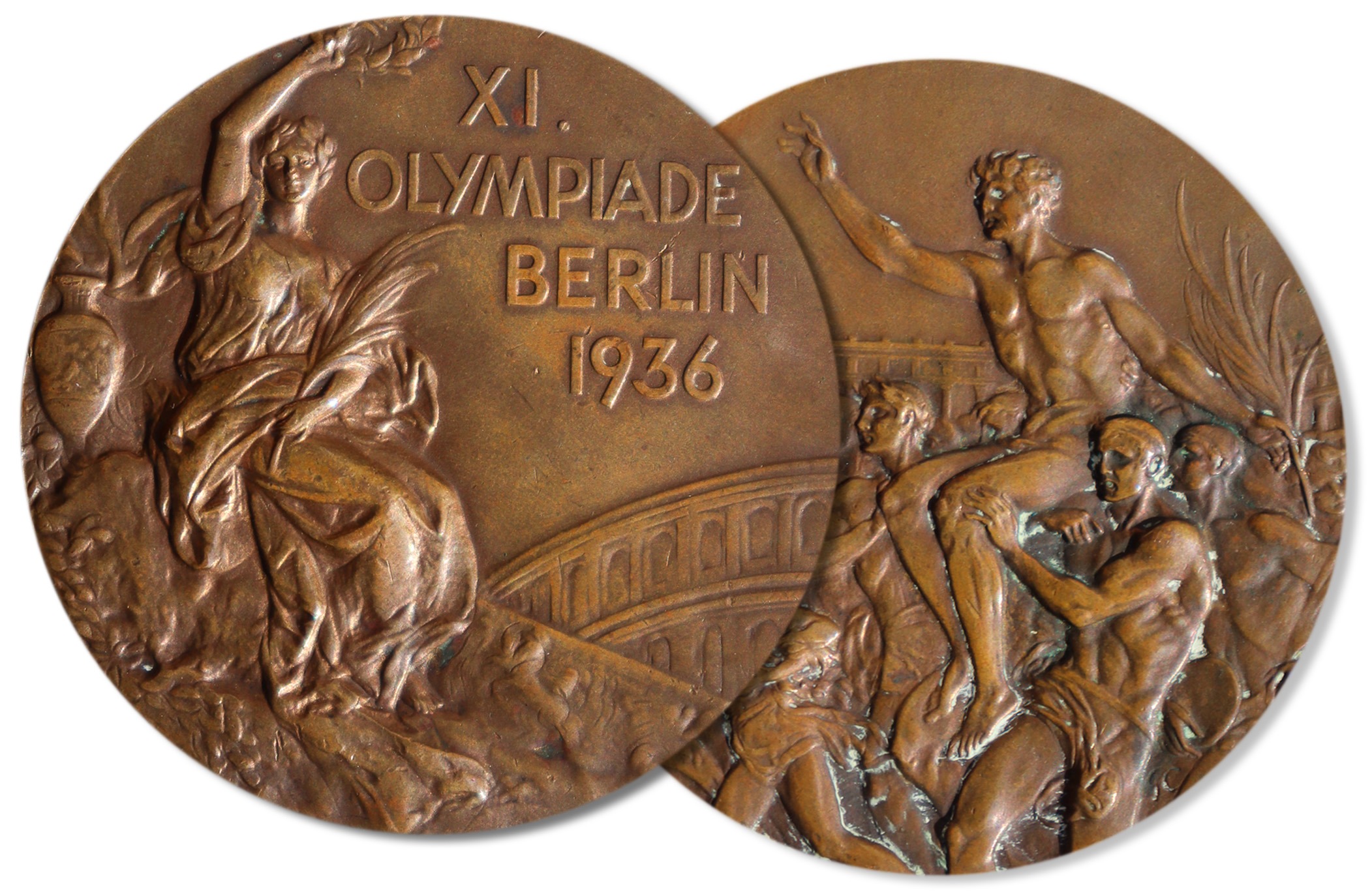
Silver medal from the XI Olympiad, won at the Olympic games in Berlin, Germany in 1936. Medal bears relief of the goddess Victory to obverse, as she holds a winner’s crown in her right hand and a palm leaf in her left, accompanied by the inscription, ”XI / Olympiade / Berlin 1936”. Verso bears a relief of an Olympian carried through a crowd, the Olympic stadium in the background. Rim shows ”B.H. Mayer, Pforzheim 990”, the silversmith who manufactured the Olympic medals that year, along with the silver weight. Measures 2.2” in diameter. Some tarnishing. Very good. Sold for $15,625.
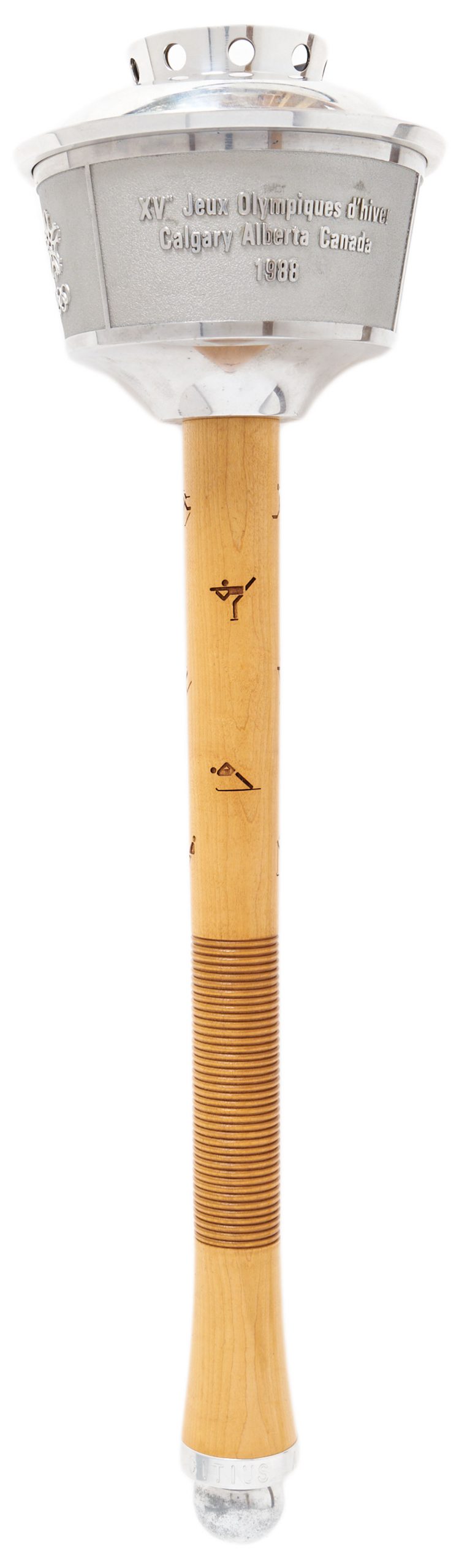
Olympic Relay Torch Used in the 1988 Calgary Winter Games — One of the Scarcest Olympic Torches
The Calgary Olympic torch used in the relay leading up to the 1988 games and one of the scarcest of Olympic torches, as they were designed to be shared among the nearly 6,500 torchbearers. The 1988 Olympic torch relay was also immensely popular, with about 6.6 million applications to be a torchbearer.
The torch features all Canadian materials: a maple handle – laser engraved with 10 pictograms representing the Olympic winter sports, contrasted with an aluminum bowl at top, and an aluminum ball at bottom. The bowl has ”XV Olympic Winter Games / Calgary Alberta Canada / 1988” in relief, in both English and French, along with the Olympic logo. The underside of the bowl is engraved, ”COA/A.O.C. 1979-1986”, and the bottom portion is engraved with the Olympic motto, ”Citius, Altius, Fortius”.
Torch measures 23.625” long, and includes burner accessories: the torch bowl spring, spring holder, and topper, which has wax residue, as does the bottom of the bowl. The spent fuel canister and wicks are not present. Torch has been well-preserved, in near fine condition. A stunning example. Sold for $15,000.
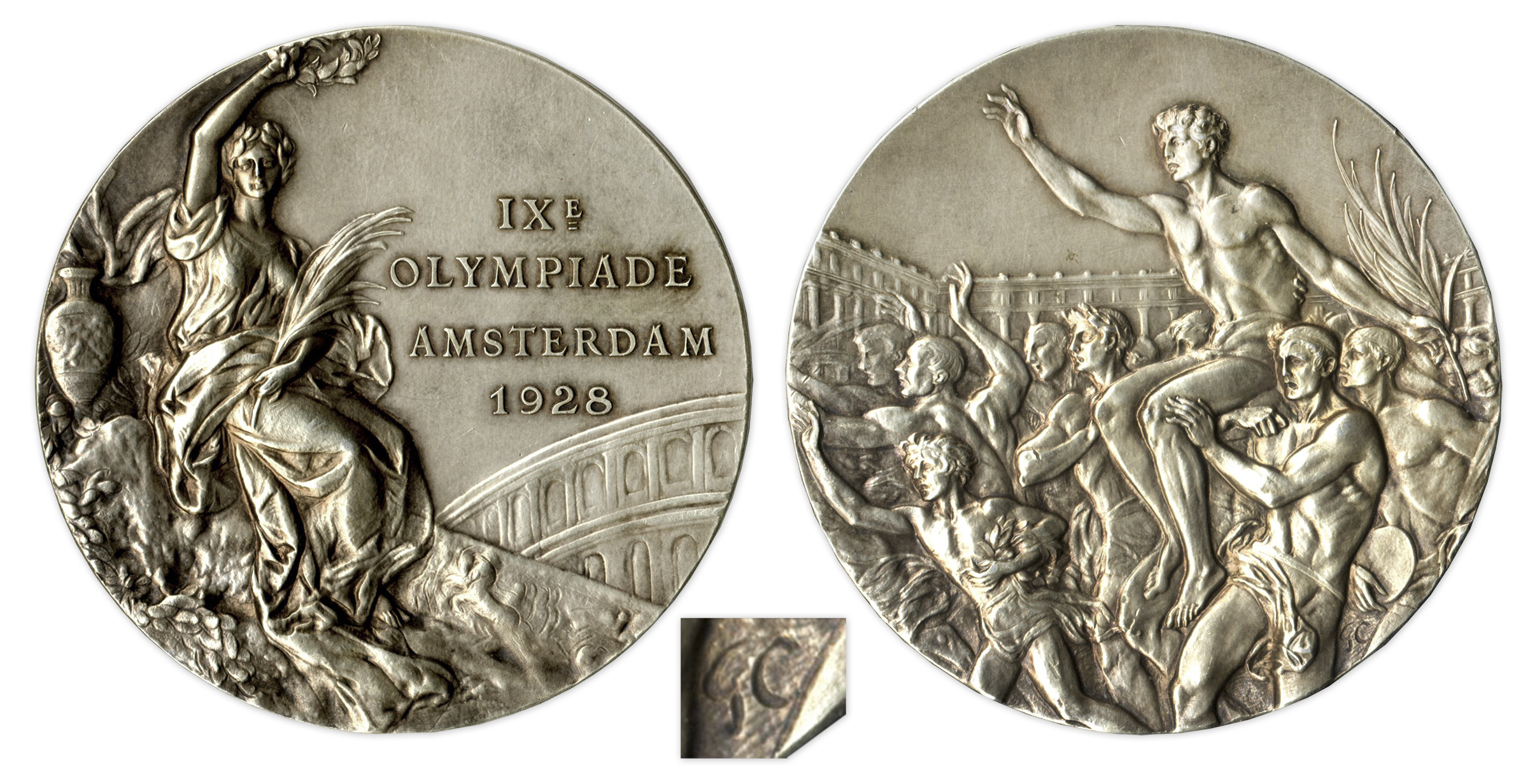
Gold Olympic Medal From the 1928 Summer Olympics, Held in Amsterdam, Netherlands
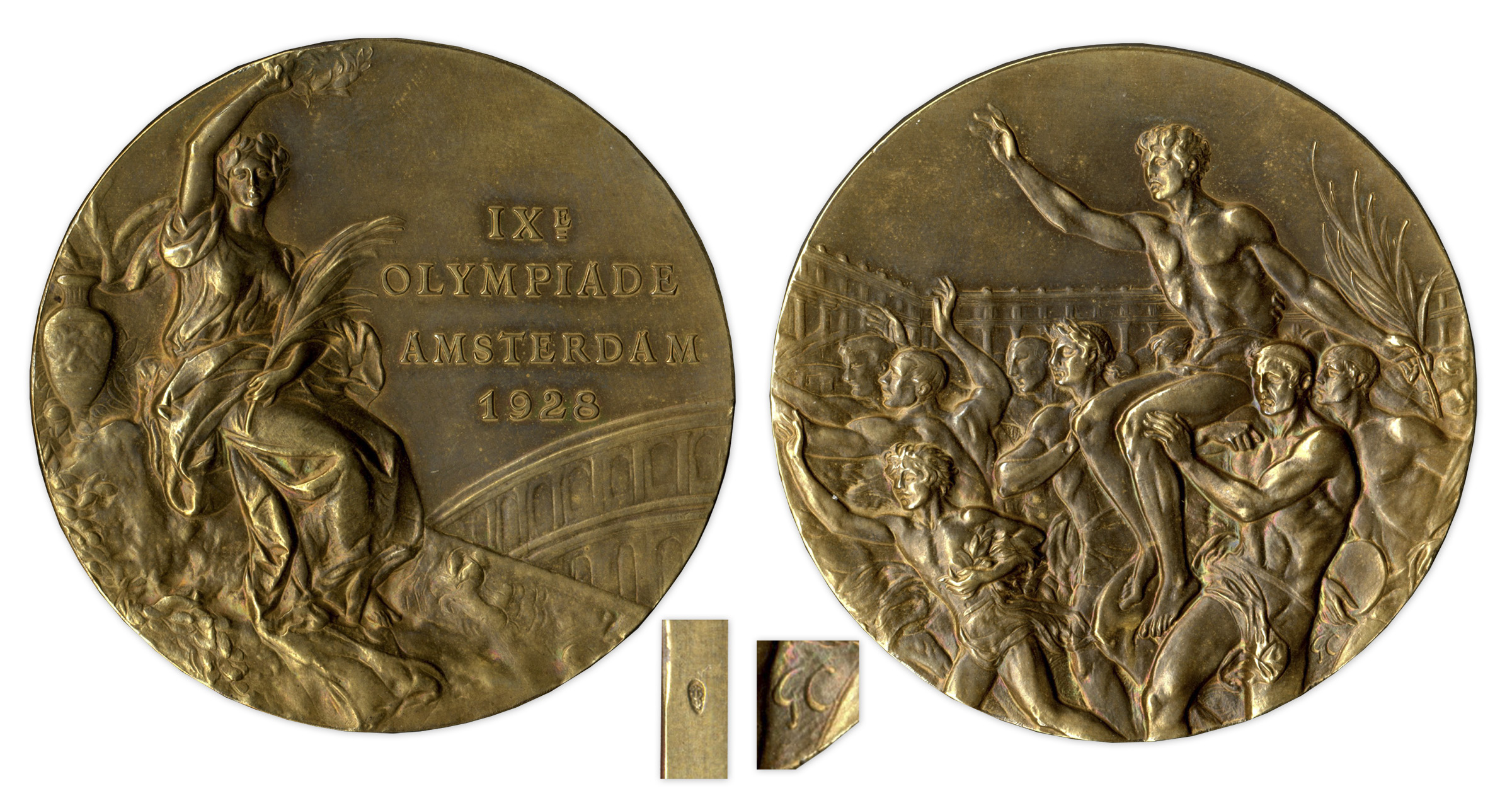
Gold medal from the IX Olympiad, won at the games in Amsterdam, Netherlands in 1928. Medal bears relief of the traditional goddess of victory, as she holds a palm in her left hand and a winner’s crown in her right, with an Olympic champion carried in triumph by the crowd. This was the first Olympics bearing this medal design by Giuseppe Cassioli, which remained until the 1972 games. Measures 2″ or 55 mm in diameter and weighs 68 grams or 2.4 oz. Near fine condition. Sold for $14,079.
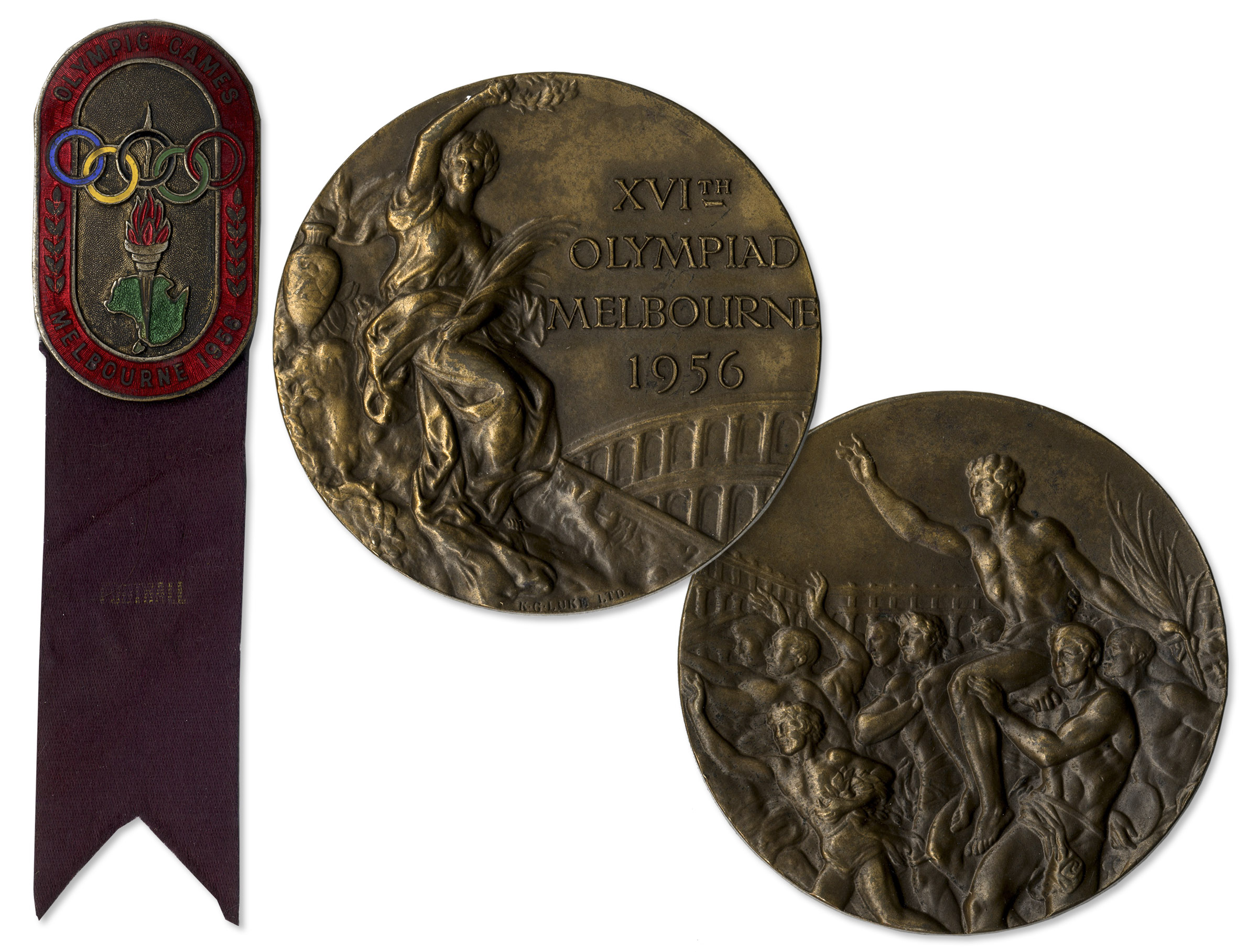
Bronze winner’s medal and badge from the XVI Olympiad, won by a member of the Bulgarian football team in Melbourne, Australia in 1956. The Bulgarian football team defeated India 3-0 in the Bronze medal game on 7 December 1956. Medal bears a relief of the goddess Victory to obverse, as she holds a winner’s crown in her right hand and a palm leaf in her left, accompanied by the inscription, ”XVIth / Olympiad / Melbourne 1956”. Reverse contains a relief of an Olympian carried through a crowd, the Olympic stadium in the background. Lot also includes the Olympic badge, attached to a purple ribbon with ”Football” printed in gold lettering. Medal measures 51 mm in diameter and weighs 63 grams. Slight fading to lettering on badge, otherwise near fine. Sold for $12,500.
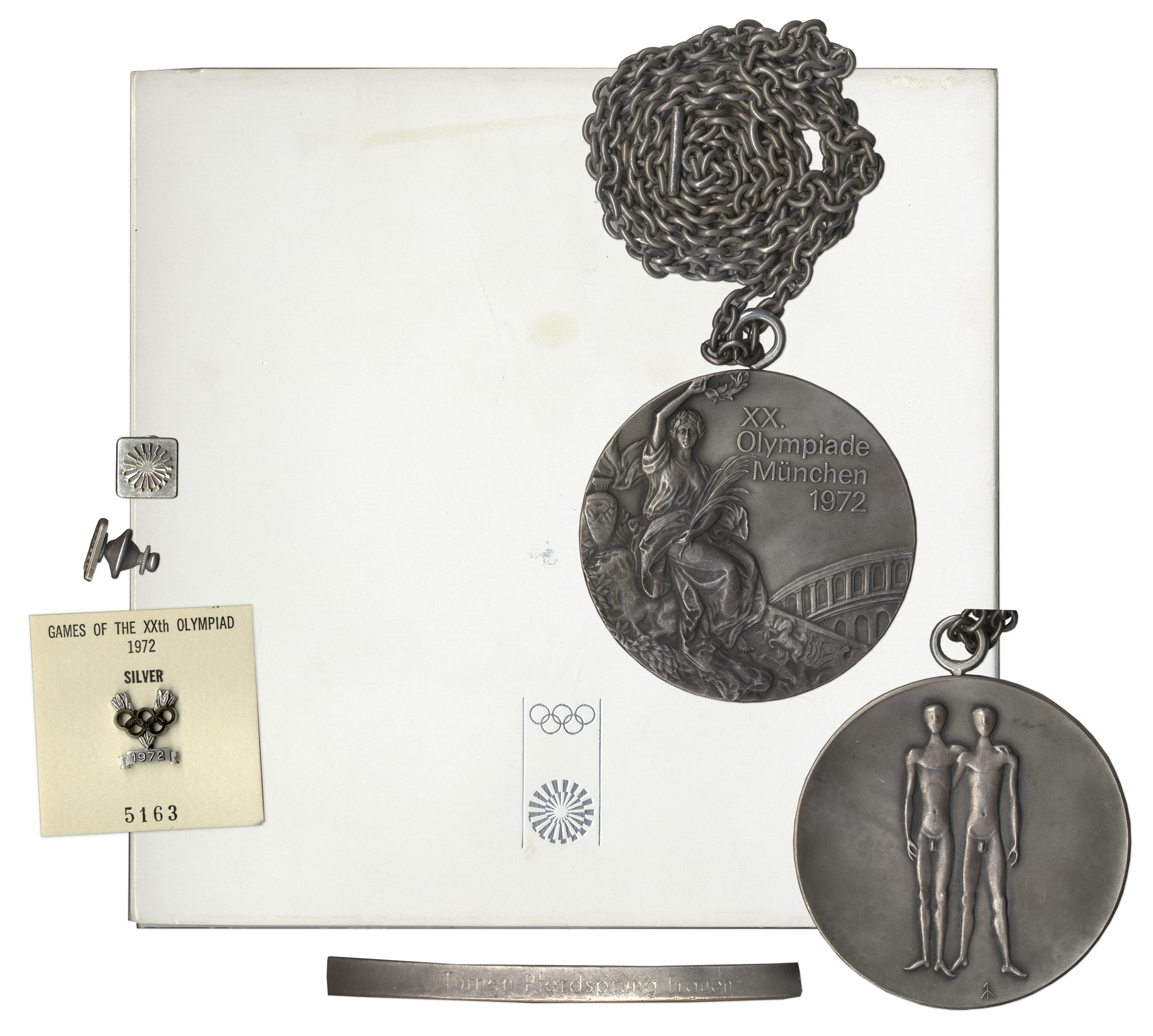
Silver medal from the XX Olympiad, won by East German gymnast Erika Zuchold for women’s vault at the Olympic games in Munich, West Germany in 1972. Named sportswoman of the year for East Germany in 1970, Zuchold won four medals at the 1972 games. Medal’s obverse bears a relief of the goddess Victory as she holds a winner’s crown in her right hand and a palm leaf in her left, accompanied by the inscription, ”XX / Olympiad / Munchen / 1972”. Reverse contains relief bearing depiction of the mythic figures Castor and Pollux, known as patrons of competitive sports and friendship. Medal, affixed to original linked chain, features edge engraving bearing ”Zuchold, Erika” and ”Turnen Pferdsprung Frauen” near top. Medal is housed in white metal box with foam backing to inside and white cardboard protective sleeve with Munich Olympics logo printed in silver to bottom. Also included is rare silver medal winner’s pin bearing Olympic ring design and ”1972”, affixed to numbered white backing bearing number 5163, awarded to Zuchold in the 1990’s and housed in its black leather pouch with gold Olympic logo above brass clasp. Medal measures 2.5” in diameter and weighs 157 grams or 5.5 oz. Near fine. Sold for $12,500.
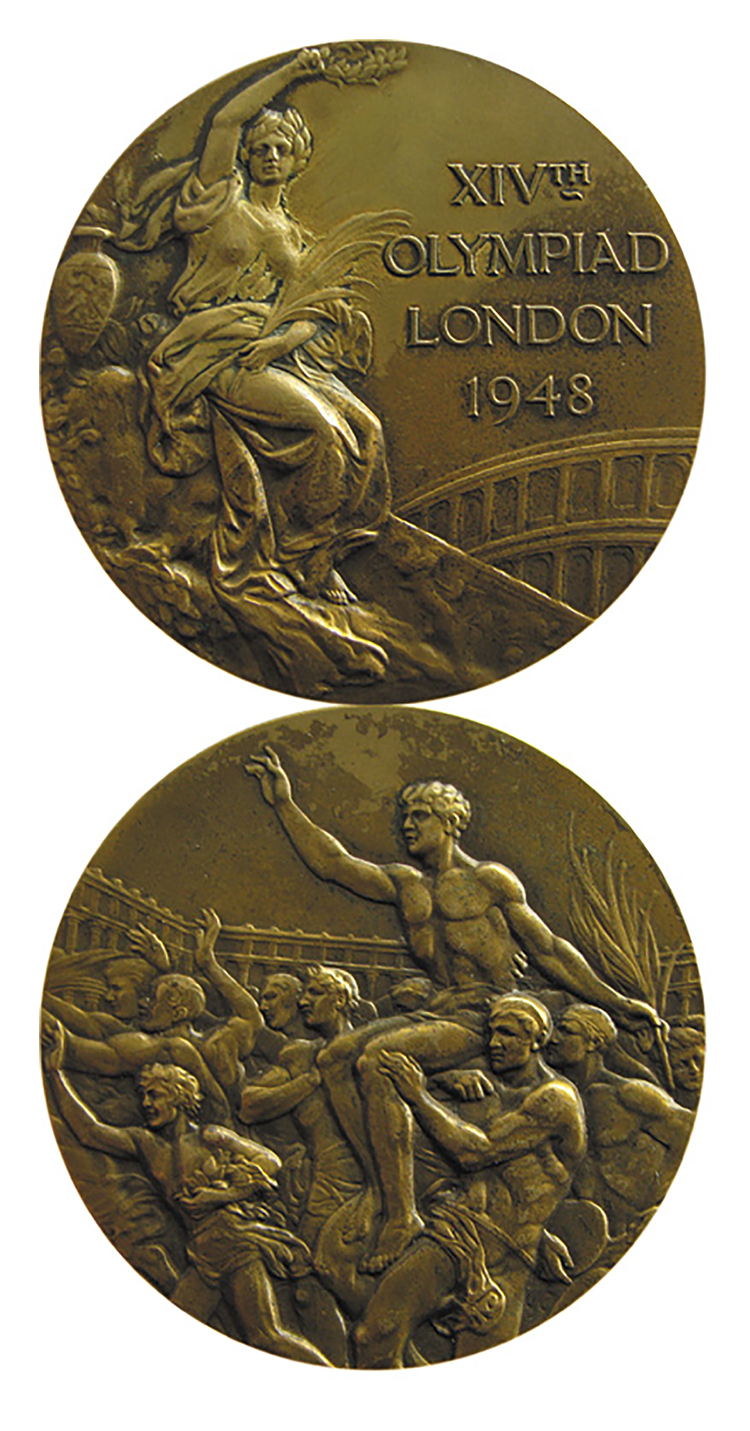
Bronze Medal From the 1948 Summer Olympics, Held in London, England
Bronze medal from the XIV Olympiad, won at the Olympic games in London, England in 1948. Medal’s obverse bears a relief of the goddess Victory as she holds a winner’s crown in her right hand and a palm leaf in her left, accompanied by the inscription, ”XIVth / Olympiad / London 1948”. Reverse bears a relief of an Olympian carried through a crowd, the Olympic stadium in the background. Measures 2” in diameter. Very good with some tarnishing. Sold for $12,500.
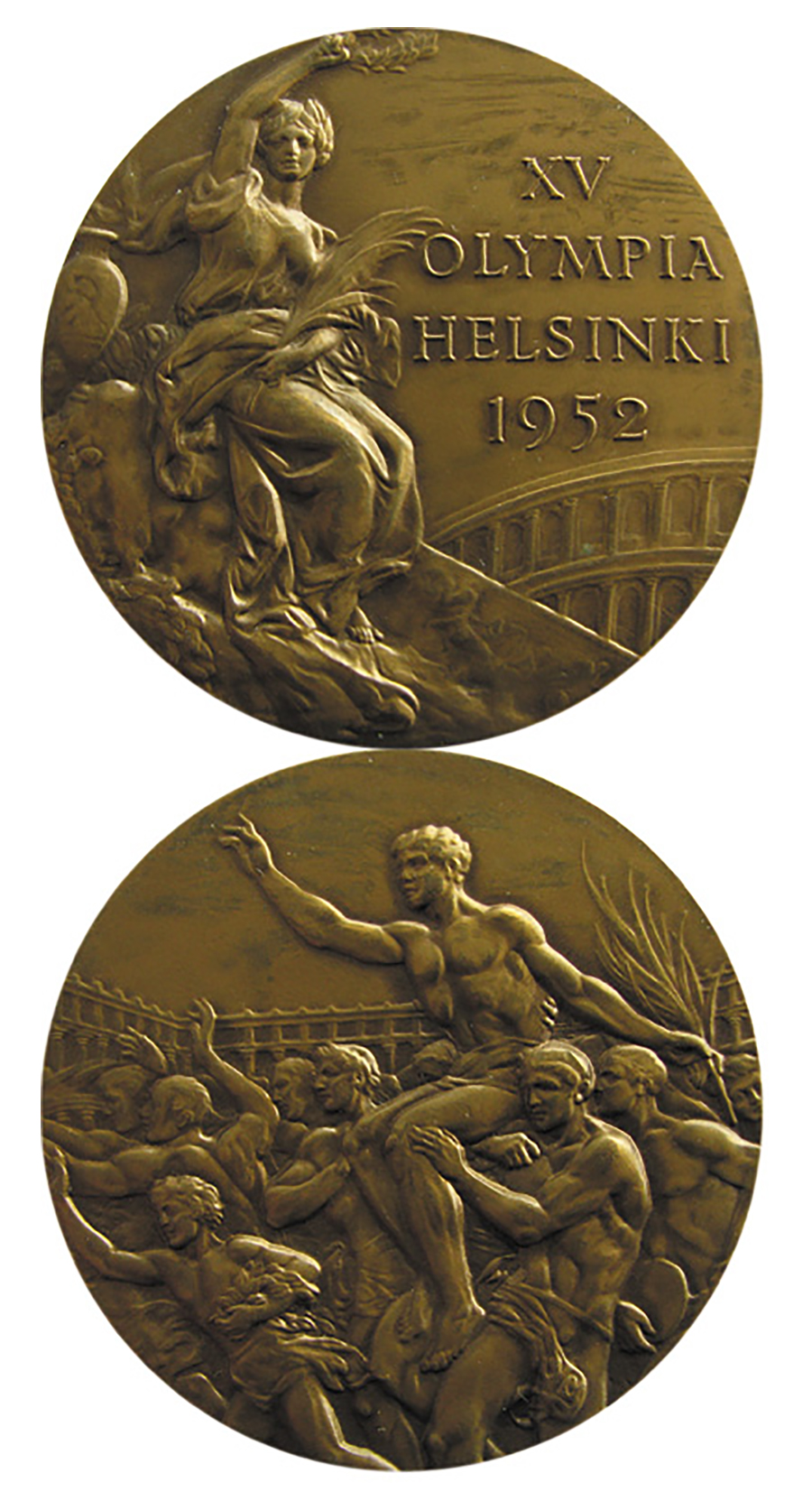
Bronze medal from the XV Olympiad, won at the Olympic games in Helsinki, Finland in 1952. Medal was won by a member of the Finnish men’s gymnastics team, who were awarded the bronze medal in the team competition that year. Medal’s obverse bears a relief of the goddess Victory as she holds a winner’s crown in her right hand and a palm leaf in her left, accompanied by the inscription, ”XV / Olympiad / Helsinki / 1952”. Reverse contains a relief of an Olympian carried through a crowd, the Olympic stadium in the background. Measures 2” in diameter. Very good to near fine. Sold for $12,500.
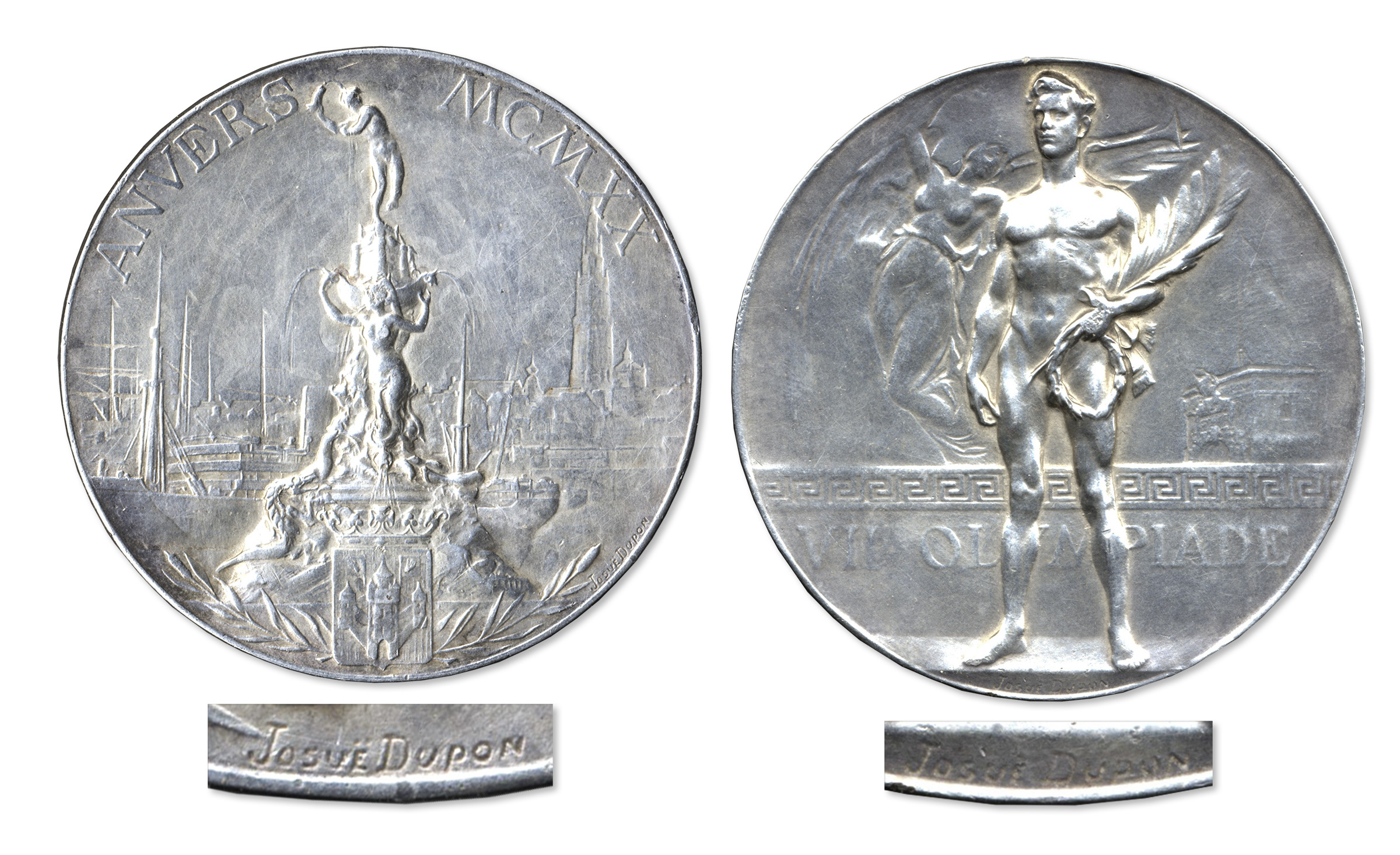
Silver Olympic Medal From the 1920 Summer Olympics, Held in Antwerp, Belgium
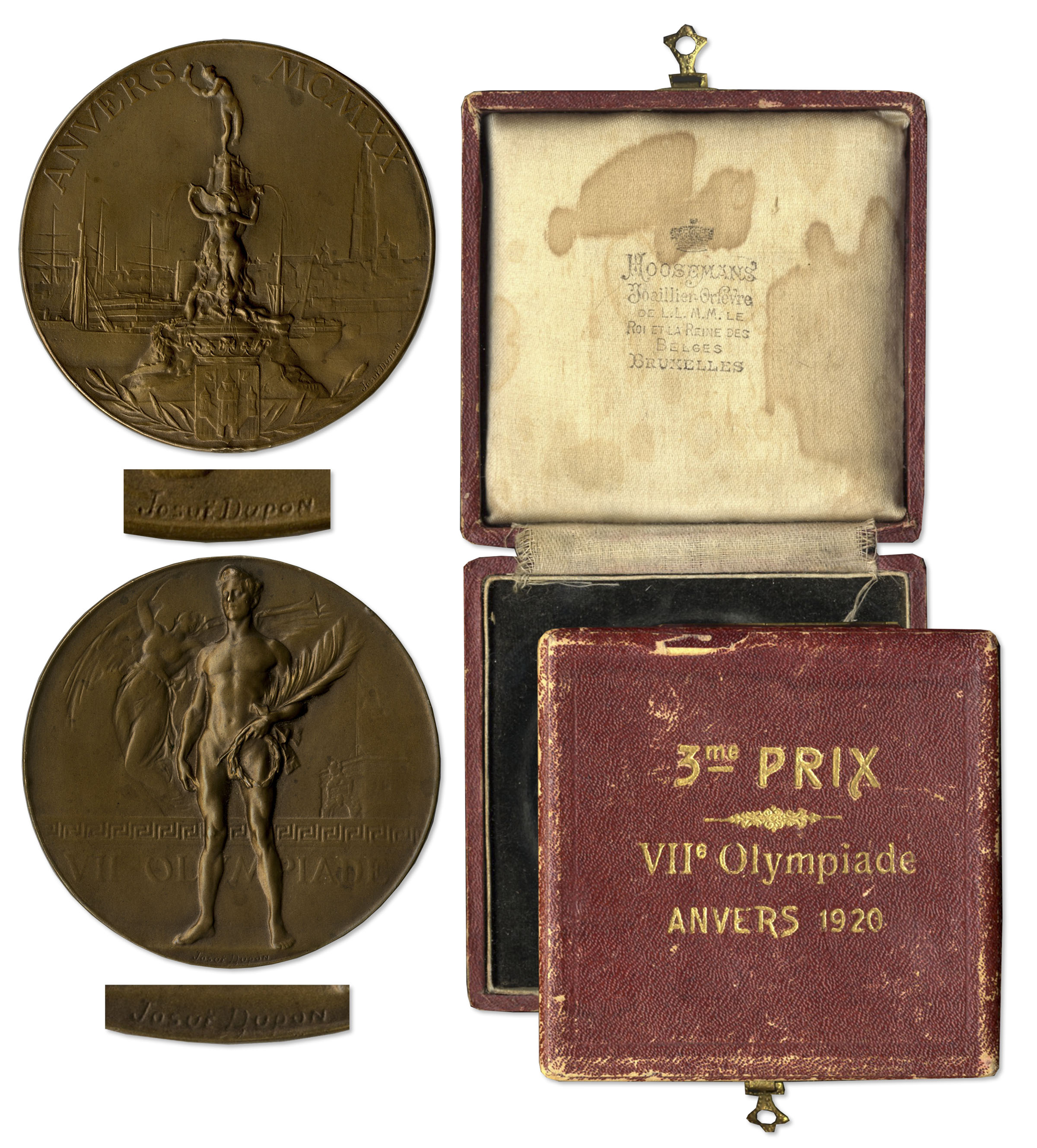
One of only 400 silver medals from the VII Olympiad, won at the games in Antwerp, Belgium in 1920. Medal bears Josue Dupon’s design of an Olympic athlete, inscribed ”VII Olympiade” on obverse and ”Anvers MCMXX” on reverse. Measures 2.5” in diameter and weighs 88 grams or just over 3 ounces. Near fine condition. Sold for $12,500.
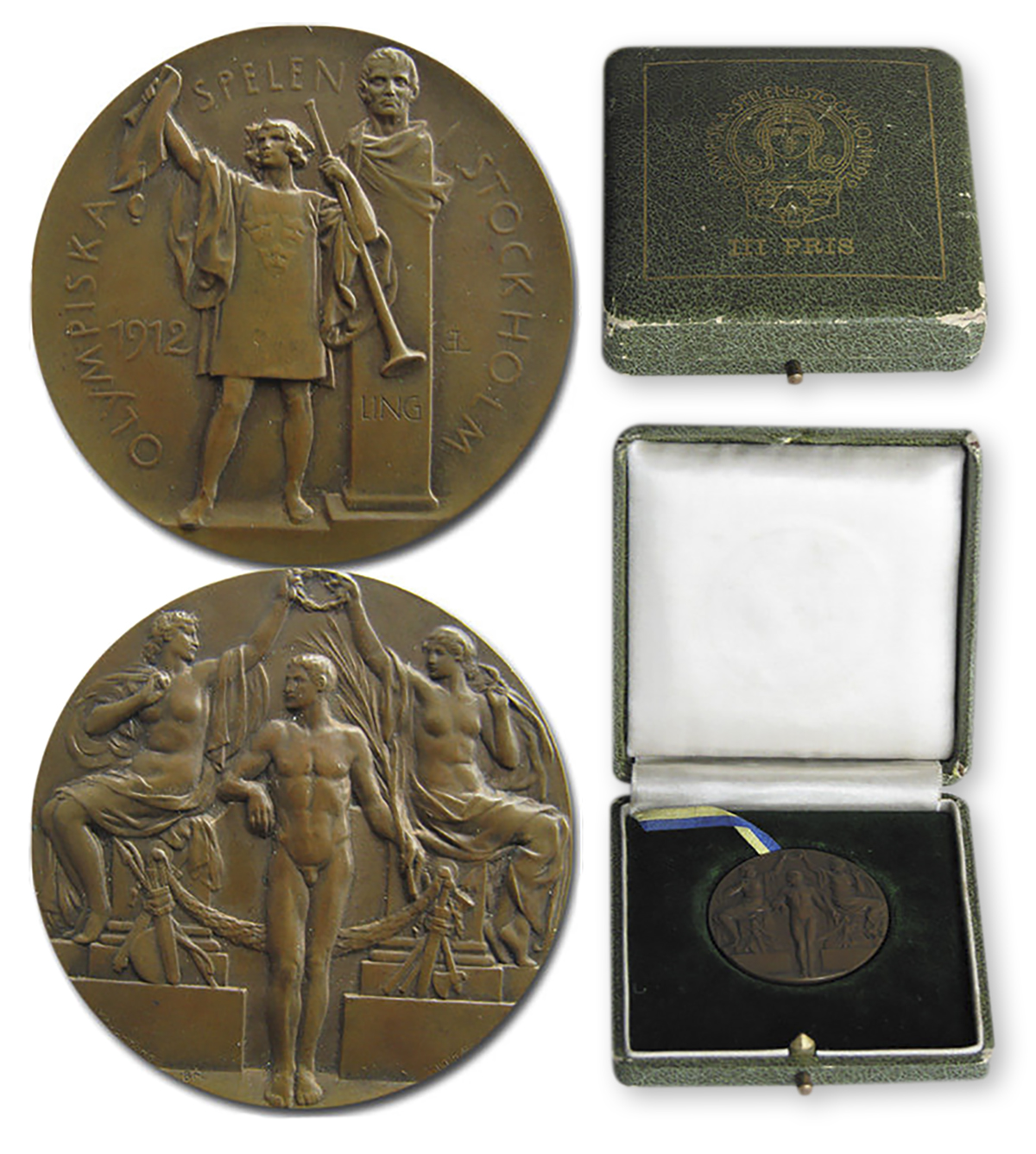
Bronze Medal From the 1912 Summer Olympics, Held in Stockholm, Sweden
Bronze medal from the V Olympiad, won at the Olympic games in Stockholm, Sweden in 1912. Obverse of medal bears a relief of two female figures, placing a crown atop an athlete; the reverse is a relief of a herald proclaiming ”Ling”, the founder of the Swedish gym system, with ”Olympiska / Spelen / Stockholm 1912” written around edge. Housed in original green box, with ”III Pris” and the Olympic logo stamped in gold to lid. Medal measures 1.4” in diameter. Near fine. Sold for $12,500.
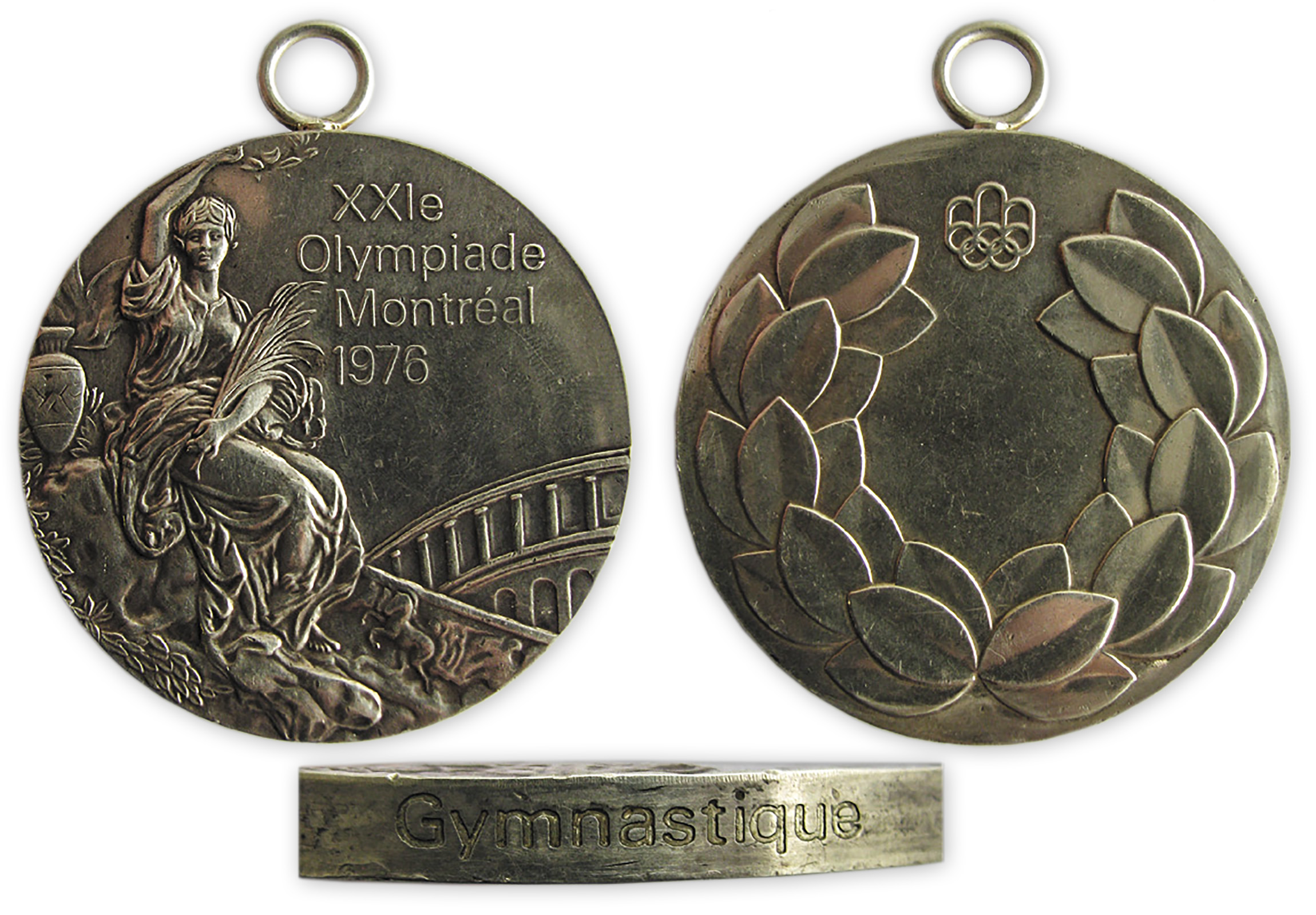
Silver Gymnastics Medal From the 1976 Summer Olympics — Won by Member of The USSR Gymnastics Team
Silver Gymnastics medal from the XXIe Olympiad, won at the Olympic games in Montreal, Canada in 1976. Front of medal features a design originally created for the 1928 games, showing a woman surrounded by the symbols of Victory, Fraternity and Universality. Stylized laurel crown and the emblem of the Montreal Games are displayed to verso of the silver medal, won by a member of the USSR gymnastics team. ”Gymnastique” is engraved to the rim. Measures 2.4” in diameter. Very good. Sold for $12,500.
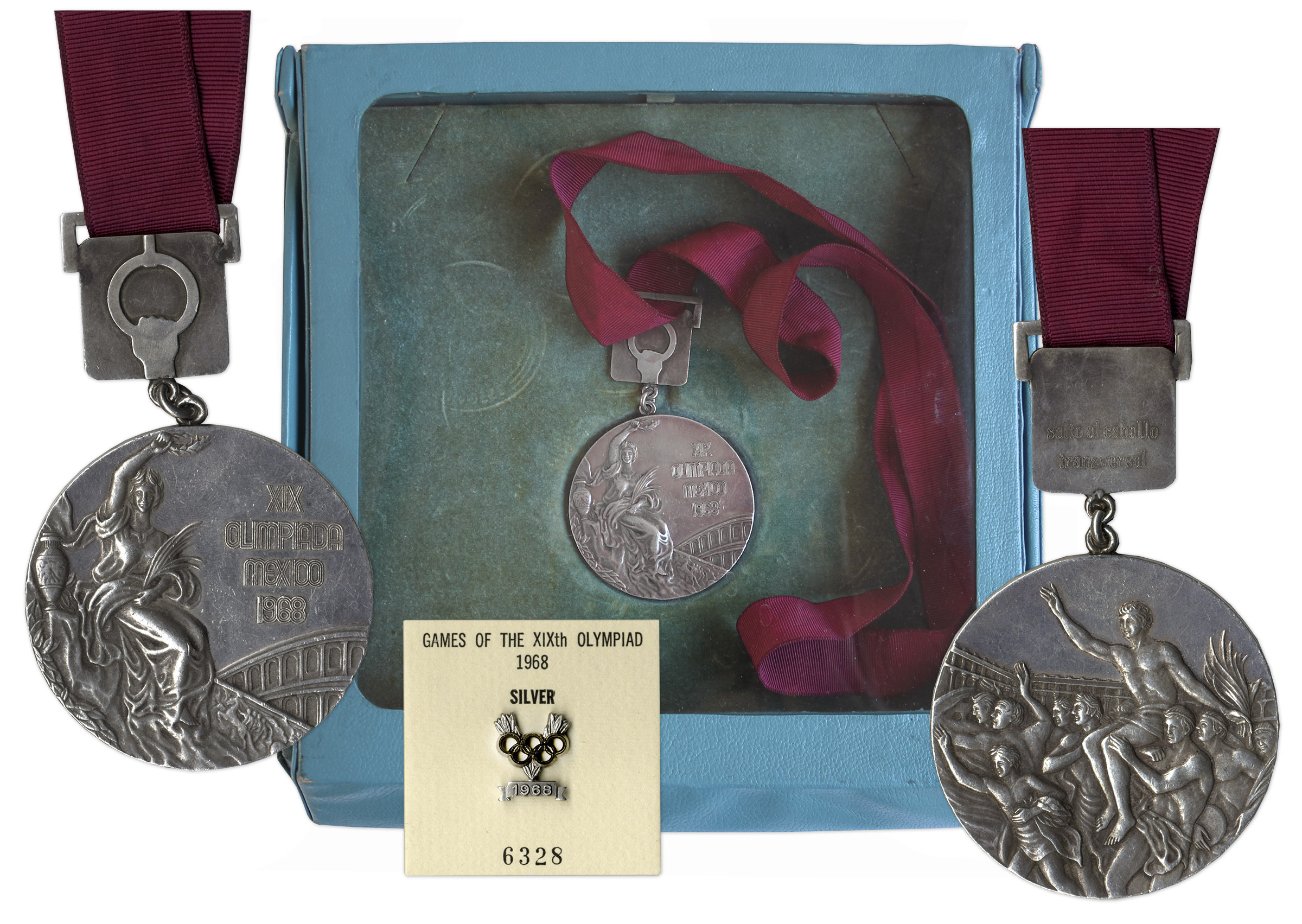
Silver Medal From the 1968 Summer Olympics, Held in Mexico City, Mexico — Awarded for the Gymnastics Vault Event
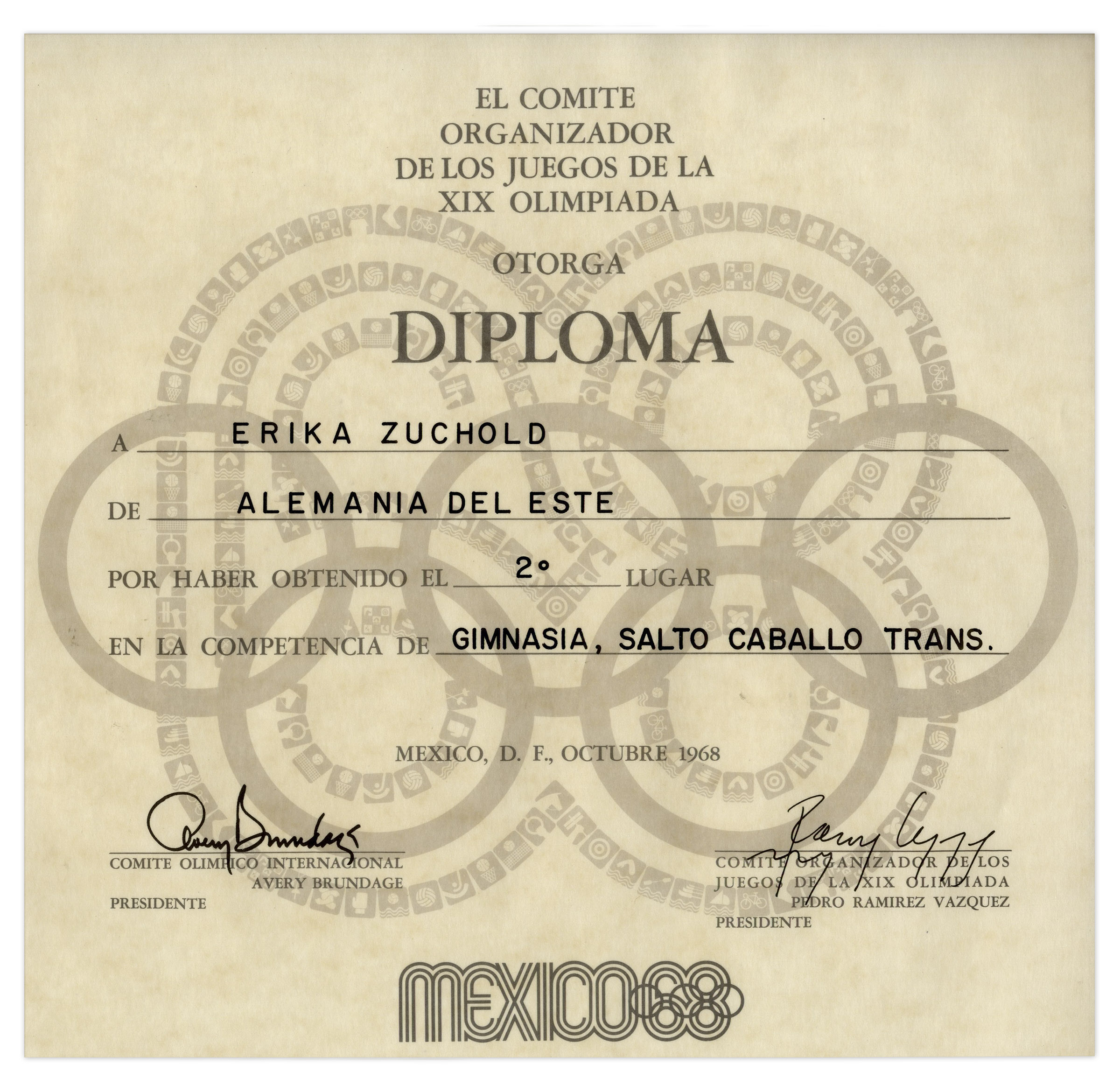
Silver medal from the XIX Olympiad, won in the Gymnastics Vault competition by Erika Zuchold at the Olympic games in Mexico City, Mexico in 1968. Medal bears a relief of the goddess Victory as she holds a winner’s crown in her right hand and a palm leaf in her left, accompanied by the inscription, ”XIX OLIMPIADA / MEXICO / 1968”. Verso features the relief of an Olympian being carried through a crowd with the Olympic stadium in the background. Medal is attached to original ruby silk ribbon. Also included is the IOC winner pin which was awarded to Zuchold in the 1990s. In her career, Zuchold won 4 silver medals and one bronze medal for East Germany and was the first woman to ever complete the flick-flack element on the balance beam. Comes with official medal certificate from the Olympic committee, measuring 12″ x 12″. Medal measures 2.25″ and weighs 124 g. or 4.4 ounces. Slight tarnishing, minor scuffing, overall very good condition. Sold for $11,942.
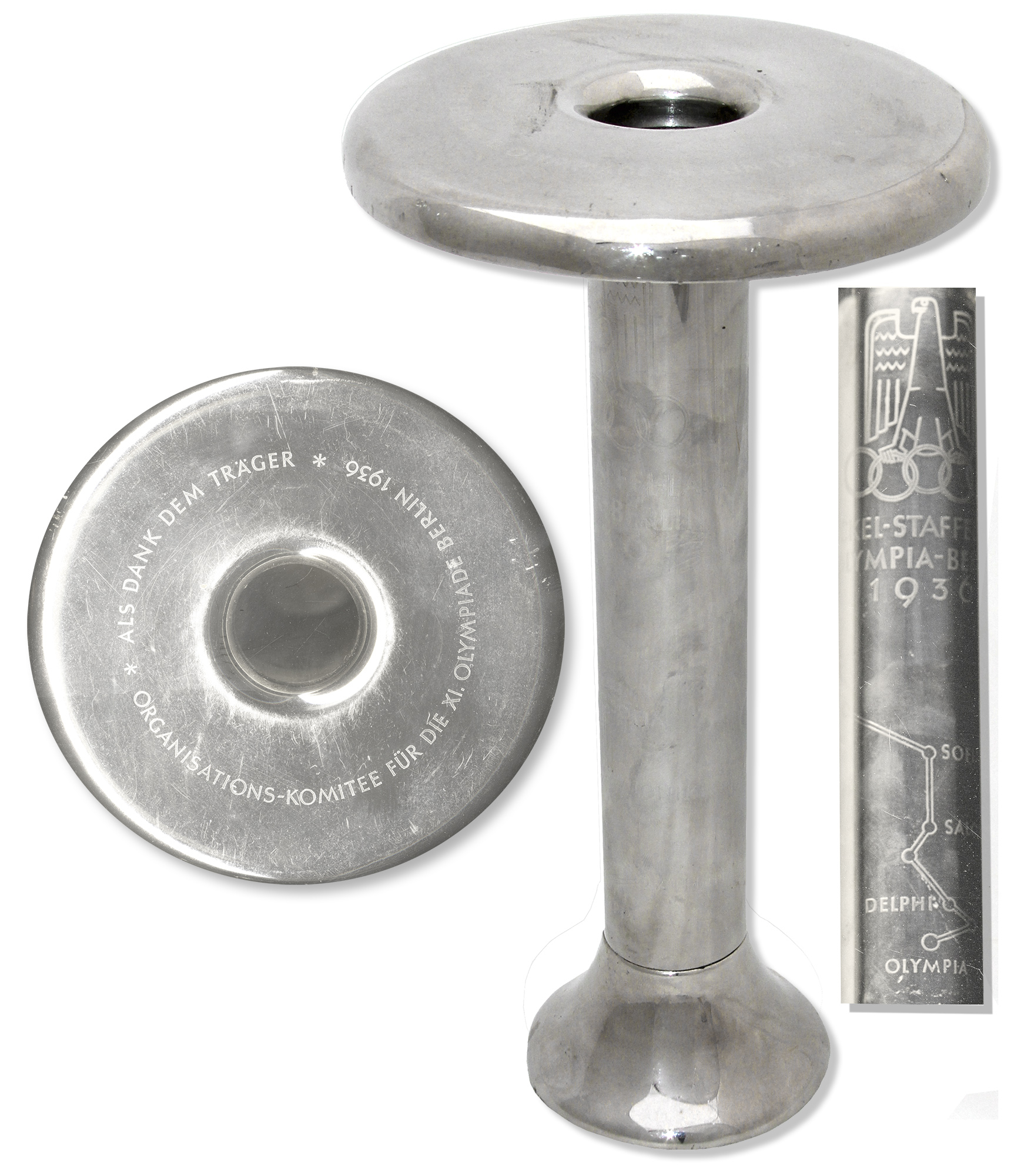
Rare Olympic torch from the 1936 Summer Olympics held in Berlin, Germany while the country was under Nazi rule. This was the first year the Olympic torch relay was held, with the torch traveling from Olympia, Greece through Europe, ultimately arriving at Olympic stadium in Berlin. Because of the stainless steel shortage in the upcoming war, very few of these torches still remain, as all stainless steel was required to be melted down to create weapons. Manufactured by Krupp, torch features an engraving of the cities through which it traveled, as well as the five Olympic rings, held in the talons of the German coat of arms. Contains a circular top where the component allowing it to be lit would be attached. Measures 10.75” tall, with the circular top measuring 6” in diameter. Light scratching, else near fine. Sold for $11,794.
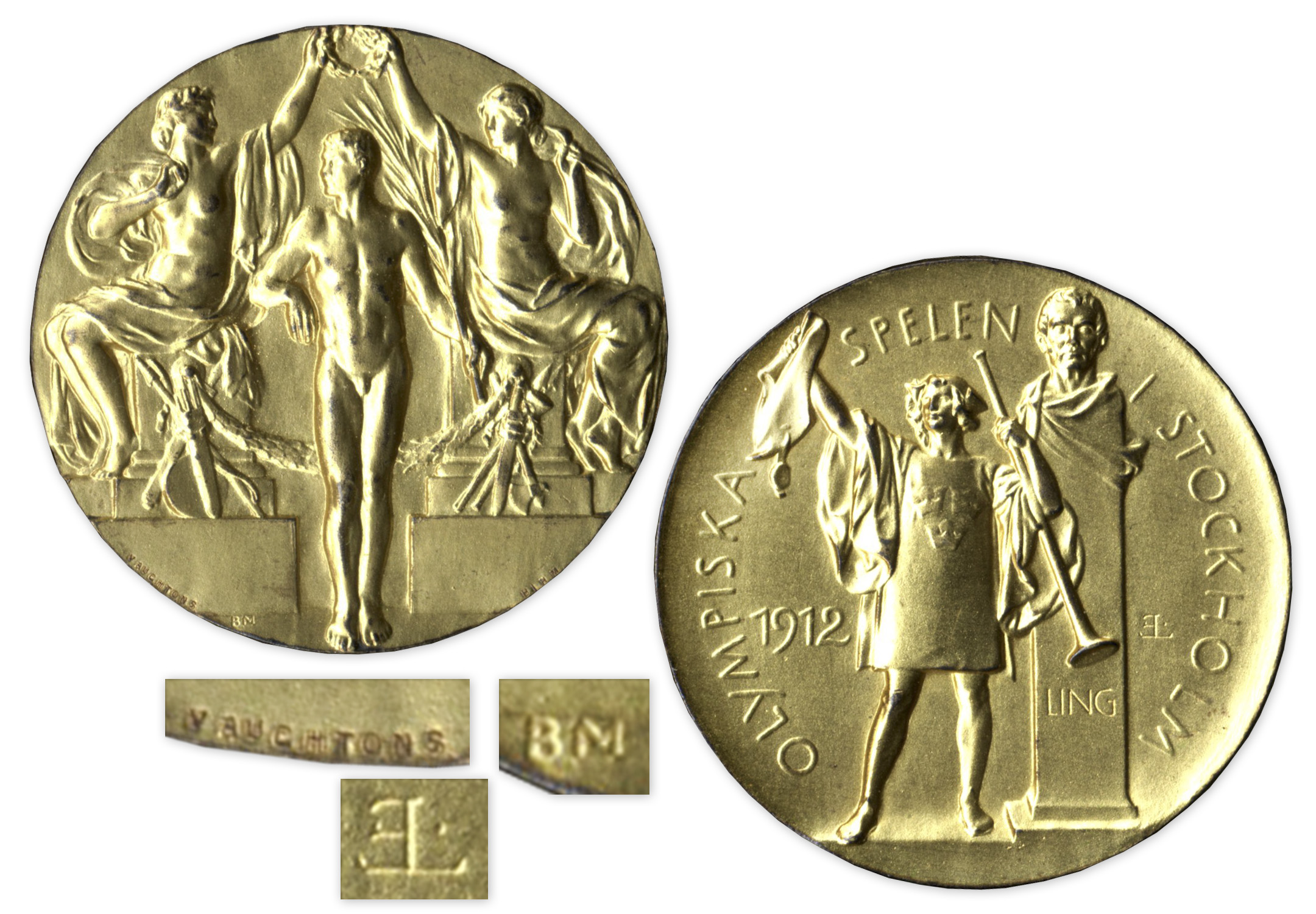
Gold Medal From the 1912 Summer Olympics, Held in Stockholm, Sweden
Gold medal from the V Olympiad, won at the Olympic games in Stockholm, Sweden in 1912. Obverse of medal bears a relief of two female figures, placing a crown atop an athlete; the reverse is a relief of a herald proclaiming “Ling”, the founder of the Swedish gym system, with “Olympiska / Spelen / Stockholm 1912” written around edge. Medal measures 33 mm in diameter. Weighs 18.4 g or 0.65 oz. Near fine. Sold for $9,975.
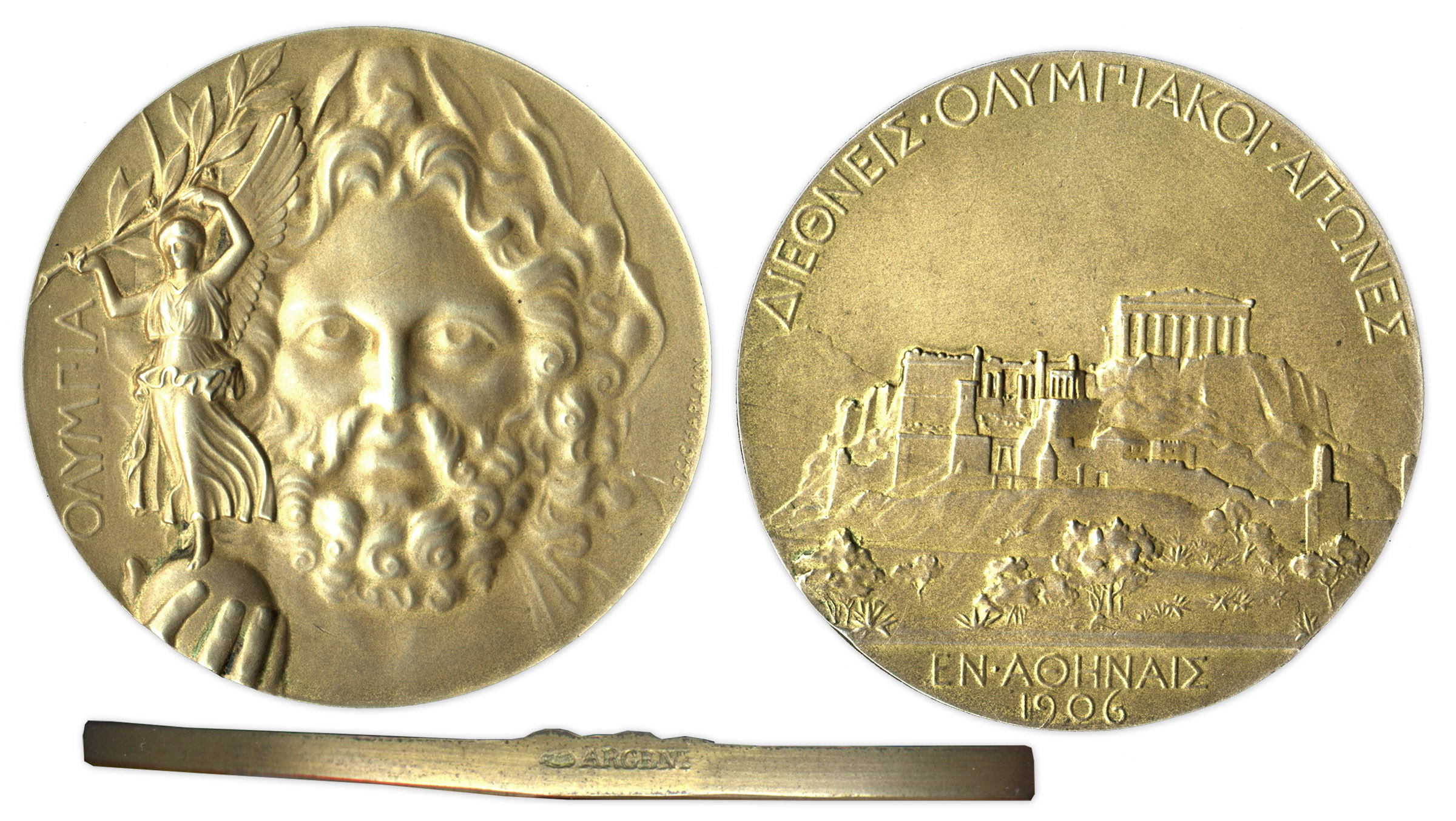
Gold Olympic Medal From the 1906 Summer Olympics, Held in Athens, Greece
Gold medal from the 1906 Olympic games, held in Athens, Greece. The 1906 Games were enormously successful, featuring the introduction of several characteristics of the modern games including the opening and closing ceremonies. Gold plated medal bears design of Zeus’ face along with his hand holding a globe and winged victory image, with caption reading “Olympia”. Depiction of the acropolis and “1906 Olympic Games” in Greek to verso. Housed in red leather case with green felt backing. Measures 2″ in diameter and weighs 57 grams or 2 oz. Slight wear to case. Medal is in near fine condition. Sold for $9,500.
Bronze Olympic Medal From the 1928 Summer Olympics, Held in Amsterdam, Netherlands
Bronze medal from the IX Olympiad, won at the games in Amsterdam, Netherlands in 1928. Medal bears relief of the traditional goddess of victory, as she holds a palm in her left hand and a winner’s crown in her right, with an Olympic champion carried in triumph by the crowd. This was the first Olympics bearing this medal design by Giuseppe Cassioli, which remained until the 1972 games. Measures 2″ or 55 mm in diameter and weighs 77 grams or 2.75 oz. Near fine condition. Sold for $6,500.
Bronze Olympic Medal From the 1920 Summer Olympics, Held in Antwerp, Belgium
Bronze medal from the VII Olympiad, won at the games in Antwerp, Belgium in 1920. Medal bears Josue Dupon’s design of an Olympic athlete, inscribed “VII Olympiade” on obverse and “Anvers MCMXX” on reverse. Housed in original red box, with “3rd Prix / VII Olympiade / Anvers 1920″ written in gold lettering. Medal measures 2.5″ in diameter and weighs 83 grams or just over 3 ounces. Box measures 3.25″ x 3.25”. Some wear to the box; very good condition. Medal is near fine. Sold for $6,000.
Bronze Medal From the 1992 Summer Olympics, Held in Barcelona, Spain
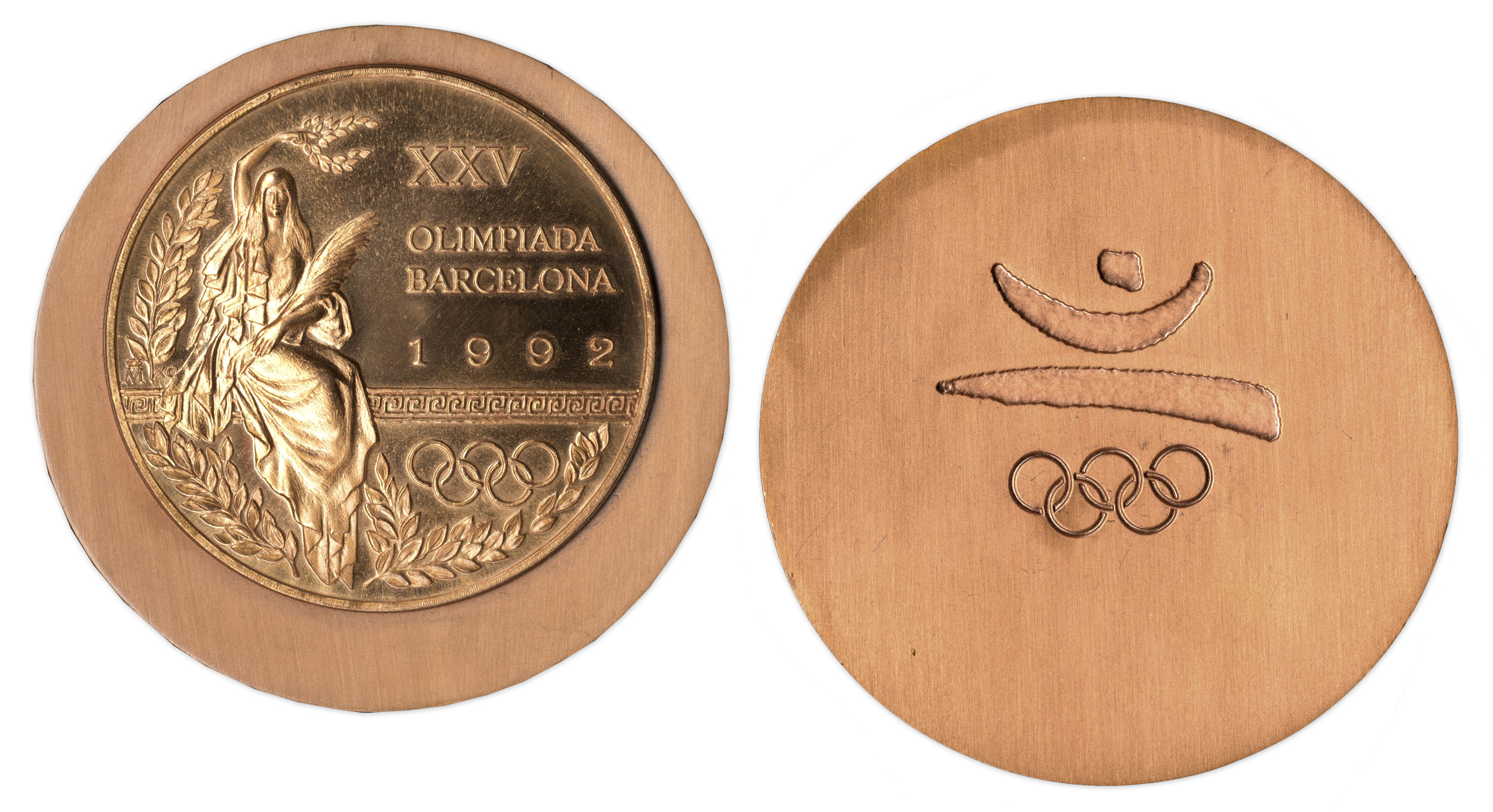
Bronze medal from the XXV Olympiad, won at the Olympic games in Barcelona, Spain in 1992. Medal, designed by the sculptor Xavier Corbero, features a smaller medal slightly off-center upon the larger portion of the medal. Medal features an image of the goddess of victory with “XXV Olimpiada Barcelona 1992″ on obverse, and the official logo of the 1992 games borne to verso. Measures 70 mm or 2.75” in diameter. Weighs 228 grams or 8 oz. Near fine. Sold for $5,125.
Bronze Medal From the 1936 Summer Olympics, Held in Berlin, Germany — Won by American Ernest Riedel
Bronze medal from the XI Olympiad, won at the 1936 Berlin Olympic games by American sprint canoeist Ernest Riedel, and accompanied by four other medals given to Riedel as provenance. Olympic medal was won in the K-1 10,000 meter event, and bears relief of the goddess Victory to obverse, as she holds a winner’s crown in her right hand and a palm leaf in her left, accompanied by the inscription, ”XI / Olympiade / Berlin 1936”. Verso bears relief of an Olympian carried through a crowd, with the Olympic stadium in the background. With manufacturer’s mark of ”B.H. Mayer Pforzheim” on rim. Medal measures 55 mm and weighs 2.7 oz. Light wear, else near fine. Lot also includes four other medals won by Riedel: his 1936 Berlin Olympics participation medal, 1948 London Olympics participation medal, A.A.U. Olympic Development Program medal with ribbon, and a medal with Riedel’s name engraved commemorating his achievement as a 1936 Olympian. Sold for $5,000.
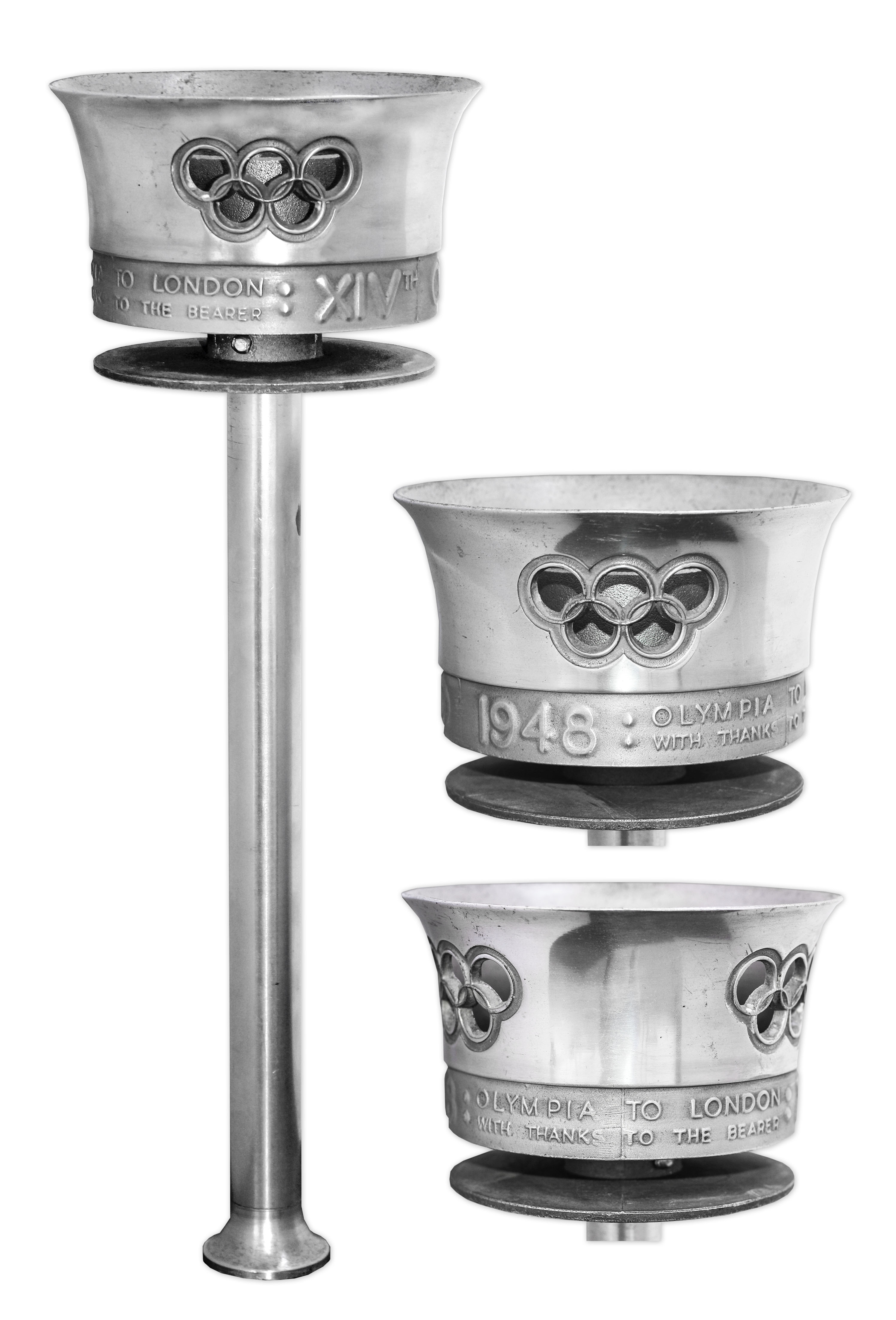
1948 Olympics Torch Used in the London Summer Games
Olympic relay torch used in the 1948 Summer Olympics. The Torch Relay tradition began in 1928, and transports a spark from the parent flame in Olympia, Greece to the host city in time for the opening ceremonies, in this case Wembley Stadium in London on 29 July 1948. There were 3 types of torches used during the 1948 relay: a land torch (of which this is an example), a torch with a gas recipient for crossing the sea, and a torch for the very last runner. Torch is made of stainless steel, features 3 sets of Olympic rings around the polished top, and reads, “XIVth OLYMPIAD 1948: OLYMPIA WITH THANKS”. Measures 16″ and weighs 1 lb., 13 oz. Small mark on handle, some wear to top, overall in very good condition. Sold for $4,867.
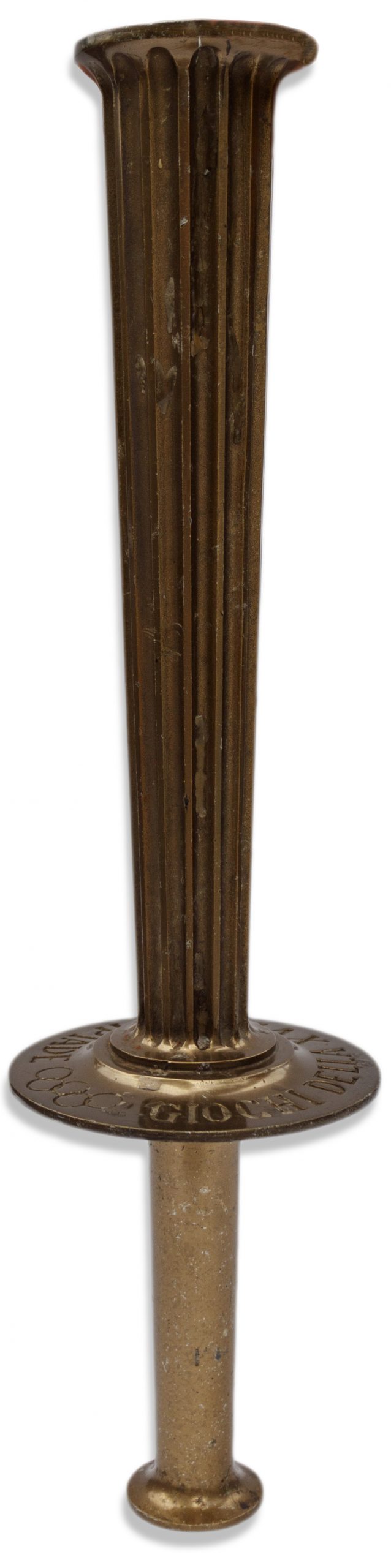
Olympic Torch Used in 1960 Rome Summer Games
Olympic relay torch used in the 1960 Summer Olympics. The Torch Relay tradition began in 1928, and transports a spark from the parent flame in Olympia, Greece to the host city in time for the opening ceremonies, in this case Rome. Designed by Pier Luigi Nervi and Amedeo Maiuri, the torch is based on a classical model and is meant to resemble torches depicted on ancient monuments. Made of aluminum and then bronze plated, the torch bears the Olympic rings and is labeled ”GIOCHI DELLA XVII OLIMPIADE” on ring. On underside of base it gives the manufacturer’s information, ”M.F. – CURTISA – BOLOGNA” with the torch number ”419”. Torch measures 15.75” and weighs 1 lb. 3.6 oz., or 555 g (without flame). Some fading of bronze plating and minor nicks from use, overall very good condition. Sold for $3,328.
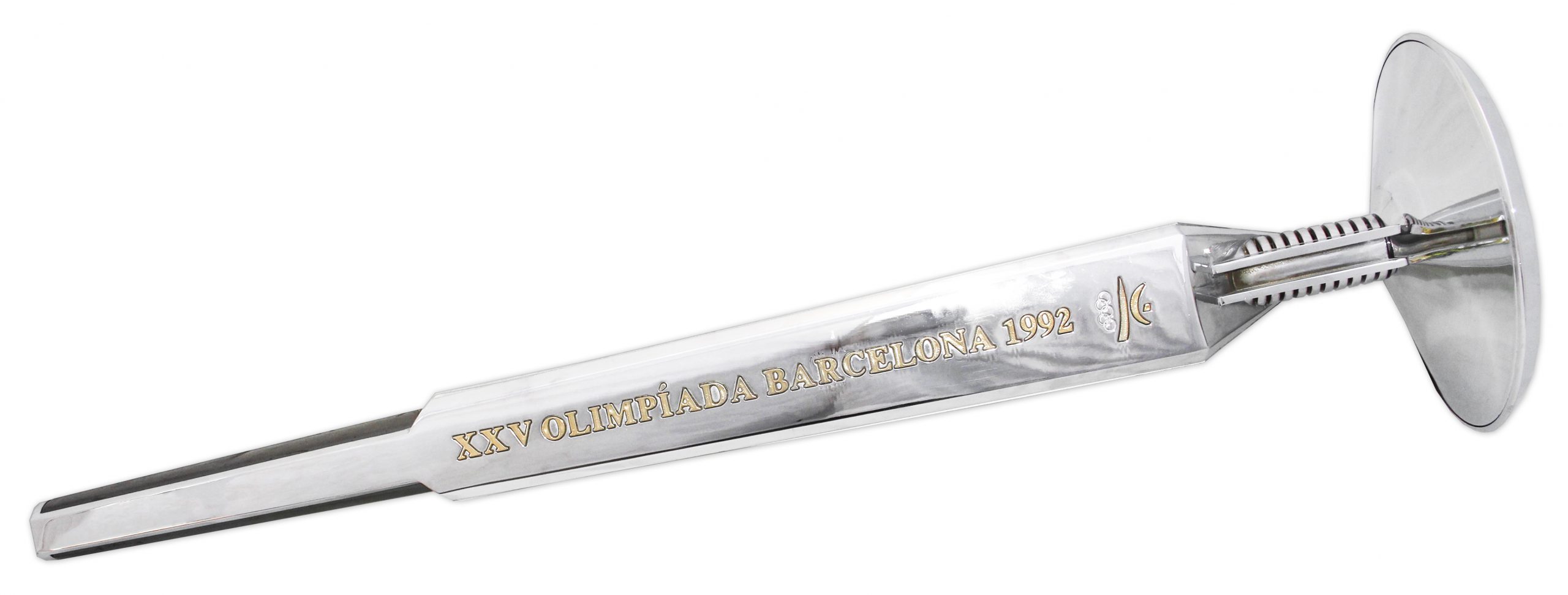
Olympic Relay Torch Used in 1992 Barcelona Summer Games
Olympic relay torch used in the 1992 Summer Olympics. The Torch Relay tradition began in 1928, and transports a spark from the parent flame in Olympia, Greece to the host city in time for the opening ceremonies, in this case Barcelona. Designed by Andre Ricard, metal torch bears the Barcelona logo with the Olympic rings and reads, “XXV OLIMPIADA BARCELONA 1992”. Measures 26″ and weighs 2 lbs. 3 oz. Plastic above handle is slightly detached and padded handle has wear from use, overall very good condition. Sold for $2,692.
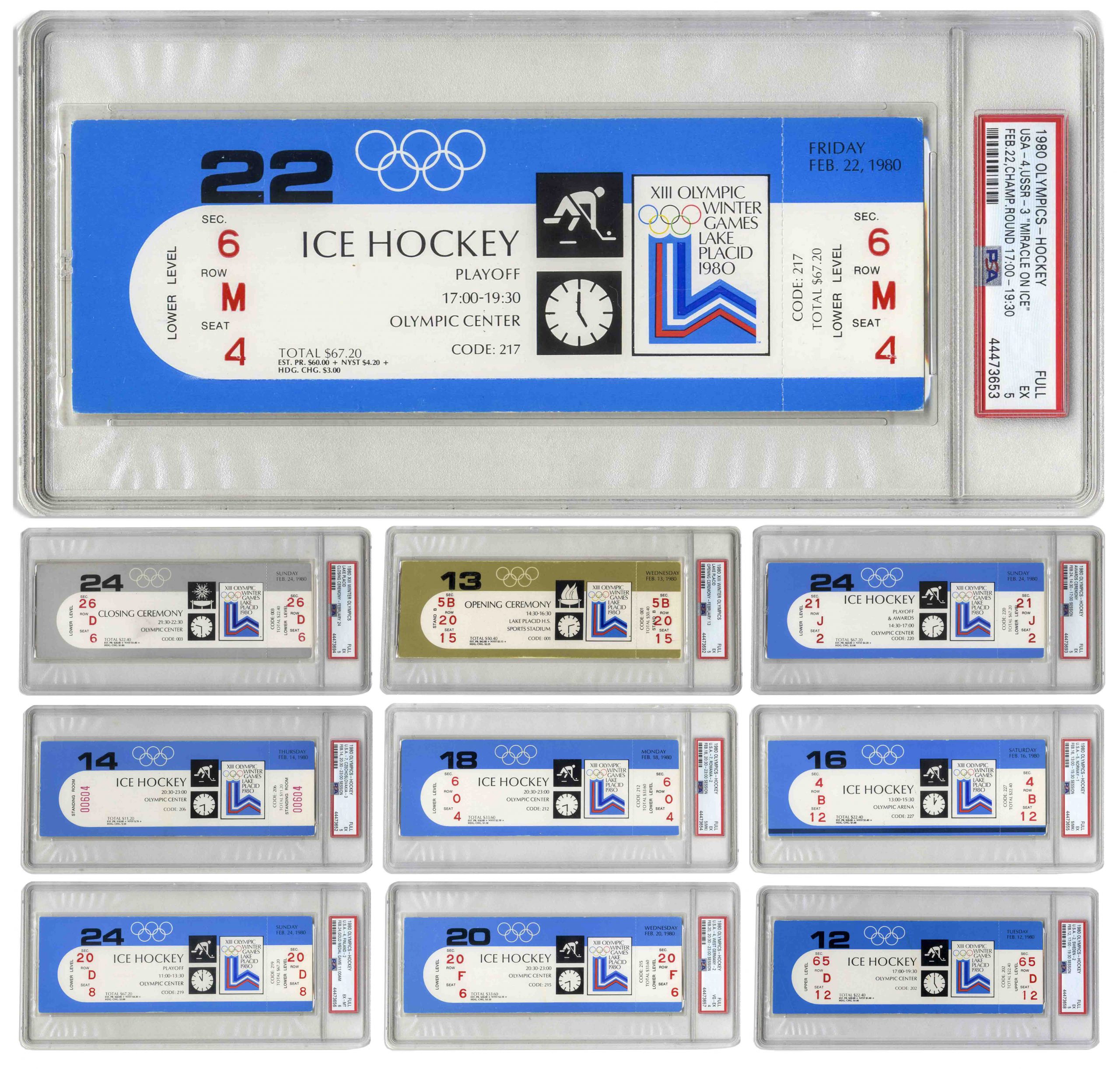
Lot of 10 Hockey Tickets for the 1980 Olympics, Including the US vs. USSR “Miracle on Ice” Game — Also Includes Opening & Closing Ceremonies & Gold Medal Award Ceremony for US Hockey — PSA Slabbed
Lot of 10 full tickets from the 1980 Winter Olympics, including the famed “Miracle of Ice” men’s hockey game where the United States, as underdog, bested the Soviet Union 4-3 in the first game of the medal round. Lot also includes tickets for the game between the US and Finland, resulting in the gold medal for the US; the medal awards ceremony for the US men’s hockey team; the opening and closing ceremonies to the Olympic games; and six other US men’s hockey games, all PSA slabbed and full tickets, with stubs intact. Complete list, in chronological order, comprises: (1) Men’s hockey ticket for 12 February 1980 between the US and Sweden, graded 5, excellent; (2) Opening ceremony full ticket for 13 February 1980, graded 5, excellent; (3) Men’s hockey ticket for 14 February 1980 between the US and Czechoslovakia, graded 5, excellent; (4) Men’s hockey ticket for 16 February 1980 between the US and Norway, graded 5, excellent with some marks; (5) Men’s hockey ticket for 18 February 1980 between the US and Romania, graded 5, excellent with some marks; (6) Men’s hockey ticket for 20 February 1980 between the US and West Germany, graded 4, very good to excellent; (7) “Miracle on Ice” men’s hockey ticket for 22 February 1980 between the US and USSR, graded 5, excellent; (8) Final round men’s hockey ticket for 24 February 1980 between the US and Finland, graded 6, excellent to mint; (9) Gold medal awards ceremony ticket for the men’s hockey team for 24 February 1980, graded 5, excellent; (10) Closing ceremony ticket for 24 February 1980, graded 5, excellent. All tickets measure 9.5″ x 4.75″ as slabbed by PSA. Sold for $1,800.
FREE ESTIMATE. To buy, auction, sell or consign your Pierre de Coubertin autograph letter signed that is for sale, please email your description and photos to [email protected] of Nate D. Sanders Auctions (http://www.NateDSanders.com).
We offer the following services for your Pierre de Coubertin autograph letter signed:
- Appraise Pierre de Coubertin autograph letter signed.
- Auction Pierre de Coubertin autograph letter signed.
- Consign Pierre de Coubertin autograph letter signed.
- Estimate Pierre de Coubertin autograph letter signed.
- Sell Pierre de Coubertin autograph letter signed.
- Pierre de Coubertin autograph letter signed valuation.