
Sell or Auction Your Palladis Tamia 1st Edition 1598 for up to Nearly $30,000 or More at Nate D. Sanders Auctions
FREE APPRAISAL. To buy, auction, sell or consign your Palladis Tamia 1st edition 1598 that is for sale, please email your description and photos to [email protected] of Nate D. Sanders Auctions (http://www.NateDSanders.com).
Sell Your Paadis Tamia 1st Edition 1598
Palladis Tamia, subtitled “Wits Treasury”, is a 1598 book written by the minister Francis Meres. It is important in English literary history as the first critical account of the poems and early plays of William Shakespeare. It was listed in the Stationers Register 7 September 1598.
Below is a recent realized price for a Palladis Tamia 1st edition 1598 item. We at Nate D. Sanders Auctions can obtain up to these amounts or more for you:
Palladis Tamia 1st Edition 1598. Sold for nearly $30,000.
Here is an example of Palladis Tamia’s work:
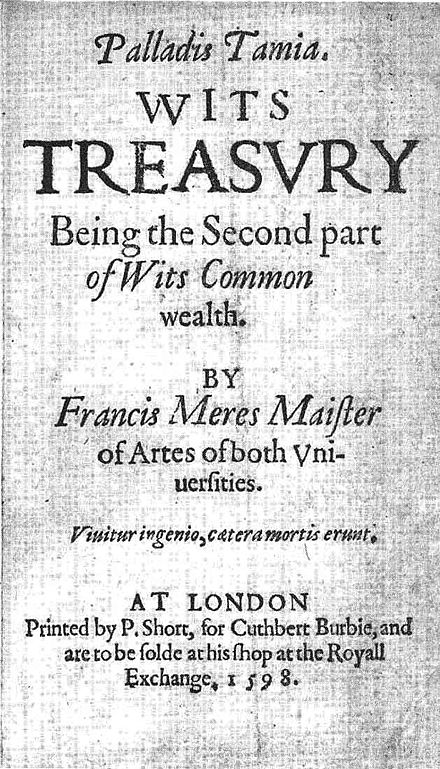
Consign your Palladis Tamia 1st edition 1598 at Nate D. Sanders Auctions. Send a description and images of your item to us at [email protected].
Here are some recent items that our auction house, Nate D. Sanders (http://www.NateDSanders.com) has sold:
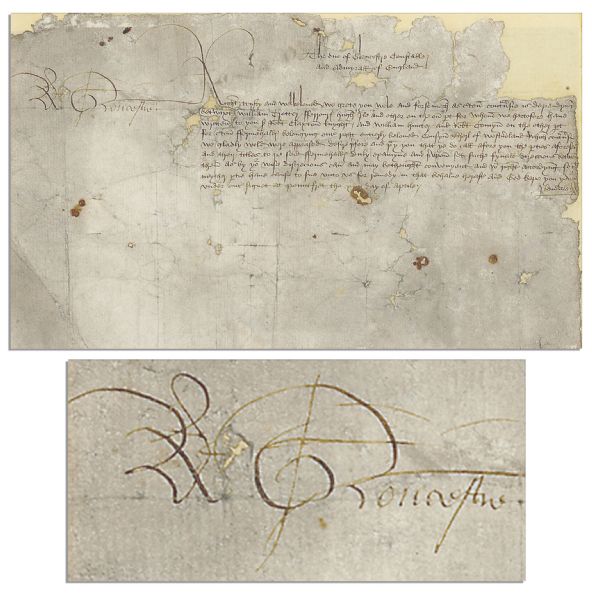
Richard III autograph signet-sealed document signed ”R. Gloucestre” (Richard III autograph) as Duke of Gloucester, one of less than a dozen such documents signed with the others residing in public institutions. Richard’s brother, Edward IV, appointed Richard as Lord President of the Council of the North, which sought to exert greater governmental control over Northern England. Document is dated by title donned on Richard as ”Constable and Admyral of England” instead of ”Great Chamberlain,” which dates the document circa 1473-77. As Duke of Gloucester in his early 20’s, Richard III was given many responsibilities by his brother, becoming a powerful landowner and political force to be reckoned with in the north, further establishing his future reign as King of England. Document illuminates his growing power as he hereby intervenes in a land dispute between Ralph Neville, 2nd Earl of Westmorland and some of his tenants. Countersigned by the Duke’s secretary, John Kendal.
Document is addressed to Sir Robert Claxton, William Claxton, Richard Bainbridge, ”and other of the ‘Counsell of our right entierly beloved Cousyn Therl of Wesm[or]land’, Pontefract, 22 April n.y. [1473 or 1476-77]”. Reads in part: ”c[er]ten cont[ro]v[er]sie’ between William Trotter, ‘ferrour’ [‘smith’?], Hugh Ile and others on the one hand and William Hunter and Robert Comyn on the other, concerning leaseholds belonging to the Earl of Westmorland. He writes now to a larger group of Westmorland councillors, asking that they examine the petitioners and settle the dispute according to their own discretion, so th[a]t neyther p[ar]tie have cause to sue unto us for remedy in that behalve heraft[er].” Measures 11.75” x 7” on one page. Framed to an overall size of 18.5″ x 14.25″; frame has a drawer that pulls up from the top edge holding a transcript of the document and a biography of Richard III. Document has been archivally restored, though still has paper loss to right side and various holes and chips throughout. Overall very good condition for such a preserved document. Document is exceedingly rare, one of only three documents signed by Richard III to come up for auction in the last 30 years. A very rare Richard III autograph. Sold for $52,417.
Consign your Palladis Tamia 1st edition 1598 that is for sale. Contact [email protected] to sell your Palladis Tamia 1st edition 1598 item.
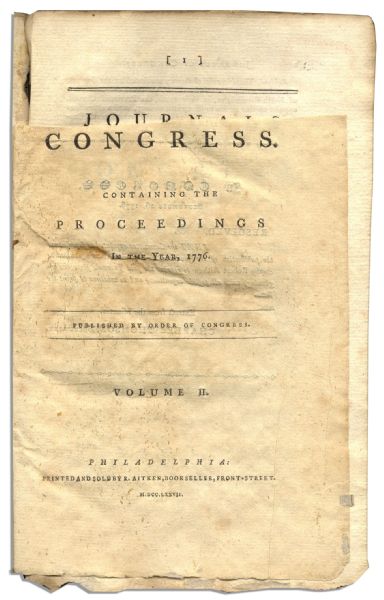
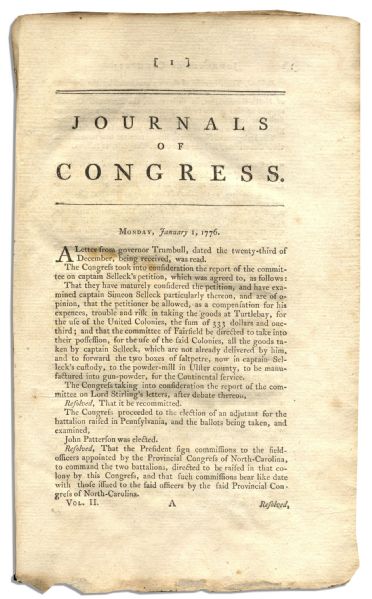
The activities of the Continental Congress for the watershed year of 1776 are recorded comprehensively here in this first edition, first printing of ”Journals of Congress Containing The Proceedings In The Year, 1776.” Published by Order of Congress, by Robert Aitken: Philadelphia: 1777. This is one of just 532 copies which were printed in 1776, with substantially less than that available today, and is complete with the original printing of the Declaration of Independence on pages 241-246. According to text upon the title page, these records of the nation’s fledgling government were taken directly from the minutes of the Continental Congress. In addition to the Declaration of Independence, this volume chronicles the preparation for the Revolutionary War, as well as Richard Henry Lee’s 15 May proposal of independence. The book reads as a diary, with each day’s activities noted, including letters from ”General Washington” and resolutions such as one from 14 August 1776, in part, ”…his British majesty, in order to destroy our freedom and happiness has commenced against us a cruel and unprovoked war; and unable to engage Briton’s sufficient to execute his sanguinary measures has applied for aid to foreign princes, who are in the habit of selling the blood of their people for money…” Volume runs 512pp. plus index and measures 5.5” x 8.5”. Deckled-edge leaves are bound in paper boards, not original calf binding. Loss of backstrip reveals a thin layer of fabric affixed over a ribbed spine. Title page is missing the top 1.5”. Chipping to bottom edge of front board and a stamp of the previous owner on the front pastedown. In very good condition considering age. A precious record codifying the founding of the United States of America. Sold for $6,083.
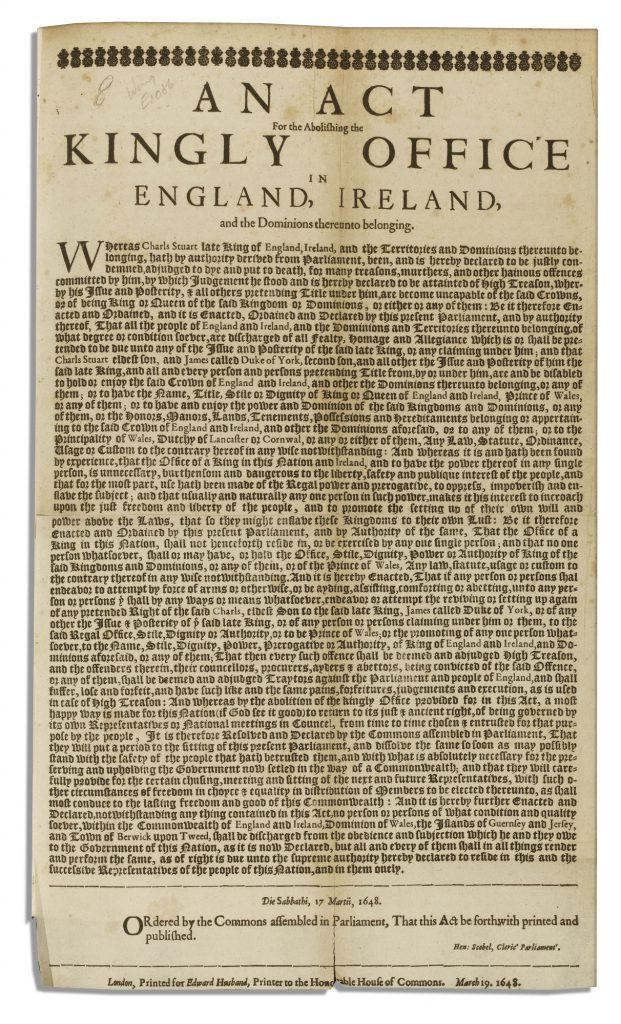
English Civil War Act Abolishing Monarchy in England
Historically significant and original from 1648, a broadside announcing the English Act to abolish the King of England, written by the newly established Commonwealth parliament. Dated 19 March 1648, the Act was officially passed in 1649 immediately after Charles I’s regicide, which occurred amidst Pride’s Purge, the violent coup d’etat in which the Army violently removed any dissenters from the House, including Charles I, who was executed in January of 1649. Act marks the beginning steps toward the Interregnum period in England, a period of a military and parliamentary control under Oliver Cromwell that lasted until 1660 when Charles II was eventually reinstated. The Act establishes the Commonwealth of England with unchecked executive and legislative power, in order to create legal basis of the Republic after Charles I’s execution. Though Charles II was proclaimed king by the Scots after Charles I beheading, this Act was passed immediately to prevent proclamation of a successor. Act is written in a terrifying tone of restitution and reads in full: “An Act For Abolishing the Kingly Office in England, Ireland, and the Dominions thereunto belonging. Whereas Charles Stuart late King of England, Ireland, and the Territories and Dominions thereunto belonging, hath by authority decided from Parliament, been, and is hereby declared to be justly condemned, adjudged to die and put to death, for many treasons, murders, and other hainous offences committed by him, by which Judgement be [good] and is hereby declared to be attained of high Treason, whereby his Issue and Posterity, & all others pretending Title under him, are become incapable of the laid Crowns, & of being King and Queen of the laid Kingdom of Dominions, or either or any of them: Be it therefore Enacted and Ordained, and it is Enacted, Ordained and Declared by the present Parliament, and by authority thereof, That all the people of England and Ireland, and the Dominions and Territories thereunto belonging, of what degree or condition [foeber], are discharged of a realty, homage and Allegiance which is [of] shall be pretended to be due unto any of the Issue and Posterity of the laid late King, or any claiming under him; and that Charles Stuart eldest son, and James called Duke of York, second son, and all other the Issue and Posterity of him the laid late King, and all and every person and persons pretending Title from, by or under him, are and be disabled to hold or enjoy the laid Crown of England and Ireland, and other the Dominions thereunto belonging, or any of them; or to have the Name, Title, Stile or Dignity of King or Queen of England and Ireland, Prince of Wales, or any of them; or to have and enjoy the power and Dominion of the laid Kingdoms and Dominions, or any of them, or the honors, Manors, Lands, Tenements, Possessions and hereditaments belonging to or appertaining to the laid Crown of England and Ireland, and other Dominions aforesaid, or to any of them; or to the Principality of Wales, Dutchy of Lacaster or Cornwal, or any or either of them, Any Law, Statute, Ordinance, [Usage] or Custom to the contrary hereof in any wife notwithstanding: And whereas it is and hath been found by experience, that the Office of a King in this Nation and Ireland, and to have the power thereof in any single person, is unnecessary, but burdensome and Dangerous to the liberty, safety and publique interest of the people, and that for the most part, use hath been made of the Regal power and prerogative, to oppress, improperly and enslave the subject; and that usually and naturally any one person in such power, makes it his interest to encroach upon the just freedom and liberty of the people, and to promote the fessing up of their own will and power above the Laws, that so they might enable [there] Kingdoms to their own [Lust]: Be it therefore enacted and ordained by this present Parliament, and by Authority of the same, That the Office of a King in this Nation, shall not henceforth recide in, or be exercised by any one single person; and that no one person whatsoever, shall or may have, or hold the Office, Stile, Dignity, Power or Authority of King of the laid Kingdoms and Dominions, or any of them, or of the Prince of Wales, any law, statute, usage or custom to the contrary thereof in any wife notwithstanding. And it is hereby Enacted, that if any person or persons that endeavor to attempt by force of arms or other [wife], or be aiding, assisting, comforting or batting, unto any person or persons & shall by any ways or means whatsoever, endeavor or attempt the reviving or getting up again of any pretended Right of the laid Charles, eldest son to the laid late King, James called Duke of York, or of any other office the Issue & Posterity of & laid late King, or of any person or persons claiming to be under him or them, to the laid Regal Office, Stile, Dignity or Authority, or to be Prince of Wales, or the promoting of any one person whatsoever, to the Name, Stile, Dignity, Power, Prerogative or Authority, of King of England and Ireland, and dominions aforesaid, or any of them; that every such offence shall be deemed and abjudged high Treason, and the offenses therein, their councilors, procurers, aiders & abettors, being convicted of the laid Offence, or any of them, shall be deemed and adjudged Traytors against the Parliament and people of England, and shall suffer, lose and forfeit, and have such [life] and the same pains, forfeitures, judgements and execution, as is used in case of high Treason: and whereas by the abolition of the kingly Office provided for this Act, a most happy way is made for this Nation (if God see it good) to return to its just & ancient right, of being governed by its own Representatives on National meetings in Councel, from tim to time chosen & entrusted for that purpose by the people, it is therefore Resolved and Declared by the Commons assembled in Parliament, That they will put a period to the fitting of this present Parliament, and dissolve the same so soon as may possibly stand with the safety of the people that have betrusted them, and with what is absolutely necessary for the [preterbing] and upholding the Government now [settled] in the way of a Commonwealth; and that they will carefully provide for the certain [choosing], meeting and fitting of the next and future Representatives, with such other circumstances of freedom in choice & equality in distribution of Members to be elected thereunto, as shall most conduce to the lasting freedom and good of this Commonwealth: And it is hereby further Enacted and Declared, not withstanding any thing contained in this Act, no person or persons of what condition and quality foeber, within the Commonwealth of England and Ireland, Dominion of Wales, the Hands of Guernfey and Jerfey, and Town of Berwick upon Tweed, shall be discharged from the obedience and subjection which he and they owe to the Government of this Nation, as it is now Declared, but all and every of them shall in all things render and perform the fame, as of right is due unto the supreme authority hereby declared to reside in this and the successive Representatives of the people of this Nation, and in them only. Ordered by the Commons assembled in Parliament, that this Act be forthwith printed and published. London, Printed for Edward Hasband, Printer to the Honorable House of Commons. March 19. 1648.” Printed in black letter and roman types, document measures 11.5″ x 19.75″ on two broadsheets which are affixed at center, with a slight vertical crease visible and a 2.75″ split at bottom of crease. Some toning and foxing throughout, else near fine. An important document, among the first to challenge European monarchy at the very earliest stages of the Enlightenment. Sold for $5,459.
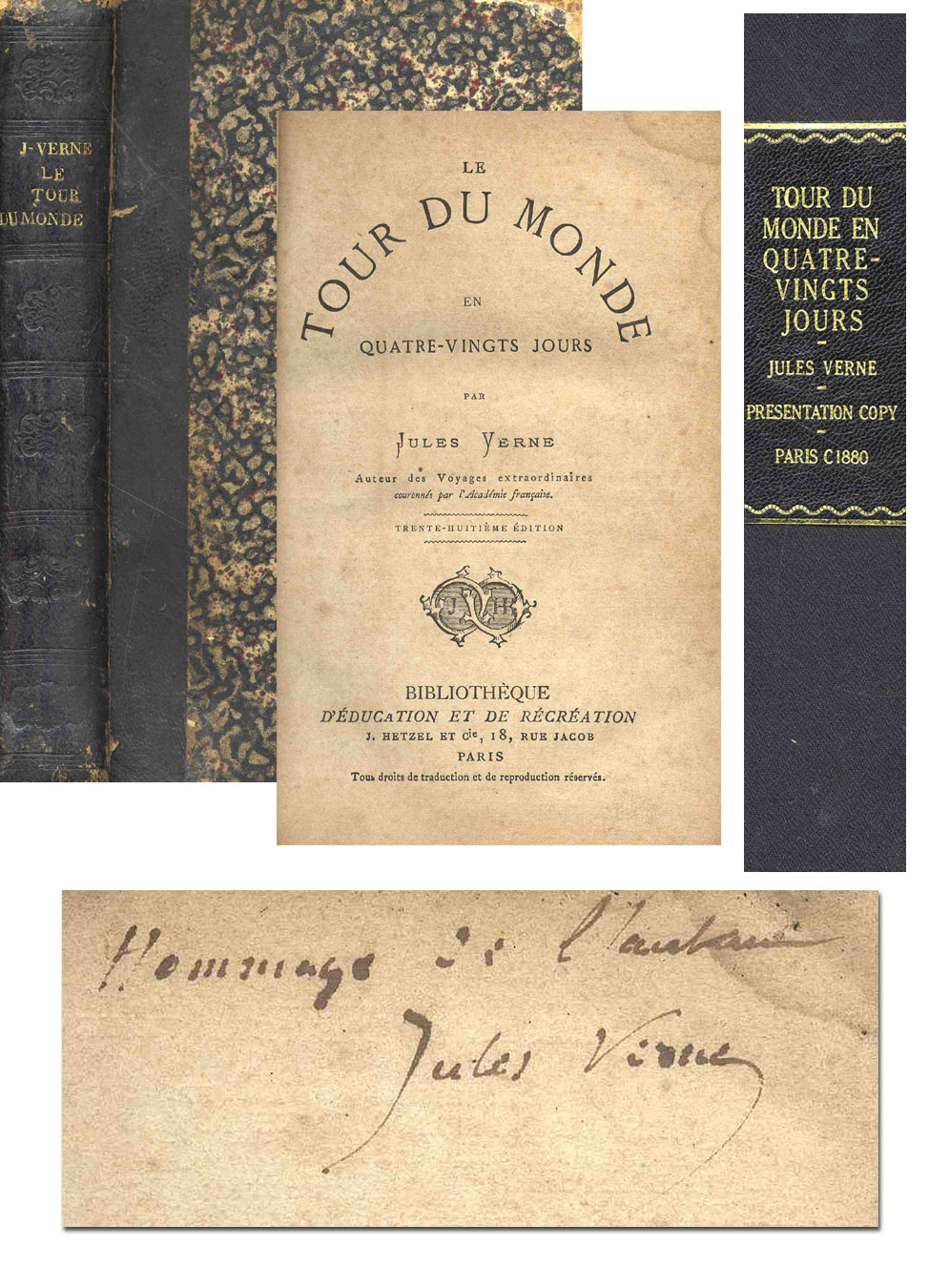
Jules Verne SB “Le Tour Du Monde”
Signed copy of Jules Verne’s “Le Tour Du Monde En Quatre-Vingts Jours.” J. Hetzel: Paris, circa 1880. 38th edition. French edition of “Round the World…” Signed in ink to half-title page, “Hommage de l’auteur / Jules Verne.” A classic signed copy of Verne’s most popular work which recounts the varied and wonderful adventures of Phileas Fogg and the faithful Passepartout. Wear to edges, ends and joints of half-marble boards. Light dampstaining slightly affects inscription, though signature remains clear. Box housed in black cloth hardcase; gilt writing to side reads “Tour Du Monde En Quatre-Vingts Jours / Jules Verne / Presentation Copy / Paris c. 1880”. Foxing and toning throughout, else good condition. Sold for $4,800.
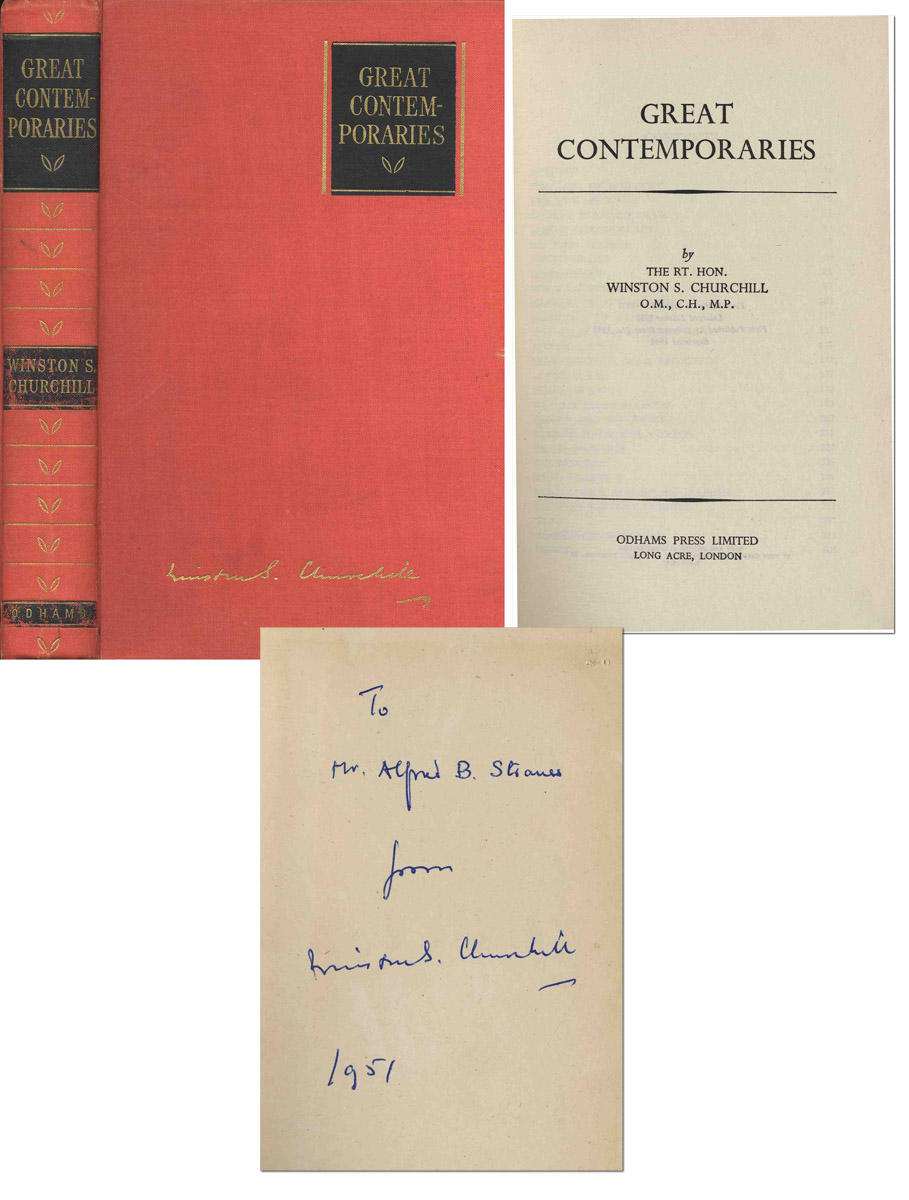
Winston Churchill Signed Book Great Contemporaries
Sir Winston Leonard Spencer-Churchill (30 November 1874 – 24 January 1965) was a British politician, army officer, and writer. He was the prime minister of the United Kingdom from 1940 to 1945, when he led Britain to victory in the Second World War, and again from 1951 to 1955. Churchill represented five constituencies during his career as a Member of Parliament (MP). Ideologically an economic liberal and imperialist, for most of his career he was a member of the Conservative Party, which he led from 1940 to 1955, but from 1904 to 1924 was a member of the Liberal Party.
Winston Churchill signed copy of his 1937 book “Great Contemporaries.” Signed and inscribed, “To Mr. Alfred B. Strauss from Winston S. Churchill / 1951” on the front free endpaper. Published by Thornton Butterworth Ltd.: London: 1948, later printing. In publisher’s original cloth. Some rubbing to spine and edges, faint toning to signature page, and two sets of staple marks at top and bottom right of signature page, far away from writing. Overall in very good condition. Sold for $3,336.
Auction your Palladis Tamia 1st edition 1598 at Nate D. Sanders Auctions. Send a description and images of your Palladis Tamia 1st edition 1598 to us at [email protected].
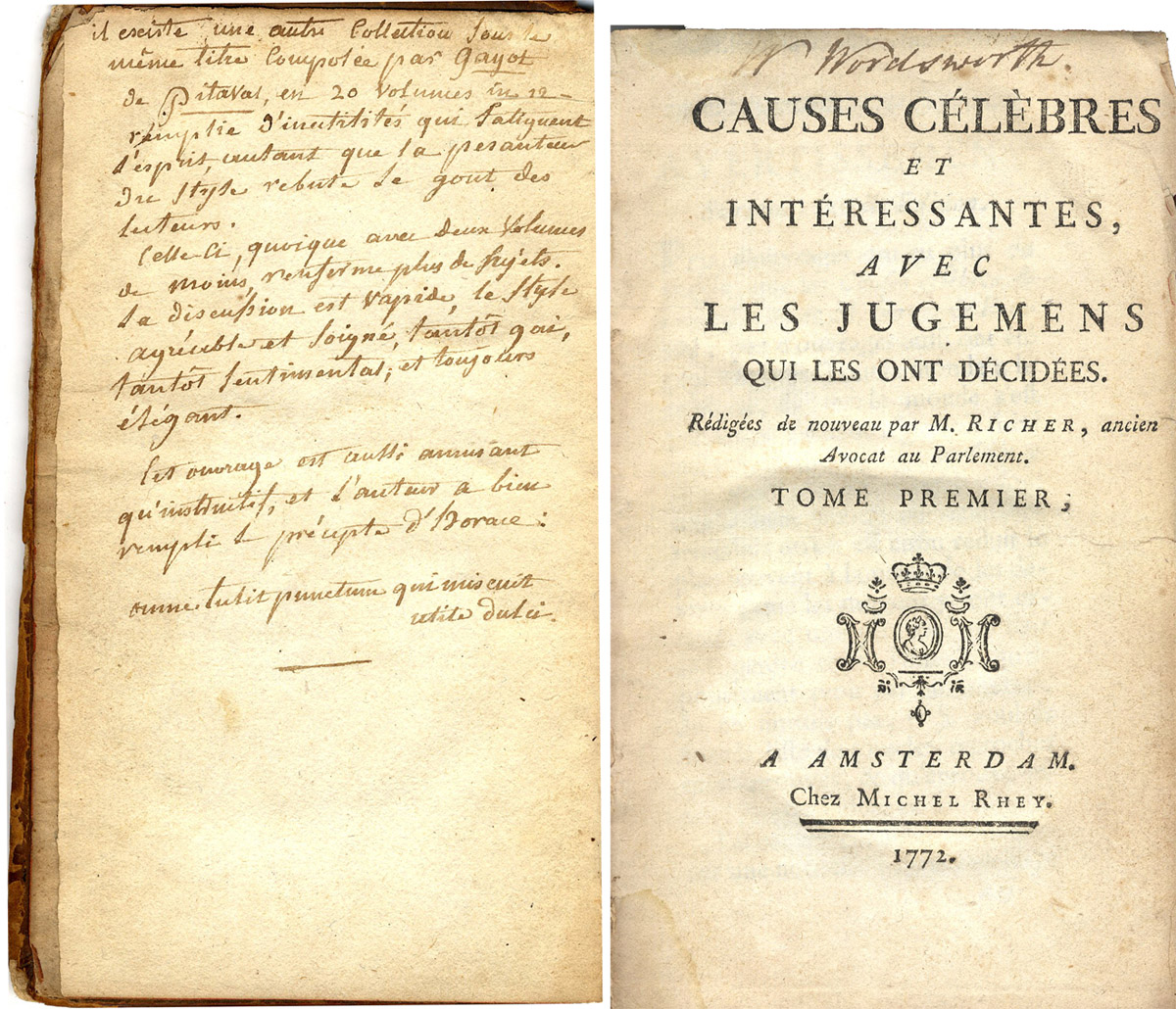
Original Book From William Wordsworth’s Personal Library — Signed by the Revered Poet on Title Page
British Romantic poet William Wordsworth book from his personal library, signed clearly ”W Wordsworth” on title page. Wordsworth spearheaded the Romantic poetry movement in England along with Samuel Taylor Coleridge and others in the 19th century, becoming known for his 1798 collaboration with Coleridge entitled ”Lyrical Ballads.” Book is written in French and titled, ”Causes celebres et Interessantes avec Les Jugements Qui Les Ont Decidees / Redigles de nouveau par M. Richer, ancien avocat au Parlement, Tome Premiere.” Published ”Chez Michel Rhey” in Amsterdam in 1772 as a volume of legal judgments by various authors. Wordsworth lived in France, becoming engrossed in the Revolutionary Republican movement. He fell in love with a French woman, Annette Vallon, who in 1792 gave birth to their child, Caroline. Front fly leaf has notes written in French, though not identifiably in Wordsworth’s hand. Book is split into two parts and the front board is detached. Very good condition otherwise. Sold for $1,420.
Lord Byron Signed Envelope — Rare
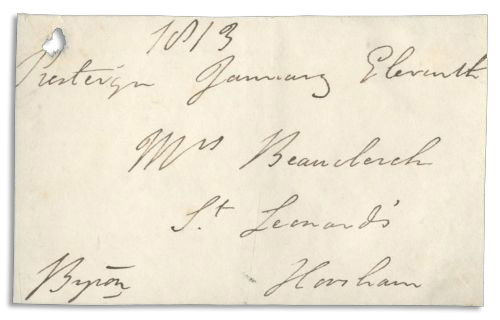
Lord Byron holograph and signed envelope. The poet inscribes in black ink, “1813 [?] January Eleventh / Mrs. Beauclerk / St. Leonard’s / Horsham / Byron”. A leading figure in the Romantic movement and a social reformist, Byron was known to send Emily Beauclerk, the half sister of Lord Edward Fitzgerald, his visiting card in an attempt to court her. 4.5″ x 2.75″ envelope is lightly soiled and has a small hole to the upper left. In very good condition with wear commensurate with age. A rare signed item by the notorious Byron. Sold for $850.
FREE ESTIMATE. To buy, auction, sell or consign your Palladis Tamia 1st edition 1598 that is for sale, please email your description and photos to [email protected] of Nate D. Sanders Auctions (http://www.NateDSanders.com).
We offer the following services for your Palladis Tamia 1st edition 1598:
- Appraise your Palladis Tamia 1st edition 1598
- Auction your Palladis Tamia 1st edition 1598
- Consign your Palladis Tamia 1st edition 1598
- Sell your Palladis Tamia 1st edition 1598
- Buy your Palladis Tamia 1st edition 1598
- Estimate your Palladis Tamia 1st edition 1598