Sell Your Science Autographs & Memorabilia for Over $1 Million Dollars
FREE VALUATION. To auction, buy, consign or sell science autographs & memorabilia, please call the Nate D. Sanders Auction House (http://www.NateDSanders.com) at 310.440.2982 or email Nate at [email protected]. Thank you.
Science Autographs & Memorabilia
We at Nate D. Sanders Auction House have had great luck with our science autographs & memorabilia. We have even sold 6 scientific Nobel Prizes, a world record for an auction house. One Nobel Prize award sold for almost $800,000. Here is the write-up from CNBC:
https://www.cnbc.com/2015/10/30/1963-nobel-prize-auctions-for-almost-800000.html
1963 Nobel Prize auctions for almost $800,000
CNBC.com

Yet another Nobel Prize has gone under the gavel.
Dr. Alan Hodgkin’s 1963 Nobel Prize sold for $795,614 by Nate D. Sanders Auctions on Thursday. The award, which Hodgkin received for his work on the central nervous system, is one of only 13 to go to auction.
Hodgkin and colleague A.F. Huxley used nerve cells from a giant squid to study electrical impulses at a cellular level and ultimately, greatly impacted modern neurology.
The Nobel Prize is made of 23 karat gold and sold with a letter of authenticity from Hodgkin’s daughter.
Several other Nobel Prizes have been auctioned in the last year. Physicist Leon Lenderman’s award sold for $765,000 in May (also by Nate D. Sanders Auction House).
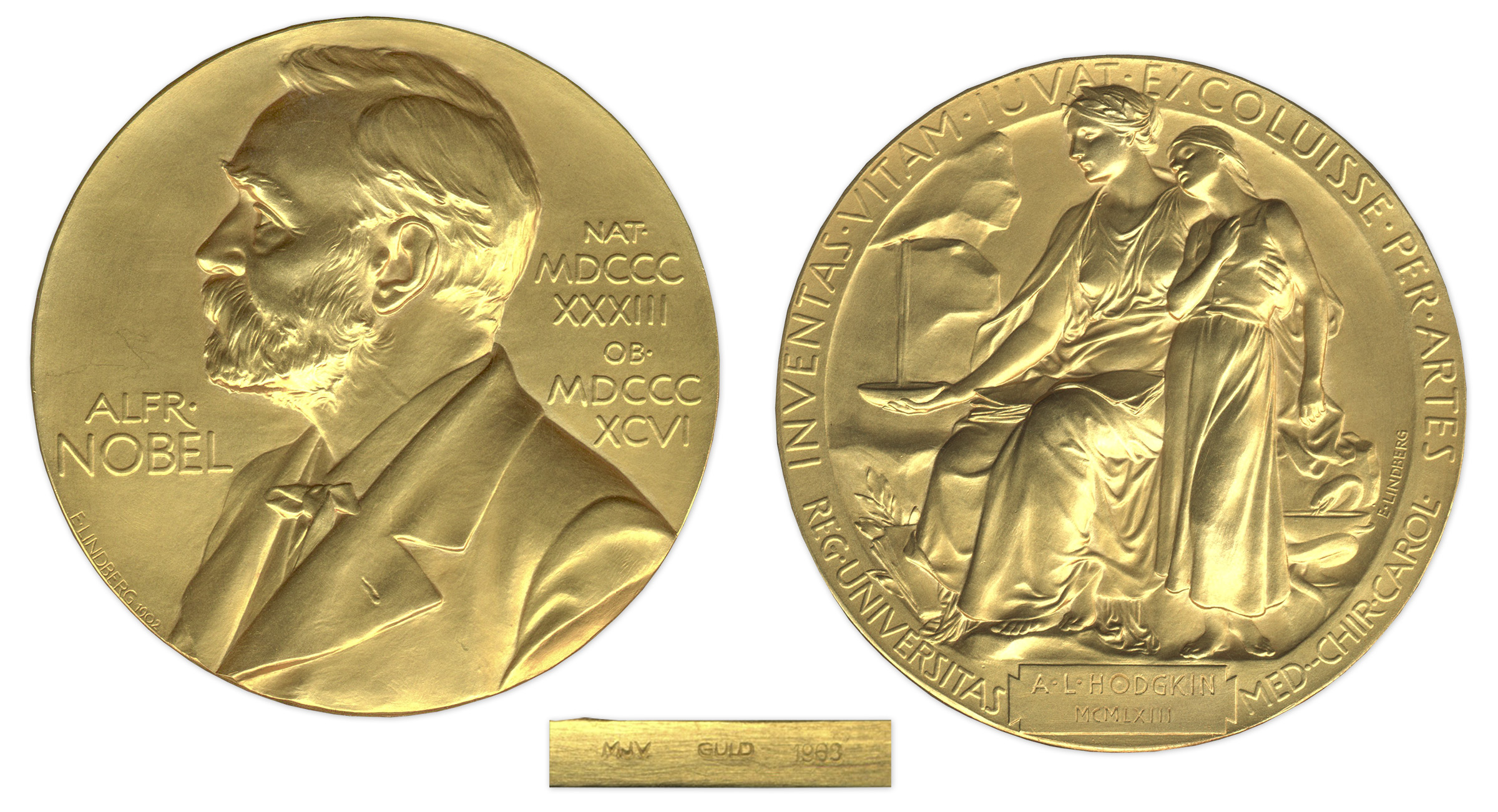
Dr. Alan Hodgkin’s 1963 Nobel Prize
https://natedsanders.com/LotDetail.aspx?inventoryid=40145
To auction, buy, consign or sell science autographs & memorabilia, please call the Nate D. Sanders Auction House at 310.440.2982 or email Nate at [email protected]. Thank you.
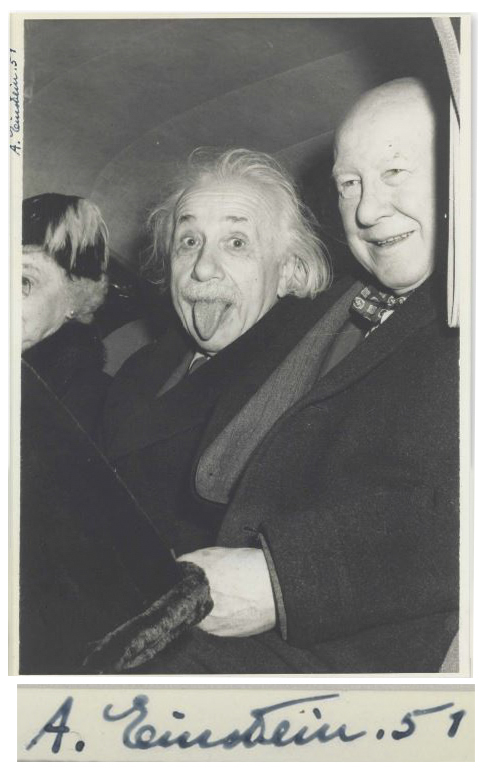
Nate D. Sanders Auctions just sold this Albert Einstein autograph on a photo for $125,000:
 |
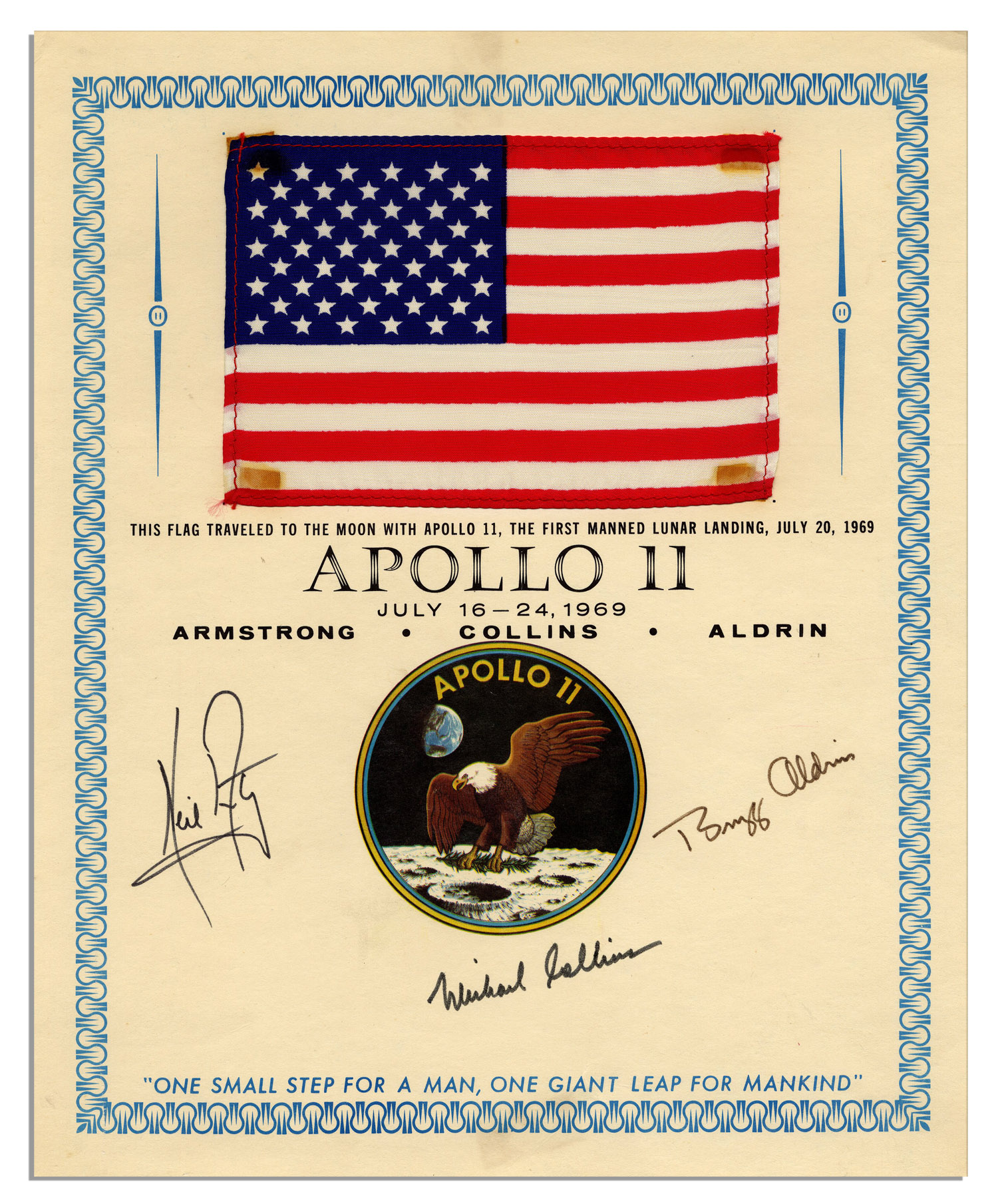
Exceptionally Scarce Apollo 11 Flag Flown to the Moon — Signed by Armstrong, Aldrin & Collins
United States flag flown to the moon on Apollo 11 during the historic 1969 mission. Flag is mounted to an official NASA certificate reading: ”This flag traveled to the Moon with Apollo 11, the first manned lunar landing, July 20, 1969.” Certificate is signed ”Neil Armstrong”, ”Michael Collins” and ”Buzz Aldrin” in felt tip and has the Apollo 11 crew emblem near the center. Printed along the bottom edge are the first words by Neil Armstrong after stepping upon the moon: ”One small step for man, one giant leap for mankind”. The silk United States flag measures 6” x 4”, mounted to the NASA certificate, which measures 10” x 12”. Some show through of adhesive to flag corners and light toning to certificate, else near fine. Our most expensive Apollo 11 flag flown to the moon that we auctioned. Sold for $63,195.
To auction, buy, consign or sell science autographs & memorabilia, please call the Nate D. Sanders Auction House at 310.440.2982 or email Nate at [email protected]. Thank you.
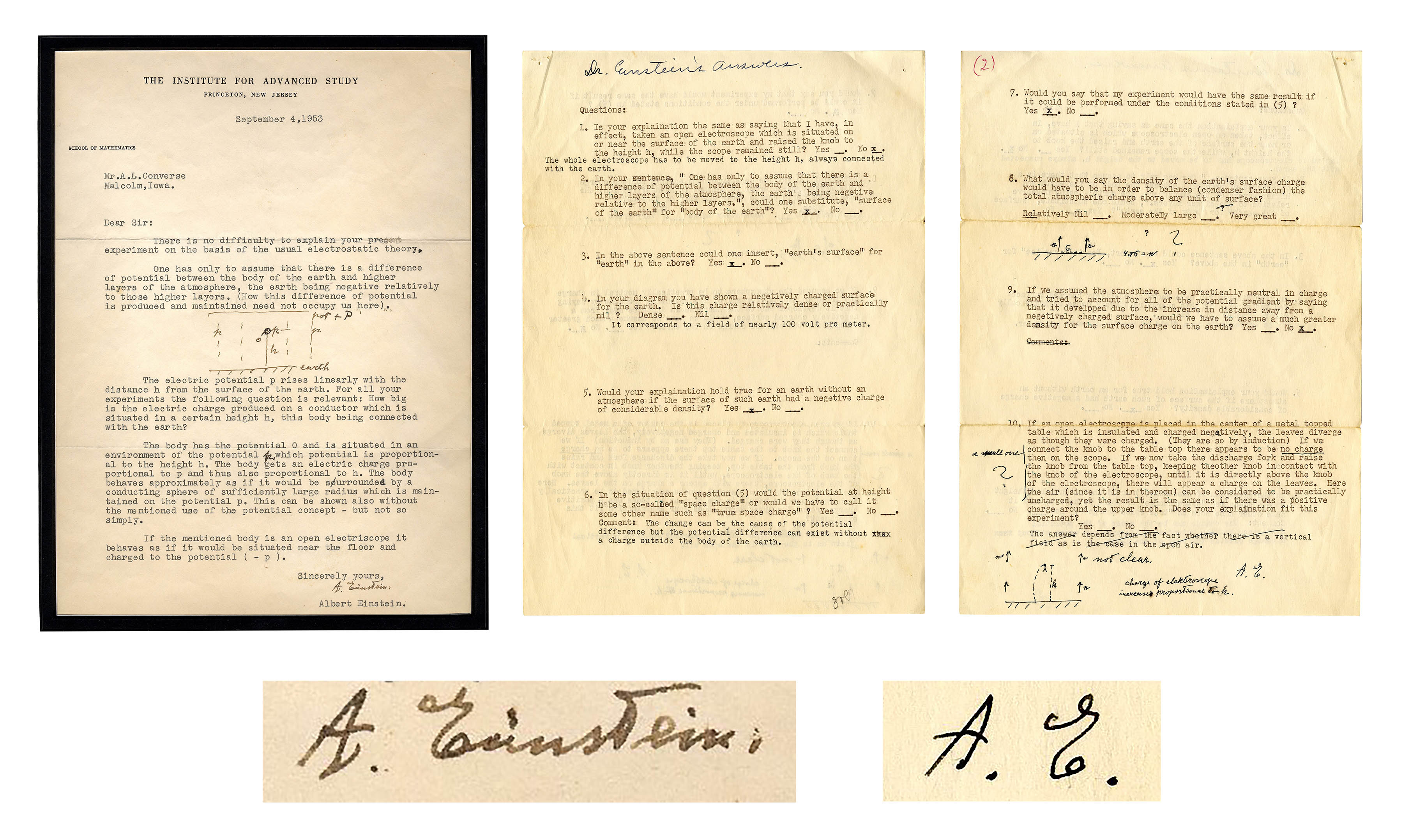
Remarkable Albert Einstein Autograph Letter Signed, Along With His Initialed Drawings — Explaining the Science Behind His Groundbreaking Work on Electrostatic Theory and Special Relativity
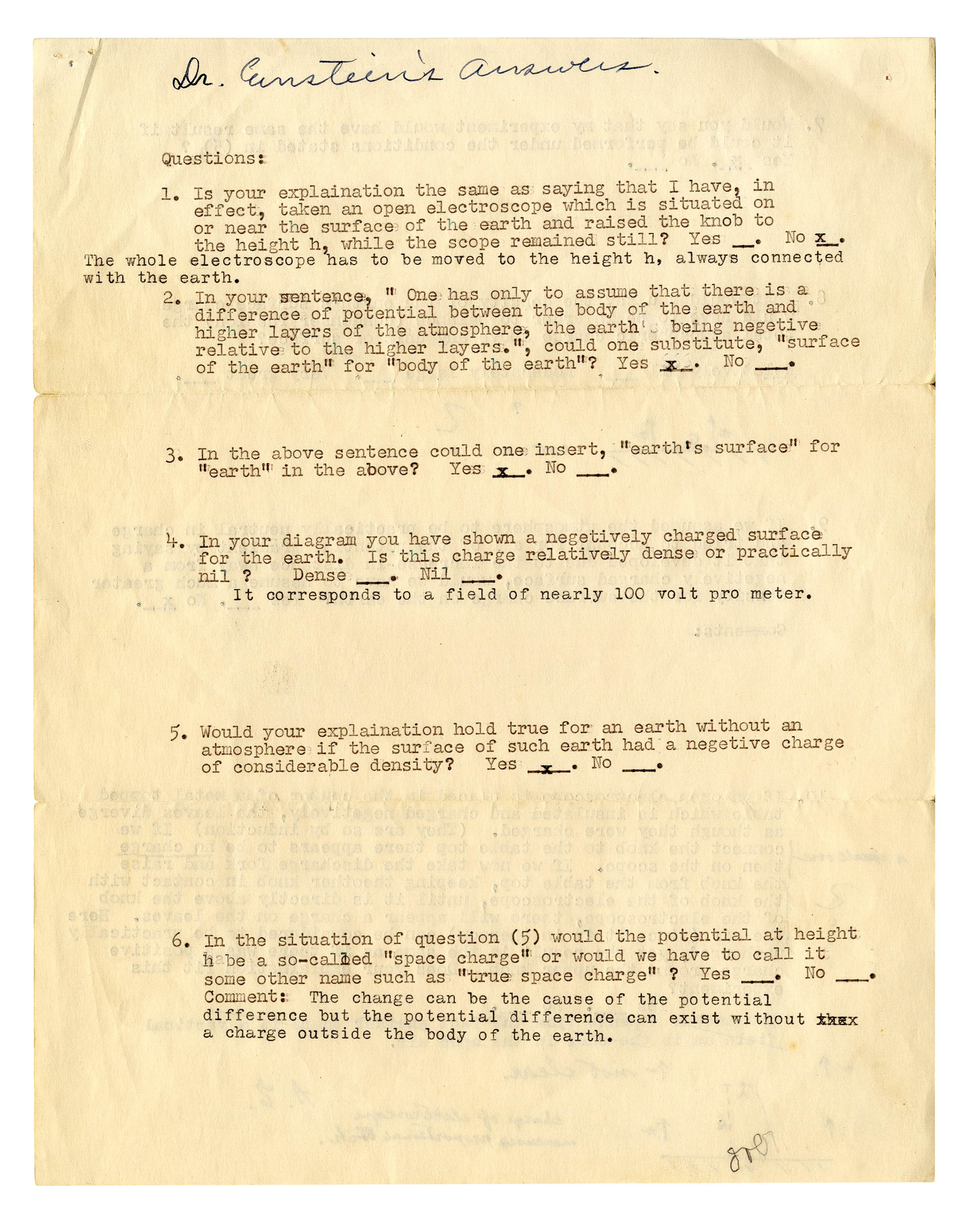
Albert Einstein autograph letter signed with his hand drawings, elegantly explaining his electrostatic theory of special relativity to a physics teacher struggling to reconcile it with experiments he was conducting. In addition to the letter, which is new to the market, Einstein generously replies to a series of questions the teacher asks him on a questionnaire, providing additional drawings and calculations, initialed ”A.E.” at the conclusion. Dated 4 September 1953 on Princeton’s Institute for Advanced Study letterhead, Einstein writes to Arthur L. Converse, the teacher from Malcolm, Iowa, in part, ”There is no difficulty to explain your present experiment on the basis of the usual electrostatic theory. One has only to assume that there is a difference of potential between the body of the earth and higher layers of the atmosphere, the earth being negative relatively to those higher layers…[Einstein then draws Earth and the atmosphere, referring to it for clarification] The electric potential p rises linearly with the
To auction, buy, consign or sell science autographs & memorabilia, please call the Nate D. Sanders Auction House at 310.440.2982 or email Nate at [email protected]. Thank you.
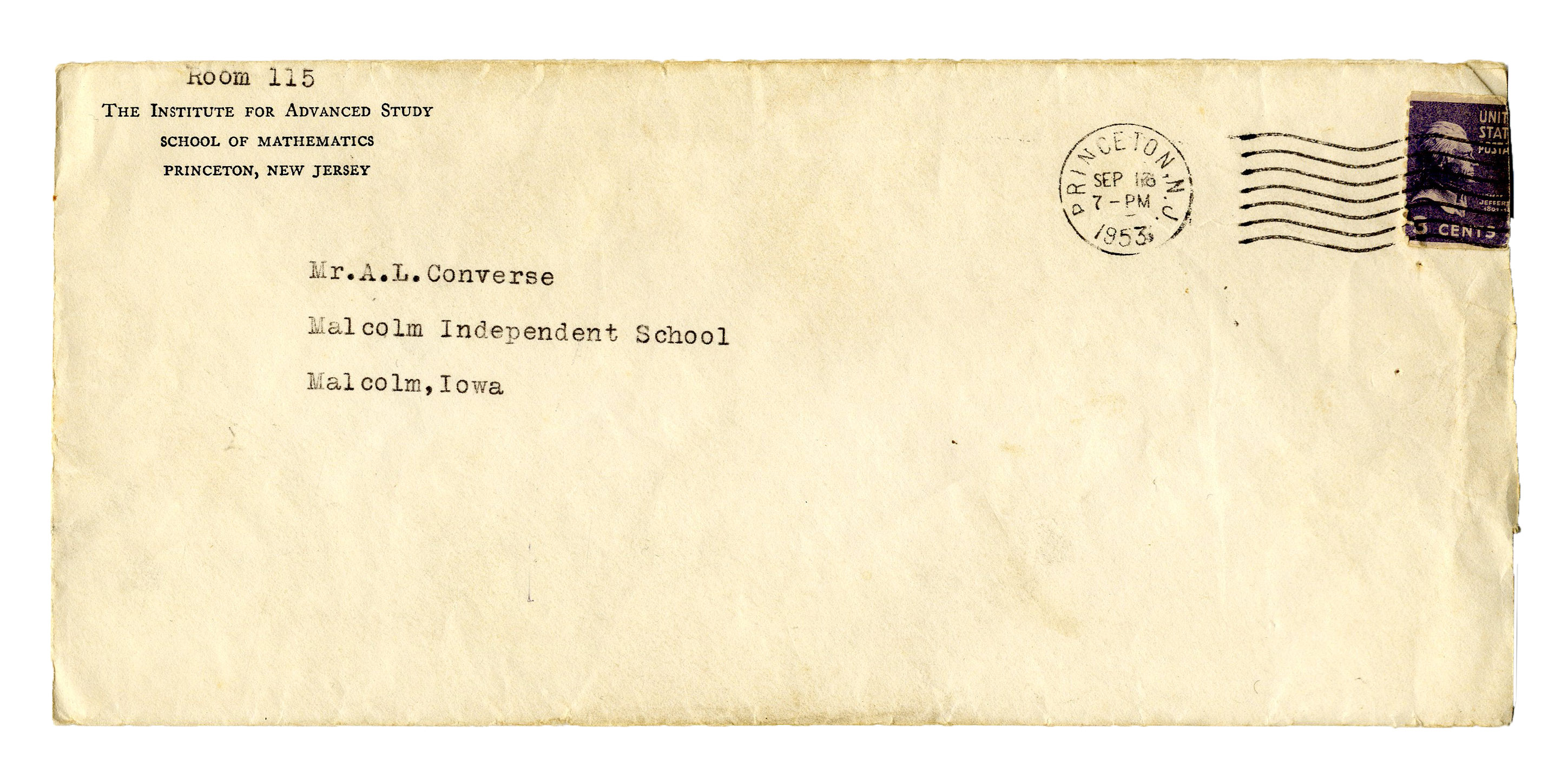
distance h from the surface of the earth…For all your experiments the following question is relevant: How big is the electric charge produced on a conductor which is situated in a certain height h, this body being connected with the earth…” Einstein then answers Converse’s questions on a two-page questionnaire. In one answer, Einstein seems to disagree with the question, providing both a diagram and mathematical equation and then a ”?” to try to aid understanding. He later writes ”not clear” to one answer along with a question mark and additional diagram with the notation ”charge of elektroscope increased proportional to h”. An extraordinary lot by Einstein showing the generosity of his time, with rare content on his theory of special relativity. Single page letter and two-page questionnaire each measures 8.5” x 11”. Also included is Einstein’s original mailing envelope from ”Room 115” of the Institute for Advanced Study, postmarked 7 September 1953 from Princeton. Folds and very light toning to letter, otherwise near fine. Questionnaire has folds, light toning and staple mark, otherwise near fine with bold handwriting by Einstein. Dark Albert Einstein autograph. With an LOA from the nephew of Arthur Converse and new to the market.
Sold for $53,504.
 |
 |
 |
|||||||||
  |
|||||||||||
https://natedsanders.com/LotDetail.aspx?inventoryid=46232
To auction, buy, consign or sell science autographs & memorabilia, please call the Nate D. Sanders Auction House at 310.440.2982 or email Nate at [email protected]. Thank you.
In August 2017, Nate D. Sanders Auctions sold this Albert Einstein autograph letter signed regarding Hitler for $31,250.
1938 Albert Einstein Autograph Letter Signed Regarding Hitler: ”…Hoping that Hitler might let off steam…[Chamberlain] saved Hitler in the nick of time by crowning himself with the wreath of love of peace…”
Exceptional and lengthy Albert Einstein autograph letter signed in October 1938, ten days after English Prime Minister Neville Chamberlain signed the Munich Agreement, effectively ceding Czechoslovakia to Adolf Hitler. Albert Einstein autograph letter signed shows that his sharp mind extends beyond physics to also include the nuances and repercussions of international diplomacy; while most people praised Chamberlain (including President Roosevelt and the Royal family) for avoiding war by appeasing Hitler, Einstein accurately predicted that it would embolden Hitler and do further damage to European alliances. Albert Einstein autograph letter signed datelined Princeton, 10 October 1938, where he writes to his close friend Michele Besso in German, beginning with his attempts to help European Jews by issuing affidavits: ”Dear Michele! / I am not able to give any more affidavits, and I would endanger the ones that are still pending if I issued additional new ones. The few persons I know who have some assets are already encumbered to their limit. The pressure on us from these poor people over there is such that, in view of the amount of misery and the scant opportunity of being able to help, one feels absolute despair. It is bloody difficult here for business people to establish themselves. It is significantly better for trades-people – this would apply in the case of your protege’s wife. However, it will be very difficult, if these people do not have any relatives over here. You see, affidavits from relatives receive
To auction, buy, consign or sell science autographs & memorabilia, please call the Nate D. Sanders Auction House at 310.440.2982 or email Nate at [email protected]. Thank you.
priority consideration, and increasingly this means exclusion of all others. / You have confidence in the British and even Chamberlain? O sancta simpl…! [‘Oh holy innocence’, i.e., naivete in Latin] Hoping that Hitler might let off steam by attacking Russia, he sacrifices Eastern Europe. But we will come to see once more that shrewdness does not win in the long term. In France, he pushed the Left into a corner and, in France as well, helped give power to those people whose motto is, ‘Better Hitler than the Reds.’ The extermination policy against Spain already showed this clearly. Now he saved Hitler in the nick of time by crowning himself with the wreath of love of peace and inducing France to betray the Czechs. He did all this in such a clever way that he deceived most people, even you (unfortunately). His only fear, which spurred him on to his humiliating flights, was the worry that Hitler might lose ground. / I do not have any hope left for the future of Europe. America valiantly joined in with the effort to strangle Spain. For here too, to all intents and purposes, money and the fear of Bolshevists prevail – or, just in general, the fear of the owning class for their privileges. I wouldn’t want to be alive if I didn’t have my work. At any rate, it is good to be old now and, as a person at least, not to have to count on a distant future. / I am sending you our most recent work; I have great hopes for its further elaboration. I am still thoroughly convinced that, looked at from a deeper perspective, explaining the laws of nature in terms of probability constitutes a wrong direction, in spite of all practical successes of the statistical method. / From this work, you will not yet be able to clearly see the physical implications. Nevertheless, I am sure that you will like its purely logical aspect, irrespective, at this point, of whether anything can be done with it from the actual physical point of view. / I am glad for you that
To auction, buy, consign or sell science autographs & memorabilia, please call the Nate D. Sanders Auction House at 310.440.2982 or email Nate at [email protected]. Thank you.
you are going to retire. You have pulled this tedious cart, which never arrives anywhere, long enough, and now, during your last years, you will be able to devote yourself purely to thought. Plato, as you know, desired this for all members of his privileged class who had reached the age of 50. / Mileva [Einstein’s ex-wife] has great difficulties making her mortgage payments. I suppose I will have to assume ownership of the house, in which she lives, in my own name, even though this constitutes a considerable risk. / Affectionate greetings to you and Anna from your / Albert Einstein autograph”. Two page letter with blind-stamped address measures 8.5” x 11”. With original transmittal envelope postmarked Princeton, 11 October 1938. Remarkable Albert Einstein autograph letter signed. Near fine condition. Accompanied by a full translation. Sold for $31,250.
![Science Autographs Albert Einstein 1938 ALS Regarding Hitler: ''...Hoping that Hitler might let off steam...[Chamberlain] saved Hitler in the nick of time by crowning himself with the wreath of love of peace...''](https://natedsanders.com/ItemImages/000046/Albert-Einstein-Autograph-Letter-Signed-53983_lg.jpeg "Click to enlarge") |
![Science Autographs Albert Einstein 1938 ALS Regarding Hitler: ''...Hoping that Hitler might let off steam...[Chamberlain] saved Hitler in the nick of time by crowning himself with the wreath of love of peace...''](https://natedsanders.com/ItemImages/000046/Albert-Einstein-Autograph-Letter-Signed-53983b_lg.jpeg "Click to enlarge") |
![Science Autographs Albert Einstein 1938 ALS Regarding Hitler: ''...Hoping that Hitler might let off steam...[Chamberlain] saved Hitler in the nick of time by crowning himself with the wreath of love of peace...''](https://natedsanders.com/ItemImages/000046/Albert-Einstein-Autograph-Letter-Signed-53983c_lg.jpeg "Click to enlarge") |
|||||||||
![Science Autographs Albert Einstein 1938 ALS Regarding Hitler: ''...Hoping that Hitler might let off steam...[Chamberlain] saved Hitler in the nick of time by crowning himself with the wreath of love of peace...''](https://natedsanders.com/ItemImages/000046/Albert-Einstein-Autograph-Letter-Signed-53983d_lg.jpeg "Click to enlarge") ![Science Autographs Albert Einstein 1938 ALS Regarding Hitler: ''...Hoping that Hitler might let off steam...[Chamberlain] saved Hitler in the nick of time by crowning himself with the wreath of love of peace...''](https://natedsanders.com/ItemImages/000046/Albert-Einstein-Autograph-Letter-Signed-53983z_lg.jpeg "Click to enlarge") |
|||||||||||
FREE VALUATION. To auction, buy, consign or sell science autographs & memorabilia, please call the Nate D. Sanders Auction House (http://www.NateDSanders.com) at 310.440.2982 or email Nate at [email protected]. Top dollar obtained for your science autographs & memorabilia. Thank you.
Nate D. Sanders Auctions offers the following services for science autographs & memorabilia:
- Appraise science autographs
- Auction science autographs
- Consign science autographs
- Sell science autographs
- Buy science autographs
- Research science autographs
- Authenticate science autographs
- Assess science autographs
- Science autographs for sale
- Science autographs appraisal
- Science autographs auction
- Science autographs consignment
- Science autographs sold
- Science autographs bought
- Science autographs researched
- Science autographs authentication
- Science autographs valuation
- Science autographs estimate
- Science autographs prices realized
- Science autographs for sale at auction
- Science autographs appraisement
- Science autographs auctioned
- Science autographs worth
- Science autographs value
- Science autographs research
- Science autographs no cost estimate
- Science autographs assessment
- Science autographs estimation
- Science autographs consign
- Science autographs auction prices realized
- Science autographs for purchase
- Science autographs Einstein
- Science autographs Darwin
- Science autographs astronauts
- Science autographs physics
- Science autographs biology
- Science autographs chemistry
- Science autographs Neil Armstrong
- Science autographs Buzz Aldrin
- Science autographs Michael Collins