
Sell or Auction Your Joseph E Field Texas 1st Edition 2nd Issue 1836 for up to Over $20,000 or More at Nate D. Sanders Auctions
FREE APPRAISAL. To buy, auction, sell or consign your Joseph E Field Texas 1st edition 2nd issue 1836 that is for sale, please email your description and photos to [email protected] of Nate D. Sanders Auctions (http://www.NateDSanders.com).
Free Appraisal, Auction or Sell Your Joseph E Field Texas 1st Edition 2nd Issue 1836
Below is a recent realized price for a 1st edition 2nd issue copy of Joseph E Field’s Texas. We at Nate D. Sanders Auctions can obtain up to this amount or more for you:
Joseph E Field Texas 1st Edition 2nd Issue 1836. Sold for Over $20,000.
Here are some related items we have sold:
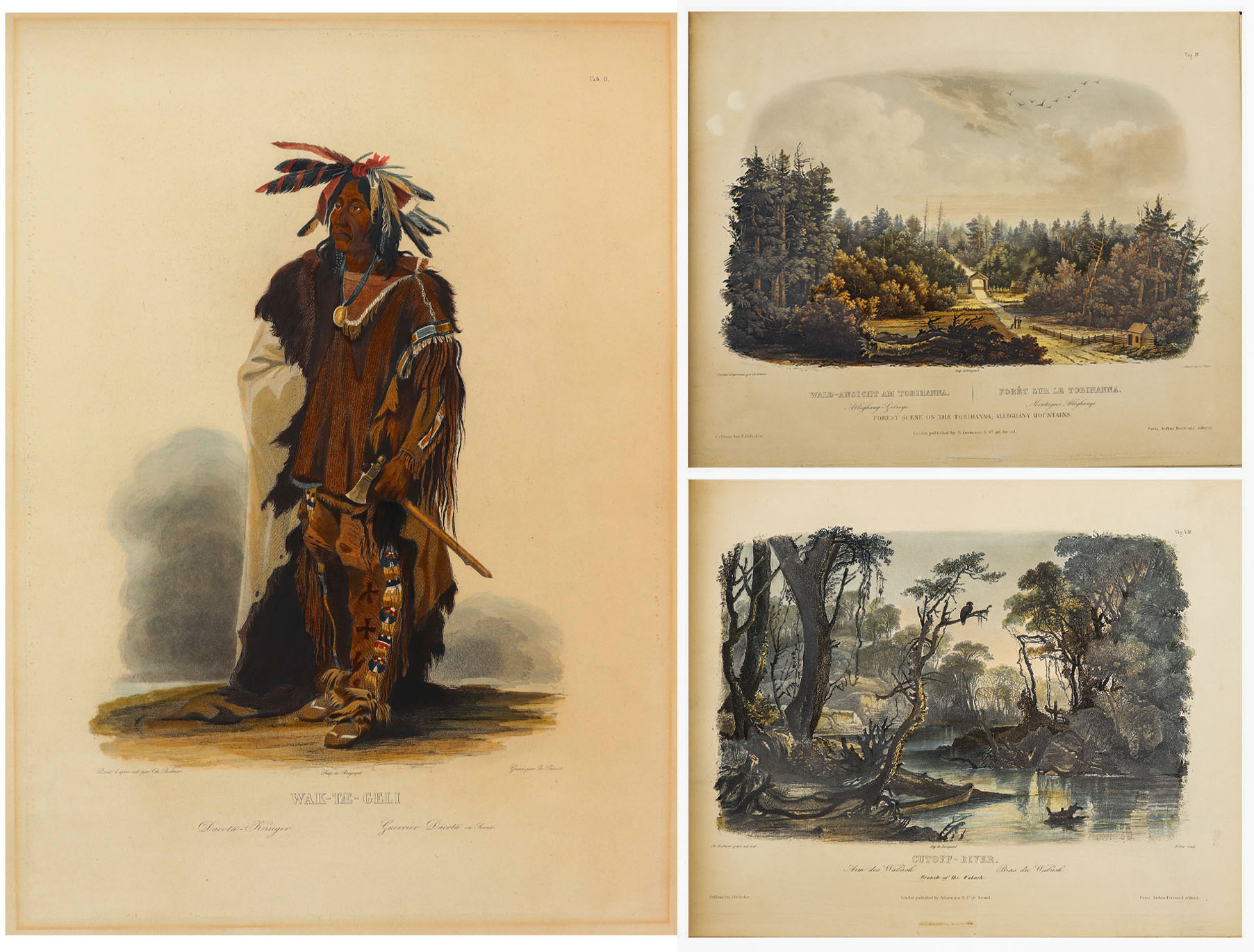
81 Beautiful Hand-Colored Aquatints by Karl Bodmer Depicting the American Frontier in the 1830s — Contained in the Illustrated Travelogue “Prince of Wied’s Travels in the Interior of North America”
Stunningly beautiful collection of 81 hand-colored aquatints by the Swiss artist Karl Bodmer, a complete collection from the illustrated travelogue, “Prince of Wied’s Travels in the Interior of North America”. Bodmer, who journeyed with the German Prince Maximilian of Wied-Neuwied from 1833-34 along the Missouri River, produced what is considered the best depictions of the indigenous peoples and landscapes during the frontier era, an America then still unspoiled by western migration. Of the Native American tribes of the Great Plains that they encountered, Bodmer’s depictions of the Blackfeet and Mandan tribes are especially important as the populations of these tribes were greatly affected by the smallpox epidemic of 1837, thus making Bodmer’s work the last visual testament to their culture.
Prince Max, as he was called, chose Bodmer to accompany him on the expedition along the Missouri River to visually depict the scenes that the Prince would write about. The result is this collection: three volumes of text by the Prince and two volumes of aquatints by Bodmer, in the first Paris edition published by Chez Arthus Bertrand, 1840-43 (“Voyage dans l’interieur de l’Amerique du Nord”). Text volumes in French also include 37 wood-engraved illustrations, only lacking the map in completeness. The two complete volumes of illustrations include the large folio volume with 48 oversized hand-colored aquatints measuring approximately 24.5″ x 18″, and the quarto volume with 33 hand-colored aquatints measuring approximately 12.5″ x 10.25″. The complete set of 81 aquatints is magnificent in their display, a time capsule with their hand-coloring evoking the sense of awe and discovery of the expedition. All volumes are bound in half black morocco and blue paper-covered boards with gilt accenting, and with black morocco labels to illustrated volumes. Minor handling wear to volumes, with a few small repaired tears to plates, some plates supplied with variance to margins, minute toning and foxing, a few plates beginning to separate from binding. Overall a very good plus set with excellent display quality. Sold for $175,000.


Gutenberg Bible Leaf — Scarce Leaf From the 15th Century Bible Made From Moveable Type That Ushered in the Age of Enlightenment
Scarce leaf from the Gutenberg Bible, one of the earliest major books printed from moveable metal type, the invention that ushered in the Age of Enlightenment by democratizing knowledge through mass production of literature. Printed by Johannes Gutenberg in Mainz, Germany from 1450-1455, less than 50 complete or near-complete copies of the Gutenberg Bible are now extant, with nearly all those housed in public institutions. Singular leaves are also scarce, with the leaf presented here having been acquired by bookseller Gabriel Wells, whose purchase of an incomplete Bible in 1920 gave way to selling the individual leaves alongside an essay by A. Edward Newton entitled “A Noble Fragment”. Leaf is number 193 of the full Latin Bible, with the recto being the Prologue to 1 Chronicles of the Old Testament, and the verso the first part of Chapter 1 of 1 Chronicles. Each page features two columns of 42 lines in dark black Gothic type, accented by red and blue rubrication. Each copy of the Gutenberg Bible differs in its rubrication and illumination, with buyers at the time deciding upon these embellishments after the Bible was printed. The six-line rubricated letters of this leaf were likely added later, restored to match the original style. Leaf measures 11.125″ x 15.375″, bound on edge to portfolio measuring 11.75″ x 16″. Paper quality is still bright with very little foxing or discoloration compared to other examples. A stunning example from the book that changed the course of history. Sold for $136,500.

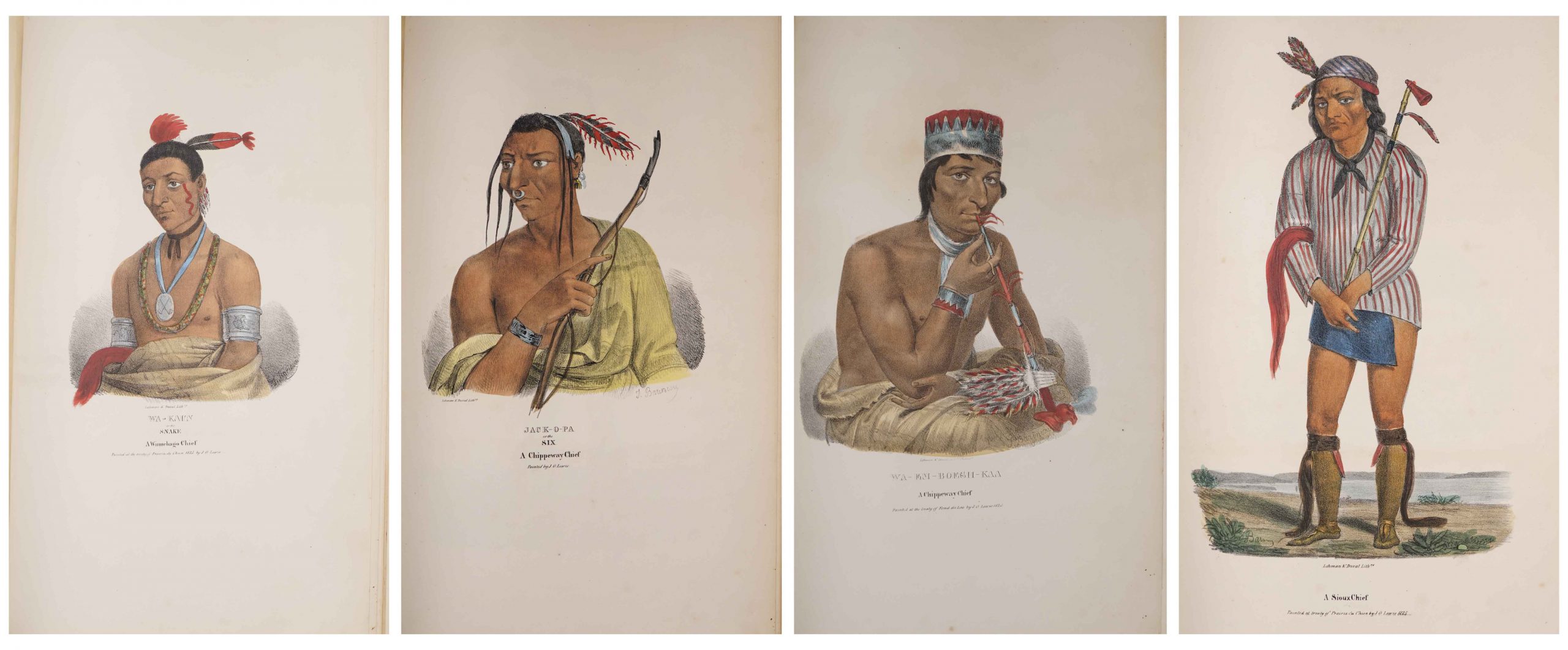
Complete Set of 80 Hand-Colored Lithographs of “The Aboriginal Port Folio” by James Otto Lewis From 1835-1838 — Extremely Scarce Complete Set
Very scarce complete set of the “Aboriginal Port Folio”, containing 80 hand-colored lithographs by Native American visual chronicler James Otto Lewis, whose travels to various treaty ceremonies during the early 19th century produced lasting portraits of Native American leaders and customs. Lewis was the first to create such artwork, preceding McKenney & Hall by several years. Philadelphia: George Lehman and Peter S. Duvall, 1835-1838.
After painting portraits of members from the Sioux, Potawatomi, Winnebago, Fox, Shawnee, Miami, and Iowa tribes, Lewis brought his paintings to Philadelphia for lithography, releasing them by subscription in 10 installments of 8 lithographs apiece. Each installment grew more scarce as subscriptions trailed off with the impending publication of the more comprehensive (and more formally posed) “History of the Indian Tribes of North America” by McKenney & Hall, whose portrait artist Charles Bird King even copied some of Lewis’ paintings. As a result, the full collection of 80 lithographs of “The Aboriginal Port Folio” is so scarce that only five to ten copies are known to exist. To make matters worse, Lewis’ original paintings were destroyed in the Smithsonian fire in 1865.
This set is in very good to near fine condition, with only minor scattered foxing affecting some sheets. In addition to the 80 pictorial lithographs, set also includes the lithograph title page and three leaves of advertisements, making it a truly complete set. Lithographs each measure 11.5″ x 18.125″, housed in three-quarter red morocco clamshell case with custom lettering to spine. One of the few visual remembrances of this important collection preserved for history. Sold for $84,000.

Scarce 1493 First Edition of “Nuremberg Chronicle”, the Lavishly Illustrated High Point of Printing in the Age of Incunable, Published Shortly After the Gutenberg Bible
Scarce first edition, first printing of “Liber Chronicarum” or “Nuremberg Chronicle”, the 15th century illustrated history of the world, widely considered the high point of printed books in the post-Gutenberg incunable era. Nuremberg: Anton Koberger for Sebald Schreyer and Sebastian Kammermeister, 12 July 1493. Written by the Nuremberg doctor and humanist Hartmann Schedel, and largely illustrated by Michael Wolgemut’s workshop, with many views reportedly completed by Albrecht Durer, who apprenticed with Wolgemut at the time. Sold for $31,500.

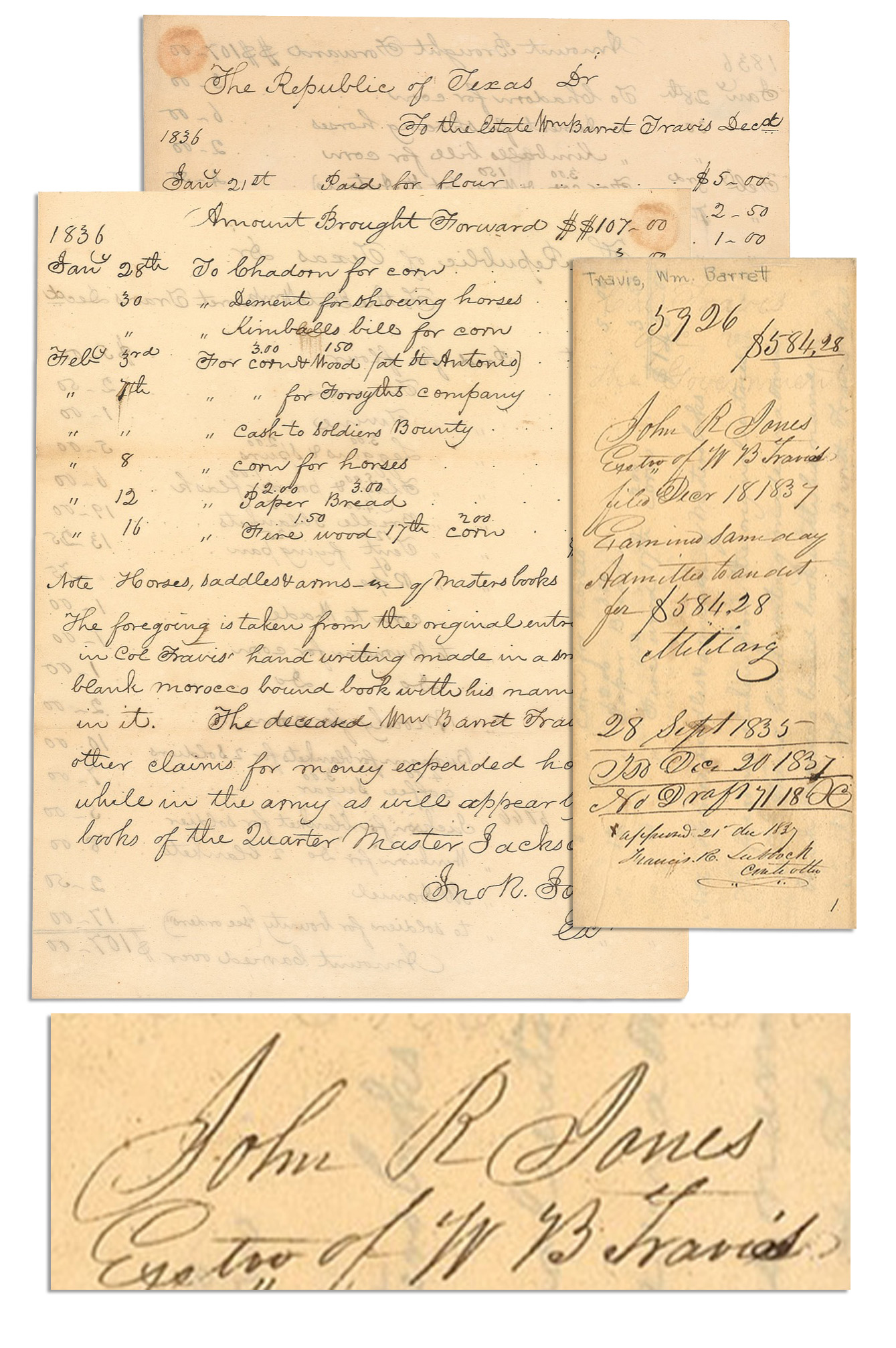
Receipt with itemized expenses incurred by Lt. Col. William Barret Travis for provisions he bought to arm and feed his Alamo soldiers. Receipt is signed by General John R. Jones, executor of Travis’ estate, listing 27 items for a total of $143 that Travis bought from January through March 1836, while under assault from the Mexican Army. It was in February 1836 that Travis wrote to his fellow Texans: ”I am besieged, by a thousand or more of the Mexicans under Santa Anna…The enemy is receiving reinforcements daily…I shall never surrender or retreat.” Addressed to the Republic of Texas, document reads: ”…the Estate Wm Barret Travis…1836 Jany 21st Paid for flour $5.00 / Tin ware 2.50 / Twine 1.00 / Leggins 3.00 & Spurs 2.00 / Flag 5.00 & Powder Flask 1.00…” continuing, ”…The foregoing is taken from the original entries in Col. Travis’ handwriting made in a small black morocco bound book with his name in it. The deceased Wm. Barret Travis has other claims for money expended horses &c while in the army as will appear by the books of the Quarter Master Jackson…” Jones notes the document was, ”…filed Dec. 18, 1837.” An endorsement by Francis Lubbock reads, ”Approved 21st Dec 1837, Francis R. Lubbock, Controller.” 2pp. document on a single sheet, measures 7.75” x 9.75”. Toning, circular stain to upper left corner and light show-through from writing on opposite side, else near fine condition. An incredible document honoring the heroism and self-sacrifice of the Alamo commander. Sold for $20,133.
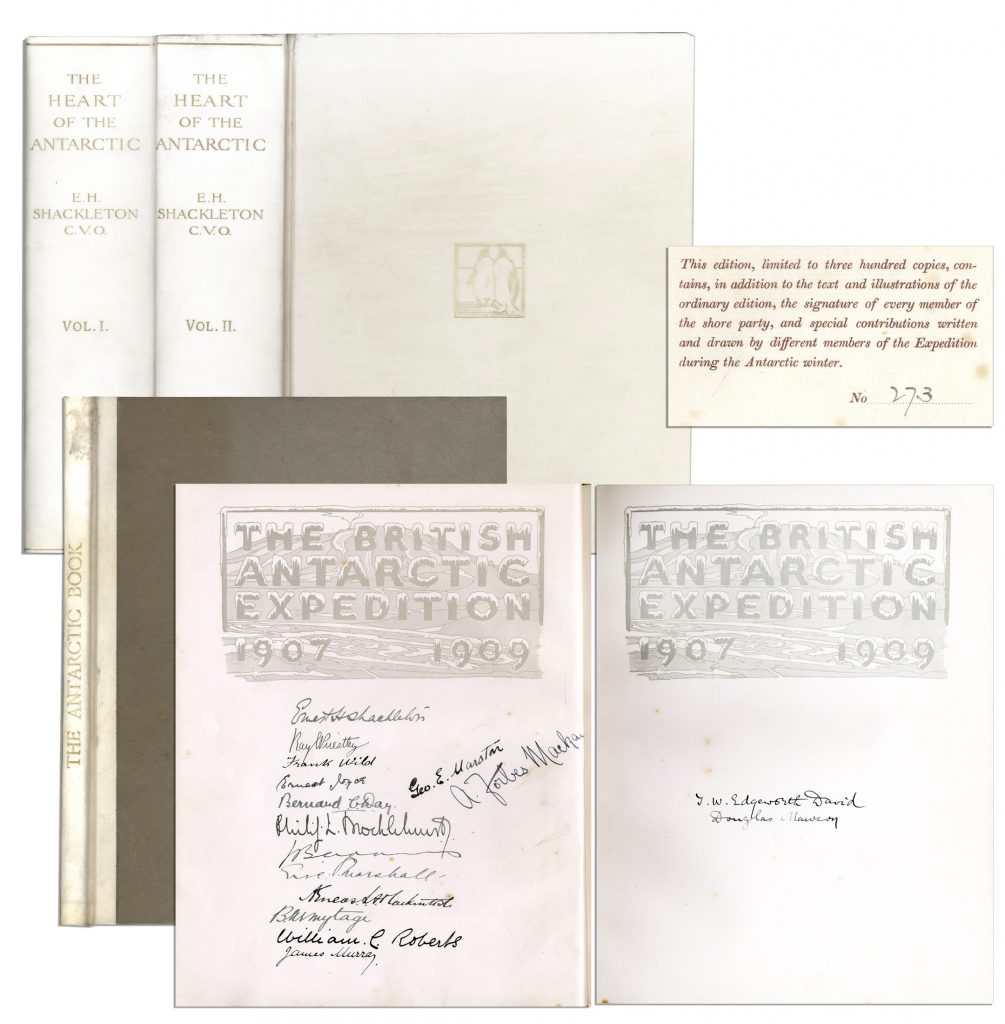
Ernest Shackleton & Crew Signed “The Heart of the Antarctic. Being the Story of the British Antarctic Expedition 1907-1909” Limited to Just 300 Copies, This Being All Three Volumes — Scarce
Ernest Shackleton’s signed copy of “The Heart of the Antarctic. Being the Story of the British Antarctic Expedition 1907-1909, 3 volumes (including “The Antarctic Book Winter Quarters 1907-09”), limited to 300 copies (here #273), also with signatures of the entire Shore party. Photogravure frontispiece, numerous plates (including 6 etched plates by George Marston, 16 tipped-in color after George Marston, others mostly photographic), one folding panorama and three folding lithographed maps in pocket at the end of volume three, illustrations and diagrams in the text. In publisher’s vellum, blocked in gilt with design of two penguins and top edges gilt. Occasional light spotting and small tear on cover of volume two. Overall in very good to near fine condition, signed by the Nimrod Shore Party crew. Sold for $12,718.
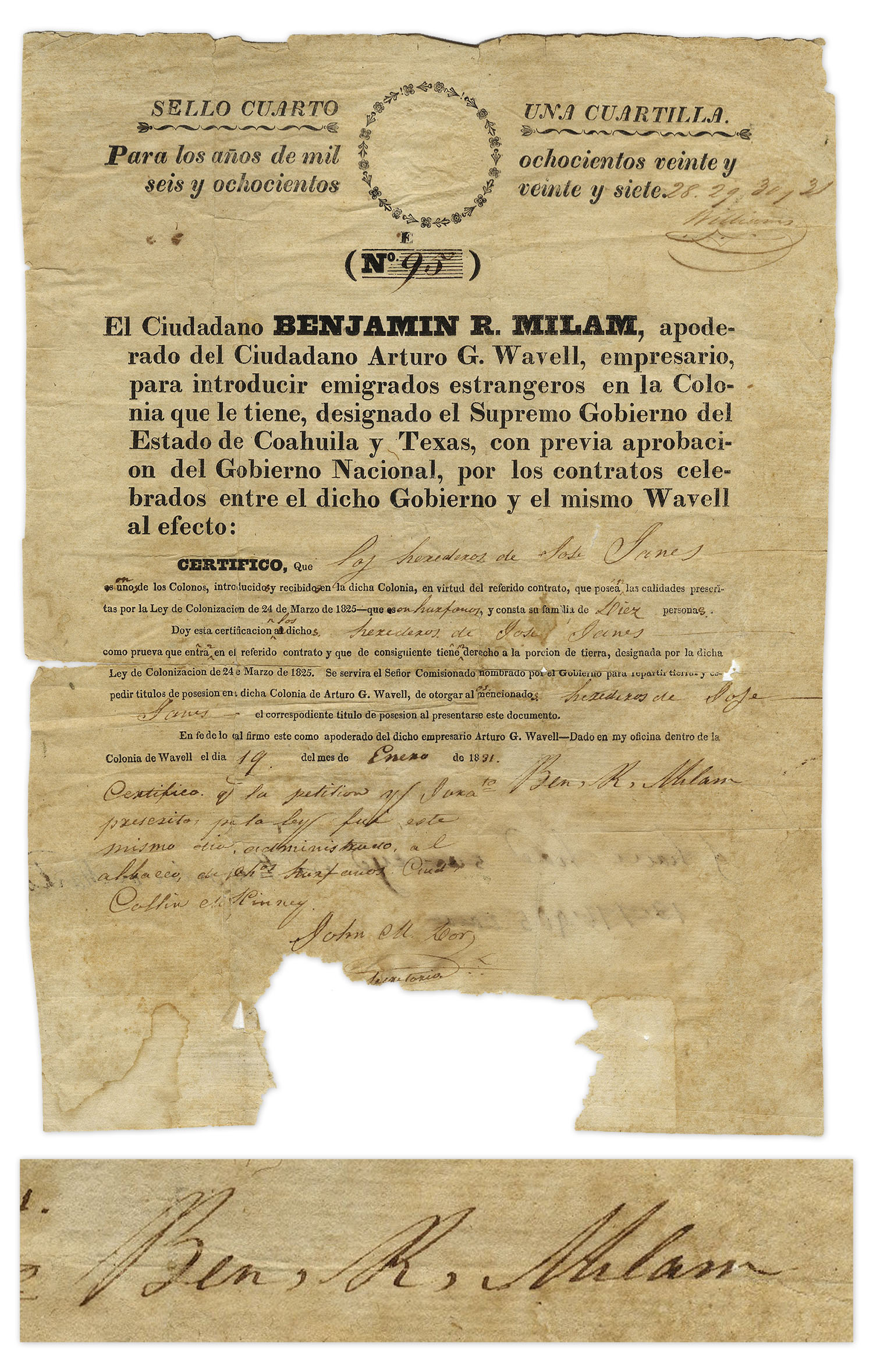
Very rare document signed by Benjamin Rush Milam, granting citizenship into Milam’s Red River Colony. Dated 19 January 1831, Milam signs this document nearly five years before he would be killed in the Siege of Bexar during the Texas Revolution, as he called to his fellow compatriots: ”Who will go with old Ben Milam into San Antonio?”
Founded by Milam and Arturo G. Wavell in 1826, the Red River Colony was an effort by the men to settle land in present-day northeast Texas along the Red River under the Colonization Law of March 24, 1825. The Mexican law was passed to encourage Texas settlement by offering 4,000 acres of land for farming and ranching with the caveats that the colonists abide by Mexican law, worship as Catholics, and demonstrate good moral conduct. Milam and Wavell applied for a land grant from the vice governor of Coahuila y Texas, who approved the request in 1826, giving the entrepreneurs six years to form the Colony. Partially-printed document ”No. 95” lists Milam and Wavell’s names in print, translated in part, ”…For the years one thousand eight hundred twenty-six and eight hundred twenty-seven [handwritten numbers of 28, 29, 30, 31 added]…The Citizen Benjamin R. Milam, agent for the Citizen Arturo G. Wavell, businessman, introduce foreign emigrants into the Colony…I certify that he and heirs of Jose Janes[?] are one of the settlers, introduced into the said colony, by virtue of said contract, possessing the qualities prescribed by the Colonization Law of March 24, 1825 – which are and consist of his family of Ten people. I hereby certify the said heirs of Jose Janes as proof that he enters into said contract and that he is therefore entitled to the portion of land designated by said Colonization Act of March 24, 1825…in said Colony of Arturo G. Wavell…I sign this as proxy of the said businessman Arturo G. Wavell – Given in my office inside the Colony of Wavell on the 19th, of the month of January, 1831…” Signed ”Ben. R. Milam”. Single page document measures 8.25” x 11.25”. Paper loss at bottom of approximately 3” x 1.25, light wear and toning. Mounting remnants and archival tape repair to verso. Overall in good to very good condition. One of less than a handful of documents signed by Milam known to exist, and the only known document granting citizenship in his Red River Colony. Sold for $12,000.
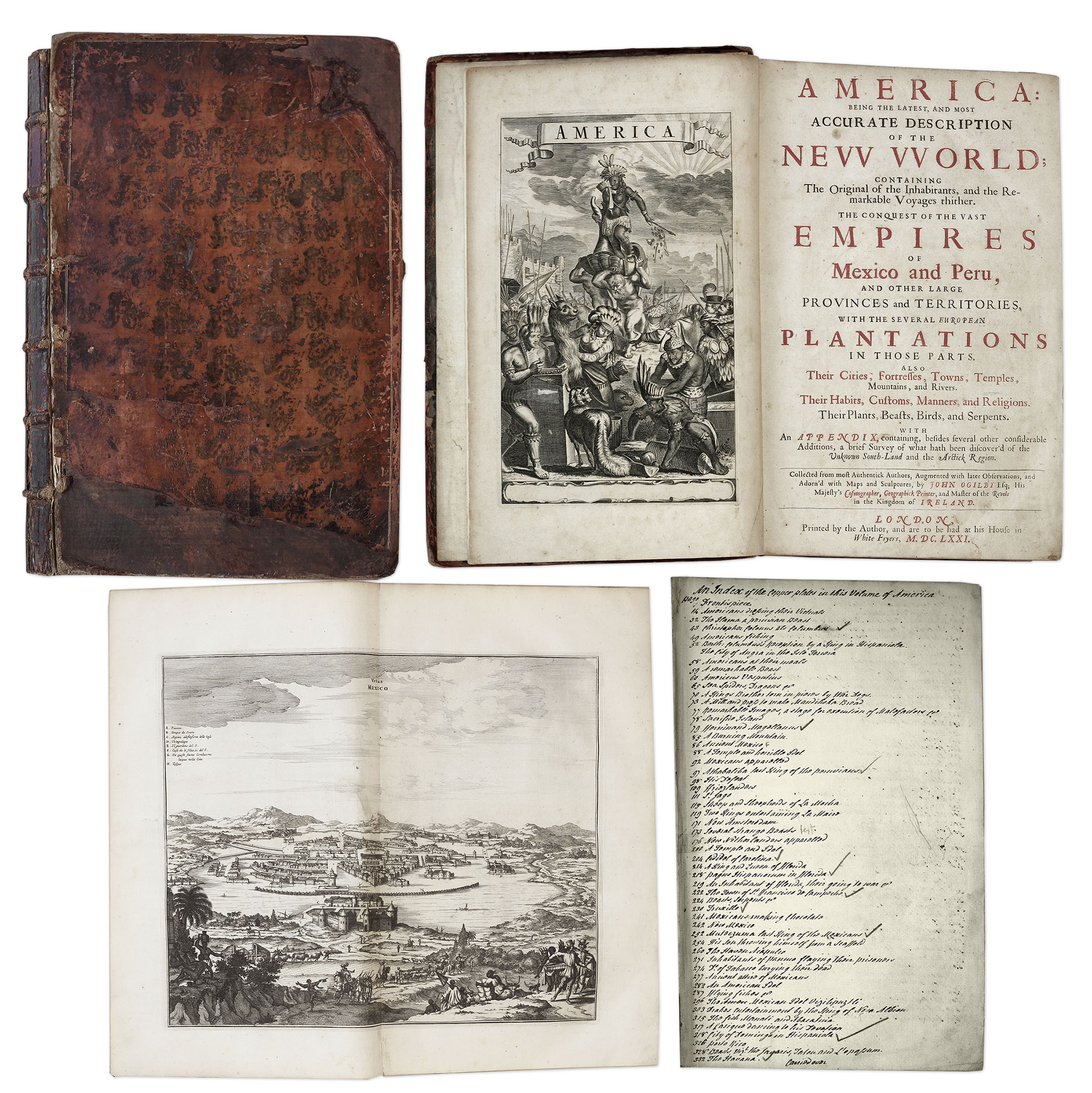
One of the most important books on the history of America (cited by Borba de Moraes, Howes, Sabin and Wing), the 1671 first edition of ”America: Being the Latest and Most Accurate Description of the New World”. Privately printed in London by the author, Arnoldus Montanus, and edited by John Ogilby. In ”America” Montanus goes into great detail of the new continents, with dozens of engravings of Native Americans, species of animals and reptiles, and the landscapes and settlements in the new world, accompanied by text. The book covers speculation regarding the earliest voyages to America, along with later recorded voyages and the settlements of New Netherlands/New York, New England, Hudson’s Bay, Labrador, Canada, Nova Scotia, Maryland, Virginia, (including Captain Smith’s capture and rescue by Pocahontas), Carolinas, Florida and California, plus accounts of Mexico and nearby islands, even including Australia and New Zealand. 674pp. book contains 75 original engravings (64 copper plates within the text and 9 plates throughout), lacking the maps and 28 engravings, which is typical as this edition is almost never found with all plates intact. All text is complete except for missing pages 445-446. Large format book measures 10” x 15”. Bound in original full leather boards, with some loss of leather to covers, cracking along spine and front board detached. Interior text is near fine and very readable. An important and fascinating addition to early knowledge of the American continent. Sold for $9,375.
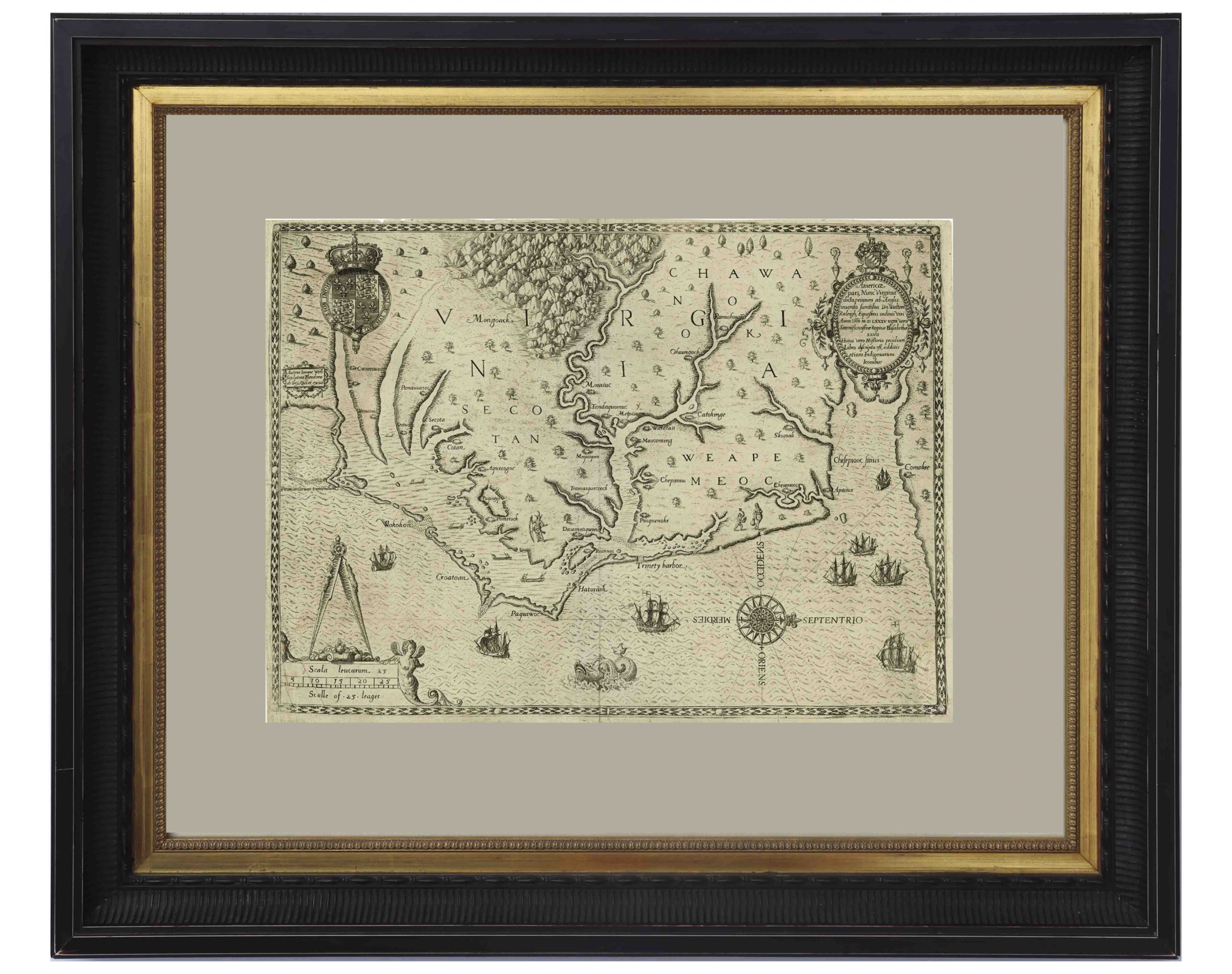
John White’s Map of Virginia From 1590 — The First Printed Map of Virginia and North Carolina
An important 16th century North American map known not only for its level of detail and accuracy, but also for its “firsts”: the first printed map of Virginia and North Carolina, the first to use Virginia in its title, the first to name the Chesapeake Bay, and also the first regional map showing the Roanoke Colony. Frankfurt: Theodor de Bry (engraver) for inclusion in his “Anglorum in Virginiam aduentus”, 1590.
Map is based on the work of cartographer, artist and explorer John White, one of the first settlers and Governor of the Roanoke Colony who, after sailing back to the Colony from England in 1587, had found all the colonists famously missing, their fate a mystery still unsolved. Philip Burden, who wrote the definitive reference book, “The Mapping of North America”, wrote of this map: “One of the most significant cartographical milestones in colonial North American history…the most accurate map drawn in the sixteenth century of any part of that continent.”
This full-sheet engraved map still retains its dark print, with the English Royal Arms at top left, and artistic touches throughout such as ships and sea monsters in the open ocean, and Native American canoeists in the inland waters. Map is the second state, with “C” laid over the “E” in Ehesepiooc. Map measures 16.675″ x 12.25″, nicely matted and framed to a size of 28″ x 23.5″. Expert repair to single vertical fold, and small area of repair to lower right corner, just touching the edge of the ship, where paper loss has been replaced. Overall in very good to near fine condition given age, displaying beautifully. Sold for $6,665.
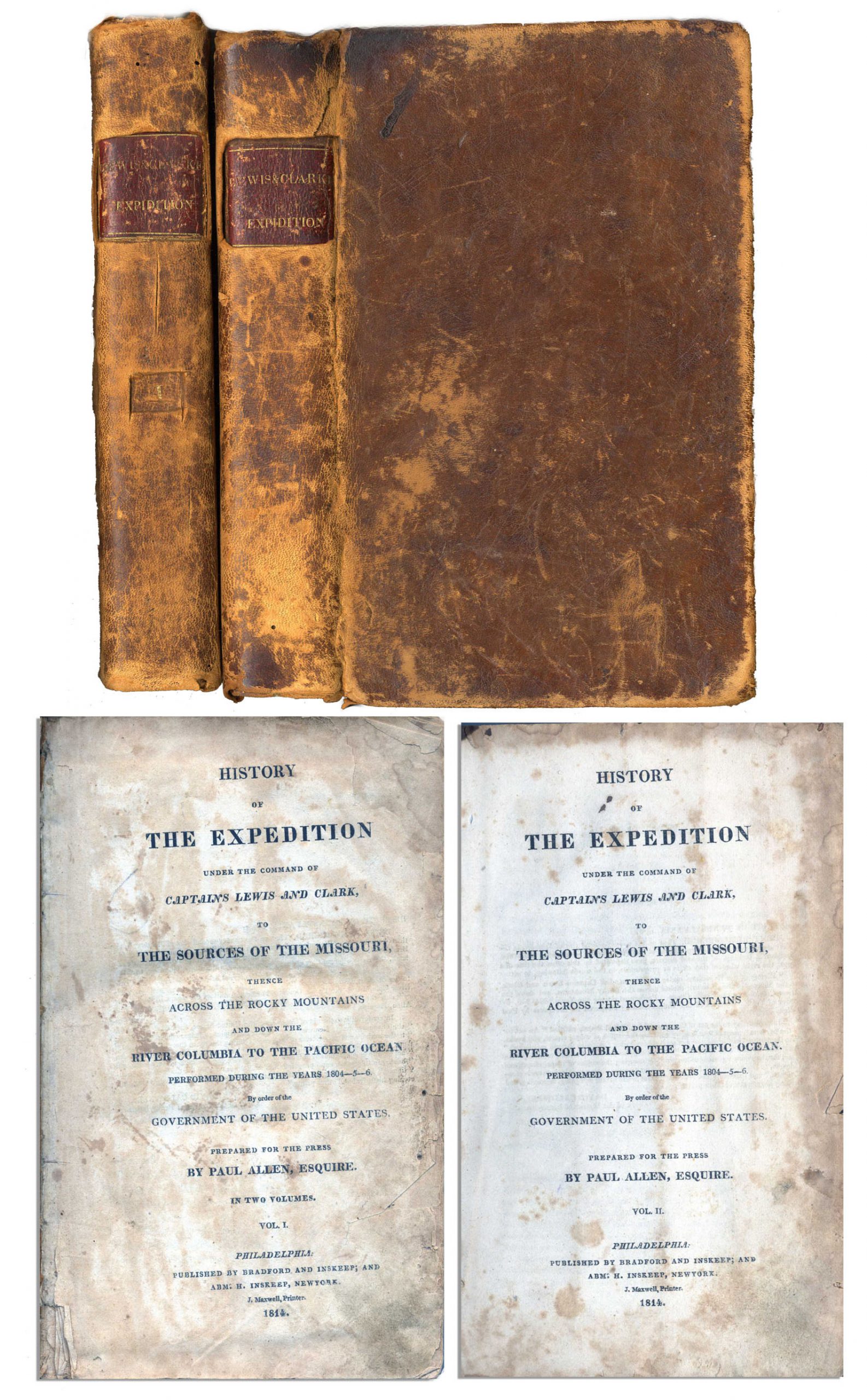
First edition, two-volume set of ”History of the Expedition under the Command of Captains Lewis and Clark to the source of the Missouri thence across the Rocky Mountains and down the river Columbia to the Pacific Ocean performed during the years 1804-05-06 by Meriwether Lewis and William Clark”. Published by Bradford and Inskeep: New York: 1814. Regarded as the definitive account of the first exhaustive, and most important Western exploration of America, which covered some eight thousand miles in slightly more than twenty-eight months. Lewis and Clark brought back the first reliable information about much of the area they traversed, made contact with the Native Americans as a prelude to the expansion of the fur trade, and advanced the geographical knowledge of the continent. This official account of the expedition is as much a landmark in Americana as the trip itself. Books, each measuring 5.5” x 8.75”, are bound in original marble-patterned leather boards and have five engraved, bound-in maps, missing the fold-out map found in some copies. Covers are worn and scuffed and the inside of covers have insect channels. Vol. I, 470pp., is missing the front free endpaper and has a chip out of the title page. Volume II runs 522pp. Light foxing and dampstaining throughout both volumes and some paper loss not affecting text. Overall in very good condition. An attractive set of America’s most important exploration narrative. Sold for $6,544.
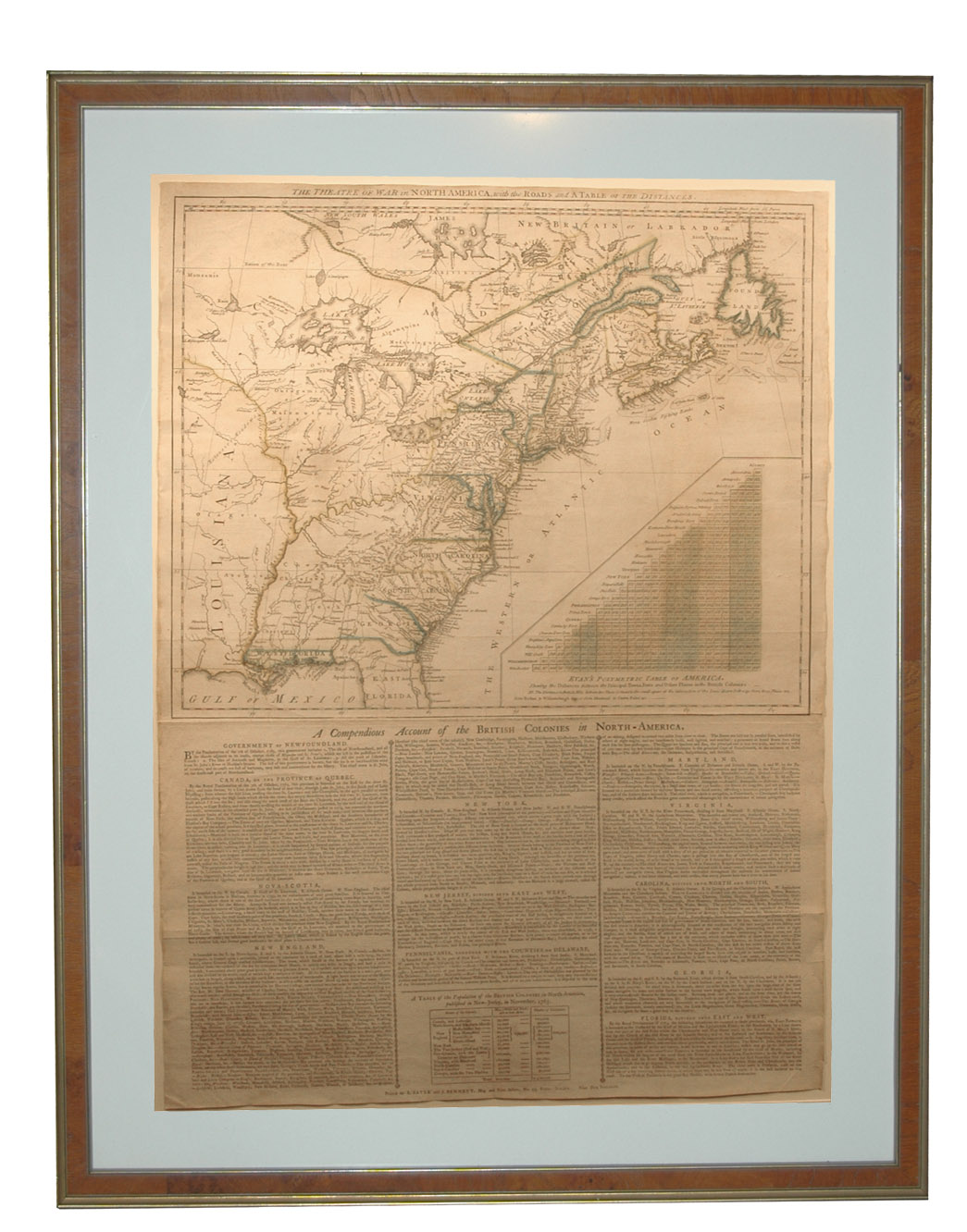
Revolutionary War Map 1776
Revolutionary War map dated March 1776. “The Theatre of War in North America, With the Roads and a Table of the Distances…” Printed in London for R. Sayer and J. Bennett. Map depicts the area east of the Mississippi River from James Bay to Cape Canaveral, and locates provincial boundaries, towns, forts, roads, Indian villages, New England fishing waters, and the like. An inset is comprised of “Evan’s Polymetric Table of America,” which allows one to calculate the distance between most of the prominent towns. Text below the map reads, “A Compendious Account of the British Colonies in North America,” which devotes a paragraph of description to each of the North American colonies, including Florida, Canada, and the Province of Quebec. Issued separately by Sayer and Bennett, who also published “the American Military Pocket Atlas,” that year for the use of British officers. A notable map of the American Revolution, published the same year as the American Declaration of Independence. 20.75″ x 28.5″; 29.25″ x 37.5″ framed. Excellent condition. Sold for $6,000.
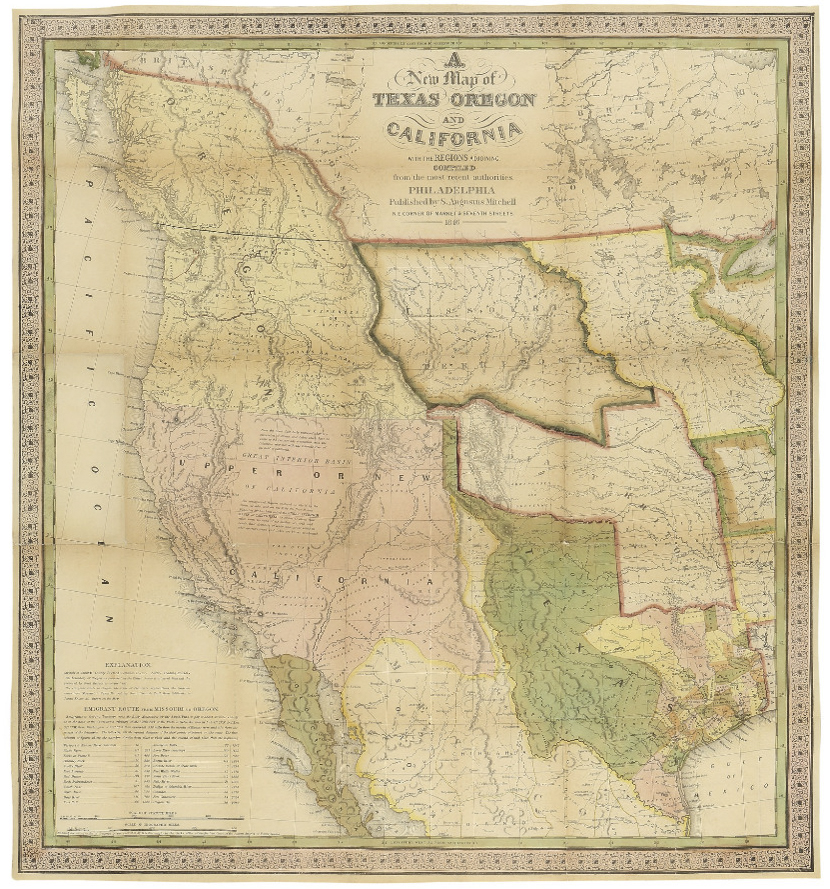
Map of Texas, Oregon and California From 1846 — The Definitive Map Used by Western Settlers During the Gold Rush
“A New Map of Texas Oregon and California with the Regions Adjoining. Compiled from the most recent authorities.” By cartographer Samuel Augustus Mitchell, published in 1846 as a pocket map, and considered the definitive map for settlers in the nation’s westward expansion during the Gold Rush. Philadelphia: Published by S. Augustus Mitchell, 1846. With contemporary hand-coloring, folding map by engraver H.N. Burroughs was Mitchell’s most important map, considered the defacto standard and thereby affecting subsequent maps of the area. It was the first to include recent explorations in the Great Basin, with boundary lines of Rio Grande to the south, and Oregon to the north at 54 degrees 40 minutes, above which are “British Possessions”. An inset to lower left entitled “Emigrant Route from Missouri to Oregon”, provides the distance between western cities and landmarks, undoubtedly aiding weary travelers. With decorative scrollwork along the margins, map measures 21″ x 22.5″ unfolded, nicely matted and framed to a size of 34.5″ x 41.5″. Some expert repair at fold separations and mild fading, overall in very good condition. Sold for $4,800.
Scarce First Edition, First Printing Map of London Just After the Great Fire in 1666, by Wenceslaus Hollar
A very rare first printing of the post-Great Fire map of London by noted artist and engraver to the King, Wenceslaus Hollar. After the Great Fire swept across London in September 1666, destroying nearly 90% of the homes, Hollar almost immediately produced this map, titled “A MAP or GROUNDPLOT of the Citty of London”, noted for its accuracy and attention to detail. Printed in London by John Overton, 1666. Appointed by King Charles II to document the destruction, Hollar was able to quickly plot the map based on his previous but failed passion project – to produce the greatest map of London that ever existed. Hollar used those previous drawings as the basis for his post-Great Fire map, adding detail for areas that survived the fire, and foregoing details for the destroyed areas. The result was an immensely popular and well-received map that grounded Hollar’s reputation as engraver and cartographer. In this first printing – distinguished by the placement of the legend, inset map and scale of the city, Hollar documents the destruction of London, from Lincoln’s Inn Fields in the west to East Smith’s Field in the east, including the Great Tower of London, and from just south of the Thames River in the south to Bunhill Fields Burial Ground in the north. An inset to churches throughout the city “and other remarkable places” is present, as is a scale for the map. Finally, an inset map showing a larger portion of London is found at lower left, including Westminster which narrowly missed the fire’s path. Map is astonishingly complete and detailed given the speed that Hollar produced it, with printed signature appearing at bottom of inset map, “W. Hollar fecit [Latin, ‘he made’] 1666″. Map measures 14.5″ x 12”. Light toning and faint creasing, small quarter-inch closed tear at lower left margin, and spot of discoloration at mid-right margin. Mounting remnants on verso. Overall near fine condition given age. Sold for $4,383.

FREE APPRAISAL. To buy, auction, sell or consign your Joseph E Field Texas 1st edition 2nd issue 1836 that is for sale, please email your description and photos to [email protected] of Nate D. Sanders Auctions (http://www.NateDSanders.com).
We offer the following services for your Joseph E Field Texas 1st edition 2nd issue 1836:
- Appraise Joseph E Field Texas 1st edition 2nd issue 1836.
- Auction Joseph E Field Texas 1st edition 2nd issue 1836.
- Consign Joseph E Field Texas 1st edition 2nd issue 1836.
- Estimate Joseph E Field Texas 1st edition 2nd issue 1836.
- Sell Joseph E Field Texas 1st edition 2nd issue 1836.
- Joseph E Field Texas 1st edition 2nd issue 1836 valuation.