
Sell or Auction Your John Middleton Grecian Remains in Italy 1812-19 1st Edition for up to Over $10,000 or More at Nate D. Sanders Auctions
FREE APPRAISAL. To buy, auction, sell or consign your John Middleton Grecian remains in Italy 1812-19 1st edition that is for sale, please email your description and photos to [email protected] of Nate D. Sanders Auctions (http://www.NateDSanders.com).
Sell Your John Middleton Grecian Remains in Italy 1812-19 1st Edition
John Izard Middleton (August 13, 1785 – October 5, 1849) was an American archeologist and artist who was dubbed “the first American Classical Archaeologist” by Charles Eliot Norton. Admitted to Cambridge University in 1803, though it is doubtful if he resided, John Middleton spent a good part of his adult life traveling in France and in Italy. While in Italy he was attracted to the remains of ancient sites, particularly those in Latium (modern Lazio). Inspired perhaps by the work of the Frenchman Louis-Charles-Francois Petit-Radel (author of Voyage historique cronographique et philosophique dans le principales villes des l’Italie (Paris, 1815) ; Recherches sur le Monuments Cyclopéens (Paris, 1841)), Middleton made observations and sketches of the sites he visited. Middleton executed the drawings while traveling in Italy during 1808 and 1809 and considered his work an artistic achievement. He attributed more importance to the drawings than the text, but because it appeared during a time of turmoil in Europe, his work received slight attention from contemporaries. Some of the drawings appeared in later works on archaeology without credit to Middleton, notably those of Edward Dodwell with whom Middleton travelled. He compiled the sketches from his travels in 1808 and 1809 in order to publish as a folio-sized book, Grecian remains in Italy: a description of Cyclopian walls, and of Roman antiquities.
Below is a recent realized price for a John Middleton Grecian remains in Italy 1812-19 1st edition item. We at Nate D. Sanders Auctions can obtain up to these amounts or more for you:
John Middleton Grecian Remains in Italy 1812-19 1st Edition. Sold for over $10,000.
We have also sold the following similar memorabilia:
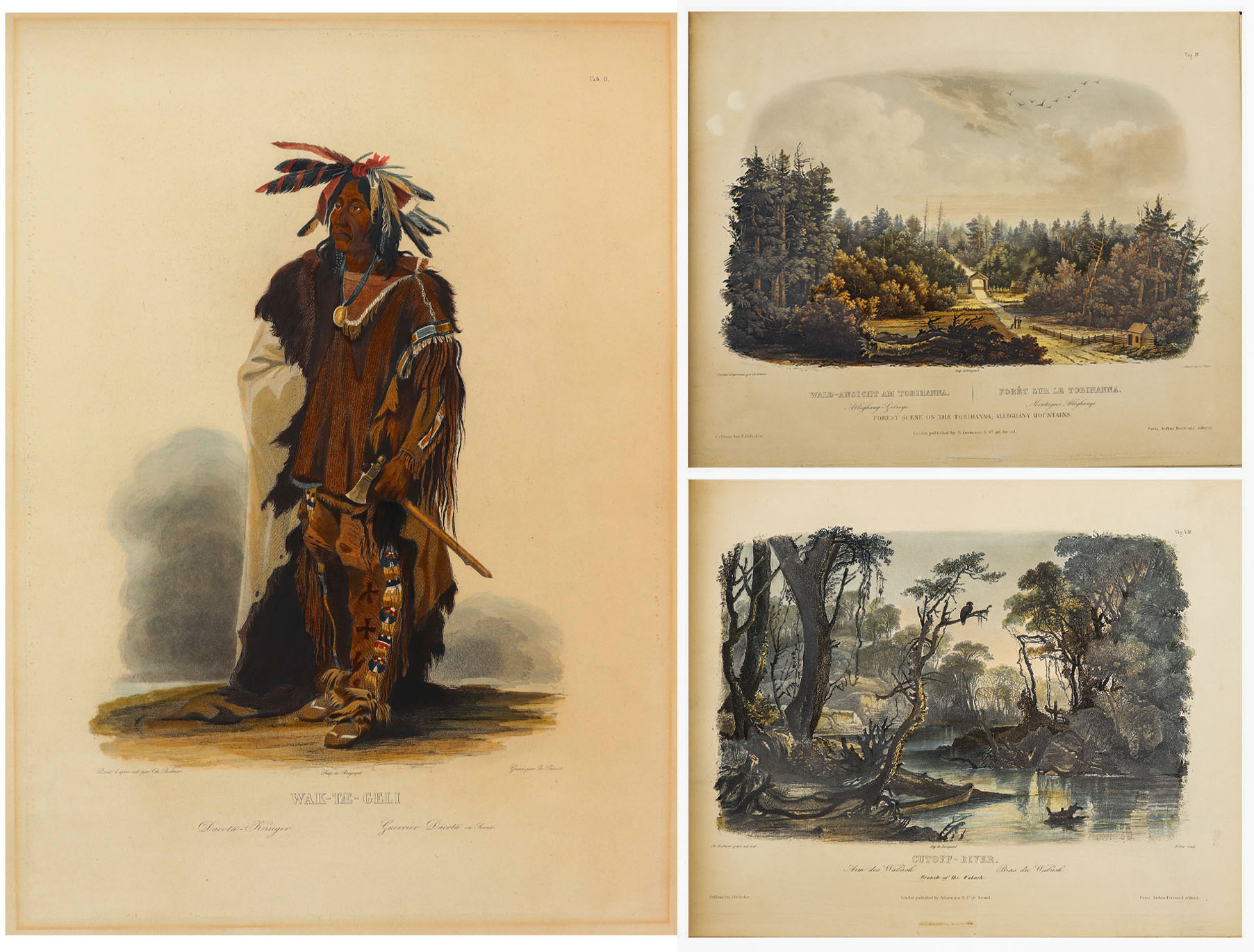
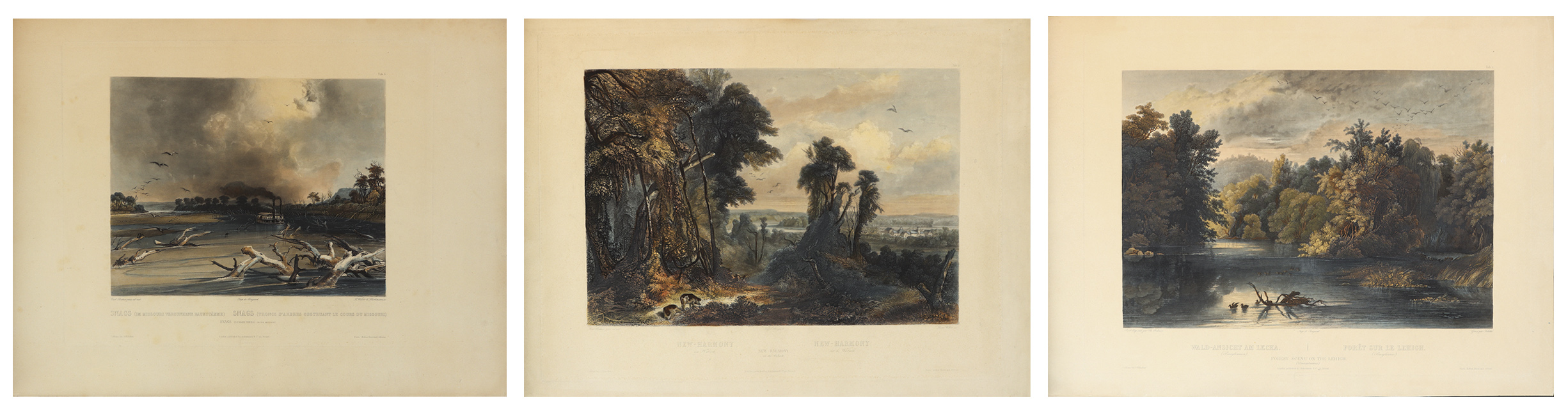
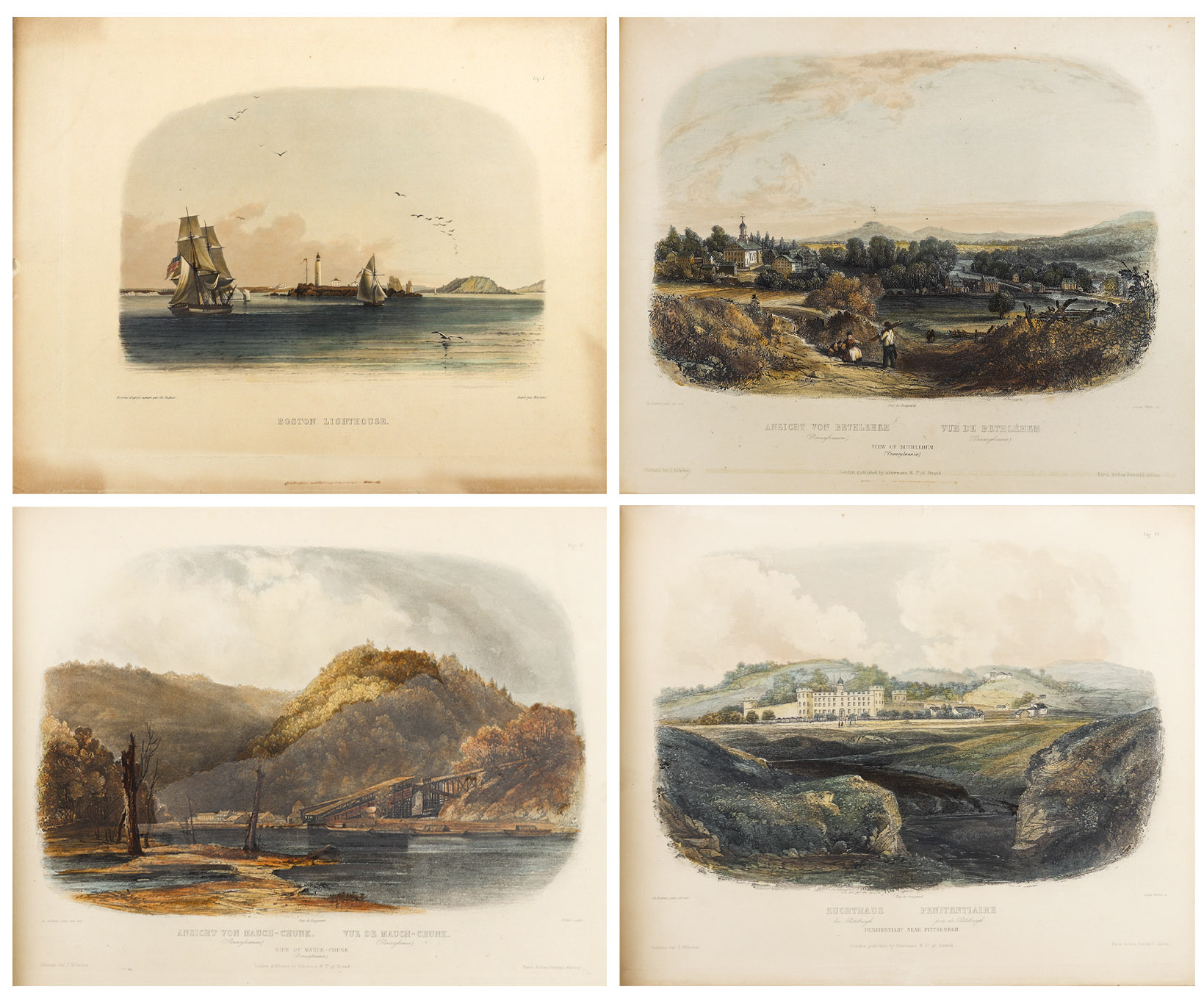
Karl Bodmer Prince of Wied’s Travels in the Interior
Stunningly beautiful collection of 81 hand-colored aquatints by the Swiss artist Karl Bodmer, a complete collection from the illustrated travelogue, “Prince of Wied’s Travels in the Interior of North America”. Bodmer, who journeyed with the German Prince Maximilian of Wied-Neuwied from 1833-34 along the Missouri River, produced what is considered the best depictions of the indigenous peoples and landscapes during the frontier era, an America then still unspoiled by western migration. Of the Native American tribes of the Great Plains that they encountered, Bodmer’s depictions of the Blackfeet and Mandan tribes are especially important as the populations of these tribes were greatly affected by the smallpox epidemic of 1837, thus making Bodmer’s work the last visual testament to their culture.
Prince Max, as he was called, chose Bodmer to accompany him on the expedition along the Missouri River to visually depict the scenes that the Prince would write about. The result is this collection: three volumes of text by the Prince and two volumes of aquatints by Bodmer, in the first Paris edition published by Chez Arthus Bertrand, 1840-43 (“Voyage dans l’interieur de l’Amerique du Nord”). Text volumes in French also include 37 wood-engraved illustrations, only lacking the map in completeness. The two complete volumes of illustrations include the large folio volume with 48 oversized hand-colored aquatints measuring approximately 24.5″ x 18″, and the quarto volume with 33 hand-colored aquatints measuring approximately 12.5″ x 10.25″. The complete set of 81 aquatints is magnificent in their display, a time capsule with their hand-coloring evoking the sense of awe and discovery of the expedition. All volumes are bound in half black morocco and blue paper-covered boards with gilt accenting, and with black morocco labels to illustrated volumes. Minor handling wear to volumes, with a few small repaired tears to plates, some plates supplied with variance to margins, minute toning and foxing, a few plates beginning to separate from binding. Overall a very good plus set with excellent display quality. Sold for $175,000.
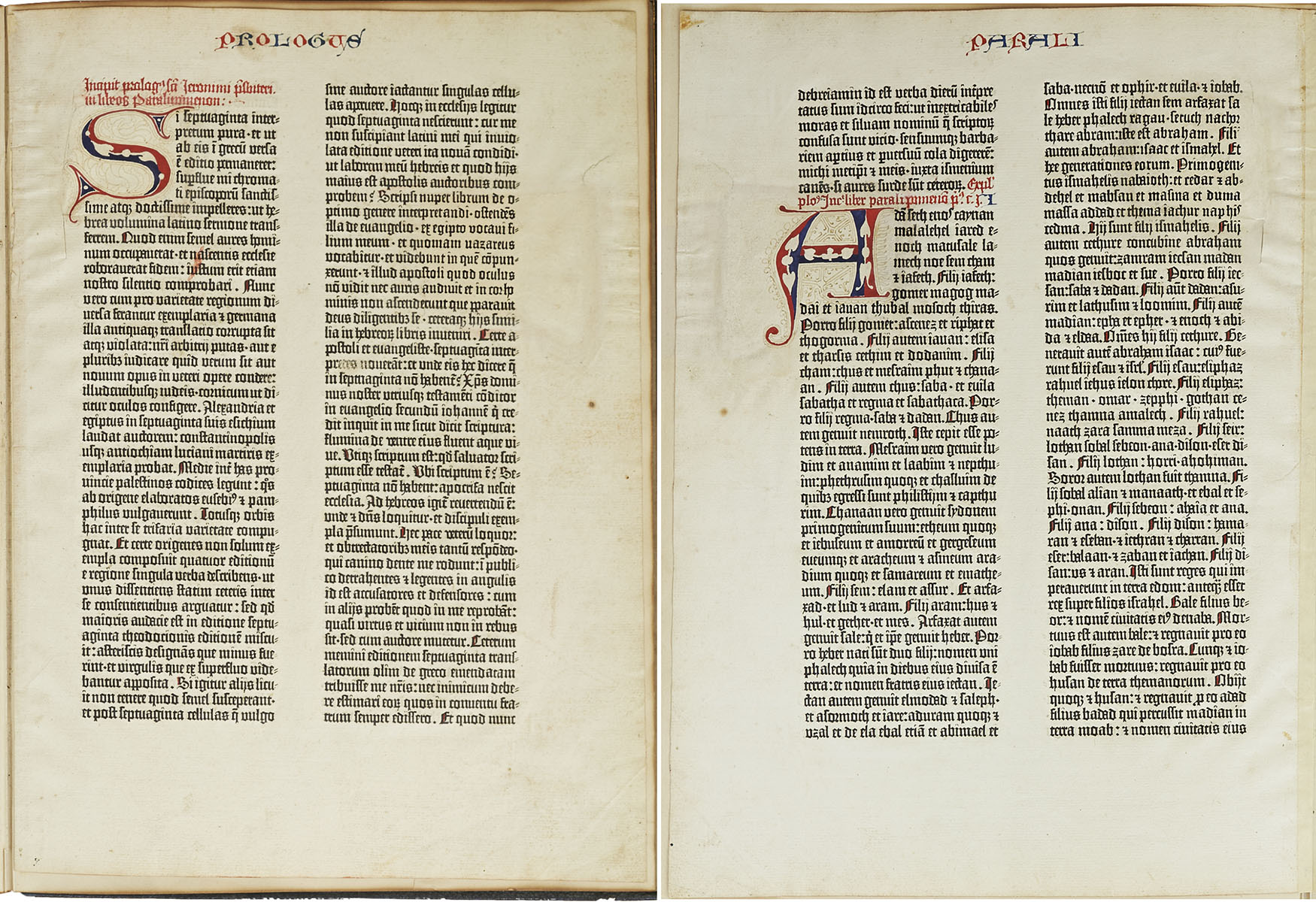
Gutenberg Bible Leaf 193 Chronicles of Old Testament
Scarce leaf from the Gutenberg Bible, one of the earliest major books printed from moveable metal type, the invention that ushered in the Age of Enlightenment by democratizing knowledge through mass production of literature. Printed by Johannes Gutenberg in Mainz, Germany from 1450-1455, less than 50 complete or near-complete copies of the Gutenberg Bible are now extant, with nearly all those housed in public institutions. Singular leaves are also scarce, with the leaf presented here having been acquired by bookseller Gabriel Wells, whose purchase of an incomplete Bible in 1920 gave way to selling the individual leaves alongside an essay by A. Edward Newton entitled “A Noble Fragment”. Leaf is number 193 of the full Latin Bible, with the recto being the Prologue to 1 Chronicles of the Old Testament, and the verso the first part of Chapter 1 of 1 Chronicles. Each page features two columns of 42 lines in dark black Gothic type, accented by red and blue rubrication. Each copy of the Gutenberg Bible differs in its rubrication and illumination, with buyers at the time deciding upon these embellishments after the Bible was printed. The six-line rubricated letters of this leaf were likely added later, restored to match the original style. Leaf measures 11.125″ x 15.375″, bound on edge to portfolio measuring 11.75″ x 16″. Paper quality is still bright with very little foxing or discoloration compared to other examples. A stunning example from the book that changed the course of history. Sold for $136,500.
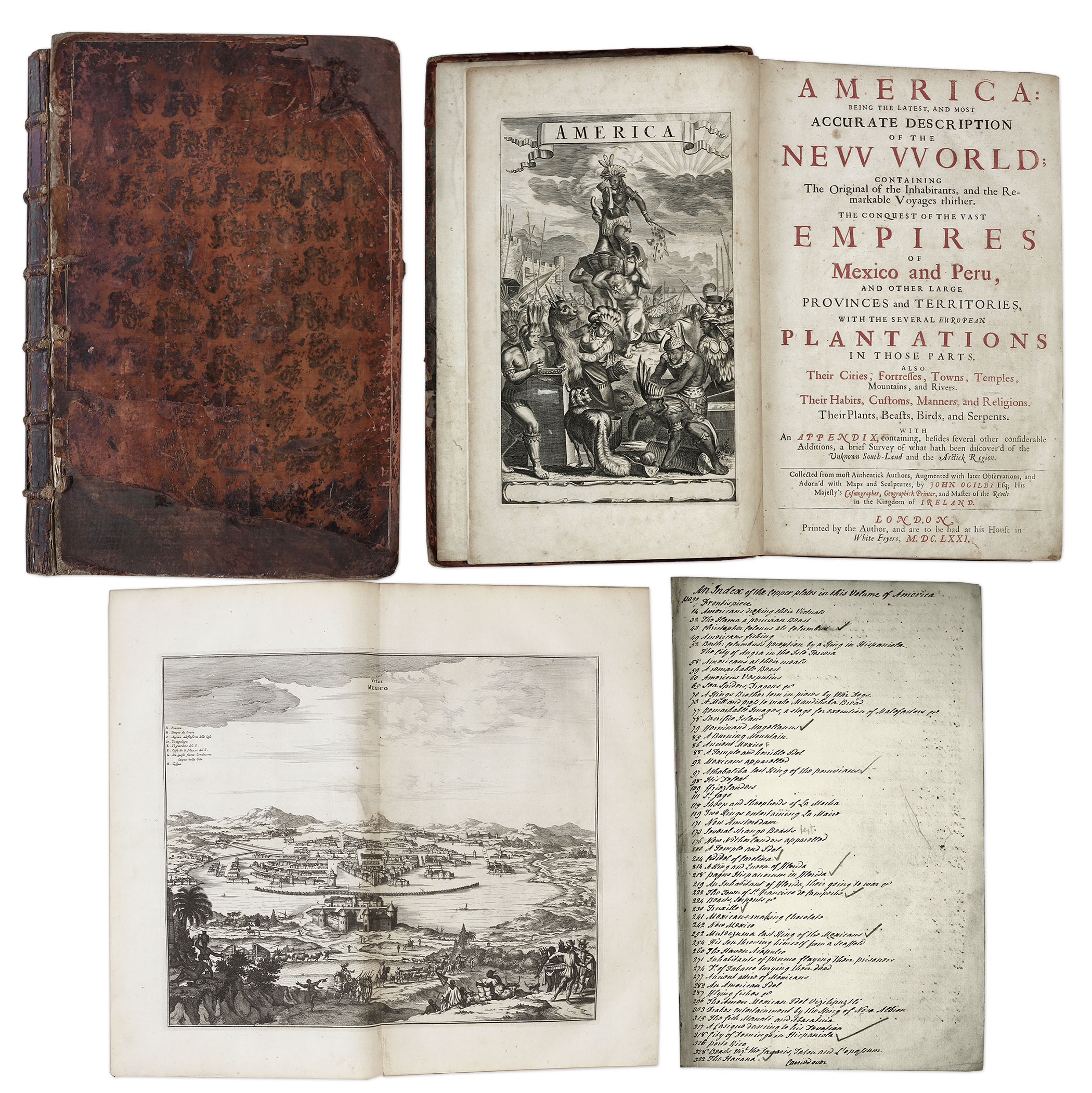
One of the most important books on the history of America (cited by Borba de Moraes, Howes, Sabin and Wing), the 1671 first edition of ”America: Being the Latest and Most Accurate Description of the New World”. Privately printed in London by the author, Arnoldus Montanus, and edited by John Ogilby. In ”America” Montanus goes into great detail of the new continents, with dozens of engravings of Native Americans, species of animals and reptiles, and the landscapes and settlements in the new world, accompanied by text. The book covers speculation regarding the earliest voyages to America, along with later recorded voyages and the settlements of New Netherlands/New York, New England, Hudson’s Bay, Labrador, Canada, Nova Scotia, Maryland, Virginia, (including Captain Smith’s capture and rescue by Pocahontas), Carolinas, Florida and California, plus accounts of Mexico and nearby islands, even including Australia and New Zealand. 674pp. book contains 75 original engravings (64 copper plates within the text and 9 plates throughout), lacking the maps and 28 engravings, which is typical as this edition is almost never found with all plates intact. All text is complete except for missing pages 445-446. Large format book measures 10” x 15”. Bound in original full leather boards, with some loss of leather to covers, cracking along spine and front board detached. Interior text is near fine and very readable. An important and fascinating addition to early knowledge of the American continent. Sold for $9,375.
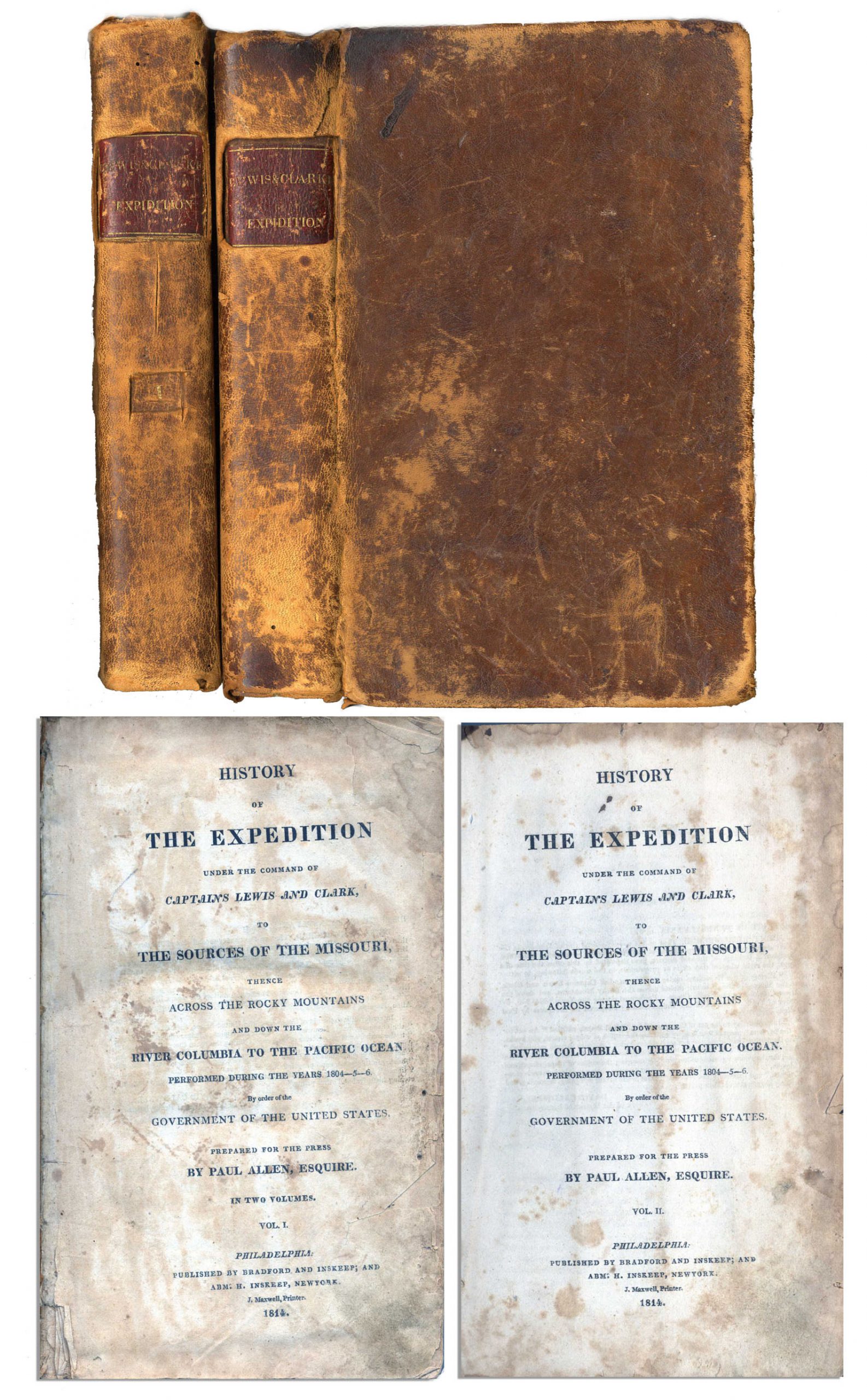
First edition, two-volume set of ”History of the Expedition under the Command of Captains Lewis and Clark to the source of the Missouri thence across the Rocky Mountains and down the river Columbia to the Pacific Ocean performed during the years 1804-05-06 by Meriwether Lewis and William Clark”. Published by Bradford and Inskeep: New York: 1814. Regarded as the definitive account of the first exhaustive, and most important Western exploration of America, which covered some eight thousand miles in slightly more than twenty-eight months. Lewis and Clark brought back the first reliable information about much of the area they traversed, made contact with the Native Americans as a prelude to the expansion of the fur trade, and advanced the geographical knowledge of the continent. This official account of the expedition is as much a landmark in Americana as the trip itself. Books, each measuring 5.5” x 8.75”, are bound in original marble-patterned leather boards and have five engraved, bound-in maps, missing the fold-out map found in some copies. Covers are worn and scuffed and the inside of covers have insect channels. Vol. I, 470pp., is missing the front free endpaper and has a chip out of the title page. Volume II runs 522pp. Light foxing and dampstaining throughout both volumes and some paper loss not affecting text. Overall in very good condition. An attractive set of America’s most important exploration narrative. Sold for $6,544.
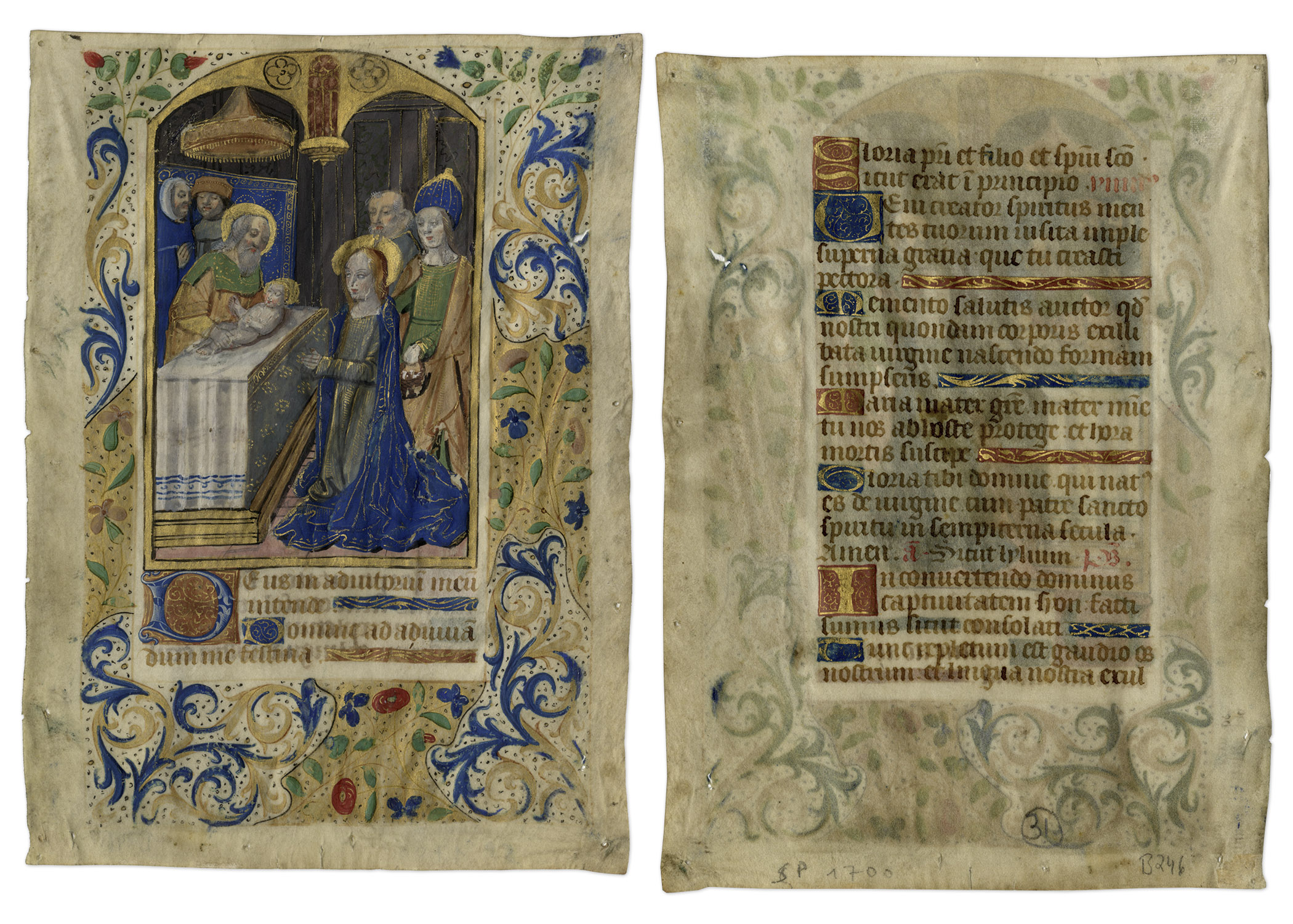
15th Century Hand-Painted Manuscript Page From “Book of Hours” — Illustrates Presentation of Jesus Christ
Hand-painted manuscript page from the liturgical text “Book of Hours”, from Paris, circa 1490. Front of double-sided page illustrates a scene from the presentation of Jesus Christ, who was circumcised on the 8th day after his birth. Includes 3/4 colored acanthus and floral border. Verso has single column with 22 lines of Latin text. Page is made of virgin-vellum and measures 4.25″ x 6″. Near fine condition given age. Sold for $1,469.
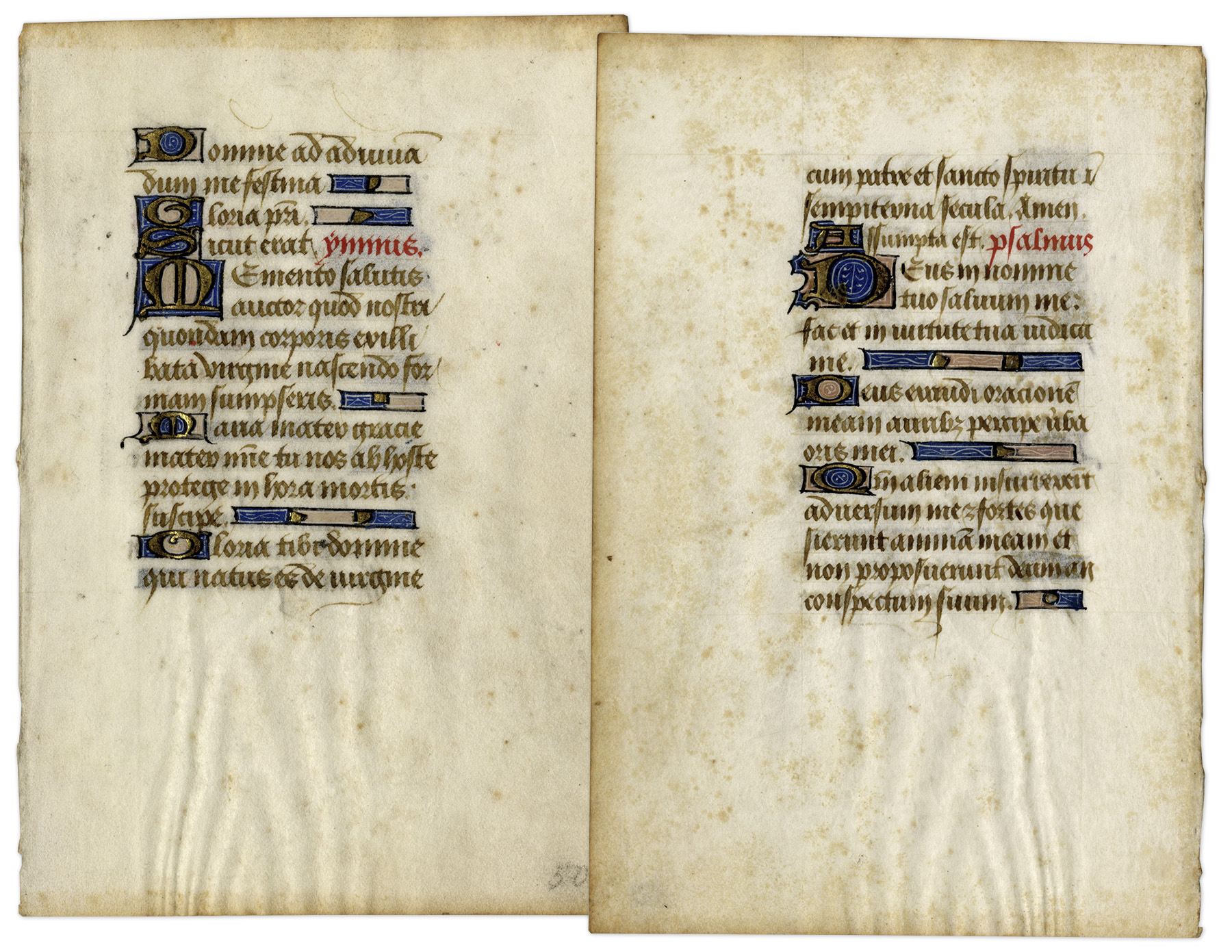
12th Century Hand-Painted Manuscript From ”Book of Hours”
Hand-painted manuscript page from the liturgical text ”Book of Hours”, from Tours in northern France, circa 1250. Double-sided page is beautifully rubricated in bright gold, blue and red. Single columns on each side contain 15 lines of Latin text. Page is made of virgin-vellum and measures 3.5” x 5”. Some rippling to bottom center, minor discoloration to edges and some foxing. Near fine given age. Sold for $1,250.
Bible Leaf From the Medieval Age, Circa 1250-1275 — Crusades Era Document on Vellum
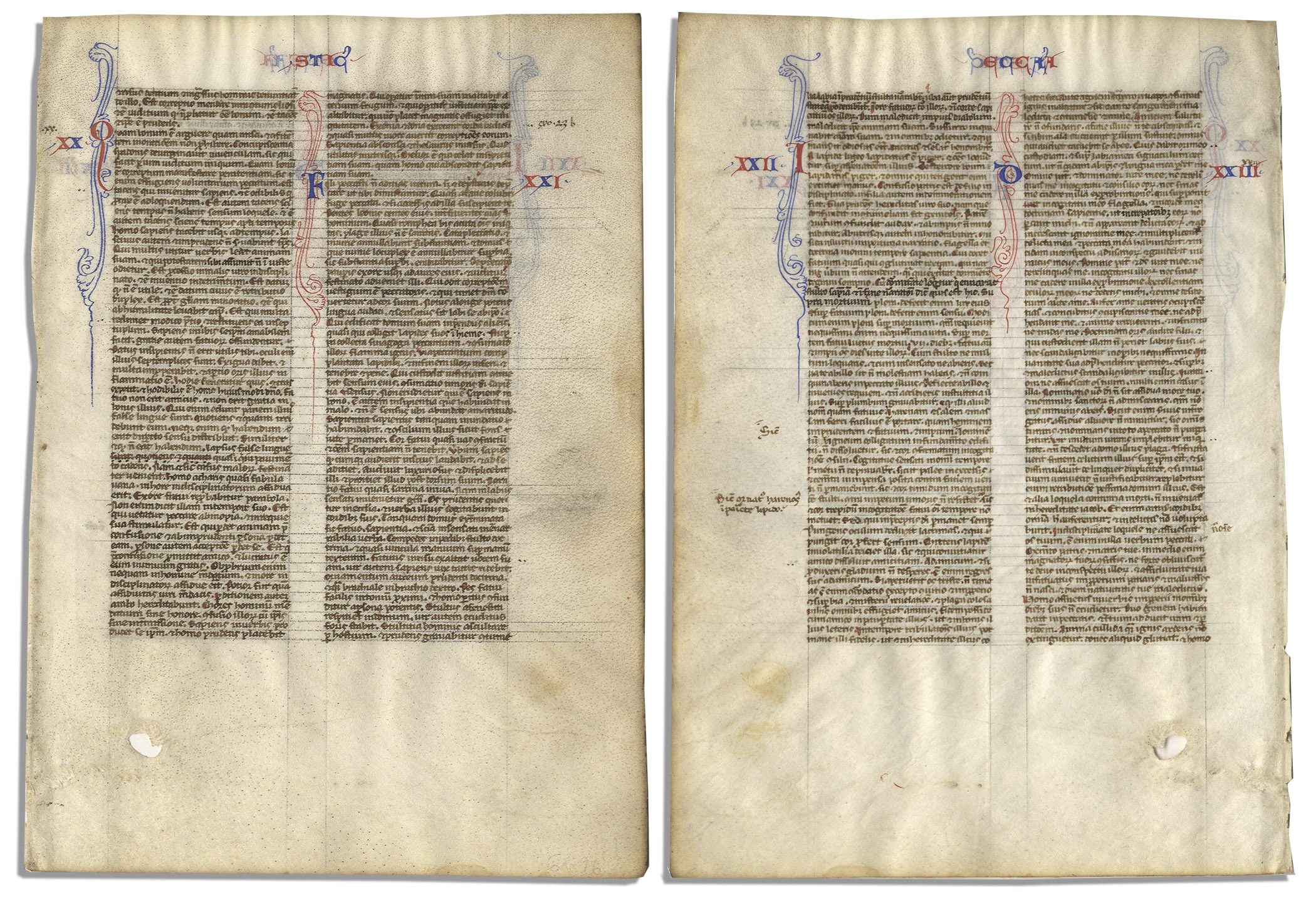
Miniature medieval Bible page. Illuminated manuscript Bible page on vellum dates to the mid 13th century when pocket size Bibles were a common means of spreading Christianity to remote areas. Tiny Gothic script in Latin appears in brown ink with red and blue rubrication. Features a total of 56 lines of text, beginning with Ecclesiasticus (Sirach) 20:1 and running through 23:22. Translates in part, ”How much better is it to reprove, than to be angry, and not to hinder him that confesseth in prayer…The slipping of a false tongue is as one that falleth on the pavement: so the fall of the wicked shall come speedily…Flee from sins as from the face of a serpent: for if thou comest near them, they will take hold of thee. The teeth thereof are the teeth of a lion, killing the souls of men…The mourning for the dead is seven days: but for a fool and an ungodly man all the days of their life…” Thin sheet features text on both sides. Measures 4.25” x 6”. Hole in the margin at lower right is likely from original stretching. Very slight buckling to top edge. Near fine given age. Sold for $1,100.
Illuminated Leaf From 15th Century French Psalm Book
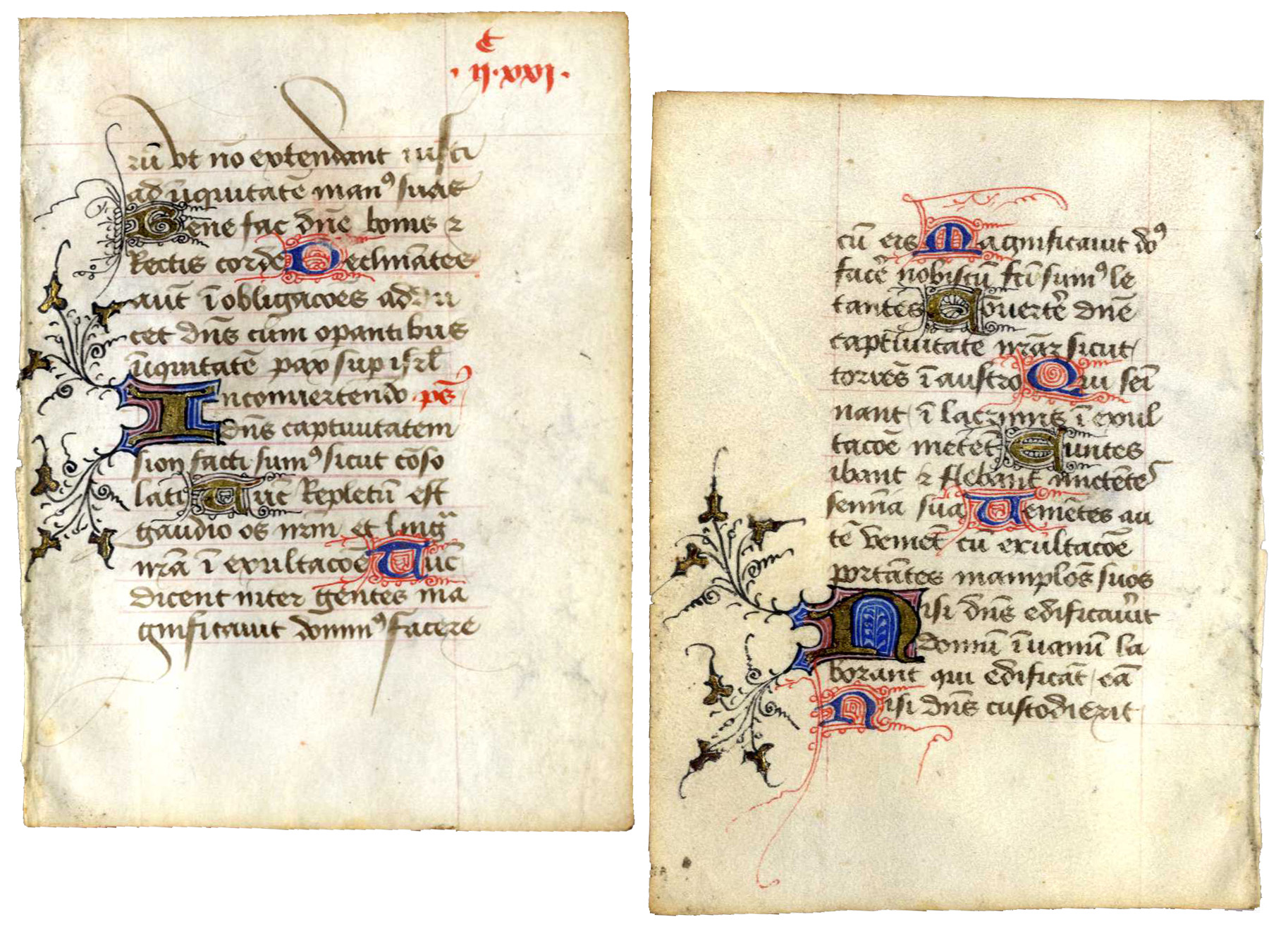
Beautiful leaf from a 15th century French Book of Psalms. Fifteen lines of rubricated and gilt text appear on each side of the vellum leaf, written in a Gothic script. These illuminated leaves were created in the middle ages by artist scribes, who wrote in extraordinary detail, embellishing the text with gold, red and blue dyes. Because of the labor involved, the books were quite expensive at the time, and individual leaves have since been collected as works of art. Leaf measures approximately 3″ x 4″. Light toning, else near fine. Sold for $756.
FREE APPRAISAL. To buy, auction, sell or consign your John Middleton Grecian remains in Italy 1812-19 1st edition that is for sale, please email your description and photos to [email protected] of Nate D. Sanders Auctions (http://www.NateDSanders.com).