
Sell or Auction Your Johannes Kepler Astronomia Nova 1st Edition 1609 for up to Over $600,000 or More at Nate D. Sanders Auctions
FREE VALUATION. To buy, auction, sell or consign your Johannes Kepler Astronomia nova 1st edition 1609 that is for sale, please email your description and photos to [email protected] of Nate D. Sanders Auctions (http://www.NateDSanders.com).
Sell Your Johannes Kepler Astronomia Nova 1st Edition 1609
Johannes Kepler (/ˈkɛplər/; German: [joˈhanəs ˈkɛplɐ, -nɛs -] (listen); 27 December 1571 – 15 November 1630) was a German astronomer, mathematician, astrologer, natural philosopher and writer on music. He is a key figure in the 17th-century Scientific Revolution, best known for his laws of planetary motion, and his books Astronomia nova, Harmonice Mundi, and Epitome Astronomiae Copernicanae. These works also provided one of the foundations for Newton’s theory of universal gravitation.
Below is a recent realized price for a Johannes Kepler Astronomia nova 1st edition 1609. We at Nate D. Sanders Auctions can obtain up to this amount or more for you:
Johannes Kepler Astronomia Nova 1st Edition 1609. Sold for Over $600,000.

Nate D. Sanders Auctions has sold the following similar memorabilia:
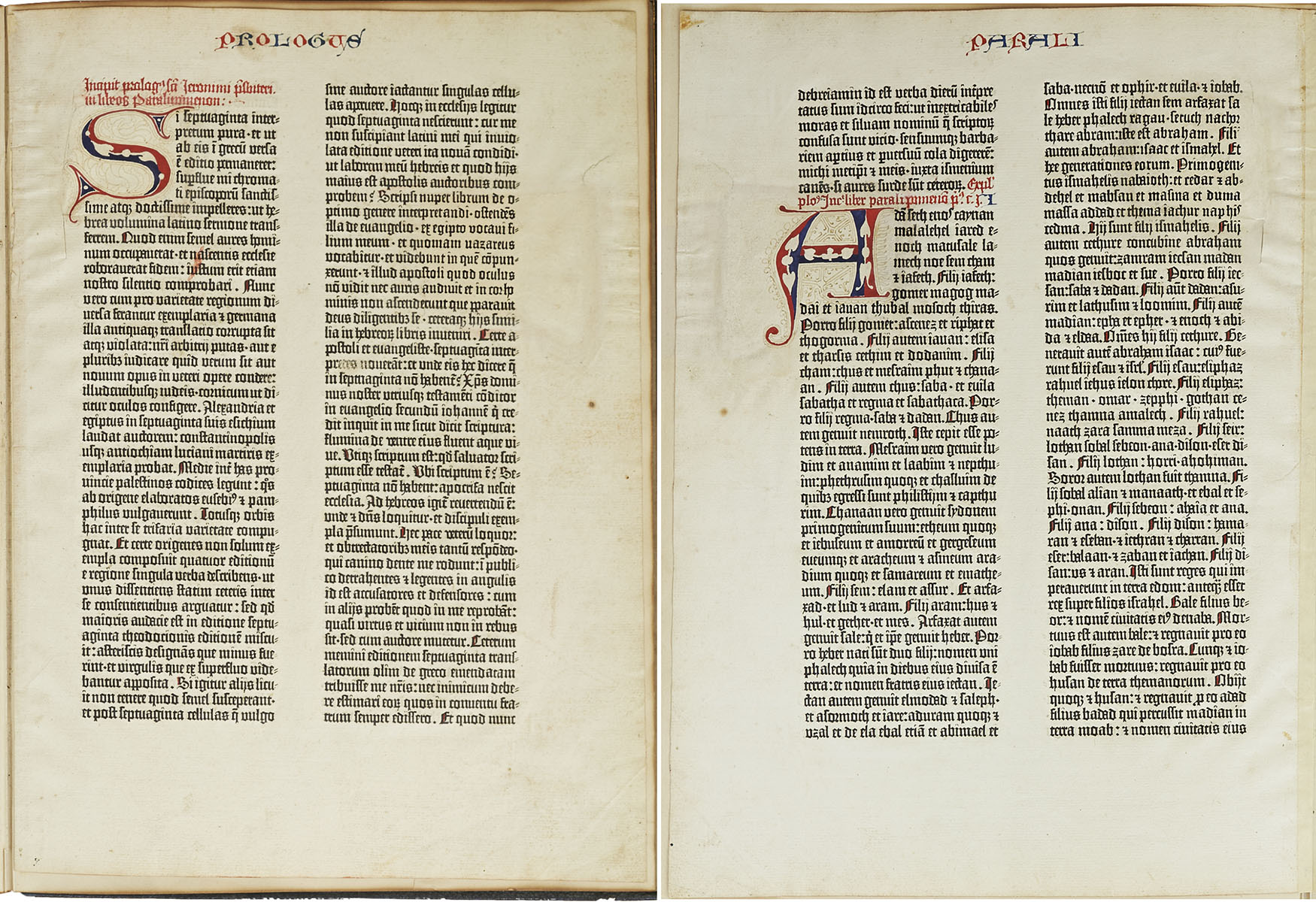
Gutenberg Bible Leaf 193 Chronicles of Old Testament
Scarce leaf from the Gutenberg Bible, one of the earliest major books printed from moveable metal type, the invention that ushered in the Age of Enlightenment by democratizing knowledge through mass production of literature. Printed by Johannes Gutenberg in Mainz, Germany from 1450-1455, less than 50 complete or near-complete copies of the Gutenberg Bible are now extant, with nearly all those housed in public institutions. Singular leaves are also scarce, with the leaf presented here having been acquired by bookseller Gabriel Wells, whose purchase of an incomplete Bible in 1920 gave way to selling the individual leaves alongside an essay by A. Edward Newton entitled “A Noble Fragment”. Leaf is number 193 of the full Latin Bible, with the recto being the Prologue to 1 Chronicles of the Old Testament, and the verso the first part of Chapter 1 of 1 Chronicles. Each page features two columns of 42 lines in dark black Gothic type, accented by red and blue rubrication. Each copy of the Gutenberg Bible differs in its rubrication and illumination, with buyers at the time deciding upon these embellishments after the Bible was printed. The six-line rubricated letters of this leaf were likely added later, restored to match the original style. Leaf measures 11.125″ x 15.375″, bound on edge to portfolio measuring 11.75″ x 16″. Paper quality is still bright with very little foxing or discoloration compared to other examples. A stunning example from the book that changed the course of history. Sold for $136,500.
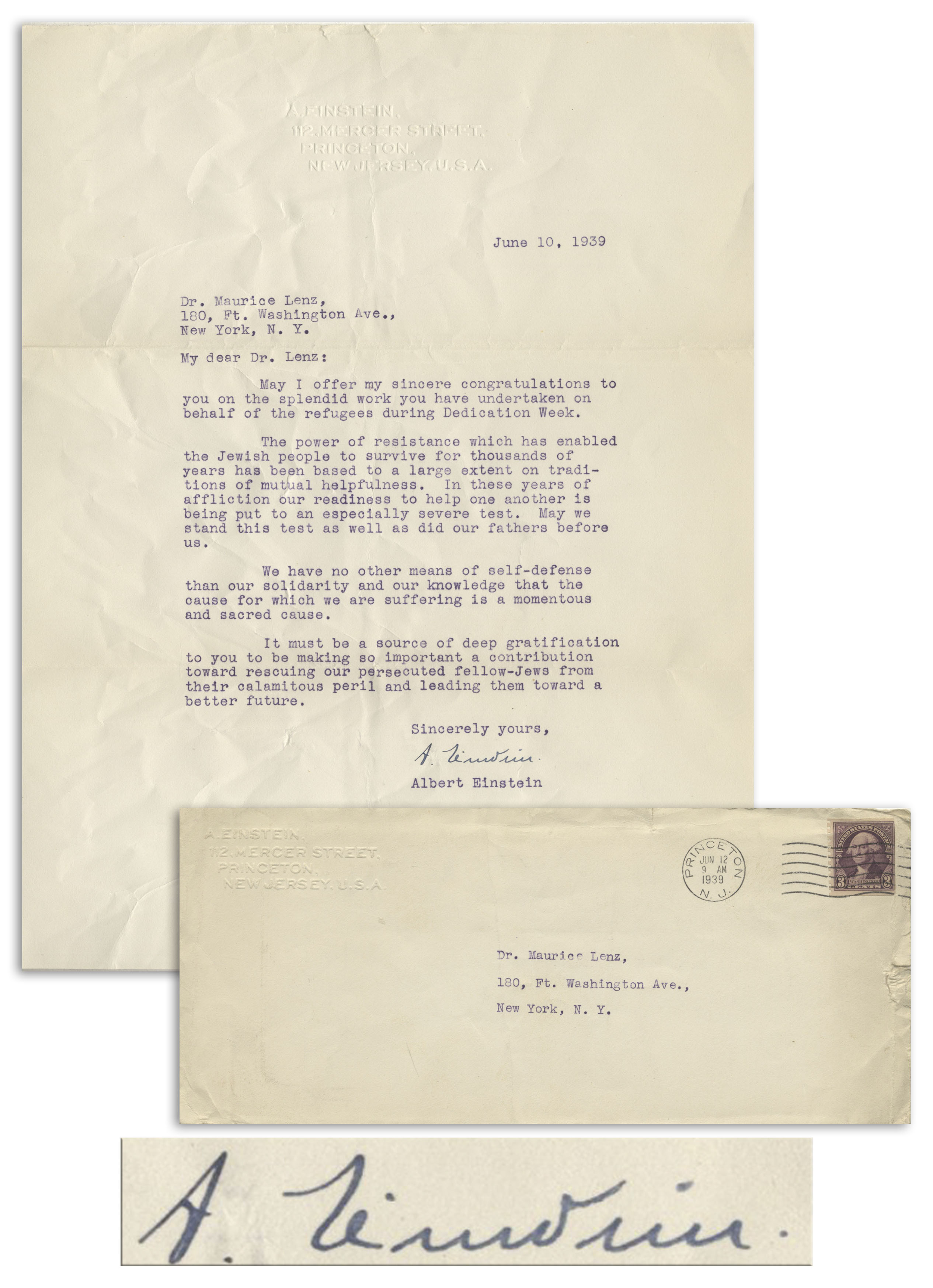
Albert Einstein typed letter signed during World War II, with moving content regarding helping Jewish refugees. Dated 10 June 1939 on his personal embossed letterhead from Princeton, Einstein writes to Dr. Maurice Lenz who worked on ”behalf of the refugees during Dedication Week.” Einstein continues, ”…The power of resistance which has enabled the Jewish people to survive for thousands of years has been based to a large extent on traditions of mutual helpfulness. In these years of affliction our readiness to help one another is being put to an especially severe test. May we stand this test as well as did our fathers before us.
We have no other means of self-defense than our solidarity and our knowledge that the cause for which we are suffering is a momentous and sacred cause.
It must be a source of deep gratification to you to be making so important a contribution toward rescuing our persecuted fellow-Jews from their calamitous peril and leading them toward a better future…[signed] A. Einstein”.
Single page letter measures 8.5” x 11”. Folds and light creasing, otherwise near fine condition. Accompanied by Einstein’s embossed mailing envelope, postmarked Princeton on 12 June 1939. Sold for $134,344.
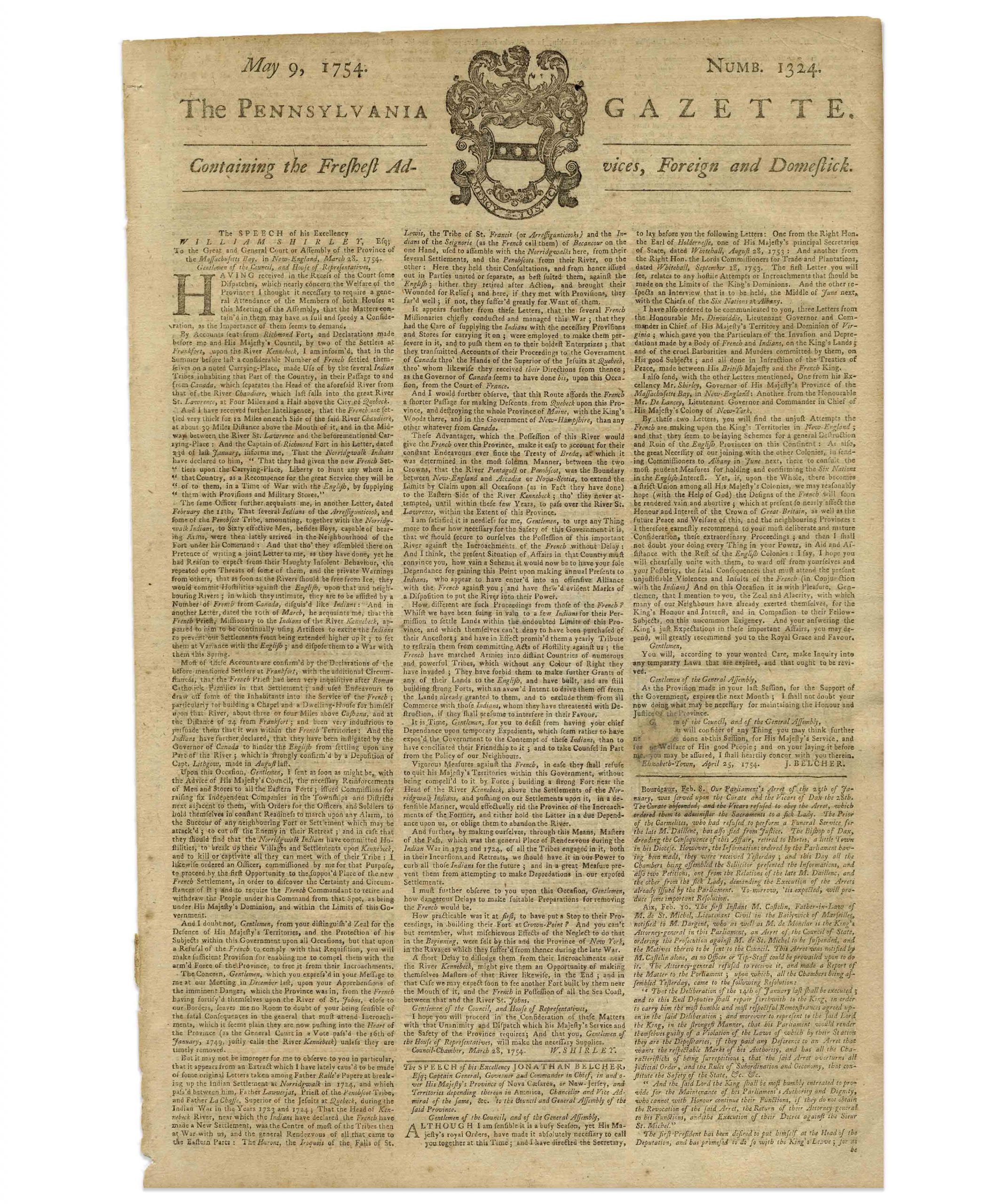
The most influential political cartoon in the history of America, the ”JOIN, or DIE” severed rattlesnake designed by Benjamin Franklin and published in his ”Pennsylvania Gazette” on 9 May 1754. This incredibly scarce newspaper is the very first printing of the ”JOIN, or DIE” cartoon, and the only known copy apart from one other housed in the permanent collection at the Library of Congress.
Frustrated by the colonists’ inability to join forces against westward expansion by the French, Franklin created this cartoon of a rattlesnake, cut into 8 pieces symbolizing the American colonies, to dramatically impart the effective message: join together as one cohesive body, or die. Along with the cartoon, Franklin published an editorial in the newspaper, urging the colonists to work together, reading in part, ”…The Confidence of the French in this Undertaking seems well-grounded on the present disunited State of the British Colonies…while our Enemies have the very great Advantage of being under one Direction, with one Council, and one Purse…”
Little did Franklin know at the time that his symbol of the dis-united rattlesnake would echo over twenty years later to inspire the colonists to unite against the British – Paul Revere added the ”JOIN, or DIE” cartoon to the nameplate of his paper, the ”Massachusetts Spy”, and even later, with the ”Don’t Tread on Me” flag, any individual or group whose personal liberty is threatened. The phrasing has also proved highly enduring, likely influencing John Stark, the Revolutionary War General from New Hampshire whose toast, ”Live free or die: Death is not the worst of evils”, inspired New Hampshire’s motto, and again suggests that personal liberty is one of the highest human values, and a founding tenet of the United States.
Franklin’s choice of a rattlesnake is curious for several reasons: as the timber rattlesnake was found throughout the colonies but not England, Franklin argued in an earlier 1751 editorial that the colonists should ship rattlesnakes to England in exchange for the criminals that England was sending to America. Franklin now, however, seems to fully embrace the rattlesnake as metaphor, and would argue, during the American Revolution, its virtues. Using a pseudonym to conceal his identity, he wrote in 1775, ”…she has no eye-lids-She may therefore be esteemed an emblem of vigilance.-She never begins an attack, nor, when once engaged, ever surrenders…to those who are unacquainted with her, she appears to be a most defenseless animal; and even when those weapons are shown and extended for her defense, they appear weak and contemptible; but their wounds however small, are decisive and fatal:-Conscious of this, she never wounds till she has generously given notice, even to her enemy, and cautioned him against the danger of stepping on her.-Was I wrong, Sir, in thinking this a strong picture of the temper and conduct of America?”
While the British loyalists played upon Franklin’s symbolism of the rattlesnake, arguing that the colonists were deceptive and cunning, Franklin turned the characterization on its head, skilled and interested as he was in the art of propaganda. Ultimately, the symbolism would prove highly enduring and compelling: both the idea of uniting to fight a greater, more powerful enemy, and the power of a sudden, deadly attack by an underestimated opponent.
Four page newspaper (without advertising) measures 9.75” x approximately 15”, with an irregularly trimmed top edge. Expert restoration to head of snake, and light uniform toning, consistent with age. Newspaper has been well-preserved, in very good to near fine condition. One of the most important newspapers in America’s colonial history and a cornerstone of her philosophical underpinnings. Sold for $50,000.

click to enlarge
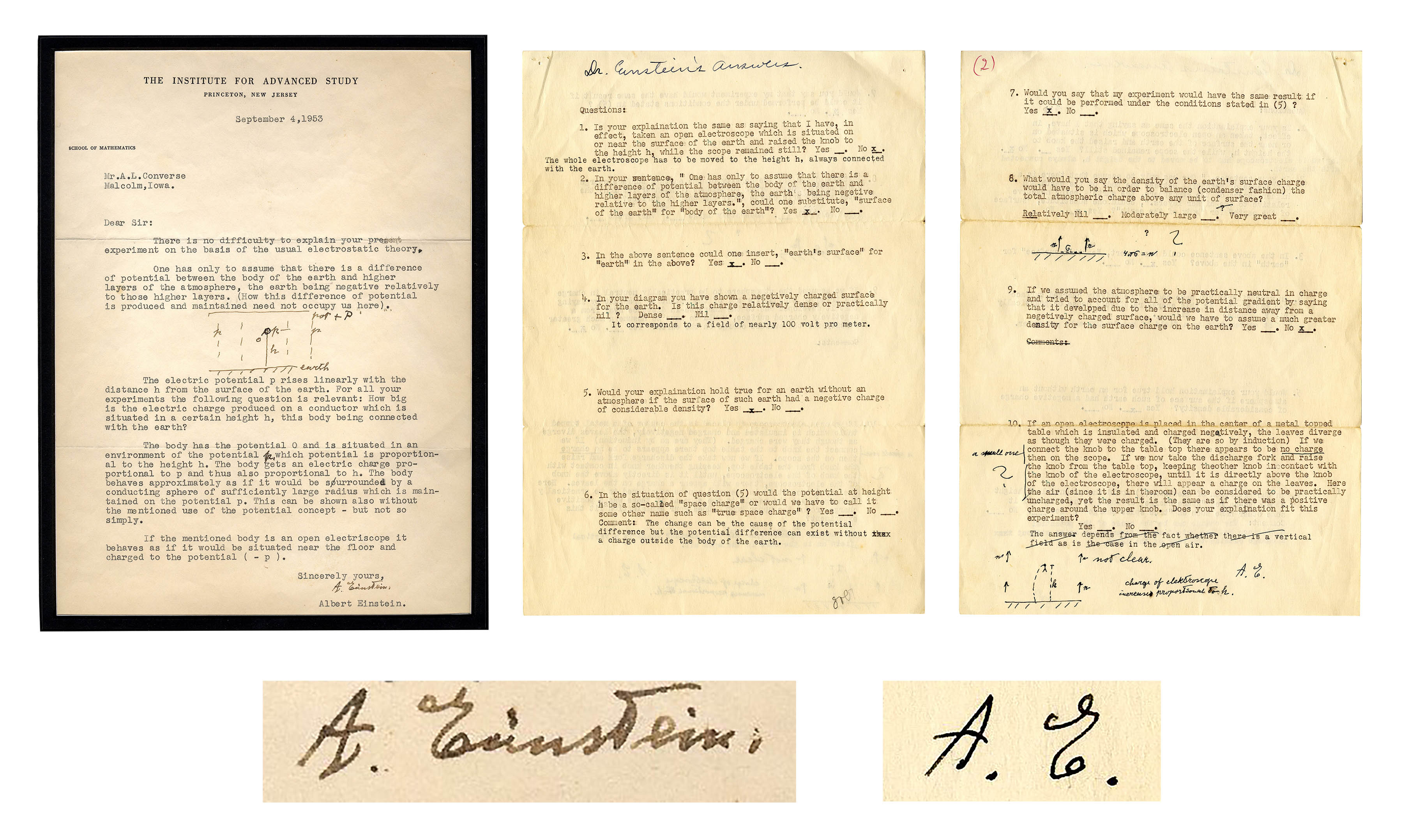
Albert Einstein letter signed with his hand drawings, elegantly explaining his electrostatic theory of special relativity to a physics teacher struggling to reconcile it with experiments he was conducting. In addition to the letter, which is new to the market, Einstein generously replies to a series of questions the teacher asks him on a questionnaire, providing additional drawings and calculations, initialed ”A.E.” at the conclusion. Dated 4 September 1953 on Princeton’s Institute for Advanced Study letterhead, Einstein writes to Arthur L. Converse, the teacher from Malcolm, Iowa, in part, ”There is no difficulty to explain your present experiment on the basis of the usual electrostatic theory. One has only to assume that there is a difference of potential between the body of the earth and higher layers of the atmosphere, the earth being negative relatively to those higher layers…[Einstein then draws Earth and the atmosphere, referring to it for clarification] The electric potential p rises linearly with the distance h from the surface of the earth…For all your experiments the following question is relevant: How big is the electric charge produced on a conductor which is situated in a certain height h, this body being connected with the earth…” Einstein then answers Converse’s questions on a two-page questionnaire. In one answer, Einstein seems to disagree with the question, providing both a diagram and mathematical equation and then a ”?” to try to aid understanding. He later writes ”not clear” to one answer along with a question mark and additional diagram with the notation ”charge of elektroscope increased proportional to h”. An extraordinary lot by Einstein showing the generosity of his time, with rare content on his theory of special relativity. Single page letter and two-page questionnaire each measures 8.5” x 11”. Also included is Einstein’s original mailing envelope from ”Room 115” of the Institute for Advanced Study, postmarked 7 September 1953 from Princeton. Folds and very light toning to letter, otherwise near fine. Questionnaire has folds, light toning and staple mark, otherwise near fine with bold handwriting by Einstein. With an LOA from the nephew of Arthur Converse and new to the market. Sold for $53,504.
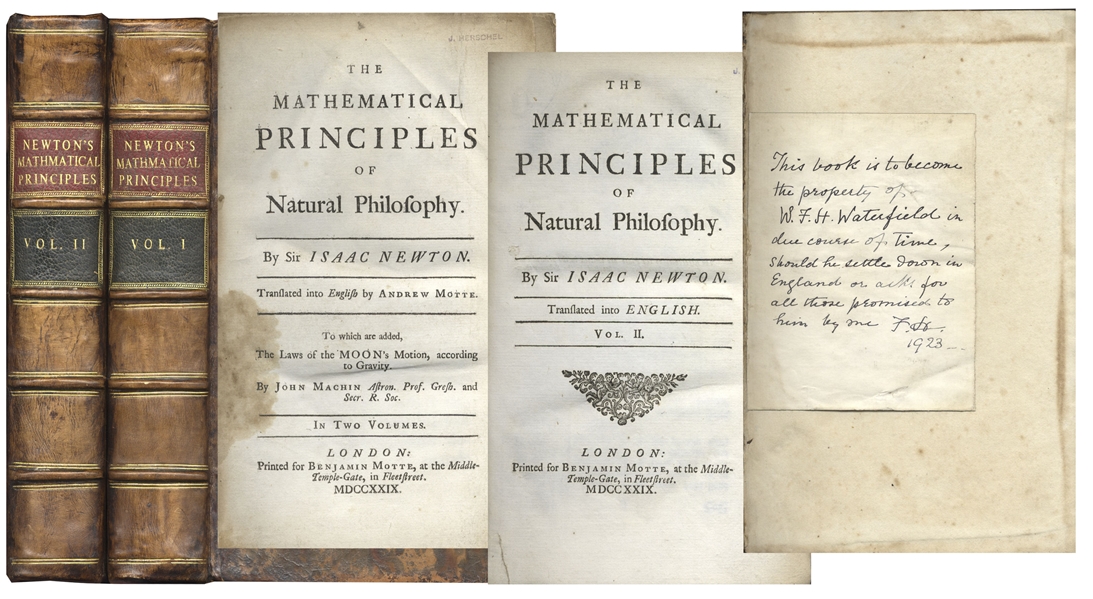
Rare First Edition of Sir Isaac Newton’s ”The Mathematical Principles of Natural Philosophy” — Two Volume Set From 1729
Rare Sir Isaac Newton first edition ”The Mathematical Principles of Natural Philosophy” in two volumes. London: Benjamin Motte, 1729. One of the most important works by the leading mind of the 18th century scientific revolution. Bound in contemporary tree calf, sympathetically rebacked, with gilt tooling to spines. Two octavo volumes measure 5.5” x 8.5” each. Volumes contain two folding letterpress tables and 47 folding engraved plates; the two frontispieces and pp. 385-393 and first 7pp. of index are replaced in facsimile, but hardly distinguishable from the original. The ”Laws of Moon’s Motion” usually found in Vol. II are here bound at end of Vol. I, and with errata for both volumes on verso of E4. Small stain to inner part of title in Vol. I, short tear to lower margin of G1, small section missing from lower margin of M3 and with lower corner cut away of A8 and C4 of ”Laws of Moon’s Motion” (no loss of text). Some marginal dampstaining and occasional soiling and spotting, overall in very good, clean condition with most edges untrimmed. Excellent Isaac Newton first edition. Sold for $22,500.
Consign your item at Nate D. Sanders Auctions. Send a description and images of your item to us at [email protected].
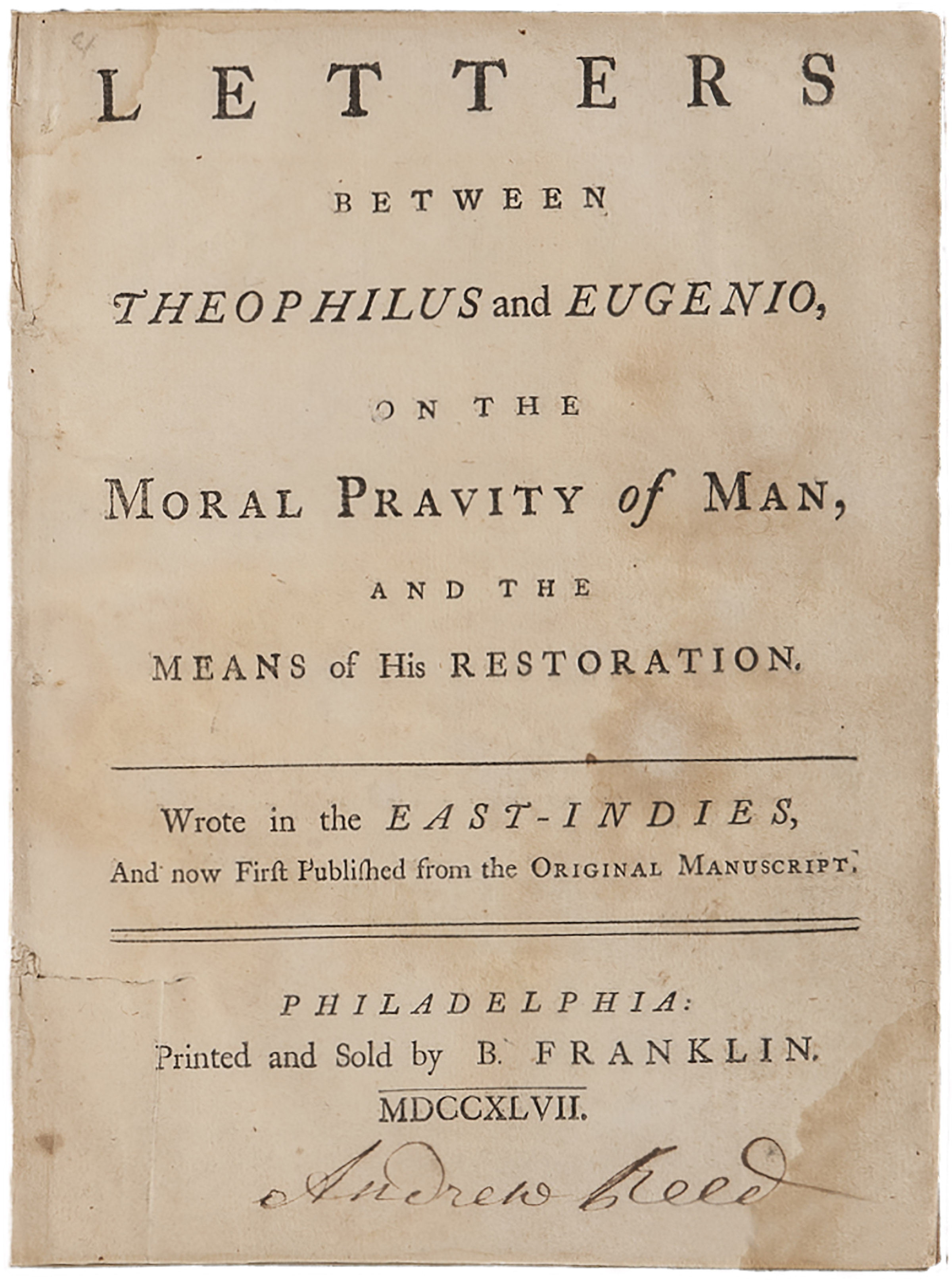
From the Printing Press of Benjamin Franklin, “Letters between Theophilus and Eugenio, on the Moral Pravity of Man, and the Means of his Restoration” — One of Only 16 Titles Published by Franklin
One of only 16 books printed by Benjamin Franklin, “Letters between Theophilus and Eugenio, on the Moral Pravity of Man, and the Means of his Restoration”. Philadelphia: Printed and Sold by B.[enjamin] Franklin, 1747. The first and only edition. Authorship of this volume of letters was once erroneously attributed to Franklin by Sabin, although it’s now believed to be by Sir Richard Blackmore. Book runs 64pp. in original wrappers, bound in full morocco black pebbled leather measuring 6.25″ x 7.75″ with git titling on spine. Previous owner’s name of “Andrew Reed” written to bottom of title page and page 20, possibly the wealthy 18th century Philadelphia merchant. Closed tear and water stain to title page, both lessening over the subsequent 2-3 leaves. Very good condition. Sold for $5,775.
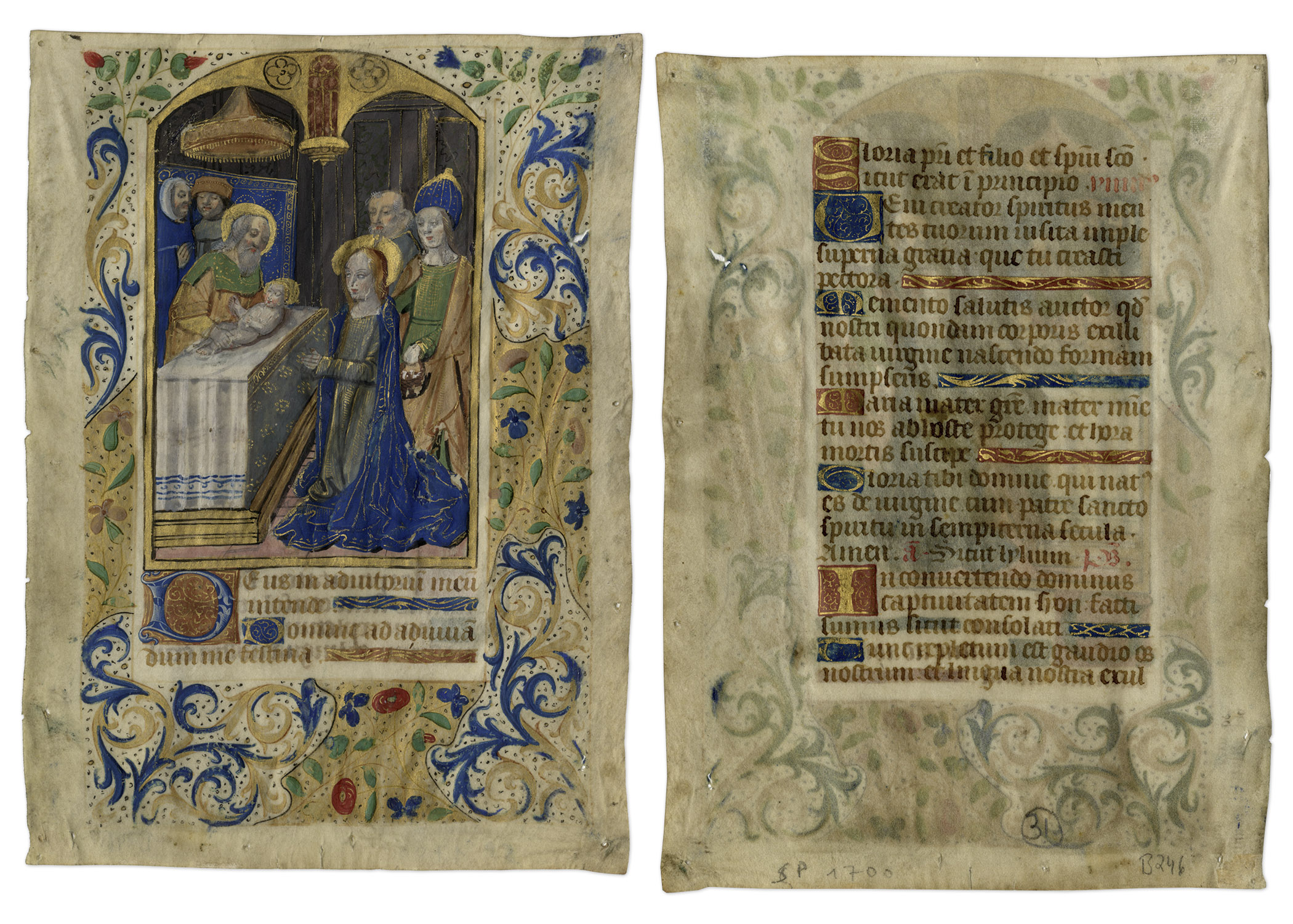
15th Century Hand-Painted Manuscript Page From “Book of Hours” — Illustrates Presentation of Jesus Christ
Hand-painted manuscript page from the liturgical text “Book of Hours”, from Paris, circa 1490. Front of double-sided page illustrates a scene from the presentation of Jesus Christ, who was circumcised on the 8th day after his birth. Includes 3/4 colored acanthus and floral border. Verso has single column with 22 lines of Latin text. Page is made of virgin-vellum and measures 4.25″ x 6″. Near fine condition given age. Sold for $1,469.
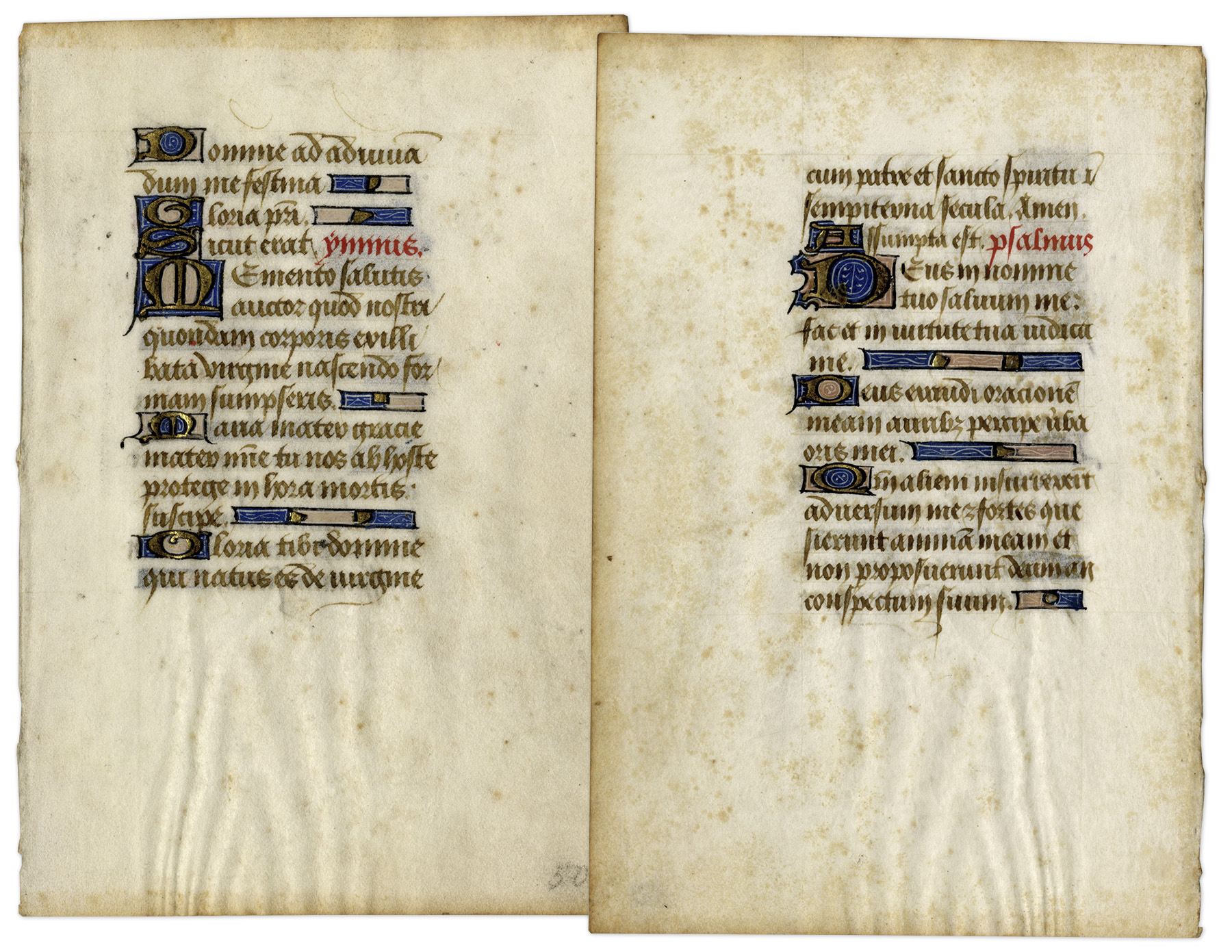
12th Century Hand-Painted Manuscript From ”Book of Hours”
Hand-painted manuscript page from the liturgical text ”Book of Hours”, from Tours in northern France, circa 1250. Double-sided page is beautifully rubricated in bright gold, blue and red. Single columns on each side contain 15 lines of Latin text. Page is made of virgin-vellum and measures 3.5” x 5”. Some rippling to bottom center, minor discoloration to edges and some foxing. Near fine given age. Sold for $1,250.
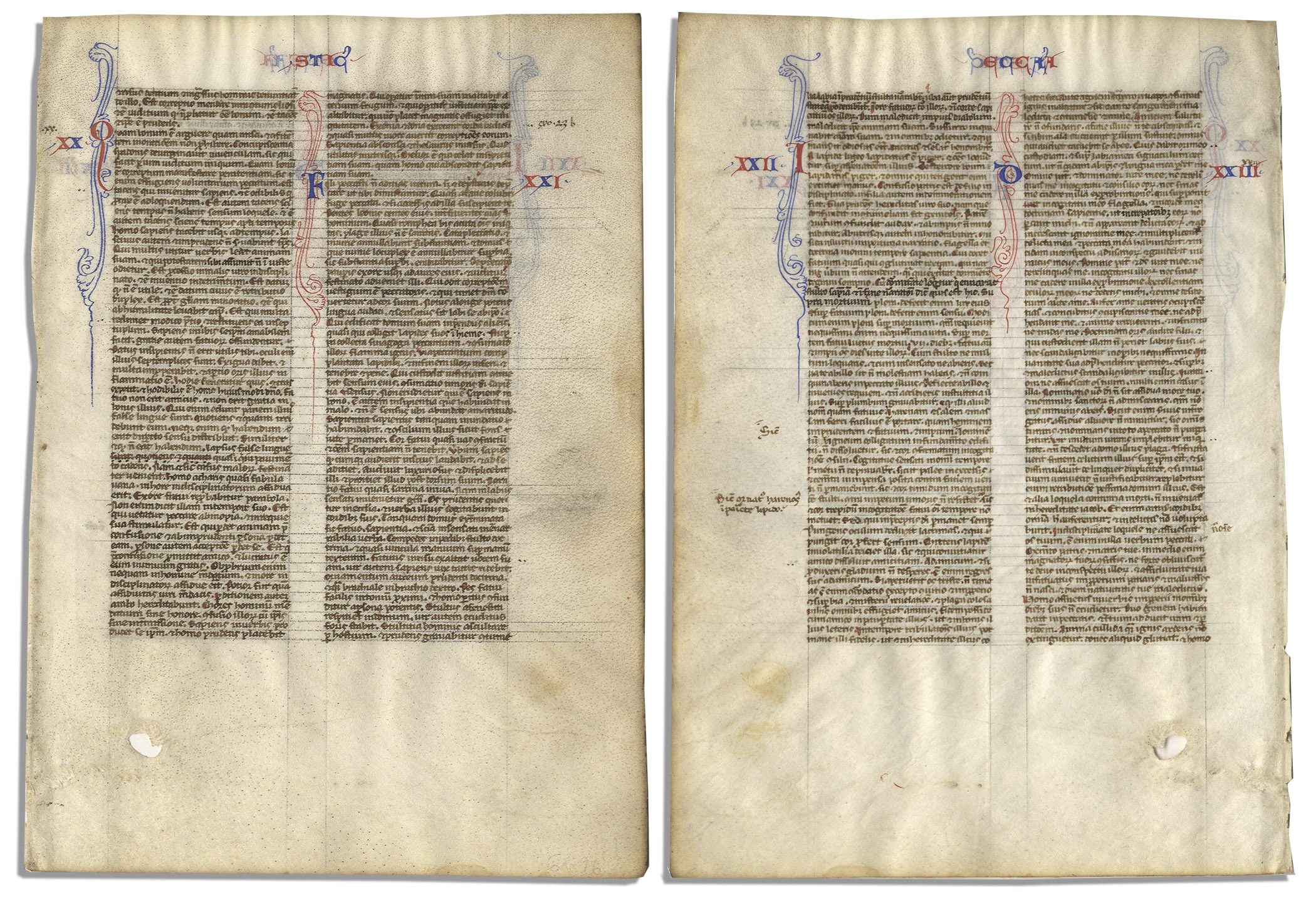
Bible Leaf From the Medieval Age, Circa 1250-1275 — Crusades Era Document on Vellum
Miniature medieval Bible page. Illuminated manuscript Bible page on vellum dates to the mid 13th century when pocket size Bibles were a common means of spreading Christianity to remote areas. Tiny Gothic script in Latin appears in brown ink with red and blue rubrication. Features a total of 56 lines of text, beginning with Ecclesiasticus (Sirach) 20:1 and running through 23:22. Translates in part, ”How much better is it to reprove, than to be angry, and not to hinder him that confesseth in prayer…The slipping of a false tongue is as one that falleth on the pavement: so the fall of the wicked shall come speedily…Flee from sins as from the face of a serpent: for if thou comest near them, they will take hold of thee. The teeth thereof are the teeth of a lion, killing the souls of men…The mourning for the dead is seven days: but for a fool and an ungodly man all the days of their life…” Thin sheet features text on both sides. Measures 4.25” x 6”. Hole in the margin at lower right is likely from original stretching. Very slight buckling to top edge. Near fine given age. Sold for $1,100.
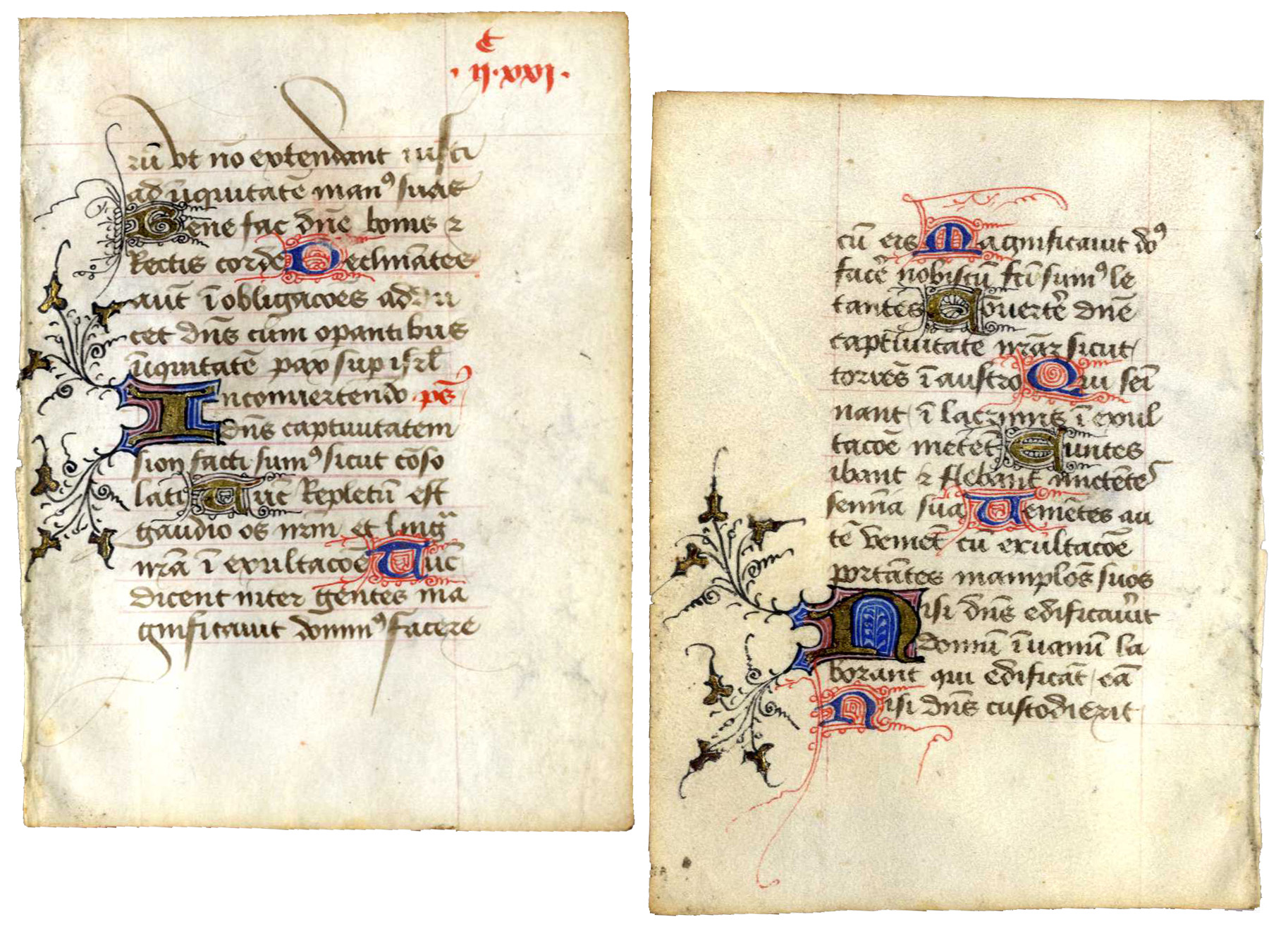
Illuminated Leaf From 15th Century French Psalm Book
Beautiful leaf from a 15th century French Book of Psalms. Fifteen lines of rubricated and gilt text appear on each side of the vellum leaf, written in a Gothic script. These illuminated leaves were created in the middle ages by artist scribes, who wrote in extraordinary detail, embellishing the text with gold, red and blue dyes. Because of the labor involved, the books were quite expensive at the time, and individual leaves have since been collected as works of art. Leaf measures approximately 3″ x 4″. Light toning, else near fine. Sold for $756.
Consign your Johannes Kepler Astronomia nova 1st edition 1609 at Nate D. Sanders Auctions. Send a description and images of your item to us at [email protected].
Consign your Johannes Kepler Astronomia nova 1st edition 1609 at Nate D. Sanders Auctions. Send a description and images of your Johannes Kepler Astronomia nova 1st edition 1609 to us at [email protected].