Sell or Auction Your JEB Stuart 1863 Autograph Letter Signed for up to Nearly $10,000 or More at Nate D. Sanders Auctions
FREE ESTIMATE. To buy, auction, sell or consign your JEB Stuart 1863 autograph letter signed that is for sale, please email your description and photos to [email protected] of Nate D. Sanders Auctions (http://www.NateDSanders.com).
Sell Your JEB Stuart 1863 Autograph Letter Signed
James Ewell Brown “Jeb” Stuart (February 6, 1833 – May 12, 1864) was a United States Army officer from Virginia who became a Confederate States Army general during the American Civil War. He was known to his friends as “Jeb,” from the initials of his given names. Stuart was a cavalry commander known for his mastery of reconnaissance and the use of cavalry in support of offensive operations. While he cultivated a cavalier image (red-lined gray cape, the yellow waist sash of a regular cavalry officer, hat cocked to the side with an ostrich plume, red flower in his lapel, often sporting cologne), his serious work made him the trusted eyes and ears of Robert E. Lee’s army and inspired Southern morale.
Below is a recent realized price for a JEB Stuart 1863 autograph letter signed item. We at Nate D. Sanders Auctions can obtain up to this amount or more for you:
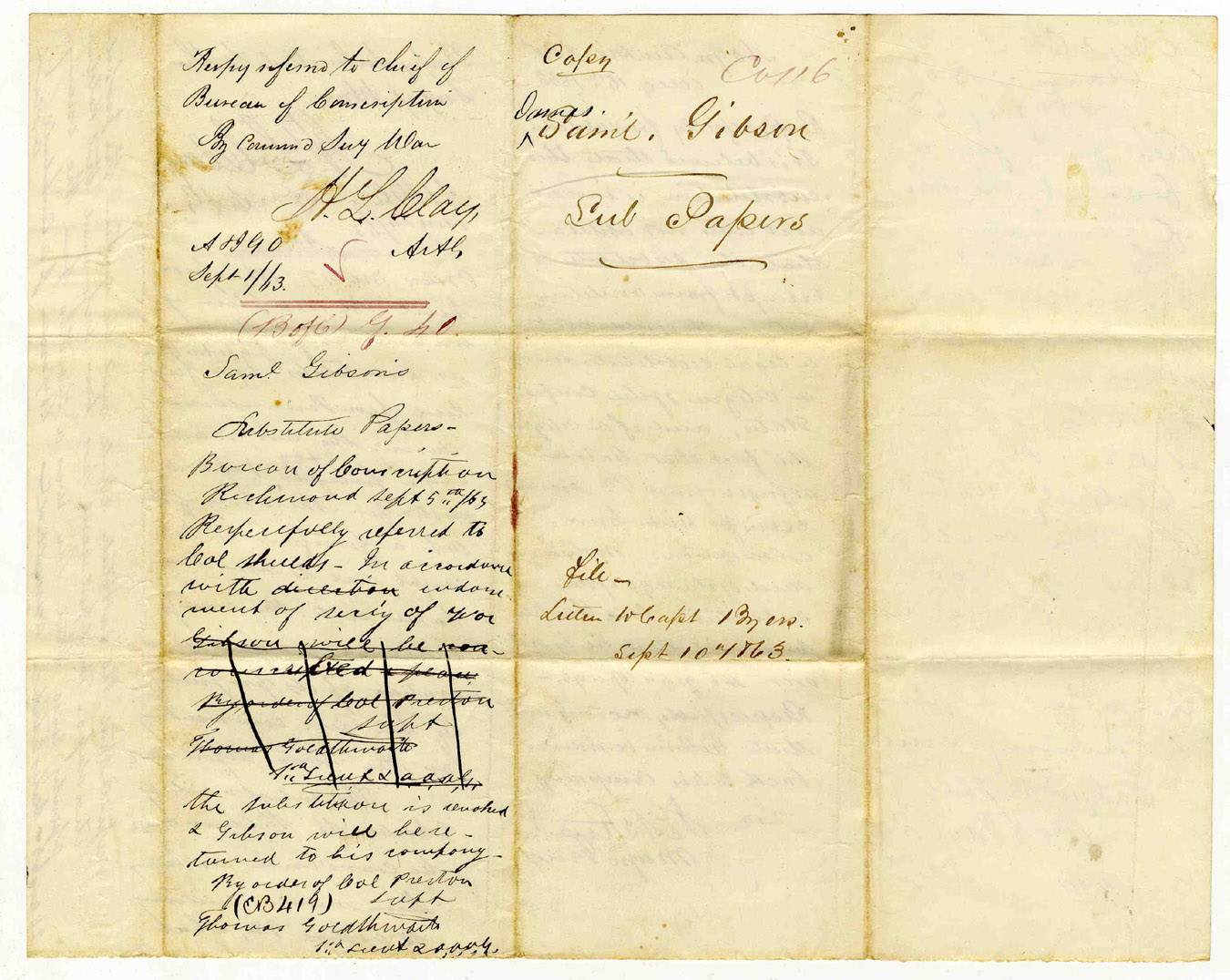
JEB Stuart 1863 Autograph Letter Signed. Sold for nearly $10,000.
Nate D. Sanders Auctions has sold the following similar items:
1863 Confederate General J.E.B. Stuart AES
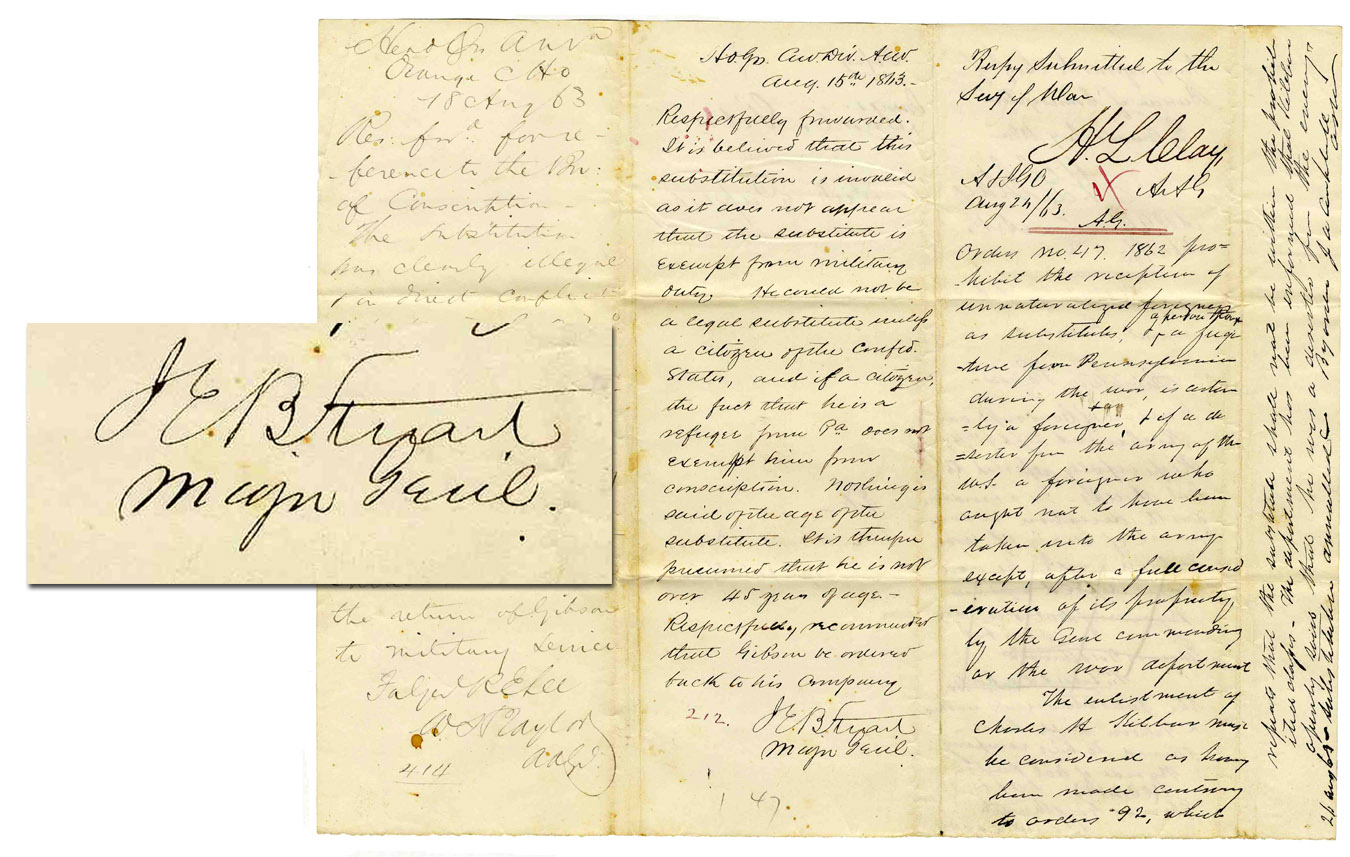
Confederate General J.E.B. Stuart Civil War dated endorsement signed. Civil War document relating to Confederate soldier Samuel Gibson’s efforts to obtain a substitute bears four signatures including that of General Stuart. Composed at “Hdqrs. Cav. Div. A.N.V” and signed on 15 August 1863, Stuart notes that he believes the substitute for Samuel Gibson is invalid because the substitute himself is exempt from military service. He goes on to include his reasons for the invalidity of the substitute and finally recommends that Gibson be returned to service. Boldly signed, “J.E.B. Stuart, Major Gen’l.” Additionally signed by Adjutant W.H. Taylor who notes that the substitute is “clearly illegal.” The matter was later submitted to the Secretary of War and signed by Confederate officials, H.L. Clay and J.A. Campbell who cite Order No. 47 in which “unnaturalized foreigners” are not permitted to serve as substitutes. The case was then submitted to the Chief of the Bureau of Conscription and signed by 1st Lieutenant Goldthwaite. Samuel Gibson was ultimately ordered to return to duty. Document measures approximately 8″ x 10″. Creasing and overall toning and wear, else good condition. Sold for $5,100.
General J.E.B. Stuart Signed Page with PSA/DNA COA
Confederate General J.E.B. Stuart signature, “J.E.B. Stuart / Lt. Col. V.P.A.” Stuart joined the Confederate army as a Lt. Col. on 10 May 1861 and was quickly promoted to Captain on 24 May, thus dating this signature to very early in the war. Signature appears on a 2.5” x 1” slip, presented with a photo of Stuart. Near fine. With a COA from PSA/DNA. Sold for $2,925.
Tense and interesting archive of over 50 Civil War letters, the vast majority written by Jacob ”Jake” David Minton of the 67th Ohio Infantry, Co. H, a sergeant who died from wounds incurred during the Second Battle of Fort Wagner. In addition to Minton’s letters, five additional letters from other soldiers are included, all of whom write Minton’s family concerning his wound, decline and eventual death.
Letters to his parents and sister begin on 7 November 1861, the day Minton, aged 20, musters into the Army. His regiment had the first taste of combat in March 1862 at the First Battle of Kernstown, of which Minton writes, ”…our regt were called into line and informed that Old Jackson was coming to attack us at Winchester. The boys all leaped for joy at the prospect of having a battle with him, every man being on hand. In fifteen minutes we were on the field of battle deployed as skirmishers. Our regt being first on the ground…they opened their cannon upon us and several of their shells passed direct through our ranks. This began to make our eyes hang out, but our batteries comeing they soon silenced them for the night. Our loss was one killed and Gen. Shields was slightly wounded in the arm. The rebels moved back to a small place called Currents Town. Our company and two others were placed as an advance guard. We had no blankets and it was very cold. Also no supper to stiffen our backs. At about ten on Sunday they attacked us again, by this time our division were all on hand. It was evident that they were going to make a desperate effort. They had heard that we had but two regts at Winchester which gave them some courage. Our batteries were immediately placed and our regt had the honor to guard the best one on the field throughout the day. (Dammis Battery of regulars). We soon made them take to their runners, that is move their cannon back. Our advancing as they retreated. In this way it continued till about four o’clock when we came to a narrow valley. Their troops on one side and ours on the other. It was dreadful to hear the hum of their balls passing in every direction about us, but to hear ours respond to them was glorious. At this point they were evidently getting a much better position than we had, they being shielded by heavy timber. At this critical time we were ordered all hands to charge upon them. We crossed the valley on double quick and many of us faster, their grape and bomb shells bursting right in our midst, but not a man was killed. It seemed like we were protected by the Almighty. Their batteries soon became useless to them. Our infantry opened a dreadful fire upon them and the two foes fought face to face, each one seeming determined to hold their ground. At last after hard fighting a shout went up that they were running. We all pursued, slaying them by hundreds. On catching stragglers they would throw up their hands and pray us not to shoot them. We told them not to fear. It was night and we had to be upon the ground with nothing to eat and no blankets. Our killed is estimated to be 105. The enemies 550 and 500 taken prisoners. It is quite singular but nearly all of the rebles were shot in the head. I gave them twenty rounds. George Parsons is wounded in the calf of his leg, but nothing serious. I think the rebles say Bull Run was not a comparison to what they suffered here. It is said to be the hardest battle fought yet in Virginia…JD Minton”.
With much more content, including an inspection by President Lincoln (”Old Abe said we were the toughest looking chaps he had seen”), movements by the military, and insightful observations of the military command. In one of his last letters home he writes excitedly of battle preparations, including, ”We anticipate a hard fight if we take Morris Island.” Most letters, nearly all composed in pen with legible handwriting, include the original envelopes, several on patriotic stationery. An exciting and interesting set of letters, in very good plus condition. With near complete transcriptions. Sold for $18,750.
Civil War Confederate General P.G.T. Beauregard autograph manuscript signed, leaving his Army of the Potomac, the first established Army of the Confederacy whom Beauregard — the Confederacy’s first Brigadier General — led at First Bull Run. Having been transferred to the Army of the Tennessee, Beauregard writes from “Head Quarters 1st Corps A of P Near Centreville” on 30 January 1862: “…You are now undergoing the severest trial of a soldier’s life…My faith in your patriotism, your devotion and determination, and in your high soldierly qualities is so great, that I shall rest assured you will pass through the ordeal resolutely…Still, I cannot quit you without…deep anxiety, in the moment of our country’s trials and dangers…[T]his is no time for the army of the Potomac – the men of Manassas – to stack their arms and quit…To the army of Shenandoah, I desire to return my thanks for their assistance, last July, their timely, decisive arrival…Those…not so fortunate as yet to have been with us in conflict with our enemy, I leave with all confidence that on occasion they will show themselves fit comrades for the men of Manassas, Bull Run, and Ball’s Bluff…” G.T. Beauregard / Gen’l Com’dg”. 2pp. measures 8″ x 12.5″. Foxing, toning minor separation at folds and paper loss to corners. One of the best P.G.T. Beauregard autograph items one could hope to own. Very good condition. Sold for $12,500.
General William Sherman autograph letter signed: ”W.T. Sherman / M.G.” on Military Division of the Mississippi Headquarters stationery. In a letter datelined ”In the Field, 4 miles S of Hickory Hill, 1 February 1865”, the infamous Civil War figure writes to General John Gray Foster: ”…I cannot modify my orders relative to General Saxton having the charge of recruiting blacks…I think the impression at Washington is that both you and I are inimical to the policy of arming negroes, and all know that Saxton is not, and his appointment reconciles that difficulty. If anything serious occurs correspond directly with Mr. Stanton…Let Grant know I am in motion, and telegraph to Easton that if Slocum has to wait for provisions it will be dead loss [sic], as we are eating up ours. Let Hatch continually feel the Salkehatchie, and the moment the enemy lets go, get the railroad broken back to the Edisto…” By this time in the war, approximately 10% of Union regiments were composed of black soldiers, and public opinion, including that held by officers and soldiers, had accepted the concept of arming former slaves in the war effort. This letter clearly shows that General Sherman was one of the remaining hold-outs in his opposition. Written in pencil, single page measures 7.75″ x 9.75″. Near fine. Sold for $9,582.
Ulysses S. Grant autograph letter twice-signed, dated 21 April 1863, while Grant served as Major General for Union forces. The 18th U.S. President writes to Colonel C.A. Reynaud in Millikins Bend, Louisiana in full: ”In view of the expected fall in the river, and possibly the difficulties that may be encountered in reaching Walnut Bayou through the Canal, I think it advisable to put through at once all the barges now ready to receive freight &c. to Cooper’s Plantation. Should the water there fall the distance would not be great to haul supplies to reach the bayou which will be navigable with a great fall of water. Should the river still keep up the barges can be brought back to the mouth of the canal to receive their loading. / Respectfully / US Grant / Maj. Gen.” In a postscript Grant adds, ”This should not be delayed longer than to-morrow / U.S.G.” Five days prior, Grant had ordered Union troops under fire in Vicksburg to meet up with his troops at the West side of the Mississippi. This move confused the Confederate Army and led to a victory at the Battle of Champion Hill on 16 May 1863. 2pp. letter is written in ink on one page, front and back. Measures 8” x 10”. Folds, dampstaining to top right corner and archivally repaired tear at left edge. Overall very good condition with bold and legible writing. Sold for $3,781.
Ulysses S. Grant autograph letter signed, dated 14 August 1861 at the beginning of the Civil War, and a week after Grant’s promotion from Colonel to Brigadier General. Grant writes from his Headquarters at Ironton, Missouri to a Mr. Crane in Pilot Knob, MO, in full, ”Sir: Send me six teams this morning. Let them come by the depot and put in two sacks of corn each. / Respectfully / U.S. Grant / Brig. Gen. Comdg”. Letter measures 7.75” x 9.75”. Professionally restored along folds, overall in very good condition. A rare letter by Grant during the Civil War, likely one of his first as General. Sold for $3,000.
1883 General Ulysses S. Grant ALS
Ulysses S. Grant autograph letter signed. Datelined New York City, 8 October 1883 & signed, “U.S.Grant.” 2pp. letter addressed to Theodore Lyman, asks that he send a request to the Peabody Educational Fund Trustees, on Grant’s behalf, for a copy of a recent resolution. The Fund was founded to promote the “intellectual, moral & industrial education in the most destitute portion of the Southern States.” Grants writes “I am sorry to trouble you with this, but I will do as much for you some time if it comes in my way.” 4.75″ x 8″. Fine. Sold for $1,507.
Ulysses S. Grant 1869 Postmaster Appointment Signed
President Ulysses S. Grant document signed “U.S. Grant”, dated 15 May 1869. Countersigned by Secretary of State Hamilton Fish. Here, Grant appoints a James M. Reed, “…Deputy Postmaster at Steubenville, Ohio until the end of the next Session of the Senate of the United States…” Document measures 16.25″ x 10.5″ with original blindstamped seal intact at lower left. Minor toning and folds throughout with a few separations along folds, archivally repaired on verso. Very good condition overall. Sold for $935.
Consign your item at Nate D. Sanders Auctions. Send a description and images of your item to us at [email protected].
FREE APPRAISAL. To buy, auction, sell or consign your JEB Stuart 1863 autograph letter signed that is for sale, please email your description and photos to [email protected] of Nate D. Sanders Auctions (http://www.NateDSanders.com).