
Sell or Auction Your Ezekiel Russell Bloody Butchery by The British Troops 1775 for up to Over $200,000 or More at Nate D. Sanders Auctions
FREE APPRAISAL. To buy, auction, sell or consign your Ezekiel Russell Bloody Butchery by the British Troops 1775 that is for sale, please email your description and photos to [email protected] of Nate D. Sanders Auctions (http://www.NateDSanders.com).
Sell Your Ezekiel Russell Bloody Butchery by The British Troops 1775
Below is a recent realized price for an Ezekiel Russell Bloody Butchery by the British Troops 1775 item. We at Nate D. Sanders Auctions can obtain up to this amount or more for you:
Ezekiel Russell Bloody Butchery by The British Troops 1775. Sold for over $200,000.
Here are some items that our auction house, Nate D. Sanders (http://www.NateDSanders.com), has sold:
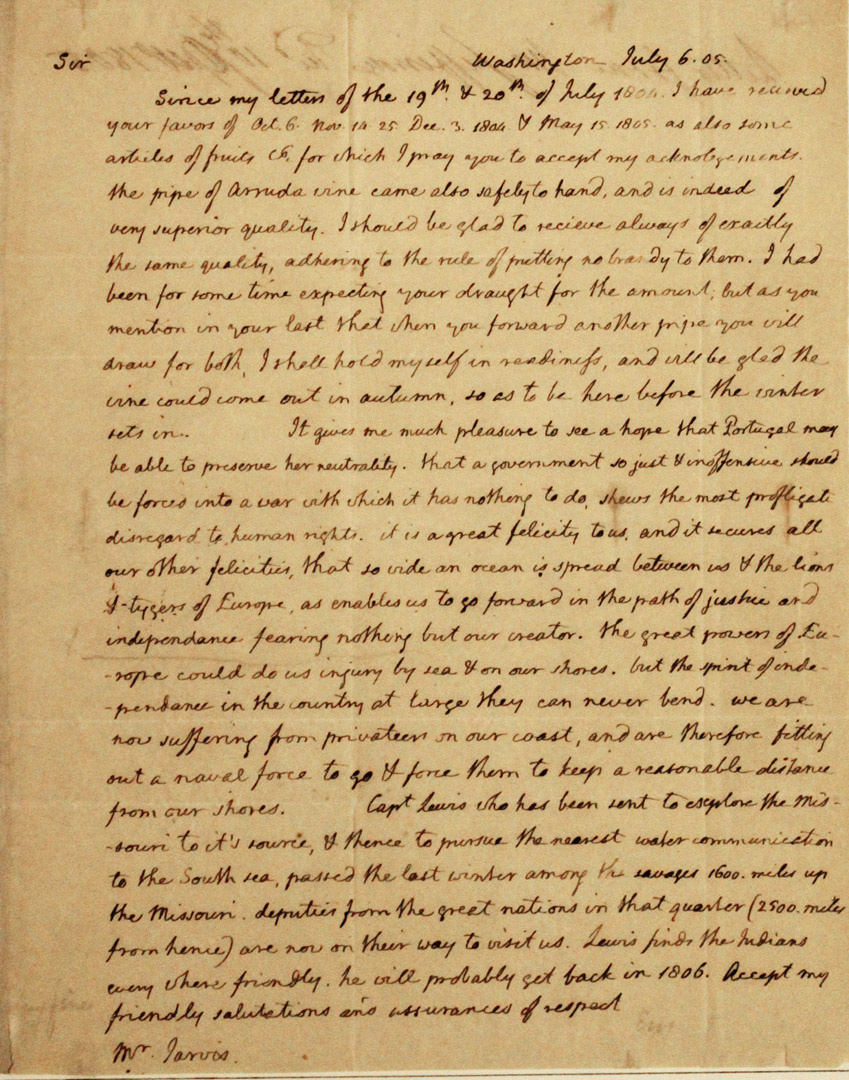
Thomas Jefferson Handwritten Report as President Regarding the Lewis & Clark Expedition — “…Capt. Lewis who has been sent to explore the Missouri to its source & thence to pursue the nearest water communication to the South sea, passed the last winter among the savages 1600 miles up the Missouri. Deputies from the great nations in that quarter (2500 miles from hence) are now on their way to visit us. Lewis finds the Indians every where friendly. He will probably set back in 1806…”
Exceptional, museum-worthy report, handwritten by Thomas Jefferson as President, regarding the Lewis and Clark Expedition. Letter is addressed to William Jarvis of the U.S. consul in Lisbon, Portugal, dated 6 July 1805, describing the historic expedition that Jefferson authorized during his Presidency. In its entirety: “Sir / Since my letters of the 19th & 20th of July 1804 I have received your favors of Oct. 6 Nov. 14-25 Dec. 3 1806 & May 15 1805. As also some articles of fruits & for which I may you accept my acknowledgments. The pipe of Arruda vine came also safely to hand, and is indeed of very superior quality. I should be glad to receive always of exactly the same quality, adhering to the rule of putting no brandy to them. I had been for some time expecting your draught [draft] for the amount; but as you mention in your last that when you forward another pipe you will draw for both, I shall hold myself in readiness, and will be glad the vine would come out in autumn, so as to be here before the winter sets in. It gives me much pleasure to see a hope that Portugal may be able to preserve her neutrality. That a government so just & inoffensive should be forced into a war with which it has nothing to do shows the most profligate disregard to human rights. It is a great felicity to us and it secures all our other felicities, that so wide an ocean is spread between us & the lions & tygers of Europe, as enables us to go forward in the path of justice and independence fearing nothing but our creator. The great powers of Europe could do us injury by sea & on our shores. But the spirit of independence in the country at large they can never bend. We are now suffering from privateers on our coast, and are therefore fitting out a naval force to go & force them to keep a reasonable distance from our shores. Capt. Lewis who has been sent to explore the Missouri to its source & thence to pursue the nearest water communication to the South sea, passed the last winter among the savages 1600 miles up the Missouri. Deputies from the great nations in that quarter (2500 miles from hence) are now on their way to visit us. Lewis finds the Indians every where friendly. He will probably set back in 1806. Receipt my friendly salutations and assurances of respect.” Document measures 8″ x 10″ on two pages, with integral fly-leaf addressed to Jarvis in the hand of Jefferson’s secretary. Toning and folds throughout, with minor tape residue at top and a tiny chip at lower right corner. Near fine condition with bold, legible handwriting. An important piece of handwritten history by the President who commissioned America’s greatest exploration adventure. ADDITIONAL INFORMATION: A near exact copy of this letter resides in the Library of Congress’ Thomas Jefferson Papers. One of the two letters was produced by Jefferson’s polygraph machine (used from 1804 until his death), which provided an immediate copy of his handwritten letters. Though impossible to determine which copy was produced by the pen that Jefferson held, Jefferson typically kept the machine-produced letter as a copy for himself. Since this letter was mailed to William Jarvis (unlike the letter in the LOC), it’s probable that this letter was the one handwritten by Jefferson. Sold for $226,871.
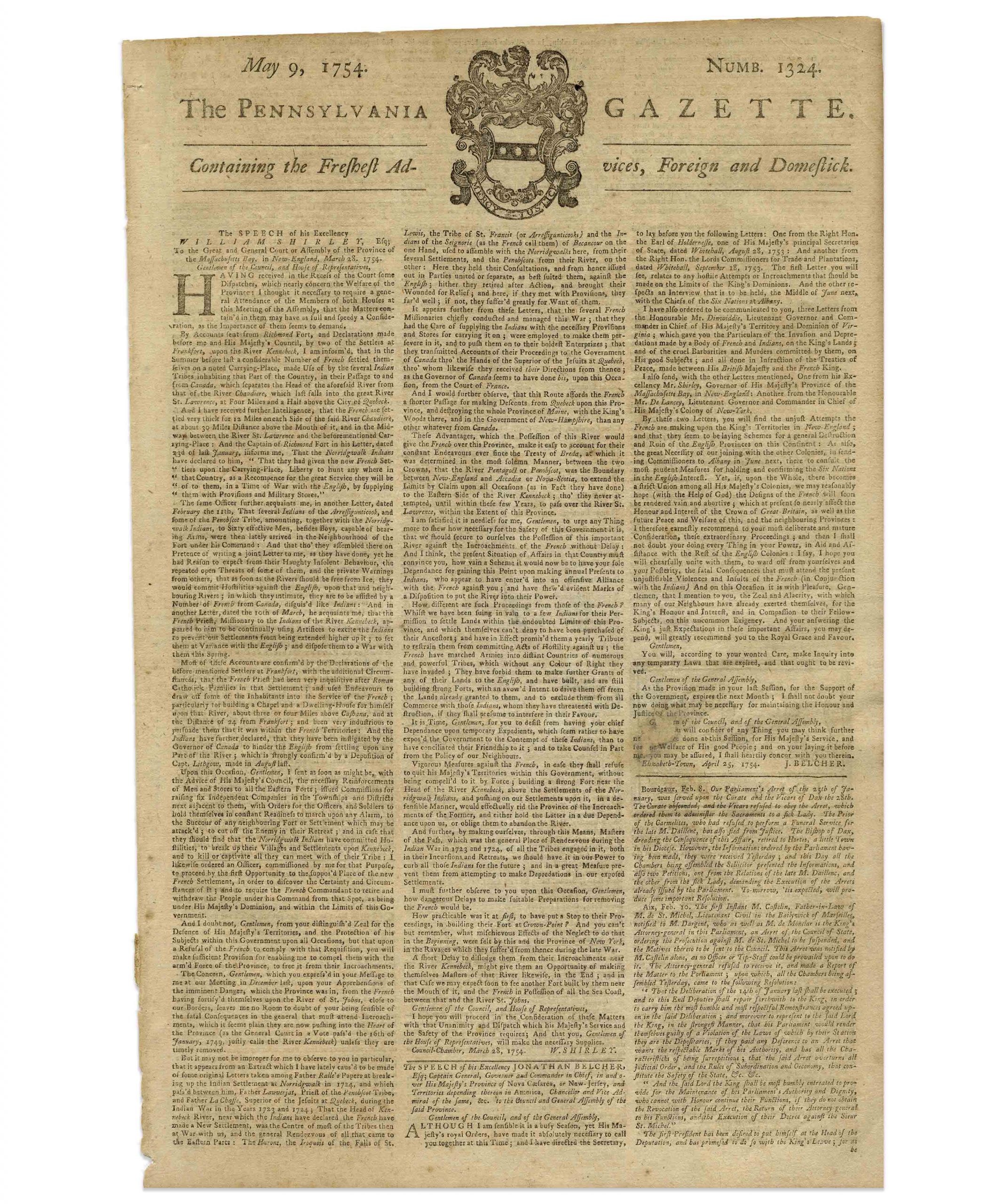
The most influential political cartoon in the history of America, the ”JOIN, or DIE” severed rattlesnake designed by Benjamin Franklin and published in his ”Pennsylvania Gazette” on 9 May 1754. This incredibly scarce newspaper is the very first printing of the ”JOIN, or DIE” cartoon, and the only known copy apart from one other housed in the permanent collection at the Library of Congress.
Frustrated by the colonists’ inability to join forces against westward expansion by the French, Franklin created this cartoon of a rattlesnake, cut into 8 pieces symbolizing the American colonies, to dramatically impart the effective message: join together as one cohesive body, or die. Along with the cartoon, Franklin published an editorial in the newspaper, urging the colonists to work together, reading in part, ”…The Confidence of the French in this Undertaking seems well-grounded on the present disunited State of the British Colonies…while our Enemies have the very great Advantage of being under one Direction, with one Council, and one Purse…”
Little did Franklin know at the time that his symbol of the dis-united rattlesnake would echo over twenty years later to inspire the colonists to unite against the British – Paul Revere added the ”JOIN, or DIE” cartoon to the nameplate of his paper, the ”Massachusetts Spy”, and even later, with the ”Don’t Tread on Me” flag, any individual or group whose personal liberty is threatened. The phrasing has also proved highly enduring, likely influencing John Stark, the Revolutionary War General from New Hampshire whose toast, ”Live free or die: Death is not the worst of evils”, inspired New Hampshire’s motto, and again suggests that personal liberty is one of the highest human values, and a founding tenet of the United States.
Franklin’s choice of a rattlesnake is curious for several reasons: as the timber rattlesnake was found throughout the colonies but not England, Franklin argued in an earlier 1751 editorial that the colonists should ship rattlesnakes to England in exchange for the criminals that England was sending to America. Franklin now, however, seems to fully embrace the rattlesnake as metaphor, and would argue, during the American Revolution, its virtues. Using a pseudonym to conceal his identity, he wrote in 1775, ”…she has no eye-lids-She may therefore be esteemed an emblem of vigilance.-She never begins an attack, nor, when once engaged, ever surrenders…to those who are unacquainted with her, she appears to be a most defenseless animal; and even when those weapons are shown and extended for her defense, they appear weak and contemptible; but their wounds however small, are decisive and fatal:-Conscious of this, she never wounds till she has generously given notice, even to her enemy, and cautioned him against the danger of stepping on her.-Was I wrong, Sir, in thinking this a strong picture of the temper and conduct of America?”
While the British loyalists played upon Franklin’s symbolism of the rattlesnake, arguing that the colonists were deceptive and cunning, Franklin turned the characterization on its head, skilled and interested as he was in the art of propaganda. Ultimately, the symbolism would prove highly enduring and compelling: both the idea of uniting to fight a greater, more powerful enemy, and the power of a sudden, deadly attack by an underestimated opponent.
Four page newspaper (without advertising) measures 9.75” x approximately 15”, with an irregularly trimmed top edge. Expert restoration to head of snake, and light uniform toning, consistent with age. Newspaper has been well-preserved, in very good to near fine condition. One of the most important newspapers in America’s colonial history and a cornerstone of her philosophical underpinnings. Sold for $50,000.
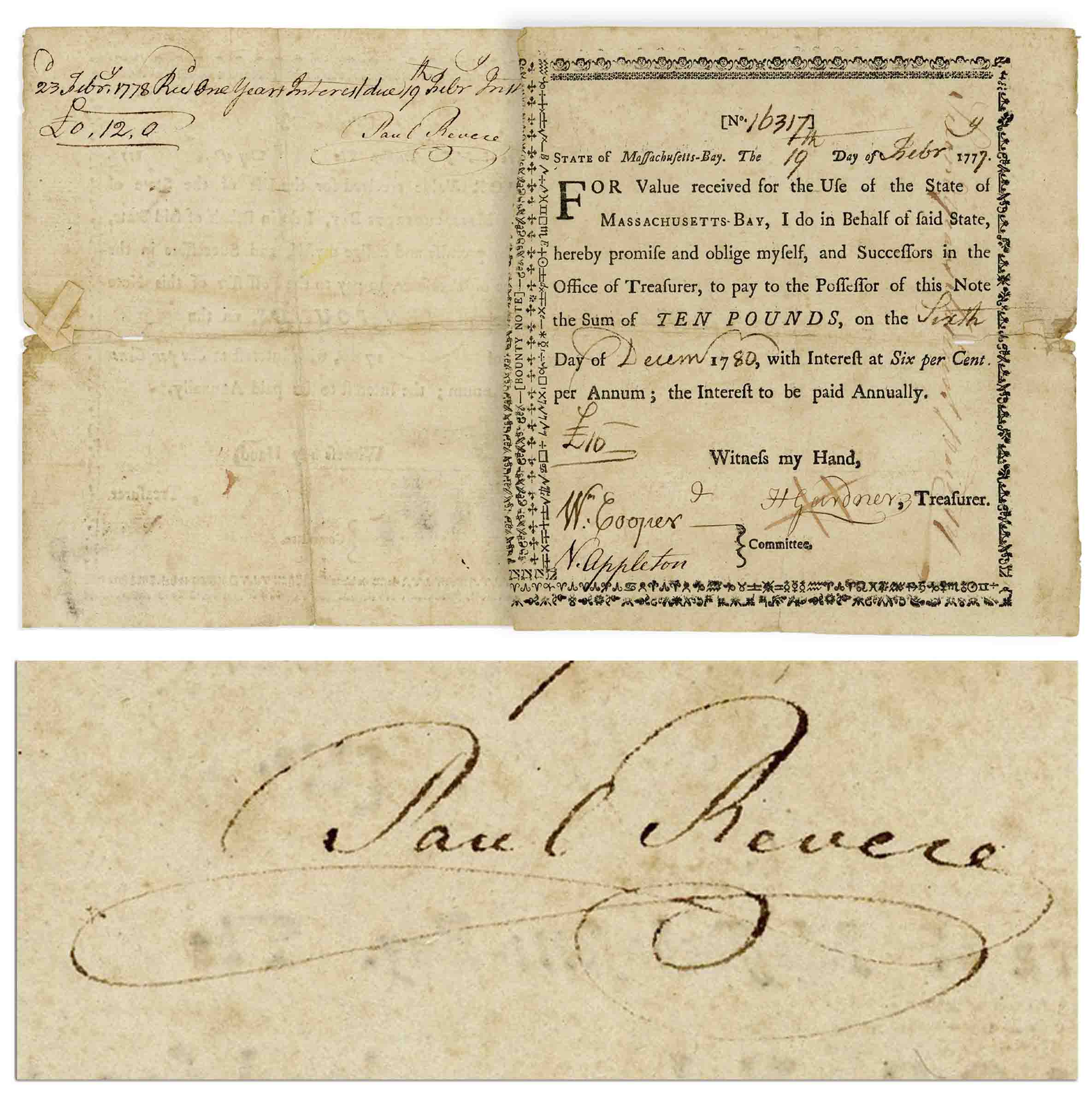
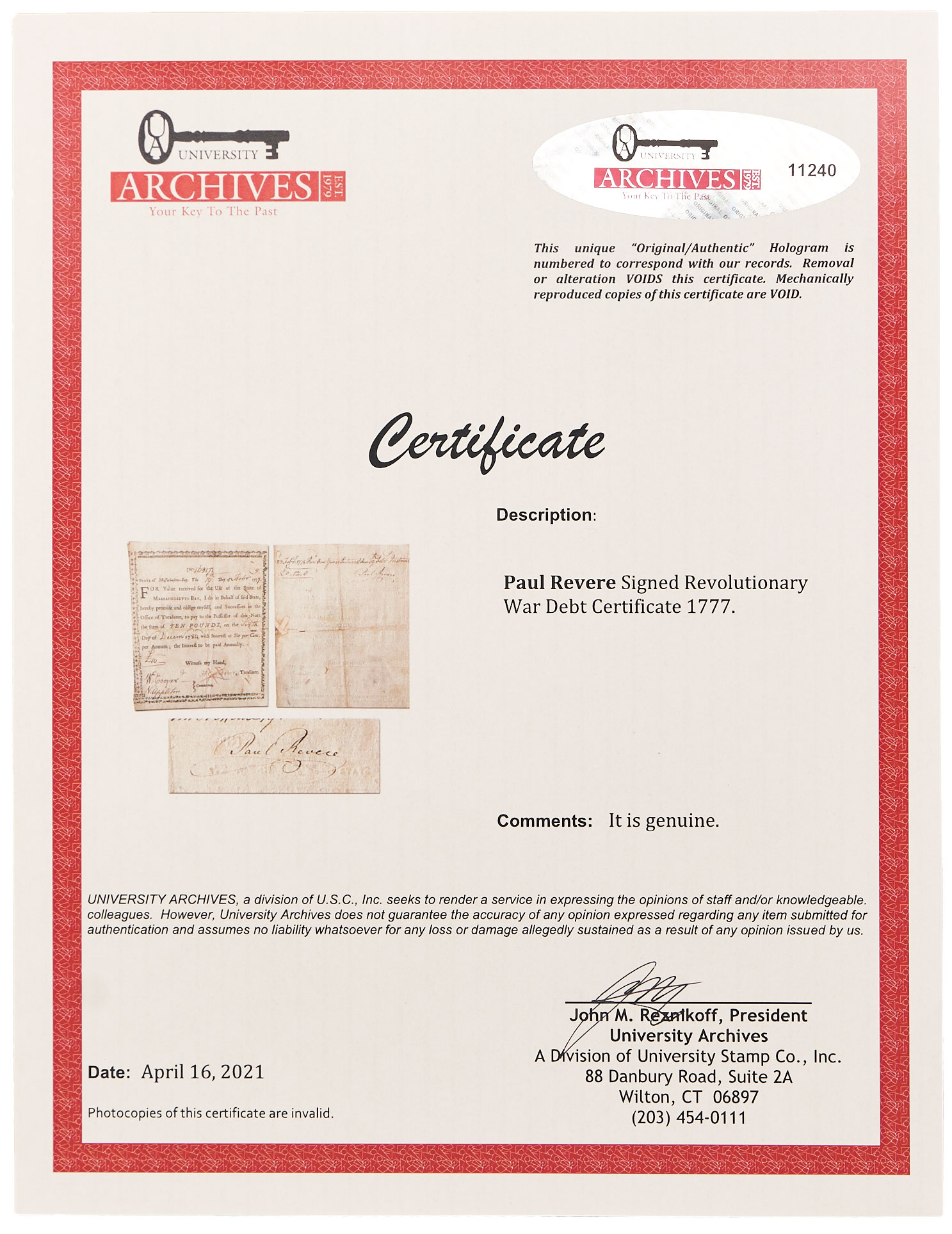
Very scarce debt certificate signed by Paul Revere during the Revolutionary War, issued by the Massachusetts-Bay Colony to raise badly needed funds for the war. Issued 19 February 1777, this note is signed by Revere on the verso, acknowledging annual interest in the amount of 12 shillings, dated 23 February 1778. Beautifully signed ”Paul Revere” with an elegant paraph accentuating his signature. Sold for $36,603.


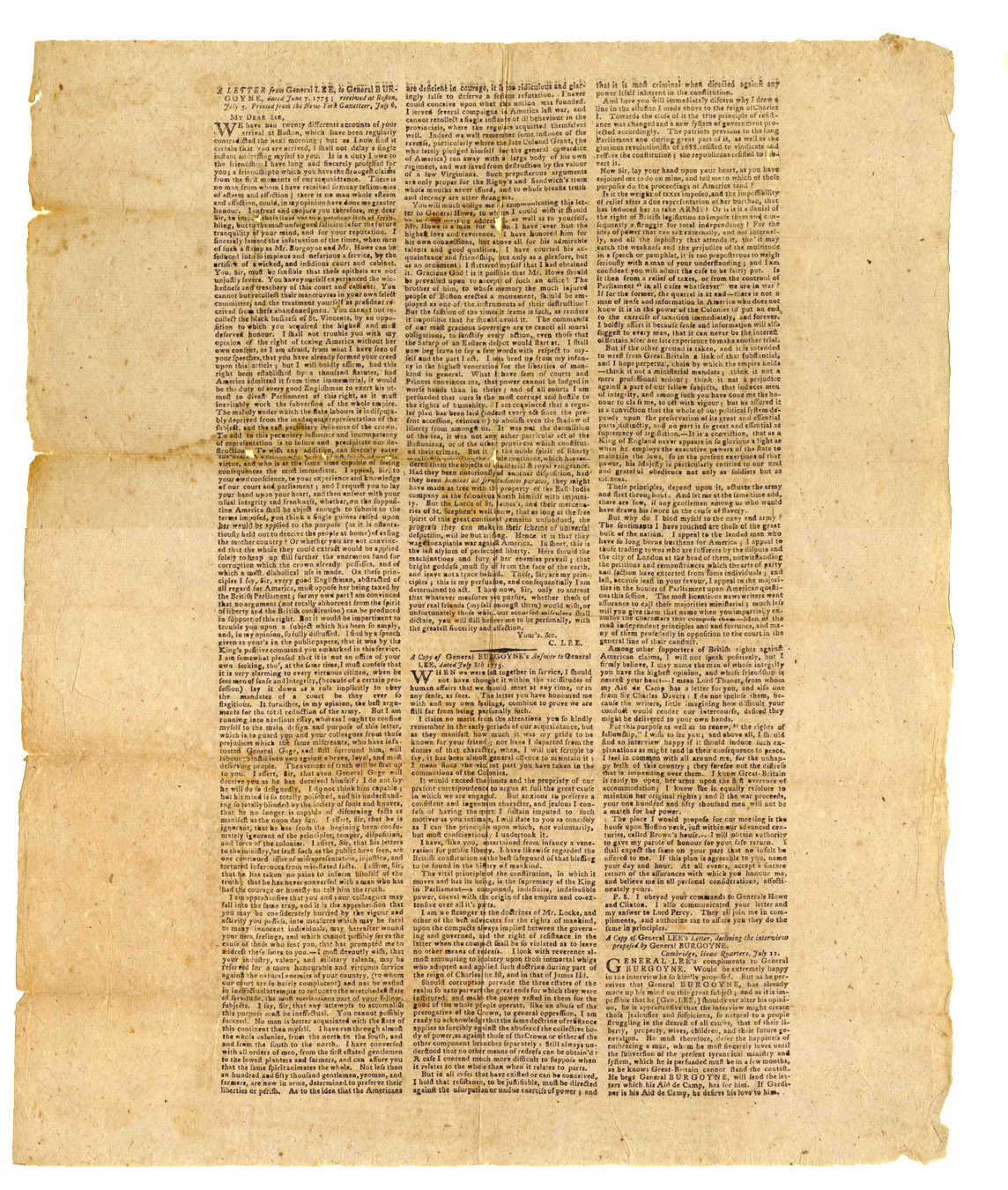
Revolutionary War Broadside 1775
Revolutionary War broadside, “A Letter From General Lee, To General Burgoyne, Dated June 7, 1775″ A broadside containing a spate of correspondence between former colleagues Lee and Burgoyne, including a defense of Lee’s support of the American colonies. Likely published in New York, as it seems unlikely this would have been published in British-occupied Boston. Measures 14″ x 17”. Docketed in contemporary manuscript on verso. Light fold lines, minor separations at folds with partial loss to some letters. Extremely rare. Sold for $5,250.
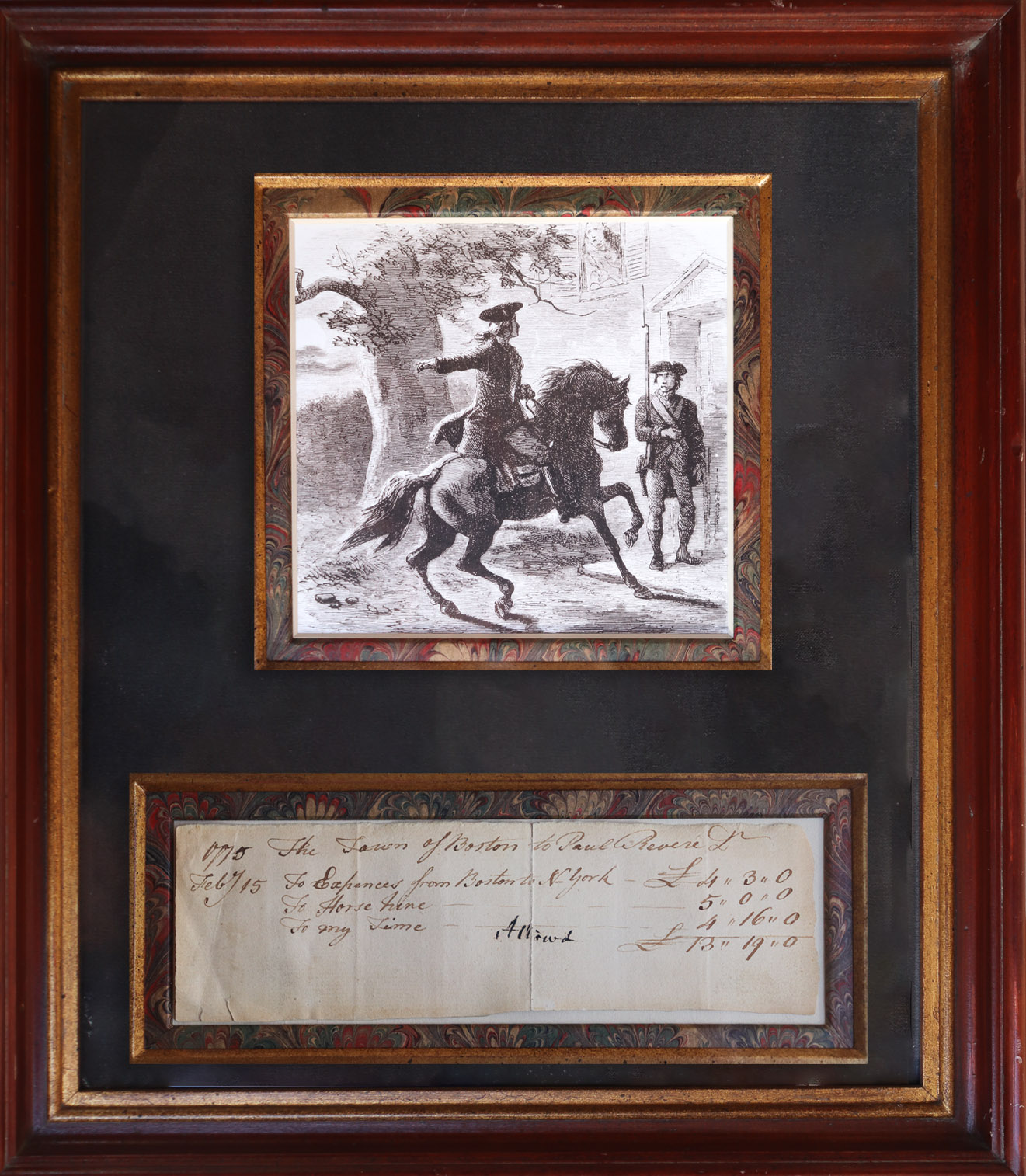
Very scarce receipt signed by Paul Revere regarding one of his famous horseback rides, dated 15 February 1775 just two months before his Midnight Ride warning colonists that ”The British Are Coming” before the Battle of Lexington & Concord. As official courier for the Boston Committee of Public Safety, Revere was tasked with riding from Boston to Philadelphia and New York, with historians documenting 18 such rides from December 1773 to November 1775. This was likely the last of the rides before the Revolutionary War began, and is only one of two receipts for the rides ever to appear at auction, with the other selling at Christie’s for $140,000 in 2002. Composed entirely in the hand of Revere, receipt documents expenses ”from Boston to N. York” in the amount of 4 pounds, 3 shillings, and additional expenses for his Horse, and his time, all totaling 13 pounds, 19 shillings. Dated 15 February 1775 by Revere. Document measures 7.5” x 2.25”, framed with an engraving of Revere on horseback to a size of 15.75” x 18”. Uneven edges, clean vertical separation and light chipping at lower left edge. Overall very good plus condition with legible and strong handwriting. With Profiles in History COA. Sold for $36,603.
Consign your Ezekiel Russell Bloody Butchery by the British Troops 1775 at Nate D. Sanders Auctions. Send a description and images of your Ezekiel Russell Bloody Butchery by the British Troops 1775 to us at [email protected].
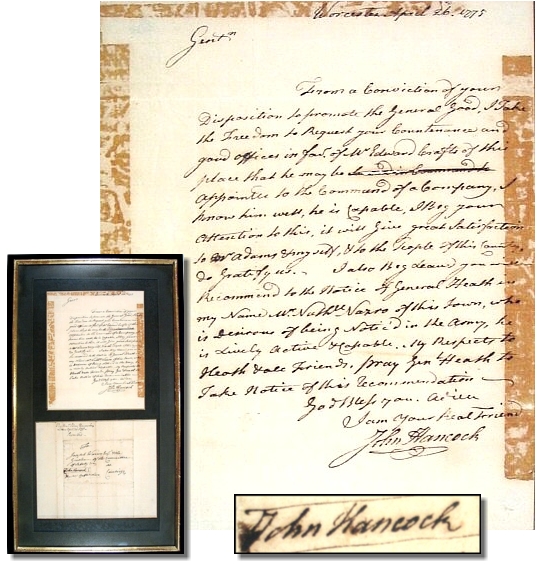
John Hancock Autograph Letter Dated April 26, 1775
John Hancock signed autograph letter to Joseph Warren and the Committee of Safety, requesting two soldiers be appointed for command. A very important John Hancock signed autograph letter from one week after the Revolutionary War started. Dated 26 April 1775, 7.5″ x 9″, from Worcester, Massachusetts. Slight fold creases, tape stains on top, left, and right margins, not affecting text. Small tear through date. Includes address cover, with second “John Hancock” autograph, both nicely matted in a 14″ x 24″ frame. In full, “From a Conviction of your Disposition to promote the General Good, I take the Freedom to Request your Countenance and good offices in fav. of W Edward Crafts of this place that he may be appointed to the Command of a Company. I know him well, he is capable, I Beg your attention to this, it will give great Satisfaction to Mr. [Samuel] Adams & to myself, & to the People of this Country, do gratify us. I also beg leave you will Recommend to the Notice of General Heath in my Name W. Nathel Nazro of this Town, who is serious of being Notic’d in the Army, he is lively, active, and capable. My respects to Heath & all friends. Pray Gen Heath to take Notice of this Recommendation- / God Bless you. Adieu / I am your real friend / John Hancock (signed).” On 14 April, Massachusetts Governor Gage is secretly ordered by the British to enforce the Coercive Acts and suppress “open rebellion” among colonists by using all necessary force. An object of some importance to the royal governor, to get possession of Mr. Hancock and Samuel Adams; and this is said to have been intended in the expedition to Concord, which led to the memorable battle of Lexington, the opening scene of the revolutionary war. Notwithstanding the secrecy with which that expedition was planned, these patriots, who were at the time members of the provincial congress at Concord, fortunately made their escape; but it was only at the moment the British troops entered the house where they lodged. Following this battle, Governor Gage issued his proclamation, offering a general pardon to all who should manifest a proper penitence for their opposition to the royal authority, excepting the above two gentlemen, whose guilt placed them beyond the reach of the royal clemency. On Tuesday evening, 18 April, General Gage orders 700 British soldiers to Concord to destroy the colonists’ weapons depot. Observing the movements of the British troops, Dr. Joseph Warren dispatched William Dawes, by way of Roxbury, and Paul Revere, by way of Charlestown, to give the alarm to the people dwelling on the roads toward Concord. Revere reaches Lexington about midnight and warns Sam Adams and John Hancock who are hiding out there. Next morning, on hearing the news of the firing at Lexington, Warren left his patients in charge of his pupil and assistant, William Eustis, and rode off to the scene of action. He seems to have attended a meeting of the committee of safety that morning at the Black Horse tavern in Menotomy (now Arlington), and there to have consulted with Gen. William Heath. By the time Lord Percy reached Menotomy on his retreat, Gen. Heath had assumed command of the militia, and the fighting there was perhaps the severest of the day. Dr. Warren kept his place near Heath, and a pin was struck from his head by a musket-ball. During the next six weeks he was indefatigable in urging on the military preparations of the New England colonies. General William Heath performed valuable services in the pursuit of the British troops from Concord on 19 April, 1775. At dawn on April 19 about 70 armed Massachusetts militiamen stand face to face on Lexington Green with the British advance guard. An unordered ‘shot heard around the world’ begins the American Revolution. A volley of British rifle fire followed by a charge with bayonets leaves eight Americans dead and ten wounded. The British regroup and head for the depot in Concord, destroying the colonists’ weapons and supplies. At the North Bridge in Concord, a British platoon is attacked by militiamen, with 14 casualties. British forces then begin a long retreat from Lexington back to Boston and are harassed and shot at all along the way by farmers and rebels and suffer over 250 casualties. News of the events at Lexington and Concord spreads like wildfire throughout the Colonies. On 23 April, the Provincial Congress in Massachusetts ordered 13,600 American soldiers to be mobilized. Colonial volunteers from all over New England assemble and head for Boston, then establish camps around the city and begin a yearlong siege of British-held Boston. An excellent John Hancock signed autograph letter.Sold for $10,745.
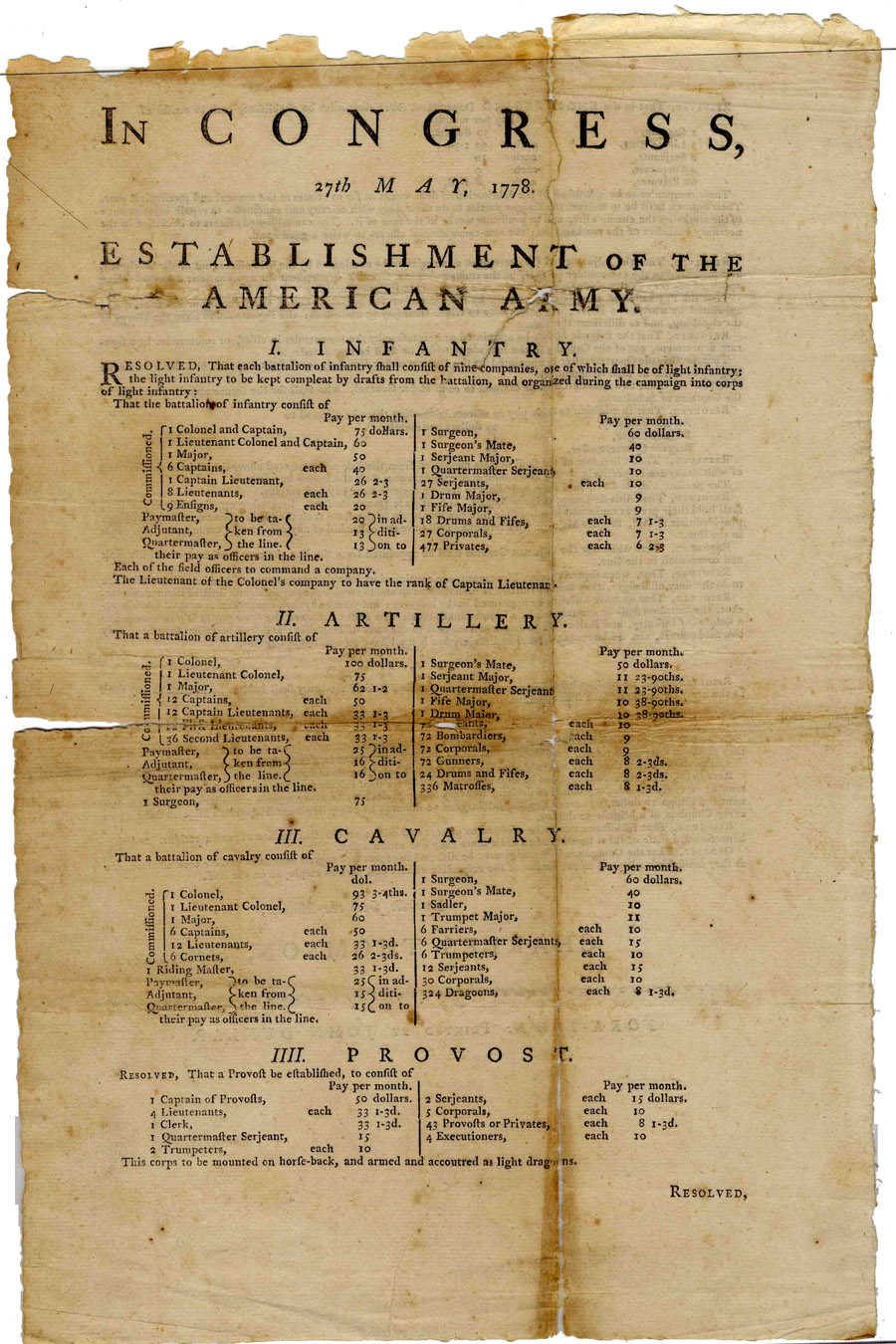
American Army Establishment Broadside
Scarce Revolutionary War “In Congress” broadside entitled, “Establishment of the American Army.” Printed by John Dunlap: York-Town. Dated 27 May 1778 document divides the American army into four parts; infantry, artillery, cavalry and provost and details positions and payments within each department. Further resolutions dated 29 May and 2nd June detail compensation and rations. In part, “…Resolved, That each battalion of infantry shall consist of nine-companies, one of which shall be of light infantry; the light infantry to be kept compleat by drafts from the battalion, and organized during the campaign into corps of light infantry: That the battalion of infantry consist of…Colonel and Captain [etc]…” 2pp. front and verso. Measures approximately 9.25″ x 14″. Fragile paper shows chipping and paper loss to edges and near complete separation at folds. Overall toning, wear and soiling, else good condition. Sold for $4,200.
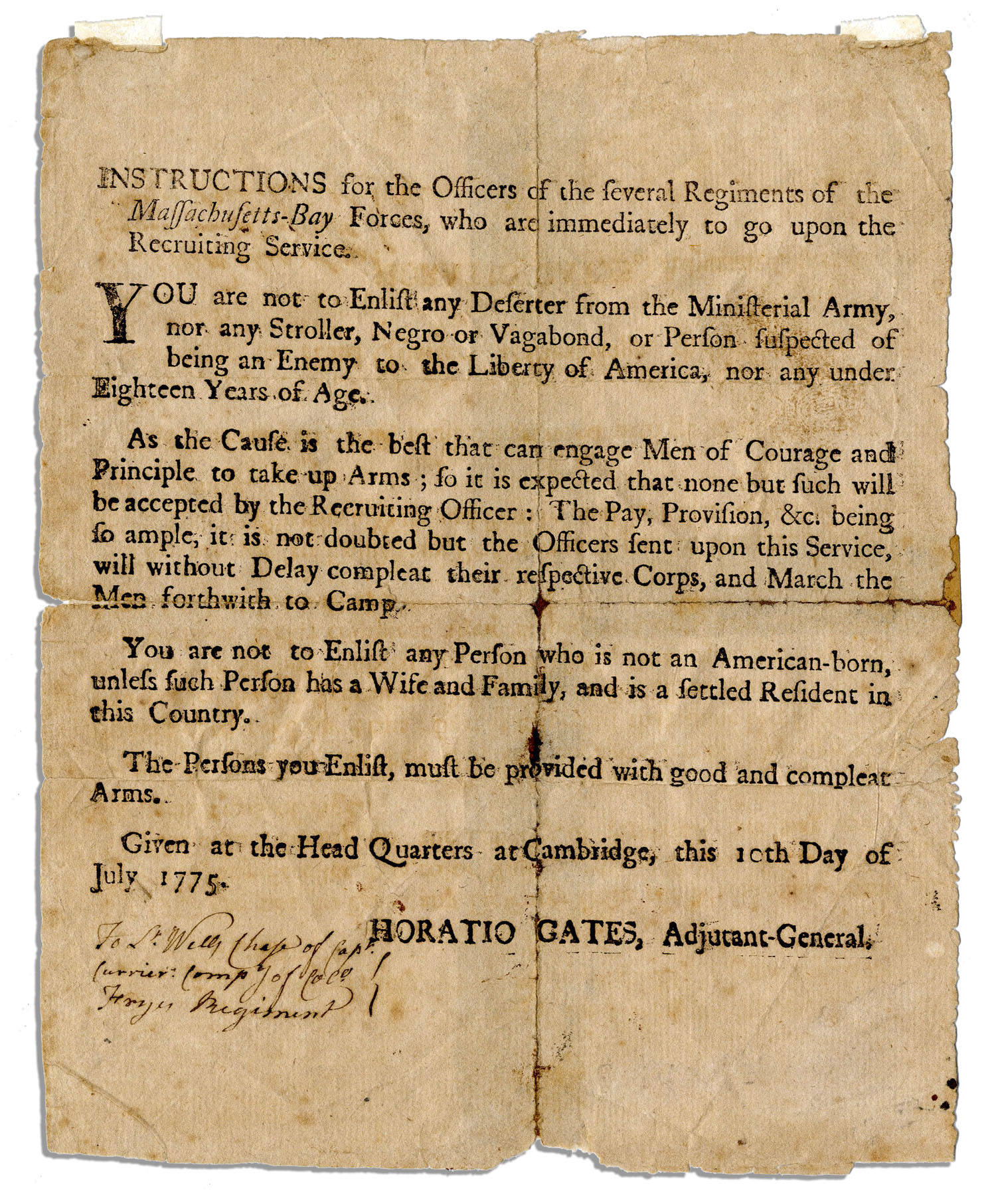
1775 Revolutionary War Broadside — With Enlistment Instructions From Horatio Gates to Officers of the Massachusetts Bay Forces
Broadside announces the recruitment of soldiers for the American Revolutionary War. The document, dated 1775 and signed in type by Horatio Gates as Adjutant General reads in full: ”Instructions for the Officers of the several Regiments of the Massachusetts Bay Forces, who are immediately to go upon the Recruiting Services. You are not to Enlist any Deserter from the Ministerial Army, nor any Stroller, Negro or Vagabond, or Person suspected of being an enemy to the Liberty of America, nor any under Eighteen Years of Age. As the cause is the best that can engage Men of Courage and Principle to take up Arms; so it is expected that non but such will be accepted by the Recruiting Officer: The Pay, Provision, etc. being so ample, it is not doubted but the Officers sent upon this Service will without Delay compleat their respective Corps, and March the Men forthwith to Camp. You are not to enlist any Person who is not American-born, unless such Person has a wife and Family, and is a settled Resident in this Country. The Persons you Enlist must be provided with good and compleat Arms. Given at the Head Quarters at Cambridge, this 10th Day of July, 1775. / Horatio Gates, Adjutant General”. Single-page broadside measures 6.5” x 8.25”. Toning, chipping and minor tears along edges, with separation to fold intersection from the left edge. Very good condition. Sold for $2,886.
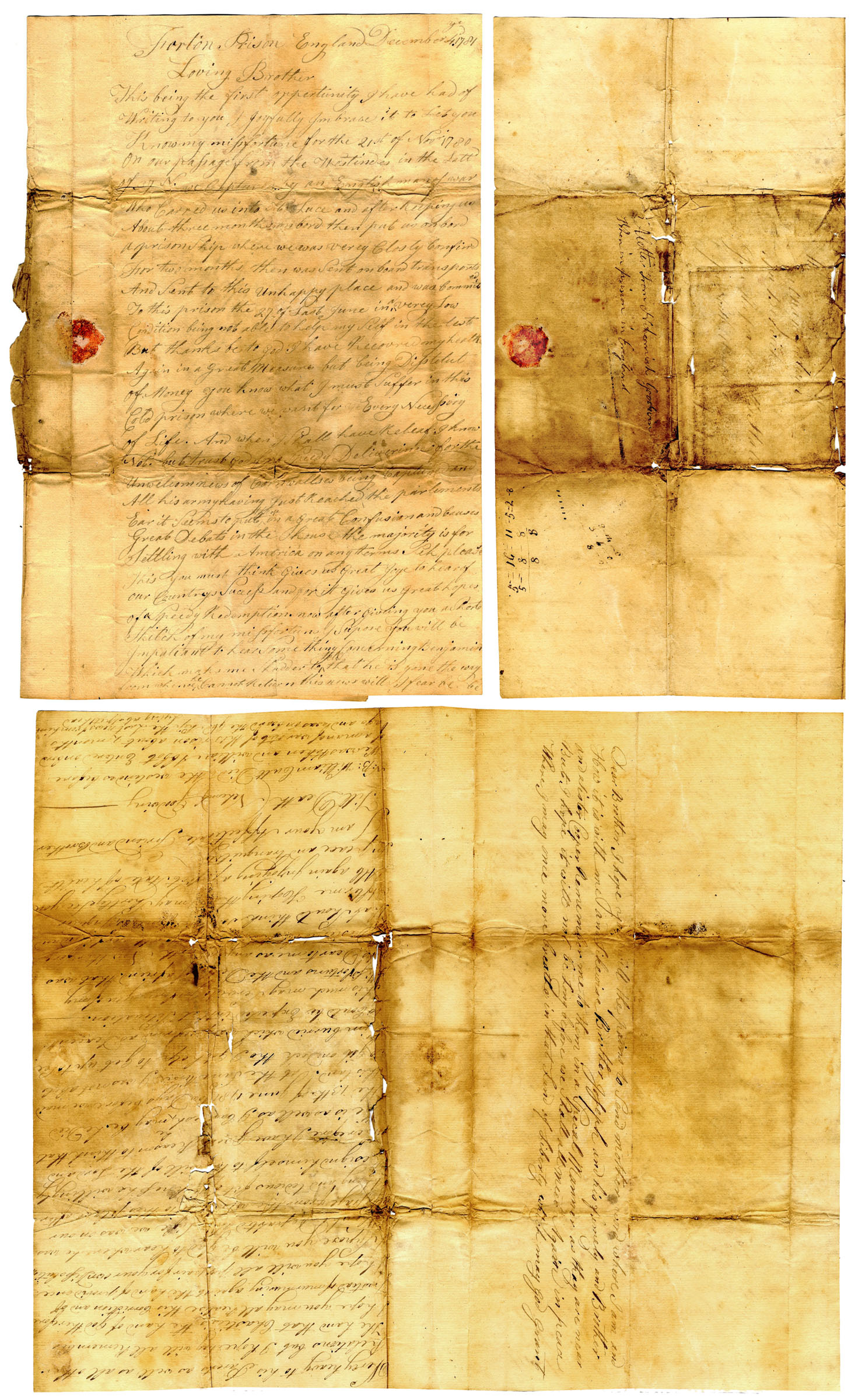
Revolutionary War POW Soldier Letter From Forton Prison
Fantastic autograph letter signed by Revolutionary War POW, dated 4 December 1781. Written by American Nathaniel Goodwin while incarcerated at the infamous Forton Prison in Portsmouth, England. Here, Goodwin notes his capture by an English man-of-war, his detainment on a prisoner ship, the death of another soldier who was a dear friend, and Goodwin’s subsequent confinement at Forton Prison. The letter continues to mention the capture of Cornwallis and the English Parliament’s interest in “…settling with America on any terms…” In part, “Loving Brother…to let you know my misfortune for the 21st of Nov 1780 on our passage from the Westindies …captured by an English man of war…after keeping us about three months onbord then put us onbord a prison ship where we was very closly confined for two months then was sent onboard transports and sent to this unhappy place and was commited to this prison the 27 of last June in a very low condition being not able to help my self in the least. But thank be to God I have recovered my health again in a great measure but being disstetut of money you know what I must suffer in this cold prison where we want for every necessory of Life…” Goodwin survived his prison stay and later became a captain of the Maine Militia. One page letter, front and verso, measures 15″ x 12.75, with significant toning, tearing along folds and wax seal remnants on integral address leaf. Fascinating letter is in good condition. Sold for $1,155.
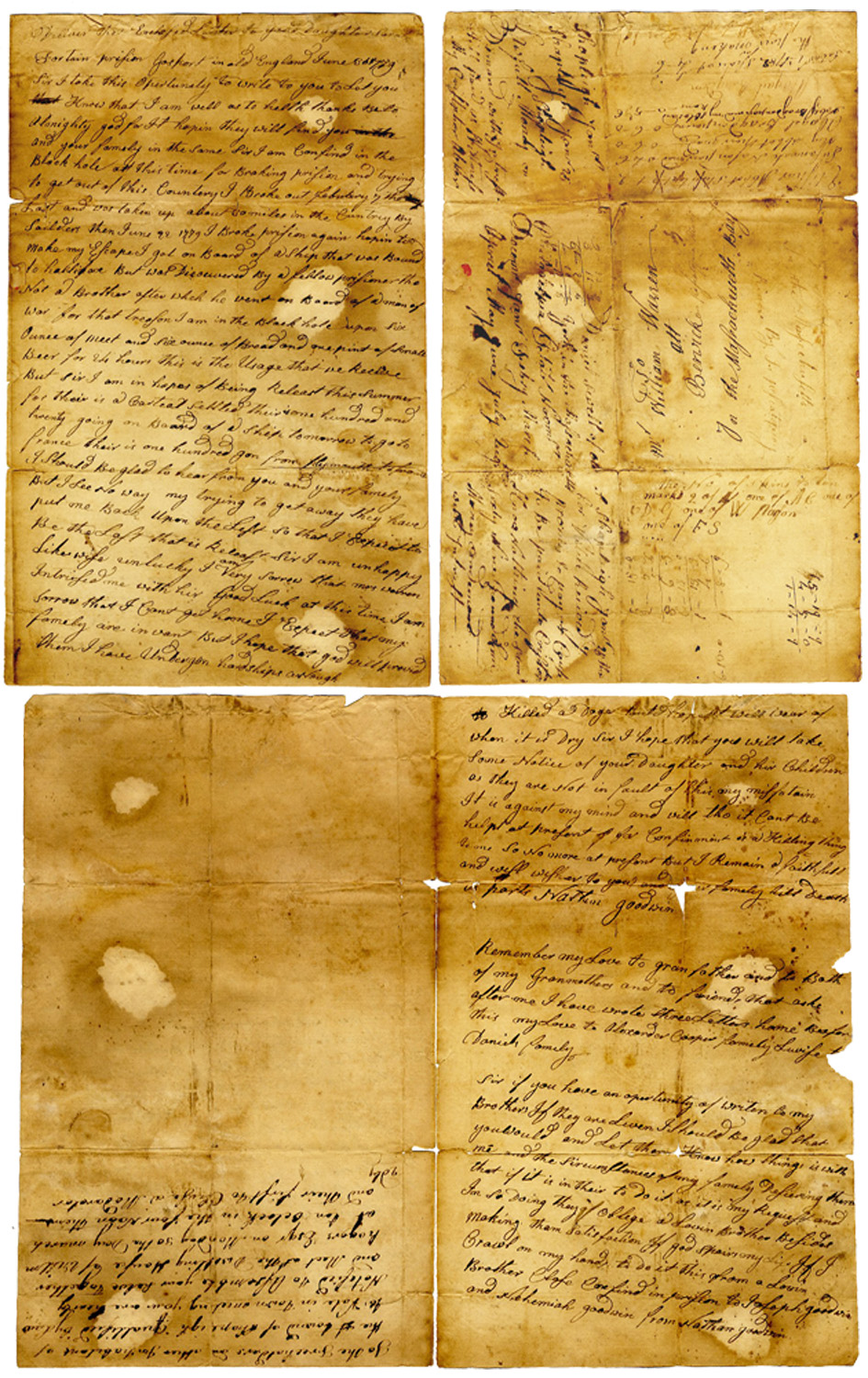
Original Revolutionary War Prisoner Soldier Letter
Revolutionary War POW autograph letter signed, dated 30 June 1779, written by American Nathaniel Goodwin while being held at Forton Prison in Portsmouth, England. Addressed to William Warren, father of Goodwin’s wife, Sarah. Letter reads in part: “…I am confind in the Black hole at this time for braking prison and trying to get out of this Countery. I broke out February 7 the last and was taken up about 30 miles in the Cuntrey by soldiers. Then June 22 1779 I broke prison again hopin to make my escaped. I got on board of a ship that was bound to Halifax but was discovered by a fellow prisoner tho not a brother…for that reason I am in the Black hole…six ounces of meat and six ounce of bread and one pint of…beer for 24 hours…I am sorrow that I can’t get home. I expect that my family are in want but I hope that god will provide them. I have undergon hardships enough…” One page letter, front and verso, measures 15″ x 12″, with integral address leaf, significant toning and some tearing at folds. Very good. Sold for $683.
Consign your Ezekiel Russell Bloody Butchery by the British Troops 1775 at Nate D. Sanders Auctions. Send a description and images of your item to us at [email protected].
FREE APPRAISAL. To buy, auction, sell or consign your Ezekiel Russell Bloody Butchery by the British Troops 1775 that is for sale, please email your description and photos to [email protected] of Nate D. Sanders Auctions (http://www.NateDSanders.com).