
Sell or Auction Your Edward Rutledge Autograph Letter Signed for up to Over $1,000 or More at Nate D. Sanders Auctions
FREE APPRAISAL. To buy, auction, sell or consign your Edward Rutledge autograph letter signed that is for sale, please email your description and photos to [email protected] of Nate D. Sanders Auctions (http://www.NateDSanders.com).
Free Appraisal, Auction or Sell Your Edward Rutledge Autograph Letter Signed
Edward Rutledge (November 23, 1749 – January 23, 1800) was an American politician and youngest signatory of the United States Declaration of Independence. He later served as the 39th Governor of South Carolina.
Below is a recent realized price for an Edward Rutledge autograph letter signed item. We at Nate D. Sanders Auctions can obtain up to these amounts or more for you:
Edward Rutledge Autograph Letter Signed. Sold for over $1,000.
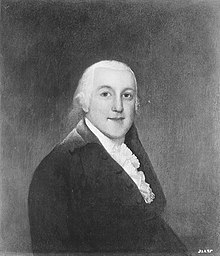
Here are some recent items that our auction house, Nate D. Sanders (http://www.NateDSanders.com) has sold:
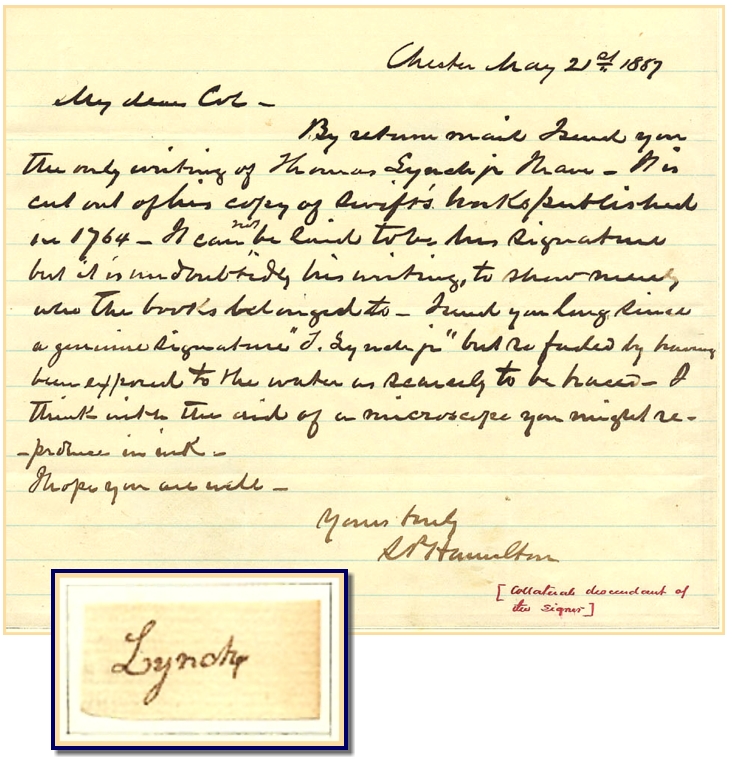
The second rarest Declaration of Independence signer’s autograph behind Button Gwinnett is a Thomas Lynch autograph, a signer from South Carolina. We at NateDSanders.com were lucky enough to have sold his autograph in 2004. Here is the description, picture and the price realized:
Thomas Lynch autograph book page from the 2nd rarest signer of the Declaration of Independence. Extremely rare signature which has been cut from a book. Comes with a 1-page letter, dated 1887, from Samuel Prioleau Hamilton, 6th son of South Carolina Governor James Hamilton and grand nephew of Thomas Lynch Jr. Reads in part: “…By return mail I send you the only writing of Thomas Lynch Jr. I have. It is cut out of his copy of Swift’s works published in 1764. It can not be laid to his [Declaration of Independence] signature but it is undoubtedly his writing…I sent you long since a genuine signature ‘T. Lynch jr’ but so faded by having been exposed to the water as scarcely to be read. I think with the aid of a microscope you might reproduce in ink…” Also comes with a 3-page letter from noted autograph expert Kenneth W. Rendell, dated 1966, certifying the authenticity of this signature. Reads in small part, “…I received the Lynch back today and have gather[ed] together a mass of evidence to confirm its authenticity. In comparing my signature with that on the Declaration of Independence there is a definite difference, as you point out…The first difference is in the L. In mine it is started after the downstroke and in the Declaration before it. This is a very easy alteration to make in writing. He just started it a little before he previously did…Lynch’s early writing (my signature) was much stronger, because he was…very ill when he signed the Declaration. In 1775 Lynch contracted bilious fever and became…a partial invalid. After signing the declaration he continued to get worse and he left two years later for the West Indies…He died in a ship-wreck on that voyage…In Mary Benjamin’s book, which is the leading work on autographs, she also makes reference to the problem of comparing early signatures with that on the declaration…there is no question of the serious effect that this illness had on him, and also on his writing…Beneath the facisimile Hamilton writes, “Seven signatures, mainly from school books. Long after Lynch’s death in 1779, his sister cut many signatures from books in his library to supply autograph collectors…” Mounted to another sheet, with the Hamilton letter laid beneath it. Very good condition. An excellent Thomas Lynch autograph. Sold for $26,000.
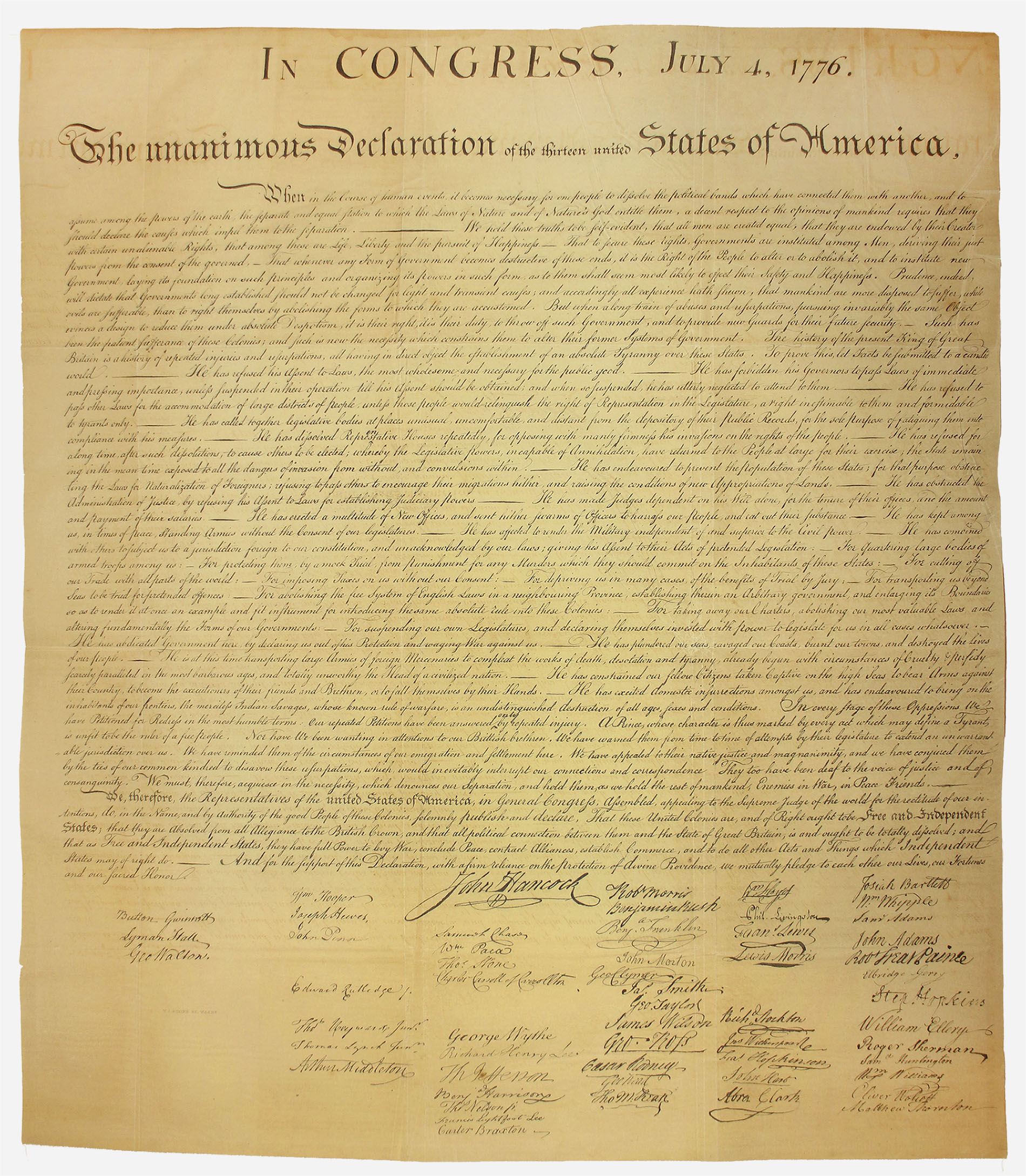
1843 Force Declaration of Independence From Original Copper Plate — Beautiful Copy
1843 Force Declaration of Independence from the original copper plate by William Stone, one of the earliest copies of the Declaration of Independence. In 1823, Congress authorized the production of facsimile copies of the Declaration of Independence for two reasons: the original was deteriorating rapidly and many of the aging original Signers sought copies. John Quincy Adams, then Secretary of State, oversaw the project and commissioned noted engraver William J. Stone to reproduce the document. Stone used a new Wet-Ink transfer process to create a copper plate from which facsimile copies were made. By wetting the original document, some of the original ink was transferred to the copperplate, which was then used for printing. Stone printed 201 copies on vellum, keeping one copy for himself (now residing in the Smithsonian) and distributing other copies to Thomas Jefferson, President James Monroe, members of Congress, surviving original Signers, various colleges and universities, and others. Of the original 201 copies, only 31 examples are currently known to exist, 19 of which are permanently housed in museums. In 1843, Peter Force used the original Stone copperplate to print additional copies of the Declaration of Independence on rice paper for inclusion in his book, ”American Archives”. Congress authorized up to 1,500 copies of the book to be printed, and while the actual number of copies printed is unknown, it’s generally estimated at 500. The Stone and Force copies represent an irony: certainly, they allowed additional people and institutions to obtain an identical facsimile of this most beloved of all historic American documents, but Stone’s Wet-Ink transfer process contributed to the deterioration of the original signed copy of the Declaration. The parchment did not respond well to water, with the unfortunate result being that the original Declaration of Independence, on display in our nation’s capitol, is in a rather sad state of preservation. This Force Declaration measures approximately 24.75” x 29.5” on rice paper. Folded for its original purpose of inclusion in Force’s book. A very good to near fine copy except for archival tape repairs on verso, and some creasing to front. The paper quality is very good, without as much brittleness as we usually see. A visually stunning example of one of America’s most beloved documents. Sold for $21,963.
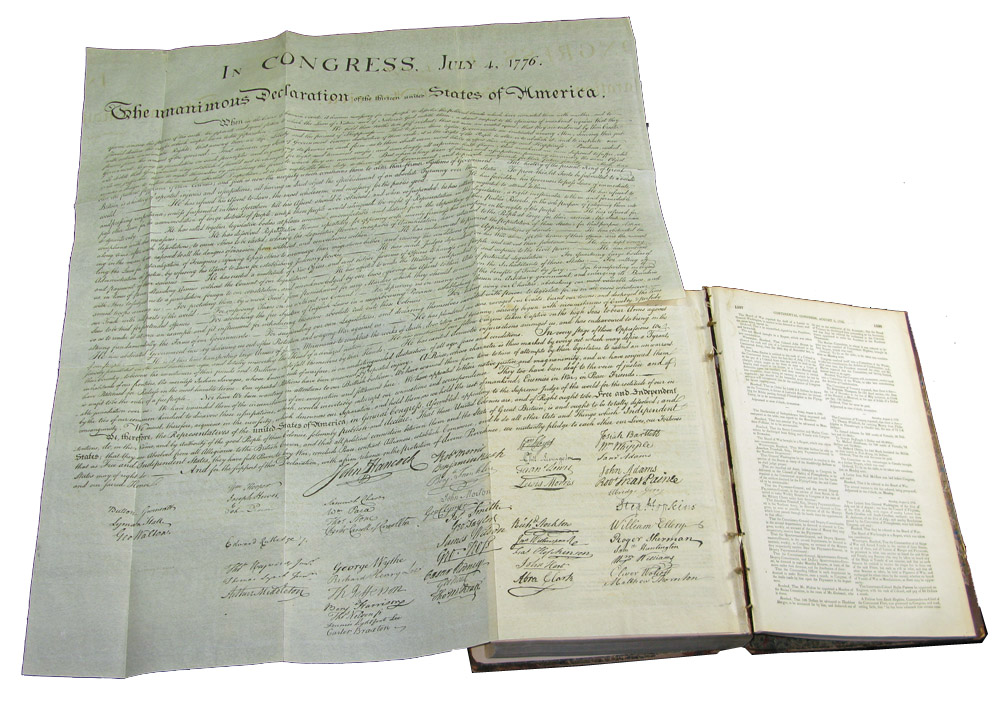
Rare 1843 Declaration of Independence Print — Peter Force Printing From the Original William Stone Copper Plate — In the Original Book — With Complete Set of Volumes
Extremely rare fold-out Force print of William J. Stone’s official engraving of the Declaration of Independence from “American Archives,” Volume I of the Fifth Series. With complete set of nine volumes edited by Peter Force. Washington, D.C.: M. St. Clair Clarke and Peter Force: 1843. Folio Volume I with marbled boards and endpapers runs 951pp. Most extant copies of this volume are missing the highly sought after fold-out rice paper Declaration of Independence. When Congress commissioned Peter Force to compile the nine-volume, 15,500pp. “American Archives” series documenting the nation’s history in 1843, it was determined that a copy of the Declaration would be included in the volume covering 1776. Twenty-three years earlier, as the original document was rapidly deteriorating, Secretary of State John Quincy Adams had authorized engraver William J. Stone to create a copperplate of the Declaration via painstaking wet-ink transfer. It took Stone three years to create a plate with absolute fidelity to the original, although the process caused additional deterioration to the original document, now exhibited in the Capitol Rotunda in Washington, D.C. Stone printed 201 copies on vellum. He kept one copy for himself, now residing in the Smithsonian, and the other copies were distributed to Thomas Jefferson, President James Monroe, members of Congress, surviving original Signers, various colleges and universities, and others. Of the original 201 copies, only 31 examples are currently known to exist, 19 of which are permanently housed in museums. The remaining dozen vellum examples are rarely offered for sale. The “American Archives” copies were made from Stone’s plate, now housed in the National Archives. Congress authorized up to 1,500 copies of the book to be printed, but subscriptions fell far short of that number. The actual number of copies of the book printed is unknown, with estimates ranging at around 500 copies. Fewer than half are believed to have survived, in varying states of preservation, most missing the Declaration. This is an extremely rare opportunity to find the book with the Declaration still intact and in such pristine condition. The fold-out document measures 26″ x 29″ and is stamped at lower left, “W.J. Stone S.C. Washn.” Document shows minor ink transfer from being folded and has a horizontal split approximately 3″ towards the middle of the right edge from folding, as well as two other small tears and along folds affecting words in the center of the document. Very good condition. All other American Archives volumes present as a set. Boards on several books show separation and wear. Books are in good condition. Sold for $20,000.
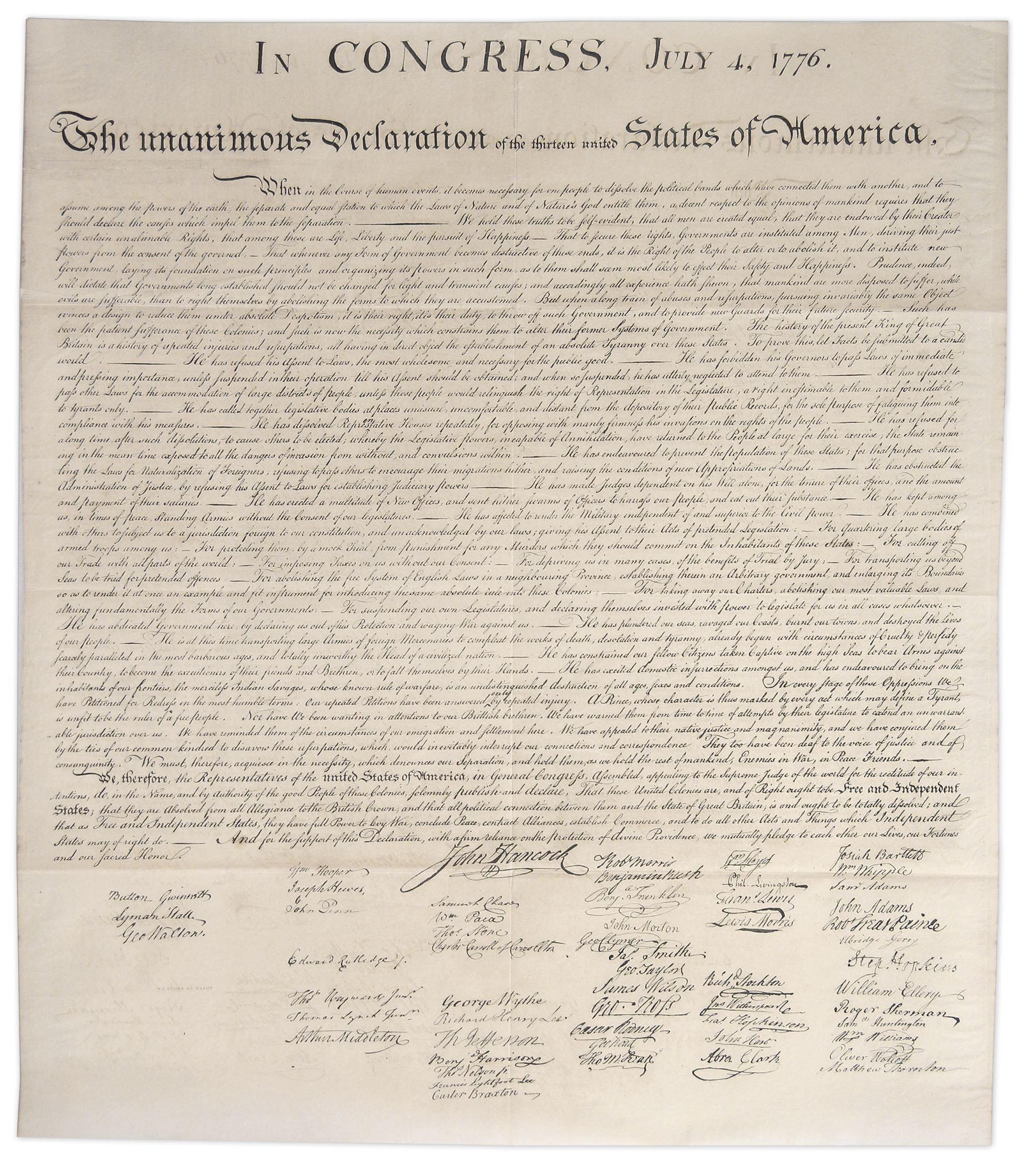
1843 Force Declaration of Independence From Original Copper Plate — Beautiful Copy
1843 Force Declaration of Independence from the original copper plate by William Stone, one of the earliest copies of the Declaration of Independence. In 1823, Congress authorized the production of facsimile copies of the Declaration of Independence for two reasons: the original was deteriorating rapidly and many of the aging original Signers sought copies. John Quincy Adams, then Secretary of State, oversaw the project and commissioned noted engraver William J. Stone to reproduce the document. Stone used a new Wet-Ink transfer process to create a copper plate from which facsimile copies were made. By wetting the original document, some of the original ink was transferred to the copperplate, which was then used for printing. Stone printed 201 copies on vellum, keeping one copy for himself (now residing in the Smithsonian) and distributing other copies to Thomas Jefferson, President James Monroe, members of Congress, surviving original Signers, various colleges and universities, and others. Of the original 201 copies, only 31 examples are currently known to exist, 19 of which are permanently housed in museums. In 1843, Peter Force used the original Stone copperplate to print additional copies of the Declaration of Independence on rice paper for inclusion in his book, ”American Archives”. Congress authorized up to 1,500 copies of the book to be printed, and while the actual number of copies printed is unknown, it’s generally estimated at 500. The Stone and Force copies represent an irony: certainly, they allowed additional people and institutions to obtain an identical facsimile of this most beloved of all historic American documents, but Stone’s Wet-Ink transfer process contributed to the deterioration of the original signed copy of the Declaration. The parchment did not respond well to water, with the unfortunate result being that the original Declaration of Independence, on display in our nation’s capitol, is in a rather sad state of preservation. This Force Declaration measures approximately 25.5” x 29” on rice paper. Folded for its original purpose of inclusion in Force’s book. A near fine copy except for some archival tape repairs on verso, so subtle as not to be noticed even upon close examination. A visually stunning example of one of America’s most beloved documents. Sold for $18,750.
Declaration of Independence Broadside Printed by John Binns
John Binns (22 December 1772 – 16 June 1860) was a Dublin-born American journalist, the son of ironmonger John Binns (who died in a shipwreck aged about 30 in 1774) and his wife Mary Pemberton. A grand-nephew of Irish Patriot politician and member of Dublin Corporation John Binns, he and his older brother Benjamin moved to London and became involved with the politically radical London Corresponding Society, closely aligned with the Society of United Irishmen. As a result of his activities he was imprisoned several times for treason but was released after a two-year term in Gloucester jail, as part of a general amnesty.
John Binns’ Declaration of Independence. Binns, publisher of “The Democratic Press”, painstakingly designed this example of the Declaration in 1818. Design features the text of the Declaration, surrounded by 16 cartouches containing pictorial vignettes for each of the colonies, plus a George Washington bust portrait occupying a place of honor at top center, flanked by John Hancock and Thomas Jefferson. Bears the printed signature of John Adams to the lower right corner. Engraved paper print is mounted expertly to a thin fabric backing. Measures 25.25″ x 35″. Very mild toning. Light foxing but near fine given age. Sold for $5,750.

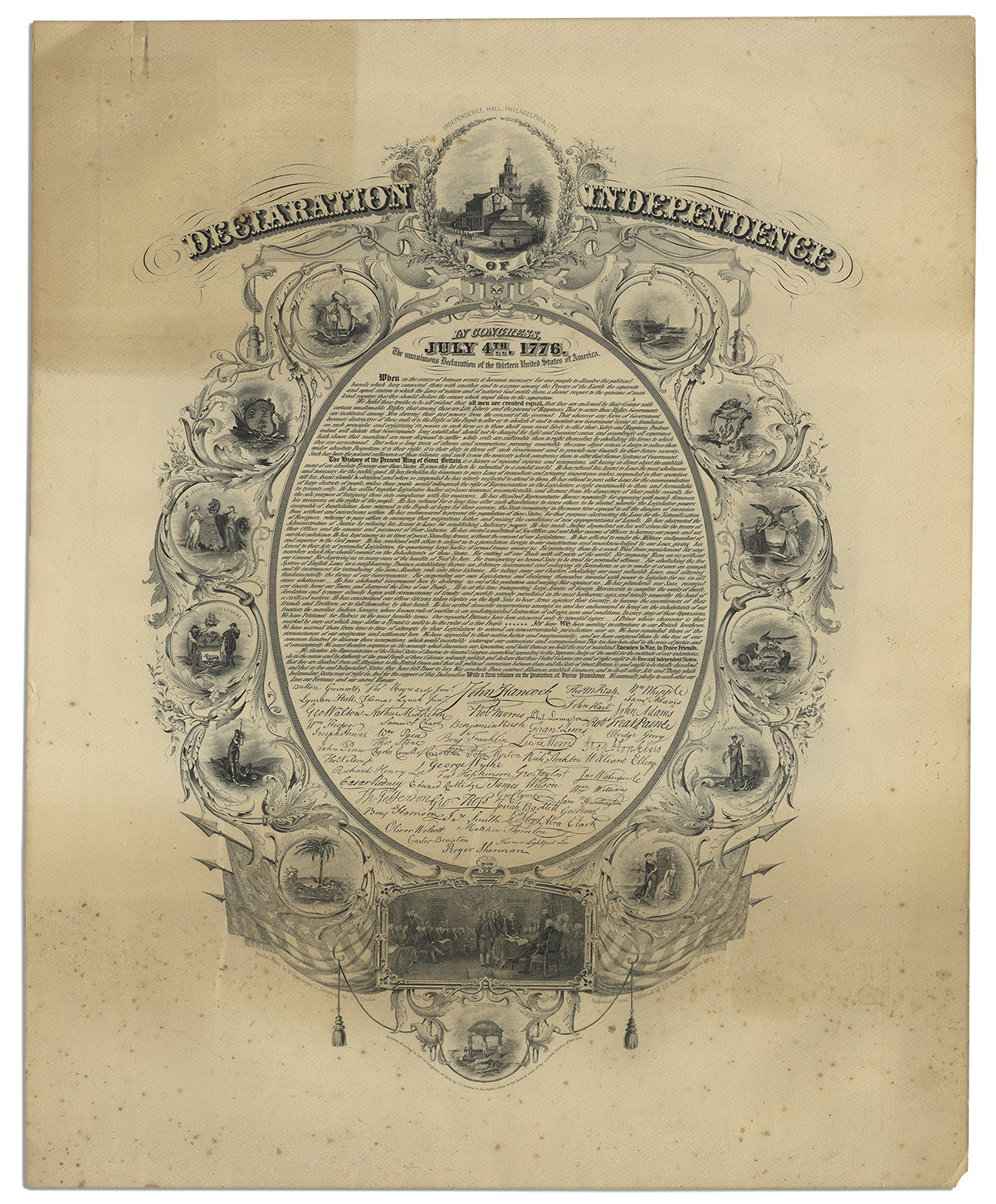
Declaration of Independence Print by J.C. Buttre 1856
John Chester Buttre (10 June 1821 Auburn, New York – 2 December 1893 Ridgewood, New Jersey), was an American steel-plate engraver and lithographer, responsible for some 3,000 engraved portraits of American political, naval and military personalities. He published “The American Portrait Gallery” in 3 volumes (1880–81) with text by his daughter, Lillian C. Buttre.
The Declaration of Independence print by J.C. Buttre, New York. Print from 1856 features the Declaration’s text in an oval cartouche, surrounded by vignettes of the 13 colonies designed by W. Momburger. Measures 16″ x 20″. Foxing and toning, with toning concentrated at upper left, and paperclip imprint to top edge. Very good condition. Sold for $1,239.
Consign your Edward Rutledge autograph letter signed at Nate D. Sanders Auctions. Send a description and images of your item to us at [email protected].
Edward Rutledge autograph letter signed