Sell or Auction Your Douglas DC-7 1950s Contractors Model for up to Over $2,000 or More at Nate D. Sanders Auctions
FREE APPRAISAL. To buy, auction, sell or consign your Douglas DC-7 1950s contractors model that is for sale, please email your description and photos to [email protected] of Nate D. Sanders Auctions (http://www.NateDSanders.com).
Sell Your Douglas DC-7 1950s Contractors Model
Below is a recent realized price for a Douglas DC-7 1950s contractors model. We at Nate D. Sanders Auctions can obtain up to this amount or more for you:
Douglas DC-7 1950s Contractors Model. Sold for Over $2,000.
Here are some space and aviation models we have sold:
Chuck Yeager signed Bell X-1 model airplane, the plane Yeager piloted on 14 October 1947 when he broke the sound barrier in a dangerous, top-secret flight not disclosed to the public until a year later. Model plane by National Geographic is a 1/32 scale model, signed ”Chuck Yeager” in black felt-tip on the right wing. Plane measures 12.5” long x 11” wide x 8.5” tall as displayed. Near fine condition. Sold for $1,250.

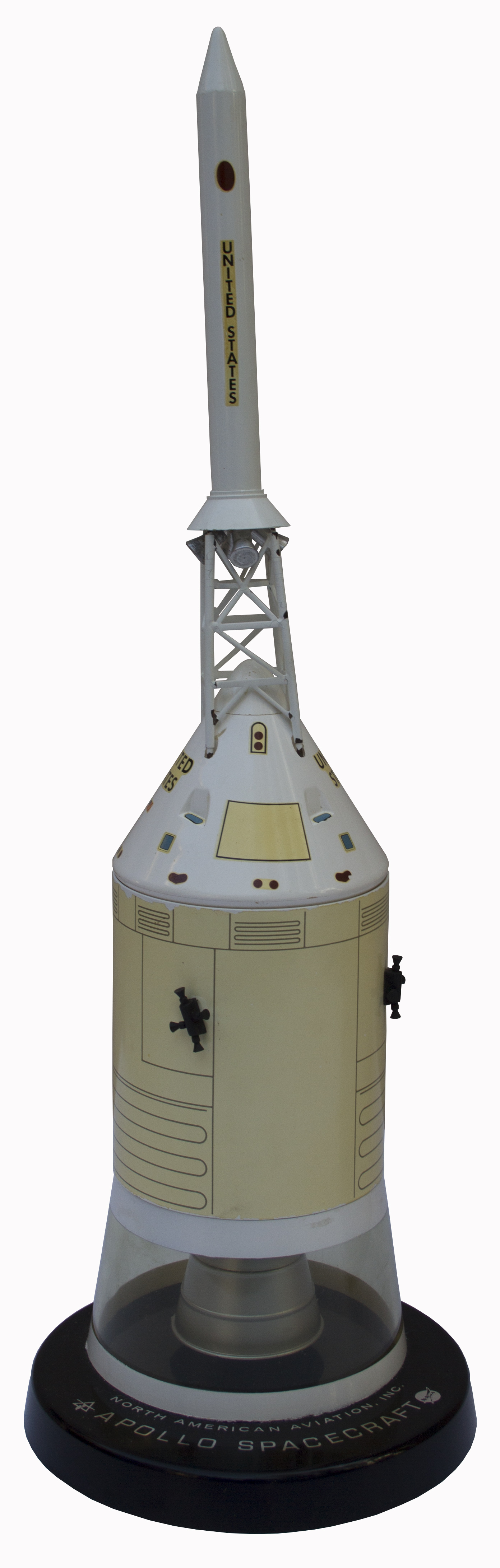
Apollo Spacecraft Model Signed by 22 Astronauts, Including 9 Moonwalkers & 3 From Project Mercury — Signatures Include Neil Armstrong, Buzz Aldrin, Alan Shepard & 19 More — With Steve Zarelli COA
Very rare Apollo spacecraft model signed by 22 astronauts, including Neil Armstrong and eight other Moonwalkers, as well as three Project Mercury astronauts. This pre-Apollo I model is from the mid-1960s, made by North American Aviation, Inc., the company that merged with Rockwell-Standard in March 1967 to form North American Rockwell, whose models are much more common. All 22 signatures appear on the command module, and include: Neil Armstrong, Buzz Aldrin, Alan Shepard, Alan Bean, Charles Conrad Jr., Ed Mitchell, Jim Irwin, Dave Scott, John Young, Gordon Cooper, Wally Schirra, Donn Eisele, Rusty Schweickart, James McDivitt, Dick Gordon, James Lovell, Jack Swigert, Ken Mattingly, Ron Evans, Joe Engle, Joe Kerwin and Jerry Carr. Model measures 6.5″ in diameter and 21″ tall, upon a circular base that reads “North American Aviation, Inc. / APOLLO SPACECRAFT”. Some signatures have faded and subsequently been touched up or traced over, as indicated on the COA. Most signatures, including Armstrong and Aldrin, remain bold and instantly recognizable. Model is missing one metal rocket booster, otherwise complete and in very good condition. With a Steve Zarelli Space Authentication COA for all signatures. A rarely seen Apollo model signed by the astronauts. Sold for $7,535.

Model Vanguard 1 satellite from the Navy Research Laboratory, the firm that built the satellites of Project Vanguard. Vanguard 1 was launched on 17 March 1958, shortly after the Soviet launch of Sputnik kicked off the Space Race. The United State’s first successful satellite launch after Explorer, Vanguard 1 remains in orbit today, holding the record for longest-orbiting satellite made by man. Model satellite features a spherical shell, with one half made of metal and the other half rendered in clear plastic to reveal the mechanics within. Secured at the center, a clear cylinder which contains seven numbered layers of colored sponges represents the hermetically sealed mercury cell battery container and radio transmitter machinery used in the space-bound version. Wires connect the payload to six terminals on the exterior that represent the six solar cell clusters by which the satellite was powered as the first ever satellite to employ solar power. With a 22” diameter, model satellite is much larger in scale than its counterpart in orbit, which was nicknamed by Kruschev the ”grapefruit satellite” for its petite size. Model is mounted to a 2” tall transparent base that contains a plaque reading in full, ”Full Scale Model / Scientific Earth Satellite / Designed and Built by Project Vanguard / US Naval Research Laboratory / Washington D.C.” An important piece of pre-NASA space history in near fine condition. With provenance from the family of Howard Tihila, Office of International Science Activities for the National Science Board, the government agency that backed Project Vanguard. Sold for $5,530.

Scarce Saturn C-5 Model Made by the Marshall Space Flight Center, Circa Early 1960s Before It Was Renamed Saturn V — In Original Box Shipped to Houston
Scarce Saturn C-5 model made by the George C. Marshall Space Flight Center (MSFC), circa early 1960s before NASA decided to use this rocket for the Apollo program and renamed it Saturn V. While Saturn V models are occasionally available at auction, Saturn C-5 models such as this one are virtually non-extant.
Model is housed in its original MSFC blue wooden case, with a partially torn NASA label addressed to a “Dr. Joseph” in Houston. As the model originates from an estate in Massachusetts, the recipient was possibly Joseph Shea, Deputy Director of the Office of Manned Space Flight, who joined NASA in late 1961 as a systems engineer and retired in Massachusetts.
Model is approximately 1/100 scale, measuring 42.75″ tall. Nearly all components are present: the S-IC with five F-1 engines, screwed to the wooden base and measuring 18.25″ tall and 4.25″ in diameter at top; piece connecting the S-IC and S-II measuring 3.125″ tall including transparent connecting rings; S-II measuring 12.75″ tall, featuring five silver and red J-2 rocket engines; S-IV B measuring 9.5″; slanted interstage measuring 3.75″ tall, missing the bottom connecting ring; service module measuring 2.5″ tall”; command module measuring 1.25″ tall; and finally, orange lunar excursion module landing stage with lunar legs, attached with tape underneath the launch stage, all measuring 3.25″ tall – this entire component is designed to fit into the slanted interstage. Set also includes two 2″ pins to fit pieces together. Wooden base measures 8.25″ x 8.5″ with metal plaque identifying the model as “SATURN C-5″ from the George C. Marshall Space Flight Center. Original blue wooden carrying case measures 23.75″ x 15.5″ x 9.75″ tall, with a 3.5″ x 4.5” photo affixed to interior showing the contents of model in box. Model is missing the launch escape system that tops the model, and the boost protective cover that fits over the command module. Part of the service module is missing, and one of the gray F-1 rocket engines is present but detached. Slanted interstage is starting to separate along seam. Additionally some isolated chipping to paint. Overall very good condition. An extraordinarily rare and early prototype for the Saturn V rocket, a historic memento from the early days of the Space Race. Sold for $4,500.

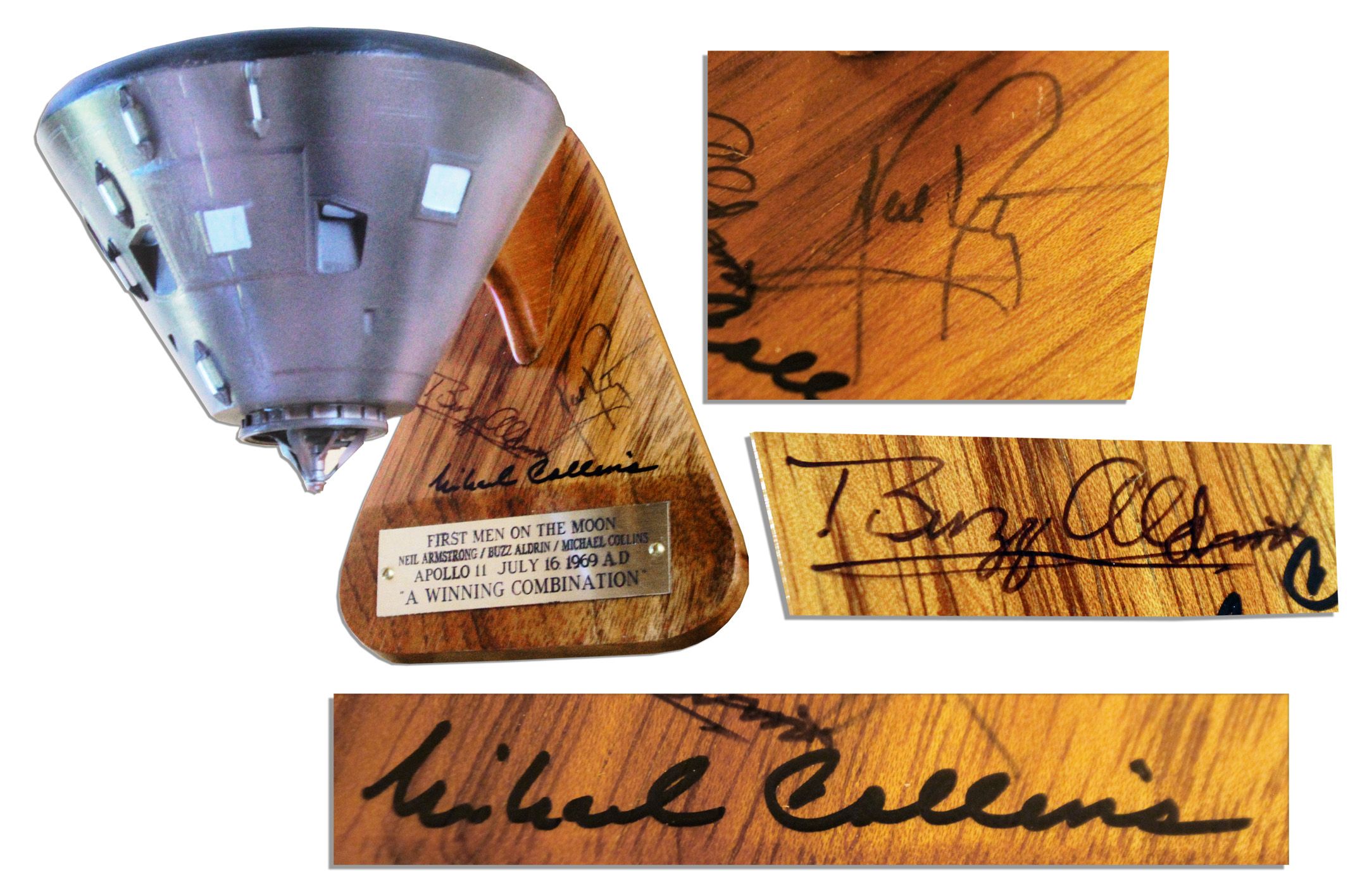
Model of the Apollo 11 Command Module signed by the crew: ”Neil Armstrong”, ”Michael Collins” and ”Buzz Aldrin”. The model was reportedly signed first by Armstrong in the 1980’s, then by Aldrin and Collins at the 2009 Spacefest convention in San Diego, CA. Engraved plaque affixed to the front reads: ”First Men on The Moon / Neil Armstrong, Buzz Aldrin, Michael Collins / Apollo 11 July 16 1969 A.D. / A Winning Combination”. Lightweight, handcrafted model measures 8.75” in height. Wooden triangular base measures 4.75” across and 7.25” deep. Near fine. Sold for $4,468.
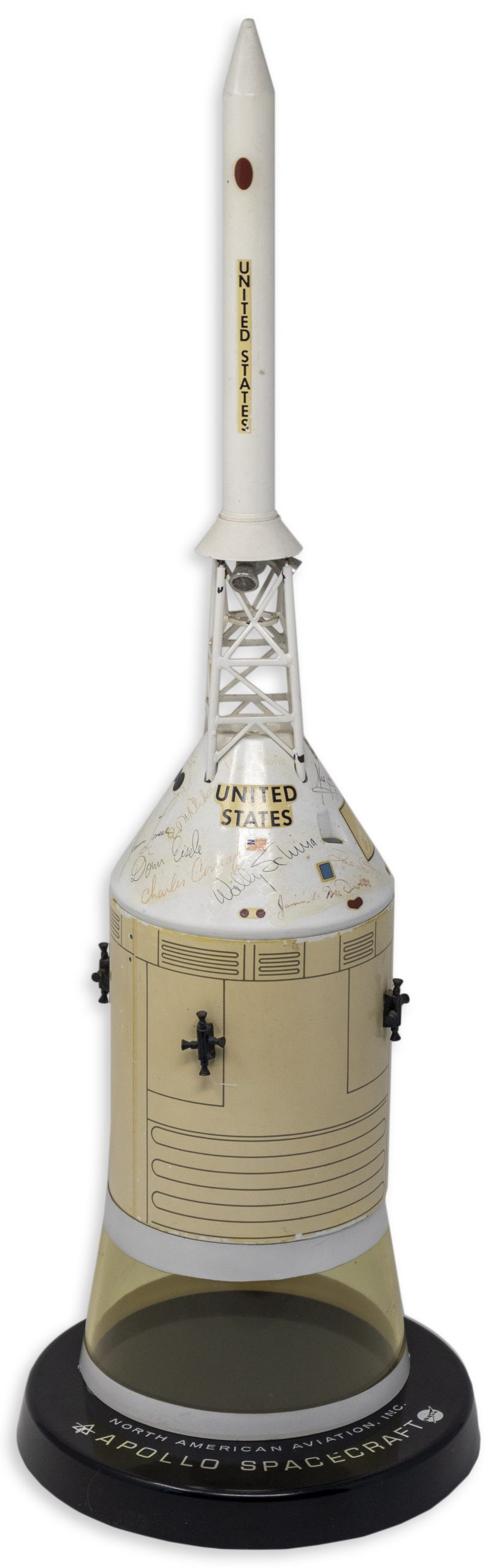
Apollo Spacecraft Model by North American Aviation, Inc. — Pre-Apollo I Model
Very early mid-1960s Apollo spacecraft model, made by North American Aviation, Inc., the company that merged with Rockwell-Standard in March 1967 shortly after the Apollo I fire. Unlike more common models made by North American Rockwell after the merger, this is one of the earliest Apollo models ever produced. Saturn model spacecraft is comprised of the Escape Rocket, which sits atop the Command Module, housed in a circular base that reads ”North American Aviation, Inc. / APOLLO SPACECRAFT” with the NASA emblem. United States decals and flag are on both the Escape Rocket and Command Module. Affixed to the underside of the base is a label by The Walter J. Hyatt Co. Model measures 6.75” in diameter and 20.5” tall. Complete in its original foam-protected box from North American Aviation, Inc. that reads ”Apollo SPACECRAFT”. One small black piece missing that clips to side of rocket, else near fine condition. Sold for $3,994.

Fred Haise Signed Apollo Saturn V Rocket Model
Fred Haise signed Saturn V rocket model, a 1:200 scale model of the rocket that transported Haise on the Apollo 13 mission. Base is signed “Fred Haise / Apollo 13″ in silver felt-tip. Measures approximately 22” tall. Near fine condition. Sold for $1,785.

We also sold the following aviation memorabilia:
Wilbur Wright Over-sized 12″ x 16″ Signed Historical & Vintage Photograph of a Very Early Wright Brothers Airplane with Wilbur Standing By — Possibly the Best Wilbur Wright Signed Item Extant
Very large 12″ x 16″ photo of Wilbur Wright with six other men, preparing his plane in France during August 1908 in an attempt to mute French critics who had portrayed the Wright Brothers as bluffers. His first flight lasted only one minute 45 seconds, but his ability to effortlessly make banking turns and fly a circle amazed and stunned onlookers, including several pioneer French aviators, among them Louis Bleriot. In the following days, Wilbur made a series of technically challenging flights, including figure-eights, demonstrating his skills as a pilot and the capability of his flying machine, which far surpassed those of all other pilot pioneers. The French public was thrilled by Wilbur’s feats and flocked to the field by the thousands. The Wright brothers catapulted to world fame overnight. Former doubters issued apologies and effusive praise. “L’arophile” editor Georges Besanaon wrote that the flights “have completely dissipated all doubts. Not one of the former detractors of the Wrights dare question, today, the previous experiments of the men who were truly the first to fly….” Leading French aviation promoter Ernest Archdeacon wrote, “For a long time, the Wright brothers have been accused in Europe of bluff… They are today hallowed in France, and I feel an intense pleasure…to make amends.” The signed photo features a huge bold 3 1/2″ signature. Excellent condition but for one light scratch below the lower wing. Exhibited at “Orville and Wilbur – The Wright Brothers Legacy”, Dayton Art Institute 2003 and Virginia Air & Space Center 2003. The last Wilbur Wright signed photo, an 8″ x 10″ signed portrait, not a fantastic aviation over-sized image displaying an early Wright Brothers flyer documenting the pioneering days of flying history, sold in June 2010 for $27,500 and that amount might not include the buyer’s premium. Sold for $36,000.

Fabric from the Wright Flyer, the first airplane which made its debut flight at Kitty Hawk on 17 December 1903, famously giving wings to mankind. Fabric measures 1.25” square, encapsulated by CAG, who certifies that the fabric was taken from the wings of the Wright Flyer flown at Kitty Hawk. When the Flyer was prepared for public exhibition, Orville Wright discovered that the fabric on parts of the plane could not be used, and substituted new fabric. The original fabric was then bequeathed to Lester Gardner, Editor of Aviation and Aeronautical Engineering, and close friend of Orville Wright, who gave the fabric to individuals in the aeronautical community, including Otto Kallir, from whom this fabric originates. Casement by CAG measures 2.375″ x 3.375″. A rare memento from the first flight, famously launching the century of aviation and space travel. Sold for $19,425.

Scarce Plane Piece From Charles Lindbergh’s Plane, ”Spirit of St. Louis”
Plane piece from ”The Spirit of St. Louis”, piloted by Charles Lindbergh in the historic first solo non-stop transatlantic flight in 1927 from New York to Paris. Piece is a Valve Spring Washer, taken from the Wright J-5 Whirlwind Radial Engine in the plane, here presented by Wright Aviation Engine Company, a short-lived aeronautics venture which owned the ”Bellanca” plane that flew from New York to Germany two weeks after Lindbergh’s flight. The ”Bellanca” was actually Lindbergh’s first choice of plane, but the Wright company wouldn’t allow him to fly it without a navigator, so Lindbergh settled on the ”Spirit”. Washer is displayed in a wood plaque measuring approximately 9” x 9.25”, with metal plaque reading in part, ”Valve Spring Washer from Wright Engine Flown by Col. Charles Lindberg [sic] From New York to Paris / May 1927”. Rusting to washer, and some wear to presentation, overall in good condition. Scarce. Sold for $15,000.

Signed photo by Wilbur Wright, Orville Wright, President Taft and a handful of others during the Wrights’ visit to the White House on 10 June 1909 to receive medals from the Aero Club of America. At this time, the Wright Brothers and their sister Katharine were among the most sought after celebrities in the world, having just completed very successful exhibition flights in Europe and the United States, as required by the U.S. Army with whom they signed a contract to build a ”flying machine”. Until this time, skeptics were reluctant to believe that the Wright Brothers were able to successfully pilot an airplane, but the Wrights’ fluency in the air caused doubters to not only reverse their criticism, but issue public apologies and lavish praise upon the aviators. At the end of 1908, their influence was so widespread that they even changed women’s fashion, with the hobble skirt (narrowed at the ankles so as not to flare up during flight) becoming mainstream shortly after the flights. Silver gelatin 9.25” x 7” matte photograph is by Harris & Ewing, mounted to a visible size of 11.75” x 8.5” upon which the individuals sign their names: ”Wilbur Wright”, ”Orville Wright”, ”Wm H Taft”, ”Katharine Wright”, aviator ”A. Holland Forbes”, aviator ”Alan R. Hawley”, automotive pioneer ”Chas Jerome Edwards”, Assistant Secretary of War ”Robert Shaw Oliver” and three others. Matted to a size of 16.25” x 14.25”. Some paper loss to left side of mat, closed tear to right side, and crack starting along bottom. Light sheen has been applied to mount, likely from previous restoration to repair cracks. Some dampstainig to lower edge. Overall in good condition with very bold and clear signatures. Sold for $15,000.

Very historic and important U.S. Patent Office document signed by Orville Wright on 25 October 1916, releasing five patents including the notorious #821,393. Originally approved as a patent in May 1906, #821,393 allowed the Wright Brothers to dominate the U.S. and world aviation industry for ten years, as this patent was the only one allowing humans to control movement of an aircraft in flight. It allowed for the control of the important 3 axes of flight: the airplane’s pitch, roll and yaw; without such control, an airplane could not safely be flown. The Wright Brothers so focused on controlling the use of this patent, in fact, that they failed to technologically innovate in other ways, allowing for Europe to surpass the U.S. in aviation prowess just before the outbreak of World War I. The expensive royalties to license the technology protected by this patent also stunted the production of American aircraft before WWI, causing the federal government in 1917 under President Wilson to step in and force plane manufacturers to share patents so that America could ready itself for WWI. This action by the federal government effectively ended the decade long ”patent war” surrounding #821,393. Lot includes the document dated 25 October 1916, signed by Orville Wright and his brother Lorin Wright (Wilbur had died in 1912), releasing the five patents, since payment had been completed on them. A group of New York investors led by William Boyce Thompson had bought the patents, not knowing that they’d be stymied from collecting royalties on them come 1917. Document reads in part, ”I, ORVILLE WRIGHT, of the City of Dayton, State of Ohio, do hereby certify that a certain mortgage…made and executed by The Wright Company…covering the following described United States letters patent: No. 821,393, dated May 22nd, 1906, for improvements in flying machines…is paid. And I do hereby consent that the same be discharged of record…” Attached to the document is a notarized slip from Montgomery County, Ohio, and also a U.S. Patent Office slip with seal, dated 28 October 1916, confirming the patent transfer. Single page document measures 8.5” x 14”. Half inch tear to right edge, folds, pinholes at top left and some chipping to edges of blue paper, to which document is attached. Overall in very good plus condition, with a large and prominent signature by Orville Wright, perfect for display. An extremely rare document in early 20th century aviation history, and one of the few important Wright Brothers documents in private hands. Sold for $15,000.

Charles Lindbergh Signed Piece of Fabric From the Spirit of St. Louis — Very Scarce Given by Lindbergh to Select Individuals on Christmas, 1928.
Exceptionally rare piece of fabric from the Spirit of St. Louis, signed by the aircraft’s chaperone to Paris, Charles Lindbergh. Upon the 3.25″ x 2.75″ piece of fabric, Lindbergh writes “Original fabric from the Spirit of St. Louis. Sincerely, Charles A. Lindbergh / Dec. 25, 1928”. This piece of silver, stiffened fabric was treated at the time of its manufacture, and therefore likely taken from the fuselage area of the plane. Especially made by Ryan Airlines in 1926 for Charles Lindbergh’s transatlantic flight, the Spirit of St. Louis was a highly experimental aircraft in its time, with its single-engine design, which Lindbergh believed would optimize his chance of success. As tradeoffs, however, the engine tank was situated at the front to improve the center of gravity (denying Lindbergh a front windshield) and the fuel capacity of the plane was dangerously low. Lindbergh, in fact, was so concerned with losing fuel from the weight of the plane that he trimmed excess paper from his maps. This piece of fabric from the spectacular and revolutionary aircraft was removed after Lindbergh flew The Spirit on its final flight from St. Louis to the Smithsonian Institution in Washington, D.C., in April 1928, where it still resides. There, at the Smithsonian, it was renovated and this piece of the plane’s fabric was saved and, on Christmas, 1928 signed and given to only a select few individuals close to the courageous aviator. Very good. Sold for $14,035.

Wilbur Wright Postcard Signed From December 1908 During Their Very Successful Exhibition Flights in Europe
Wilbur Wright signed French postcard captioned “La Conquete de L’air” (“Conquest of the Air”), cleverly signed “Wilbur Wright.” on the roof of the barn underneath the plane. At the time of this photo in December 1908, the Wright brothers were conducting exhibition flights throughout Europe that made them worldwide celebrities. Collotype photographic postcard shows Wilbur Wright piloting the plane in Le Mans, France. Measures 5.5″ x 3.5″. Small bit of tape at top edge, otherwise near fine condition. Sold for $13,650.

Exceptional Orville Wright typed letter signed, dated 24 March 1928 on his personal stationery. Addressed to Senator Hiram Bingham, Wright defends his and Wilbur’s reputation as inventors of the ”first flying machine” and attacks the Smithsonian for trying to discredit them. Page one of the letter reads: ”The important point at issue is as to who was the inventor of the first successful flying machine. The Smithsonian for the past seventeen years has kept up a constant propaganda to take the credit for this away from my brother and myself. It has done this partly through some actually false statements and partly through statements so cunningly worded as to give a false impression without actually being false in themselves. This last resolution is a fair sample. It certainly can not be considered ingenuous….Such practice as this is beneath the dignity of a scientific institution, such as the Smithsonian purports to be, and such conduct on the part of an institution administering government bureaus with government funds certainly needs investigation by the Government…” Wright then ends his letter on page 2 by writing: ”A good many people do not seem to grasp the difference between the first man-carrying flying machine and the first man-carrying machine to fly. There may be a big difference. Our pride was in producing the first man-carrying flying machine rather than in producing the first man flight. Wilbur and I did not take nearly so much pride in the fact that we were the first to fly as we did in the fact that we were the first to have the scientific data from which a flying machine could be built…I believe there was no one else in the world at that time beside Wilbur and myself that had the scientific data for building a machine that would fly.” Wright’s letter runs 2pp. on 2 separate sheets, signed ”Orville Wright” in striking black ink. Included is a 2pp. joint resolution spanning 20 lines on card-style paper. Dated 29 February 1928, the resolution reads: ”the President of the United States be, and is hereby, authorized and directed to appoint a commission of five distinguished citizens of the United States to whom Orville Wright, and all other persons in any way interested, shall be publicly invited to present evidence as to which was the first successful heavier-than-air flying machine.” Letter pages measures 7.25” x 10.5”. Resolution measures 15” x 11”. Folds in letter pages, small pencil note on first page and staple holes, otherwise near fine condition. Sold for $12,963.

Fabric Swatch From the First Airplane, the Wright Flyer
Fabric from the first airplane, the Wright Flyer, which made its debut flight at Kitty Hawk on 17 December 1903. Fabric measures 1.5” square, affixed to a certificate signed by Lester D. Gardner, Editor of Aviation and Aeronautical Engineering, and close friend of Orville Wright. Certificate to Gordon P. Olley, a World War I flying ace, reads in part, ”…Orville Wright…had preserved some of the original coverings of the wing and [his executors] entrusted several pieces of this most valuable relic to me for distribution to notable aeronautical friends. I certify that this piece was used in the first successful flight in history by Orville Wright on December 17, 1903 at Kitty Hawk, N.C. [signed] Lester D. Gardner”. Certificate measures 8” x 10”, handsomely framed in gold and black to 12.25” x 15.25”. Uniform toning to certificate, else near fine condition. Sold for $12,500.


Wilbur & Orville Wright Checks Signed, Displayed with a Wright Flyer Fabric Swatch & 20″ x 16″ Photograph of the First Flight — Encapsulated by PSA/DNA & CAG
Extraordinary display of the Wright Flyer, the first human powered airplane which made its debut flight at Kitty Hawk on 17 December 1903, famously giving wings to mankind. Titled “First Flight”, display comprises a swatch of the Flyer, matted with checks signed by both Wilbur Wright and Orville Wright, all underneath a 20″ x 16″ photograph of the event. Entire display measures 25.5″ x 36″.
First check is signed by Wilbur Wright, who passed away in 1912, making his autograph quite rare. Composed entirely in his hand, Wright signs “Wright Brothers”, dates the check 4 November 1909 and handwrites the payee of Reed & Barnett for $100. Check measures 6.25″ x 2.75″, encapsulated by PSA/DNA to a size of 9.5″ x 4.5″. Block of toning and bank cancellation hole over the word Brothers, else near fine. Second check is elegantly signed “Orville Wright”, addressed in another hand to Carrie Grumbach on 13 July 1929 for $239.54. Check measures 9″ x 3.2125″, encapsulated by PSA/DNA to a size of 12.25″ x 5.625″. Small bank cancellation holes, not affecting signature. Very good plus condition. Display is completed with a fabric swatch from the Wright Flyer, measuring approximately .75″ x .625″ and encapsulated by CAG to a size of 2.25″ x 3.375″.
Entire archival mat measures 25.5″ x 36″ with display card reading “First Flight / December 17, 1903 / Original signatures of Wilbur and Orville Wright with a swatch of fabric from the Wright Flyer, flown at Kitty Hawk on that historic day.” Near fine condition. Sold for $11,550.


Amelia Earhart Signed Limited Edition of “20 Hrs. 40 Mins.” — One of Only 150 Limited Edition Copies Signed by Earhart, With a U.S. Flag Carried Aboard Her 1928 Transatlantic Flight
Scarce copy of “20 Hrs. 40 Mins.”, one of only 150 signed by Amelia Earhart in the limited edition. New York: G.P. Putnam’s Sons, 1928. Signed by Earthart on the limitation page, “Amelia M. Earhart”, where the copy is designated as #62 in the limited edition of 150. Volume is full of photographs documenting Earhart’s groundbreaking transatlantic flight in 1928, and contains one of the U.S. flags carried aboard her aircraft “Friendship”, affixed to the front pastedown. Flag is described on the limitation page as “one of the small silk flags which Miss Earhart carried in the ‘Friendship’ from Boston to Wales”. Book runs 374pp. and measures 6.5″ x 10″; flag measures 3″ x 2.25″. A pristine, near fine copy bound in publishers maroon and gilt boards, with deckled edges and photogravure portrait of Earhart. Housed in original glassine jacket, which has several tears but served its purpose by protecting the book. Sold for $11,250.

Orville Wright Signed “First Flight” Photo — Large Uninscribed Photo Measures 7″ x 4.875″ on Custom Period Mat Measuring 11″ x 9″
Gorgeous silver gelatin photograph with an uninscribed signature by Orville Wright in fountain pen at lower left on the photographic border, “Orville Wright”, showing the Wright Flyer in motion, capturing man’s first sustained flight on 17 December 1903. Orville Wright is shown flying the plane, with his brother Wilbur alongside, having just released his hand from the plane to steady it upon take-off, the entire event captured for both evidence and posterity by photographer John T. Daniels. Sold for $11,025.

Scarce copy of ”20 Hrs. 40 Mins.”, one of only 150 signed by Amelia Earhart in the limited edition. New York: G.P. Putnam’s Sons, 1928. Signed by Earthart on the limitation page, ”Amelia M. Earhart”, where the copy is designated as #67 in the limited edition of 150. Volume is full of photographs documenting Earhart’s groundbreaking transatlantic flight in 1928, and contains one of the U.S. flags carried aboard her aircraft ”Friendship”, affixed to the front pastedown. Flag is described on the limitation page as ”one of the small silk flags which Miss Earhart carried in the ‘Friendship’ from Boston to Wales”. Copy also has excellent association, previously belonging to the pilot Janet Dietrich (with two of her business cards included), one of the women of Mercury 13, a privately funded program that trained 13 women according to the same physiological screening standards as the Mercury 7 astronauts. Book is bound in publishers maroon and gilt boards, with deckled edges. Runs 374pp. and measures 6.5” x 10”; flag measures 3” x 2.25”. Light shelf wear, otherwise an exceptional near fine copy. Sold for $10,938.

Wilbur Wright Wrote an Article Around 1900 That Went Into Depth About the Obstacles to There Ever Being a Flight or an Airplane. This 1902 Wilbur Wright Typed Letter Signed Is Only About This Exact Historic Article. A Wonderful Wright Brothers Letter Tied into the 1st Flight by the Rare Wright Brother
Typed letter signed, one page, 8.5″ x 11″, Wright Cycle Company letterhead, March 3, 1902. Letter to Edmund Doyle in San Francisco. In full: “The December number of the Journal of the Western Society of Engineers may be obtained of the secretary, Mr. J. H. Warder, Monadnock Building, Chicago, Ill. The price of single numbers is fifty cents each.” In very good condition, with intersecting folds, a vertical and horizontal fold through signature, small and very light stain over beginning letters of signature, small tear to top edge, light mirroring of type to bottom portion of page, and several small holes to page, none affecting signature or text. Accompanied by the original mailing envelope, missing part of the front panel. Pre-dating their historic first flight by more than a year, this letter references a lengthy piece that appeared in the aforementioned publication. In that piece, entitled “Some Aeronautical Experiments,” Wright discussed some of “the difficulties which obstruct the pathway to success in flying-machine construction,” giving detailed engineering insight into the topic that he admits to being “very simple in theory.” In that article, he goes through great pains to discuss an unmanned flight in 1900 at Kitty Hawk, a test run that would lead to a date with history. It’s no small wonder then that someone like Mr. Doyle, and presumably countless others, would want to read more about his experiments. With PSA/DNA COA. Sold for $10,745.


Wright Brothers Kitty Hawk Display — Sold for $10,500.


Fabric from the Wright Flyer, the first airplane which made its debut flight at Kitty Hawk on 17 December 1903, famously giving wings to mankind. Fabric measures 1.25” square, encapsulated by CAG, who certifies that the fabric was taken from the wings of the Wright Flyer flown at Kitty Hawk. When the Flyer was prepared for public exhibition, Orville Wright discovered that the fabric on parts of the plane could not be used, and substituted new fabric. The original fabric was then bequeathed to Lester Gardner, Editor of Aviation and Aeronautical Engineering, and close friend of Orville Wright, who gave the fabric to individuals in the aeronautical community, including Otto Kallir, from whom this fabric originates. Casement by CAG measures 2.375″ x 3.375″. A rare memento from the first flight, famously launching the century of aviation and space travel. Sold for $10,000.

Sell your Douglas DC-7 1950s contractors model. Email a description & photos of your Douglas DC-7 1950s contractors model to [email protected].
Wilbur Wright Letter Signed From 1912 in Which He, “In the Interest of Good Sport” Allows Patent Infringing “Aeroplanes” to Participate in World Famous Race
Wilbur Wright typed letter signed on The Wright Company letterhead, dated 3 February 1912, just months before his early death from typhoid fever. Written to Robert J. Collier, President of the Aero Club of America, Wright temporarily waives his right for litigation against participants in the popular Gordon Bennett Cup. Letter reads in part, “…In the interest of good sport the Wright Company will permit representatives of foreign nations to participate in the 1912 race for the Gordon Bennett Cup, regardless of any question as to to whether their aeroplanes do or do not infringe patents owned by this company…[signed] Wilbur Wright”. At this time, The Wright Company was vigorously defending its innovations in human flight through patents, especially against foreign imitations. Single page measures 8.25″ x 11″. Piece of pink paper affixed to upper left. Closed tear on right side repaired with archival tape on verso. Overall in very good condition with an elegant signature by Wilbur Wright. In very good to near fine condition. Sold for $9,500.

Incredible collection of aviation documents, letters, telegrams, photos and patents owned by aircraft manufacturer Grover Loening, one of the first aeronautical engineers, and the second manager of the Wright Company. Archive includes a letter signed by Orville Wright concerning the famous dispute between him and the Smithsonian, as well as a letter signed by John F. Kennedy as Senator. Numerous photos of the earliest days of flight with the Wright family are also included, as is Loening’s signed Pilot’s License (he was taught to fly by Orville Wright), and copies of early patents filed by the Wright Company, along with dozens of documents from Loening’s storied career.
Several letters in the collection from 1925 concern the famous dispute between Orville Wright and the Smithsonian Museum, arising from the Museum’s reluctance to credit the Wright Flyer as the first flying machine. One of the first Secretaries of the Smithsonian, Samuel Langley, believed that he built the first plane capable of human flight, even though his plane failed several times to launch. In an almost comical series of letters between Wright, Loening, Charles Manly (representing the Langley estate), and Charles Walcott of the Smithsonian, proposals are made to restore the Langley machine — with Orville Wright fronting half the bill — to settle the question once and for all, a challenge which Wright politely declines. Other correspondence goes into great detail as to the language of the display should Wright donate the Flyer to the Smithsonian, as well as the reasons that Wright believed Langley’s plane was flawed. In one letter, Wright excoriates the Museum for failing to provide a secure environment for its valuable objects.
Lot also includes a letter likely autopen signed by Richard Nixon as President on White House stationery, dated 5 November 1969, in which Nixon accepts Loening’s resignation as a Member of the Board of the Smithsonian’s National Air and Space Museum.
Loening’s signed Pilot’s License is also included, dated 30 June 1935, accompanied by a letter from the Department of Air Commerce stating that Loening’s aeronautical experience compensates for his ”physical defect” of poor eyesight. Other items include many vintage photos of Loening as a young man with the Wright family and planes in flight. Numerous early aviation patents are included, several from the Wright Co., as well as dozens of documents related to Loening’s long and impressive aeronautical career. Most items are in very good condition. An outstanding collection. With University Archives COA for the John F. Kennedy letter signed. Sold for $8,250.


Fascinating letter signed by Orville Wright, defending the Wright brothers’ legacy as the inventors of human flight. Dated 28 February 1928 on his personal letterhead, Orville Wright here writes to Senator Hiram Bingham III, a pilot who wanted to construct a memorial for the Wright brothers at Kitty Hawk. Wright objects to the Kitty Hawk location, believing instead that he needs to reach ”the university man; the man who writes history”, rather than the ”tourist”, since the Smithsonian Institution was, according to Wright, waging a campaign of disinformation at the time. The Smithsonian had previously been headed by Samuel Langley, an aviation pioneer who fancied himself the inventor of human flight with his ”Langley Aerodrome”, and Orville Wright believed that the Smithsonian was using its influence to further Langley’s reputation at the expense of the Wright brothers. Two page letter on two sheets measures 7.25” x 10.5”. Folds, else near fine condition. Sold for $7,500.

Outstanding Orville Wright typed letter signed, with important content on the invention of the airplane. Wright reflects on why the Wright Brothers’ 1908 flights caught the public imagination more than their 1903 flights, credits the men who inspired them during the early days, and corrects the record about what scientific research they used — debunking the ”myth” that it was the work of their nemesis Samuel Langley. Dated 17 June 1926 on his personal letterhead, Orville Wright here writes to journalist Mark Sullivan for Sullivan’s 6-volume compendium ”Our Times: The United States, 1900-1925”, for which an excerpt of this letter was published in the second volume, ”America Finding Herself”, published in 1927. Three page letter on three sheets measures 7.25” x 10.5”. Folds, small bit of foxing, and rust from paperclip impressions. Overall very good condition. A fascinating letter giving historians Orville Wright’s reflections on the early days of human flight. Sold for $7,500.

FREE APPRAISAL. To buy, auction, sell or consign your Douglas DC-7 1950s contractors model that is for sale, please email your description and photos to [email protected] of Nate D. Sanders Auctions (http://www.NateDSanders.com).
We offer the following services for your Douglas DC-7 1950s contractors model:
- Appraise Douglas DC-7 1950s contractors model.
- Auction Douglas DC-7 1950s contractors model.
- Consign Douglas DC-7 1950s contractors model.
- Estimate Douglas DC-7 1950s contractors model.
- Sell Douglas DC-7 1950s contractors model.
- Douglas DC-7 1950s contractors model valuation.