
Sell or Auction Your Cicero’s Cato Major B Franklin 1744 for up to Over $17,500 or More at Nate D. Sanders Auctions
FREE VALUATION. To buy, auction, sell or consign your Cicero’s Cato Major B Franklin 1744 that is for sale, please email your description and photos to [email protected] of Nate D. Sanders Auctions (http://www.NateDSanders.com).
Sell Your Cicero’s Cato Major B Franklin 1744
Below is a recent realized price for a copy of Cicero’s Cato Major 1744 printed by B Franklin. We at Nate D. Sanders Auctions can obtain up to this amount or more for you:
Cicero’s Cato Major B Franklin 1744. Sold for Over $17,500.
Here are some rare publications that we have sold:
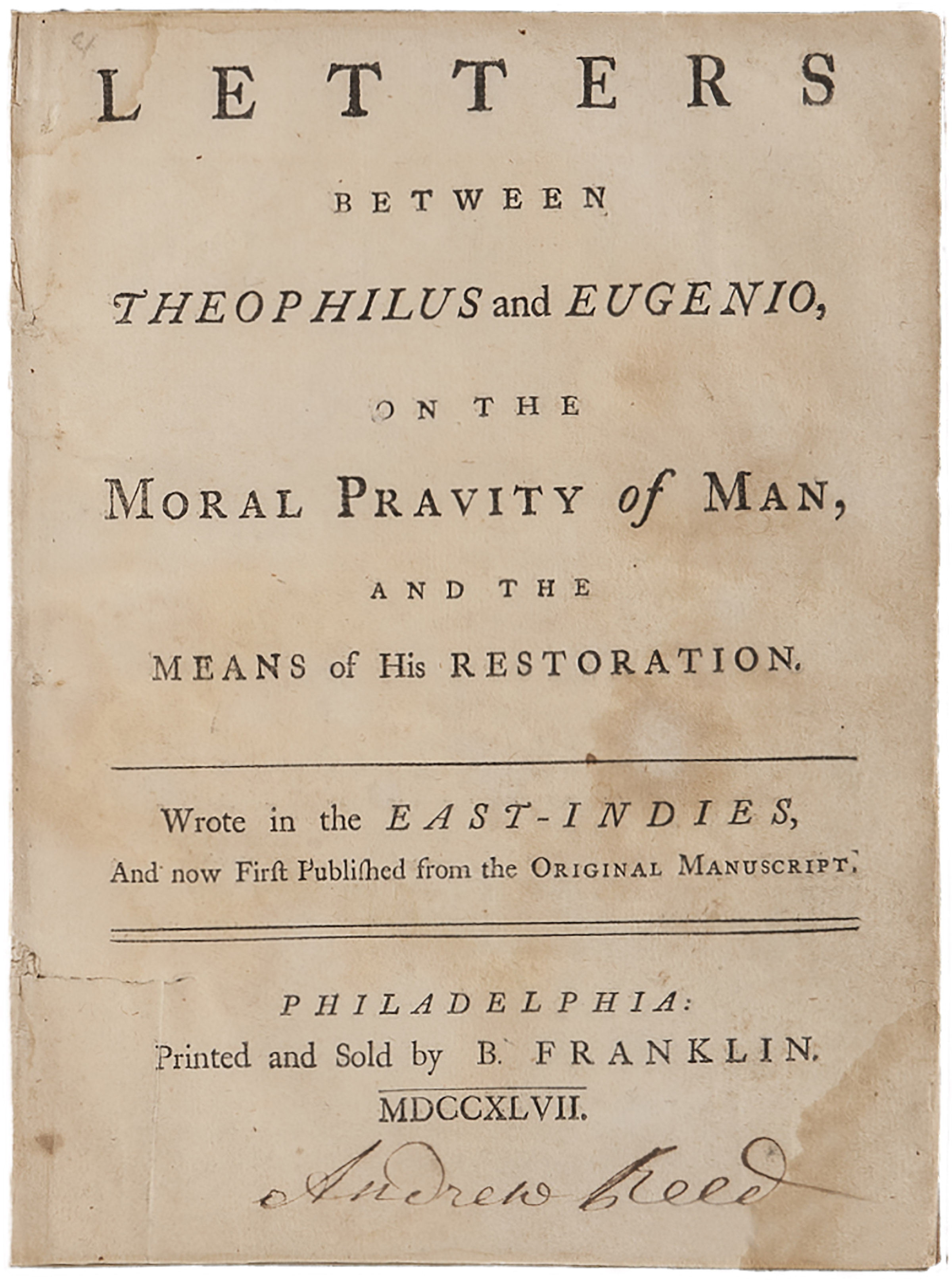
From the Printing Press of Benjamin Franklin, “Letters between Theophilus and Eugenio, on the Moral Pravity of Man, and the Means of his Restoration” — One of Only 16 Titles Published by Franklin
One of only 16 books printed by Benjamin Franklin, “Letters between Theophilus and Eugenio, on the Moral Pravity of Man, and the Means of his Restoration”. Philadelphia: Printed and Sold by B.[enjamin] Franklin, 1747. The first and only edition. Authorship of this volume of letters was once erroneously attributed to Franklin by Sabin, although it’s now believed to be by Sir Richard Blackmore. Book runs 64pp. in original wrappers, bound in full morocco black pebbled leather measuring 6.25″ x 7.75″ with git titling on spine. Previous owner’s name of “Andrew Reed” written to bottom of title page and page 20, possibly the wealthy 18th century Philadelphia merchant. Closed tear and water stain to title page, both lessening over the subsequent 2-3 leaves. Very good condition. Sold for $5,775.
Gutenberg Bible Leaf — Scarce Leaf From the 15th Century Bible Made From Moveable Type That Ushered in the Age of Enlightenment
Scarce leaf from the Gutenberg Bible, one of the earliest major books printed from moveable metal type, the invention that ushered in the Age of Enlightenment by democratizing knowledge through mass production of literature. Printed by Johannes Gutenberg in Mainz, Germany from 1450-1455, less than 50 complete or near-complete copies of the Gutenberg Bible are now extant, with nearly all those housed in public institutions. Singular leaves are also scarce, with the leaf presented here having been acquired by bookseller Gabriel Wells, whose purchase of an incomplete Bible in 1920 gave way to selling the individual leaves alongside an essay by A. Edward Newton entitled “A Noble Fragment”. Leaf is number 193 of the full Latin Bible, with the recto being the Prologue to 1 Chronicles of the Old Testament, and the verso the first part of Chapter 1 of 1 Chronicles. Each page features two columns of 42 lines in dark black Gothic type, accented by red and blue rubrication. Each copy of the Gutenberg Bible differs in its rubrication and illumination, with buyers at the time deciding upon these embellishments after the Bible was printed. The six-line rubricated letters of this leaf were likely added later, restored to match the original style. Leaf measures 11.125″ x 15.375″, bound on edge to portfolio measuring 11.75″ x 16″. Paper quality is still bright with very little foxing or discoloration compared to other examples. A stunning example from the book that changed the course of history. Sold for $136,500.

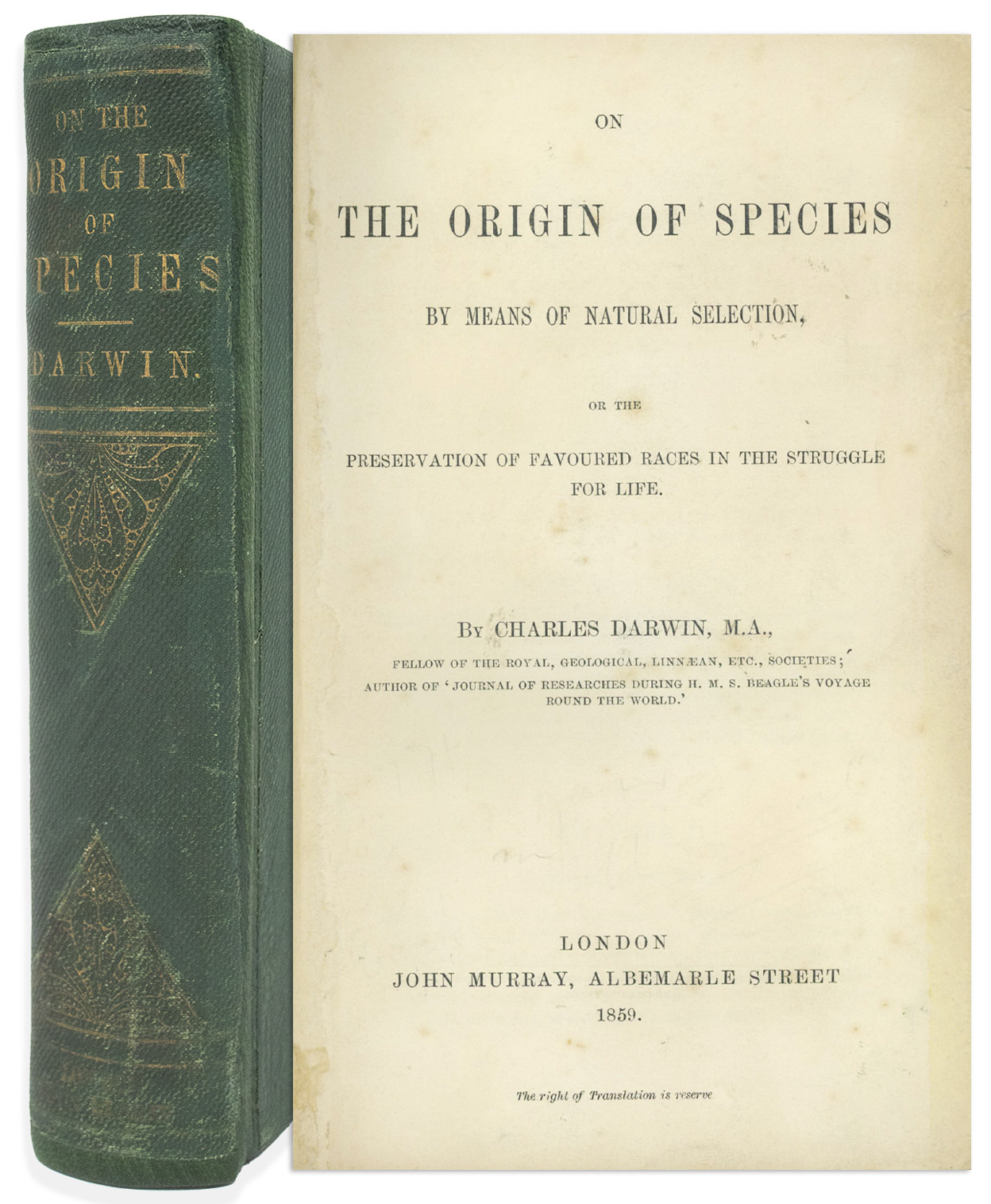
First Edition, First Printing of Charles Darwin’s Masterpiece, “On the Origin of Species” — “The most important biological book ever written”
First edition, first printing of “On the Origin of Species” by Charles Darwin, one of the most important books in the scientific canon. London: John Murray, 1859. In this revolutionary book that upended man’s own view of himself, Darwin posits natural selection as the engine driving species’ evolution, an argument so persuasive that even 19th century religious leaders adjusted their teachings to allow for evolution to work in concert with divine planning. Its importance has only grown in the 150+ years since publication, with Freeman concluding it to be “the most important biological book ever written”. First released on 24 November 1859, its scarcity nearly matches its importance, with the first printing consisting of only 1,250 copies, and the number of extant copies now significantly fewer.
All first printing points are present, including original binding, variant B, title page with copyright information on verso, Table of Contents (pages v-ix) with binder instructions to verso, complete pages 1-502, and folding table present between pages 116-117. Bound in publisher’s full green boards, stamped and lettered in gilt. Overall in very good condition; ads at back of volume have been removed as has half-title page, and endpapers have been replaced. Volume is rebacked using morocco, with original spine laid down. Some shelf wear to boards. Light foxing throughout book, with some chipping, small closed tears with repairs to a few pages, and a few dogeared pages. One small mark on page 109, otherwise no internal writing or marks. Housed in a custom quarter-leather clamshell box. Overall in very good condition, a handsome, presentable copy of this scarce first printing. Sold for $68,250.
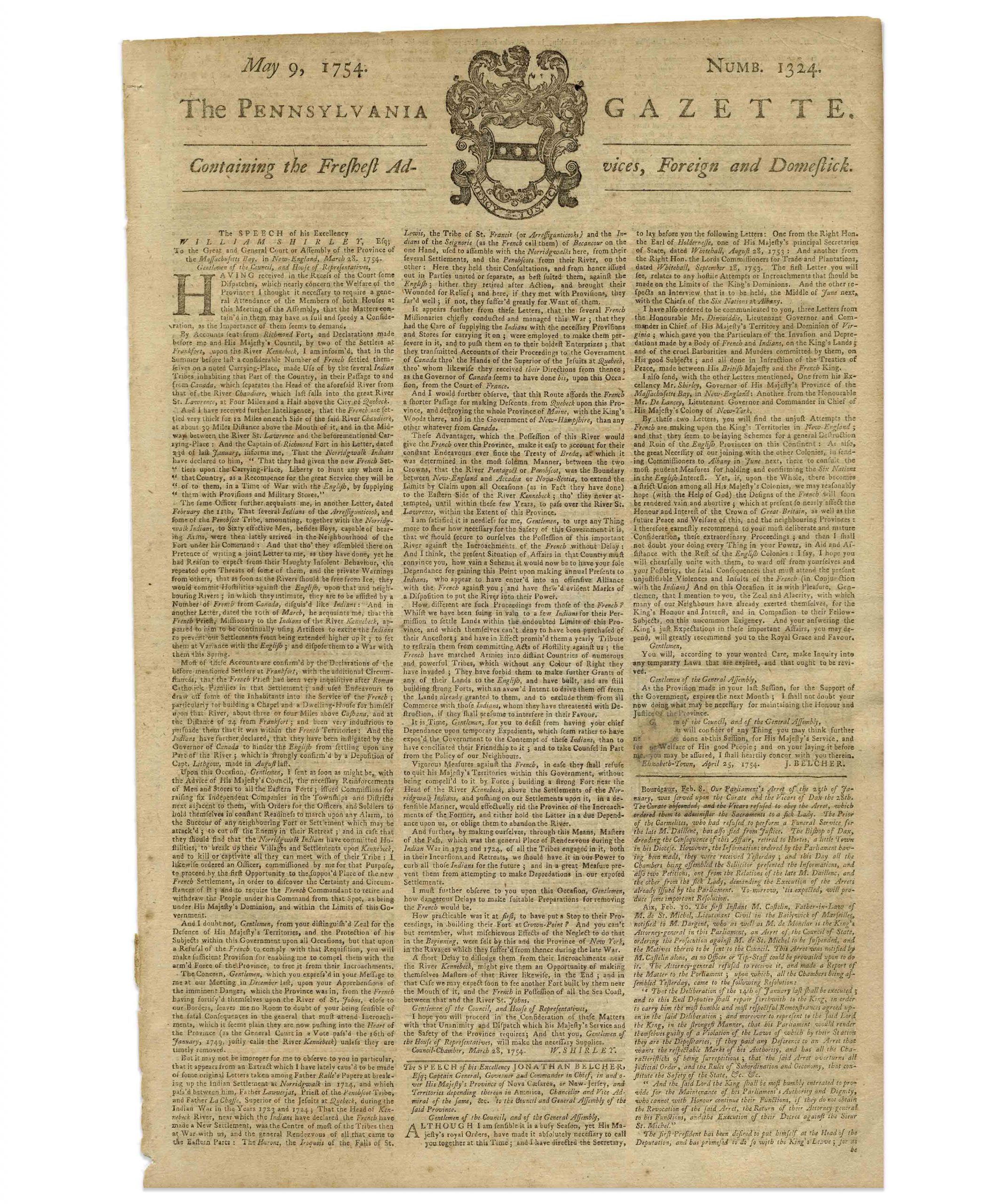
The most influential political cartoon in the history of America, the ”JOIN, or DIE” severed rattlesnake designed by Benjamin Franklin and published in his ”Pennsylvania Gazette” on 9 May 1754. This incredibly scarce newspaper is the very first printing of the ”JOIN, or DIE” cartoon, and the only known copy apart from one other housed in the permanent collection at the Library of Congress.
Frustrated by the colonists’ inability to join forces against westward expansion by the French, Franklin created this cartoon of a rattlesnake, cut into 8 pieces symbolizing the American colonies, to dramatically impart the effective message: join together as one cohesive body, or die. Along with the cartoon, Franklin published an editorial in the newspaper, urging the colonists to work together, reading in part, ”…The Confidence of the French in this Undertaking seems well-grounded on the present disunited State of the British Colonies…while our Enemies have the very great Advantage of being under one Direction, with one Council, and one Purse…”
Little did Franklin know at the time that his symbol of the dis-united rattlesnake would echo over twenty years later to inspire the colonists to unite against the British – Paul Revere added the ”JOIN, or DIE” cartoon to the nameplate of his paper, the ”Massachusetts Spy”, and even later, with the ”Don’t Tread on Me” flag, any individual or group whose personal liberty is threatened. The phrasing has also proved highly enduring, likely influencing John Stark, the Revolutionary War General from New Hampshire whose toast, ”Live free or die: Death is not the worst of evils”, inspired New Hampshire’s motto, and again suggests that personal liberty is one of the highest human values, and a founding tenet of the United States.
Franklin’s choice of a rattlesnake is curious for several reasons: as the timber rattlesnake was found throughout the colonies but not England, Franklin argued in an earlier 1751 editorial that the colonists should ship rattlesnakes to England in exchange for the criminals that England was sending to America. Franklin now, however, seems to fully embrace the rattlesnake as metaphor, and would argue, during the American Revolution, its virtues. Using a pseudonym to conceal his identity, he wrote in 1775, ”…she has no eye-lids-She may therefore be esteemed an emblem of vigilance.-She never begins an attack, nor, when once engaged, ever surrenders…to those who are unacquainted with her, she appears to be a most defenseless animal; and even when those weapons are shown and extended for her defense, they appear weak and contemptible; but their wounds however small, are decisive and fatal:-Conscious of this, she never wounds till she has generously given notice, even to her enemy, and cautioned him against the danger of stepping on her.-Was I wrong, Sir, in thinking this a strong picture of the temper and conduct of America?”
While the British loyalists played upon Franklin’s symbolism of the rattlesnake, arguing that the colonists were deceptive and cunning, Franklin turned the characterization on its head, skilled and interested as he was in the art of propaganda. Ultimately, the symbolism would prove highly enduring and compelling: both the idea of uniting to fight a greater, more powerful enemy, and the power of a sudden, deadly attack by an underestimated opponent.
Four page newspaper (without advertising) measures 9.75” x approximately 15”, with an irregularly trimmed top edge. Expert restoration to head of snake, and light uniform toning, consistent with age. Newspaper has been well-preserved, in very good to near fine condition. One of the most important newspapers in America’s colonial history and a cornerstone of her philosophical underpinnings. Sold for $50,000.

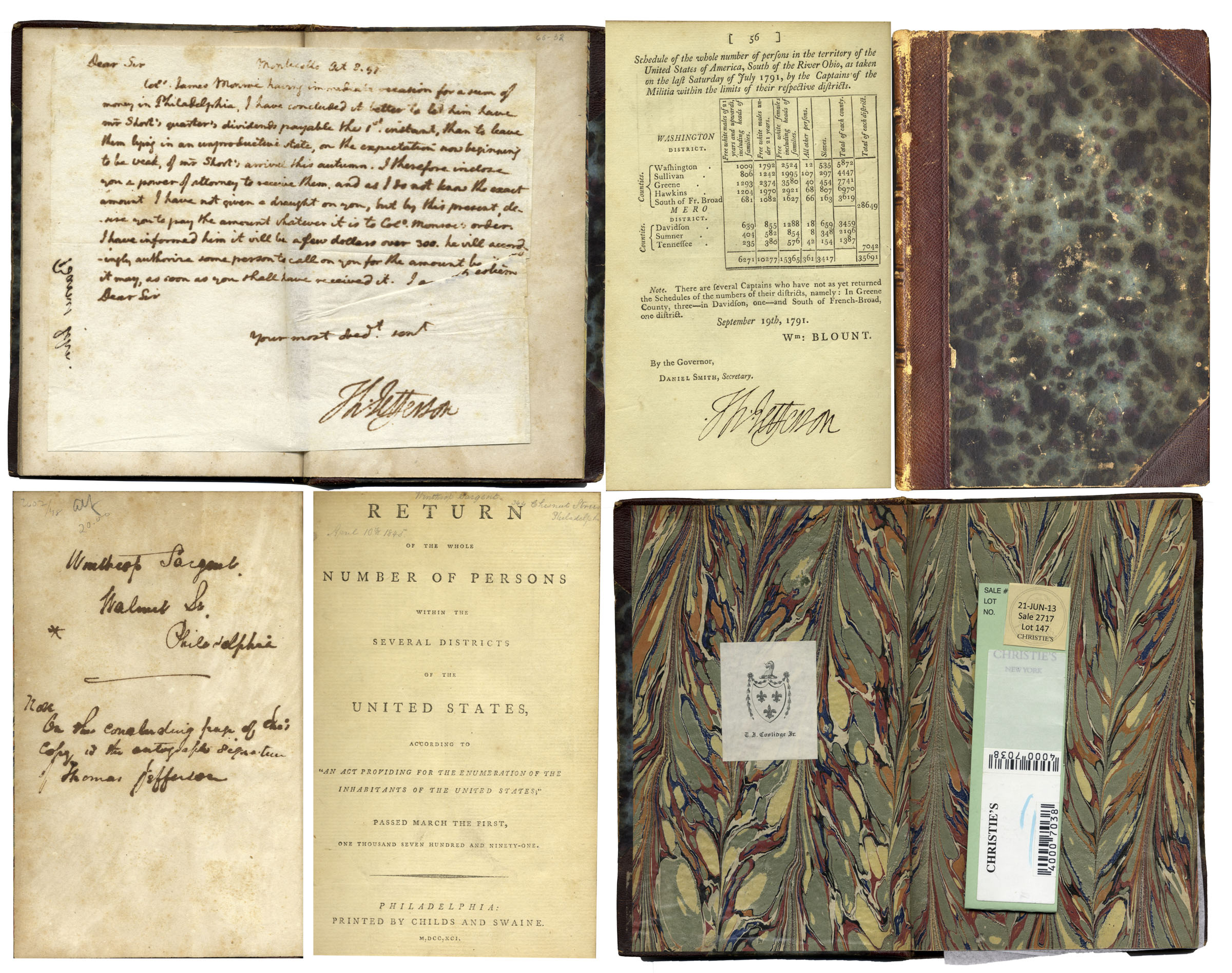
Thomas Jefferson Scarce Signed 1st Edition of the First U.S. Census — One of Only a Handful Signed & Ratified by Jefferson
Extremely rare Thomas Jefferson signed first edition of the first U.S. census, one of only a handful of Jefferson signed copies sold at auction in the last 40 years. As Secretary of State, Jefferson called for the first official census, and ratified the results of only a handful, this being one of them, signed boldly ”Th: Jefferson” on page 56. Published in Philadelphia: Childs and Swaine, 1791. Full title reads, ”Return of the Whole Number of Persons Within the Several Districts of the United States, According to ‘An Act Providing for the Enumeration of the Inhabitants of the Unites States’. Printed in a small number for distribution by Thomas Jefferson as Secretary of State, and from his direct descendant, Thomas Jefferson Coolidge Jr., with Mr. Coolidge’s crested label to front pastedown. Bound in 19th century half-morocco and marbled boards, book measures 5” x 7.25”. This copy appears to be one of the very first printings of the first edition, as it lacks the tipped-in late-returning results from South Carolina often found on page 54. The lower margins of pages 34, 42 and 43 have been shaved by binder, otherwise copy is near fine with a touch of toning and foxing. Volume also includes a press copy of an autograph letter signed by Jefferson, affixed to rear endpaper, dated 8 October 1797, measuring 6.5” x 7.75”. Letter concerns a quarterly dividend of ”a few dollars over 300”, payable to Col. James Monroe. A rare opportunity for the very first census of the United States, signed by its 3rd President, with other such copies selling for approx. $100,000. Sold for $66,435.
Scarce 1493 First Edition of “Nuremberg Chronicle”, the Lavishly Illustrated High Point of Printing in the Age of Incunable, Published Shortly After the Gutenberg Bible
Scarce first edition, first printing of “Liber Chronicarum” or “Nuremberg Chronicle”, the 15th century illustrated history of the world, widely considered the high point of printed books in the post-Gutenberg incunable era. Nuremberg: Anton Koberger for Sebald Schreyer and Sebastian Kammermeister, 12 July 1493. Written by the Nuremberg doctor and humanist Hartmann Schedel, and largely illustrated by Michael Wolgemut’s workshop, with many views reportedly completed by Albrecht Durer, who apprenticed with Wolgemut at the time. Sold for $31,500.

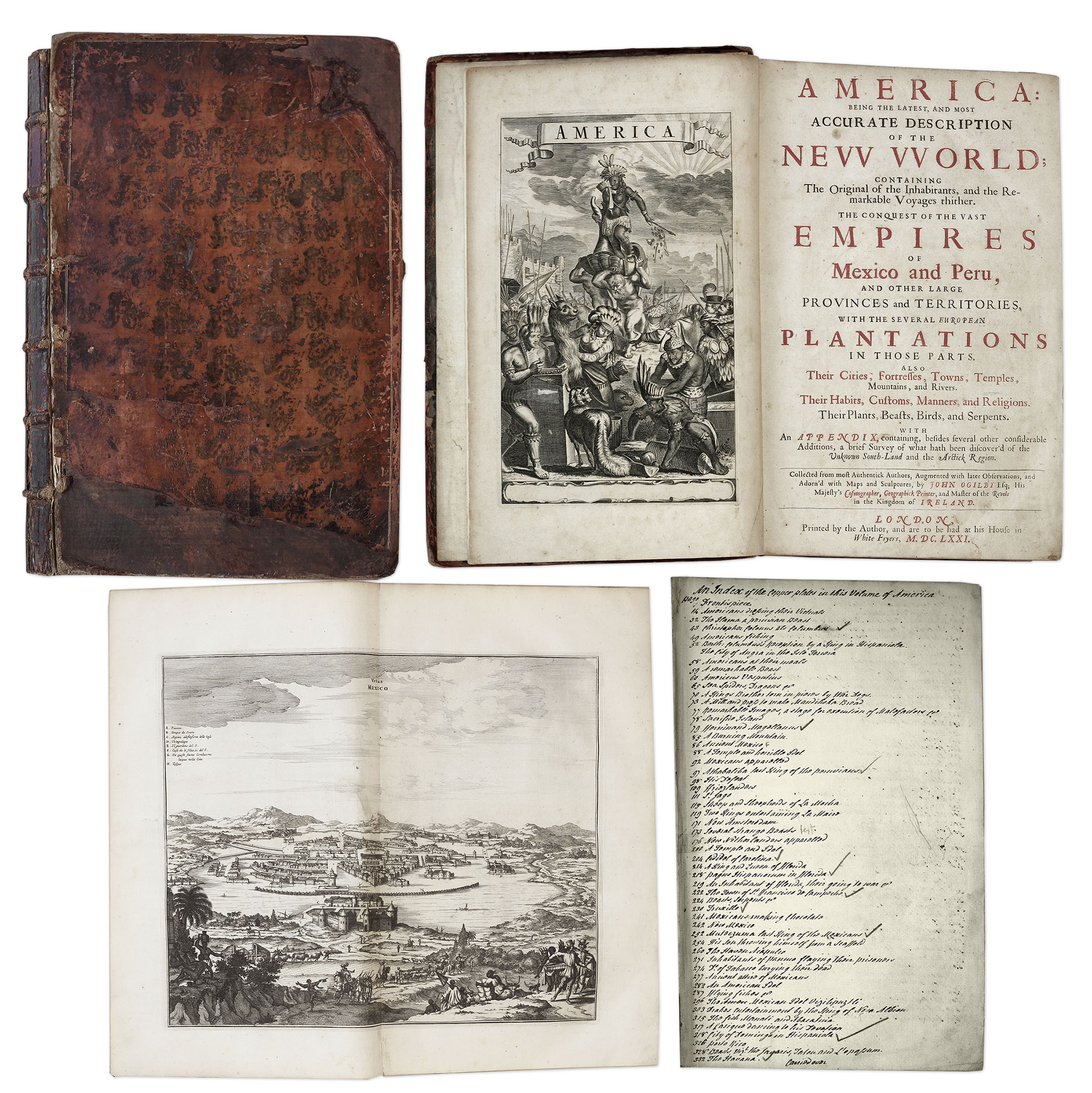
One of the most important books on the history of America (cited by Borba de Moraes, Howes, Sabin and Wing), the 1671 first edition of ”America: Being the Latest and Most Accurate Description of the New World”. Privately printed in London by the author, Arnoldus Montanus, and edited by John Ogilby. In ”America” Montanus goes into great detail of the new continents, with dozens of engravings of Native Americans, species of animals and reptiles, and the landscapes and settlements in the new world, accompanied by text. The book covers speculation regarding the earliest voyages to America, along with later recorded voyages and the settlements of New Netherlands/New York, New England, Hudson’s Bay, Labrador, Canada, Nova Scotia, Maryland, Virginia, (including Captain Smith’s capture and rescue by Pocahontas), Carolinas, Florida and California, plus accounts of Mexico and nearby islands, even including Australia and New Zealand. 674pp. book contains 75 original engravings (64 copper plates within the text and 9 plates throughout), lacking the maps and 28 engravings, which is typical as this edition is almost never found with all plates intact. All text is complete except for missing pages 445-446. Large format book measures 10” x 15”. Bound in original full leather boards, with some loss of leather to covers, cracking along spine and front board detached. Interior text is near fine and very readable. An important and fascinating addition to early knowledge of the American continent. Sold for $9,375.
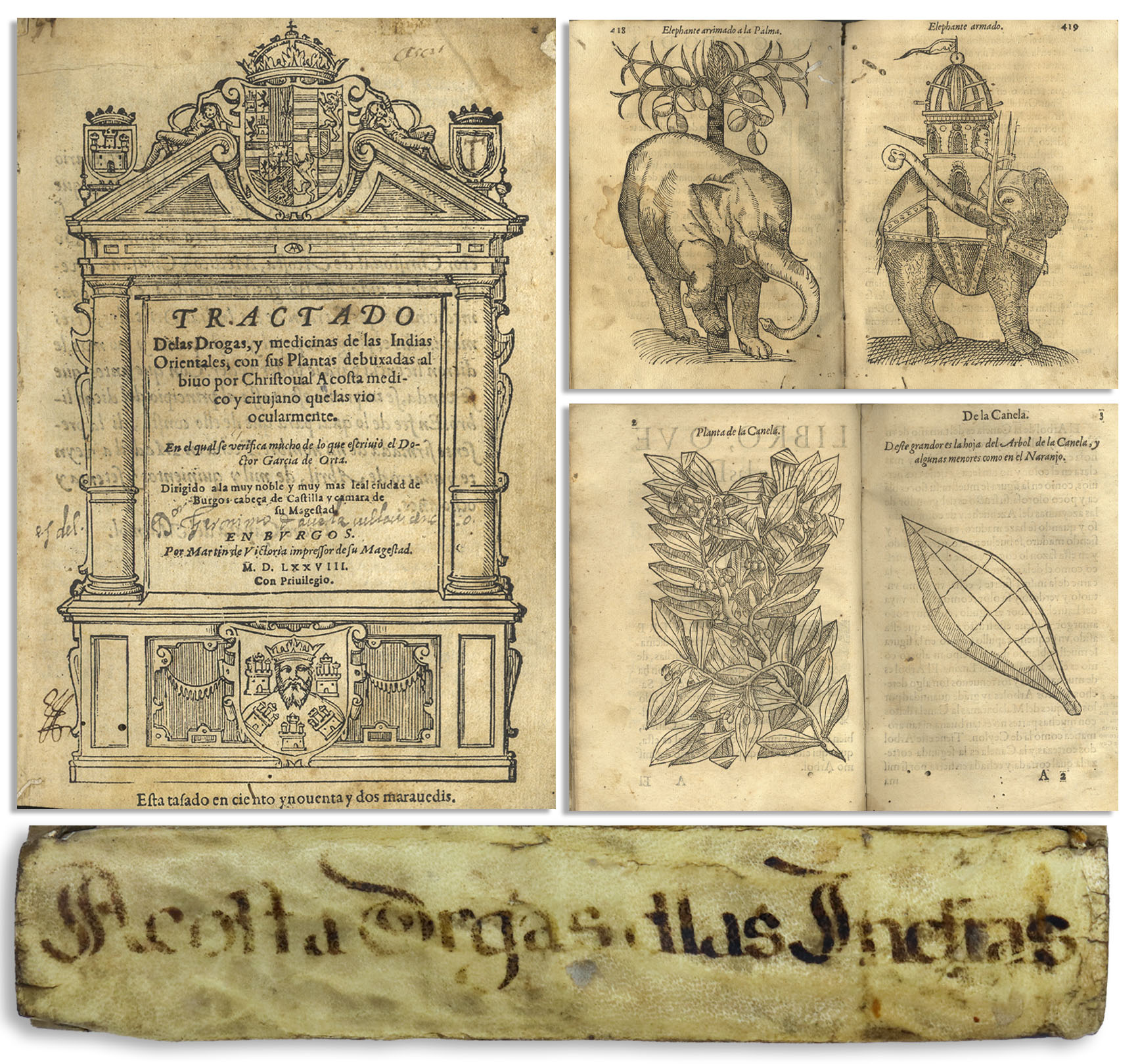
1578 First Edition of “Tractado de las drogas, y medicinas de las Indias Orientales” — The Important Reference of Therapeutic Botany From the Age of Exploration, Complete With All 48 Woodcuts
Rare 1578 first edition of “Tractado de las drogas, y medicinas de las Indias Orientales” (“Treatise of the drugs and medicines of the East Indies”) by physician and naturalist Cristobal Acosta. Burgos, Spain: Martin de Victoria, 1578. Bound in original vellum boards with leather ties, rare volume is complete with all woodcuts: title page featuring a portrait of the author, 45 pages of medicinal plants and herbs, and two pages of Asian elephants. Book also features woodcut initials heading each chapter. Acosta’s tomb of therapeutic botany was highly important in its day, giving illustration to exotic plants, animals, herbs and spices from the East Indies during the Age of Exploration, including cinnamon, garlic, nutmeg, coconut, sandalwood, and pineapple, all relatively unknown to Europe at the time. There is even a chapter on opium (“muy usual, y necessaria”), and a chapter on Asian elephants, then described for the first time in a scientific publication. Book measures 5.5″ x 7.375″. Some faint dampstaining, worming to several pages towards the end, and expected age wear. Overall very good plus condition. Sold for $3,900.
FREE VALUATION. To buy, auction, sell or consign your Cicero’s Cato Major B Franklin 1744 that is for sale, please email your description and photos to [email protected] of Nate D. Sanders Auctions (http://www.NateDSanders.com).
We offer the following for your Cicero’s Cato Major B Franklin 1744:
- Appraise Cicero’s Cato Major B Franklin 1744.
- Auction Cicero’s Cato Major B Franklin 1744.
- Consign Cicero’s Cato Major B Franklin 1744.
- Estimate Cicero’s Cato Major B Franklin 1744.
- Sell Cicero’s Cato Major B Franklin 1744.
- Cicero’s Cato Major B Franklin 1744 valuation.