
Sell or Auction Your Chicago Pile-1 Graphite 1st Nuclear Reactor for up to Over $3,000 or More at Nate D. Sanders Auctions
FREE ESTIMATE. To buy, auction, sell or consign your Chicago Pile-1 graphite 1st nuclear reactor that is for sale, please email your description and photos to [email protected] of Nate D. Sanders Auctions (http://www.NateDSanders.com).
Sell Your Chicago Pile-1 Graphite 1st Nuclear Reactor
Below is a recent realized price for graphite from Chicago Pile-1, the world’s first artificial nuclear reactor project that was led by Enrico Fermi. We at Nate D. Sanders Auctions can obtain up to this amount or more for you:
Chicago Pile-1 Graphite 1st Nuclear Reactor. Sold for Over $3,000.
Here are some related items we have sold:
Important object in the history of mankind, graphite from CP-1 (Chicago Pile 1), the first nuclear energy reactor which launched the first successful atomic energy experiment, giving life to the nuclear age. Enrico Fermi conducted the experiment on 2 December 1942 at the University of Chicago, reaching critical mass for a self-sustaining reaction at 3:25 pm, and lasting for 28 minutes. After the experiment, a coded message was relayed to James Conant, Chairman of the National Defense Research Committee, and the Manhattan Project was underway, leading to the creation of atomic energy bombs less than three years later. Stick of graphite measures 3” x .75” .75”, encased in a lucite block measuring 3.75” x 2.625” x 1.5”, one of a small number given to University of Chicago alumni donors. Block is accompanied by a detailed letter of provenance from Daniel Carlsen, who obtained the sample during his work at the University of Chicago Printing Department in the late 1970s. Other examples are housed at the Museum of Science and Industry in Chicago, and at the Bradbury Science Museum in Los Alamos. A very rare and important piece of the first nuclear energy reactor that changed the course of history. Sold for $4,000.
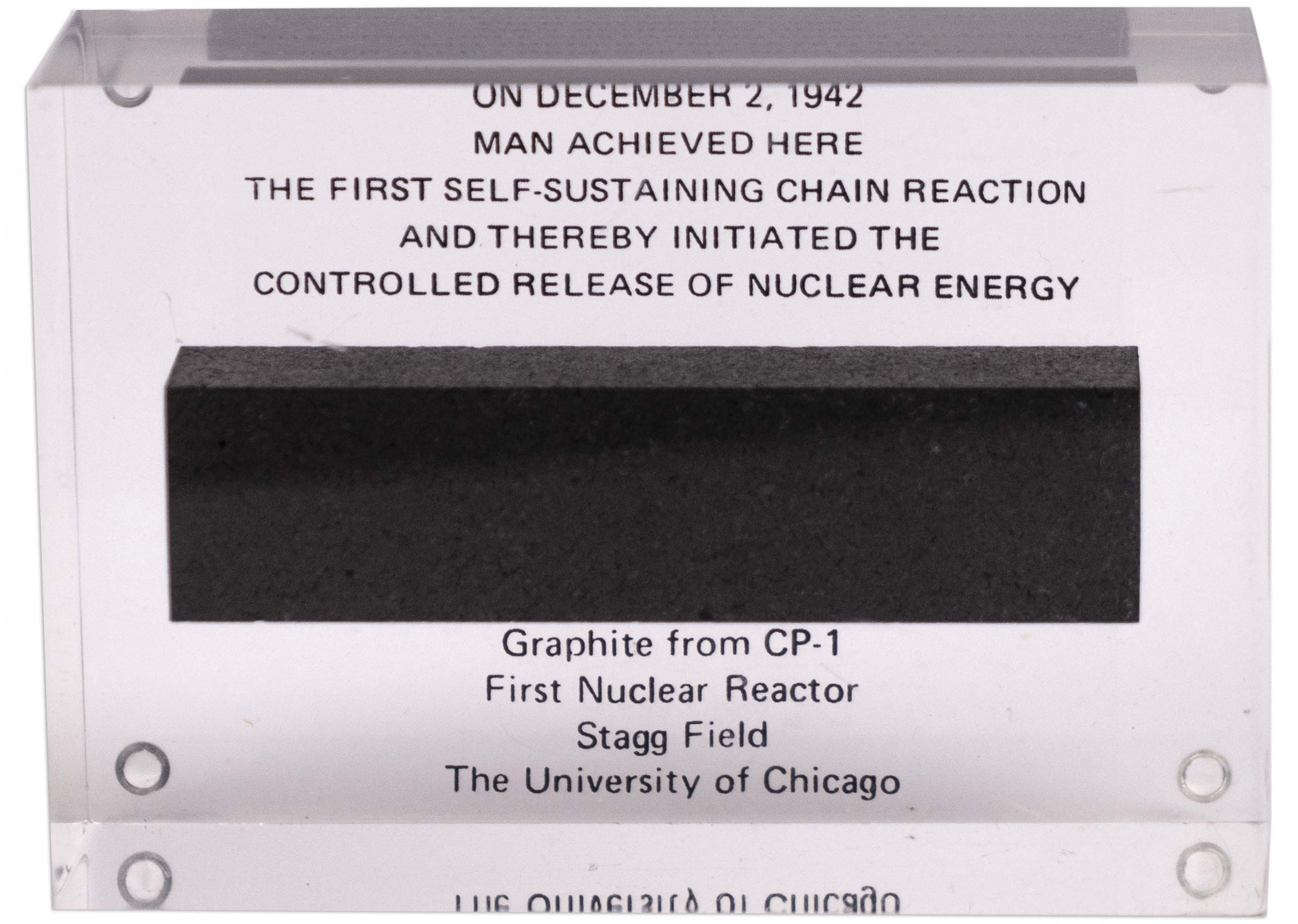

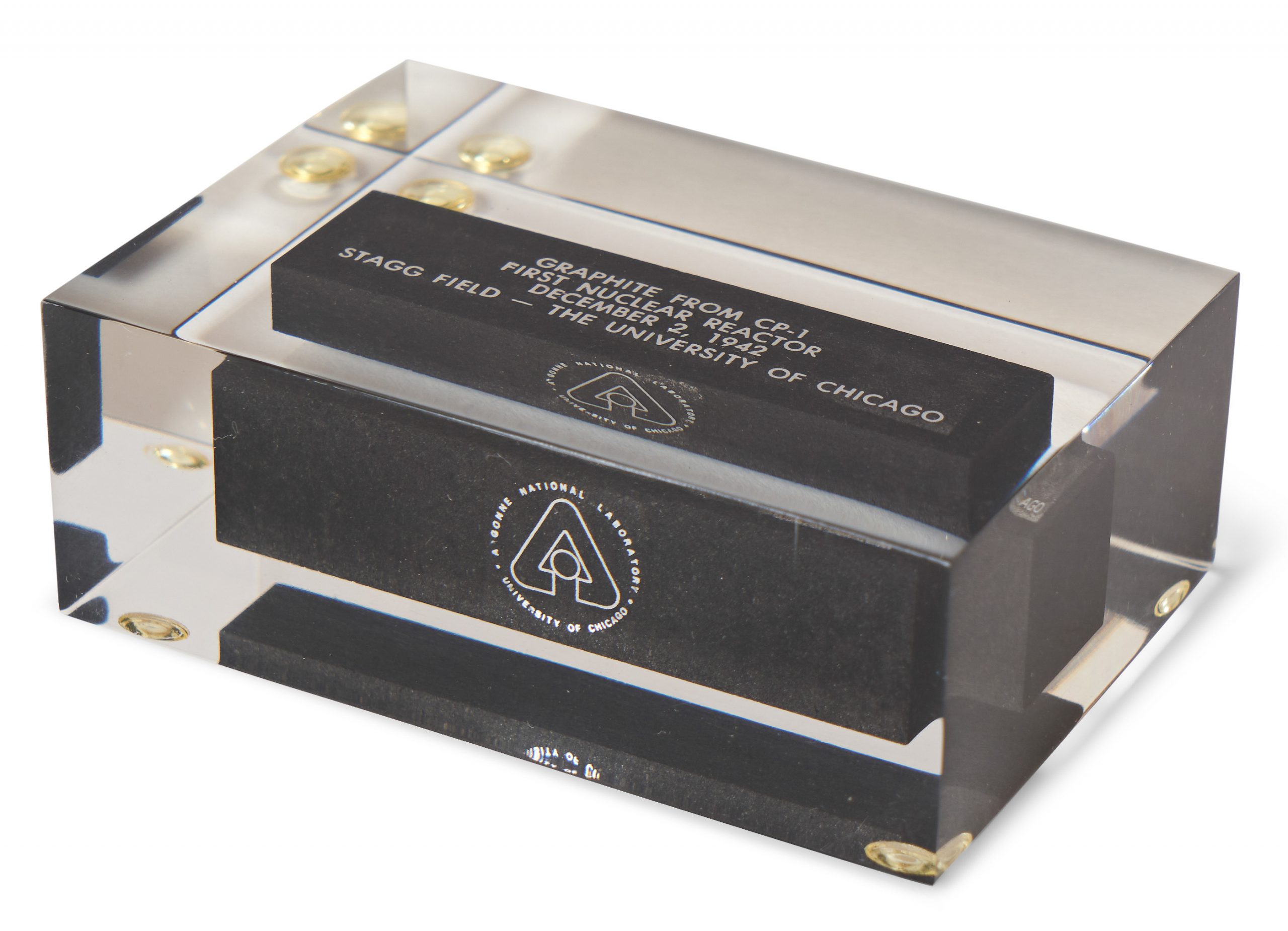
Important object in the history of mankind, graphite from CP-1 (Chicago Pile 1), the first nuclear energy reactor which launched the first successful atomic energy experiment, giving life to the nuclear age. Enrico Fermi conducted the experiment on 2 December 1942 at the University of Chicago, reaching critical mass for a self-sustaining reaction at 3:25 pm, and lasting for 28 minutes. After the experiment, a coded message was relayed to James Conant, Chairman of the National Defense Research Committee, and the Manhattan Project was underway, leading to the creation of atomic energy bombs less than three years later. Stick of graphite measures 3” x .75” x .75”, encased in a lucite block measuring 3.75” x 2.625” x 1.375”. Graphite block is identified on front, and has ”Argonne National Laboratory / University of Chicago” on its side. Other CP-1 graphite examples are housed at the Museum of Science and Industry in Chicago, and at the Bradbury Science Museum in Los Alamos. A very rare and important piece of the first nuclear energy reactor that changed the course of history. Sold for $3,661.
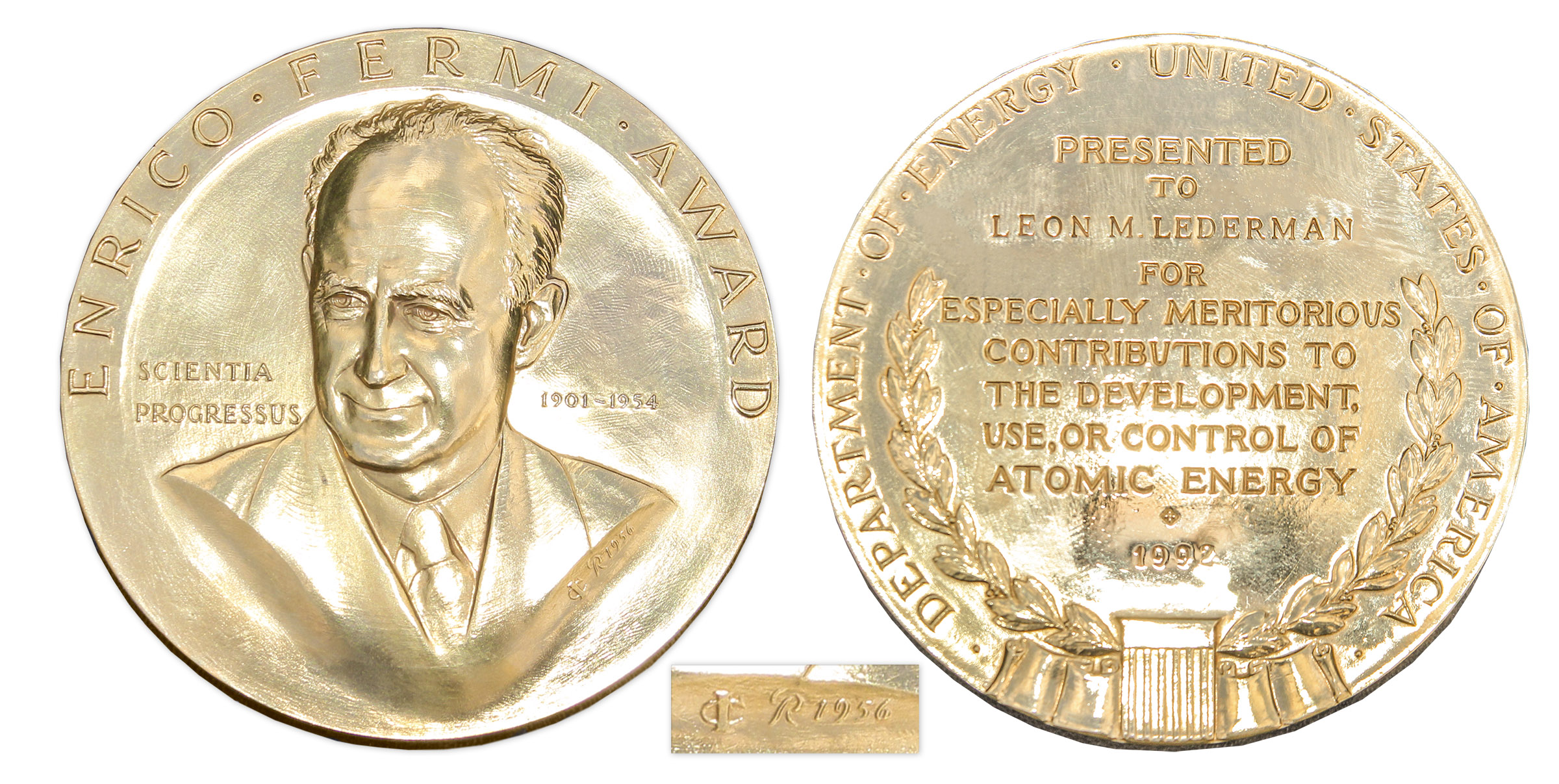
The Enrico Fermi Award presented to Nobel Prize-winning physicist Leon Lederman in 1992. The Fermi Award, first given in 1956, honors scientists from around the world for their lifetime achievements, with many of the recipients also winning Nobel Prizes. Medal features a relief portrait of Enrico Fermi, with his name and the years of his birth and death. ”SCIENTIA PROGRESSUS” is also engraved on front, which translates from Latin to ”the progress of science”. Verso reads: ”PRESENTED TO / LEON LEDERMAN / FOR ESPECIALLY MERITORIOUS CONTRIBUTIONS TO THE DEVELOPMENT, USE, OR CONTROL OF ATOMIC ENERGY / 1992” and is framed by the words, ”DEPARTMENT OF ENERGY / UNITED STATES OF AMERICA”. Gold-plated medal weighs 324 grams or 11.4 ounces, and measures 3” in diameter. Case measures 5.25” x 5.25” x 1.5”. Very small mark on front of medal on Fermi’s lapel. Near fine condition. With an LOA by Leon Lederman. Sold for $25,000.
Albert Einstein typed letter signed from 1943, with his hand-drawn diagram explaining a ”phenomenon” that confounded the scientists at the National Defense Research Committee. The NDRC, headed by Dr. James Conant, was the very secretive and important organization assembled at the start of World War II to apply scientific knowledge to warfare. Its most important project was the development of the atomic bomb through the Manhattan Project, but it also did work on radar, poison gases, submarines, radiation, etc.
Einstein here responds to Dr. George Antonoff, Chemistry Professor at Fordham University (and creator of ”Antonoff’s Rule”), regarding a physical phenomenon that Antonoff can’t quite make sense of. Although the phenomenon isn’t explained, one can deduce from Einstein’s letter that it concerns the coagulation of oil when two liquids confront each other, creating a vortex. Antonoff supposed that the interaction was the result of electrical forces, but Einstein theorizes otherwise, nicely demonstrating Einstein’s ability to analyze problems through abstract conceptualization. Letter reads in full,
”It seems to me that the supposition of electric forces is not needed to explain the phenomenon. The process seems to me to be the following: [Einstein’s sketch]
Through the stirrer is produced a circulation of the water together with a vortex. The water of the surface together with the oil-layer is hereby drawn into the vertical vortex and the oil is brought to its central line through the difference of the centrifugal forces. In this region the small drops of oil will come in contact with each other and become coagulated by the capilarr forces. There will be, of course, an optimum speed, for if the speed of the liquid in the circulation becomes too high the small oil-drops will not stay long enough in the central part of the motion to coagulate…[signed] A. Einstein.”
Letter is accompanied by Antonoff’s letter, explaining that he ”undertook this work by request of the Nat. Defense Research Committee headed by Dr. Conant. As importance [sic] of this problem in the war effort cannot be underestimated, your speedy reply will be highly appreciated.” Einstein’s letter measures 8.5” x 11”. Folds, closed tear at top and light toning. Overall very good condition. Sold for $6,875.

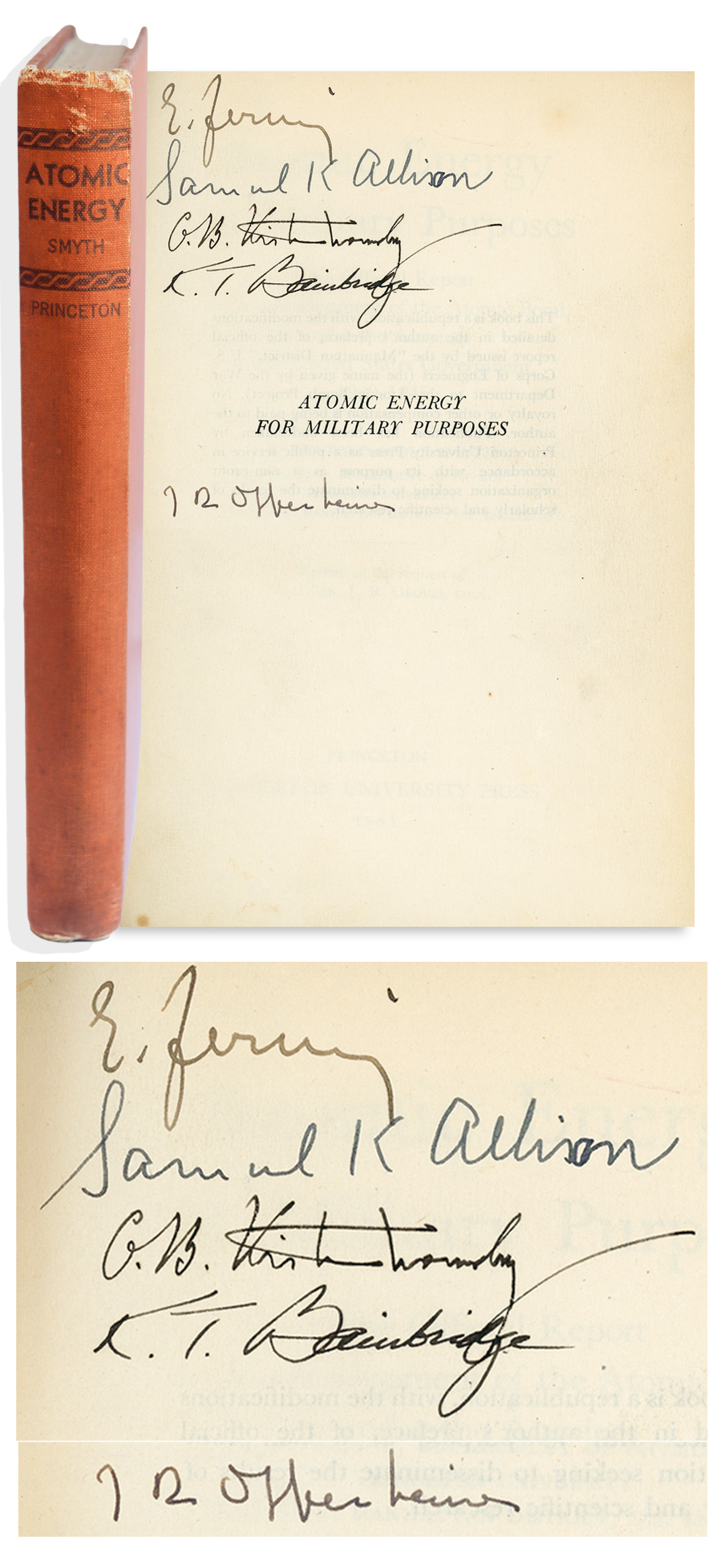
”Atomic Energy for Military Purposes”, signed in 1946 during the Manhattan Project by six of the most important individuals who developed this first atomic bomb, including Enrico Fermi and Robert Oppenheimer. Princeton: Princeton University Press, 1945. Book is the official report of the Manhattan Project, signed on the half-title page by Enrico Fermi, Samuel K. Allison, George B. Kistiakowsky, Kenneth T. Bainbridge, and Robert Oppenheimer. Signatures were acquired by another Manhattan Project scientist, Laurence Cherry, who designed the detonation system for the Fat Man bomb. Hardbound book measures 5.75” x 8”. Some light wear and spotting to boards. Mr. Cherry’s stamp appears on page edges and also on front free endpaper, along with his address and notation that the book was purchased in 1946 at Los Alamos. Very good condition. Sold for $5,000.
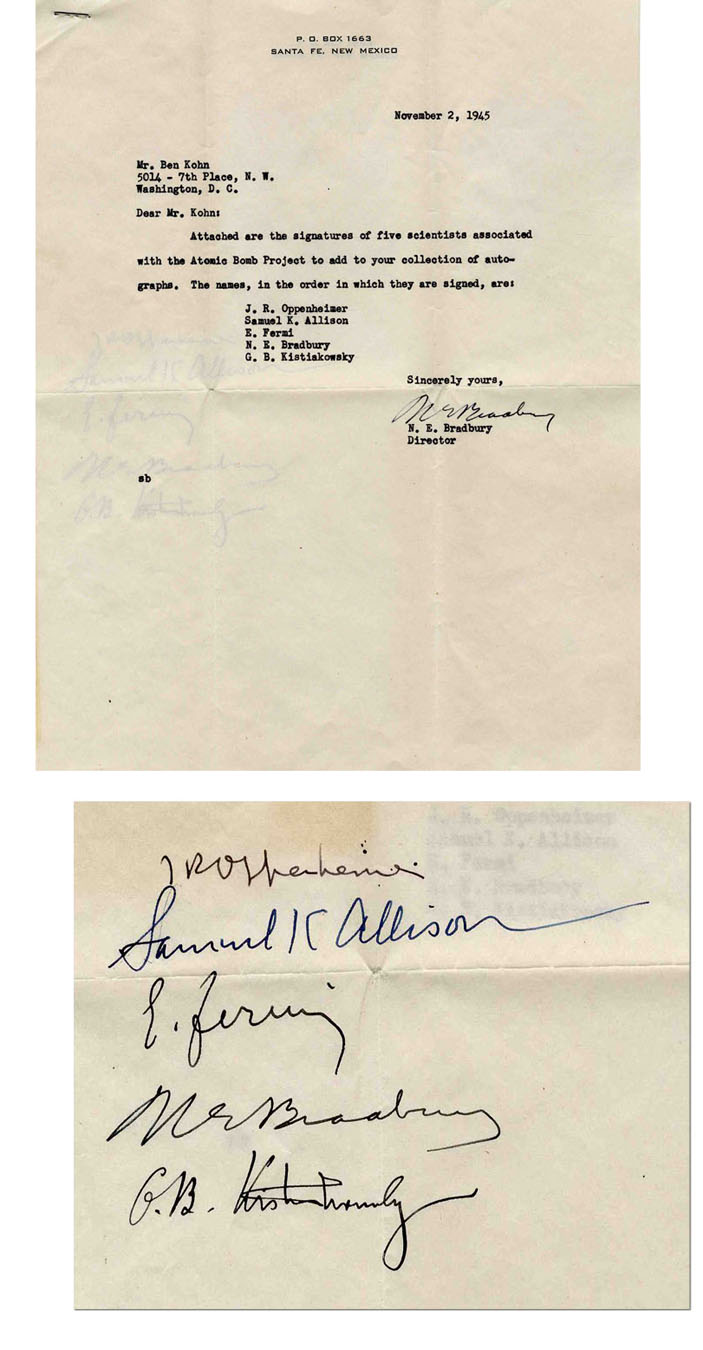
Manhattan Project Signatures of All Five Scientists Who Worked on the Atomic Bomb Including Enrico Fermi & Robert Oppenheimer — Rare Signatures on Official Los Alamos Stationery With Secret P.O. Box Address
Typed letter signed by Manhattan Project Director Norris Bradbury, who encloses the signatures of the “five scientists associated with the Atomic Bomb Project.” On a separate sheet are the promised signatures, written boldly by all: “J.R. Oppenheimer”, “Samuel K. Allison”, “E. Fermi”, “N.E. Bradbury” and “G.B. Kistiakowsky”. Letter dated 2 November 1945 is on official “P.O. Box 1663 / Santa Fe, New Mexico” stationery, the secret P.O. Box address used for the project whose physical location was undisclosed. Also includes original mailing envelope postmarked 7 November 1945. Document, measuring 8.5″ x 11″ has some folding from mailing, else near fine. Sold for $3,800.
FREE ESTIMATE. To buy, auction, sell or consign your Chicago Pile-1 graphite 1st nuclear reactor that is for sale, please email your description and photos to [email protected] of Nate D. Sanders Auctions (http://www.NateDSanders.com).
We offer the following for your Chicago Pile-1 graphite 1st nuclear reactor:
- Appraise Chicago Pile-1 graphite 1st nuclear reactor.
- Auction Chicago Pile-1 graphite 1st nuclear reactor.
- Consign Chicago Pile-1 graphite 1st nuclear reactor.
- Estimate Chicago Pile-1 graphite 1st nuclear reactor.
- Sell Chicago Pile-1 graphite 1st nuclear reactor.