Sell or Auction Your Charleston Mercury Extra Union Dissolved 1860 for up to About $15,000 or More at Nate D. Sanders Auctions
FREE ESTIMATE. To buy, auction, sell or consign your Charleston Mercury Extra Union is Dissolved 1860 that is for sale, please email your description and photos to [email protected] of Nate D. Sanders Auctions (http://www.NateDSanders.com).
Free Appraisal, Auction or Sell Your Charleston Mercury Extra Union Dissolved 1860

Below is a recent realized price for a Confederate imprint from 1860 by the Charleston Mercury Extra announcing that the Union is Dissolved. Please see details below:
Charleston Mercury Extra Union Dissolved 1860. Sold for About $15,000.
Here are some related items we have sold:
One of the scarcest and most important documents in the history of the United States: the very first printing of the reward poster for the capture of John Wilkes Booth and two other conspirators in the assassination of President Abraham Lincoln. Printed by the War Department, Washington, DC on 20 April 1865, five days after President Lincoln passed and six days before Booth was killed.
This broadside reward poster is the very first printing and also the rarest of the three iterations printed by the War Department, with some estimates of fewer than five existing today. It is much scarcer than the second printing, which has three woodcut frames at top for photographs of the conspirators. That second printing poster has recently sold several times in excess of $200,000. This first printing poster is so scarce that no recent auction records exist.
In large, bold type, poster reads ”$100,000 REWARD / THE MURDERER / Of our late beloved President Abraham Lincoln, / IS STILL AT LARGE”. Reward money for each man is listed, and at the bottom, their descriptions: Booth is ”Five Feet 7 or 8 inches high…black hair, black eyes, and wears a heavy black moustache.”; in later printings, the public is warned that Booth has likely shaved off his moustache. John H. Surratt is described at length, and then David E. Herold (here misspelled as ”David C. Harold”) is described as ”a little, chunky man, quite a youth, and wears a very thin moustache.”
Poster measures approximately 22.125″ x 12.125″, as called for, with lower edge trimmed slightly. Linen backed some time ago, with damp-staining to linen. Expected age wear, with damp-staining to edges, toning and spots of discoloration. Creasing, with closed tears and some paper loss, mostly at middle top. Overall in good to very good condition with no substantial loss of text and displaying very well.
Poster originates from the Philadelphia area, passed down through the same family until its auction here; it has never been sold or auctioned before. A museum worthy piece, perhaps the only opportunity to own the very first printing of the reward poster of the first U.S. President to be assassinated.
References: ”Twenty Days” by Kunhardt & Kunhardt; ”Lincoln’s Assassins: Their Trial and Execution” by Swanson and Weinberg. Sold for $166,375.

John Wilkes Booth Autograph
An incredible four-line verse in the hand of John Wilkes Booth autograph, “J. Wilkes Booth.” The verse is written on an envelope dated “Washington D. C., 5 March 1865,” measuring 3.25″ x 6.25″. The envelope also has inscriptions by three other hands. Booth’s document signed poetic verse reads: “Now in this hour that we part,/ I will ask to be forgotten never/ But, in thy pure and guileless heart,/ Consider me thy friend dear Eva.” The text appears on the verso of the envelope on the inside of the flap. Experts are aware of approximately 300 letters that Booth wrote. After he killed Lincoln, the people who received these letters burnt them for fear they would be linked to Booth. It is estimated that only 17 Booth letters remain in private hands. Sometime in late 1864 or early 1865, Booth entered into a serious romance with Lucy Lambert Hale, daughter of John Parker Hale, New Hampshire’s former abolitionist senator. By March, Booth was secretly engaged to Lucy Hale. On March 4th, he attended Lincoln’s second inauguration as the invited guest of Lucy. It is tempting to consider that this envelope brings us into one of the periodic meetings between the conspirators planning to kidnap or assassinate the President. They gathered in Booth’s hotel room sharing a bottle of whiskey, discussing the fate of the Confederacy, and here, expressing a regretful sentiment. Booth is known to have confided to his actor friend Samuel Knapp Chester, “What an excellent chance I had to kill the President, if I had wished, on inauguration day!” (Chester testified at the Conspiracy Trial that this conversation took place at a table at the House of Lords saloon in New York City.) Beneath Booth’s verse is inscribed, in another hand “For of all sad words from tongue or pen/ the saddest are these – it might have been,” a quotation from John Greenleaf Whittier’s Maud Muller. Beside the quote is the date “March 5, 1865 In John’s room,” referring to Booth’s room at the National Hotel in Washington D.C. On the recto, in a third hand, are two lines of docketing “Jno Conness MSS” perhaps referring to Senator John Conness of California. Beneath this notation is a 3-line inscription from Whittier’s poem “Remembrance” which reads, “Touched by change have all things been/ Yet I think of thee as when/ We had speech of lip and pen.” And, in the same hand is the sentiment: “The above, though quoted, are the real sentiments of your friend, who trusts that the acquaintance and friendship formed will never be forgotten by either.” Signed “Jno P. M. W.” A rare John Wilkes Booth autograph item. Sold for $32,500.

Abraham Lincoln & John Wilkes Booth Notes Signed, Along with a Wallpaper Swatch from the President’s Box at Ford’s Theatre — Displayed with an Illustration of the Assassination that Changed History
Dramatic signed presentation of the assassination of President Abraham Lincoln, the event that shaped history in the aftermath of the Civil War. Below an illustration of the assassination just moments before it happened, the autographs of Lincoln and Booth are displayed next to a swatch of the actual wallpaper that lined the President’s box in Ford’s Theatre, matching the illustration.
Abraham Lincoln was the first U.S. President to be assassinated, and his death reverberated decades after 14 April 1865. His Vice President, Andrew Johnson, assumed control of the country on 15 April and quickly rolled back proposed protections for newly freed black Americans. Johnson even opposed the 14th Amendment which gave citizenship to former slaves, preferring instead to leave suffrage laws up to the states. Of course it’s impossible to know how history would have changed had Lincoln survived, as it remains one of the great “what ifs” in American history.
Abraham Lincoln’s autograph note signed is displayed below his image, dated 3 November 1864 just five days before the Presidential election. Lincoln writes in full, “Allow the bearer transportation from Washington to Pittsburgh, Penn. / A. Lincoln / Nov. 3, 1864”, with recipient’s name “M.L. Cullen” written in another hand. Measures 3.25″ x 2″, with some nominal smudging to handwriting; overall in very good condition with bold handwriting. Lincoln’s note is accompanied by a PSA/DNA COA.
Booth’s signed note also appears below his image and reads, “J. Wilkes Booth”, comprising a receipt for money accepted by Booth. Booth’s signature is considered one of the scarcest of all signatures, and is accompanied by a University Archives COA. Note measures 7.5″ x 2.875″, in near fine condition. The swatch of burgundy wallpaper measuring .625″ x .5″ is encapsulated by CAG to a size of 3.375″ x 4.25″.
Photo illustration measures 20″ x 16″, archivally matted to a total size of 25.5″ x 28.5″. A compelling presentation, in near fine condition. Sold for $31,500.


Boston Corbett Autograph Document Signed
Boston Corbett autograph document signed detailing how he captured and slayed John Wilkes Booth, Lincoln’s assassin. Datelined Topeka, 19 January 1887, “Statement of Boston Corbett” reads: “In camp at Vienna, Virginia, on the morning of April 15th 1865 the news reached us that President Lincoln had been shot the night before…Our regiment the 16th N.Y. Cavalry was immediately ordered out in pursuit of the Assassin…Our Regt. was soon cut up into detachments…Col. N.B. Switzer…Major Bosworth…[and] First Lieut. Edward P. Doherty…They had photographs of Booth, Herold and Surratt…Captain Henry Wilson, who conveyed us to Belle Plain, where we landed and at once began the search between the two rivers Potomac and Rappahannock. At Port Conway the Ferryman recognized two of the pictures and said, Those two men crossed my ferry yesterday. Willie Jett, a Confederate officer, he said, aided them on their way, giving Booth a lift on his horse after crossing the river. We followed the clue given, captured Jett, who was compelled to guide us to the place where he had left the men. Arriving at Garretts Farm, the Lieut. said to me Booth is in that house, ride through the command, and see that every man’s pistol is in readiness for use. I did so…On entering the premises we found the men were no longer in the house, but had taken refuge in the barn. A surrender was demanded and refused. Booth declaring that he would not be taken alive. After much parleying Herold concluded to surrender, and was at once put under guard. The tobacco barn was then fired by Conger, the detective and Booth could then be seen. A single pistol shot from a Colts revolver brought him down and the capture was effected. A doctor was sent for who pronounced the wound fatal. Inside of three hours he was dead. Mr. Conger chose me as an Escort, and we started for Belle Plain and we there took steamer for Washington and before evening closed the news had flashed over the wires that Booth was taken. April 26 1865 was the day when God avenged Abraham Lincoln’s death…During the interval of our different Scouts I attended Prayer Meeting one night…I prayed, O Lord, lay not innocent blood to our charger, but bring the guilty speedily to punishment. Afterward when the Assassin lay at my feet, a wounded man, and I saw the bullet had taken effect about an inch back of the ear. And I remembered that Mr. Lincoln was wounded about the same part of the head. I said What a God we serve. I little thought when I offered that prayer a week ago that it would be answered in this way.” Corbett’s statement was displayed at Lincoln’s tomb. A 21″ x 16.5″ single-page document. Water, cello tape stains, toning. Matted. Good. Sold for $28,500.

200+ Letter Lot by Soldier in the 76th Illinois Infantry — With Battle Content From Vicksburg, Jackson & Fort Blakely: “…it Seems Like A hard thing to Shoot A Man But when you Are Shot At All you think of is to Shoot. Well i Shot Sixty four times during the Battle…when we were Retreating there was one officer that was urging on his Men And Some of our Boys Caled to Me Shoot him. Well i Stoped turned And fired And he went head formost out of his Saddle…”
Large lot of 201 letters by Henry B. Ingalls of the 76th Illinois Infantry, Co. B, who served from 1862-1865, diligently reporting the war to his wife and children back home. Stationed with General Grant for the latter part of 1862 and 1863, Ingalls writes most notably of skimishes throughout Mississippi, culminating in the Siege of Vicksburg, as well as fighting with Sherman’s army in the latter half of 1863-64. The 76th Illinois also fought heavily in one of the last battles of the Civil War, just days before the armistice, at the Battle of Fort Blakeley, where they lost over 50 men in killed and wounded.
Other interesting content in Ingalls’ letters includes his views on slaves, and the suspicions of a traitor in camp at the highest levels. On 17 September 1862, Ingalls writes to his wife about the degradation of working in front of idle blacks and of runaway slaves: “…There is About nine hundred negroes in this place And more coming in Every day. And i tell you what it is they have. A great deal More privilege than we do for they Can Come And go when And where they please. And if one of the Soldiers is Caught down town without A pass he is put in the guard house. And that is not the worst for our Men Are detailed Every day to do fateague duty which is to go to the river And unload Boats And the negroes Stand And look on. It is degrading in the Extreme…” In a 22 April 1863 letter, Ingalls writes about suspicions that General Elias Dennis was a Southern sympathizer: “…You need not Bee Surprised if you hear of our All Being taken prisoners Some of these Mornings for i Believe the Man that has Command of this part is A Rebel At hart And i will tell you why i think So. He Lets the Rebs Come in here to Buy provisions. Why Mary there will Bee As Many As A hundred Men And women Come in of A day And not only that But he Lets Rebel officers Come in under A flag of truce. He takes them to his head quarters And they have high times i Believe they would Come in with out A flag of truce if they were not Afraid of the pickets But he has not got them under his thumb. He make the Men take them too and fro Across the River in A Boat…There is A Store here where they trade At And the Boys went to him And told him if he did not quit Selling to the Rebels they would tear his house down But he paid no Attention…So the other knight there was About one thousand of them went over And cleaned him out. The guards tried Stop them But they Could not do any thing with them And then they told general dennis if he did not Stop the Rebs from Coming over here they would hang him…”
Lot is accompanied by a post-war kepi and shot bag, with Ingalls’ initials “H I” stitched in the lining of the kepi. Letters are very legible with most running 3-4 pages, and with covers for approximately half. Overall in very good condition. A fascinating lot, with an unusually prodigious number of Illinois Civil War Letters covering Ingalls’ entire service in the war. Sold for $25,000.

Scarce John Wilkes Booth Autograph from 1863
Single page measures 8″ x 6.5″. John Wilkes Booth writes his name and place of residence “J Wilkes Booth, Baltimore” neatly on a piece of hotel register leaf and pasted to a board above three other clipped entries from the same register including Col. Nelson A. Miles, Gen. Joseph Hooker, and “Abraham Lincoln,” in an aide’s hand, as well as the date “Wednesday 20th May 1863.” Upon his arrival in Washington in April of 1863, John Wilkes Booth was the darling of Washington, D.C., then known as Washington City. He was heralded for his realistic portrayals and the young actor was dubbed the “Darling of the Gods” and “The Pride of the American People.” He appeared in the city for seven performances including roles as Richard III and Hamlet. The press heaped praise on him declaring his Romeo to be the best ever played in that city. Contemporary accounts even mention President Lincoln present the night of Booth’s Washington debut on April 11. These register clippings came from a register maintained at the National Hotel, located only a few blocks from the White House, and one of the top hotels of the city. President Lincoln frequently visited the hotel to confer with military leaders and gave a stirring anti-slavery speech from the hotel balcony. John Wilkes Booth also stayed at this hotel when in Washington, most infamously during the days leading to the assassination. Booth’s signature is considered to be one of the rarest of all American autographs. This incredible document is the only existing relic unequivocally placing John Wilkes Booth and Abraham Lincoln in the same hotel, only days apart, and is worthy of inclusion in the finest collections of Civil War Americana. Nice John Wilkes Booth autograph. Sold for $20,939.

Extremely Scarce John Wilkes Booth Autograph Letter Signed Recounting an Incident for Which Booth Would be Tried for Assault & Battery — Composed to the Brother of Lincoln Assassination Co -Conspirator Michael O’Laughlen, Jr. — 1854 “…I knocked him down, which made him bleed like a butcher…I have to stand trial for assault and battery…”
Single page, octavo, datelined “Tudor Hall, Aug 8th, 1854,” to Samuel William “Billy” O’Laughlen, brother of Michael O’Laughlen, Jr., conspirator in the assassination of President Abraham Lincoln. Booth pens in full: “My Dear Fellow / In these last two weeks, I have had more excitement than I have had for a good while. First, and foremost, I went to a champagne drinking, and you had better believe that the road (home) seemed longer that night than it ever did before. 2dly we had a client [tenant] on the place whom we could not agree with. We had several sprees with him. In one he called my sister a liar. I knocked him down, which made him bleed like a butcher. We got the sheriff to put him off the place. He then warranted me and in a couple of weeks I have to stand trial for assault and battery, as you call it. I paid another visit to the Rocks of Deer Creek the other day. It looks just the same and Sunday I went to that large camp meeting with the hope of seeing you there, but I was disappointed. I saw John Em- there or that fellow that works in your shop. The Indian’s were up here the other day with their great Bear, excuse my bad writing and excuse me also for not writing to you sooner. Give my respects to all who ask after me. I have nothing more to say. Yours For Ever, / John W. Booth / (write soon).” The encounter with the “client” Booth mentions was doubtless the same episode his beloved sister, Asia, recounted in her memoir of the Booth family, “The Unlocked Book.” Their mother, after being widowed, rented the family farmland, stock, and hired slaves to an abusive man who insulted Mrs. Booth and her daughters. Young Wilkes went to redress matters and demand an apology, but ended up breaking a stick over the man’s head. Billy and Michael O’Laughlen were friends of Booth from boyhood, when they were neighbors in Baltimore during the acting family’s intermittent residence in that city. Booth’s signature is considered to be the one of rarest of all American autographs. His handwritten letters are even scarcer as the nation-wide manhunt after Lincoln’s assassination prompted many of those who possessed his papers to destroy them, fearful that they would be implicated in the conspiracy. This is one of his few surviving handwritten letters in private hands, and is revealing in that, aside from some adolescent boasting, touches upon a significant incident from his youth with a fine association. The left margin of the letter has been tipped to a strip of lined paper, with file holes. Minor soiling; otherwise, fine condition. Dark John Wilkes Booth autograph. Sold for $19,194.

Abraham Lincoln Check Signed from Feb 1859 — Sold for $16,275.

Abraham Lincoln Autograph Note Signed as President-Elect — Datelined Springfield, Illinois on 11 November 1860, Five Days After the Election — Scarce
Abraham Lincoln autograph note signed as President-Elect, a stellar example dated just five days after the 1860 Presidential election. Lincoln writes in full, “Springfield, Ill. Nov. 11 1860 / Absalom Wilson, Esq / My dear Sir: / Below is my autograph, according to your request. / Yours truly / A. Lincoln.” Measures approximately 5.25″ x 4″ as displayed. Larger sheet has been folded and then affixed to board backing, though section displaying Lincoln’s handwriting is free from backing. Light toning, more prominent along edges. Small closed tear at upper right, not affecting writing. Overall in very good plus condition with bold handwriting by Lincoln.
Note is accompanied by an interesting letter from the Abraham Lincoln Presidential Library & Museum, noting that Lincoln likely wrote the note in the Old State Capitol, where “Governor Richard Yates allowed candidate / president-elect Lincoln to use his anteroom as a personal office for meeting his well-wishers and advisors.” It also states the Absalom Wilson “must have caught Lincoln on a good day…because the script of Lincoln on your note is very clear, straight, and steady.” It’s also noted that Lincoln’s secretary John G. Nicolay usually handled autograph requests, and given that this is handwritten entirely by Lincoln, it was likely that Wilson met with Lincoln personally. Lot also includes a note from Wilson’s grandson, who wrote that Absalom Wilson traveled from Philadelphia to Springfield after Lincoln was elected to congratulate the new President. Sold for $14,700.


Scarce Emancipation Proclamation Engraving Displayed with Signatures of President Abraham Lincoln and His Entire Cabinet
Stunning presentation of the Emancipation Proclamation engraving, displayed with the signatures of President Abraham Lincoln and his entire cabinet. The engraving, titled “The First Reading of the Emancipation Proclamation Before the Cabinet From the Original Picture Painted at the White House in 1864” presents Abraham Lincoln surrounded by all seven members of his cabinet. Engraved by A.H. Ritchie, circa 1866, with the original painting by Francis Carpenter currently displayed in the U.S. Capitol.
The clipped signature of each man is archivally matted underneath his portrait, with Lincoln’s written entirely in his hand, signed as President: “A. Lincoln / April 21, 1862”. The other signatures include Edwin Stanton, Salmon Chase, Gideon Welles, William Seward, Caleb Smith, Montgomery Blair and Edward Bates.
Engraving measures 35.25″ x 24.75″, matted with signatures to a size of 39.75″ x 32″. Some abrasions to margins of engraving and a few discreet surface scratches. Signatures are bold and legible. Overall in very good plus condition. With University Archives COA for Lincoln’s signature and PSA/DNA COAs for cabinet signatures. A scarce collection from President Lincoln and his cabinet commemorating one of the most significant events in American history. Sold for $13,650.


Scarce Emancipation Proclamation Engraving Displayed with an Autograph Note Signed by President Abraham Lincoln, and Signatures of His Entire Cabinet
Stunning presentation of the Emancipation Proclamation engraving, displayed with an autograph note signed by President Abraham Lincoln, and signature by his entire cabinet. The engraving, titled “The First Reading of the Emancipation Proclamation Before the Cabinet From the Original Picture Painted at the White House in 1864” presents Abraham Lincoln surrounded by all seven members of his cabinet. Engraved by A.H. Ritchie, circa 1866, with the original painting by Francis Carpenter currently displayed in the U.S. Capitol.
The clipped signature of each man is archivally matted underneath his portrait, with Lincoln’s written entirely in his hand, signed as President: I approve the within, if no objection is known at the War Department. / A. Lincoln / Sep. 16, 1861.” The other signatures include Edwin Stanton, Salmon Chase, Gideon Welles, William Seward, Caleb Smith, Montgomery Blair and Edward Bates.
Engraving measures approximately 35.5″ x 25.5″, matted with signatures to a size of 39.25″ x 32.25″. Light smudging, toning or discoloration to a few of the signatures, else near fine condition. With PSA/DNA COAs for all signatures. A scarce collection from President Lincoln and his cabinet commemorating one of the most significant events in American history. Sold for $13,650.


Consign your Charleston Mercury Extra Union Dissolved 1860 at Nate D. Sanders Auctions. Email a description & images of your Charleston Mercury Extra Union Dissolved 1860 to [email protected].
Abraham Lincoln Autograph Note Signed, John Wilkes Booth Signature & Wallpaper Swatch from the Ford’s Theatre President’s Box – Displayed with an Illustration of the Assassination that Changed History
Dramatic signed presentation of the assassination of President Abraham Lincoln, the event that shaped history in the aftermath of the Civil War. Below an illustration of the assassination just moments before it happened, the autographs of Lincoln and Booth are displayed next to a swatch of the actual fabric that lined the President’s box in Ford’s Theatre, matching the illustration.
Abraham Lincoln was the first U.S. President to be assassinated, and his death reverberated decades after 14 April 1865. His Vice President, Andrew Johnson, assumed control of the country on 15 April and quickly rolled back proposed protections for newly freed black Americans. Johnson even opposed the 14th Amendment which gave citizenship to former slaves, preferring instead to leave suffrage laws up to the states. Of course it’s impossible to know how history would have changed had Lincoln survived, as it remains one of the great “what ifs” in American history.
Abraham Lincoln’s autograph note signed is displayed below his image, dated 6 February 1865 just two months before the assassination. Lincoln writes in full, “Let this man take the oath of Dec. 8, 1863 & be discharged. / A. Lincoln / Feb. 6, 1865″. Measures approximately 3.375″ x 2.25″, affixed to slightly larger backing and encapsulated by PSA/DNA to a size of 7.25″ x 4.25”. Irregularly trimmed edges, overall in very good condition.
Booth’s signature is considered one of the scarcest of all signatures, and is also encapsulated by PSA/DNA. Clipped signature measures 1.875″ x .75″, encapsulated to a size of 5.25″ x 3.25″. The swatch of burgundy wallpaper measuring .5″ square is encapsulated by CAG to a size of 3.375″ x 4.25″.
Photo illustration measures 20″ x 16″, archivally matted to a total size of 25.5″ x 29.5″. A compelling presentation, in near fine condition. Sold for $12,600.

Scarce Abraham Lincoln Signed Free Frank — With University Archives COA
Scarce free frank signature by Abraham Lincoln, who here signs as a former Member of Congress in 1853, boldly signing at top right ”A Lincoln MC”. Lincoln writes to General David Campbell in Abingdon, Virginia, the former Governor of Virginia who, like Lincoln, strongly supported compulsory education. Wrapper measures approximately 6.75” x 3.75” as folded, unfolding to a size of 13” x 8.75”. With red wax seal at bottom, and docketing on verso. Folds, including a shallow one through Lincoln’s signature, otherwise in near fine condition with an exceptionally bold signature. With University Archives COA. Sold for $11,875.


Large 13-Star U.S. naval flag for the Brig Rival, likely an English merchant ship captured during the Civil War by the U.S. Navy. In 1850 the U.S. Navy adopted the 13-star flag for use on their smaller boats, and then added a number system in 1863 to designate boat size; this flag doesn’t have an additional number, dating it to sometime between 1850-1863. Although U.S. naval records don’t show the existence of a ”Rival” ship, an English merchant ship named Rival was in operation in the mid-19th century transporting goods from the Americas to England. Many of these English merchant vessels ran goods to the South during the war, and it’s likely that Rival was one of the 350 plus blockade runners captured by the U.S. Navy, and subsequently put to use during the Civil War. Large mainmast-sized wool flag measures 5′ 1” x 11′ 6”, with the 13 linen stars hand sewn in a 4-5-4 horizontal pattern. Two holes are sewn at the top and bottom of hoist, upon which ”BRIG RIVAL” is written in ink. A 19th century metal tag reading ”3154.L” also appears. Flag shows considerable wear from use on the high seas, and likely from military action with part of the fly portion missing and numerous holes throughout. Originally owned by the Fine Art Museum of San Francisco. Sold for $10,000.

Highly desirable 1860 check signed by the nation’s then rising star, Abraham Lincoln and made out entirely in his hand. Drawn on the Springfield Marine & Fire Insurance Company, check is dated 12 January 1860, the day that Lincoln argued a case before the Illinois Supreme Court, defending the Illinois Central Railroad against a lawsuit filed by the state concerning unpaid taxes. Lincoln also traded in his old buggy to a carriage maker on this day and wrote the check offered here, payable to Ruth, Matheny & Watson for $5.00. Signed ”A. Lincoln”. Measures 7.25” x 2.25”. With cancellation cut above signature, overall in near fine condition. With PSA/DNA COA. Sold for $9,000.

Abraham Lincoln Military Appointment Signed as President — With Full ”Abraham Lincoln” Signature
Abraham Lincoln military commission signed as President, appointing Samuel B. Roney to the rank of Captain, signed on 1 March 1864. Vellum document features a prominent signature by Lincoln with his full name, ”Abraham Lincoln”, decorative military vignettes, and green paper seal. Countersigned by Secretary of War Edwin Stanton. Measures 14.75” x 18.375”. Folds including one through top of signature. Unusually bright vellum displays beautifully, in near fine condition. Sold for $8,319.

Abraham Lincoln Autograph Manuscript Signed, Circa 1837 as a Young Public Defender
Abraham Lincoln autograph manuscript signed ”Lincoln”, undated but circa 1837 when Lincoln was a young lawyer who had just passed the bar. In this praecipe order, Lincoln defends two men who claim innocence of ”trespass, quan clausen fragit”, or ”trespass, when he breaks the lock”. Lincoln handwrites in part, ”And the said defendants come and defend the force and injury…and say plaintiff acts now, because they say they are not guilty, nor is either of them, in matter and form, as is in the declaration alleged, and of this they put themselves upon the county…Lincoln p.d. [public defender].”
Document is undated but likely circa 1837 as the opposing counsel appears to be James Shields, who was elected state auditor in 1839. Lincoln and Shields actually have a fascinating history, with Lincoln penning an anonymous letter to the editor which was highly critical of Shields as an auditor. Shields then challenged Lincoln to a duel in 1842, and the two men even drew weapons on ”Bloody Island”, the location of the duel, before common sense prevailed. Lincoln and Shields eventually resolved their differences and reportedly became good friends.
Document on pale blue lined paper measures approximately 7.75” x 4.25”, secured in mat measuring 11.5” x 8”. Document is free floating in mat and not hinged in any way. Minor foxing and horizontal fold, overall near fine condition with bold handwriting. An exceptional handwritten document by Lincoln. Sold for $8,319.

Abraham Lincoln Free Frank Cover Signed as President — Addressee in the Hand of Mary Lincoln
Abraham Lincoln free frank cover signed as President, postmarked 16 October 1861 from Washington DC. Signed “A. Lincoln” at upper left. Addressee is in the hand of Mary Todd Lincoln, who signs “M.L.” at lower left, sent to Hindhaugh & Co., a tailoring firm in New York City. Cover measures 4.5″ x 2.375″, front portion only mounted to 9.5″ x 11.5″ presentation board, which states that the Lincolns wrote Hindhaugh concerning suits made for the President. Trimmed edges affecting the very top portion of signature. Overall in very good condition. A scarce free frank signed by Lincoln as President. Sold for $7,875.

1860 Check Written and Signed by Abraham Lincoln — Year of His Successful Campaign for President
Abraham Lincoln handwritten and signed check, dated 28 January 1860, and made out to ”W.P. McKinnie” in the amount of $4.20. Check, drawn on the Springfield Marine & Fire Insurance Company, is signed in ink, ”A. Lincoln”. Just a month after this check was signed, Lincoln delivered his important Cooper Union Speech to New York Republicans, a milestone in his quest for the Presidency. In May 1860, Lincoln became the Republican candidate for President and would campaign throughout 1860 until his success at the polls in November. Minor smudging to signature on 7.75” x 2.75” check, else near fine condition. Sold for $7,199.

Abraham Lincoln autograph endorsement signed as President, dated 6 February 1865, issuing amnesty to a Confederate soldier according to the Proclamation of Amnesty on 8 December 1863, where Confederates would be given amnesty if they took the oath of allegiance to the United States. Lincoln hand writes, ”Let this man take the oath of Dec. 8, 1863 & be discharged. / A. Lincoln / Feb. 6, 1865”. Visible portion of endorsement measures 3.625” x 2.25”, matted and framed with a portrait of Lincoln to a size of 21.625” x 20.375”. Not examined out of frame; some showthrough of writing on verso, overall in very good condition with bold handwriting. Sold for $6,806.

1860 Check Written and Signed by Abraham Lincoln — In the Midst of His Campaign for President
Abraham Lincoln handwritten and signed check, dated 25 August 1860, and made out to ”Barbara Dunkel” in the amount of $14.57. Check, drawn on the Springfield Marine & Fire Insurance Company, is signed in pencil, ”A. Lincoln”. In May 1860, Lincoln became the Republican candidate for President and would campaign throughout 1860 until his success at the polls in November. Minor soiling to 7.75” x 2.75” check, else very good condition. A fine tribute to Honest Abe who assumes the honesty of others by signing this check in pencil. Sold for $5,948.

Large Jefferson Davis Signed Photo Display in Original 18″ x 21.5″ Gilt-Etched Frame
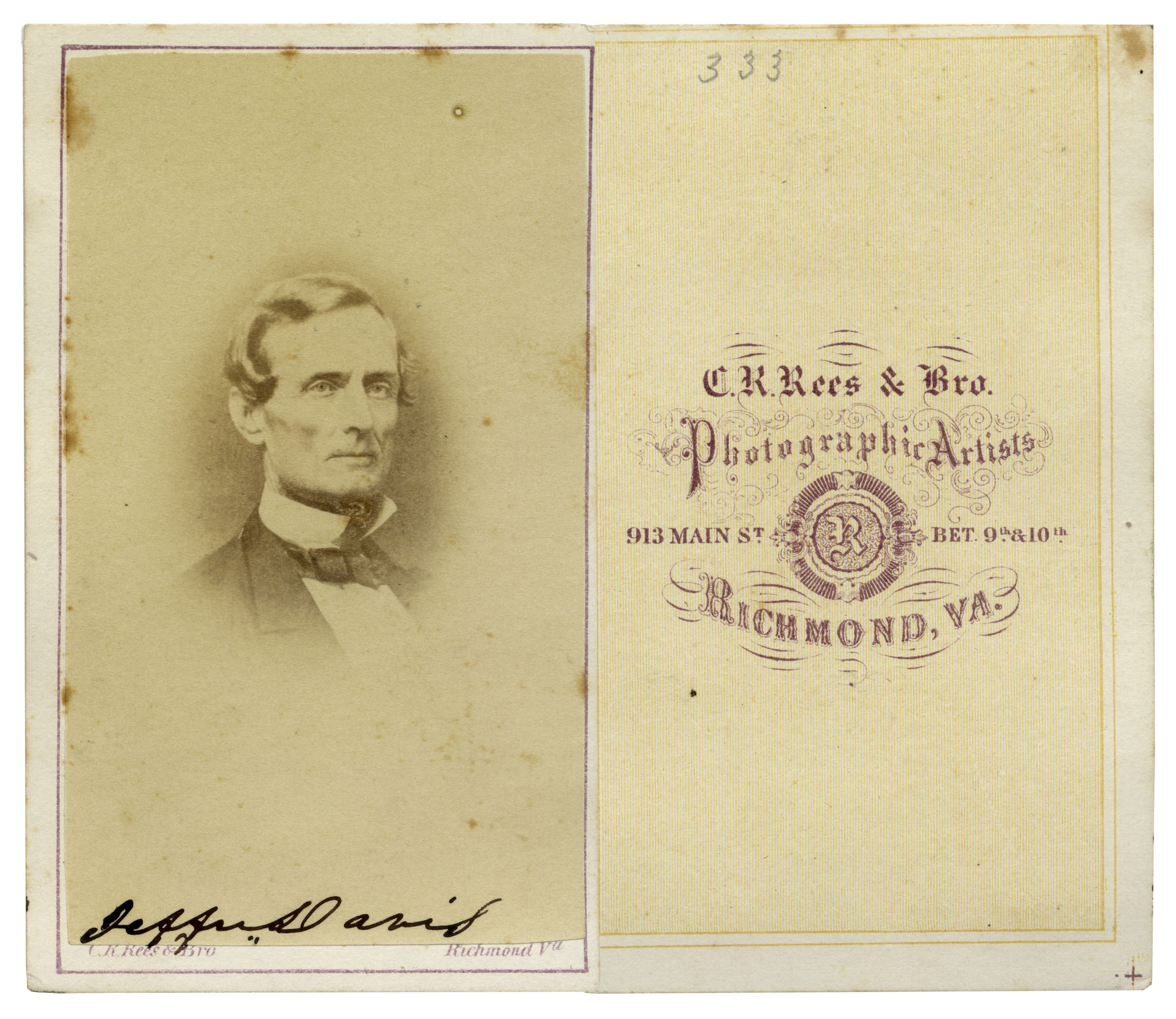
Jefferson Davis photo display signed. Full-length portrait of Davis bears his autograph inscription to the photographer Bendann Brothers’ border, upon which photo is mounted. Dedication to his nephew Maunsell White of Deer Range, Louisiana reads, “Affectionately your friend / and uncle / Jefferson Davis”. Other notations by unknown hands are present at the lower left and top center. Framed in its original antique wooden frame with gilt decoration to an overall size of 18″ x 21.5″. Toning and fading to image, else near fine. Sold for $4,382.

Auction your Charleston Mercury Extra Union Dissolved 1860 at Nate D. Sanders Auctions. Emailed a description & images of your Charleston Mercury Extra Union Dissolved 1860 to [email protected].
Abraham Lincoln assassination letter, dated 12 August 1900, from Dr. George Loring Porter to Louis Weichmann, chief prosecution witness at the conspirators’ trial. Porter, medical doctor for the imprisoned conspirators, was present at their execution as well as at John Wilkes Booth’s burial. He corroborates events and facts for Weichmann’s book on the assassination. Weichmann lived in Mary Surratt’s boardinghouse at the time of the assassination and was a suspected conspirator himself early on. Mary Surratt was a suspect as was her son, John, who fled to Canada and found sanctuary with a priest, escaping immediate prosecution. Mary Surratt was convicted and executed. Letter reads in part, ”…My thanks are due to you for the opportunity to read the manuscript of your work regarding the assassination. I can readily believe that you had opportunities for seeing many of the actors and observing their actions which no one else could possibly have had and what you saw you have stated clearly, forceably [sic] and interestingly. I await with much anticipation the perusal of the proposed book. You were right in your statement that Mrs. Surratt did not take the whiskey to Lloyds…I place no credence in the theory that any church incouraged [sic] the conspiracy although the actions taken by the Priests in Canada in providing for the secretion, safety, and escape of Surratt has been used as the ground for such a charge. With the exception of Mrs. S., I do not think that any of the active conspirators were subject to any denominational religious influence. As to my statement in the so-called lecture of John Surratt it is entitled to no credibility whatever beyond that which it may gain from the support of satisfactory independent testimony. I have no doubt of his guilt, nor of the fact that the failure of the jury to agree was due to religious and political influences and not to the lack of legal proof. The government wire to Fort Monroe was not cut — this was the one said to have been used by the government (this was partially laid in the river I have been told). The wires to Balt. were cut. I can not give the authority…” Porter was on a lecture circuit with his talk about the assassination entitled ”The Tragedy of the Nation.” He refers to a theory at the time that the assassination was a Catholic plot. Minor creasing to 8.25” x 11” three page letter, else very good. Abraham Lincoln assassination letter sold for $4,061.

From Confederate Prison in Texas Writes a 42nd Massachusetts Soldier — “…seems as if we were to be left here to die…” — Lot of Six Letters
Lot of six Civil War letters from Captain Alfred N. Proctor of the 42nd Massachusetts Infantry, who enlisted in 1862, and was aboard the steamer Saxon when it was captured on New Year’s Day 1863 in Galveston, Texas. Letters to his brothers (Charles and his twin, Albert) and father in Boston date from 17 April 1862 to 4 April 1864. Proctor’s first letter from Fortress Monroe at the mouth of Virginia’s Hampton Roads, dated 17 April 1862, was sent shortly after the Battle of Hampton Roads involving the Confederate ship Merrimac, “…The harbor is now clear of vessels. Most of them at anchor outside for fear that the Merrimac will serve them as she did some others last week…most probably she only shows herself…to keep the gun boats here so that they will not go up to assist in the battle at Yorktown…” Letter dated 11 December 1862, on board the steamer Saxon, reads in part, “…you can judge how astonished we were…to find when 24 hours out on opening our sealed orders that we were bound for Ship Island instead of Fortress Monroe…” Letter dated 22 December 1862 on board the Saxon reads in part, “…There was a grave yard next to our ship & I saw them bury some soldiers & the water comes so near to the graves that they have to hold the coffin down with sticks in the water till they could put on the dirt…We came up to New Orleans &…sailed up to Carrolton…There are lots of soldiers…going up the river to Baton Rouge to make an attack on Port Royal where there will be a big fight. We are going to Galveston…& we expect a fight…” Letter dated 23 December 1862 from Galveston reads in part, “…we had a narrow escape from getting on shore…getting blown out of the water by a gun boat in the night…taking us for a rebel craft…We are here at last at anchor in the harbor & it looks rather bad for us…There are some 3000 rebels here…” Letter dated 6 October 1863 from Confederate POW Camp Croce reads in part, “…I see no prospect of our release as yet. Now almost 10 months in confinement & what a glorious privilege is liberty when I get home…56 officers & 350 men here, have buried 8 in all…I hope to get exchanged for some of the Texas officers that our Government have…” Letter dated 4 April 1864 reads in part, “…Still we are here in confinement & I don’t know how long we are to remain…tomorrow 20 officers & 370 men leave here exchanged by Genl Banks. It seems as if we were to be left here to die for all they care for us at home…” Proctor was ultimately exchanged in July 1864, after 1.5 years in captivity. Card style letters average 8″ x 4″ and four pages each. Lot includes two envelopes, one postmarked in Virginia with cancelled stamp. Overall very good condition. Sold for $4,000.

Ford Theatre Wallpaper Fragment from the President’s Box Where President Abraham Lincoln Was Assassinated
Wallpaper fragment from the President’s Box at Ford’s Theatre where President Abraham Lincoln was shot by John Wilkes Booth on 14 April 1865. Burgundy wallpaper encapsulated. Very good condition. Sold for $3,200.

Letter dated 20 June 1898 from Almarin C. Richards, Washington D.C. Police Superintendent and attendee at Ford’s Theatre the night of Lincoln’s killing. Richards writes to Louis Weichmann — whose controversial testimony was the key evidence in convicting assassination conspirator Mary Surratt — regarding Weichmann’s book about the assassination. In part, ”…you unfold the scheme of consummation of the plot for assassinating the chief officer of our government as well as the pursuit, capture and punishment of the chief operators in the tragedy…as to the inception, progress and outcome of this nefarious attempt to wreck our government…this supreme crime of the age…” Letter measures 8” x 10”. Some tearing at the folds and toning, else very good condition. Sold for $3,125.

Amazing autograph letter from Washington, D.C. Police Superintendent Almarin C. Richards, in the audience at Ford’s Theater the night President Lincoln was assassinated, to Louis Weichmann, chief prosecution witness at the assassination conspirators’ trial. Richards searched for suspected conspirators John Wilkes Booth and John Surratt at the boardinghouse of Mary Surratt, John’s mother. In the 24 December 1900 letter, he reviews his memory of events for the book on the assassination Weichmann was writing. Richards states, ”…The fact is well and certainly known that Booth was the assassin of Lincoln before 12 o’clock midnight of the day of the assassination…[actress] Laura Keene had stated before that hour that while she did not know who had shot the President but that the man who jumped from the President’s box on the night was J Wilkes Booth…there seemed to be a peculiar hesitancy on the part of the theatre people…to disclose information…yet Miss Keene did not hesitate to state as above indicated. It was information that I had that Booth had been an associate of John Surratt’s for a few weeks prior to the assassination that led me to visit Mrs. Surratt’s house soon after midnight on that night…” Signed, ”A.C. Richards”. Minor smudging to 7.75” x 9.75” letter, written upon both the front and verso of one sheet. Overall very good condition. Sold for $3,125.

Intriguing autograph letter signed by Almarin C. Richards, Washington DC Police Superintendent and attendee at Ford’s Theatre the night of President Lincoln’s killing. Here, Richards writes to Louis Weichmann, former friend of Mary and John Surratt, about the ”Catholic plot” to assassinate the President and Weichmann’s persecution by the Catholics for his role in Mary Surratt’s execution. Anti-Catholic sentiment ran high during the Civil War. Letter in pen reads, ”…Of course I know nothing of the course of Father Walter and other Washington Catholics toward you relating to Mrs. [Mary] Surratt and the Conspiracy. I do know however that I would rather stand in your place in relation to that matter than in that of those who are seeking to make it appear that Mrs. Surratt was innocent of the crime with which she was charged and for which she forfeited her life. The fact that certain prominent Catholics in Washington have so persistently persecuted you and others who were prominent in bringing her and the other conspirators to justice has done more to lead many people to believe that the assassination was the outcome of a Catholic plot than any or all other circumstances. In fact there is nothing else developed that could lead to a suspicion that could in any way inculpate any one of the authorities of that church. Mrs. Surratt was privy to the assassination of Abraham Lincoln, President of the United States and justly expiated her offense upon the gallows. Whether she should have her executive clemency extended to her is quite another question. Very Truly Yours, A.C. Richards”. 8” x 10” letter is datelined Eustis, FL, 3 July 1898, written to Weichmann for a book that he was writing on the assassination. Slight separation at the folds, else very good condition. Sold for $3,125.

Consign your Charleston Mercury Extra Union Dissolved 1860 at Nate D. Sanders Auctions. Email a description & images of your Charleston Mercury Extra Union Dissolved 1860 to [email protected].
Large 6.5″ x 8.5″ Albumen Photo of Lincoln Conspirator John Surratt in the Zouave Uniform in Which He Was Captured — Scarce Image Taken by Mathew Brady
Extremely rare 1867 albumen photograph of Lincoln conspirator John Surratt in the Papal Zouave military uniform in which he was captured. Large photo taken by Mathew Brady’s studio measures 6.5″ x 8.5″. Surratt – the son of conspirator Mary Surratt, who were hung along with George Azelrodt, Lewis Powell and David Herold – had earlier connived with John Wilkes Booth to kidnap Lincoln but denied any participation in the assassination plot. Surratt had met Booth while a confederate spy and participated in many secret meetings with the conspirators at his mother’s boarding house. After Lincoln’s assassination he fled to Europe where he served in the Papal Zouaves. He was eventually extradited to the U.S. where he stood trial but was never convicted of conspiracy because the statute of limitations had expired by the time his trial concluded. This extremely rare picture was taken by Mathew Brady and Co. in 1867 after his capture and is stamped by the Brady studio. It was sold to the public during Surratt’s high-profile 1867 trial. Photo is oval, measuring 6.5″ x 8.5″, and is mounted to 10″ x 12″ with a band of gold trim. Photo is captioned, in part: “Entered according to Act of Congress, by John H. Surratt, in the year 1868, in the Clerk’s Office of the District Court of the District of Columbia. John H. Surratt, in the Papal Zouave uniform in which he was captured”. Significant dampstaining on upper right, two chips out of upper edge, some foxing and a discreet 1.5″ tear along the left. Picture is nice and clear. Good condition. Sold for $2,756.

FREE ESTIMATE. To buy, auction, sell or consign your Charleston Mercury Extra Union is Dissolved 1860 that is for sale, please email your description and photos to [email protected] of Nate D. Sanders Auctions (http://www.NateDSanders.com).
We offer the following for your Charleston Mercury Extra Union Dissolved 1860:
- Appraise Charleston Mercury Extra Union Dissolved 1860.
- Auction Charleston Mercury Extra Union Dissolved 1860.
- Consign Charleston Mercury Extra Union Dissolved 1860.
- Estimate Charleston Mercury Extra Union Dissolved 1860.
- Sell Charleston Mercury Extra Union Dissolved 1860.