
Sell or Auction Your Bela Kun Typed Letter Signed for up to Nearly $5,000 or More at Nate D. Sanders Auctions
FREE APPRAISAL. To buy, auction, sell or consign your Bela Kun typed letter signed that is for sale, please email your description and photos to [email protected] of Nate D. Sanders Auctions (http://www.NateDSanders.com).
Free Appraisal, Auction or Sell Your Bela Kun Typed Letter Signed
Béla Kun (born Béla Kohn; 20 February 1886 – 29 August 1938) was a Hungarian communist revolutionary and politician who governed the Hungarian Soviet Republic in 1919. After attending Franz Joseph University at Kolozsvár (today Cluj-Napoca, Romania), Kun worked as a journalist before the First World War. He served in the Austro-Hungarian Army and was captured by the Imperial Russian Army in 1916, after which he was sent to a prisoner-of-war camp in the Urals. Kun embraced communist ideas during his time in Russia, and in 1918 he co-founded a Hungarian arm of the Russian Communist Party in Moscow. He befriended Vladimir Lenin and fought for the Bolsheviks in the Russian Civil War.
Below is a recent realized price for a Bela Kun typed letter signed item. We at Nate D. Sanders Auctions can obtain up to these amounts or more for you:
Bela Kun Typed Letter Signed. Sold for nearly $5,000.

Nate D. Sanders Auctions has sold the following similar items:
Joseph Stalin Autograph on a World War II Document
Joseph Stalin autograph on a World War II-dated document. Written in Cyrilic, ”Diploma of the Laureate of the Stalin Prize” is datelined from Moscow, and was awarded to the men who helped create emergency leather substitutes. Additionally signed by Y Chadaev, Council of the People’s Commissars, Administrator of Affairs. Reads in part: ”…by the decision of the Council of People’s Commissars of the Union at the S.S.R…the Stalin Prize second class is awarded to (Pisarenko, Alekseenko, Gavrikov, Rogov, Plotnikov, Khomutov, Marakhovskiy)…” Nicely bound document with embossed U.S.S.R. seal. Contained within a gilt hardcover folder with metallic profile busts of Stalin and Lenin. Document measures 10.25” x 14.25” and runs 8pp. Light toning to first blank page and minor foxing throughout, otherwise in very good condition. Dark Joseph Stalin autograph. Sold for $9,625.

Russian Chemist Dmitri Mendeleev Autograph Letter Signed — “…The elements of organic chemistry are represented in such a new way…”
Russian chemist Dmitri Mendeleev, mastermind behind the periodic table of elements, signs a handwritten letter, “D. Mendeleef” in black ink. The letter is written in French and datelined St. Petersburg, 25 November 1888. He writes, “Sir! Allow me to thank you for sending me Remsen’s book…’Introduction to the Study of the Compounds of Carbon.’ The elements of organic chemistry are represented in such a new way…verify if I can get the rights to translate into other languages…” Significant chipping and some paper loss to edges of 8.5″ x 11″ letter, though handwriting remains quite clear and legible. Very good. Handwritten letters by Mendeleev are quite scarce, especially so with chemistry content. Sold for $9,359.

Russian Composer Pyotr Ilyich Tchaikovsky Autograph Letter Signed — “…Give me sweetheart forty rubles as a loan…”
Undated Pyotr Ilyich Tchaikovsky autograph letter signed on the composer’s personal monogrammed stationery. He writes in Russian to Katerina Ivanovna, a close friend who married fellow musician and Tchaikovsky’s lifelong friend, Herman Laroche. Letter reads in part, “…Give me sweetheart forty rubles as a loan. I don’t have enough to pay for everything…” He adds that he will repay the loan through his friend Manya. Tchaikovsky, famous for his symphonies, operas and ballets, such as “Nutcracker Suite” and “Swan Lake,” was successful in his lifetime, but did suffer periods of financial turmoil. 3.75″ x 5.5″ letter is matted and framed with an image of the composer and a plaque with biographical information to an overall size of 18.5″ x 21.5″. Near fine condition. Sold for $6,534.

Very Scarce Handwritten Letter by Princess Anastasia, Daughter of Czar Nicholas II — Handwritten letter by the Princess Who Was Assassinated with Her Family & Whose Body Was Never Found — With PSA/DNA COA
Autograph note signed in Russian, “Little Anastasia,” on the front and inside of a 5.25″ x 2.5″ fold-open card bearing a color chromolithograph of two little girls in winter clothes and sable muffs, one of which carries a Christmas tree. The youngest daughter of Czar Nicholas II of Russia, Anastasia was murdered with her family on 17 July 1918 by forces of the Bolshevik secret police, making any signed items of hers very scarce. In this note dated 16 October 1909, the eight-year old princess writes to “Shura”, asking her, “…how are you and how are mum and dad?…What is the weather like out there? Little Anastasia”. Shura is most likely Alexandra Tegleva, Anastasia’s personal nurse whom only the Princess called “Shura.” Alexandra Tegleva would accompany the Imperial family to Siberia in 1917 when they were fleeing revolutionary forces, and ultimately married Pierre Gilliard, tutor to the children. Some scattered light toning and soiling, primarily to first page and a bit of trivial surface loss to top right corner, otherwise fine condition. A brief but tender note from the young royal. Lot includes COA from PSA/DNA. Sold for $4,300.

Stalin’s Sweet Letter to His 9 Year-Old Daughter Around the Time of His Violent Great Purge Policy — ”…I got your letter. Thank you for not forgetting about your Daddy…” — 1935
Joseph Stalin autograph letter signed as leader of the Soviet Union to his young daughter. Just before the Great Terror and his violent Great Purge policy, he writes to his nine year-old, Svetlana Alliluyeva. Dated 8 September 1935, in red grease pencil, it translates in part to: ”…I got your letter. Thank you for not forgetting about your Daddy. How are your secretaries doing? Please, find some time to write me about them. I’m doing fine, just missing you. I kiss you very much…Stalin”. After her mother’s apparent suicide and two marriages, Svetlana defected to the United States in 1967. Single page letter measures 5.25” x 7.75”. Creasing, else near fine. Sold for $4,153.

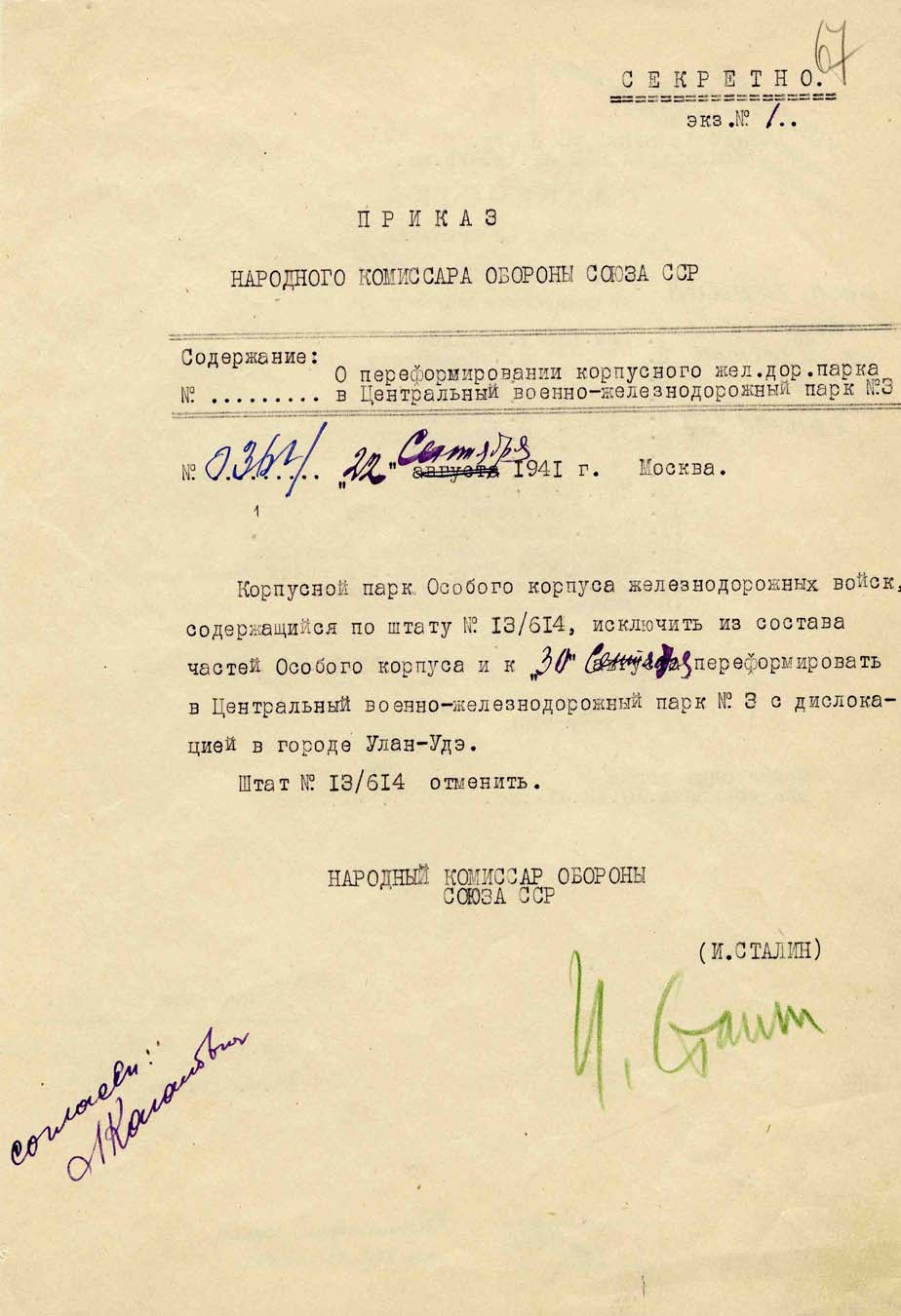
Scarce 1941 Military Orders Signed by Joseph Stalin — Restructuring Railway Lines as the Nazis Were Advancing on Moscow
Extremely rare WWII-dated military order signed by Soviet dictator Joseph Stalin, as Stalin struggled to disrupt the Nazi advance into the country and protect Moscow. Entitled, “Order of the People’s Commissar of Defense of the USSR, document is dated 22 September 1941 and orders the restructuring of rail lines along the Trans-Siberian Railway. The order translates from Russian, “The transport fleet of the special corps of the armed railway forces is to be fazed out from the inventory of the special corps by the 30th of September and to be transformed into the Central Railroad Park No. 3 with the relocation of the base to the city of Ulan-Ude. Staff No 13/614 is hereby abolished. / PEOPLE’S COMMISAR OF DEFENSE OF THE USSR / [signed] J. Stalin / [signed] Agree / L. Kaganovich.” Signed in green grease pencil by Stalin. The document’s verso lists only 18 people who were to receive the order. Double-sided 8.5″ x 11.5″ sheet has very light toning and a small chip to lower left side. Near fine condition. Bold Joseph Stalin autograph. Sold for $4,078.
Scarce Leo Tolstoy Autograph on Signed Vintage Photo Postcard — With PSA/DNA COA
Very rare autograph by the Russian literary genius, Leo Tolstoy. Tolstoy signs his name, “Leo Tolstoi” below his image on a striking postcard capturing the writer as an elderly man. The card verso is postmarked in Russian for 1909, one year before his death. The recipient is a Herrn Richard Stern in Vienna, Austria. Postcard measures 3.5″ x 5.5″ with some silvering to photo and slight wear to the edges. Very good condition. Scarce. With PSA/DNA COA. Sold for $3,500.


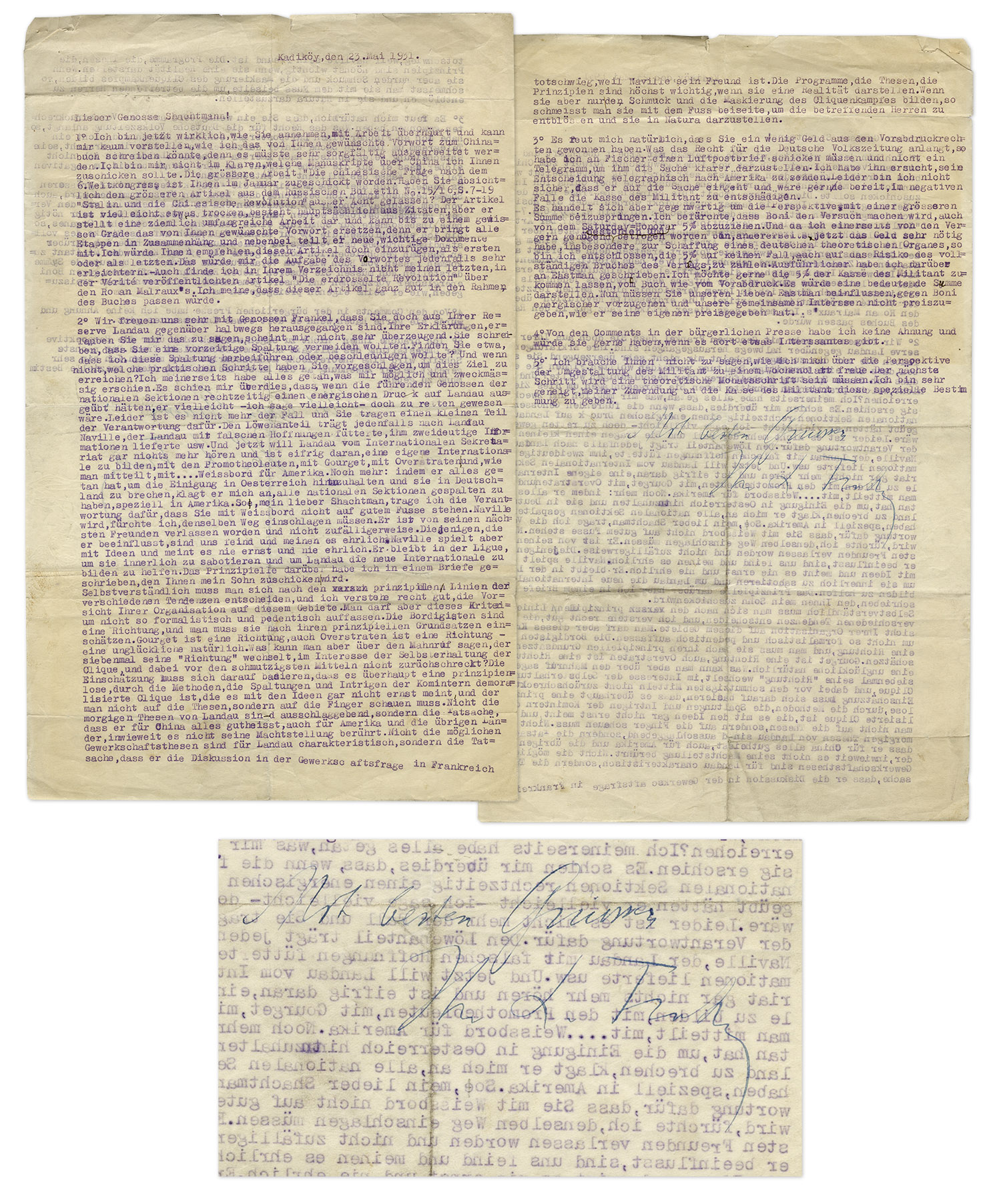
Leon Trotsky Letter Signed re Communism & Stalin
Fantastic and scarce letter signed by Leon Trotsky, dated 23 May 1931 from Kadikoy, Turkey, where Trotsky was exiled by Joseph Stalin, struggling not only to stay relevant but also to stay alive. Trotsky writes to his close friend and comrade, Max Shactman on a host of subjects, most notably the factions developing within the Communist party after its takeover by Stalin. Signed “L. Trotsky” and written in German with an English translation, the densely written letter of some 95 typed lines reads in part, “…I am now really, as you can imagine, swamped with work and can hardly imagine how I could write you the requested preface for the China book…Did you deliberately ignore the bigger article from the Russian Bulletin No. 15/16, pages 7-19 ‘Stalin and the Chinese Revolution’…I also do not find in your index my last article ‘The Strangled Revolution’…We are very glad with Comrade [Jan] Frankel that you came at least half way out of your reserve towards [Kurt] Landau. Your explanation, allow me to say, seems not to be too convincing. You write that you wanted to avoid a premature split. Do you actually believe that I wanted to provoke or expedite this split?…I for my part have done everything that seemed possible and appropriate. It appeared to me, by the way, that if the leading comrades of the national sections had put strong pressure on Landau at the right time he could have perhaps – I repeat perhaps – been saved. Unfortunately, this is no longer the case and you carry some of the responsibility. The lion’s share of the fault, after Landau, lies with [Pierre] Naville, who fed Landau false hopes, delivered confusing information to him, etc. Now Landau wanted to hear nothing more about the International Bureau and is busy creating his own International…There is more: since he did everything possible to shake up the agreement in Austria and to break it in Germany, he accuses me of splitting up all national sections, especially in America. So, my dear Shactman, you see that I am being blamed for the fact that you and [Albert] Weissbord are not on good terms…Naville, however, plays with ideas and is never earnest or honest…What can one say about the warning that if one changes one’s ‘course’ seven times in the interest of self preservation of the Clique and is not afraid to use the dirtiest methods?…Landau’s themes of tomorrow are crucial, but the fact that as long as his power is not threatened he approves of everything in China, also in America and all the other countries…” Trotsky then discusses copyright fees, “Since on the one hand I have been cheated…I do need the money very urgently now”, as well as “comments in the local press and if they are interesting I would like to know about them”. He closes with stating “how pleased I am about the prospect of the change of the ‘Militant’ to a weekly paper. The next step must be a theoretical monthly paper…” Soon after this letter was written, Trotsky would move to France where he was given asylum. He was then transferred to Norway where he lived under increasing confinement, until his move to Mexico, where he was murdered by Stalin’s proxies in 1940. Two page letter measures 8.5″ x 13.25″. Folds and some chipping to top; overall in very good condition, with exceptional content regarding the pre-WWII divisions in the Communist party. Sold for $1,995.
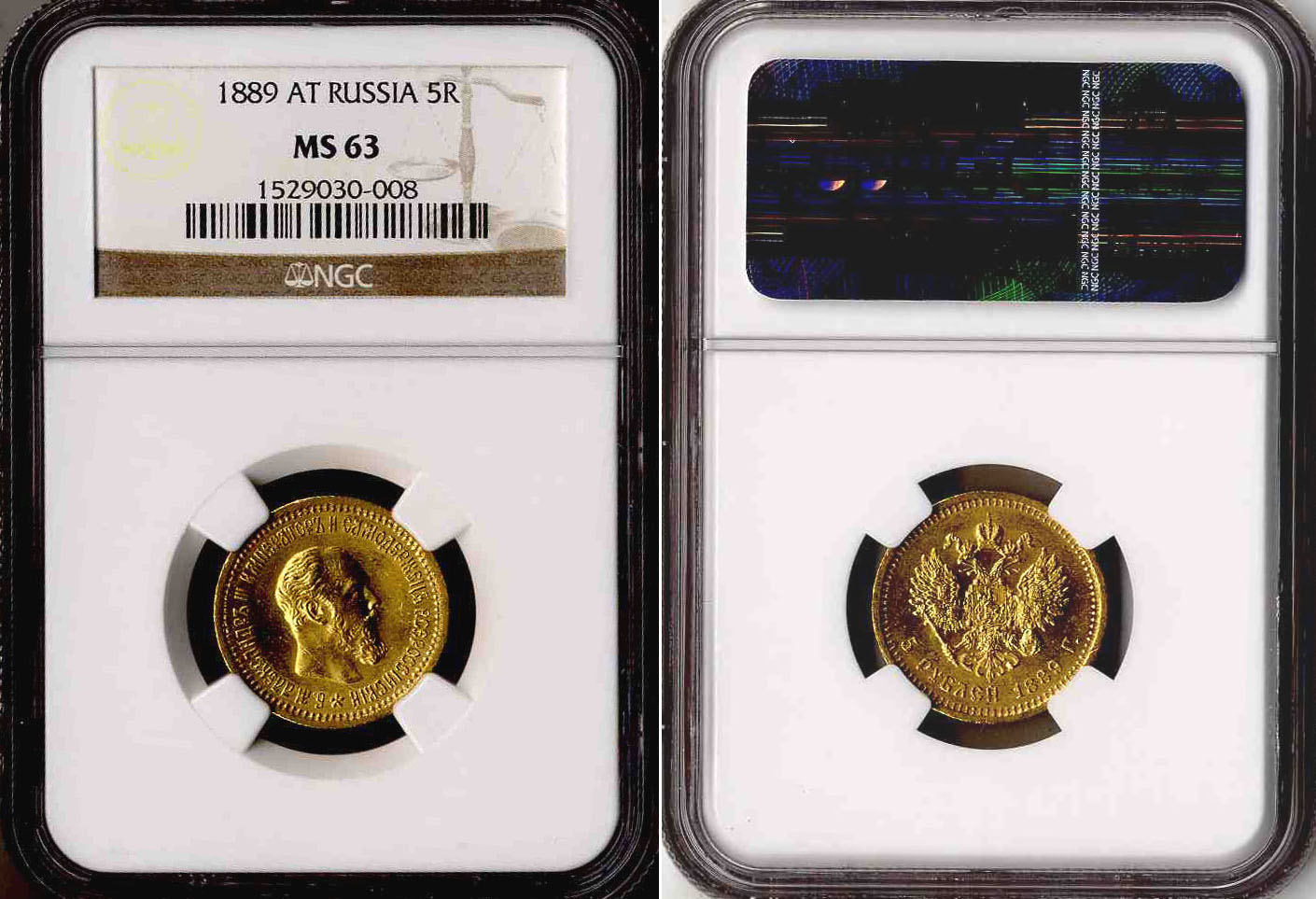
1889 AT Russian 5 Roubles NGC MS63
The ruble or rouble (/ˈruːbəl/; Russian: рубль, IPA: [rublʲ]) or ₽ is or was a currency unit of a number of countries in Eastern Europe closely associated with the economy of Russia. Originally, the ruble was the currency unit of Imperial Russia and then the Soviet Union (as the Soviet ruble), and it is currently the currency unit of Russia (as the Russian ruble) and Belarus (as the Belarussian ruble). On 17 December 1885, a new standard was adopted which did not change the silver ruble but reduced the gold content to 1.161 grams, pegging the gold ruble to the French franc at a rate of 1 ruble = 4 francs. This rate was revised in 1897 to 1 ruble = 2⅔ francs (0.774 grams gold). The ruble was worth about 0.50 USD in 1914. With the outbreak of World War I, the gold standard peg was dropped and the ruble fell in value, suffering from hyperinlation in the early 1920s. With the founding of the Soviet Union in 1922, the Russian ruble was replaced by the Soviet ruble. 1889 AT Russian 5 Roubles — NGC Graded MS63 . Sold for $1,100.
Exceptional, glossy photograph of Tsar Nicholas II, the Empress Alexandra and their first daughter the Grand Duchess Olga. A studio photograph taken by A. Pasetti Studios in St. Petersberg circa 1895, it is printed on the studio’s cardstock. Measuring 4” x 6.25”, this photo of Russia’s last imperial family has some foxing and surface wear but is otherwise in near fine condition. Sold for $600.

FREE APPRAISAL. To buy, auction, sell or consign your Bela Kun typed letter signed that is for sale, please email your description and photos to [email protected] of Nate D. Sanders Auctions (http://www.NateDSanders.com).