
Sell or Auction Your Andrew Gray Southern Pacific Railway Survey 1856 for up to Nearly $50,000 or More at Nate D. Sanders Auctions
FREE APPRAISAL. To buy, auction, sell or consign your Andrew Gray Southern Pacific Railway Survey 1856 that is for sale, please email your description and photos to [email protected] of Nate D. Sanders Auctions (http://www.NateDSanders.com).
Free Appraisal, Auction or Sell Your Andrew Gray Southern Pacific Railway Survey 1856
Andrew Belcher Gray (July 6, 1820 – April 16, 1862) was an American surveyor. Born in Norfolk, Virginia, he studied engineering and surveying under Andrew Talcott, and surveyed the Mississippi Delta with him in 1839, before joining the Texas Navy as a midshipman. Remaining in the Republic of Texas, he was appointed a surveyor for the Texas-U.S. boundary commission led by Memucan Hunt. In 1844–1846, he served as U.S. government mineral surveyor, mapping the rich copper country of the Keweenaw Peninsula in Michigan and leasing out the government’s mineral lands.
Below is a recent realized price for an Andrew Gray Southern Pacific Railway Survey 1856 item. We at Nate D. Sanders Auctions can obtain up to these amounts or more for you:
Andrew Gray Southern Pacific Railway Survey 1856. Sold for nearly $50,000.
Consign your item at Nate D. Sanders Auctions. Send a description and images to us at [email protected].
Here are some recent items that our auction house, Nate D. Sanders (http://www.NateDSanders.com) has sold:
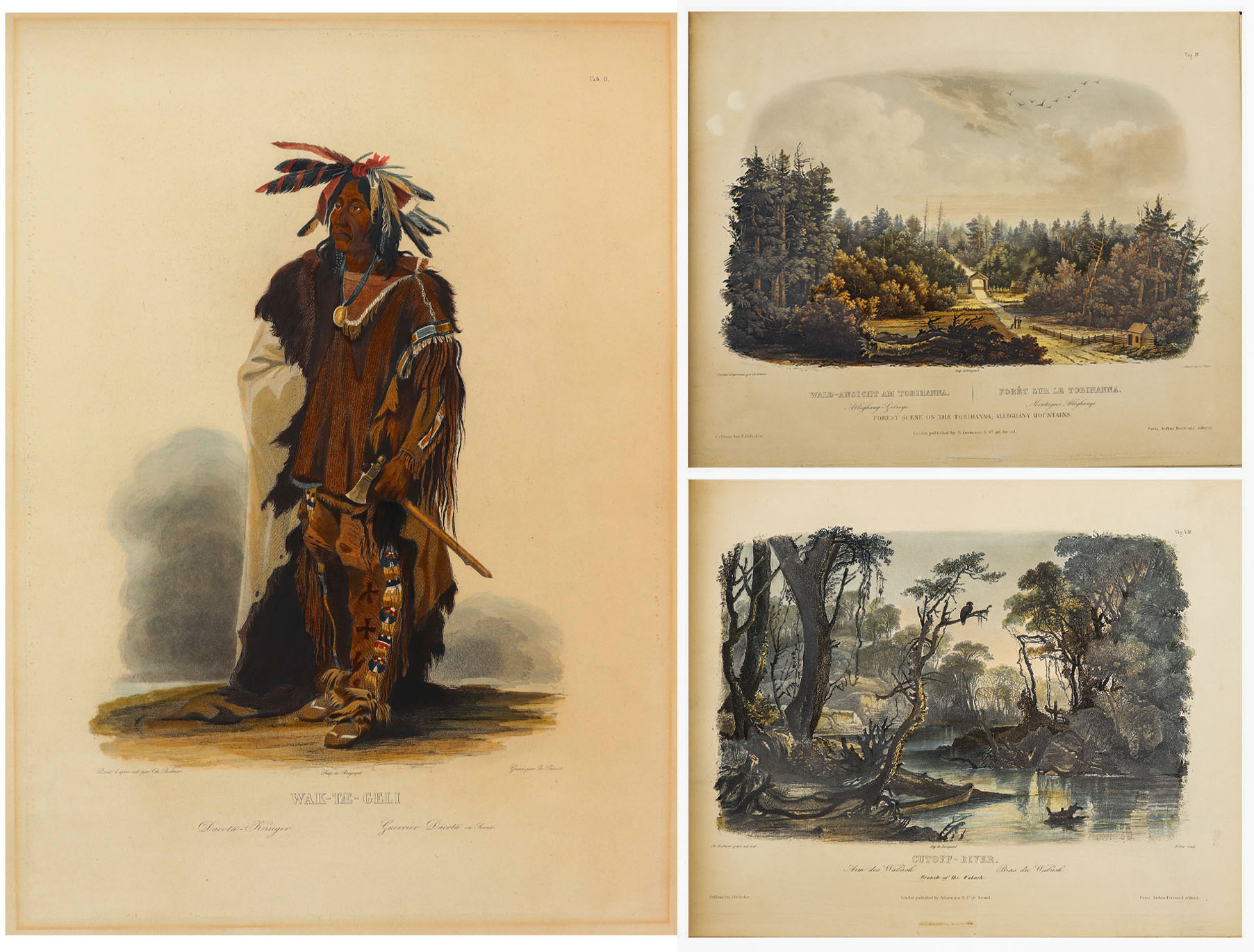
Karl Bodmer Prince of Wied’s Travels in the Interior
Stunningly beautiful collection of 81 hand-colored aquatints by the Swiss artist Karl Bodmer, a complete collection from the illustrated travelogue, “Prince of Wied’s Travels in the Interior of North America”. Bodmer, who journeyed with the German Prince Maximilian of Wied-Neuwied from 1833-34 along the Missouri River, produced what is considered the best depictions of the indigenous peoples and landscapes during the frontier era, an America then still unspoiled by western migration. Of the Native American tribes of the Great Plains that they encountered, Bodmer’s depictions of the Blackfeet and Mandan tribes are especially important as the populations of these tribes were greatly affected by the smallpox epidemic of 1837, thus making Bodmer’s work the last visual testament to their culture.
Prince Max, as he was called, chose Bodmer to accompany him on the expedition along the Missouri River to visually depict the scenes that the Prince would write about. The result is this collection: three volumes of text by the Prince and two volumes of aquatints by Bodmer, in the first Paris edition published by Chez Arthus Bertrand, 1840-43 (“Voyage dans l’interieur de l’Amerique du Nord”). Text volumes in French also include 37 wood-engraved illustrations, only lacking the map in completeness. The two complete volumes of illustrations include the large folio volume with 48 oversized hand-colored aquatints measuring approximately 24.5″ x 18″, and the quarto volume with 33 hand-colored aquatints measuring approximately 12.5″ x 10.25″. The complete set of 81 aquatints is magnificent in their display, a time capsule with their hand-coloring evoking the sense of awe and discovery of the expedition. All volumes are bound in half black morocco and blue paper-covered boards with gilt accenting, and with black morocco labels to illustrated volumes. Minor handling wear to volumes, with a few small repaired tears to plates, some plates supplied with variance to margins, minute toning and foxing, a few plates beginning to separate from binding. Overall a very good plus set with excellent display quality. Sold for $175,000.


Currier & Ives Hand-Colored Lithograph Measuring — 19th Century Print Remains Boldly Colored
Currier and Ives was a successful American printmaking firm based in New York City from 1835 to 1907 headed first by Nathaniel Currier, and later jointly with his partner James Merritt Ives. The prolific firm produced prints from paintings by fine artists as black and white lithographs that were hand colored. Lithographic prints could be reproduced quickly and purchased inexpensively, and the firm called itself “the Grand Central Depot for Cheap and Popular Prints” and advertised its lithographs as “colored engravings for the people”. The firm adopted the name “Currier and Ives” in 1857.
Beautiful Currier & Ives hand-colored lithograph entitled “The Life of a Hunter. ‘A tight fix’”. Produced in 1861 on wove paper, lithograph measures 28″ x 21.5″, framed to 39″ x 32.25″. Very well-preserved with deep, rich colors. A few small repaired tears to margin, with two extending slightly into the image at top and bottom right, though nearly indiscernible; also with faint discoloration to margins, else near fine condition. A rare lithograph so well preserved by the storied print makers. Sold for $31,680.

Important corporate ledger, describing in detail the formation, operation and sale of the mining company constituting the wealth of one of the most successful and philanthropic American families: The Guggenheims, led by patriarch Meyer Guggenheim and his sons Daniel, Morris, Benjamin, William, Simon, Isaac and Solomon, whose combined signatures total over 70 in this ledger spanning over 90 pages. Meyer’s signature, in particular, is elusive apart from this ledger.
Entire ledger is handwritten apart from the last meeting documenting the sale, and two additional typed pages noting stockholder meetings. Ledger therefore comprises 91 handwritten pages and four typed pages. Handwritten pages measure 13.75” x 8.5”, bound in quarter leather boards with gilt embellishments and marbled endpapers. Ledger is complete with the exception of pages 21-30. Some loss to spine, tape repair on endpapers and some loose pages. Pages themselves are near fine, very legible with beautiful penmanship, and very well-preserved with only nominal age wear. Sold for $30,000.
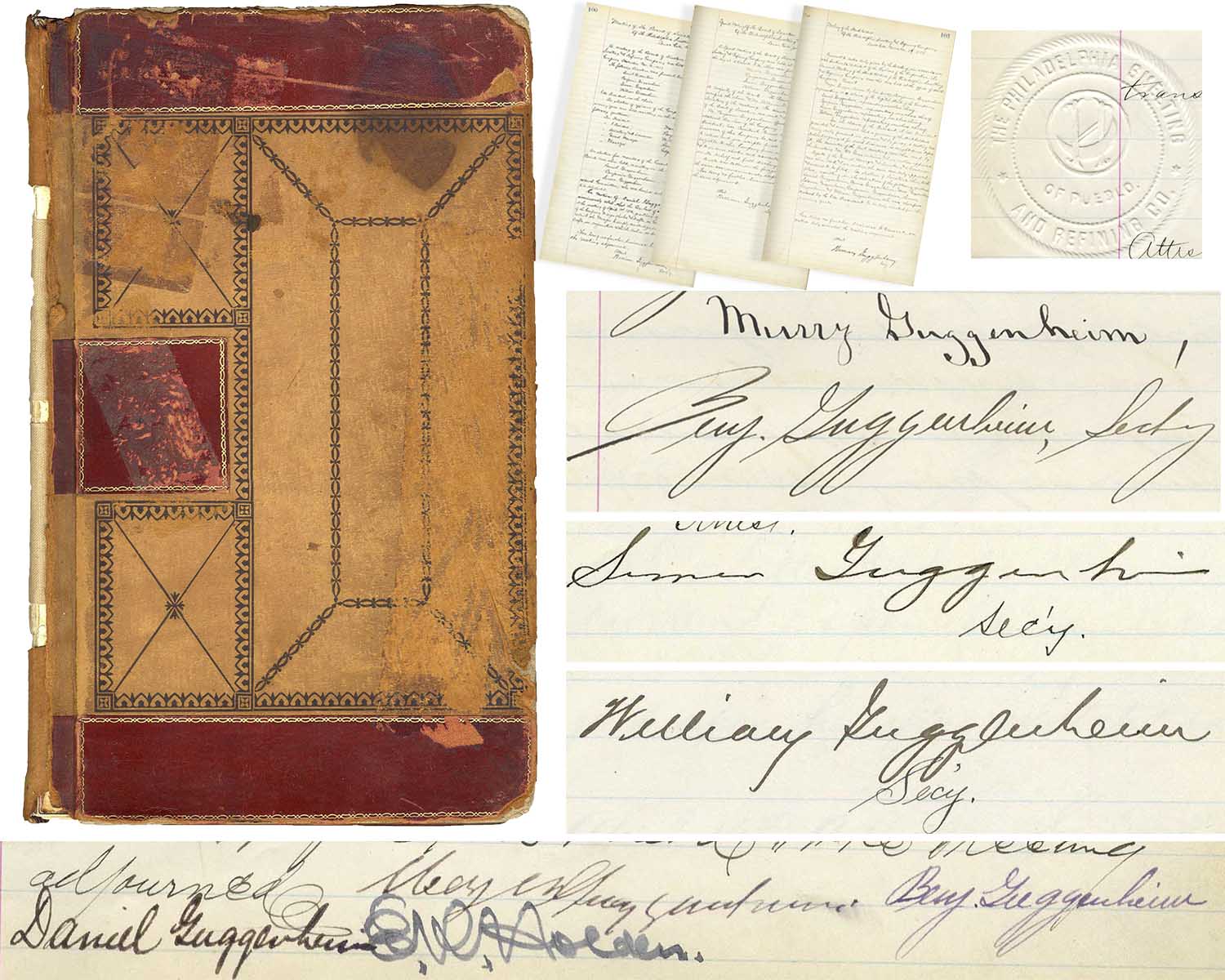
Very scarce and important Guggenheim company document from 1888 at the beginning of their mining empire, signed by three members of the Guggenheim family: patriarch Meyer Guggenheim, whose signature remains elusive apart from this document; Daniel Guggenheim, who took over the family’s business after his father’s death in 1905; and Benjamin Guggenheim (signed three times), who died on the Titanic, but not before helping women and children board life boats, and then changing into formal evening clothes ”to go down like gentlemen”. Benjamin Guggenheim’s signature is considered scarce, but can be found, unlike that of Meyer Guggenheim.
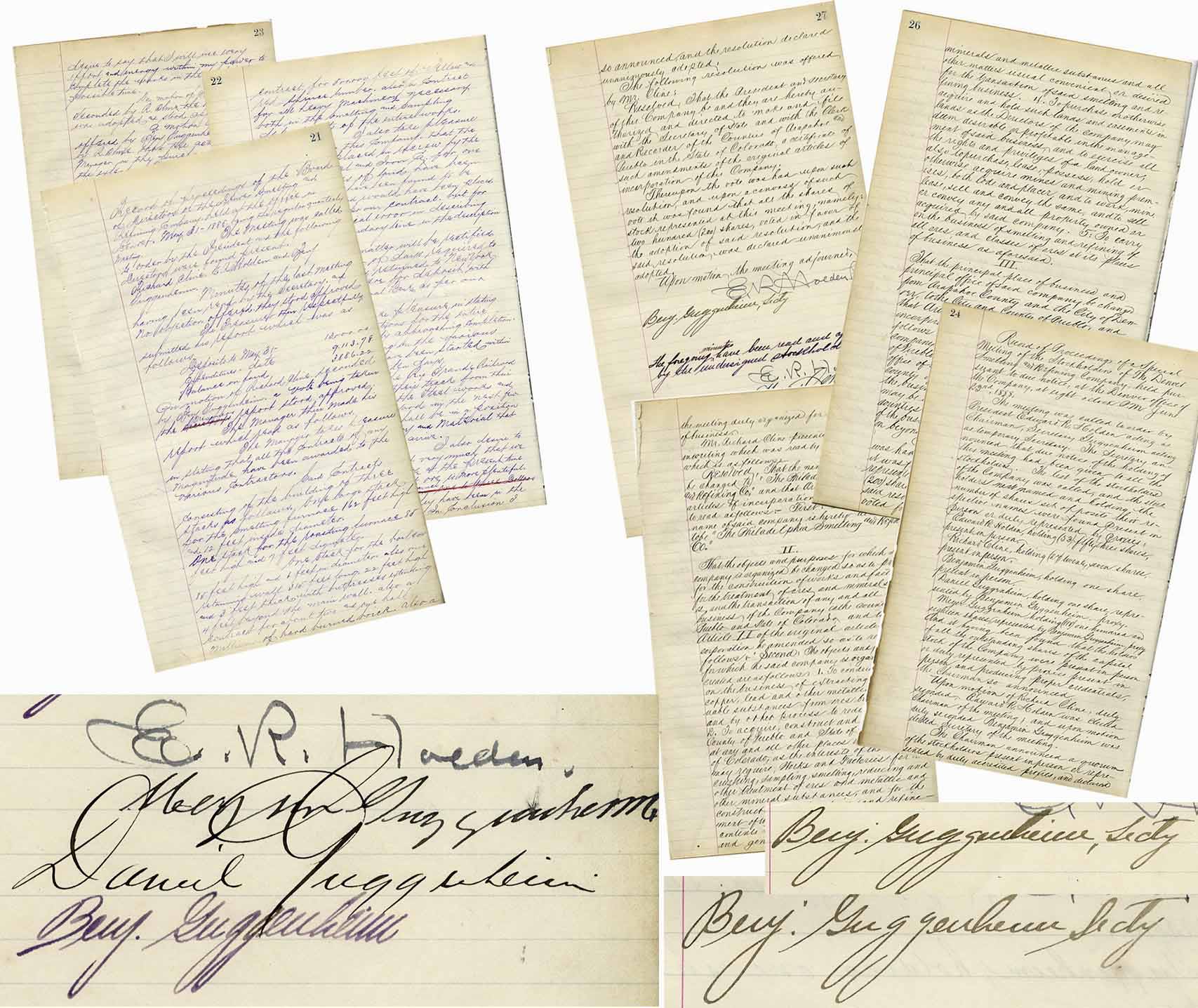
Seven page document is from the business ledger of the Denver Smelting and Refining Company from May-June 1888, consisting of pages 21-28 of the ledger. Based in Colorado, the Guggenheim family made its fortune through this company, established in January 1888 according to its Articles of Incorporation. In pages 21-23 of this ledger, business of the company is recorded, including revenues and expenditures, but the more important section is pages 24-27, where the Articles of Incorporation for the company are amended to change its name to the ”Philadelphia Smelting and Refining Co.”, and the very purpose of the company is amended to ”provide for the construction of works and factories for the treatment of ores and mineral substances”. Its revised mission continues, ”To conduct and carry on the business of extracting gold, silver, copper, lead and other metallic and valuable substances from ores by smelting and by other process…To purchase, sell and generally deal in ores and other minerals and metallic substances…To purchase or otherwise acquire and hold such lands and easements in lands…” The document enumerates the shares of the company, with the vast majority belonging to Meyer Guggenheim, and is signed at the conclusion by the shareholders: ”Meyer Guggenheim”, ”Daniel Guggenheim”, ”Benj. Guggenheim” (signs twice) and ”E.R. Holden” (signs twice). The full 7 pages has been transcribed, giving detailed insight into the beginnings of one of the greatest companies in the history of America.
Additionally, pages 21-23 are important in their own right, and read in part, ”Record of Proceedings of the Board of Directors of the Denver Smelting and Refining Company held at the office in Denver, May 31 – 1888, being the regular quarterly meeting. The meeting was called to order by the President and the following Directors were found present. [Vice President] Richard Cline, [President] E.R. Holden and Benj Guggenheim. / Minutes of the last meeting having been read by the Secretary, and no objection offered, they stood approved. / The President then respectfully submitted his report which was as follows.
Deposits to May 31 – 13,000.00
Expenditures [to] date – 9,113.78
Balance on hand – 3,886.22
On motion of Richard Cline recorded by Benj. Guggenheim a vote being taken the…report stood approved…The Manager takes pleasure in stating that all the contracts of any magnitude have been awarded to the various contractors…” The ledger then lists details of contracts, including capacity of smelting furnaces, and also details of nearby railroad construction. The ledger continues, ”…I also desire to say that I regret very much that we are not smelting ore at the present time for the reason that ore is more plentiful and the prices are much better than they have been in the past few years…I will use every effort and energy within my power to complete the works in the earliest possible time…A motion was then offered by Benj. Guggenheim…that the action of the Manager in the purchase of stock to the extent of $3500 in the Pueblo [?] association be approved…[signed] E.R. Holden. Pres. [and] Benj. Guggenheim Secty”. Seven pages penned in elegant penmanship, likely handwritten by Richard Cline, measure 8.25” x 13.5” on four sheets of lined ledger paper. Light toning, otherwise in near fine condition. Sold for $18,750.
Scarce 1941 Military Orders Signed by Joseph Stalin — Restructuring Railway Lines as the Nazis Were Advancing on Moscow
Extremely rare WWII-dated military order signed by Soviet dictator Joseph Stalin, as Stalin struggled to disrupt the Nazi advance into the country and protect Moscow. Entitled, “Order of the People’s Commissar of Defense of the USSR, document is dated 22 September 1941 and orders the restructuring of rail lines along the Trans-Siberian Railway. The order translates from Russian, “The transport fleet of the special corps of the armed railway forces is to be fazed out from the inventory of the special corps by the 30th of September and to be transformed into the Central Railroad Park No. 3 with the relocation of the base to the city of Ulan-Ude. Staff No 13/614 is hereby abolished. / PEOPLE’S COMMISAR OF DEFENSE OF THE USSR / [signed] J. Stalin / [signed] Agree / L. Kaganovich.” Signed in green grease pencil by Stalin. The document’s verso lists only 18 people who were to receive the order. Double-sided 8.5″ x 11.5″ sheet has very light toning and a small chip to lower left side. Near fine condition. Bold Joseph Stalin autograph. Sold for $4,078.

John Rockefeller Letter & Stock Certificate Both Signed
Oil mogul John D. Rockefeller signed stock certificate for Standard Oil Trust, as well as a typed letter signed “John D. Rockefeller” on his personal stationery, giving thanks for birthday wishes on his 83rd birthday. Stock is signed “J.D. Rockefeller” as company President, dated 28 June 1887, for 100 shares made out to Benjamin Brewster, who, in addition to being one of the original Trustees of Standard Oil, was also a Mayflower descendant and extremely successful Gold Rush entrepreneur. He is credited with much of the early success of Standard Oil and Rockefeller served as pallbearer at his funeral. Stock certificate and letter are beautifully framed with a photograph of Rockefeller and a photograph of Brewster’s home, named “Scrooby” and now a historical inn. Stock measures 11.75″ x 7.5″, letter measures 5.5″ x 7.5″ and entire framed presentation measures 32″ x 25.75″. Folds to documents, otherwise near fine, impressively displayed. Sold for $2,734.

Thomas Edison Signed Stock Certificate for ”Edison Phonograph Works”
Thomas Edison signs a stock certificate ”Thos A Edison” as President of Edison Phonograph Works of New Jersey. Dated 18 May 1888, the year of the company’s founding, it’s issued to R.L. Cutting in the amount of 200 shares. Best known as inventor of the incandescent light bulb, Edison was also the genius behind the phonograph, kinetoscope (an early machine to view motion pictures), ore-mill machinery, the dictating machine and more. With the phonograph, Edison pioneered sound recording. Stock certificate measures approximately 8” x 4”. Some discoloration along left side and various unobtrusive cancellation marks. In very good condition with a bold signature by Edison. Sold for $2,520.

Thomas Edison signed stock in the Edison Storage Battery Company, presciently founded in 1901 to manufacture batteries for electric cars. Dated 17 July 1901, Edison signs ”Thomas A. Edison” as President. Attractive document printed in green and black measures 13.25” x 8”. Stock is marked as cancelled with a faint swivel through Edison’s signature, and staple punctures to left edge, otherwise near fine. Sold for $2,500.

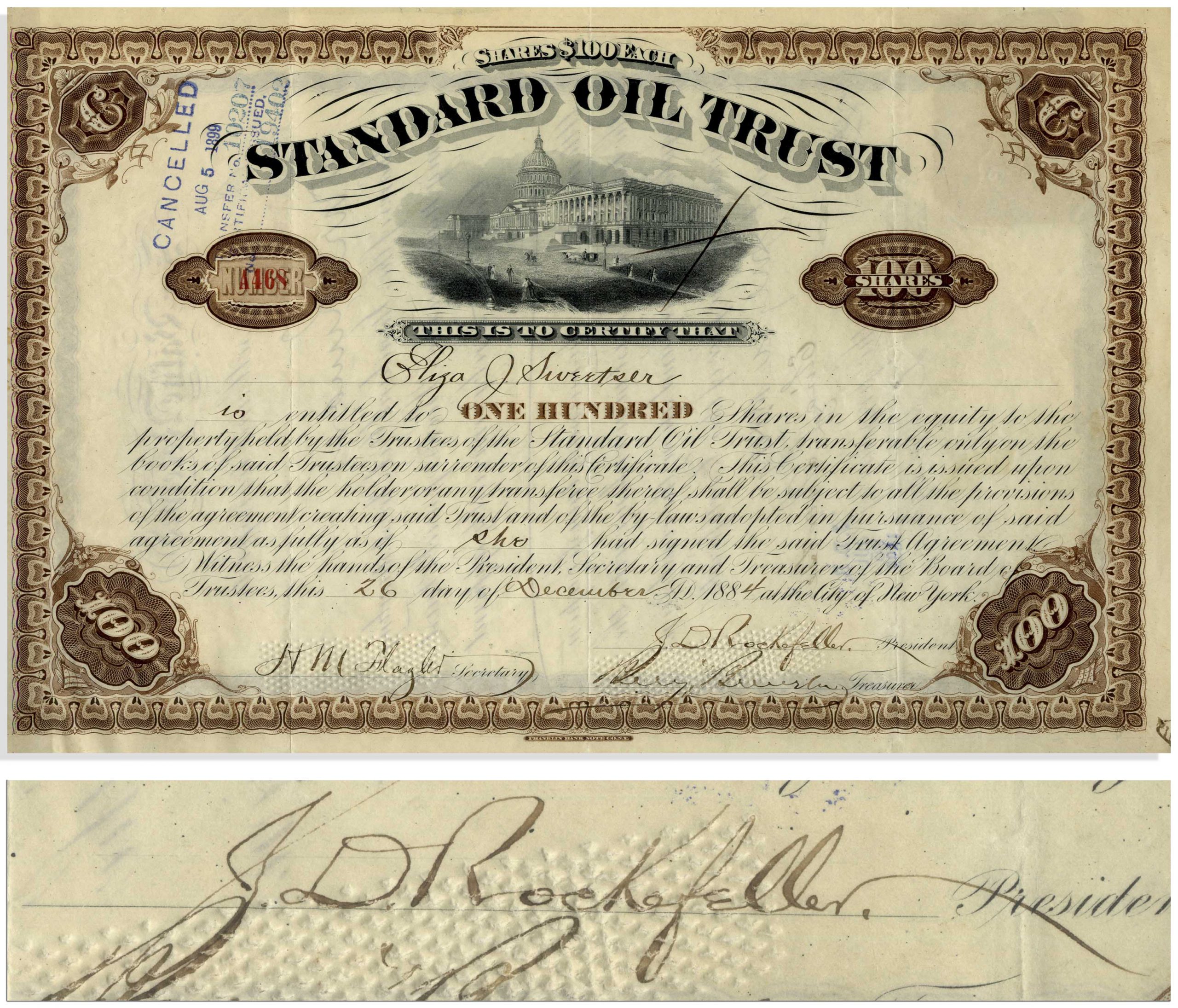
Oil mogul John D. Rockefeller signed stock certificate for Standard Oil Trust. Stock is signed ”J.D. Rockefeller” as company President. Certificate for 100 shares in the United States’ first giant business trust is dated 26 December 1884, made out to Eliza J. Sweetser with serial number A468. Countersigned by Henry Flagler as Secretary, and the Treasurer. Stock measures 16” x 7.75”. Glue remnants where stub has been attached to stock, overall in very good to near fine condition. Sold for $2,330.
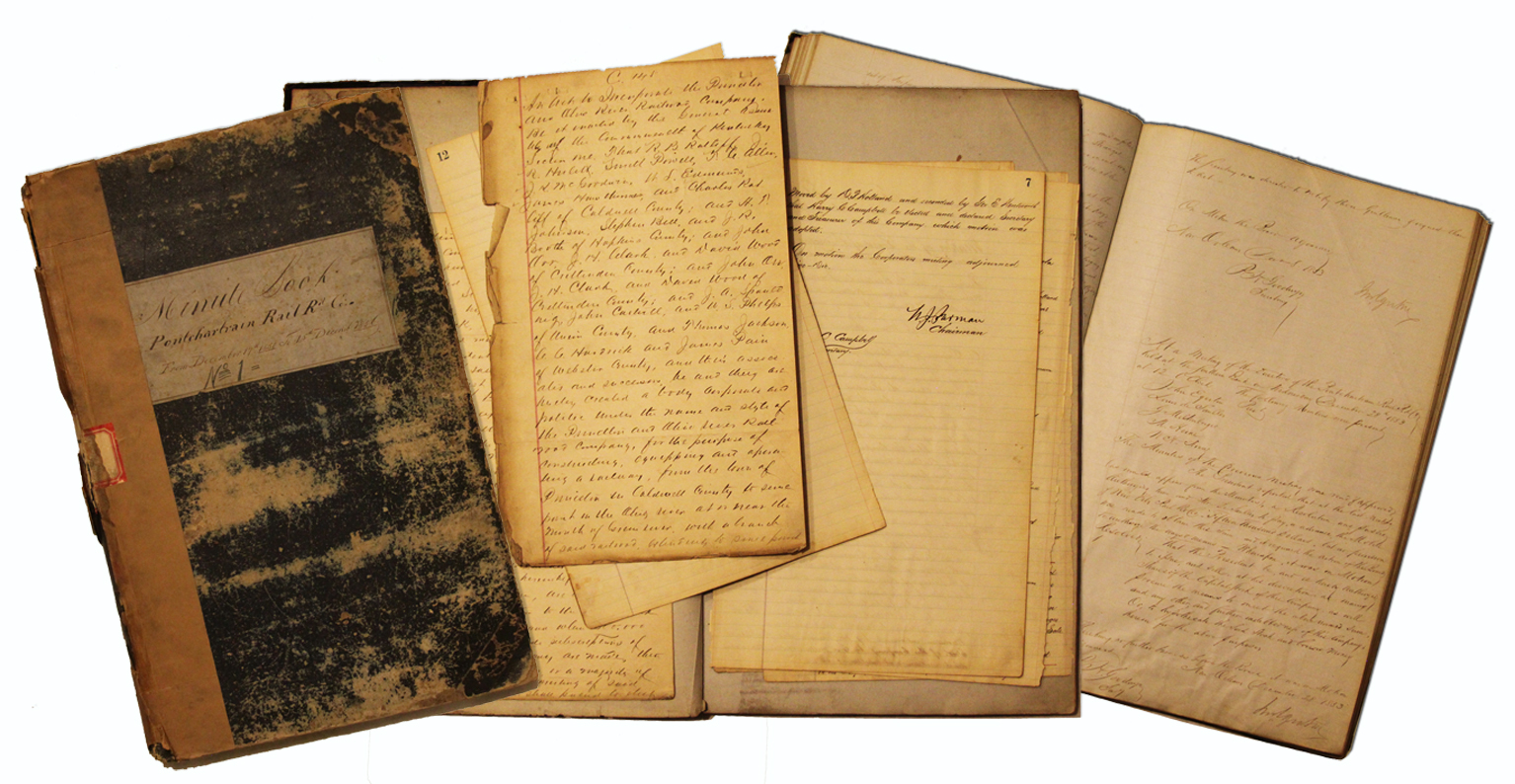
Very early Pontchartrain Railroad minutes from 17 December 1850 through 15 December 1856, accompanied by 7pp. Pensacola Railroad incorporation document. In 1830, this Louisiana railroad was only the second ever railroad constructed in the U.S. and the first west of the Allegheny Mountains; many Americans knew its steam locomotive by its popular nickname, the ”Smoky Mary.” Book of minutes comprises over 200 pages of handwritten notes from the formal meetings of the Pontchartrain Railroad’s administrators in its infancy. Log book contains all the most important information related to the major decisions made for the Pontchartrain’s earliest development, including plans for the acquisition of new land. On the upper margin of nearly every handwritten page is, ”Meeting of the Board of Directors of the Pontchartrain Railroad Company”, written with the date and usually also ”New Orleans, LA”. 208 pages are bound in dark paper boards, measuring 10.5” x 15.75”. Toning and wear to exterior, with cocking and chipping to spine, else near fine given age. An important and singular piece of railroad history. Sold for $1,563.
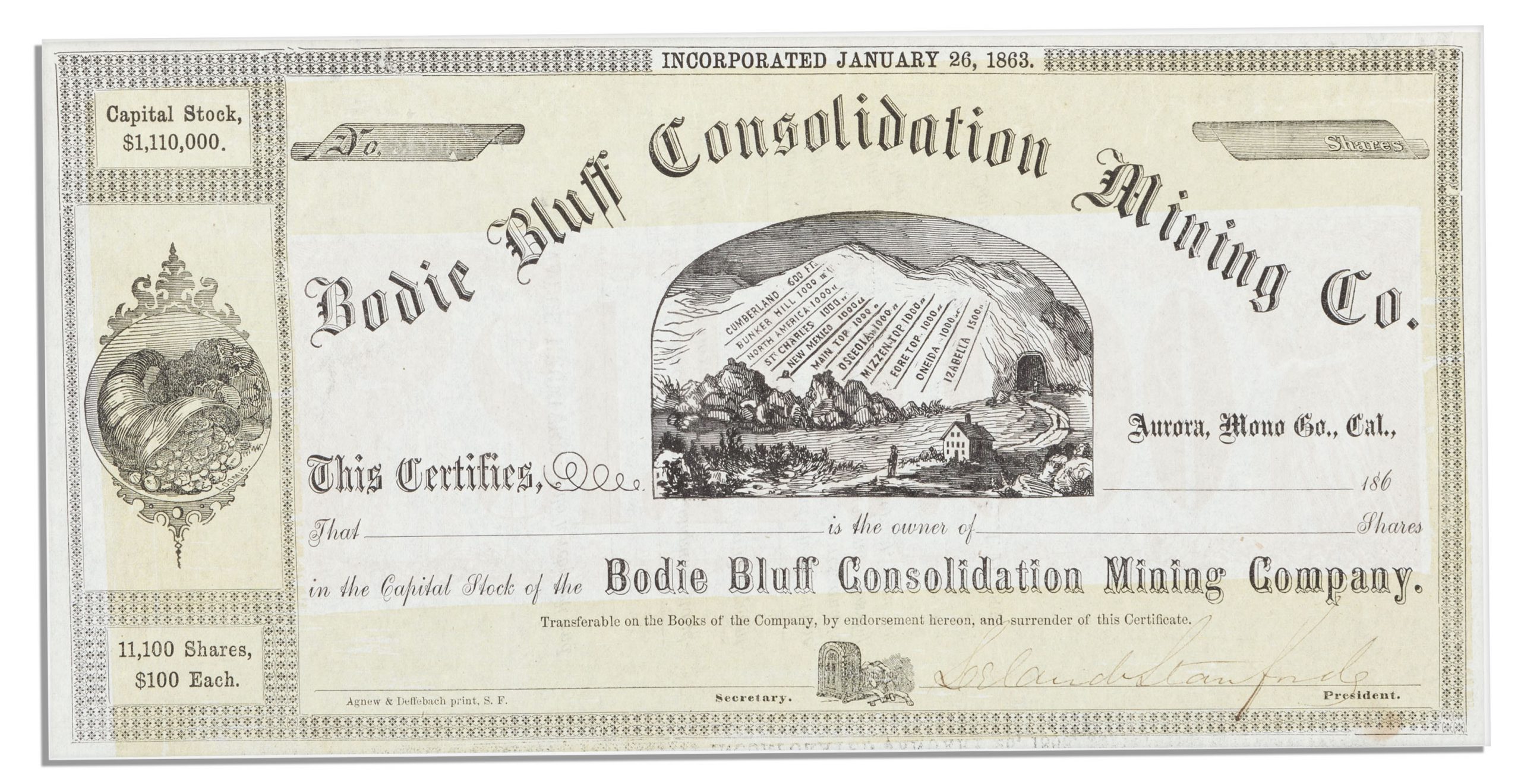
Leland Stanford Stock Certificate Signed as President of the Bodie Bluff Consolidation Mining Company ”Leland Stanford.” 10.5” x 5.25”, black engraving with light yellow and pink underprint, Central vignette of 11 different mine names on the side of a mountain with mine entrance, cornucopia on left. Undated and unissued. Fine. Amasa Leland Stanford was an accomplished politician, entrepreneur, and railroad builder. He left a lasting legacy in California politics and a fine university that bears his name. Little is known of his mining ventures, though the company operated in Aurora, Mono County, California. Sold for $756.
FREE ESTIMATE. To buy, auction, sell or consign your Andrew Gray Southern Pacific Railway Survey 1856 that is for sale, please email your description and photos to [email protected] of Nate D. Sanders Auctions (http://www.NateDSanders.com).
Andrew Gray Southern Pacific Railway Survey 1856