
Sell or Auction Your Abner Doubleday Signed Letter for up to Over $1,000 or More at Nate D. Sanders Auctions
FREE VALUATION. To buy, auction, sell or consign your Abner Doubleday signed letter that is for sale, please email your description and photos to [email protected] of Nate D. Sanders Auctions (http://www.NateDSanders.com).
Sell Your Abner Doubleday Signed Letter
Abner Doubleday (June 26, 1819 – January 26, 1893) was a career United States Army officer and Union major general in the American Civil War. He fired the first shot in defense of Fort Sumter, the opening battle of the war, and had a pivotal role in the early fighting at the Battle of Gettysburg. Gettysburg was his finest hour, but his relief by Maj. Gen. George G. Meade caused lasting enmity between the two men. In San Francisco, after the war, he obtained a patent on the cable car railway that still runs there. In his final years in New Jersey, he was a prominent member and later president of the Theosophical Society.
Below is a recent realized price for an Abner Doubleday signed letter. We at Nate D. Sanders Auctions can obtain up to these amounts or more for you:
Abner Doubleday Signed Letter. Sold for over $1,000.

Consign your Abner Doubleday signed letter at Nate D. Sanders Auctions. Send a description and images of your item to us at [email protected].
Here are some recent items that our auction house, Nate D. Sanders (http://www.NateDSanders.com) has sold:
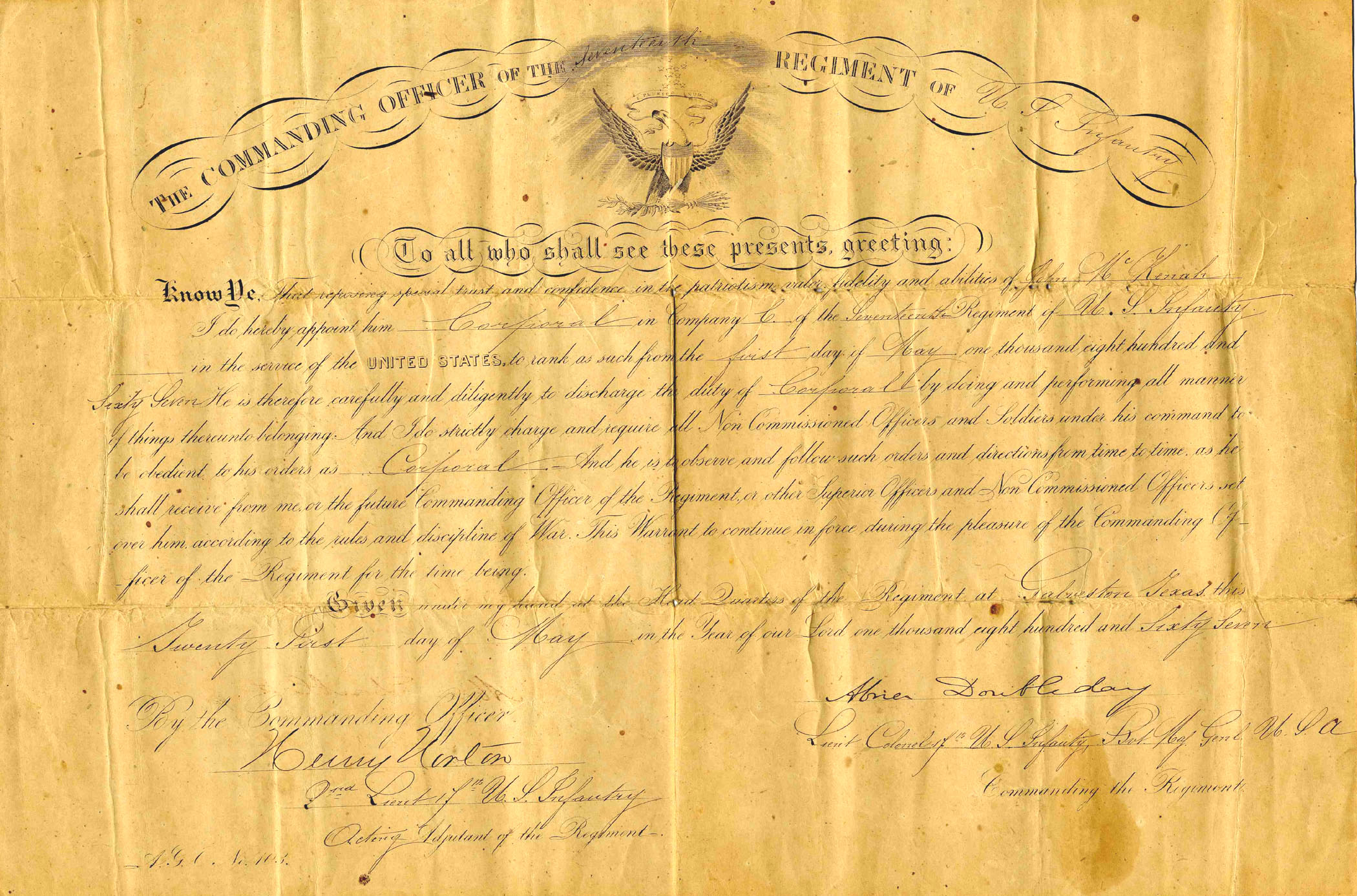
Abner Doubleday 1867 Document Signed
Post-Civil War document signed by Lieutenant Colonel Abner Doubleday, Brevet Major General and Second Lieutenant Henry Horton, Acting Adjutant of the 17th U.S. Infantry. Datelined Galveston, Texas, 21 May 1867, document appoints John McKenah Corporal of Company C. General Doubleday, a career army artillerist, fired the first Union shot in response to the Confederate attack on Fort Sumpter, South Carolina. Document measures 15″ x 10″. Mild toning and soiling, otherwise near fine condition. Sold for $1,100.
Confederate General Joseph E. Johnston autograph letter signed ”J.E. Johnston”, dated 16 May 1865 from Charlotte, North Carolina, written soon after being released on parole by the Union Army. Also with three endorsements signed by Ulysses S. Grant, Secretary of War Edwin Stanton and General John Schofield. Letter is addressed to General Schofield, just two weeks after Johnston surrendered his Army of Tennessee and still active rebel troops. After both parties agreed to military surrender, Johnston and Schofield negotiated supplementary terms, including his soldiers’ release, and here asks permission to travel to Canada. Reads in part: ”…As soon as the terms of ‘the convention’ are executed in Georgia & Florida, I wish to go to St. Catherine’s Springs, Canada. Will you be so kind as to inform me if I will be permitted to travel directly from Virginia to that point? Most respectfully / Your obt sevt / J.E. Johnston”. General Schofield endorses the letter on 16 May, the same day, ”Respectfully refered [sic] to Lt. Gen. Grant. J M Schofield Maj Genl.” Grant then endorses the letter on 22 May: ”I am very much in favor of granting Gen. Johnston’s request and if authorized will telegraph the authority at once. U. S. Grant Lt. Gen.” Lastly, Secretary of War Edwin M. Stanton seeks approval from President Johnson: ”Submitted to the President who directs that the permission asked by General Johnson [sic] be granted with the condition that he does not return to the United States without leave of the President. Edwin M Stanton Sec of War.” Letter on one page measures 8” x 6.25”, matted with a portrait of Johnston to an overall size of 12.5” x 18.25”. Light toning and folds throughout; very good to near fine. Sold for $12,500.

General William Sherman autograph letter signed: ”W.T. Sherman / M.G.” on Military Division of the Mississippi Headquarters stationery. In a letter datelined ”In the Field, 4 miles S of Hickory Hill, 1 February 1865”, the infamous Civil War figure writes to General John Gray Foster: ”…I cannot modify my orders relative to General Saxton having the charge of recruiting blacks…I think the impression at Washington is that both you and I are inimical to the policy of arming negroes, and all know that Saxton is not, and his appointment reconciles that difficulty. If anything serious occurs correspond directly with Mr. Stanton…Let Grant know I am in motion, and telegraph to Easton that if Slocum has to wait for provisions it will be dead loss [sic], as we are eating up ours. Let Hatch continually feel the Salkehatchie, and the moment the enemy lets go, get the railroad broken back to the Edisto…” By this time in the war, approximately 10% of Union regiments were composed of black soldiers, and public opinion, including that held by officers and soldiers, had accepted the concept of arming former slaves in the war effort. This letter clearly shows that General Sherman was one of the remaining hold-outs in his opposition. Written in pencil, single page measures 7.75″ x 9.75″. Near fine. Sold for $9,582.
Civil War-dated handwritten letter serving as an official notice of General Lee’s resignation, and ultimately the end of the war, dated 9 April 1865. Sent by telegraph from the ”Head Quarters Armies of the U.S.”, letter is addressed to Confederate General Cadmus Wilcox from Confederate General William Loring and is signed by an aide to Loring. Letter reads in full: ”Genl. Willcox — The following received Head Quarters Armies U.S. Appomattox C.H. April 9th, 1865 — Genl Lee this afternoon surrendered his entire army to Lieut. Genl. Grant; officers and privates to retain private horses, arms and baggage; officers and men to be permitted to return to their homes, but not be disturbed by the U.S. authorities as long as they observe the laws where they reside; all public property to be turned over to Ordinance and Quartermasters Departments. Remnant of Lee’s Army surrendered is about 30,000. – April 10, surrender is complete this morning; munitions of war turned over to the U.S. and Genl. Grant leaves for City Point at eleven o’clk this morning. The Army of Northern Virginia is no more!!! (sgd) Schemerhorn”. Card-style 2pp. letter has handwriting on pages 1 and 3. Some toning, foxing and two 1” tears along a horizontal fold. Very good condition overall. Scarce. Sold for $10,780.

Civil War Confederate General D.H. Hill Autograph Letter Signed — Identifying Roanoke Island as the “weakest point” in North Carolina
Confederate General D.H. Hill autograph letter signed, to North Carolina Governor Henry Clark, dated 6 November 1861. Letter describes Roanoke as a weak point in the South’s Atlantic Coast defenses. Hill implies that he will urge the War Department to send reinforcements: “Dear Sir, Your very kind letter is most gratefully appreciated. I regret that I cannot go to Raleigh before the 17th or 18th. I am about to start to Roanoke Island, the most important and weakest point in N.C. Unless one or more Regiments can be sent there, the whole Albermarle region will be at the mercy of the enemy. Gen’l Huger will withdraw the Georgia Regiment, and then the Island must be lost. With great respect / D.H. Hill”. Hill’s assessment was accurate and prophetic — two months later, on 8 February 1862, Roanoke Island fell to Ambrose Burnside’s expeditionary force. Letter, on 2pp., has minor toning in spots, else near fine condition. Sold for $4,884.
Excellent 1863 Civil War Gettysburg Diary from a 16th Vermont Soldier — “…under heavy firing all day. We charged on the Rebs…”
Gettysburg diary by William M. Ballou of Co. F in the 16th Vermont Infantry, whose brief service included the most pivotal battle of the war. At Gettysburg, the 16th Vermont helped reinforce a picket line along Cemetery Ridge and played a key role in the Union repulse of Pickett’s Charge. The 1863 diary has a printed “Daily Pocket Remembrancer for 1863” with “keepsake for War” and “William M. Ballou Memorandum Company F 16th Vt” written in Ballou’s hand. Entries date 1 January – 27 December 1863 and each entry is short and succinct as the diary has three dates per page. Written in pencil, entries include: “…was in the fort at Centerville expecting the enemy every moment. Was on guard at night…there was a company and battalion drill. Wrote a letter to Glenn Barker. Was on guard all night…before Col. Slaughthorn’s house…had an inspection of arms and ammunition…” The Gettysburg entries read: 1 July 1863: “…started at 10 oclock & marched in Gettysburg and camped for the night…” 2 July: “…we marched out under a hill & was under heavy fire all morn [and] afternoon. The 13th charged on Battery & took prisoners [?]” 3 July: “…is a very hot day Was under heavy firing all day. We charged on the Rebs and took batle flags. David [Ballou] is wounded in the leg…” Diary measures 2.5″ x 4″ and leather has wear, pages have toning and writing is faint for some entries. Lot also includes two additional 1869 and 1877 diaries by Ballou. In very good condition. Inexpensive Gettysburg diary. Sold for $3,032.
If you wish to sell your Abner Doubleday signed letter that you have for sale, please call Nate D. Sanders Auctions to auction or sell your Abner Doubleday signed letter.
FREE VALUATION. To buy, auction, sell or consign your Abner Doubleday signed letter that is for sale, please email your description and photos to [email protected] of Nate D. Sanders Auctions (http://www.NateDSanders.com).


