
Sell or Auction Your Frederick Great King Prussia Letter Signed for up to Nearly $2,000 or More at Nate D. Sanders Auctions
FREE ESTIMATE. To buy, auction, sell or consign your Frederick Great King Prussia letter signed that is for sale, please email your description and photos to [email protected] of Nate D. Sanders Auctions (http://www.NateDSanders.com).
Free Appraisal, Auction or Sell Your Frederick Great King Prussia Letter Signed

.jpg)
Frederick the Great was King in Prussia between 1740 and 1772. He is perhaps best remembered for his military successes in the Silesian wars and for reorganizing the Prussian Army. Below is a recent realized price for a Frederick Great King Prussia letter signed. We at Nate D. Sanders Auctions can obtain up to this amount or more for you:
Frederick Great King Prussia Letter Signed. Sold for Nearly $2,000.
Here are some related items we have sold:
Richard III signet-sealed document signed ”R. Gloucestre” as Duke of Gloucester, one of less than a dozen such documents signed with the others residing in public institutions. Richard’s brother, Edward IV, appointed Richard as Lord President of the Council of the North, which sought to exert greater governmental control over Northern England. Document is dated by title donned on Richard as ”Constable and Admyral of England” instead of ”Great Chamberlain,” which dates the document circa 1473-77. As Duke of Gloucester in his early 20’s, Richard III was given many responsibilities by his brother, becoming a powerful landowner and political force to be reckoned with in the north, further establishing his future reign as King of England. Document illuminates his growing power as he hereby intervenes in a land dispute between Ralph Neville, 2nd Earl of Westmorland and some of his tenants. Countersigned by the Duke’s secretary, John Kendal. Document is addressed to Sir Robert Claxton, William Claxton, Richard Bainbridge, ”and other of the ‘Counsell of our right entierly beloved Cousyn Therl of Wesm[or]land’, Pontefract, 22 April n.y. [1473 or 1476-77]”. Reads in part: ”c[er]ten cont[ro]v[er]sie’ between William Trotter, ‘ferrour’ [‘smith’?], Hugh Ile and others on the one hand and William Hunter and Robert Comyn on the other, concerning leaseholds belonging to the Earl of Westmorland. He writes now to a larger group of Westmorland councillors, asking that they examine the petitioners and settle the dispute according to their own discretion, so th[a]t neyther p[ar]tie have cause to sue unto us for remedy in that behalve heraft[er].” Measures 11.75” x 7” on one page. Framed to an overall size of 18.5″ x 14.25″; frame has a drawer that pulls up from the top edge holding a transcript of the document and a biography of Richard III. Document has been archivally restored, though still has paper loss to right side and various holes and chips throughout. Overall very good condition for such a preserved document. Document is exceedingly rare, one of only three documents signed by Richard III to come up for auction in the last 30 years. Sold for $52,417.

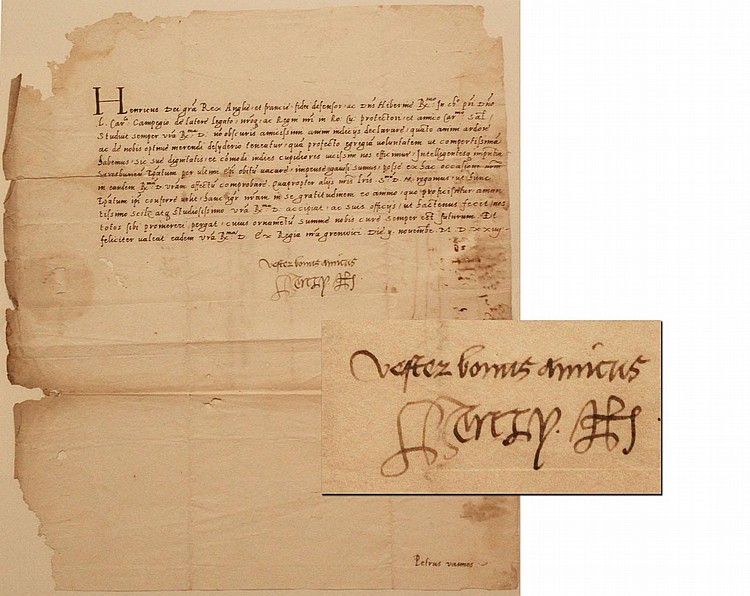
Henry VIII Document Signed as King of England — Offering Cardinal Lorenzo Campeggio the See of Salisbury — Campeggio Was Appointed to Decide Henry’s Infamous Divorce Shortly After This Appointment
Rare and desirable Henry VIII document signed as King of England and France and as Defender of the Faith. Document appoints Cardinal Lorenzo of Campeggio to the See of Salisbury, which had been promised to him in 1518 and received on 2 December 1524. Shortly thereafter, Campeggio became a key player in Henry VIII’s famed divorce from Catharine of Aragon, caught in the unenviable position of having to choose between Holy Roman Emperor Charles V (and Catharine’s nephew) or Henry VIII. Upon seeking a divorce from Catharine, Henry VIII sought nullification from the Pope, who dispatched Campeggio to England to settle the matter. Under enormous pressure from both sides, Campeggio denied the divorce, which sparked Henry VIII to strip Campeggio of his title. Campeggio did however, keep his life — after the decision, the Pope gave Campeggio the castle in Dozza, Italy and Charles took Campeggio’s family under his protective wing. Supremely rare 16th century document measures 13″ x 14.75″. In very good condition with folds throughout, small holes at folds and chips along left side. Nice, bold signature by Henry VIII. Sold for $49,374.
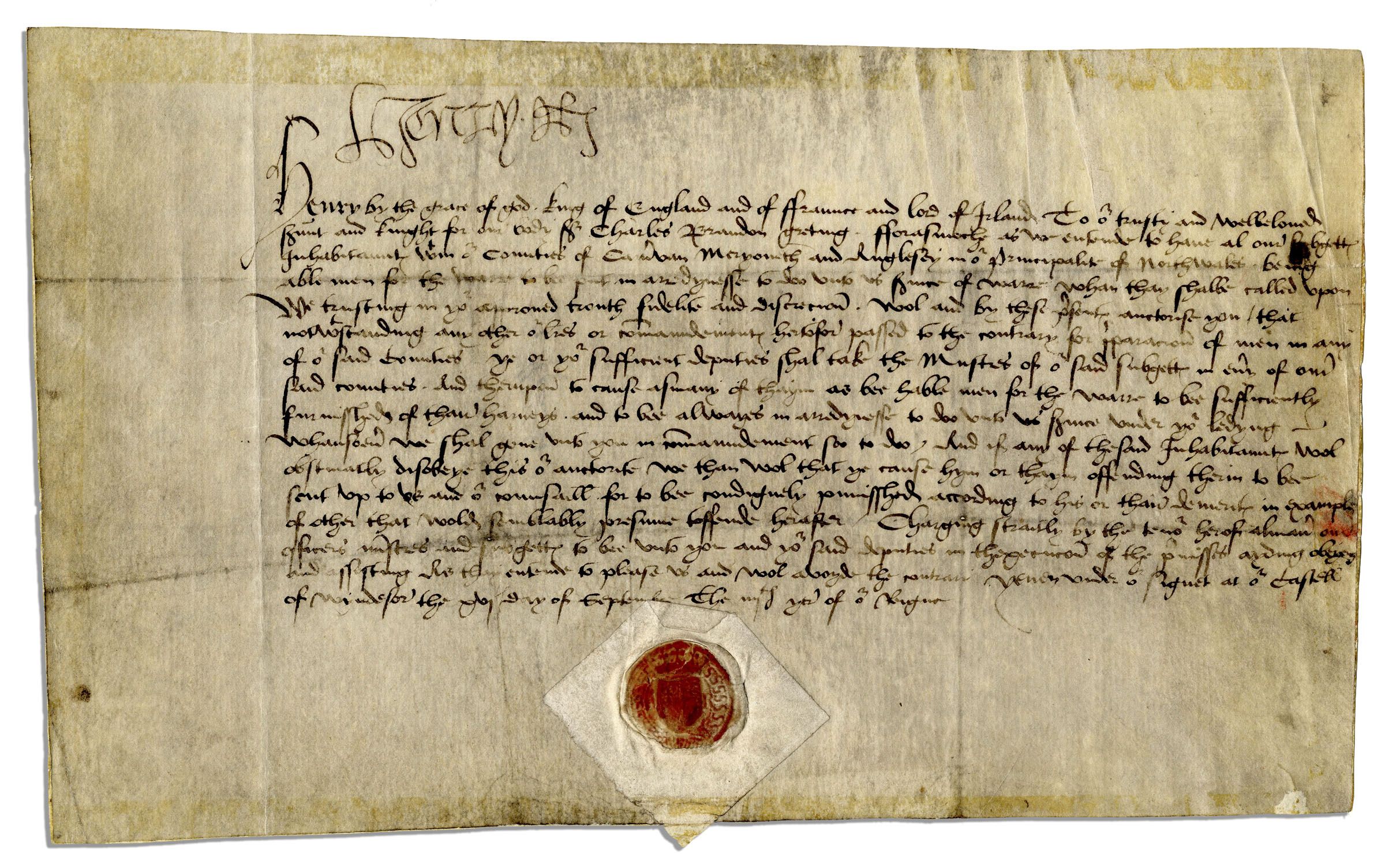
Important Henry VIII order signed ”Henry R”, as King of England and Ireland, commanding Sir Charles Brandon to gather troops in preparation for his planned invasion of France, as part of the Italian Wars. Dated 16 September 1512, only three years into his reign, Henry VIII here takes advantage of the Pope’s ”Holy League” against France to expand his territory in the northern part of that country. To that end, he orders the mustering of troops from the counties of Carnarvon, Merioneth, and Anglesey in Wales. Its compelling text reads in part: ”…’cause asmany of thaym as bee hable men for the warre to bee sufficiently furnisshed of thaire harneys and to bee always in arredynesse to doo unto us s[e]rvice under yo[u]r ledyng…” Those who refuse are ”…to be condignely punisshed according to his or thaire demerits in example of other that wolde semblably presume toffende herafter…” Sir Brandon, to whom this order is directed, went on to become the 1st Duke of Suffolk following success in August 1513 at the Battle of the Spurs — using the men culled from this initiative. A red seal is affixed to bottom center. Single page runs 16 lines on vellum and measures 11.25″ x 6.5″. Toning, creasing and some light staining, else near fine. An important document in the early years of the Italian Wars, which raged for more than sixty years, ultimately involving most of Europe in a complex conflict that spawned wars within wars. Sold for $40,954.
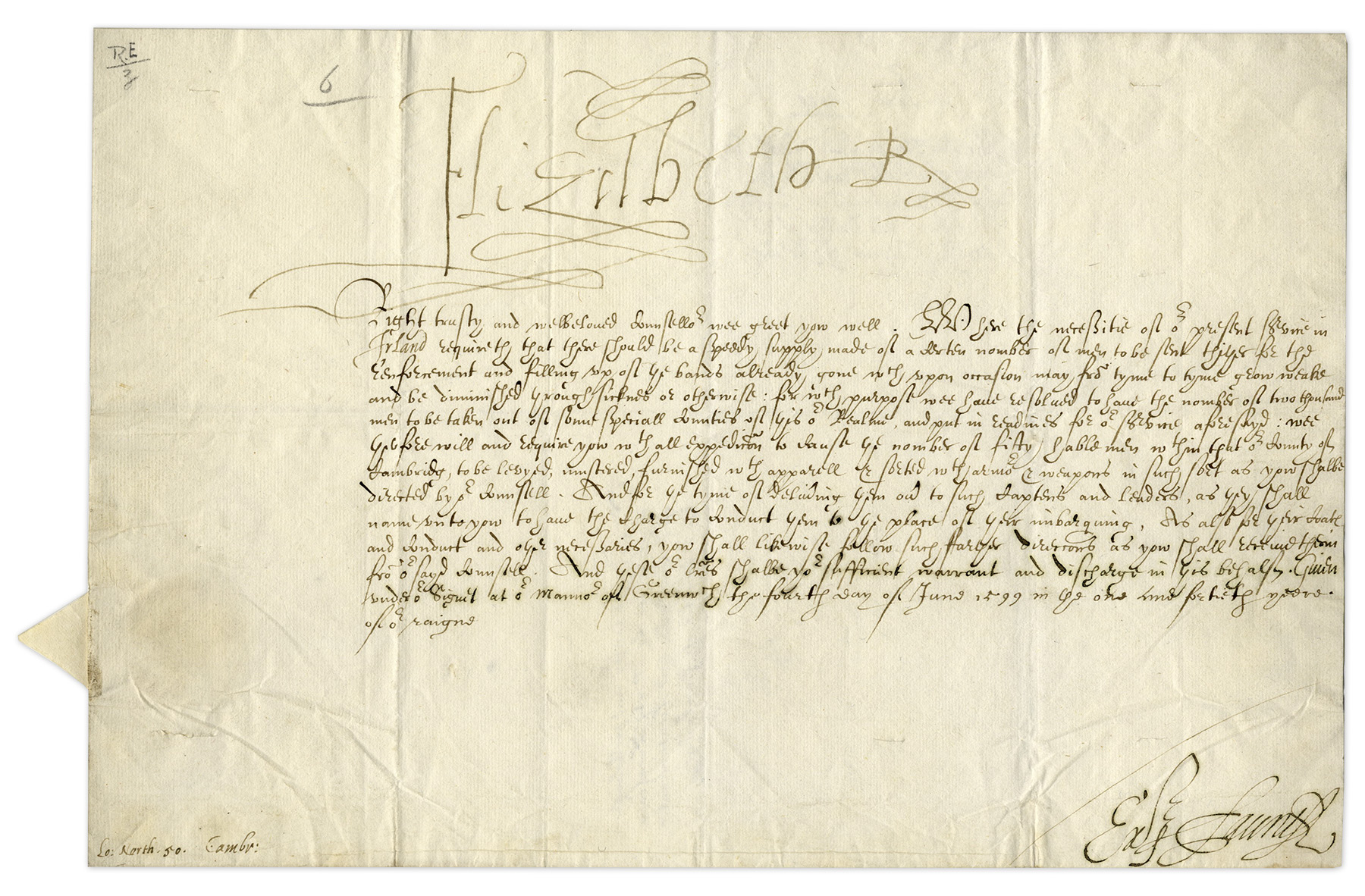
Exceptional first Queen Elizabeth autograph document signed, concerning the need for additional troops during the Nine Years War in Ireland in 1599. Fought from 1594-1603, the Nine Years’ War (also called Tyrone’s Rebellion), was the largest English conflict in the Elizabethan era, with England committing 18,000 troops to combat Gaelic Irish chieftains opposed to English rule. In this document, dated 4 June 1599, Queen Elizabeth writes to Lord Roger North, referring to him as the ”Treasurer of our Household and Lord Lieutenant of Oure Countie of Cambridge”. The Lord Lieutenant of Cambridgeshire served as the Monarch’s personal representative for the counties of the United Kingdom, which in this case included all of Ireland. Document reads in part, “Right trusty and wellbeloved Counsellor wee greet yow well…our present Service in Irland requireth that there should be a speedy supply made of a certen nomber of men to be sent thither for the reinforcement and filling up of ye bands already gone [the Earl of Essex had taken a large contingent to Ireland earlier the same year] which upon occasion may from tyme to tyme grow weake and be diminished through sicknes or otherwise: for which purpose wee have resolved to have the nomber of two thousand men to be taken out of some speciall Counties of this our Realme, and put in readines for our Service aforesayd: wee therefore will and require yow with all expedition to Cause the nomber of fifty hable men within that our County of Cambridge, to be levyed, mustered, furnished with apparell or sorted with armour or weapons in such sort as yow shalbe directed by our Counsell. And for ye tyme of delading them on to such Captens and leaders, as they shall name unto yow to have the Charge to Conduct them to ye place of their imbarquing, As also for their Coate and Conduct and other necessaries, yow shall likewise follow such farther directions as yow shall receive them from our sayd Counsell. And these…shalbe your sufficient warrant and discharge…Given under our Signet at our Mannor of Greenwich the fourth day of June 1599…” Document features large, ornate ”Elizabeth R” signature at top, along with seal from the Queen. Docketing by recipient and integral address leaf to verso. Folds and toning, but in otherwise exceptional condition for a document of its age. Bold Queen Elizabeth autograph. Very good to near fine. Sold for $27,500.
Incredibly scarce vellum document from the final few months of King Edward I’s controversial reign. Edward I has been both praised and criticized by historians, the latter largely for his Edict of Expulsion in 1290, which expelled Jews from England for most of the Middle Ages, until 1656 when the edict was reversed. This document, written in Latin, is also intriguing as it grants a Bishop the right to transfer property to St. Leonard’s Hospital in York, despite a law barring clerics from holding or transferring land. Document gives Walter Langton, the Bishop of Coventry and Lichfield, license to legally transfer half a bovate of land in Pykhale [Pickhill], Yorkshire to the ”master and brothers” of St. Leonard’s Hospital in York. Eleven lined vellum document is datelined Carlisle, 4 April 1307. Measures 12.25” x 8.5”. Ink notations to verso with some creasing and staining. Tears and scattered pinholes. In exceptionally well-preserved condition. Sold for $14,351.

Mary Queen of Scots Document Signed During the Throckmorton Plot to Kill Queen Elizabeth I
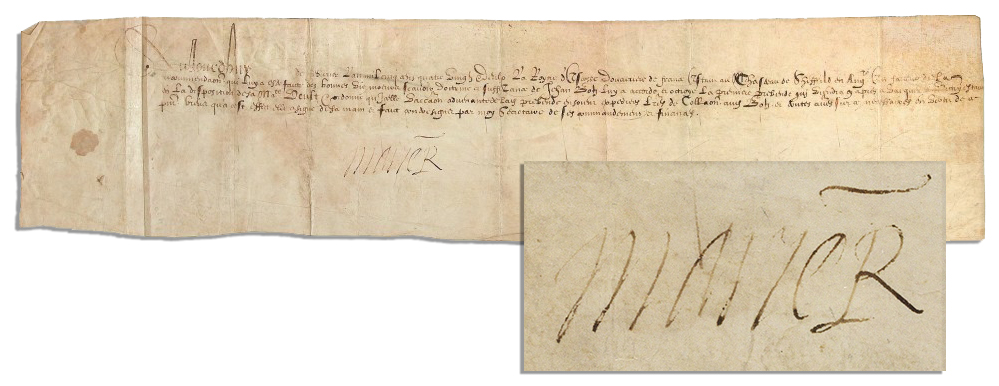
Mary Queen of Scots document signed, ”Marie R”. Vellum document is datelined February 1582, Sheffield Castle, where Mary was confined by Queen Elizabeth I. The Throckmorton plot to kill and supplant Elizabeth with Mary was underway as the time of this document, which appoints John Botz to the prebend at Bitcry: ”Today, on the [blank] day of February, in the year of 1582, the Queen of Scotland, Doweress of France, being at the Castle of Sheffield in England, on the strength of the recommendation which has been made to her…of John Botz, granted and awarded to him the first Prebend which shall fall due hereafter, and a vacancy at Bitcry being in her Majesty’s disposal, she desires and orders…the letters of Investiture be sent to the said Botz…” Document measures 15.5” x 3.5”. Ink and pencil notations to verso. Creasing, a few tiny worming holes and minor scattered soiling. Overall near fine given age. Sold for $12,500.
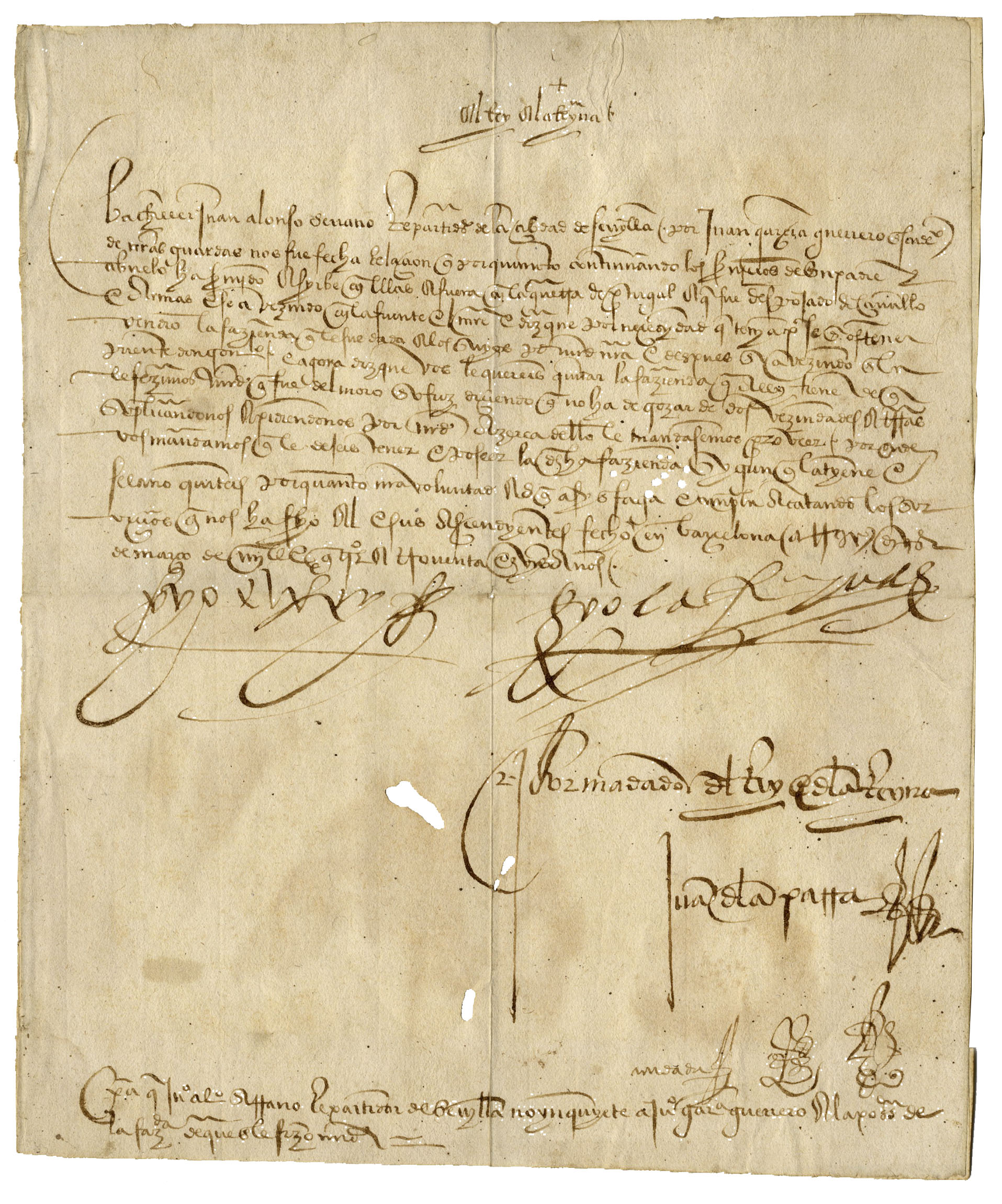
The Catholic Monarchs, Ferdinand II and Isabella I signed Royal decree as King and Queen of the Spanish Empire, dated 14 May 1491. Signed in large bold writing, ”Yo el Rey” (I the King) and ”Yo la Reyna” (I the Queen). Document instructs Juan Alfonso Serrano, a highly ranked ”pesquisidor” for the Crown, to allow a soldier, Juan Garcia Guerrero, to keep his land. At this time, Spain was driving out the Moors from southern Spain which necessitated someone to allocate these re-conquered lands. Serrano was the powerful individual responsible for this land allocation, in addition to his role of uniformly applying Spanish law. Document translates in full, ”From the King and the Queen / Bachelor Juan Alonso Serrano, Distributor of land in the city of Seville. By Juan Garcia Guerrero, a squire in our guards, it was made known to us of the continued good services of his father and grandfather, under the command of the city, and that they were sent out to the war against Portugal, where were stolen their horses and armor, and they made use of the spring and some land. He says they took it out of necessity to sustain themselves acquiring the farm that we had ordered given to some of their friends and later, settling there with their family, they gave to them. Now he says you wish to take from his possession the farm he has there that we had granted from what had belonged to the Moor Sufuz, and you say he should not enjoy use of that property. / He entreats and asks us because of our association with this to send you proof. For that end we order you to allow him to have and possess that farm in the manner he now has it and not to take it from him due to our volition in this matter, and so make an exception in consideration of the services he and his ascendants have done for us. Done in Barcelona the fourteenth of the month of May of One Thousand and Four Hundred and Ninety and One Years. / [signed] I the King I the Queen / By order of the King and Queen / Juan de la Parra / Copy so that Juan Alonso Serrano, Distributor of land in Seville, does not take from Juan Garcia Guerrero the possession of the farm that he was granted.” Additionally signed by three nobleman as witnesses. Single page document measures 8” x 9.75” Folds, small areas of worming and irregularly trimmed edges. Overall very good to near fine given age. Accompanied by a COA from University Archives. Sold for $10,068.
The Catholic Monarchs, Ferdinand II and Isabella I signed Royal decree as King and Queen of the Spanish Empire, dated 26 March 1498. Signed in large bold writing, “Yo el Rey” (I the King) and “Yo la Reyna” (I the Queen). Intriguing document suggests a corrupted electoral process in the city of Villadolid, possibly at the hands of its Mayor, Dr. Alfonso Ramires de Villaescusa, to whom the letter is addressed. The Monarchs instruct de Villaescusa to appoint the count of Ribadeo as a named representative of the city; de Villaescusa was not friendly with the count of Ribadeo and would supersede him as the Regidor of Villadolid several years later. The count of Ribadeo was a key figure to the Edict of Expulsion in 1492, which forced all practicing Jews out of Spain if they failed to convert to Christianity. In a famous and historical letter regarding the Edict, Ferdinand wrote to the count on 31 March 1492, the same day the Edict was issued, insisting that the Jews must be expelled to stop the “evils and harm which come to the Christians from participating with and conversation with the said Jews,” who continue to “pervert” them. Because of the Edict, many practicing Jews joined the “Converso” (Jews who had converted to Christianity) community; the recipient of this letter, Dr. Alfonso Ramires de Villaescusa, had a daughter who married into the Converso community, which continued to be discriminated against after the Edict. Single page document measures 8.5″ x 9.25″. Folds, light foxing, and irregularly trimmed edges. Overall very good to near fine given age. Accompanied by a COA from University Archives.
Letter translates in full, “Dr. de Villaescusa, our municipal royal representative in the town of Villadolid. It has been reported to us that the municipal councilors of that town are not in agreement about the election of their parliamentary representatives and that some of them have given their votes to the count of Ribadeo, and since the count is the person that he is, we would like him to be one of those named as representatives of that town. We therefore order that you find a way to bring this about. And regarding the salary, let there be given what seems to you to be just for the person who is to have it. From the town of Alcala de Henares, on the 26th day of the month of March of the year 98. / Yo el Rey / Yo la Reyna”. At lower right, “By order of the King and of the Queen / Francisco de Madrid.” Sold for $10,000.


King Henry VII Signed Document — Scarce, From 15th Century Where Henry Orders Clothing for One of His Groomsmen
Henry VII signs “H.R.” as King of England in impressive scale to the very top of a document datelined Greenwich, 26 March 1498. This vellum document hints at the indulgence for which Henry VII was known, as he orders clothing for one of his chamber grooms. A voucher for Sir Robert Lytton — the “ke[e]per of oure grete Warderobe”, document in old English reads in part, “…his warrant for delivering to Oudet Taillefer, a groom of the chamber, thre[e] yerds of good ta[w]ney cloth w[i]t[h] asmoch whit lambe as wol suffice to furre the same for a gowne and two yerds of blak satyne w[i]t[h] stuffe for a doublet to be taken of o[u]r giest… w[i]t[h]in o[u]r grete Warderobe…” Document comprises nine lines on single page vellum. Measures 7.25″ x 5.25″. Expected toning, creasing and staining. In very good condition given age. Sold for $8,055.

Napoleon Bonaparte letter signed with exceptional content regarding funding his vast armies which, by 1811 when this letter was written, encompassed almost all of Europe and with preparations to invade Russia in the works. Dated 21 April 1811, letter translates in part, ”Count Mollien, I cannot sign this partial decree. It is necessary that you agree beforehand with the Minister of War Administration. It results from your report that, if you paid 4/5th of the 42 millions, he would have received only 27 million, and that you had 40 million paid. But the minister’s budget, considering the extraordinary arming which is being done, must be increased to 160 millions. Thereupon, I pray to God that he keeps you under his Holy protection. / Napoleon”. Single page measures 7.25” x 9”. Folds and light uniform toning, overall near fine. Sold for $5,125.

Napoleon Bonaparte Letter Signed, With an Exceptionally Large Signature
Napoleon Bonaparte letter signed, with an exceptionally large signature filling half the page. Bonaparte writes to one of his closest allies in the French government, Michel-Louis-Etienne Regnaud de Saint-Jean d’Angely, who then served as president of the Interior at the Council of State. Two page document on a single sheet measures 7.25” x 9”. Ink stain at bottom of second page, and shallow folds, else near fine. Sold for $5,000.

Queen Victoria Signs a Royal Summons to Her Coronation — ”…you are not to fail…”
England’s monarch inscribes the uppermost portion of a royal summons: ”Victoria R” as Queen. The Queen Victoria autograph document commands the presence of Lord Bishop James Henry to the Royal Coronation on 28 June 1838. Summons dated 9 May 1838 reads in part: ”…These are to Will and Command you (all excuses set apart) to make your personal attendance you are not to fail…” Measures 8” x 12”. One closed tear runs from the bottom edge to the middle of the document. Some discoloration and a smudge to the signature. Overall very good condition. Dark Queen Victoria autograph and important Queen Victoria memorabilia from her Coronation. Sold for $3,120.

Queen Elizabeth’s Official Coronation Photo Signed in 1959
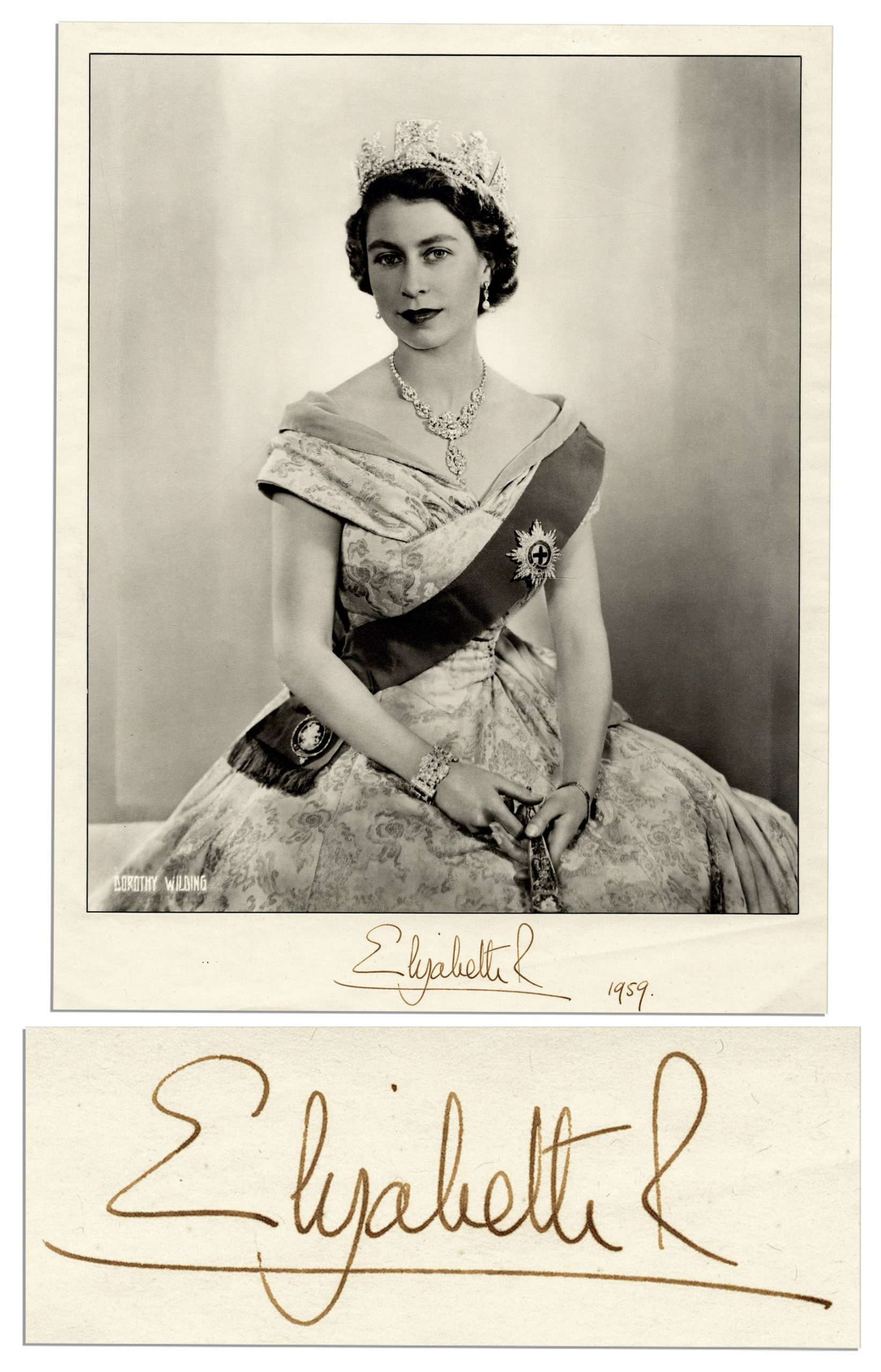
Queen Elizabeth II photo signed on the mat ”Elizabeth R / 1959”. This iconic image of the newly crowned Queen of England was her official coronation portrait. It became the most famous of noted photographer Dorothy Wilding’s works, popularized by the postage stamp series that ran from 1953 to 1967. Queen Elizabeth has since celebrated her diamond jubilee. Matte photo measures approximately 11” x 14” overall. Labeled ”British Mission in Conakry, Guinea, West Africa” on verso. Toning, else near fine. A gorgeous Queen Elizabeth autograph. Sold for $3,049.
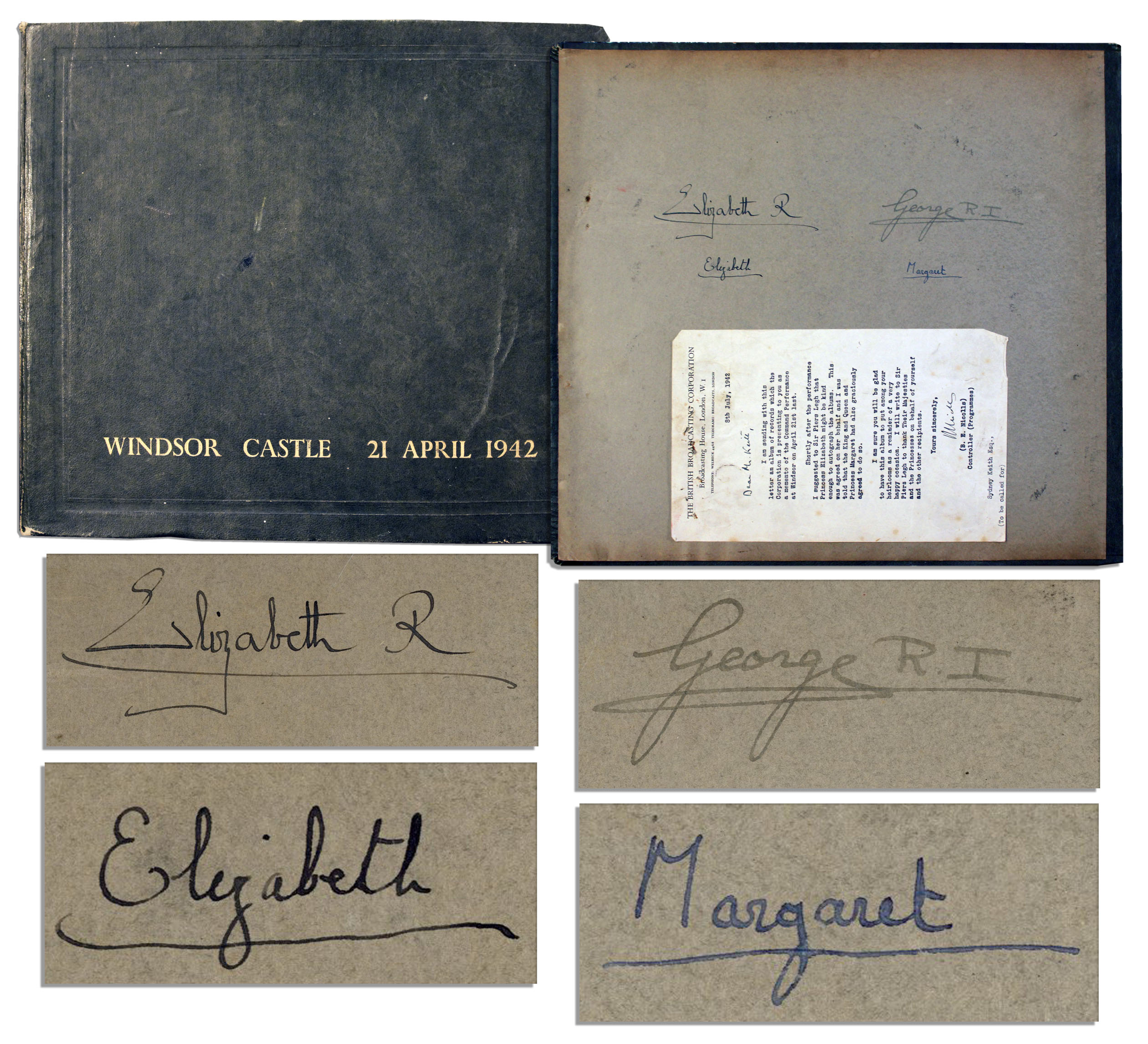
Elaborate leather bound book signed by the entire Royal family in 1942. Upon the front pastedown, the King and his wife sign ”George R.I.” and ”Elizabeth R”. Under their parents’ signatures, Princesses ”Elizabeth” and ”Margaret” sign as well. Mounted beneath the autographs is a typed letter on BBC letterhead, dated 1942, telling the story of the record album, which contains 6 vinyl LP’s, produced by the BBC for a special performance at Windsor Castle on 21 April 1942 of the show, ”It’s That Man Again,” Princess Elizabeth’s favorite radio program. Record album contains all six original LP’s, although none are in playable condition and are broken in parts. The front of the leather bound book is embossed in gilt, ”Windsor Castle / 21 April 1942”. Book itself is in very good condition with a burn mark on the back cover and general wear. Autograph page is lightly discolored, though autographs themselves remain quite clear and bold, with the exception of King George’s signature which has faded slightly. A very attractive and unusual WWII memento of the British Royal family. Very early Elizabeth autograph. Sold for $2,772.
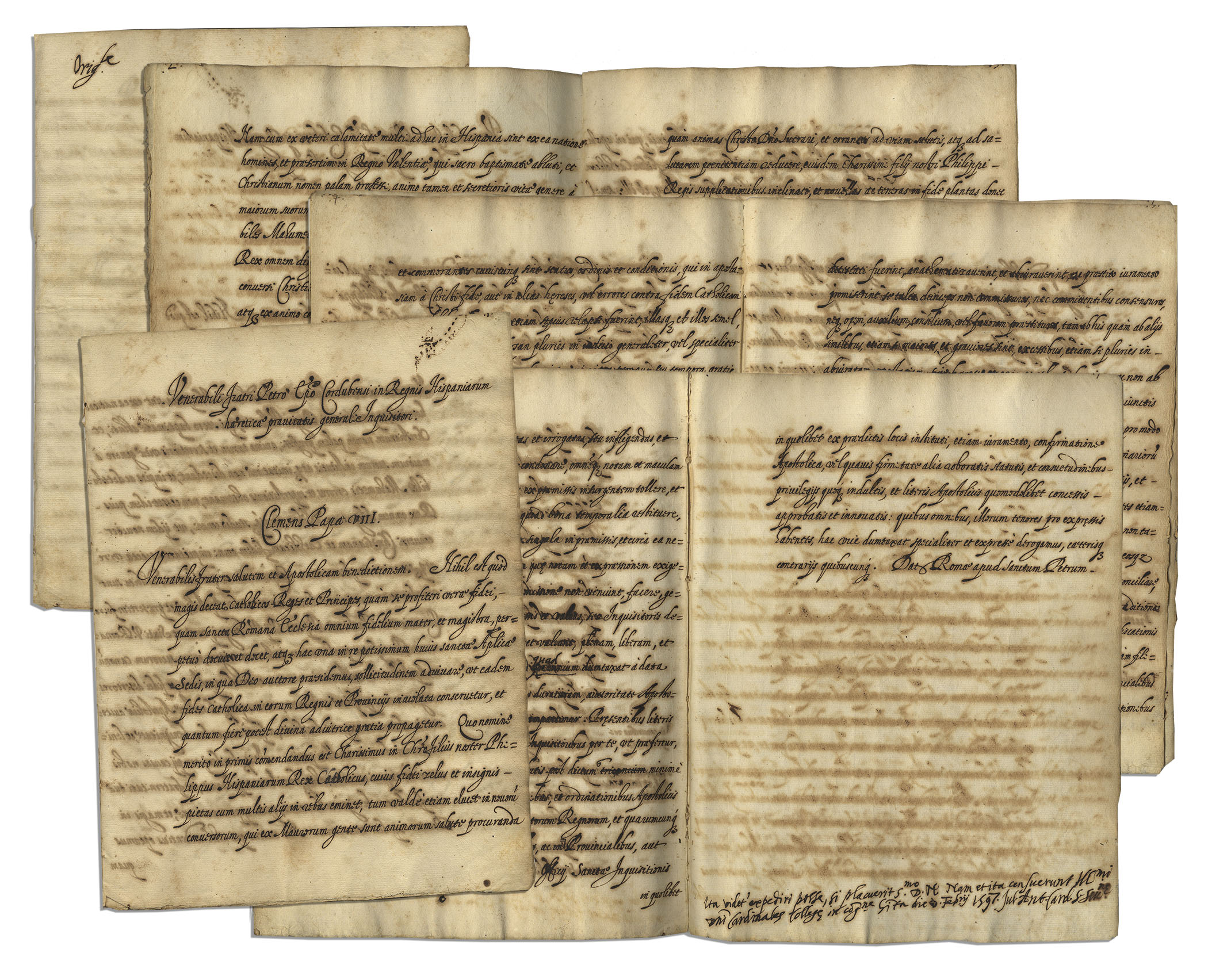
Extraordinary Spanish Inquisition Letter by Pope Clement VIII — ”follow the errors of Mohamed…enforce greater punishments…cut off the lethal cult…by appointing more inquisitors”
Period manuscript copy of Pope Clement VIII’s letter to the General Inquisitor of Spain, with forceful content regarding the Inquisition. Dated 1597, document in Latin translates in part, ”Pope Clemens VIII to the General Inquisitor of Spain, Peter the Bishop of Corduba…Since there is nothing more suitable to kings and princes than professing the true faith, King Phillip of Spain, recently converted some moors, yet many of them, especially in Valencia, even though having been baptized, still secretly profess and practice their former religion, and follow the errors of Mohamed. Following his former predecessors in going against apostasy and heresy, Clemens VIII asks the bishop, in order to better strengthen the faith of the newly converted, to enforce greater punishments upon them, and to cut off the lethal cult at its roots, by even appointing more inquisitors, and converting the moors, their children, and nephews, by oath and confirmation…” Runs 7pp. on 5 sheets, with one sheet blank save for a small notation to upper left. Measures 8.5 x 10.5”. Toning and bleeding to ink, else near fine. Sold for $1,875.
FREE ESTIMATE. To buy, auction, sell or consign your Frederick Great King Prussia letter signed that is for sale, please email your description and photos to [email protected] of Nate D. Sanders Auctions (http://www.NateDSanders.com).
We offer the following for your Frederick Great King Prussia letter signed:
- Appraise Frederick Great King Prussia letter signed.
- Auction Frederick Great King Prussia letter signed.
- Consign Frederick Great King Prussia letter signed.
- Estimate Frederick Great King Prussia letter signed.
- Sell Frederick Great King Prussia letter signed.