
Sell or Auction Your North America Corrected Royal Society 1710 for up to Over $1,000 or More at Nate D. Sanders Auctions
FREE ESTIMATE. To buy, auction, sell or consign your North America Corrected Royal Society 1710 that is for sale, please email your description and photos to [email protected] of Nate D. Sanders Auctions (http://www.NateDSanders.com).
Free Appraisal, Auction or Sell Your North America Corrected Royal Society 1710
Below is a recent realized price for a North America Corrected Royal Society 1710 item. We at Nate D. Sanders Auctions can obtain up to this amount or more for you:
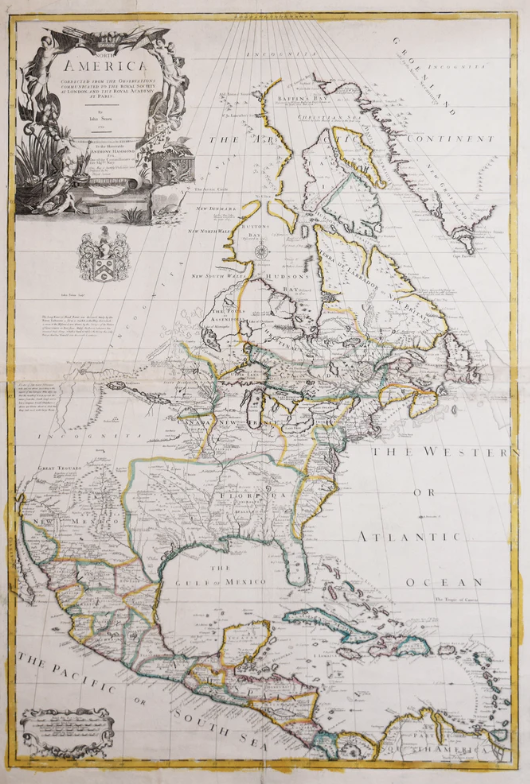
North America Corrected Royal Society 1710. Sold for over $1,000.
The following are some prices we have realized for related items:
Scarce 1493 First Edition of “Nuremberg Chronicle”, the Lavishly Illustrated High Point of Printing in the Age of Incunable, Published Shortly After the Gutenberg Bible
Scarce first edition, first printing of “Liber Chronicarum” or “Nuremberg Chronicle”, the 15th century illustrated history of the world, widely considered the high point of printed books in the post-Gutenberg incunable era. Nuremberg: Anton Koberger for Sebald Schreyer and Sebastian Kammermeister, 12 July 1493. Written by the Nuremberg doctor and humanist Hartmann Schedel, and largely illustrated by Michael Wolgemut’s workshop, with many views reportedly completed by Albrecht Durer, who apprenticed with Wolgemut at the time. Sold for $31,500.

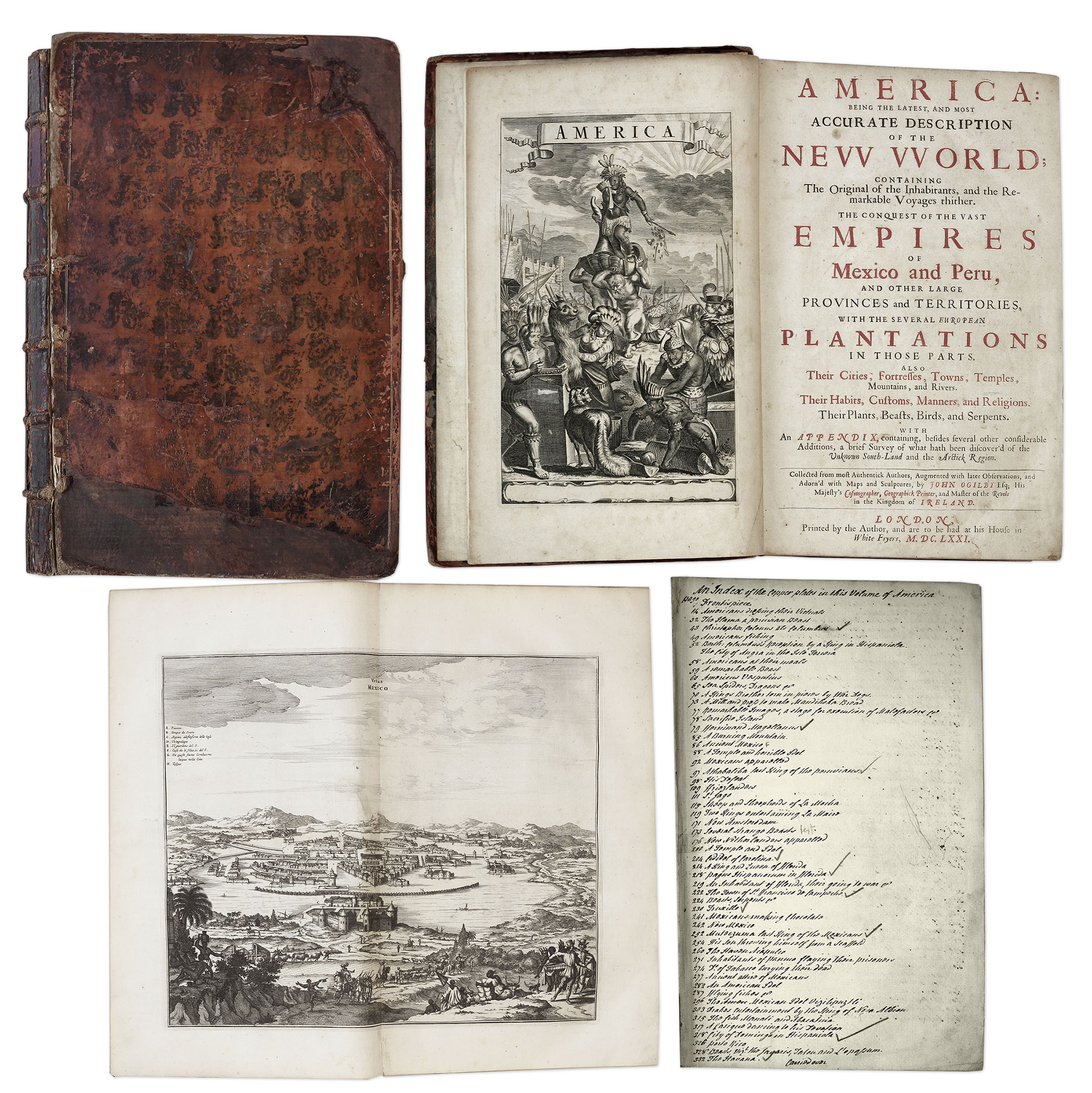
One of the most important books on the history of America (cited by Borba de Moraes, Howes, Sabin and Wing), the 1671 first edition of ”America: Being the Latest and Most Accurate Description of the New World”. Privately printed in London by the author, Arnoldus Montanus, and edited by John Ogilby. In ”America” Montanus goes into great detail of the new continents, with dozens of engravings of Native Americans, species of animals and reptiles, and the landscapes and settlements in the new world, accompanied by text. The book covers speculation regarding the earliest voyages to America, along with later recorded voyages and the settlements of New Netherlands/New York, New England, Hudson’s Bay, Labrador, Canada, Nova Scotia, Maryland, Virginia, (including Captain Smith’s capture and rescue by Pocahontas), Carolinas, Florida and California, plus accounts of Mexico and nearby islands, even including Australia and New Zealand. 674pp. book contains 75 original engravings (64 copper plates within the text and 9 plates throughout), lacking the maps and 28 engravings, which is typical as this edition is almost never found with all plates intact. All text is complete except for missing pages 445-446. Large format book measures 10” x 15”. Bound in original full leather boards, with some loss of leather to covers, cracking along spine and front board detached. Interior text is near fine and very readable. An important and fascinating addition to early knowledge of the American continent. Sold for $9,375.
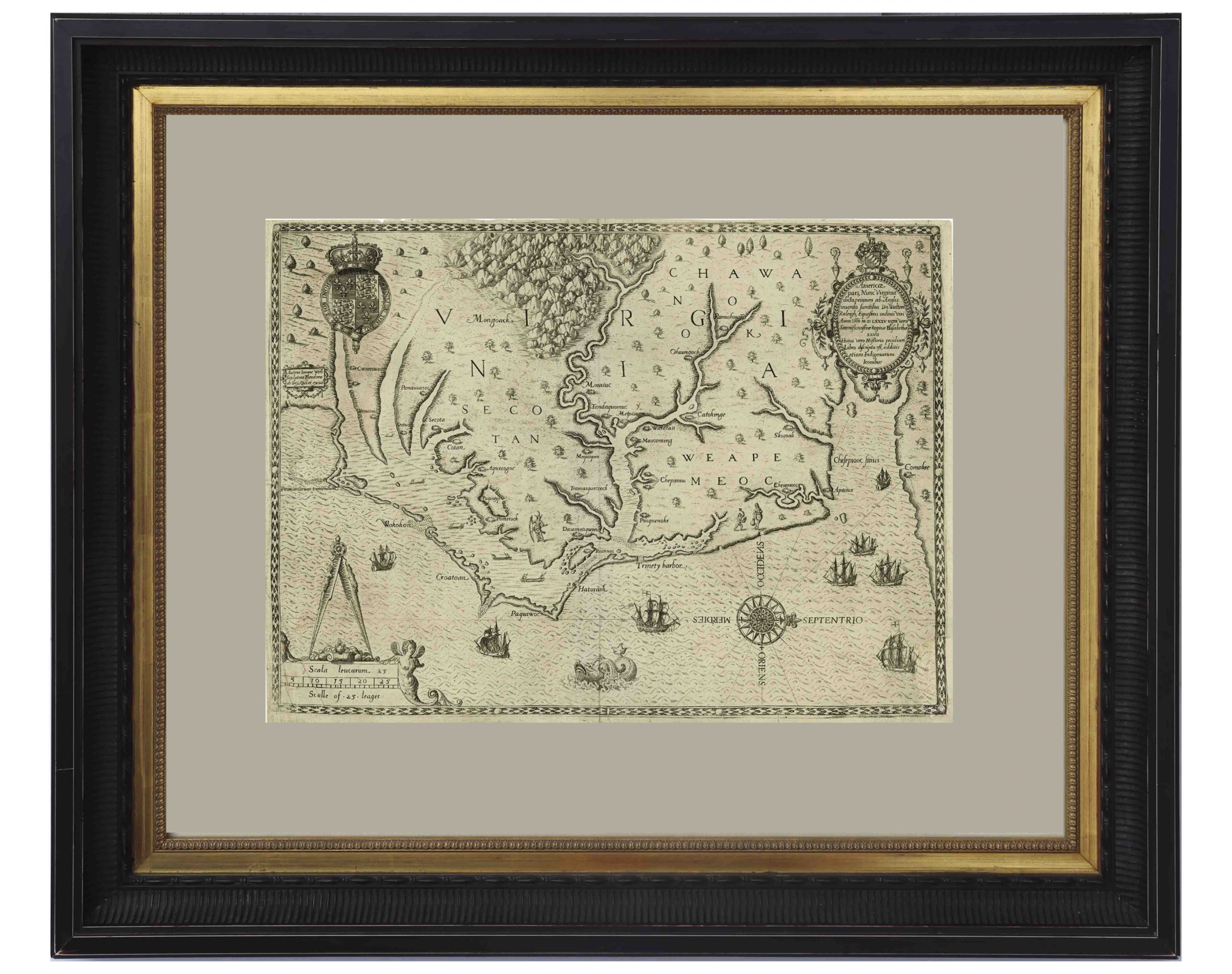
John White’s Map of Virginia From 1590 — The First Printed Map of Virginia and North Carolina
An important 16th century North American map known not only for its level of detail and accuracy, but also for its “firsts”: the first printed map of Virginia and North Carolina, the first to use Virginia in its title, the first to name the Chesapeake Bay, and also the first regional map showing the Roanoke Colony. Frankfurt: Theodor de Bry (engraver) for inclusion in his “Anglorum in Virginiam aduentus”, 1590.
Map is based on the work of cartographer, artist and explorer John White, one of the first settlers and Governor of the Roanoke Colony who, after sailing back to the Colony from England in 1587, had found all the colonists famously missing, their fate a mystery still unsolved. Philip Burden, who wrote the definitive reference book, “The Mapping of North America”, wrote of this map: “One of the most significant cartographical milestones in colonial North American history…the most accurate map drawn in the sixteenth century of any part of that continent.”
This full-sheet engraved map still retains its dark print, with the English Royal Arms at top left, and artistic touches throughout such as ships and sea monsters in the open ocean, and Native American canoeists in the inland waters. Map is the second state, with “C” laid over the “E” in Ehesepiooc. Map measures 16.675″ x 12.25″, nicely matted and framed to a size of 28″ x 23.5″. Expert repair to single vertical fold, and small area of repair to lower right corner, just touching the edge of the ship, where paper loss has been replaced. Overall in very good to near fine condition given age, displaying beautifully. Sold for $6,665.
Revolutionary War Map 1776
Revolutionary War map dated March 1776. “The Theatre of War in North America, With the Roads and a Table of the Distances…” Printed in London for R. Sayer and J. Bennett. Map depicts the area east of the Mississippi River from James Bay to Cape Canaveral, and locates provincial boundaries, towns, forts, roads, Indian villages, New England fishing waters, and the like. An inset is comprised of “Evan’s Polymetric Table of America,” which allows one to calculate the distance between most of the prominent towns. Text below the map reads, “A Compendious Account of the British Colonies in North America,” which devotes a paragraph of description to each of the North American colonies, including Florida, Canada, and the Province of Quebec. Issued separately by Sayer and Bennett, who also published “the American Military Pocket Atlas,” that year for the use of British officers. A notable map of the American Revolution, published the same year as the American Declaration of Independence. 20.75″ x 28.5″; 29.25″ x 37.5″ framed. Excellent condition. Sold for $6,000.
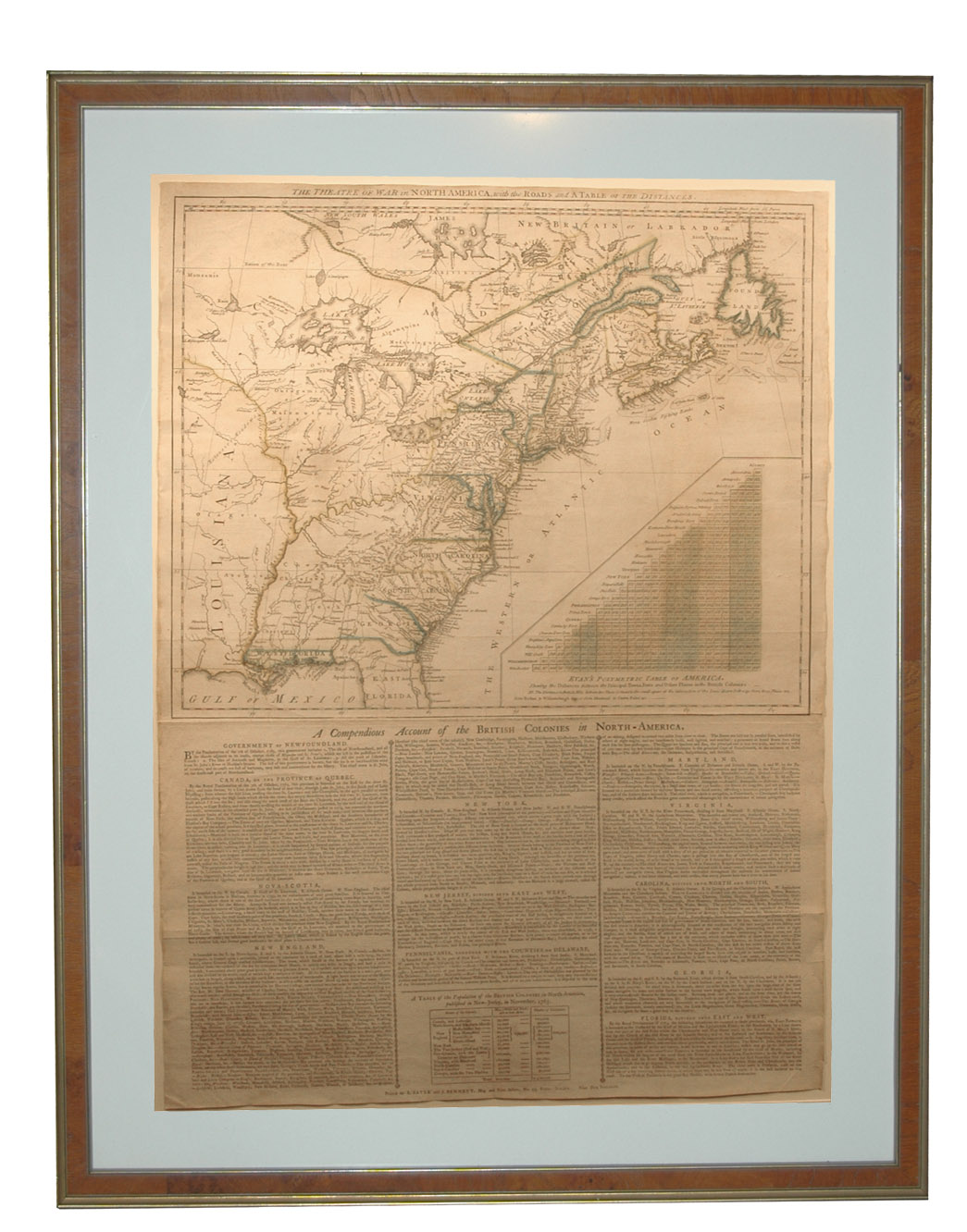
Revolutionary War Map 1776
Revolutionary War map dated March 1776. “The Theatre of War in North America, With the Roads and a Table of the Distances…” Printed in London for R. Sayer and J. Bennett. Map depicts the area east of the Mississippi River from James Bay to Cape Canaveral, and locates provincial boundaries, towns, forts, roads, Indian villages, New England fishing waters, and the like. An inset is comprised of “Evan’s Polymetric Table of America,” which allows one to calculate the distance between most of the prominent towns. Text below the map reads, “A Compendious Account of the British Colonies in North America,” which devotes a paragraph of description to each of the North American colonies, including Florida, Canada, and the Province of Quebec. Issued separately by Sayer and Bennett, who also published “the American Military Pocket Atlas,” that year for the use of British officers. A notable map of the American Revolution, published the same year as the American Declaration of Independence. 20.75″ x 28.5″; 29.25″ x 37.5″ framed. Excellent condition. Sold for $6,000.
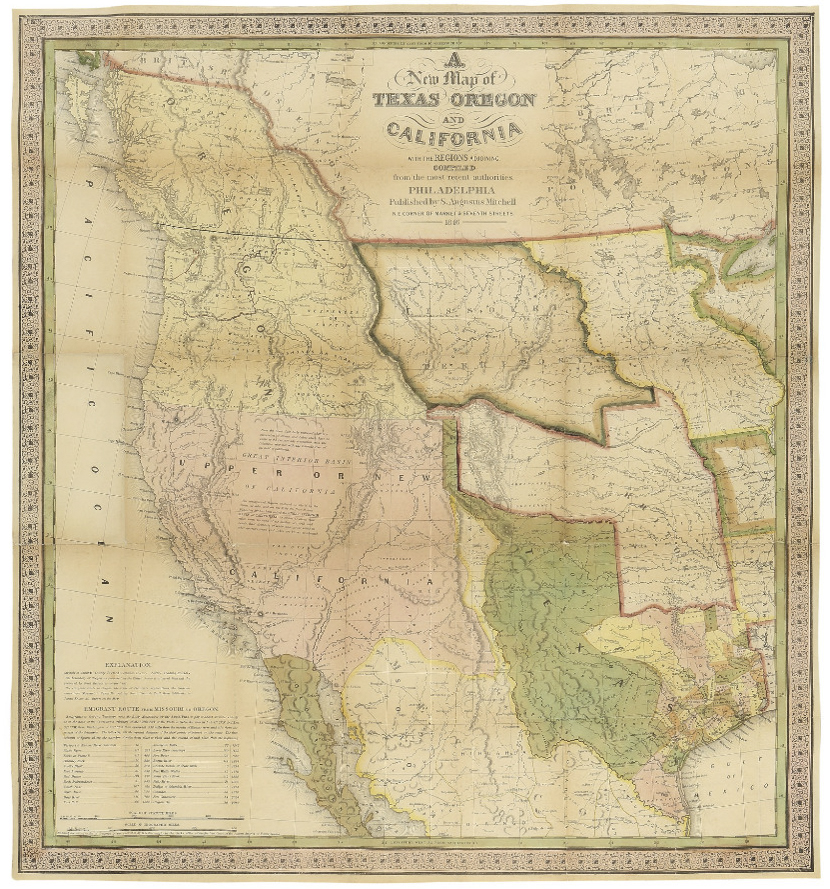
Map of Texas, Oregon and California From 1846
“A New Map of Texas Oregon and California with the Regions Adjoining. Compiled from the most recent authorities.” By cartographer Samuel Augustus Mitchell, published in 1846 as a pocket map, and considered the definitive map for settlers in the nation’s westward expansion during the Gold Rush. Philadelphia: Published by S. Augustus Mitchell, 1846. With contemporary hand-coloring, folding map by engraver H.N. Burroughs was Mitchell’s most important map, considered the defacto standard and thereby affecting subsequent maps of the area. It was the first to include recent explorations in the Great Basin, with boundary lines of Rio Grande to the south, and Oregon to the north at 54 degrees 40 minutes, above which are “British Possessions”. An inset to lower left entitled “Emigrant Route from Missouri to Oregon”, provides the distance between western cities and landmarks, undoubtedly aiding weary travelers. With decorative scrollwork along the margins, map measures 21″ x 22.5″ unfolded, nicely matted and framed to a size of 34.5″ x 41.5″. Some expert repair at fold separations and mild fading, overall in very good condition. Sold for $4,800.
Scarce First Edition, First Printing Map of London Just After the Great Fire in 1666, by Wenceslaus Hollar
A very rare first printing of the post-Great Fire map of London by noted artist and engraver to the King, Wenceslaus Hollar. After the Great Fire swept across London in September 1666, destroying nearly 90% of the homes, Hollar almost immediately produced this map, titled “A MAP or GROUNDPLOT of the Citty of London”, noted for its accuracy and attention to detail. Printed in London by John Overton, 1666. Appointed by King Charles II to document the destruction, Hollar was able to quickly plot the map based on his previous but failed passion project – to produce the greatest map of London that ever existed. Hollar used those previous drawings as the basis for his post-Great Fire map, adding detail for areas that survived the fire, and foregoing details for the destroyed areas. The result was an immensely popular and well-received map that grounded Hollar’s reputation as engraver and cartographer. In this first printing – distinguished by the placement of the legend, inset map and scale of the city, Hollar documents the destruction of London, from Lincoln’s Inn Fields in the west to East Smith’s Field in the east, including the Great Tower of London, and from just south of the Thames River in the south to Bunhill Fields Burial Ground in the north. An inset to churches throughout the city “and other remarkable places” is present, as is a scale for the map. Finally, an inset map showing a larger portion of London is found at lower left, including Westminster which narrowly missed the fire’s path. Map is astonishingly complete and detailed given the speed that Hollar produced it, with printed signature appearing at bottom of inset map, “W. Hollar fecit [Latin, ‘he made’] 1666″. Map measures 14.5″ x 12”. Light toning and faint creasing, small quarter-inch closed tear at lower left margin, and spot of discoloration at mid-right margin. Mounting remnants on verso. Overall near fine condition given age. Sold for $4,383.

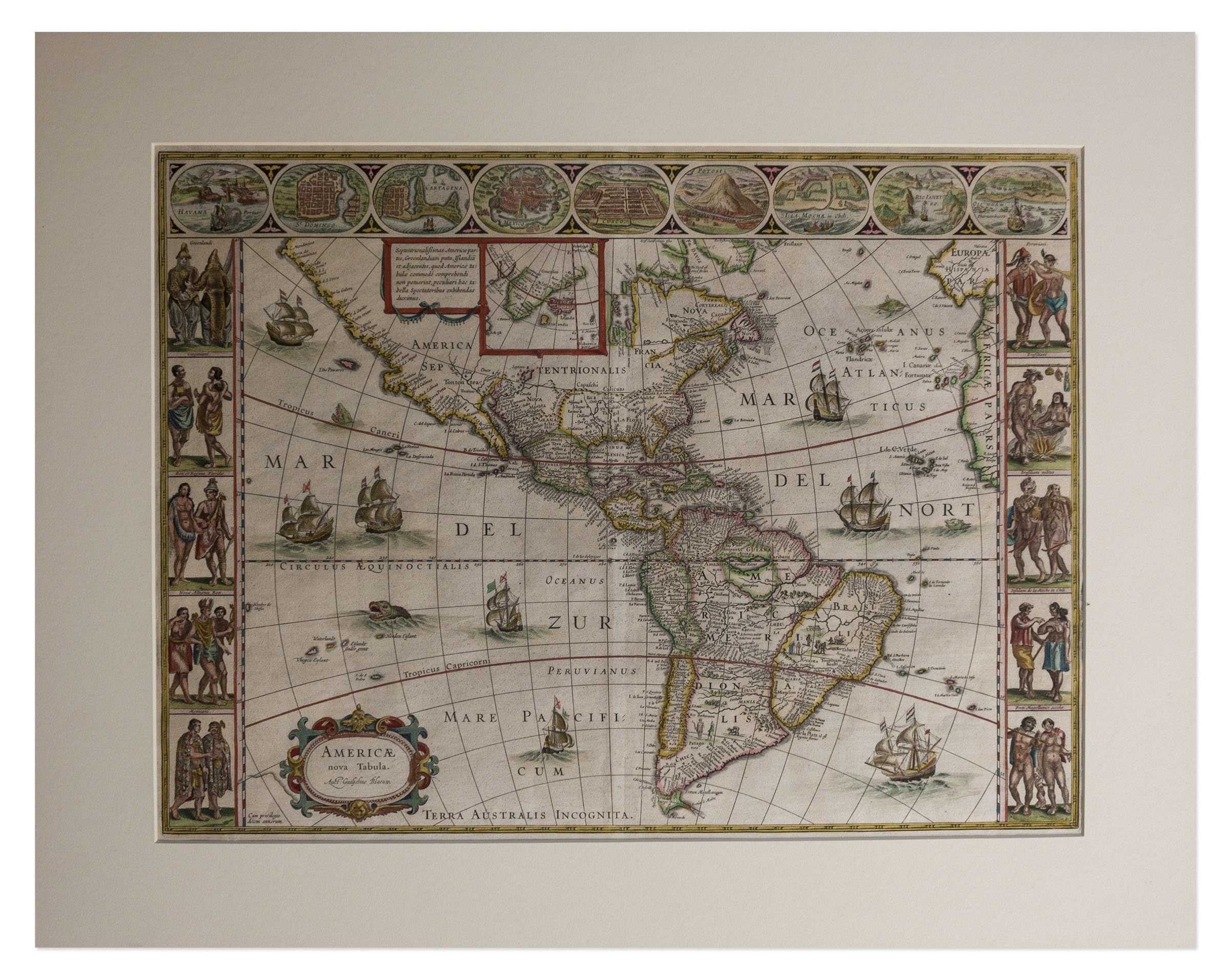
17th Century Hand-Colored Map of the Americas by Noted Cartographer Willem Blaeu — Entitled “A New Map of America”
One of the few maps of the Americas by renowned 17th century Dutch cartographer Willem Blaeu, published in Amsterdam, circa 1640s, entitled “Americae Nova Tabula” or “A New Map of America”. Hand-colored engraved map is accentuated with a sea monster and galleon ships in the body of the map, with Blaeu further decorating the side borders with semi-nude and costumed figures, and the top border with geographical areas such as Mexico and Havana. Of this particular map, the expert Philip Burden has stated, “This is one of only a few maps relating to North America by Blaeu. Its visual appeal is enhanced greatly by the inclusion of three decorative borders. These are drawn from various sources, including Theodore de Bry.” Map measures 23.75″ x 19.25″, matted to 28″ x 22.25″. French text printed on verso. Mild, uniform toning and archival repair to verso, overall in exceptional near fine condition given age. Sold for $4,000.
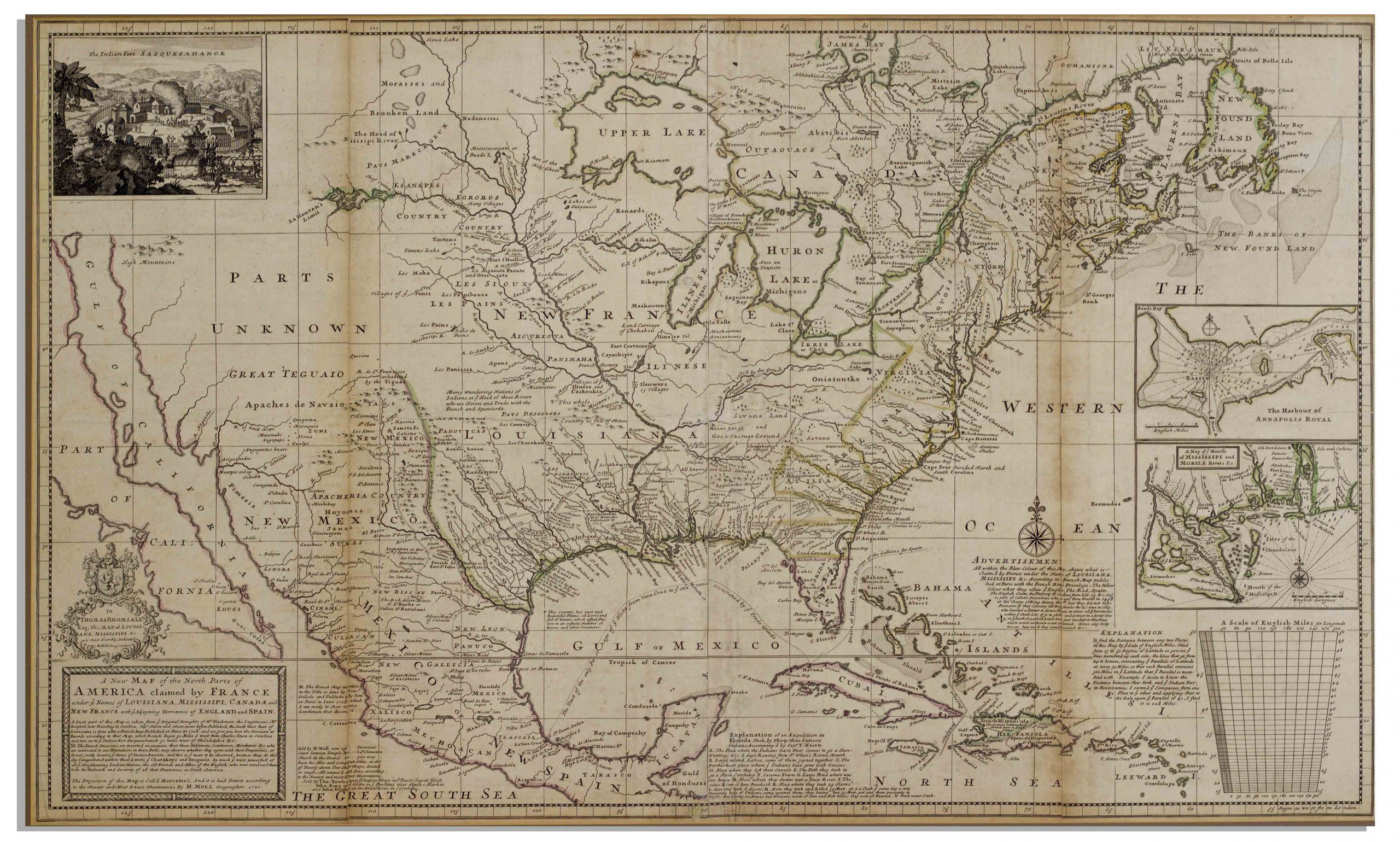
Americas Map Published in 1720 by London Cartographer Herman Moll — Measures 25″ x 40.75″
Large map of the Americas, published in 1720 by London cartographer Herman Moll entitled “A New Map of the North Parts of America claimed by France under ye names of Louisiana, Mississipi, Canada and New France with ye adjoyning territories of England and Spain”. Engraved map incorporates the latest surveying of the Americas, such as a French expedition into Texas in 1716. Map is hand-colored at boundaries, featuring a vignette at upper left of “The Indian Fort Sasquesahanok”, and with various “Explanations” of the map printed at bottom, including one of an Indian expedition into Florida, “6 days Rowing”. Insets of the Annapolis Harbor and the mouths of the Mississippi and Mobile Rivers are also included. Map is published in four vertical sections, laid down on archival paper and mounted on board. Map measures 25″ x 40.75″. Minor browning at section lines and a few spots of buckling. An attractive map in very good condition, giving historical insight into the jockeying for land among the major European powers in the early 18th century. Sold for $3,200.
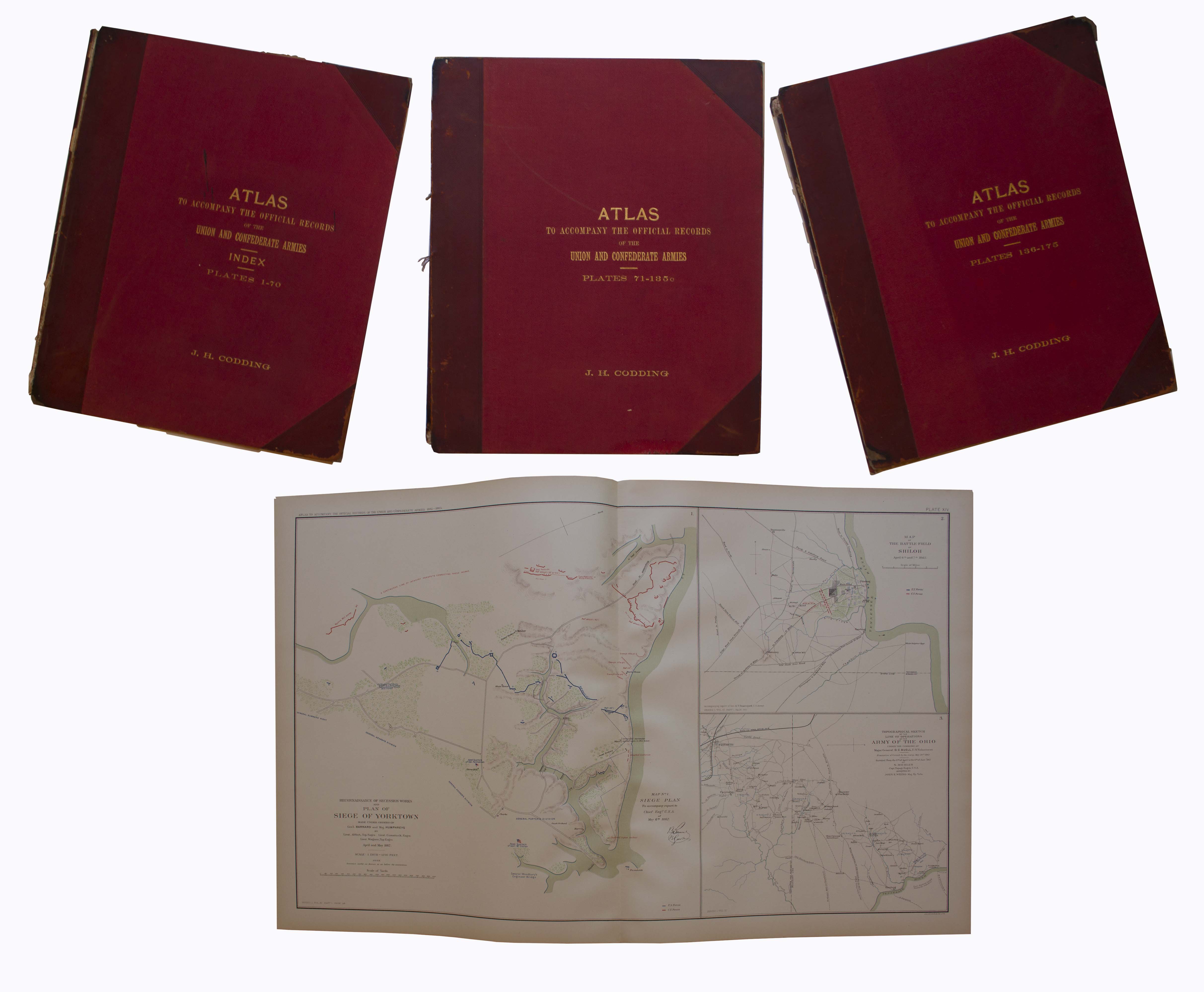
Three volume set of the ”Atlas to Accompany the Official Records”, compiled by Capt. Calvin D. Cowles. Washington, D.C.: U.S. Government Printing Office, 1891-1895. This three volume set of maps and drawings was printed to accompany the most comprehensive primary reference for the Civil War: ”War of the Rebellion: Official Records of the Union and Confederate Armies”, published by the U.S. Government in 53 volumes. All 175 plates are present here, with detailed schematics of battlegrounds, troop movements, examples of uniforms, transportation methods etc. Set is bound in original three-quarter red leather and maroon cloth, with marbled endpapers. Separated front board on Vols. 1 and 2, scuffing to boards and some loss to leather of spines, especially on Vol. 1. Maps and drawings, however, are in very good to near fine condition, with virtually no toning. Sold for $2,000.
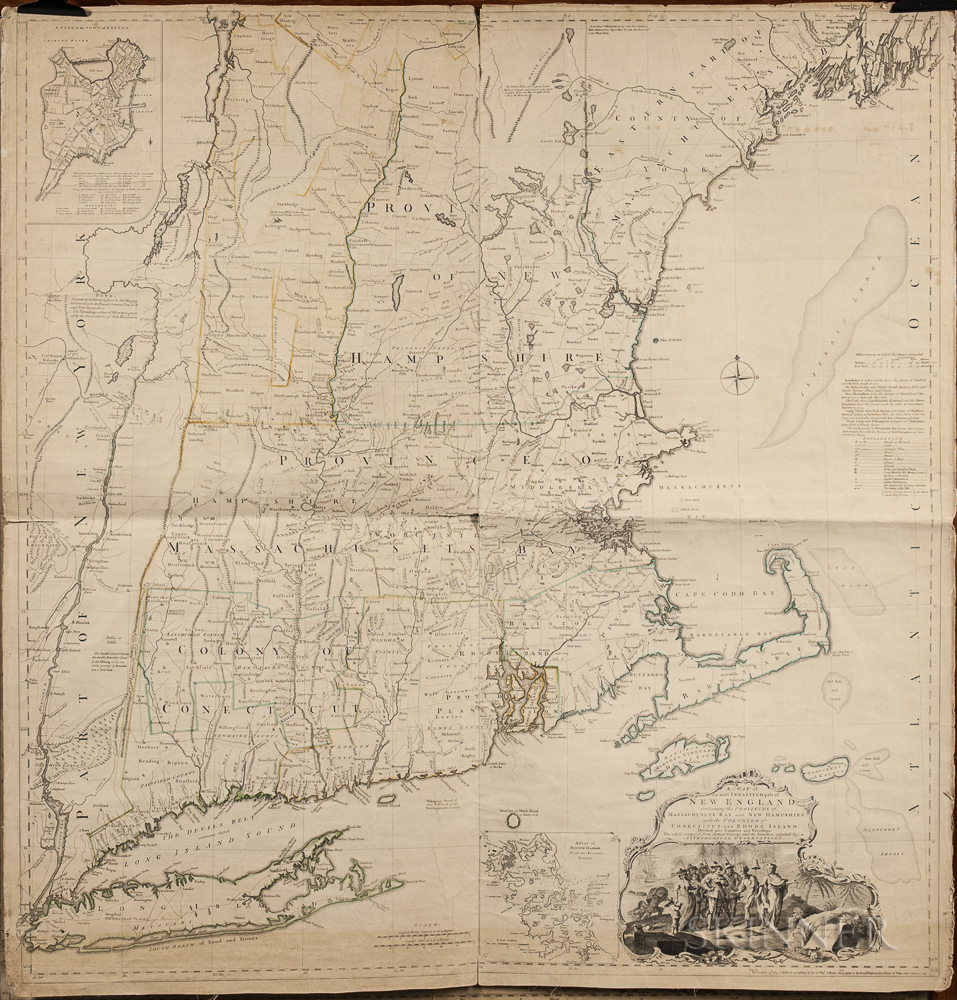
1774 Map of New England measuring over 40” square, the earliest large scale map of the New England colonies and used in the American Revolution. Drawn by Braddock Mead, and originally published in 1755, this copy was included in Thomas Jefferys’ ”American Atlas”, with hand-outlines. London: Printed and sold by R. Sayer and J. Bennett, 1776 (map dated 1774). Entitled in full, ”A Map of the Most Inhabited Part of New England Containing the Provinces of Massachusetts Bay and New Hampshire, with the Colonies of Connecticut and Rhode Island, Divided into Counties and Townships: The whole composed from Actual Surveys and its Situation adjusted by Astronomical Observations.” Measures 40” x 41.25”. Folded in fourths, as printed by copper-plate engraving on laid paper, mounted to linen. Light toning, chipping along margins and separation starting along folds. Overall in very good condition, a bright copy ideal for framing. Sold for $1,875.
Lotter New and Correct Map of North America 1784
Large four-sheet engraved map measuring nearly 4′ x 3.5′ showing North America in 1784, with sovereignty of the thirteen colonies belonging to the United States following the Treaty of Paris that concluded the Revolutionary War. Published in Ausburg, Germany by Mathew Albert Lotter and Georg Frederic Lotter, 1784. Map is titled at upper right, “A new and correct map of North America with the West India Islands. Divided according to the last Treaty of Peace, concluded at Paris the 20th of Jan. 1783. wherein are particularly distinguished the Thirteen Provinces wich [sic] compose the United States of North America”. A cartouche underneath shows tradesmen and workers on the banks of Bermuda, and two insets show Baffin and Hudson’s Bay beneath the Arctic, and land bordering the “Sea of California” partially described as “The Passage by Land to California”. Map measures 46.875″ x 41″. Professionally backed to linen and lightly mounted to board. Minute foxing and a few spots of repair. Overall very good to near fine condition given age including superior color contrast. With fascinating detail, map would anchor a room and serve as an excellent topic of ongoing reflection and discussion. Sold for $1,750.

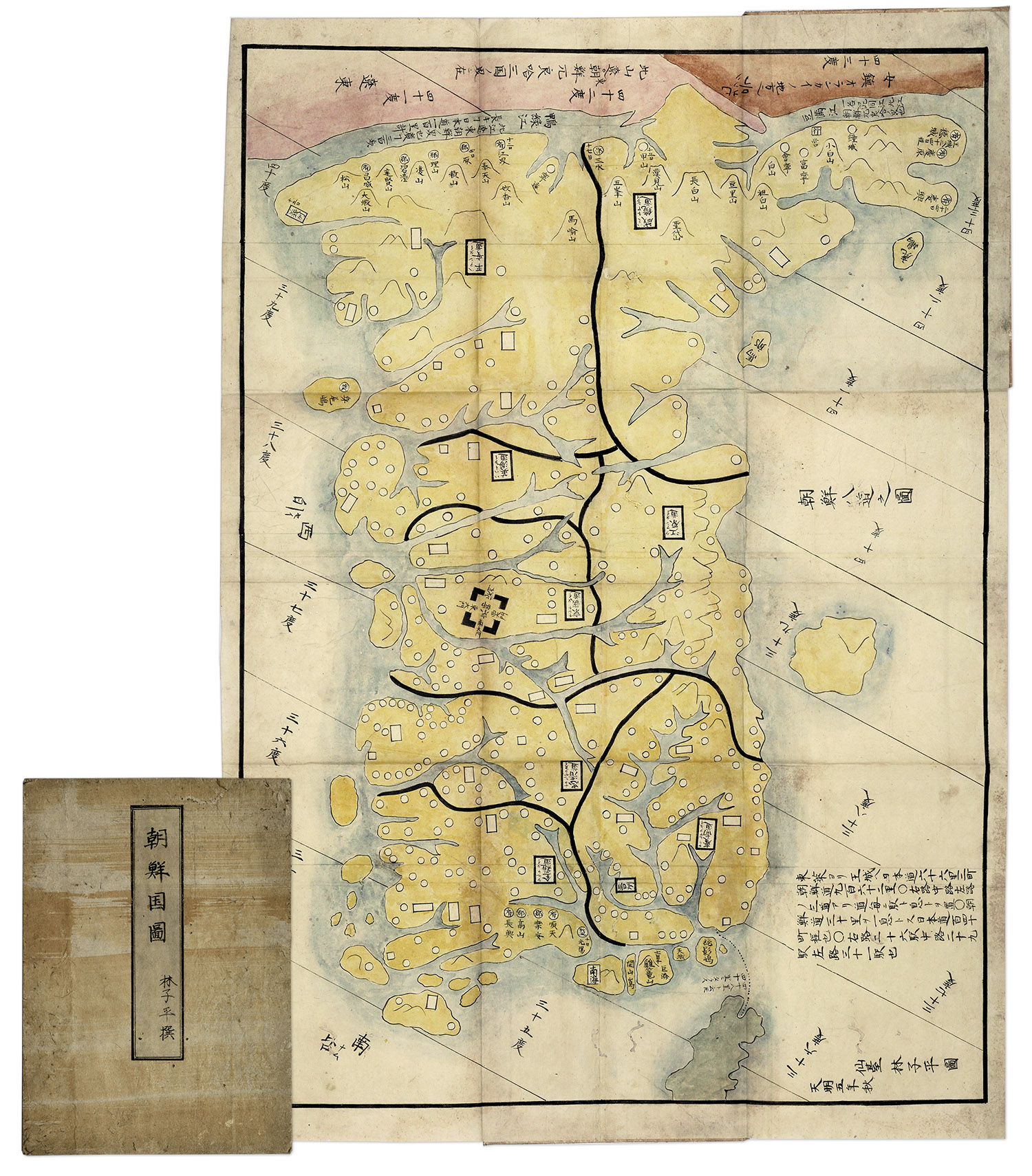
Hand-painted map of Korea by Hayashi Shihei, from Japan, circa 1785. Fold-out map shows the kingdoms outside Japan’s boundaries, but with the Kingdom of Joseon (Korea) being an important trading partner, the map was considered dangerous, and consequently banned by the Shogun in 1792. Has original cover boards and title slip. Measures 20” x 29” when folded out, and 7” x 9.5” when closed. Lightly toned and soiled, overall very good condition. Sold for $1,563.
FREE ESTIMATE. To buy, auction, sell or consign your North America Corrected Royal Society 1710 that is for sale, please email your description and photos to [email protected] of Nate D. Sanders Auctions (http://www.NateDSanders.com).