
Sell or Auction Your Herman Melville Autograph Letter Signed for up to Over $7,000 or More at Nate D. Sanders Auctions
FREE APPRAISAL. To buy, auction, sell or consign your Herman Melville autograph letter signed that is for sale, please email your description and photos to [email protected] of Nate D. Sanders Auctions (http://www.NateDSanders.com).
Free Appraisal, Auction or Sell Your Herman Melville Autograph Letter Signed
Below is a recent realized price for a Herman Melville autograph letter signed. We at Nate D. Sanders Auctions can obtain up to this amount or more for you:
Herman Melville Autograph Letter Signed. Sold for Over $7,000.
The following are some related items we have sold:
1851 1st/1st Melville`s “Moby Dick”
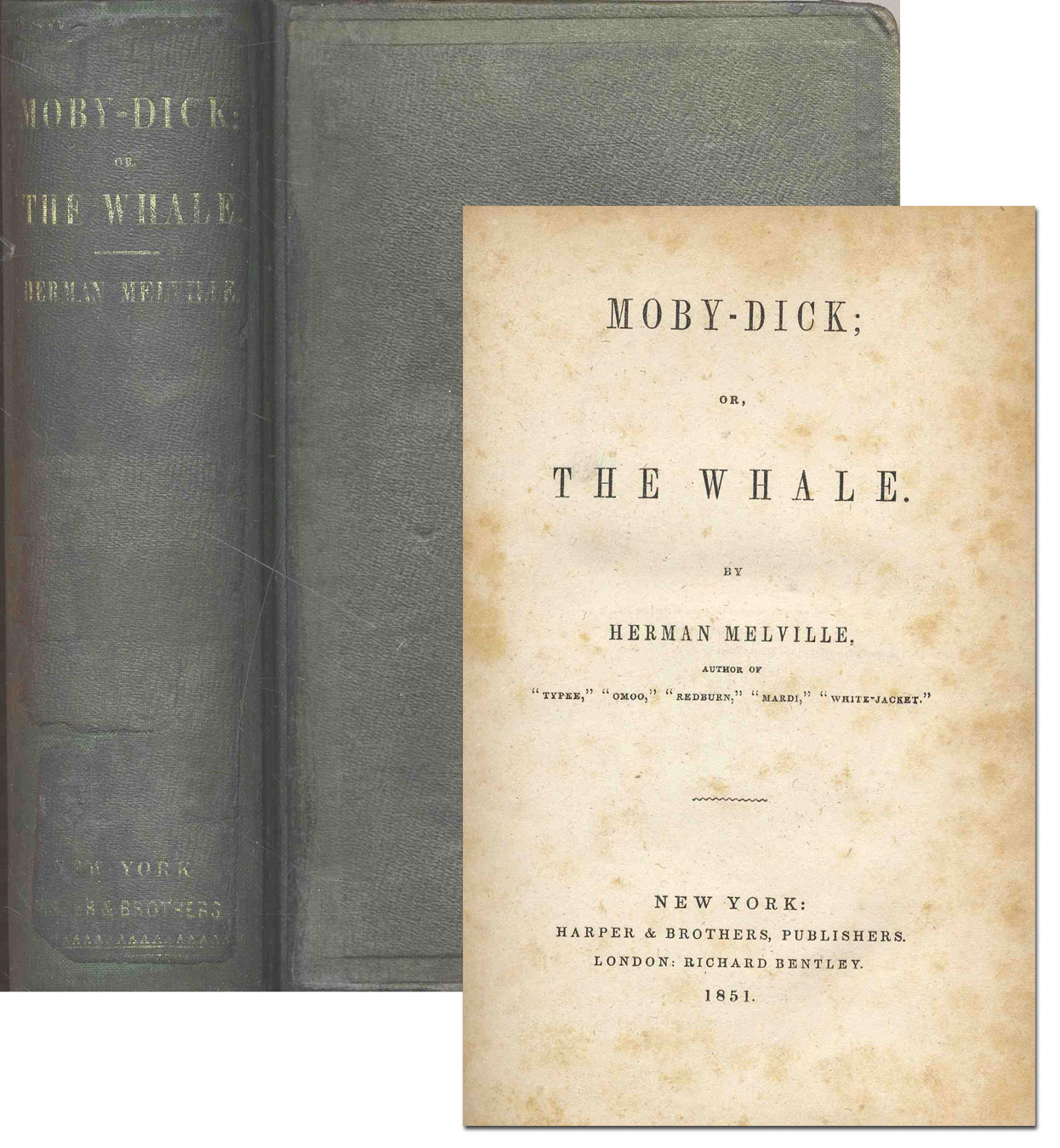
“Moby Dick; or The Whale” by Herman Melville. New York: Harper & Brothers: 1851. First edition, first state. 635pp. with original orange endpapers. A masterwork, and a book collector’s necessity. From its indelible first line, “Call me Ishmael,” to its last, Melville’s singular novel establishes his authority as one of the literary masters of the nineteenth or any century. One of only 2,800 first edition copies published, this volume remains extremely rare as many were destroyed in an 1851 Harper’s warehouse fire. Complete with all leaves for first edition, first state; two flyleaves in the front, 3 at rear along with 6pp. of book ads; title page, dedication page, 2pp. contents, 1p. fore title, 2pp. etymology, 14pp. extracts. Volume measures approximately 5.75″ x 7.75″. Previous owner’s ink inscription to front free endpaper. Overall toning and foxing to interior. Very good, professionally restored condition. Sold for $15,000.

1851 Moby Dick First Edition/ First Printing
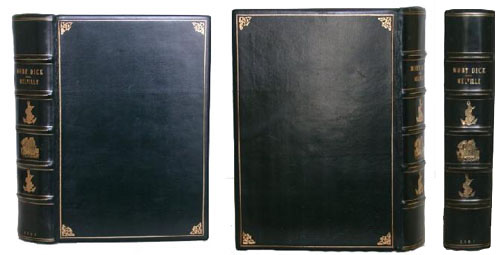
Scarce first edition of Herman Melville’s “Moby Dick.” New York: Harper and Brothers: 1851. First American edition. A masterwork, and a book collector’s necessity. From its indelible first line, “Call me Ishmael,” to its last, Melville’s singular novel establishes his authority as one of the literary masters of the nineteenth or any century. Handsome volume is housed in custom quarter-leather blue clamshell case. Octavo hardcover has been rebound in dark green leather; otherwise, near fine condition. Sold for $12,750.
Edgar Allan Poe autograph letter signed, with dramatic content regarding his famous feud with poet and playwright Thomas Dunn English. Poe writes to John Bisco, publisher of the defunct ”Broadway Journal”, which Poe had once edited. Poe asks Bisco to call upon an attorney in relation to ”attacks made upon me” by Mr. English. This is the first time since 1941, when it was sold by Parke-Bernet, that this letter has been at auction.
Although the public feuding between Poe and English was not new – with both men trading veiled barbs in various publications over the years, English raised the stakes when he wrote a letter published in the 23 June 1846 edition of the ”New York Evening Mirror.” Not only did English accuse Poe by name of being a forger, drunk, deadbeat, and scoundrel for besmirching a lady’s honor, but also, perhaps most unforgivable, a serial plagiarist. Poe likely got advance notice of the article as this letter is dated 17 July 1846, only six days before the publication. However, although Poe couldn’t stop the article from running, he was successful in suing the ”Mirror” for libel, collecting $225.06 in damages a year later, likely more than Poe made during his lifetime from writing. Letter reads,
”My Dear Mr. Bisco / You will confer a very great favor on me by stepping in, when you have leisure, at the office of E.L. Fancher, Attorney-at-Law, 33 John St. Please mention to him that I requested you to call in relation to Mr. English. He will, also, show you my Reply to some attacks lately made upon me by this gentleman. / Cordially yours. / Poe”.
Single page letter on pale blue stationery measures 7.875” x 7”, framed with a CDV of Poe to a size of 21.25” x 16”. Not examined out of frame. Folds, tape repair, faint discoloration and small areas of paper missing along edges. Irregular lower border. Overall in very good condition with bold handwriting and excellent legibility. A scarce letter by Poe with excellent association, backed by an intriguing story worthy of the famous author. With provenance from the 19th Century Shop, and exhibition history at The Poe Museum in Richmond, Virginia. Sold for $73,693.

F. Scott Fitzgerald Lot of Two Extraordinary, Unpublished & Handwritten Poems: “…Tenderest evidence, thumb-print of lust…”
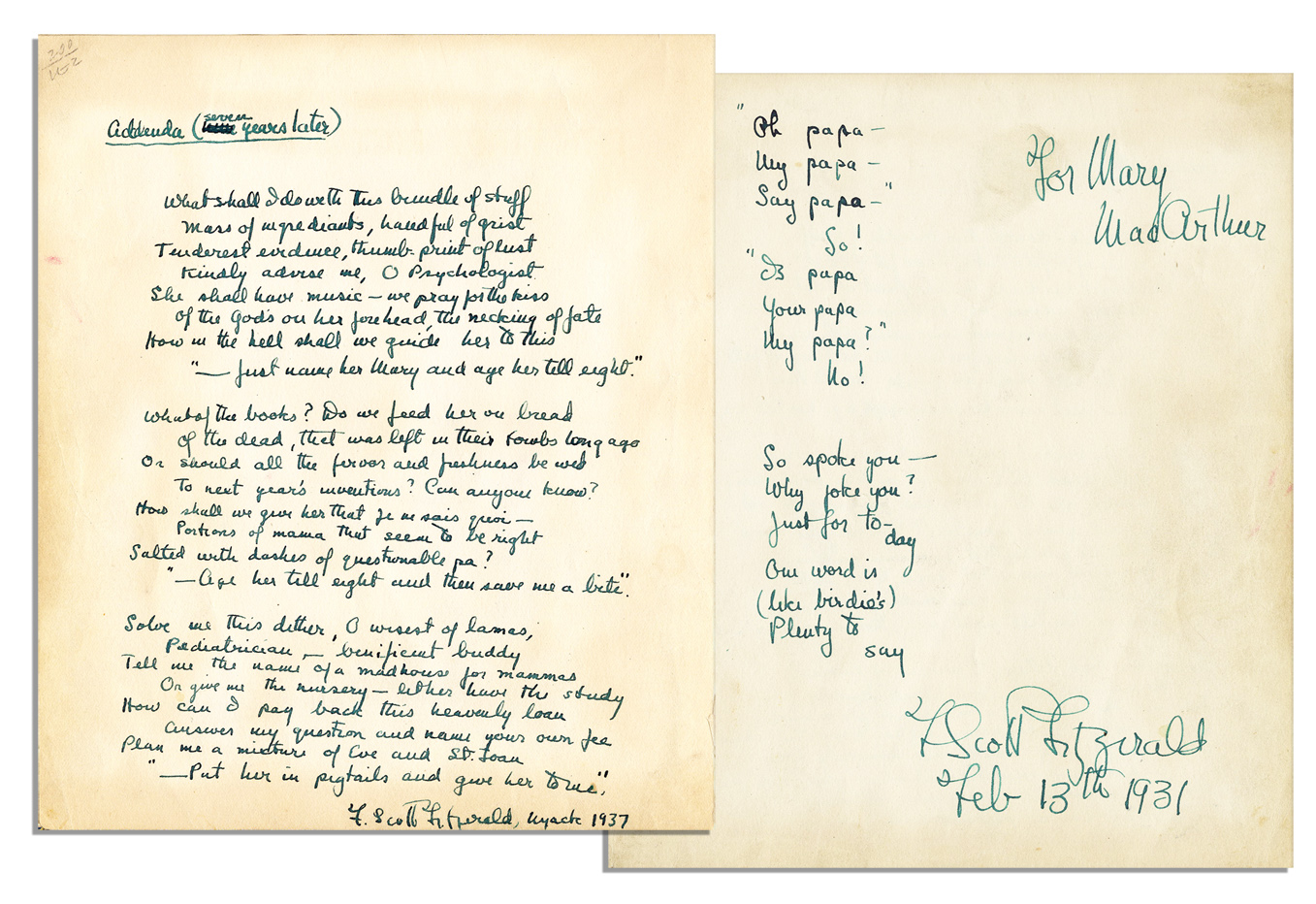
Incredible grouping of F. Scott Fitzgerald original prose, written for Helen Hayes’ daughter Mary MacArthur, who died of polio at the young age of 19. Here, the already famous author pens two lyrical poems, dated 1931 and 1937. At the time he writes the first poem, Fitzgerald was completing “Tender is the Night” while caring for his ailing wife, Zelda, whose mental illness had left her hospitalized in 1930. Fitzgerald handwrites the first, shorter poem in green ink. Inscribed “For Mary MacArthur”, it reads in full: “‘Oh Papa — / My Papa — / Say Papa’ / So! / ‘Is Papa / Your Papa / My Papa?’ / No! / So Spoke You / Why Joke You? Just For To-day / Our Word Is / (Like Birdie’s) / Plenty To Say”. Signed, “F. Scott Fitzgerald / Feb. 13th 1931”. The second, lengthier poem appears on the verso of the same sheet, titled, “Addenda (seven years later)”. Reads in full, “What shall I do with this bundle of stuff / Mass of ingredients, handful of grist / Tenderest evidence, thumb-print of lust / Kindly advise me, O psychologist / She shall have music — we pray for the kiss / of the god’s on her forehead, the necking of fate / How in the hell shall we guide her to this / ‘- Just name her Mary and age her till eight.’ / What of the books? Do we feed her our bread / of the dead, that was left in their tombs long ago / Or should all the fervor and freshness be wed / To next year’s inventions? Can anyone know? / How shall we give her that je ne sais quoi – / Portions of mama that seem to be right / Salted with dashes of questionable pa? / ‘- Age her till eight and then save me a bite.’ / Solve me this dither, O wisest of lamas, / Pediatrician – beneficent buddy / Tell me the name of a madhouse for mammas / Or give me the nursery – let her have the study / How can I pay back this heavenly loan / Answer my question and name your own fee / Plan me a mixture of Eve and St. Joan / ‘- Put her in pigtails and give her to me.’” Signed, “F. Scott Fitzgerald, Nyack 1937”. Sheet measures 7″ x 8″ with poem to front and longer prose poem to verso. From the estate of Helen Hayes. An extraordinary collection, adding to the catalogue raisonne of Fitzgerald’s known works. Sold for $30,875.
Exceptional Ernest Hemingway autograph letter and signed envelope, one day after catching the 500 lb. marlin in Bimini that inspired ”The Old Man and the Sea”, apocryphal until this letter which documents for the first time in Hemingway’s own words not only the size of the marlin, but also its attack by sharks, similar to the plot of Hemingway’s novel. Letter is accompanied by a photo of Hemingway and his friend, Henry Strater, with the half-eaten marlin. Dated 8 May (identified as 1935 by the “Hemingway Letters Project”), Hemingway writes to Erl Roman, the fishing editor of the ”Miami Herald”, describing the catch in detail, the attack by the sharks, and also mentioning that he is sending some photos to Roman. Letter in pencil reads in part,
”Will make this very short on acct. Bill Fagen leaving May 8 / Dear Erl: Yesterday May 7 Henry H. STRATER, widely known painter of OGUNQUIT Maine, Pres. Maine Tuna Club, fishing with me on Pilar landed Blue Marlin which weighed 500 lbs on tested scales after all of meat below anal fin had been torn away by sharks when fish was brought to gaff– Had him ready to take in when sharks hit him– Fish 12 feet 8 1/2 inches– Tail 48 inch spread–girth 62 in. (will send all other exact measurements when have chance to use Steel tape on him). Fish hooked off Bimini, hooked in corner of mouth, never layted, jumped 18 times clear, brought to boat in an hour such a heavy fish jumped hell out of himself. We worked him fast our system. Had him at boat when shark hit him. Strater has football knee, went out of joint, had hell with it, we wouldnt handline fish, he got him up himself, in one hour 40 minutes, we got him over the roller after Some lifting boy, all blood drained, meat gone below anal fin to tail, but fish completely intact, Fred Parke is mounting it–“
Two page autograph letter is accompanied by an envelope signed in pencil, addressed in Hemingway’s hand to ”Erl Roman Esq. / Miami Herald / Miami / Fla.” and signed by Hemingway on the verso, ”E. Hemingway / Yacht Pilar / Bimini / B.W.I.”
Importantly, Hemingway’s account of the marlin catch differs from other anecdotal stories of it, one of which describes Hemingway using a ”machine gun” on the shark, which purportedly attracted more sharks to the feeding frenzy. It’s likely Hemingway left out this detail, as Strater would blame its use on attracting more sharks to the marlin, depriving Strater of a world record marlin catch. “Old Man and the Sea” has been noted by Hemingway scholars as most likely inspired by this particular 7 May 1935 trip, including Michael Culver in his biography “Sparring in the Dark: Hemingway, Strater and The Old Man and the Sea”.
Letter measures 8.5” x 11”, envelope measures approximately 6.25” x 3.625” and photo, which is a modern reproduction, measures 7.75” x 9.75”. Letter is uniformly toned with some chipping along edges, and small piece of tape at very top. Envelope has some foxing and torn edge from opening. Both items are in very good condition. A remarkable letter in Hemingway’s own words of a legendary fishing adventure that inspired one of his most popular, Pulitzer-Prize winning novels. Sold for $28,000.

Incredible Six Page Autograph Letter Twice Signed by J.D. Salinger — Mentions Short Stories “I’m Crazy” Which Was the Early Draft of Chapters 1, 2 & 22 From “Catcher” & Narrated by Holden Caulfield — & “Boy Standing in Tennessee,” Original, Unpublished Short Story That References Holden
Virtually unheard of six-page J.D. Salinger autograph letter signed “Jerry” and, at head of first page, “Cpl. J.D. Salinger.” Written from France while Salinger served in WWII to Terry (Mrs. Frances Thierolf “Terry” Glassmoyer), Salinger’s friend from Ursinus College and inspiration for his literary character Franny Glass in “Franny and Zooey.” Headed by Salinger “August 7 [1944] / Cpl. J.D. Salinger, 3232520 / C.I.C. [Counter Intelligence Corps] Section, 4th Inf. Div. / APO #4, c/o PM, N.Y.C.”, just a few months after D-Day where Salinger stormed Utah Beach and fought continually for nearly a month. By July his regiment would lose almost 2,000 men out of 3,080. Letter is in near fine condition on six separate pages measuring 6″ x 9″. In this letter, Salinger reminisces about their school days, meeting Ernest Hemingway (who’s “extremely nice and completely unpatronizing”), his upcoming stories to be published and war. In small part, “Dear Terry…I’ve been in France since D-Day…Am scared stiff constantly and can’t remember ever having been a civilian…Jerry”. Also in this letter, Salinger reacts to Terry telling him how Mary Helen Stoudt, a fellow classmate, felt about him; in the 12 December 1938 issue of his college newspaper, “The Ursinus Weekly,” freshman Jerome Salinger reviewed the Senior Play, mentioning M.H. Stoudt’s performance: “On the evening of December tenth, the Senior Class, under the direction of Dr. and Mrs. Reginald S. Sibbald, offered ‘Lady Of Letters,’ a three-act farce by Turner Bullock Mary Helen Stoudt filled the insignificant role of Daughter Susie to its scant capacity”. Regarding the stories that Salinger mentions, his short story “Elaine” appeared in the March-April 1945 issue of “Story” magazine, not in late 1944 as he expected. “Boy Standing in Tennessee” was never published and its existence is unknown. It is said to be the original version of “This Sandwich Has No Mayonnaise” which was published in the October 1945 issue of “Esquire.” In it, a character named Vincent Caulfield mentions his brother Holden and his sister Phoebe. “I’m Crazy” was in “Colliers” on 22 December 1945, not S.E.P., (“Saturday Evening Post”) as Salinger had thought. In “I’m Crazy,” Salinger used Holden Caulfield as the narrator. The story included an early draft of portions of chapters 1, 2, and 22 of “The Catcher in the Rye.” “Two Lonely Men” and “The Children’s Echelon” were never published. “The Children’s Echelon” is a story told by an 18-year-old girl, Bernice Herndon, through her diary. In one entry, she mentions that she loves to watch children at the merry-go-round just like Holden Caulfield in “The Catcher in the Rye.” Accompanied by copy of original envelope postmarked 9 August 1944. Long J.D. Salinger autograph letter signed. Sold for $14,500.

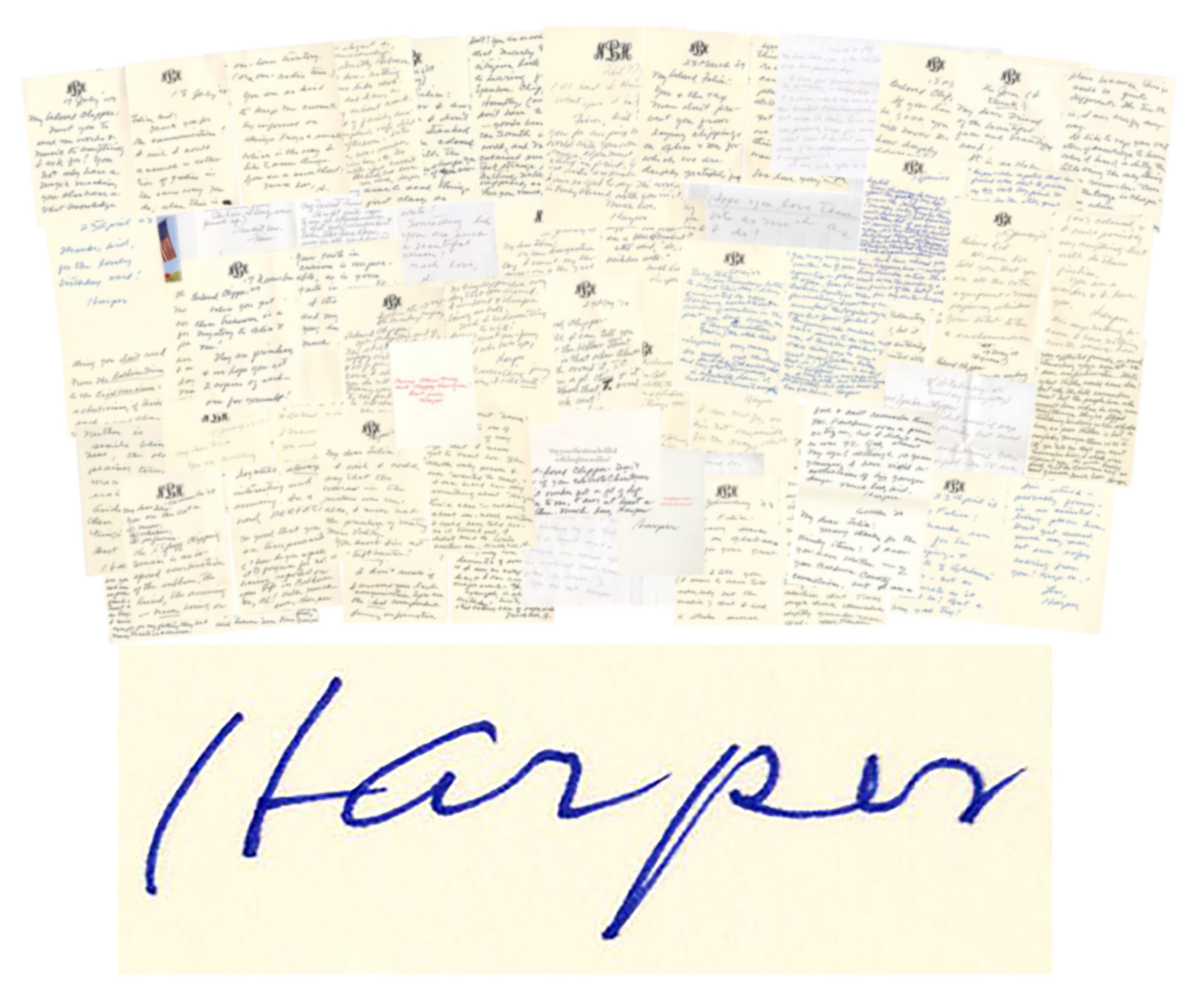
Lot of 38 letters signed by ”To Kill a Mockingbird” novelist Harper Lee, many with exceptional content, including Barack Obama’s presidency, Eudora Welty’s criticism of Lee for only writing one book, defense of ”To Kill a Mockingbird”, Lee’s Southern heritage, recollections of her father, Christianity and her apparent atheism, a funny story of Vivien Leigh, Laurence Olivier & Helen Keller, and even making fun of Hitler. Lot includes 26 autograph letters signed ”Harper”, six autograph letters signed with the initial ”H”, four autograph notes signed ”Harper”, a Christmas card signed ”Harper”, and one autograph note unsigned. Most letters are on her personal stationery and all but one include the original envelope in Lee’s hand. Lee writes the letters to her friend Felice Itzkoff of New York, whom Lee affectionately calls ”Clipper” as in Yankee Clipper. The letters span from December 2005 to May 2010, with unique content excerpted below:
In a lovely letter dated 20 January 2009, the day of Barack Obama’s inauguration, Lee writes, ”On this Inauguration Day I count my blessings…I’m also thinking of another friend, Greg Peck, who was a good friend of LBJ. Greg said to him, ‘Do you suppose we will live to see a black President?’ LBJ said, ‘No, but I wish her well’…Harper”. In a letter dated 18 April 2009, Lee writes of her affection for Eudora Welty, even though Welty obliquely criticized her: ”…alas, I never had the privilege of meeting Miss Welty – You know I’m not a ‘tuft hunter,’ ie, seek out ‘names’ to meet – it’s one of the downers of life that N never got to meet her. She was the only person I ever ‘wanted to meet.’ I once heard her say something about ‘Harper Lee’s case’ – talking about one-novel writers. I could have told her: as it turned out, I didn’t need to write another one – much xxx, H.” In a letter dated 13 May 2009, Lee recounts a funny story of her friend Vivien Leigh and Leigh’s ex-husband Laurence Olivier who inadvertently insulted Helen Keller: ”My Helen Keller story is second-hand, but it comes from good authority. I was acquainted with Vivien Leigh – long divorced from Lord Olivier. Nevertheless her chief topic of conversation was ‘Larry.’ (She had a mine of good stories.) He was ‘on’ one night and was considerably annoyed by the ‘noise’ coming from two people in the audience. ‘Somebody making slapping sounds-can’t the management put a stop to it?’ / ‘If you want to put a stop to Helen Keller’s enjoyment of your program, have her interpreter be quiet,’ he was told. ‘It is sometimes rather noisy, when things go as they should.’ Of course, Olivier melted, begged Miss Keller’s pardon, and gave the rest of his performance in her honor, seemingly unaware of the ‘noise.’ / Vivien was a character and I loved her. She, after he left her, ‘adored Larry,’ but I understand was not very nice to him beforehand – it was so like her! Much love, H.” In a letter dated 14 May 2009 (”I think”), Lee writes of her friend Horton Foote, the Academy Award winning screenwriter for ”To Kill a Mockingbird”, who had just died. She compares Foote to her own father, in part, ”…The service seemed to catch Horton in full. If he was your friend, it meant you had another ‘best friend.’ I am so proud to say that he was my friend. I loved him with all my heart and shall miss him for as long as I am aware of anything. I never knew anybody like him except for my father, they had many traits in common. He was a great gentleman, and he did look like God! / The Foote children will have a lot to live up to. Their mother was as influential in their growing up as their father…There is so much evil in the world today that I guess people don’t recognize plain goodness. I wish ‘heaven’ were true. Much love, Harper”. Sold for $12,500.
Scarce 1951 J.D. Salinger Autograph Letter Signed Regarding “Catcher in the Rye” — “I think it’s delightful that you identify me with Holden”
Amazing J.D. Salinger autograph letter signed dated 8 September 1951 thanking Frances (Terry) Thierolf and her husband Tom for their positive review of his new novel “Catcher in the Rye.” Thierolf was a former Ursinus College classmate of Salinger and inspiration for his literary character Franny Glass in “Franny & Zooey.” Written when he was 32, shortly after the publication of “Catcher in the Rye.” In full, “Dear Terry & Tom, Terry, I’m so glad you like the book and that you bothered to write to me about it. Thank you, too, Tom. I think it’s delightful that you identify me with Holden, Terry. I don’t think I’ll be turning up at Wanamaker’s, but maybe I can drop by some other time. Any way, best to you both. It’s fi[ne] that you sound happy. Yrs, Je[rry].” Includes original New York stamped 6″ x 4.5″ envelope dated 8 September 1951 with back flap signed in pen “Salinger / 300 E. 57th St. / N.Y., N.Y.” Envelope was addressed by Salinger to “Mr. & Mrs. T. Glassmoyer / North Hills Ave., R.F.D. / Willow Grove, Pa.” Overall very good condition. Single page letter on JDS stationery measures 5.75″ x 8.75″ and has torn upper right and lower right corner eliminating two letters of a word and the “rry” in Salinger’s signature. Incredibly scarce handwritten item connecting Salinger to his famous protaganist Holden. Sold for $10,000.

J.D. Salinger typed letter, clearly signed “J.D. Salinger” in blue ink, dated 14 May 1966 and written while on a trip to Bermuda. Addressed to a Carrol Roderick in Hampshire, England, 3pp. letter — in typical Salinger style with much tongue-in-cheek content — begins with a list of made up headlines about local town goings-on in Bermuda, and then continues in small part, “…They asked me to justify American policy in Vietnam and were rather shocked when I told them this I could not do because our VN policy stinks…” On page two, Salinger writes 10 lengthy stories about the “headlines” from page one, calling it a “six-penny edition”. The letter then reflects upon the saying that “we have the government we deserve” with Salinger writing, “…It would appear that the British and Americans have been very naughty indeed to have the governments they currently have…[signed] J.D. Salinger”. Letter measures 8.5″ x 11″ on three separate sheets. Folds from mailing, staple holes and paper loss at the upper left corners; overall in very good plus condition. Photo has been intentionally blurred. Sold for $9,424.

Excellent Harper Lee typed letter signed, dated 23 March 1990, confronting head-on the lingering questions of ”To Kill a Mockingbird’s” authorship. Lee confides in ”Doris: How kind of you to send me the READ ALABAMA info, and how like you to do it. Not only did I remember the first time my opinion was ever sought, I remember that the person seeking it was one of the most elegant-looking creatures I had ever seen. What touched me most was that your generosity of spirit included someone who was (and still is) the reverse of elegant, and made her feel a part of things. You made a friend for life that evening. Yes indeed, I have Alabama Memories, and think it fills a great need. You should have the enormous satisfaction of knowing that your creation will last forever as a permanent asset to all researchers and people who are interested in Alabama writing. Your report of Dr. Beidler’s remarks was most reassuring///I tremble at Mockingbird’s falling into the hands of professors and being Analyzed to death. (I understand there’s one academic nut at large who declares that Truman Capote wrote it!) If panel discussions of Mockingbird could inspire people to read, then I’m all for them. Last night I attended the opening of The Grapes of Wrath///the Broadway production by the Steppenwolf company. My private memories of John as a friend go back for many years, but as I sat watching the familiar scenes unfold I wondered if the young people in the audience knew what they were looking at: a novel that helped change the direction of the country. And I wondered how many of them realized///sitting in their opening-night finery…that they are descendants of the Joads///Love [signed] Nelle”. The two page letter includes original envelope. Each page measures 5.5” x 7.75” in fine condition. Sold for $5,948.

Mary Shelley Autograph Letter Signed During Her Travels Through Italy in 1843 — Shelley Gives Thanks for Sending Letters Written by Her Late Husband, Percy Shelley
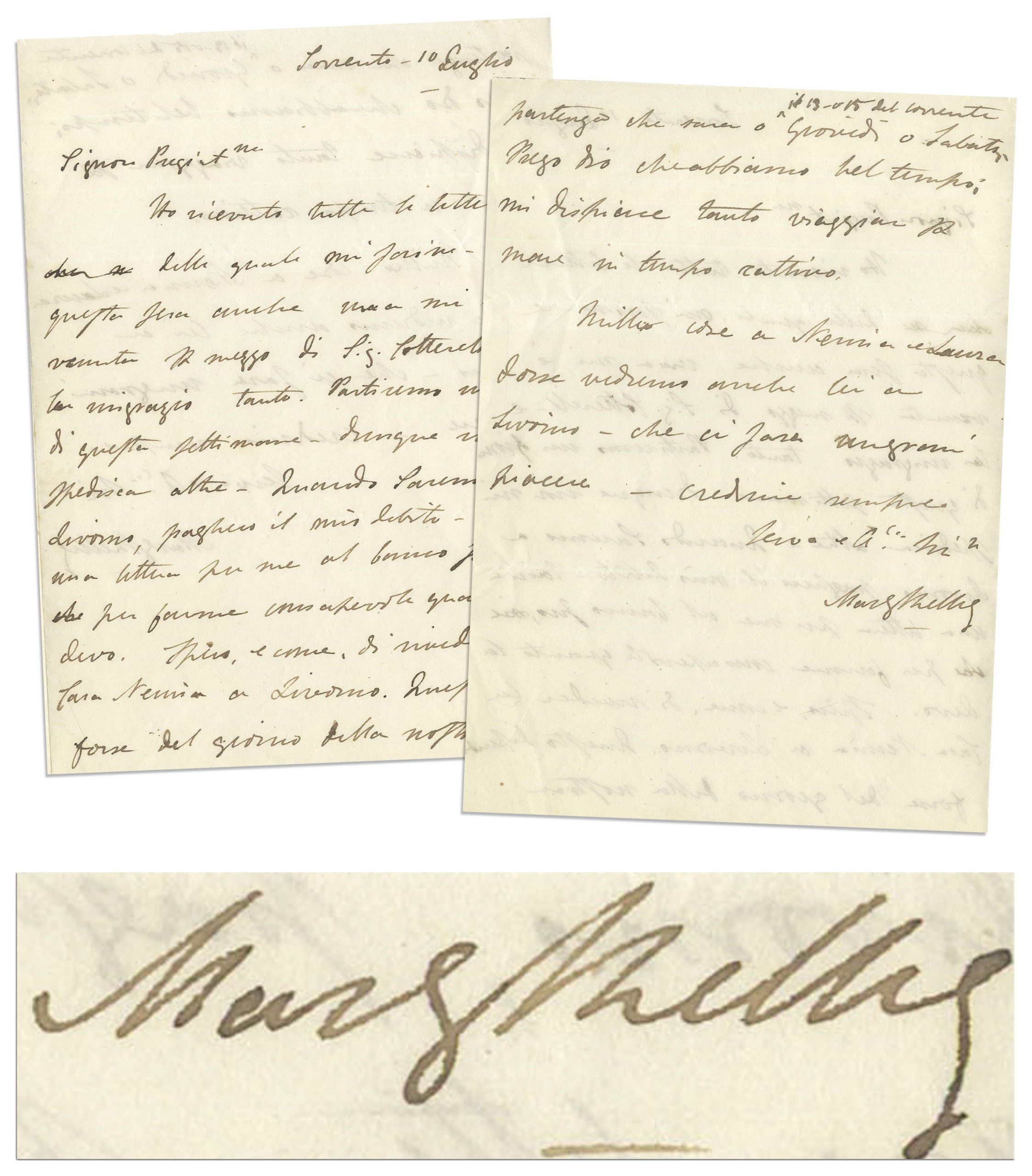
Mary Wollstonecraft Shelley autograph letter signed, dated 10 July (1843) from Sorrento, Italy. In this rare missive by the “Frankenstein” author, Shelley writes to the Italian nobleman Bartolomeo Cini regarding letters written by her late husband Percy Shelley to Cini’s mother-in-law, the writer Margaret King, which Shelley hoped to acquire.
Letter in Italian reads in part, “…I have received all of the letters about which you wrote to me, and this evening another one arrived to me by way of Signor Lotterelli, and I thank you greatly. We will depart one day this week. So please don’t send me any more. When we get to Livorno, I shall repay my debt. Leave a letter for me at your bank in order to let me know how much I owe you. I hope (and how much!) to see dear Nerina in Livorno. That may depend upon the day of our departure, which will be either Thursday or Saturday the 13th or 15th of this month. I pray to God that we have good weather. I very much dislike traveling by sea in bad weather…Mary Shelley”.
Shelley’s travels through Europe with her son Percy and his friends formed the basis of her travelogue, “Rambles in Germany and Italy in 1840, 1842 and 1843”. Two page letter on bifolium stationery measures 5.5″ x 7.75″ as folded, with address panel on verso. Remnant of red wax seal at top right corner. Very good plus condition. With full translation. Sold for $4,950.
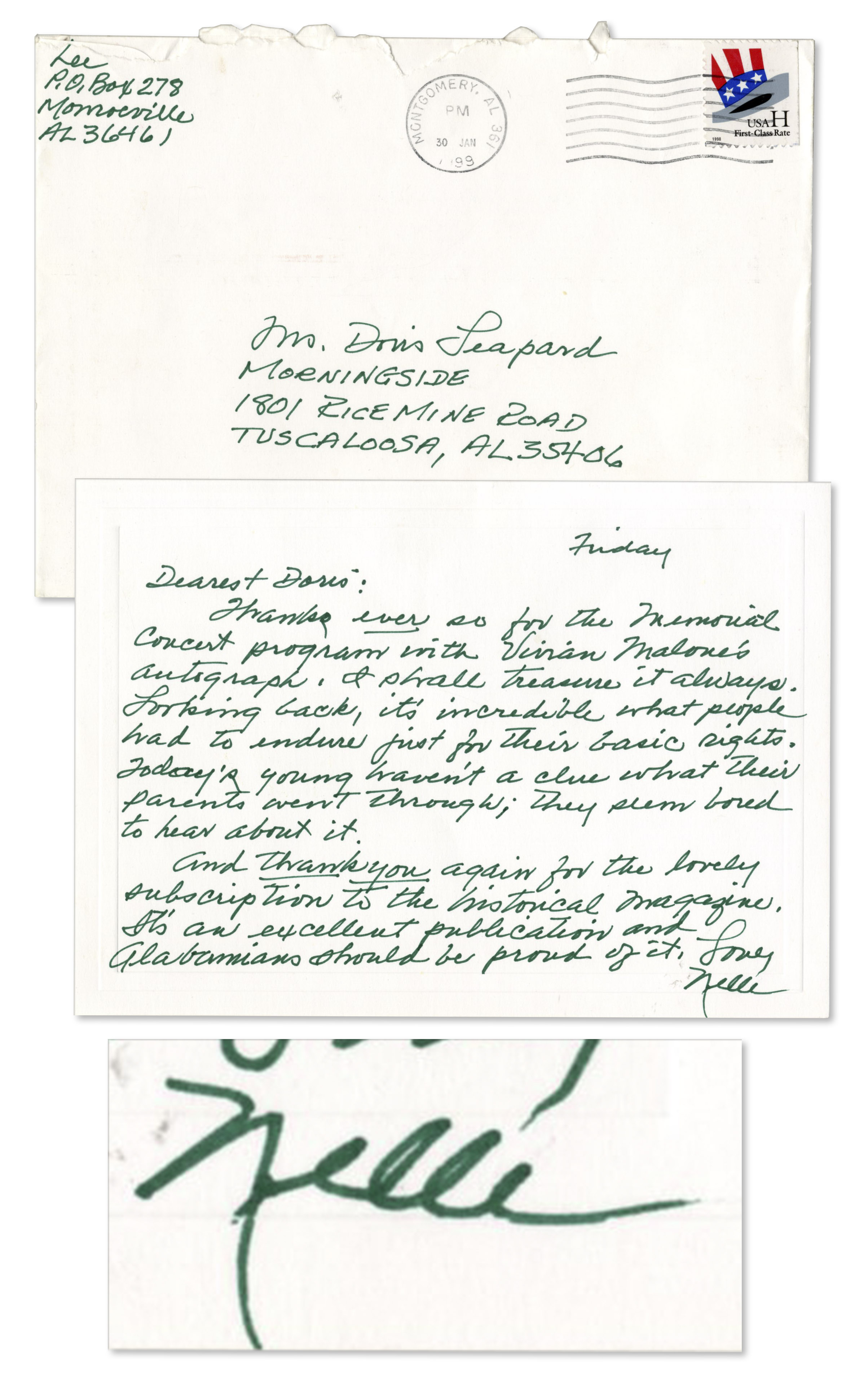
Harper Lee autograph letter signed, dated 29 January 1999, to her friend Doris Leapard. Lee thanks Leapard for the autograph of Vivian Malone, one of the first students to integrate the all white University of Alabama in 1963, shortly after publication of ”To Kill a Mockingbird”. Lee writes, ”…I shall treasure [the autograph] always. Looking back, it’s incredible what people had to endure just for their basic rights. Today’s young haven’t a clue what their parents went through; they seem bored to hear about it…Nelle”. Fine condition. Accompanying envelope is very good. Sold for $4,753.
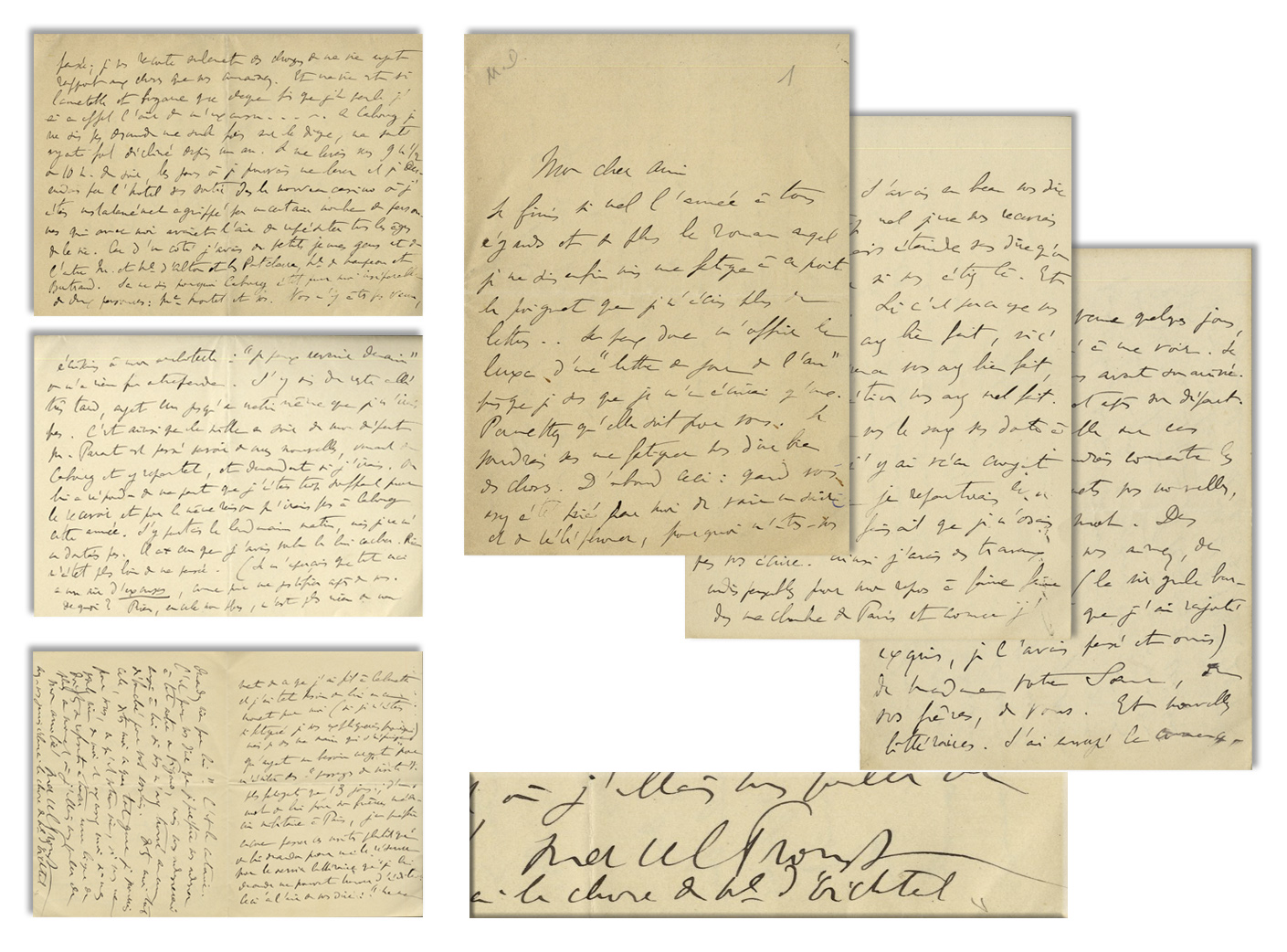
Marcel Proust autograph letter signed spanning seven pages, penned while writing his magnum opus, ”In Search of Lost Time”, as indicated in the letter. Proust writes at the end of 1909 to Max Daireaux, a man 13 years his junior whom he had met the year before in Cabourg, France; Cabourg was the inspiration for the resort town of Balbec in Proust’s novel. In this letter, Proust comes across as rather animated, clearly conscious of how his words will be interpreted by Daireaux, whom he lightly chastises for not visiting him, and ”wonders why did you never come?” He also expresses his desire to help Daireaux in his professional literary pursuits. Seven page letter is written in black ink on four sheets of paper, each measuring 5.25” x 7.125”. Letter has been documented in Kolb’s archive of Proust letters, Vol. IX, number 126. Toning to a few pages, and horizontal folds, overall very good plus condition. Sold for $4,688.
Charles Dickens Autograph Letter Signed From 1854 — ”…The result of the night is very gratifying indeed, and fills me with pleasure…”
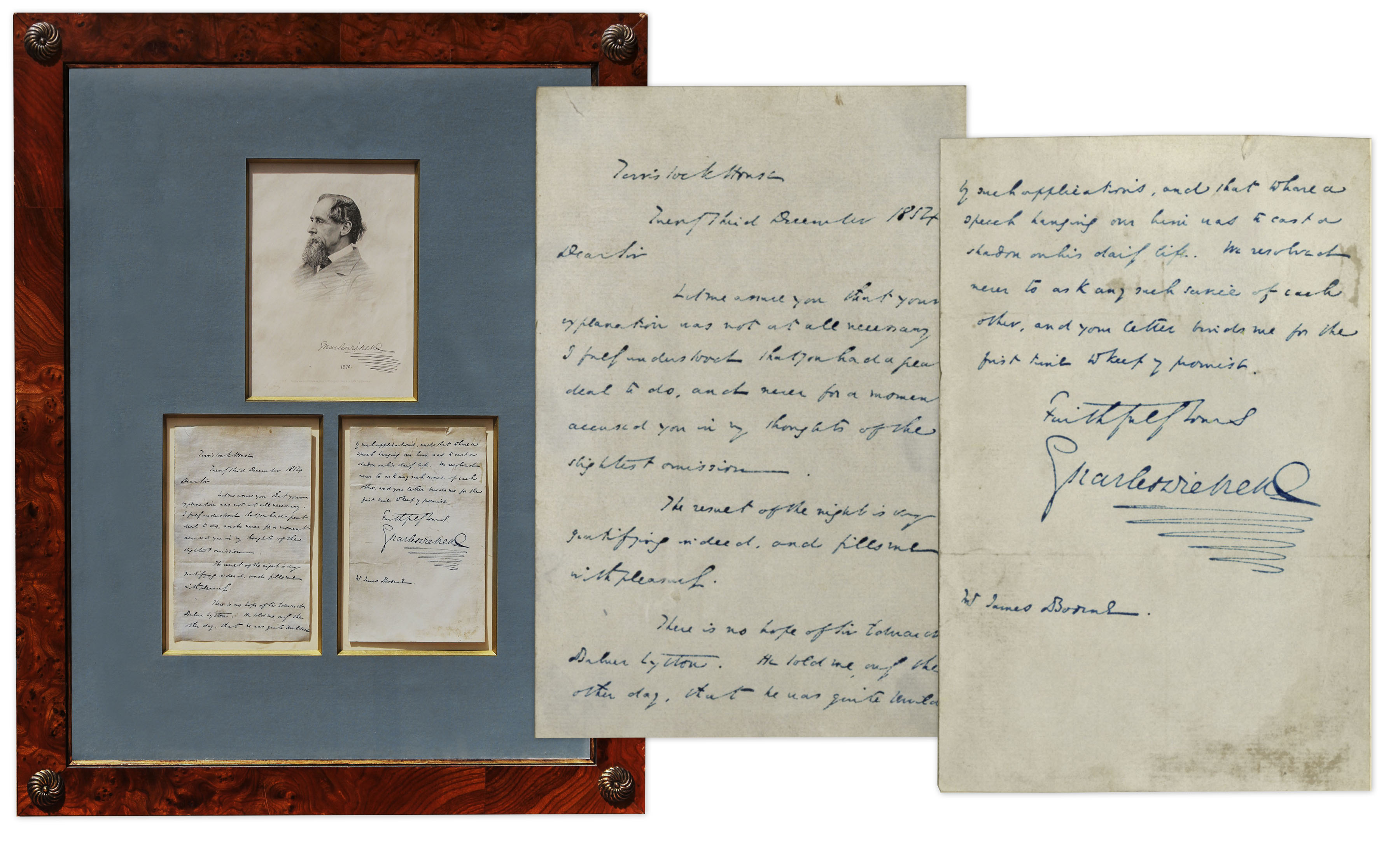
Charles Dickens autograph letter signed from 1854, shortly after writing ”Hard Times”. Dickens writes from Tavistock House in London on 23 December 1854, writing ”Dear sir, Let me amuse you that your explanation was not at all necessary. I fully understood that you had a great deal to do, and never for a moment accused you in my thoughts of the slightest omission. The result of the night is very gratifying indeed, and fills me with pleasure. There is no hope of Sir towards Dalmer Lytton. He told me only the other day, that he was quite bewildered by such applications, and that where a speech hanging on him was to cast a shadow on his daily life. We resolve of never to ask any such service of each other and your letter binds me for the first time what I promise.” Dickens signs ”Faithfully yours / Charles Dickens” with his ornate paraph to second page of 2pp. letter on two sheets. Matted to blue background underneath brown wooden frame with engraving of Dickens. Letter measures 4.25” x 6.5”, framed to 20.25” x 26”. Light soiling to bottom of second page of letter, and very small tears to top of each sheet. Very good condition overall. Bold Charles Dickens autograph. Sold for $3,781.
FREE APPRAISAL. To buy, auction, sell or consign your Herman Melville autograph letter signed that is for sale, please email your description and photos to [email protected] of Nate D. Sanders Auctions (http://www.NateDSanders.com).
We offer the following services for your Herman Melville autograph letter signed:
- Appraise Herman Melville autograph letter signed.
- Auction Herman Melville autograph letter signed.
- Consign Herman Melville autograph letter signed.
- Estimate Herman Melville autograph letter signed.
- Sell Herman Melville autograph letter signed.
- Herman Melville autograph letter signed valuation.