
Sell or Auction Your Jose de Acosta Morall Historie East West Indies 1604 for up to Nearly $12,500 or More at Nate D. Sanders Auctions
FREE APPRAISAL. To buy, auction, sell or consign your Jose de Acosta Morall Historie East West Indies 1604 that is for sale, please email your description and photos to [email protected] of Nate D. Sanders Auctions (http://www.NateDSanders.com).
Free Appraisal, Auction or Sell Your Jose de Acosta Morall Historie East West Indies 1604
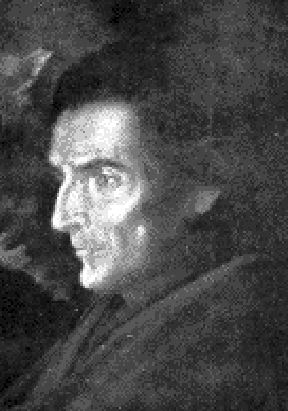

Jose de Acosta was a 16th century Spanish naturalist and Jesuit missionary who lived in Latin America. He’s best known for his books De Natura Novi Orbis, De promulgatione Evangelii apud Barbaros, sive De Procuranda Indorum salute and the Historia natural y moral de las Indias. He observed symptoms of altitude sickness when crossing ove the Andes Montains that is often referred to as Acosta’s disease.
Below is a recent realized price for a copy of The Naturall and Morall Historie of the East and West Indies (1604) by Jose de Acosta. We at Nate D. Sanders Auctions can obtain up to this amount or more for you:
Jose de Acosta Morall Historie East West Indies 1604. Sold for Nearly $12,500.
The following are some related items we have sold:
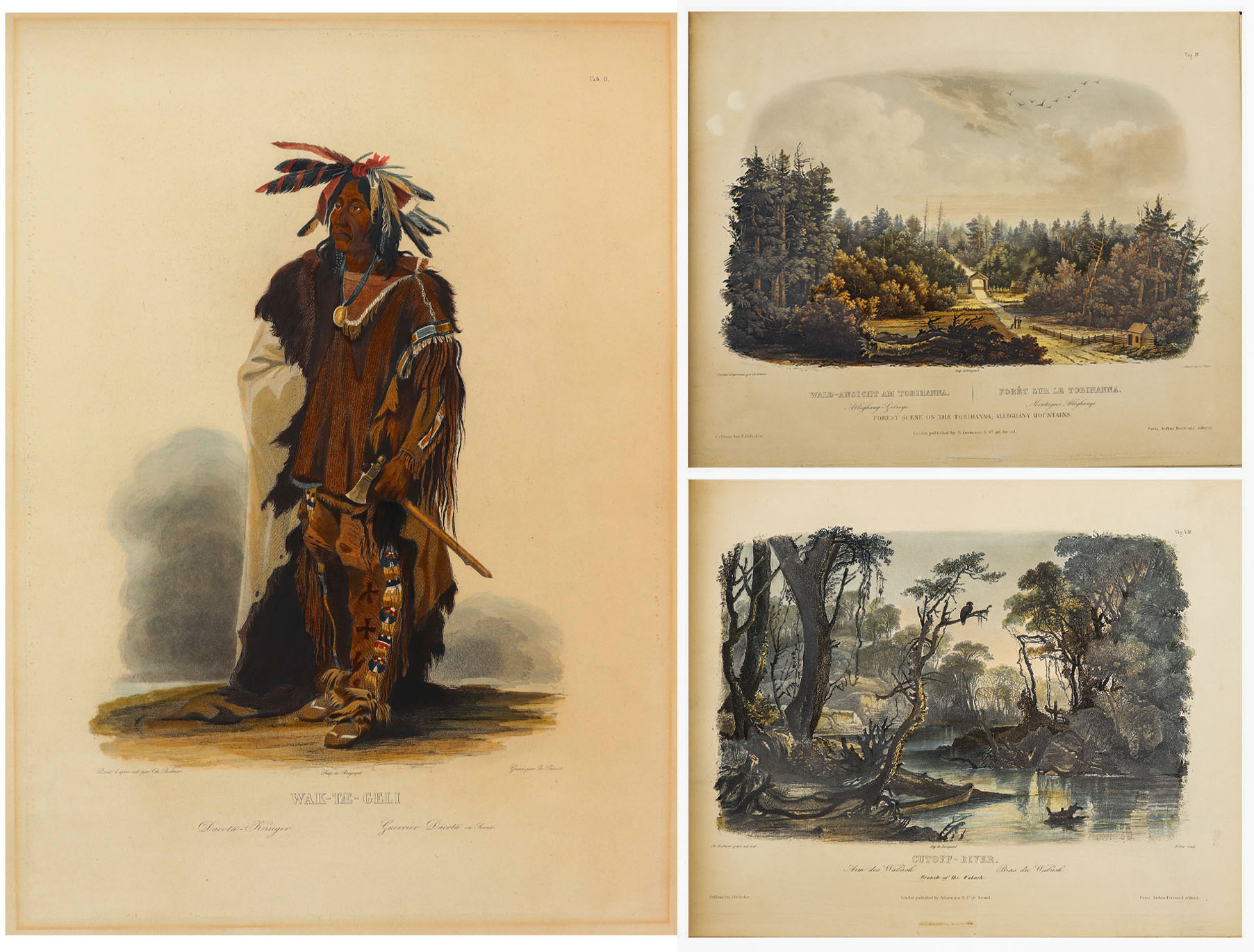
81 Beautiful Hand-Colored Aquatints by Karl Bodmer Depicting the American Frontier in the 1830s — Contained in the Illustrated Travelogue “Prince of Wied’s Travels in the Interior of North America”
Stunningly beautiful collection of 81 hand-colored aquatints by the Swiss artist Karl Bodmer, a complete collection from the illustrated travelogue, “Prince of Wied’s Travels in the Interior of North America”. Bodmer, who journeyed with the German Prince Maximilian of Wied-Neuwied from 1833-34 along the Missouri River, produced what is considered the best depictions of the indigenous peoples and landscapes during the frontier era, an America then still unspoiled by western migration. Of the Native American tribes of the Great Plains that they encountered, Bodmer’s depictions of the Blackfeet and Mandan tribes are especially important as the populations of these tribes were greatly affected by the smallpox epidemic of 1837, thus making Bodmer’s work the last visual testament to their culture.
Prince Max, as he was called, chose Bodmer to accompany him on the expedition along the Missouri River to visually depict the scenes that the Prince would write about. The result is this collection: three volumes of text by the Prince and two volumes of aquatints by Bodmer, in the first Paris edition published by Chez Arthus Bertrand, 1840-43 (“Voyage dans l’interieur de l’Amerique du Nord”). Text volumes in French also include 37 wood-engraved illustrations, only lacking the map in completeness. The two complete volumes of illustrations include the large folio volume with 48 oversized hand-colored aquatints measuring approximately 24.5″ x 18″, and the quarto volume with 33 hand-colored aquatints measuring approximately 12.5″ x 10.25″. The complete set of 81 aquatints is magnificent in their display, a time capsule with their hand-coloring evoking the sense of awe and discovery of the expedition. All volumes are bound in half black morocco and blue paper-covered boards with gilt accenting, and with black morocco labels to illustrated volumes. Minor handling wear to volumes, with a few small repaired tears to plates, some plates supplied with variance to margins, minute toning and foxing, a few plates beginning to separate from binding. Overall a very good plus set with excellent display quality. Sold for $175,000.


Gutenberg Bible Leaf — Scarce Leaf From the 15th Century Bible Made From Moveable Type That Ushered in the Age of Enlightenment
Scarce leaf from the Gutenberg Bible, one of the earliest major books printed from moveable metal type, the invention that ushered in the Age of Enlightenment by democratizing knowledge through mass production of literature. Printed by Johannes Gutenberg in Mainz, Germany from 1450-1455, less than 50 complete or near-complete copies of the Gutenberg Bible are now extant, with nearly all those housed in public institutions. Singular leaves are also scarce, with the leaf presented here having been acquired by bookseller Gabriel Wells, whose purchase of an incomplete Bible in 1920 gave way to selling the individual leaves alongside an essay by A. Edward Newton entitled “A Noble Fragment”. Leaf is number 193 of the full Latin Bible, with the recto being the Prologue to 1 Chronicles of the Old Testament, and the verso the first part of Chapter 1 of 1 Chronicles. Each page features two columns of 42 lines in dark black Gothic type, accented by red and blue rubrication. Each copy of the Gutenberg Bible differs in its rubrication and illumination, with buyers at the time deciding upon these embellishments after the Bible was printed. The six-line rubricated letters of this leaf were likely added later, restored to match the original style. Leaf measures 11.125″ x 15.375″, bound on edge to portfolio measuring 11.75″ x 16″. Paper quality is still bright with very little foxing or discoloration compared to other examples. A stunning example from the book that changed the course of history. Sold for $136,500.

Scarce collection of 63 photographs from Carleton Watkins’ groundbreaking publication, ”Yosemite Valley: Photographic Views of the Falls and Valley of Yosemite in Mariposa County, California”. San Francisco, 1863. One of the most complete collections, lot comprises a total of 63 photographs, with two of the title page and map, and 61 of the Yosemite Valley, each measuring 11.625” x 7.5”. Scarce as such.
Lured out to California for the Gold Rush, Watkins soon turned his pursuits to photography, a calling for which he was naturally gifted. In 1861, he traveled to Yosemite outfitted with both mammoth-plate and stereoscopic cameras to make the first photographic narrative of the majestic valley, with these photographs the result. They were so impactful, after having been shared amongst Congressmen and Abraham Lincoln, that the Yosemite Grant Act was passed in 1864, a precursor to the creation of the U.S. National Park System in 1872.
Interestingly, no complete accounting of Watkins’ Yosemite photos from 1863 is documented, but next to a collection of 65 photographs, this grouping is the most complete at 63 photographs. Only a handful of other collections even claim more than 50 photographs. The views are exquisite, capturing the rock formations, foliage and natural water sources of the Valley as they appeared in 1861, yet unspoiled by overcrowding. Watkins’ ability to capture the depth of the images – with distant mountains hovering over meadows and streams, is particularly beautiful, aided by the use of his two camera systems.
Photographs retain superb contrast and tonality, all disbound in a period brown morocco gilt slipcase, tooled in gilt on the cover, ”Watkins’ Yosemite Gallery.” Overall in very good to near fine condition. Sold for $112,500.

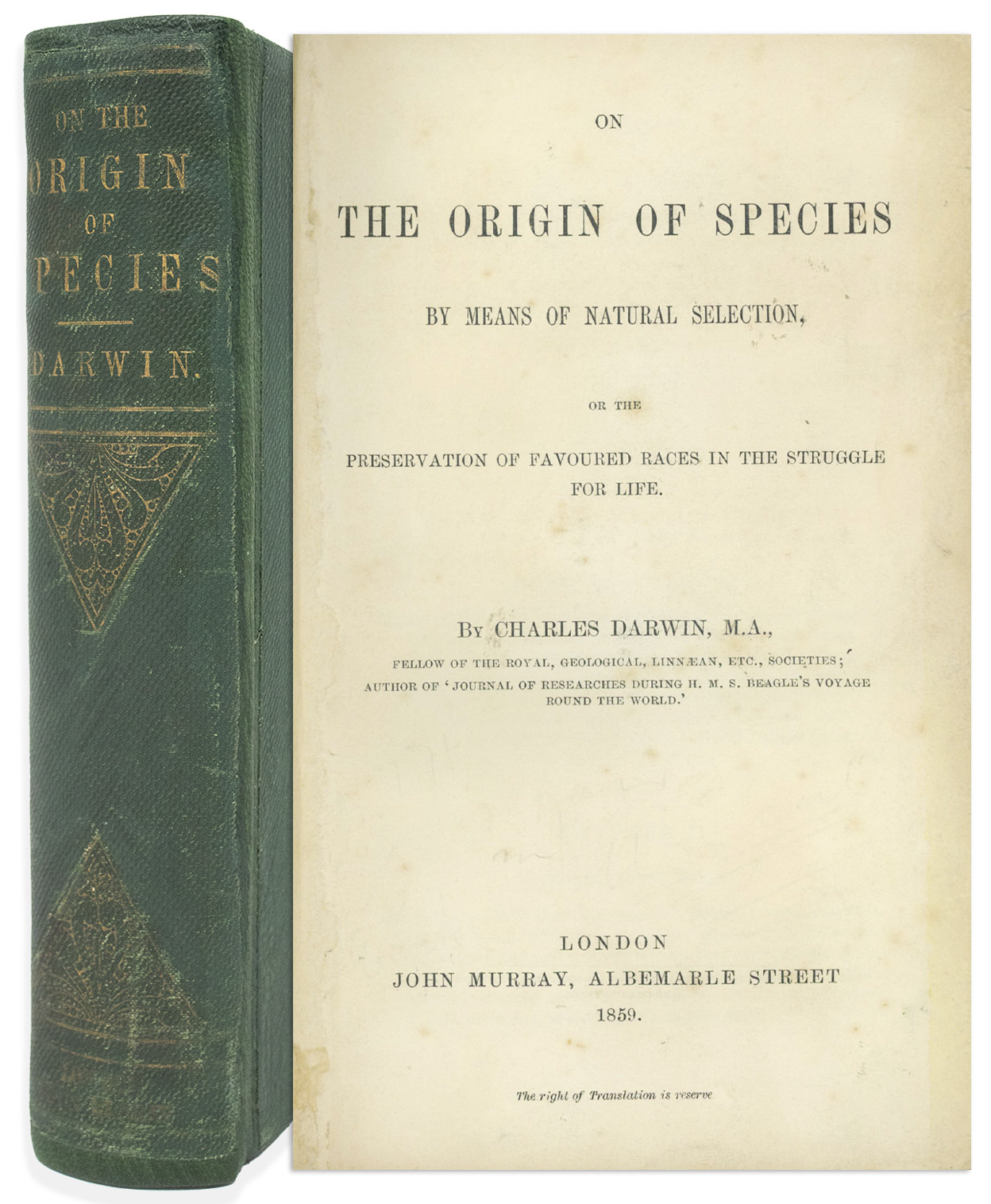
First Edition, First Printing of Charles Darwin’s Masterpiece, “On the Origin of Species” — “The most important biological book ever written”
First edition, first printing of “On the Origin of Species” by Charles Darwin, one of the most important books in the scientific canon. London: John Murray, 1859. In this revolutionary book that upended man’s own view of himself, Darwin posits natural selection as the engine driving species’ evolution, an argument so persuasive that even 19th century religious leaders adjusted their teachings to allow for evolution to work in concert with divine planning. Its importance has only grown in the 150+ years since publication, with Freeman concluding it to be “the most important biological book ever written”. First released on 24 November 1859, its scarcity nearly matches its importance, with the first printing consisting of only 1,250 copies, and the number of extant copies now significantly fewer.
All first printing points are present, including original binding, variant B, title page with copyright information on verso, Table of Contents (pages v-ix) with binder instructions to verso, complete pages 1-502, and folding table present between pages 116-117. Bound in publisher’s full green boards, stamped and lettered in gilt. Overall in very good condition; ads at back of volume have been removed as has half-title page, and endpapers have been replaced. Volume is rebacked using morocco, with original spine laid down. Some shelf wear to boards. Light foxing throughout book, with some chipping, small closed tears with repairs to a few pages, and a few dogeared pages. One small mark on page 109, otherwise no internal writing or marks. Housed in a custom quarter-leather clamshell box. Overall in very good condition, a handsome, presentable copy of this scarce first printing. Sold for $68,250.
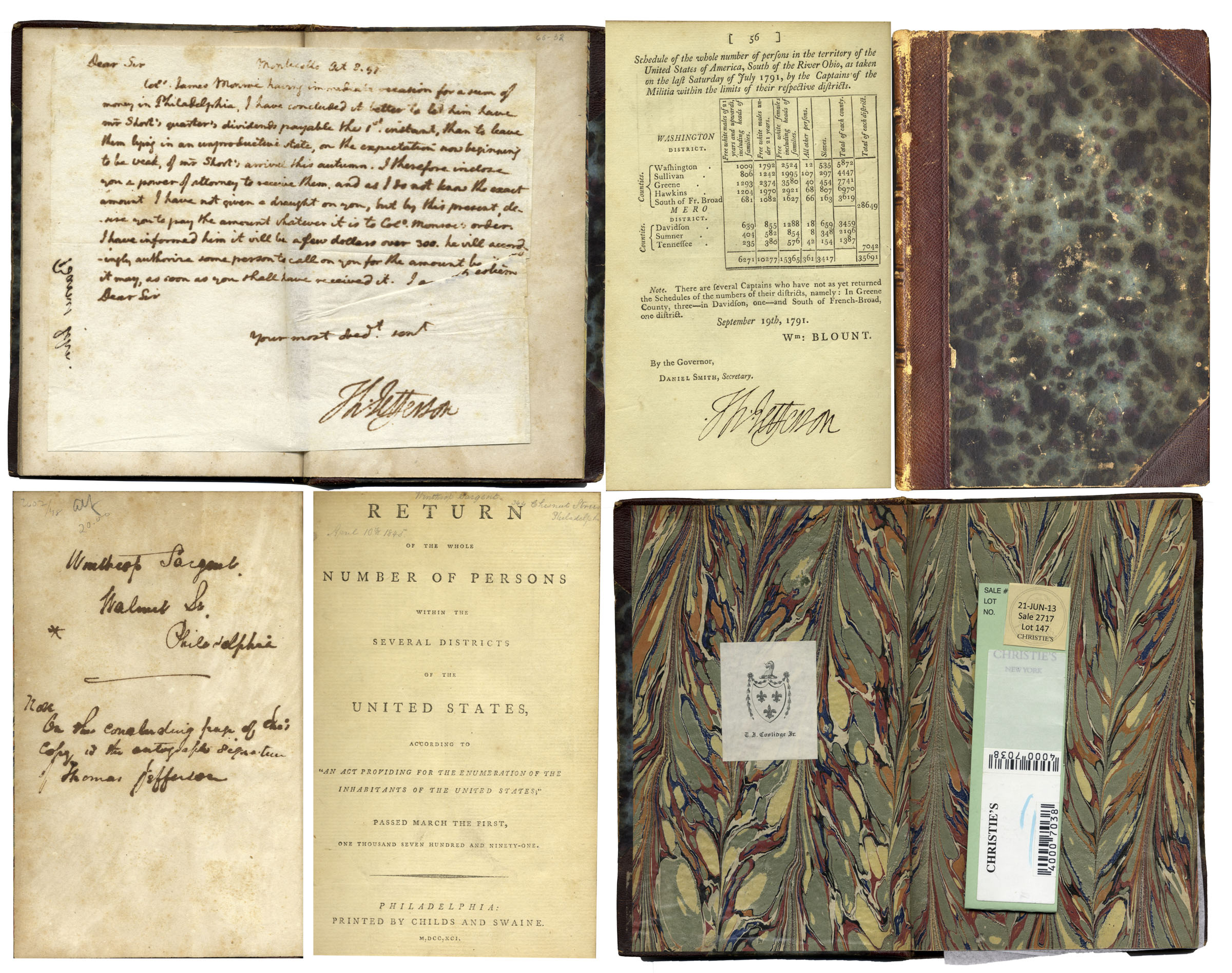
Extremely rare Thomas Jefferson signed first edition of the first U.S. census, one of only a handful of Jefferson signed copies sold at auction in the last 40 years. As Secretary of State, Jefferson called for the first official census, and ratified the results of only a handful, this being one of them, signed boldly ”Th: Jefferson” on page 56. Published in Philadelphia: Childs and Swaine, 1791. Full title reads, ”Return of the Whole Number of Persons Within the Several Districts of the United States, According to ‘An Act Providing for the Enumeration of the Inhabitants of the Unites States’. Printed in a small number for distribution by Thomas Jefferson as Secretary of State, and from his direct descendant, Thomas Jefferson Coolidge Jr., with Mr. Coolidge’s crested label to front pastedown. Bound in 19th century half-morocco and marbled boards, book measures 5” x 7.25”. This copy appears to be one of the very first printings of the first edition, as it lacks the tipped-in late-returning results from South Carolina often found on page 54. The lower margins of pages 34, 42 and 43 have been shaved by binder, otherwise copy is near fine with a touch of toning and foxing. Volume also includes a press copy of an autograph letter signed by Jefferson, affixed to rear endpaper, dated 8 October 1797, measuring 6.5” x 7.75”. Letter concerns a quarterly dividend of ”a few dollars over 300”, payable to Col. James Monroe. A rare opportunity for the very first census of the United States, signed by its 3rd President, with other such copies selling for approx. $100,000. Sold for $66,435.
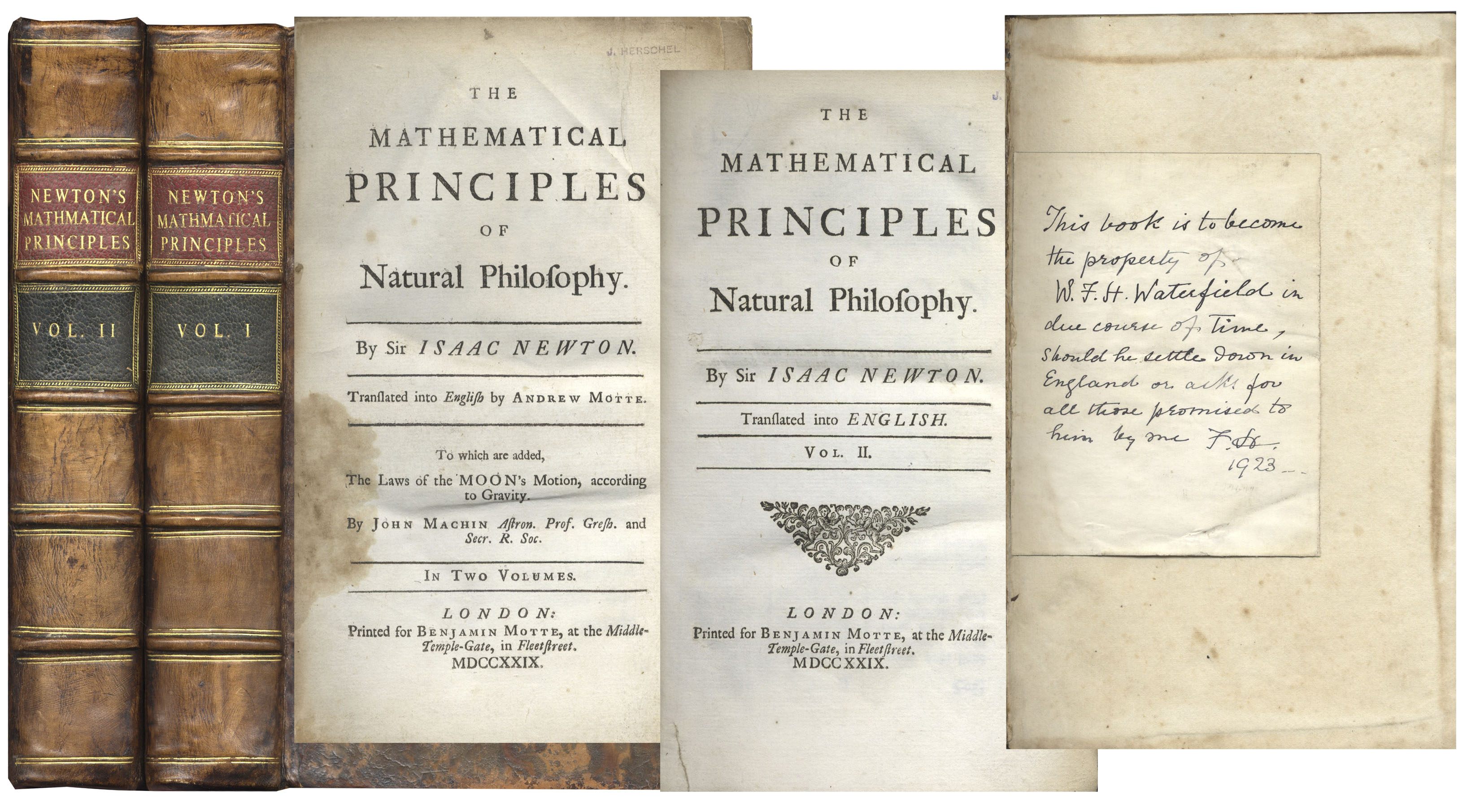
First edition of Sir Isaac Newton’s ”The Mathematical Principles of Natural Philosophy” in two volumes. London: Benjamin Motte, 1729. One of the most important works by the leading mind of the 18th century scientific revolution. Bound in contemporary tree calf, sympathetically rebacked, with gilt tooling to spines. Two octavo volumes measure 5.5” x 8.5” each. Volumes contain two folding letterpress tables and 47 folding engraved plates; the two frontispieces and pp. 385-393 and first 7pp. of index are replaced in facsimile, but hardly distinguishable from the original. The ”Laws of Moon’s Motion” usually found in Vol. II are here bound at end of Vol. I, and with errata for both volumes on verso of E4. Small stain to inner part of title in Vol. I, short tear to lower margin of G1, small section missing from lower margin of M3 and with lower corner cut away of A8 and C4 of ”Laws of Moon’s Motion” (no loss of text). Some marginal dampstaining and occasional soiling and spotting, overall in very good, clean condition with most edges untrimmed. Sold for $22,500.
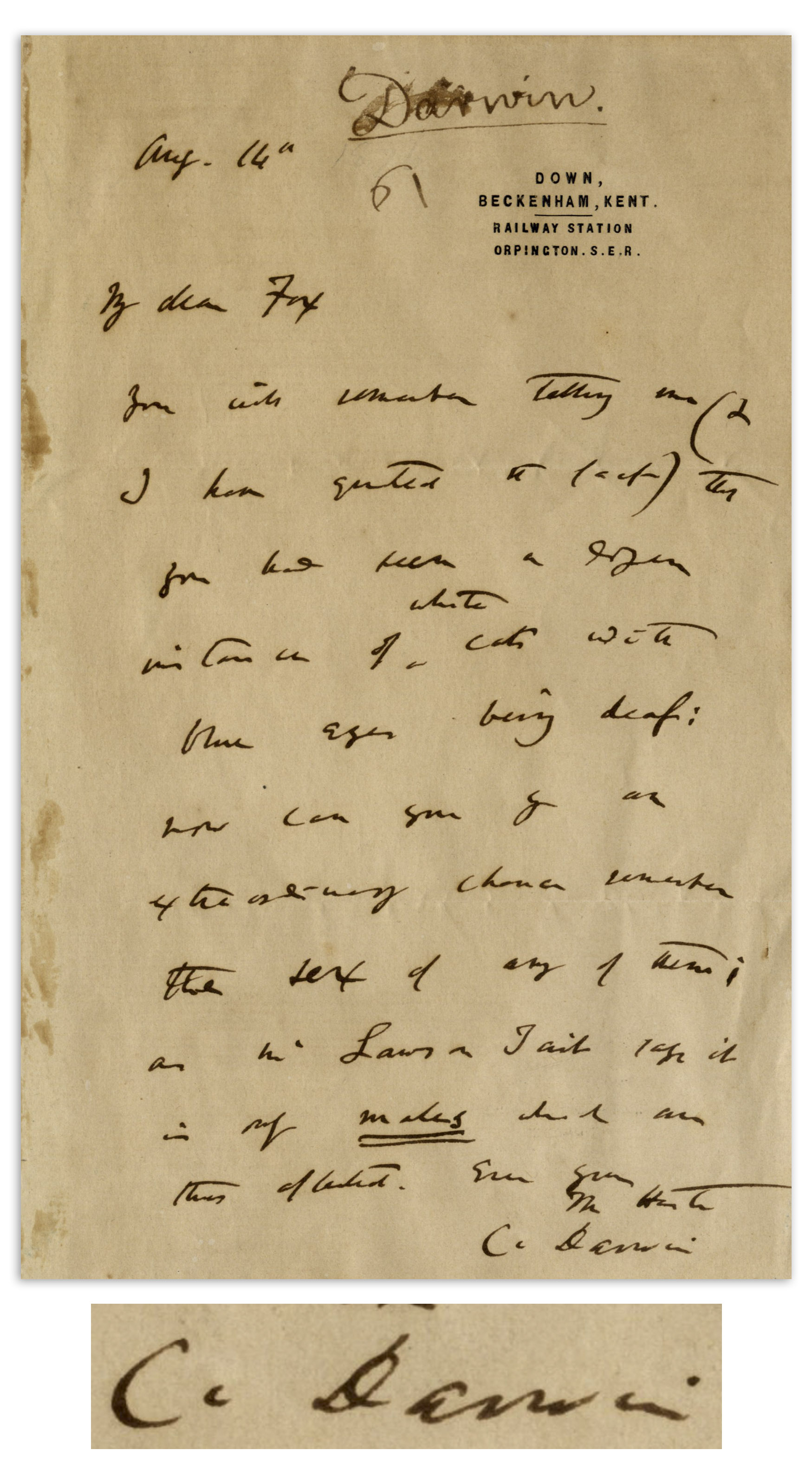
Charles Darwin autograph letter signed with evolution related content written shortly after ”On the Origin of Species” was published. Dated 16 August (1860 or 1861), Darwin writes to his second cousin William Darwin Fox, who introduced Charles Darwin to entomology. Upon Down, Kent stationery, Darwin writes in part, ”…you had seen a dozen instances of white cats with blue eyes being deaf: how can you by an extraordinary chance remember the sex of any of them…C. Darwin”. Fox’s reply to Darwin, giving additional details on the white, blue-eyed, blind cats, is archived in the Darwin Correspondence Project. Single page letter measures 5” x 8”, with an engraving of Darwin measuring 5.5” x 8”. Uniform toning, mounting tape remnants and writing at top not in Darwin’s hand, overall very good condition. Sold for $15,000.
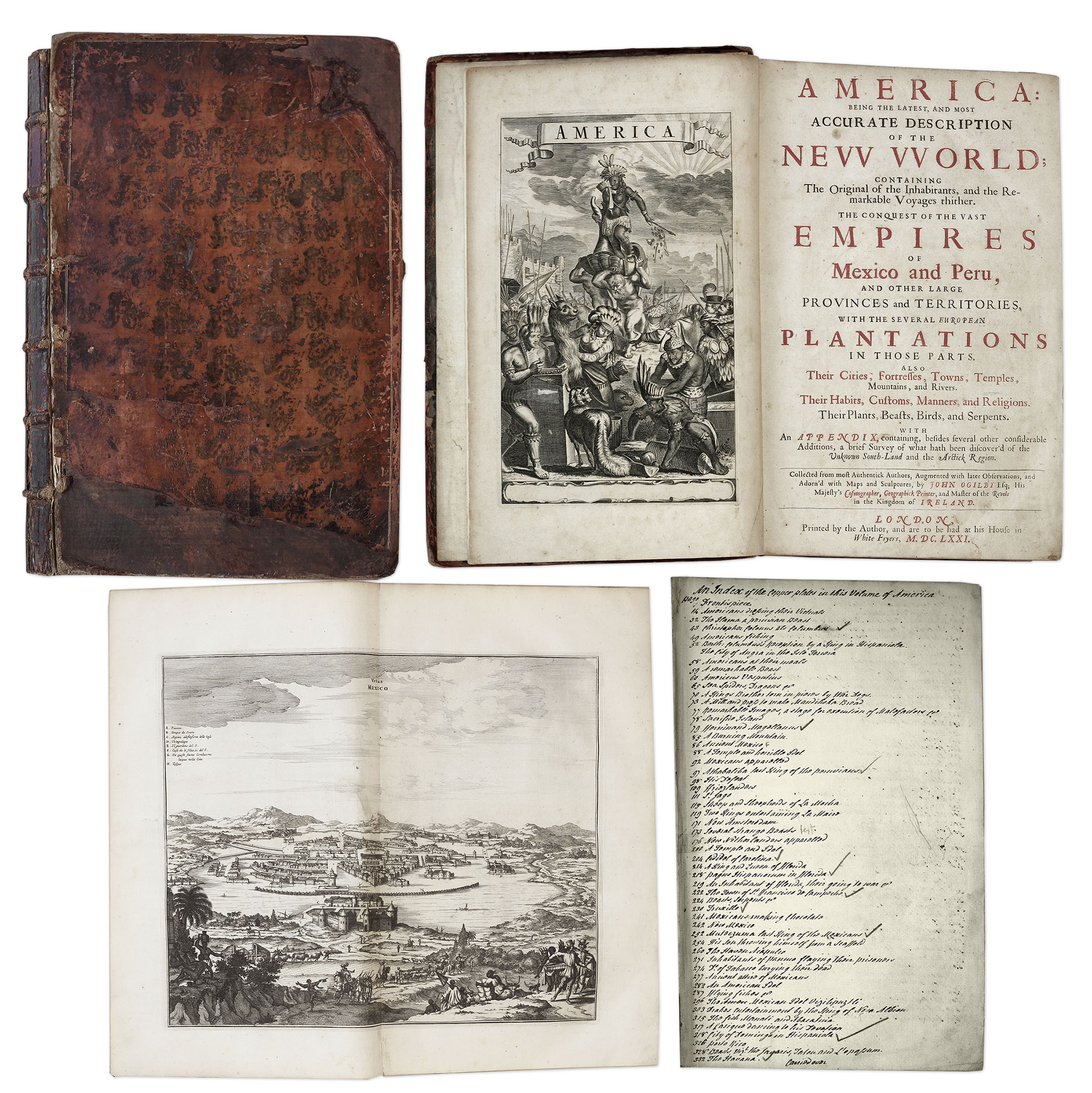
One of the most important books on the history of America (cited by Borba de Moraes, Howes, Sabin and Wing), the 1671 first edition of ”America: Being the Latest and Most Accurate Description of the New World”. Privately printed in London by the author, Arnoldus Montanus, and edited by John Ogilby. In ”America” Montanus goes into great detail of the new continents, with dozens of engravings of Native Americans, species of animals and reptiles, and the landscapes and settlements in the new world, accompanied by text. The book covers speculation regarding the earliest voyages to America, along with later recorded voyages and the settlements of New Netherlands/New York, New England, Hudson’s Bay, Labrador, Canada, Nova Scotia, Maryland, Virginia, (including Captain Smith’s capture and rescue by Pocahontas), Carolinas, Florida and California, plus accounts of Mexico and nearby islands, even including Australia and New Zealand. 674pp. book contains 75 original engravings (64 copper plates within the text and 9 plates throughout), lacking the maps and 28 engravings, which is typical as this edition is almost never found with all plates intact. All text is complete except for missing pages 445-446. Large format book measures 10” x 15”. Bound in original full leather boards, with some loss of leather to covers, cracking along spine and front board detached. Interior text is near fine and very readable. An important and fascinating addition to early knowledge of the American continent. Sold for $9,375.
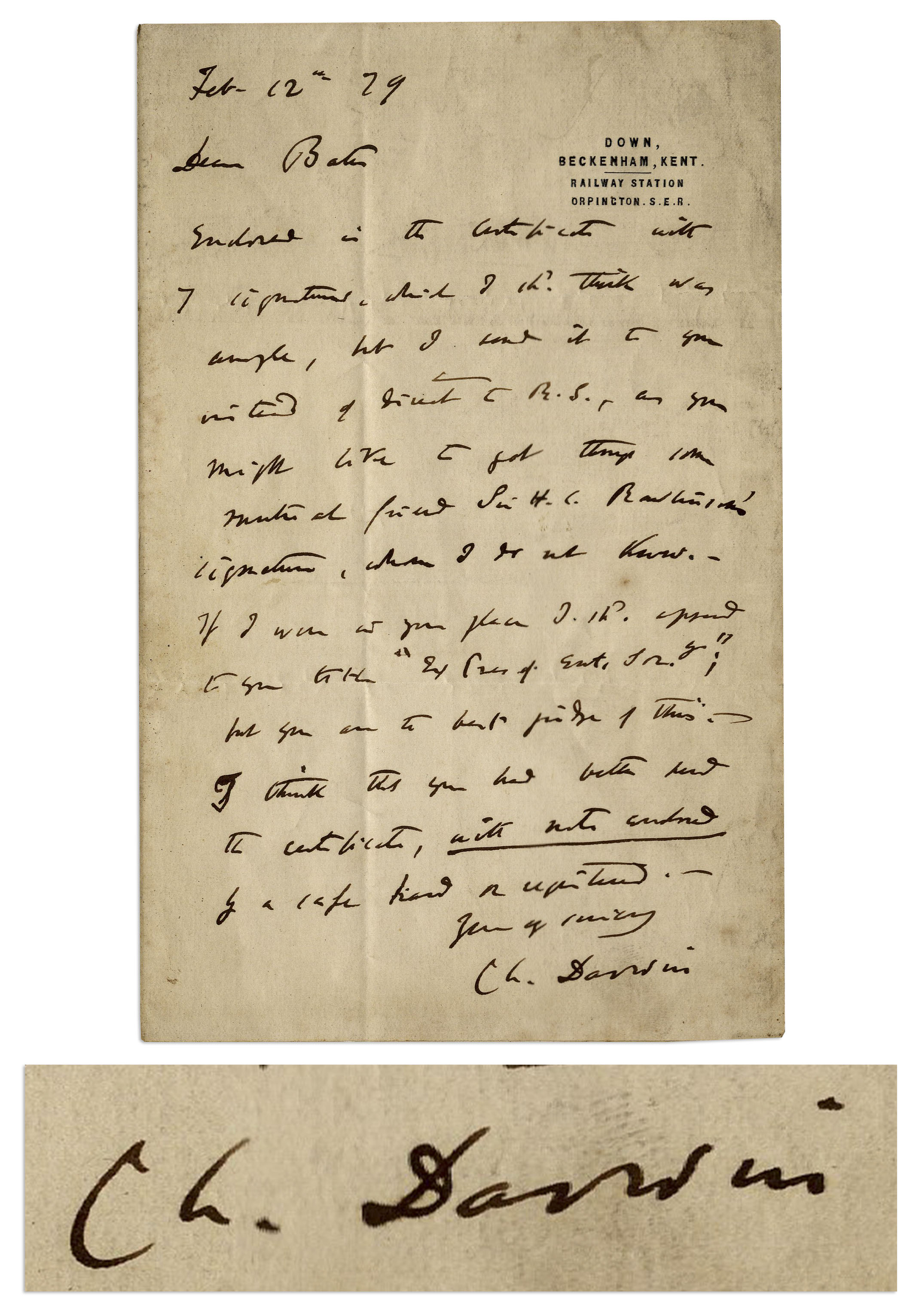
Charles Darwin autograph letter signed, dated 12 February 1879 shortly before his publication ”The Power of Movement in Plants”. Darwin writes fellow English naturalist and explorer Henry Walter Bates regarding a document to be sent to the Royal Society. Letter reads, ”Feb 12th 79 / Dear Bates / Enclosed is the certificate with 7 signatures, which I would think was ample, but I send it to you instead of direct to R.S. [Royal Society], as you might have to get stamps from Martin and friend Sir H.C. Rowlinson’s signature, whom I do not know. If I were in your place I would append to your title ‘Ex Pres [President] of Ent. [Entomological] Soc. [Society] Yr’; but you are the best judge of this. I think that you had better send the certificate, with note enclosed by a safe hand or [?]. Yours sincerely, Ch. Darwin”. Darwin had earlier praised Bates seminal work, ”The Naturalist on the River Amazons”, as the ”best book of Natural History Travels ever published in England”. Single page letter measures 5” x 8”. Light soiling and wear; overall in very good plus condition with very bold handwriting and signature. Sold for $6,250.
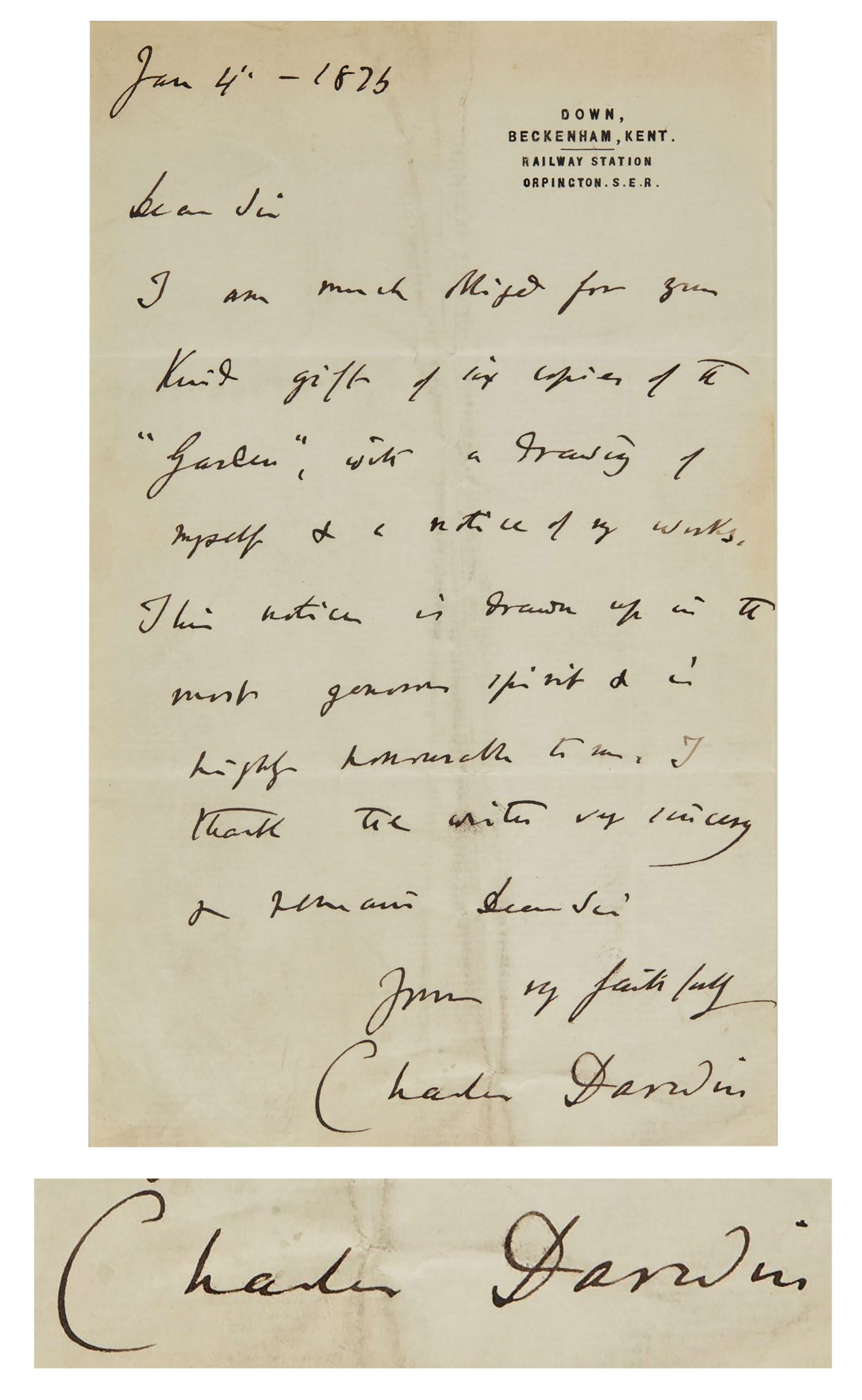
Charles Darwin autograph letter signed, dated 4 January 1876 upon his letterhead from Down House in Kent. Darwin writes to ”The Garden” magazine founder William Robinson, with whom Darwin had corresponded regarding the behavior of climbing plants and waterlilies. At the time of this letter, public opinion of Darwin’s recent works was positive, a dramatic shift from ”On the Origin of Species”, deemed controversial and even scandalous when it was published 17 years earlier; Darwin even commented that ”everybody is talking about it without being shocked.” The newfound appreciation for his publications is evident in this letter, in full: ”Dear Sir / I am much obliged for your kind gift of six copies of the ‘Garden,’ with a drawing of myself & a notice of my works. This notice is drawn up in the most generous spirit & is highly honourable to me. I thank the writer very sincerely & remain Dear Sir / Yours very faithfully / Charles Darwin”. Single page letter measures 4.75” x 7.5”, archivally framed to 9.25” x 12.25”. Folds and a vertical strip of light discoloration, otherwise near fine condition with bold handwriting and a full, bold signature. Sold for $5,938.
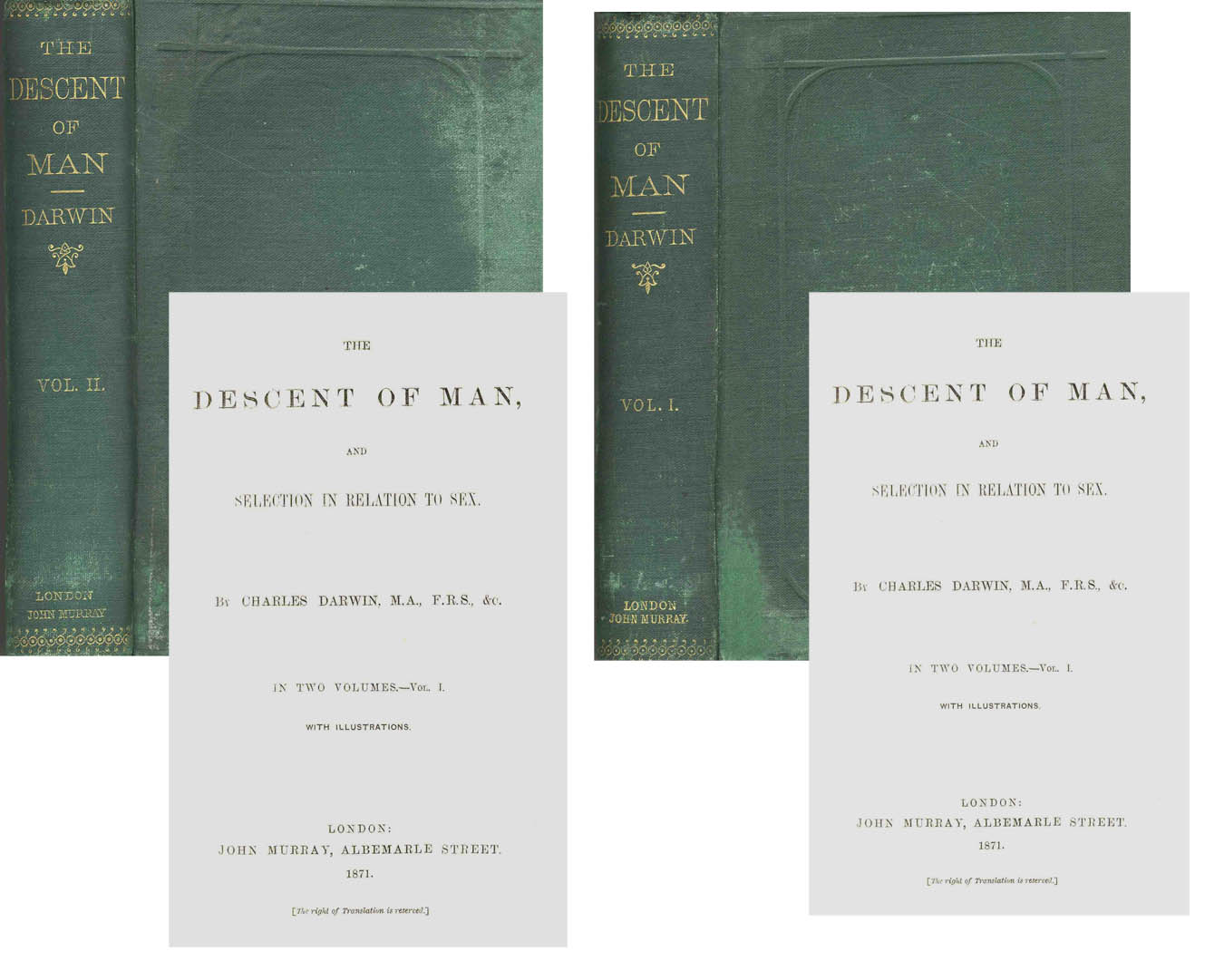
First Edition, First Printing of Charles Darwin’s 1871 Masterpiece, “The Descent of Man” — First Printing of the Controversial Word “Evolution”
First edition, first printing of “The Descent of Man and Selection in Relation to Sex” by Charles Darwin. London: John Murray: 1871. In two volumes with illustrations, “The Descent of Man” applies Darwin’s theory first conceived in “Origin of Species” to human evolution, and details his theory of sexual selection. Volume I of this set is the very first time in which the word evolution appears in print in any of Darwin’s works. All first issue points present including the errata on the verso of the title leaf of Volume II; seventeen errata for Volume I and eight for Volume II; the verso of the half title leaf of Volume II bears the printer’s note; present with note on a tipped-in leaf in Volume II, which refers to “a serious and unfortunate error” affecting pages 297-299 in Volume I, and pages 161 and 237 in Volume II; page 297 begins with the word “transmitted.” Publisher’s full green pictorial cloth, stamped and lettered in gilt. Covers have been re-backed with vintage cloth. Some fading to the cloth on the covers around edges. The binding in both volumes is very tight and secure with no loose pages or sections. Internally very good. The endpapers have been replaced with paper in keeping with the original dark navy ones. Signature by previous owner on the half-title of Volume I and the title page of Volume I. Overall a beautiful set in very good condition. Sold for $5,073.
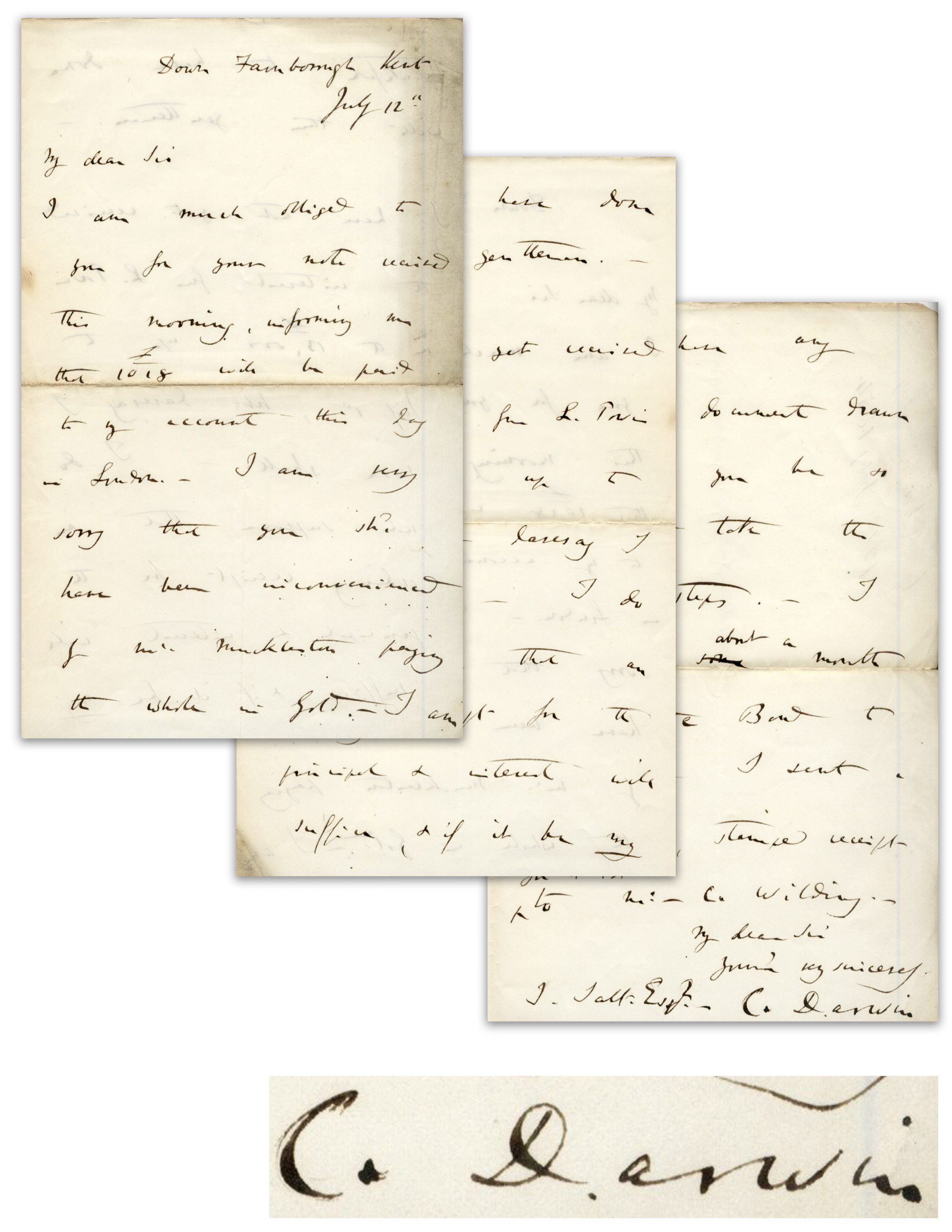
Charles Darwin Autograph Letter Signed From 1854, the Year He Began Writing “On the Origin of Species”
Charles Darwin autograph letter signed to his financial advisor, dated 12 July with no year, but docketed on blank page as 1854 by the recipient, Thomas Salt. At this time, Darwin was beginning to write “On the Origin of Species”, which would be published in 1859. Darwin discusses several financial accounts in the letter, including a loan to a Mr. Muckleston, which had been intended for five years, but took nine to be repaid; Darwin writes “I am thankful to have done with the gentleman.” From his home in Down Farnborough Kent, Darwin writes in full, “My dear Sir / I am much obliged to you for your note received this morning, informing me that 1018 [pounds] will be paid to my account this day in London. – I am very sorry that you shd. have been inconvenienced by Mr. Muckleston paying the whole in Gold. – I am thankful to have done with the gentleman. / I have not yet received the interest from L. Powis on the 13,000 [pounds] up to July 1st., but daresay I soon shall. – I do not suppose that an ordinary receipt for the principal & interest will suffice, & if it be my part to have any formal document drawn up will you be so kind to take the necessary steps. – I sent about a month ago the Bond to you. – I sent a provisional, stamped receipt for the 13,000 [pounds] to Mr. – C. Wilding. / My dear Sir / Your’s very sincerely / C. Darwin”. Three page letter on bifolium stationery measures 9.75″ x 7.75″ unfolded. Small hole at center, folds and light wear, overall very good condition with a bold signature. Sold for $4,520.
FREE APPRAISAL. To buy, auction, sell or consign your Jose de Acosta Morall Historie East West Indies 1604 that is for sale, please email your description and photos to [email protected] of Nate D. Sanders Auctions (http://www.NateDSanders.com).
We offer the following services for your Jose de Acosta Morall Historie East West Indies 1604:
- Appraise Jose de Acosta Morall Historie East West Indies 1604.
- Auction Jose de Acosta Morall Historie East West Indies 1604.
- Consign Jose de Acosta Morall Historie East West Indies 1604.
- Estimate Jose de Acosta Morall Historie East West Indies 1604.
- Sell Jose de Acosta Morall Historie East West Indies 1604.