
Sell or Auction Your Czar Alexander III of Russia Document Signed for up to Nearly $2,000 or More at Nate D. Sanders Auctions
FREE VALUATION. To buy, auction, sell or consign your Czar Alexander III of Russia document signed that is for sale, please email your description and photos to [email protected] of Nate D. Sanders Auctions (http://www.NateDSanders.com).
Free Appraisal, Auction or Sell Your Czar Alexander III of Russia Document Signed
Alexander III (Russian: Алекса́ндр III Алекса́ндрович, tr. Aleksandr III Aleksandrovich; 10 March 1845 – 1 November 1894) was Emperor of Russia, King of Congress Poland and Grand Duke of Finland from 13 March 1881 until his death in 1894. He was highly reactionary and reversed some of the liberal reforms of his father, Alexander II. This policy is known in Russia as “counter-reforms” (Russian: контрреформы). Under the influence of Konstantin Pobedonostsev (1827–1907), he opposed any reform that limited his autocratic rule. During his reign, Russia fought no major wars; he was therefore styled “The Peacemaker” (Russian: Миротворец, tr. Mirotvorets, IPA: [mʲɪrɐˈtvorʲɪt͡s]). It was he who helped forge the Russo-French Alliance.
Below is a recent realized price for a Czar Alexander III of Russia document signed item. We at Nate D. Sanders Auctions can obtain up to this amount or more for you:
Czar Alexander III of Russia Document Signed. Sold for nearly $2,000.

Nate D. Sanders Auctions has sold the following Russian items:
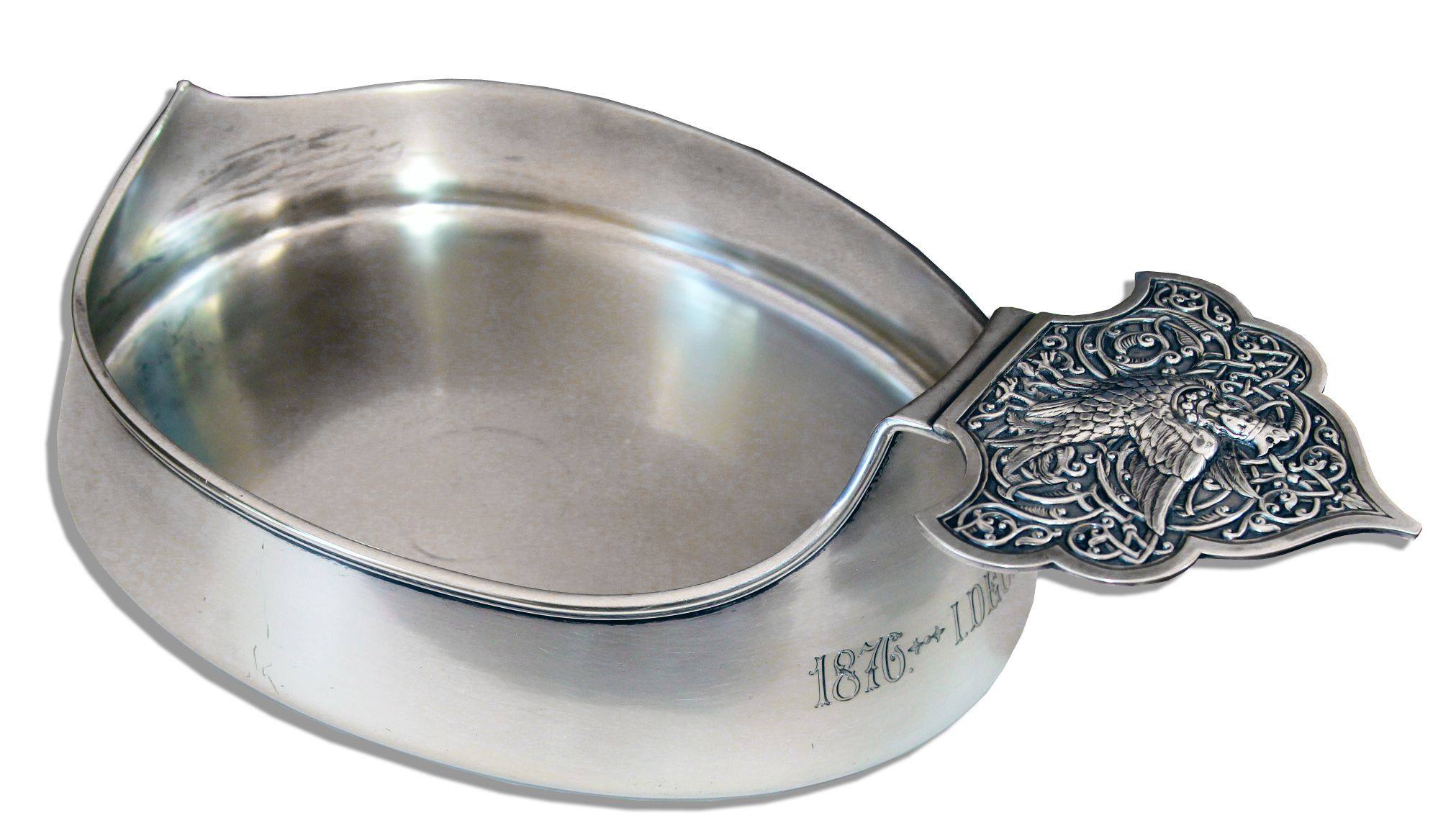
A Parcel-Gilt Silver Kovsh Marked K. Faberge With The Imperial Warrant, Moscow, 1899-1908
Of traditional form with flat oval base, with raised prow, the front engraved with monogram ‘AE,’ the reverse engraved ‘1876 – 1. Dec. – 1901’, the flat stylized handle cast and chased with a Sirin amidst scrolling foliage, marked under base. 12 1/8″ x 24.6″. Provenance from Christie’s. Sold for $23,116.
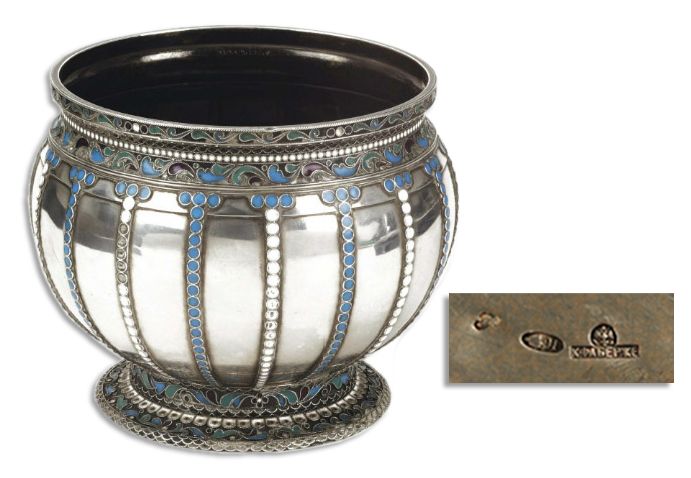
Faberge Vase From The Last Days of the Company’s Pre-Bolshevik Era — Stunning
Perfect silver Faberge vase crafted circa 1908-1917, just before the Bolshevik take-over of the company and when Faberge produced its most exquisite objects. Ribbed bombe vase on a circular foot features applied filigree and cloisonne in white, blue, sea green and purple enamels. Stamped in Russian, ”K. Faberge” with the imperial warrant, Moscow and also ”91”. The inventory number is engraved clearly: ”35280”. A stylized V-shaped stamped character is likely a Faberge workmaster’s mark. Measures 4.25” in height and 5.5” deep at its widest. The diameter of the mouth measures 4.75” and the base, 3.75”. Light tarnishing with occasional scratching and loss of colored enamel, else near fine. A beautiful representation of the Faberge company during Imperial Russia. Sold for $21,013.
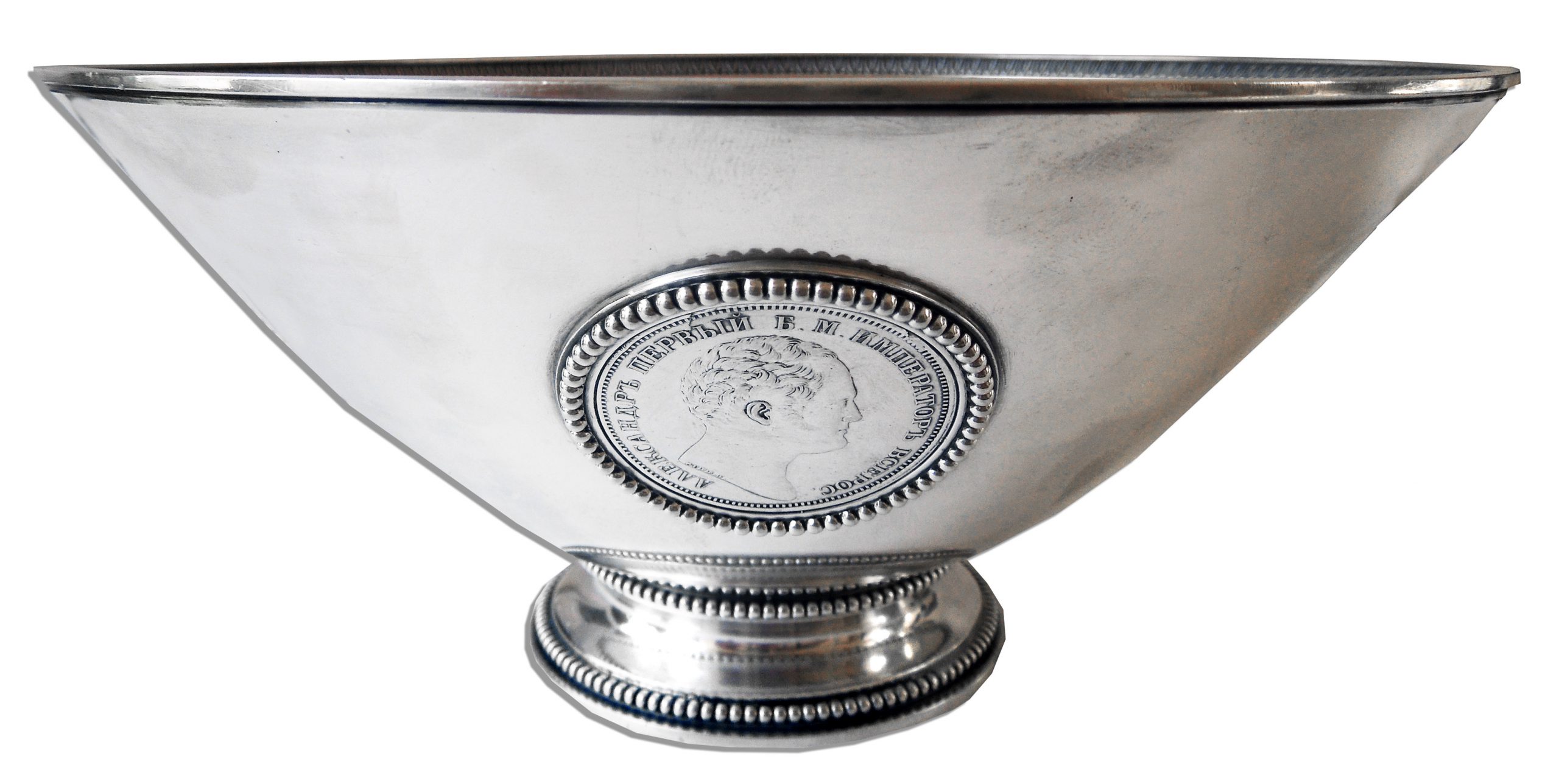
The conical bowl on a circular foot with beaded rim, the sides inset with four silver ruble coins depicting the emperors Nicholas I, Alexander I, Alexander II and Alexander III within beaded roundels, the interior of the rim with chased stiff-leaf motif, marked under base. 7.75” wide. Near fine. Provenance from Christie’s. Sold for $14,351.
Russian Chemist Dmitri Mendeleev Autograph Letter Signed — “…The elements of organic chemistry are represented in such a new way…”
Russian chemist Dmitri Mendeleev, mastermind behind the periodic table of elements, signs a handwritten letter, “D. Mendeleef” in black ink. The letter is written in French and datelined St. Petersburg, 25 November 1888. He writes, “Sir! Allow me to thank you for sending me Remsen’s book…’Introduction to the Study of the Compounds of Carbon.’ The elements of organic chemistry are represented in such a new way…verify if I can get the rights to translate into other languages…” Significant chipping and some paper loss to edges of 8.5″ x 11″ letter, though handwriting remains quite clear and legible. Very good. Handwritten letters by Mendeleev are quite scarce, especially so with chemistry content. Sold for $9,359.

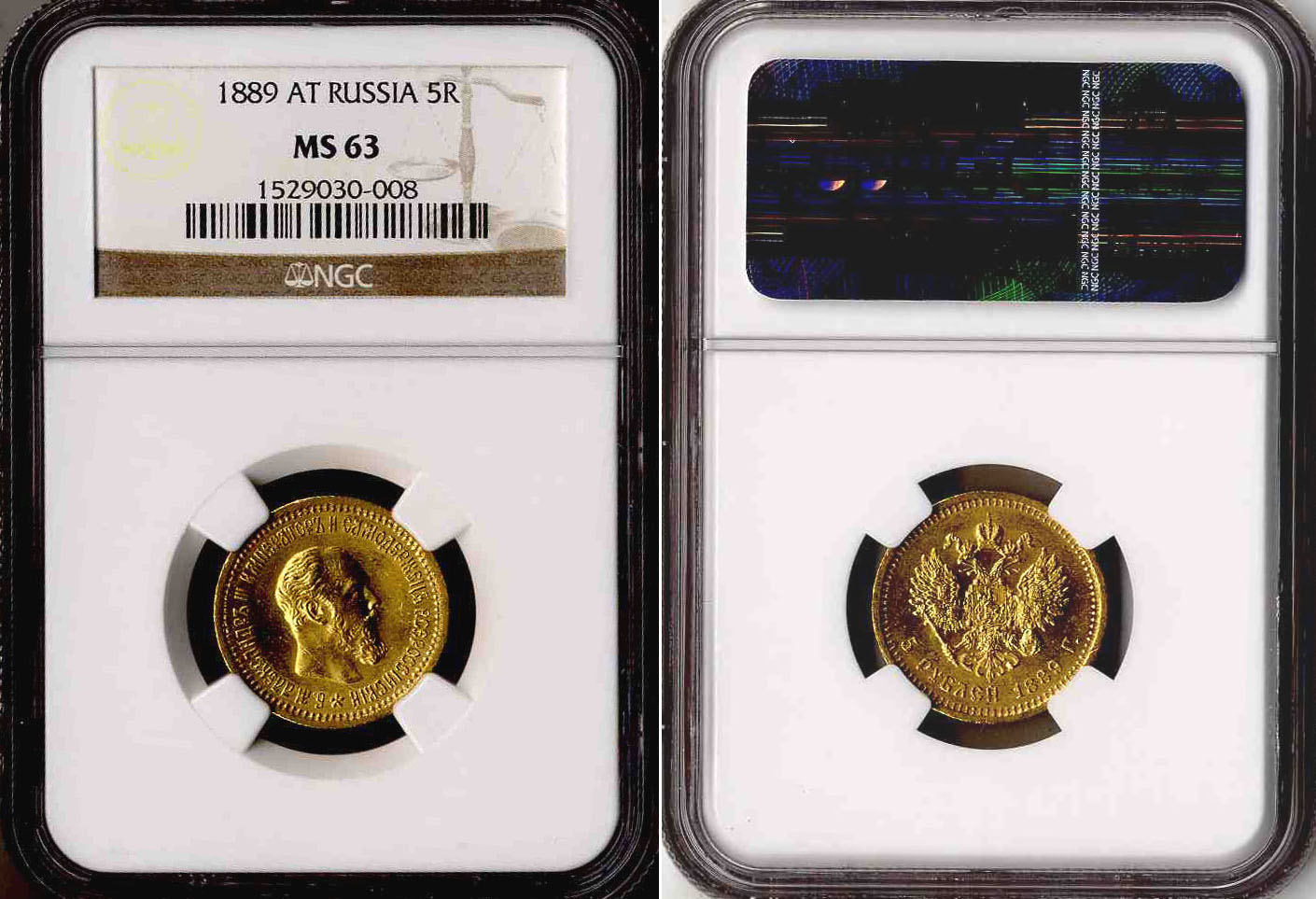
1889 AT Russian 5 Roubles NGC MS63
The ruble or rouble (/ˈruːbəl/; Russian: рубль, IPA: [rublʲ]) or ₽ is or was a currency unit of a number of countries in Eastern Europe closely associated with the economy of Russia. Originally, the ruble was the currency unit of Imperial Russia and then the Soviet Union (as the Soviet ruble), and it is currently the currency unit of Russia (as the Russian ruble) and Belarus (as the Belarussian ruble). On 17 December 1885, a new standard was adopted which did not change the silver ruble but reduced the gold content to 1.161 grams, pegging the gold ruble to the French franc at a rate of 1 ruble = 4 francs. This rate was revised in 1897 to 1 ruble = 2⅔ francs (0.774 grams gold). The ruble was worth about 0.50 USD in 1914. With the outbreak of World War I, the gold standard peg was dropped and the ruble fell in value, suffering from hyperinlation in the early 1920s. With the founding of the Soviet Union in 1922, the Russian ruble was replaced by the Soviet ruble. 1889 AT Russian 5 Roubles — NGC Graded MS63 . Sold for $1,100.
Exceptional, glossy photograph of Tsar Nicholas II, the Empress Alexandra and their first daughter the Grand Duchess Olga. A studio photograph taken by A. Pasetti Studios in St. Petersberg circa 1895, it is printed on the studio’s cardstock. Measuring 4” x 6.25”, this photo of Russia’s last imperial family has some foxing and surface wear but is otherwise in near fine condition. Sold for $600.

FREE ESTIMATE. To buy, auction, sell or consign your Czar Alexander III of Russia document signed that is for sale, please email your description and photos to [email protected] of Nate D. Sanders Auctions (http://www.NateDSanders.com).
Czar Alexander III of Russia document signed