
Sell or Auction Your Emancipation Proclamation circa January 5 1863 4th Edition for up to About $50,000 or More at Nate D. Sanders Auctions
FREE APPRAISAL. To buy, auction, sell or consign your Emancipation Proclamation circa January 5 1863 4th edition that is for sale, please email your description and photos to [email protected] of Nate D. Sanders Auctions (http://www.NateDSanders.com).
Free Appraisal, Auction or Sell Your Emancipation Proclamation Circa January 5 1863 4th Edition
Below is a recent realized price for an Emancipation Proclamation circa January 5 1863 4th edition. We at Nate D. Sanders Auctions can obtain up to this amount or more for you:
Emancipation Proclamation Circa January 5 1863 4th Edition. Sold for About $50,000.
The following are some related items we have sold:
1865 Period Broadside of the Emancipation Proclamation
A rare, original broadside of Abraham Lincoln surrounded by the complete text of the Emancipation Proclamation. Done by artist Gilman R. Russell, broadside was printed in 1865 by Philadelphia lithographer P.S. Duvall & Son Ltd. Citizens of the newly re-United States displayed commemorative prints of the celebrated Emancipation Proclamation in their homes, especially as one might imagine, in the northern states. The Proclamation was an executive order issued by Lincoln on 1 January 1863 that freed more than three-quarters of the nation’s slaves. By July of the year this piece was crafted, almost all of those enslaved had been liberated. Framed to an overall size of 24” x 30.75”. Toning and somewhat heavy dampstaining; overall in good condition. Frame may be original to the 1860’s as well. A proud tribute to Lincoln and the order that earned him the sobriquet: The Great Emancipator. Sold for $938.

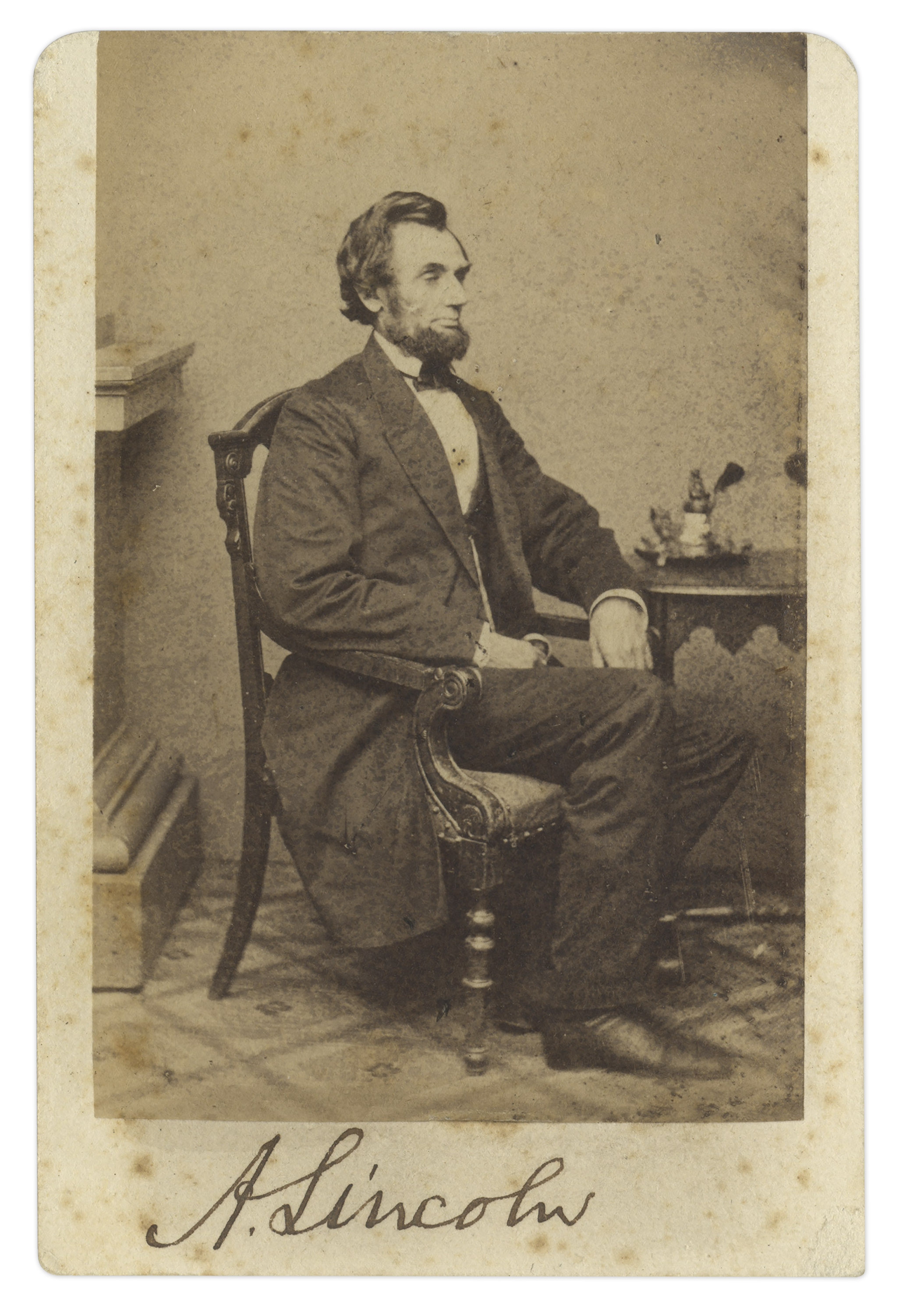
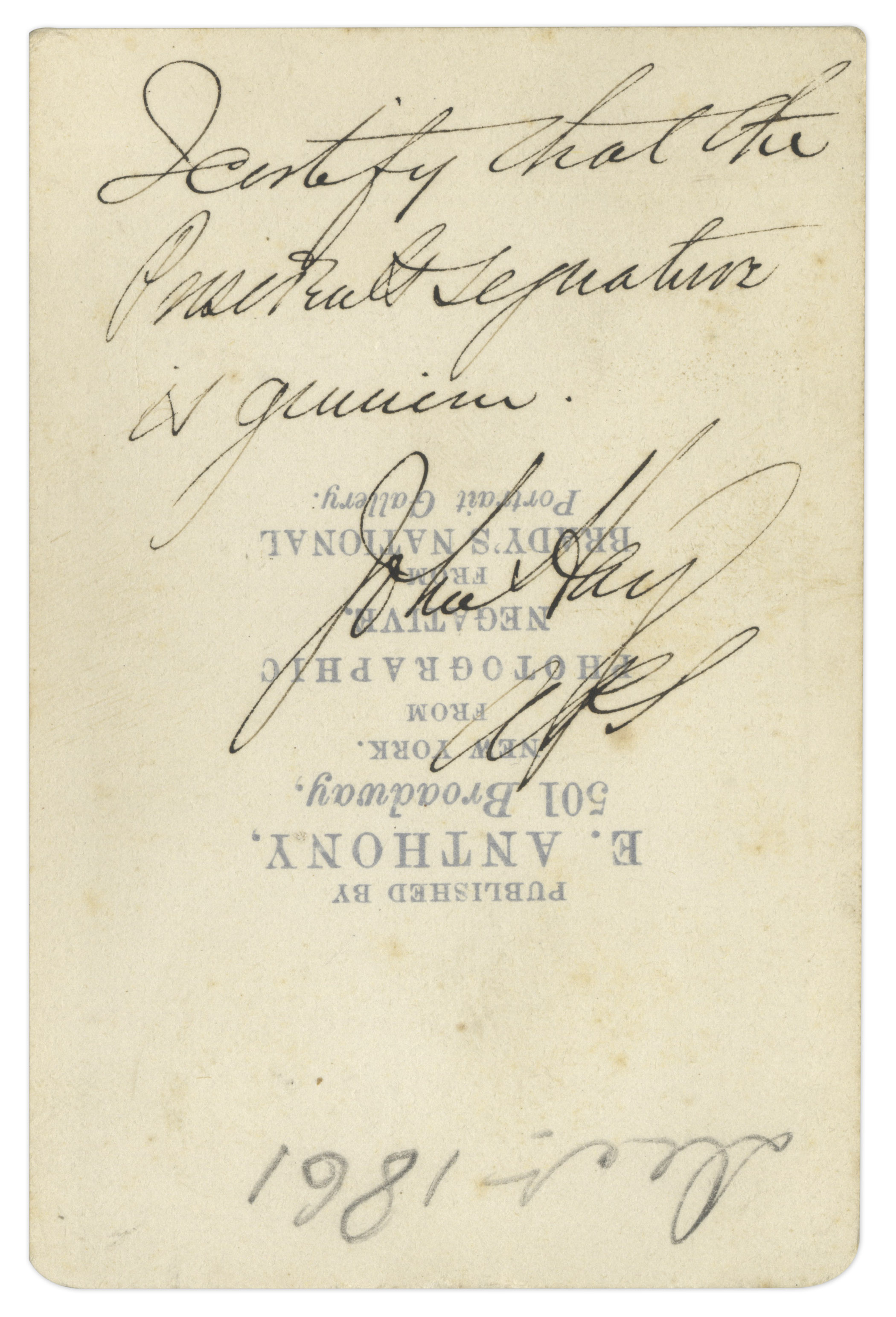
Abraham Lincoln Signed CDV as President — John Hay Certifies Signature as Authentic on Verso
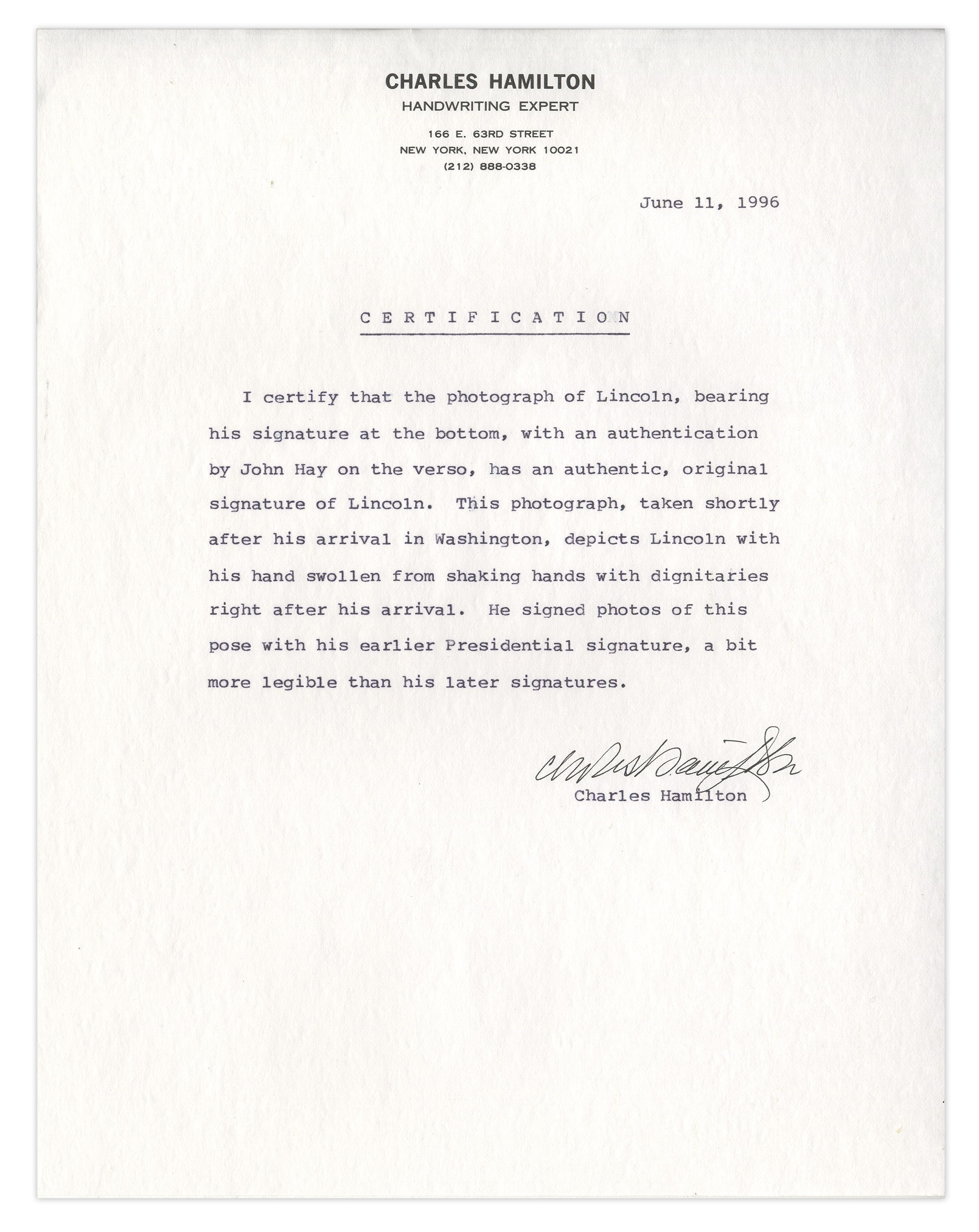
Exceptionally rare Abraham Lincoln signed carte-de-visite photograph, taken by Alexander Gardner in 1861 and signed as President. Signed ”A. Lincoln” below the seated portrait of Lincoln. John Hay, Lincoln’s private secretary, authenticates the signature upon the verso by writing, ”I certify that the President’s signature is genuine / John Hay”. With ”Brady’s National Portrait Gallery” backstamp. Measures 2.5” x 3.75”. Very good with some foxing and wear, but with a strong signature by Lincoln. With provenance from Profiles in History and with a COA from Charles Hamilton. Sold for $49,913.
Important Civil War letter signed by President Abraham Lincoln, exactly one week after the disastrous Battle of Fredericksburg that left Lincoln in ”a worse place than hell” upon hearing the results of the ”butchery” of Union forces. The hope of taking the Confederacy’s capital of Richmond had been stymied yet again, and criticism of Lincoln’s handling of the war reached such a pitch that there was even serious consideration of removing him as Commander-in-Chief. In this letter, written to Major Generals William B. Franklin and William F. Smith, Lincoln responds to another possible plan of how to approach the city, presented by the Generals (see lot 135 for Franklin and Smith’s plan). General Franklin, in particular, was likely trying to fix the problem of capturing Richmond, as his command of the Left Grand Division during the Battle of Fredericksburg had been criticized in some quarters; Lincoln, however, views this new plan with skepticism and even issues a mild rebuke at the end of the letter, for what seems to be an inconsistency in Franklin’s recommended strategy.
On Executive Mansion letterhead, Lincoln responds confidently to the Generals, displaying his knowledge of military strength and logistics, in full, ”Yours of the 20th suggesting a plan of operations for the Army of the Potomac is received. I have hastily read the plan, and shall yet try to give it more deliberate consideration, with the aid of military men. Meanwhile let me say it seems to me to present the old questions of preference between the line of the Peninsula, and the line you are now upon. The difficulties you point out pertaining to the Fredericksburg line are obvious and palpable. But now, as heretofore, if you go to James River, a large part of the army must remain on or near the Fredericksburg line, to protect Washington. It is the old difficulty.
When I saw Gen. Franklin at Harrison’s Landing on James River last July, I can not be mistaken in saying that he distinctly advised the bringing of the Army away from there. / Yours very truly, A. Lincoln”.
Lincoln’s understanding of Richmond’s difficulty was confirmed by history – it wouldn’t be until early April 1865, just days before Lee’s surrender, that the city was ultimately captured by siege, rather than direct assault, by cutting its supply lines. Single page letter is written in the hand of Lincoln’s secretary John G. Nicolay, boldly signed by Lincoln at the conclusion. On bifolium stationery measuring 7.875” x 9.875”. Fold lines, else near fine condition. Sold for $40,000.

Abraham Lincoln Autograph Letter
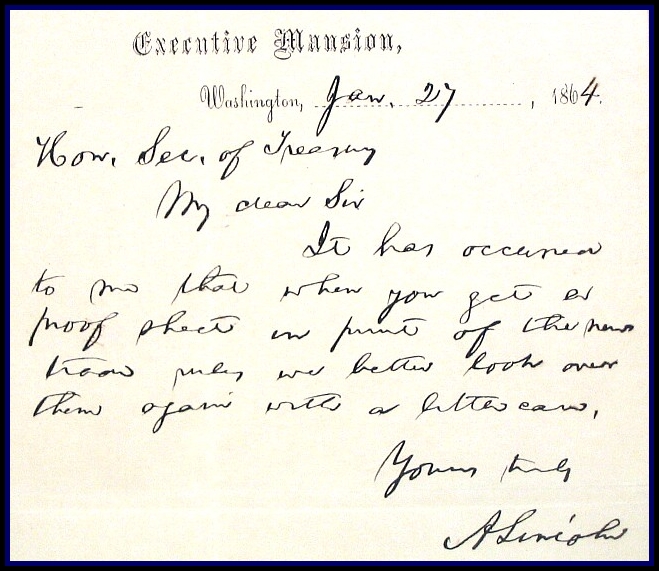
Abraham Lincoln signed autograph letter to Salmon P. Chase, the Secretary of the Treasury. Written the year Lincoln’s second term began, the letter refers to the “Reconstruction” plan Lincoln was in the process of executing. The plan called for protectionism, arguably a more immediate cause of the American Civil War than the abolition of slavery. In 1864, before the war ended, Abraham Lincoln raised trade taxes to the highest level they had ever reached to cripple the South, while the southern states were pro-free trade. On 8 December 1863, Lincoln announced his reconstruction program during his Annual Message to Congress. The only person who objected to this message was Sec. Chase. Here, Lincoln mentions looking over the trade rules again with Chase to hurt the Confederacy. Reads in full: “Executive Mansion, Washington, Jan. 27, 1864/ Hon. Sec. Of Treasury/ My dear Sir/ It has occurred to me that when you get a proof sheet in print of the new trade rules we better look over them again with a little care/ Yours truly / A(braham) Lincoln (signed).” Folds showing, two small spots on right margin, otherwise nicely matted in 10.5″ x 13.5″ frame. Mint. An excellent Abraham Lincoln signed autograph letter. Sold for $32,548.
Fascinating autograph letter signed by Abraham Lincoln in 1859, an unpublished letter written to Lincoln’s close associate Norman B. Judd, the Republican State Chairman of Illinois at the time. Lincoln discusses a plan to reach German voters in the state via the purchase of a printing press that would ostensibly print literature in German, saying he’s in favor of the plan if it would cost no more than $400 – ”we seem to be gaining with the Germans; and perhaps it is right to press our own luck while it runs favorably”.
As evidenced by this letter, Lincoln and Judd were close allies at this time. It was a year earlier that Judd had proposed the idea that Lincoln should debate Stephen Douglas on the issue of slavery, catapulting Lincoln to national prominence. And it would be Judd who, a year later, nominated Lincoln for President at the Republican National Convention in Chicago – the city selected by Judd so that Lincoln would have an advantage over the other contenders, even going so far as arranging the seating chart so that anti-Lincoln men were in the back of the convention hall. Single page letter measures 7.75” x 9.875”. Mounting remnant to one corner on verso, and restoration along fold on verso. Also an ink blot at bottom in what looks to be a fingerprint. Writing remains bold, overall very good plus condition. Sold for $25,000.

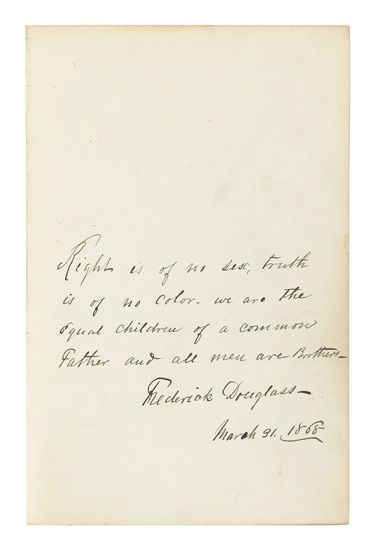
Frederick Douglass Autograph Quotation Signed — “Right is of no sex, truth is of no color. We are the equal children of a common Father and all men are Brothers” — With 30+ Signatures of 19th Century Abolitionists
Inspiring collection of signatures by 19th century abolitionists, with the crown jewel being an autograph quotation signed by Frederick Douglass, “Right is of no sex, truth is of no color. We are the equal children of a common Father and all men are Brothers – Frederick Douglass – March 31, 1868”. Album contains about 35 other signatures. Album is very worn with front board detached and backstrip missing. Some dampstaining present on front and rear blank pages. Page signed by Douglass is near fine with only toning to margins. Sold for $8,800.
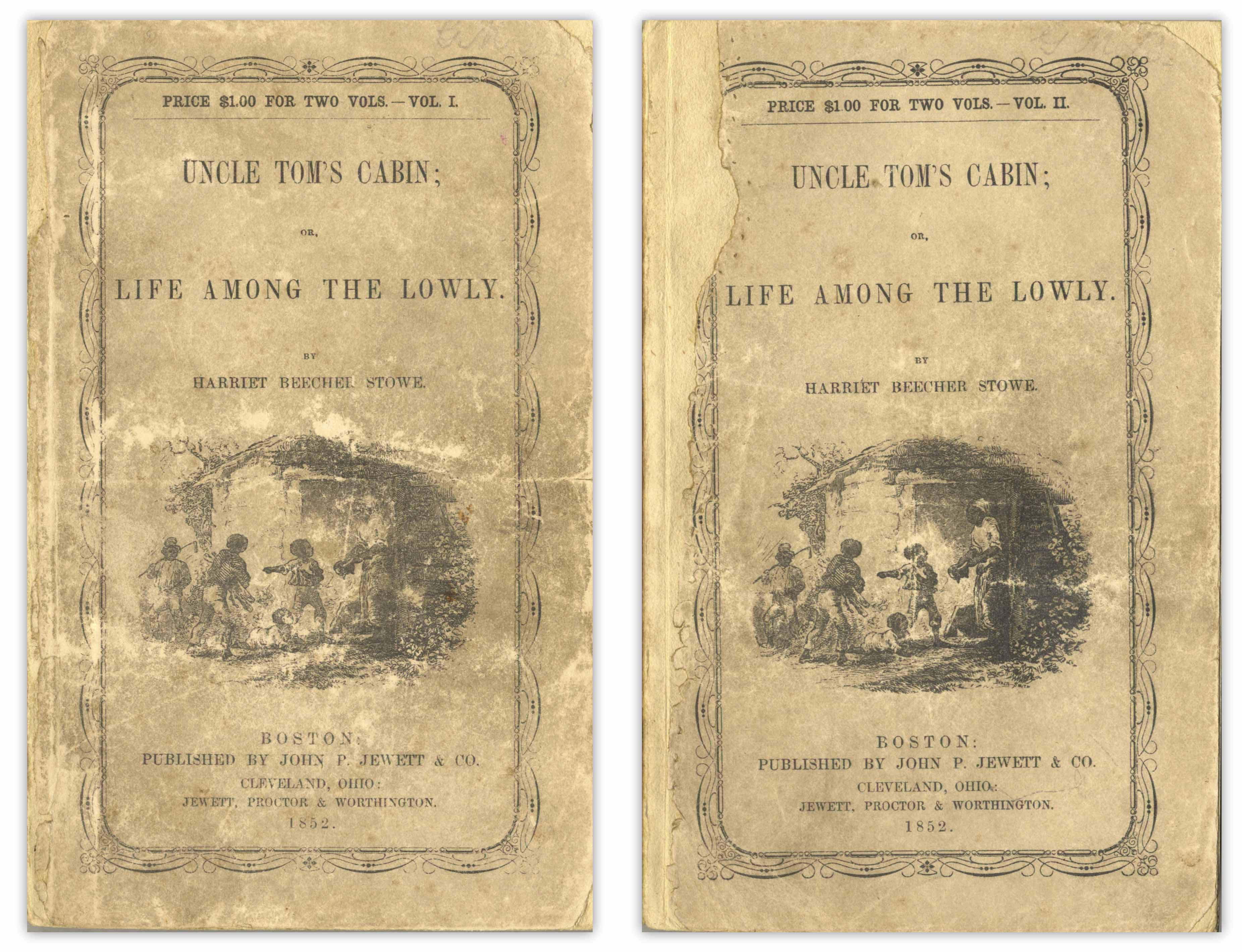
First Edition, First Printing of “Uncle Tom’s Cabin” by Harriet Beecher Stowe — The Scarcest Variant of the First Printing, in Publisher’s Wrappers
Extraordinarily scarce first edition, first printing of Harriet Beecher Stowe’s ”Uncle Tom’s Cabin”, in the publisher’s wrappers binding ”A”, the rarest of the three variants of the first printing. Boston: John P. Jewett, 1852. Two volumes, as issued, with three plates in each volume by Hammett Billings, priced at $1.00 for both volumes. All other first printing points are present: ”spilt” instead of ”spiled” on page 42, line 1 of Vol. I; ”cathecism” instead of ”catechism” on page 74, line 5 of Vol. II; no attribution to Billings for the engravings; no other printings designated on the title page of either volume; with the following statements on the copyright page: ”Entered according to Act of Congress, in the year 1851, by Harriet Beecher Stowe” and ”Stereotyped by Hobart & Robbins”.
Published on 20 March 1852 after first appearing in serialized form, the first printing of 5,000 copies of ”Uncle Tom’s Cabin” sold out within a few days, and the second printing by the end of March. Included in ”Books That Changed America”, the author Robert Downs stated of it, ”Within a decade after its publication Uncle Tom’s Cabin had become the most popular novel ever written by an American…there is substantial evidence that the book precipitated the American Civil War.” And from PMM, the catalog of the most influential books ever written: ”In the emotion charged atmosphere of mid-19th century America Uncle Tom’s Cabin exploded like a bombshell. To those engaged in fighting slavery it appeared as an indictment of all the evils inherent in the system they opposed; to the pro-slavery forces it was a slanderous attack on ‘the Southern way of life’…the social impact of on the United States was greater than that of any book before or since.”
Volumes measure 4.625” x 7.375” housed in blue clamshell cases and a custom slipcase. With provenance from famed dermatologist and collector Paul E. Bechet, with his library labels, causing shadowing to title pages. Spines of both volumes repaired, with some paper loss, more so on Vol. II with that back cover replaced. Light toning, wear and soiling. Overall a very good set. Sold for $5,750.
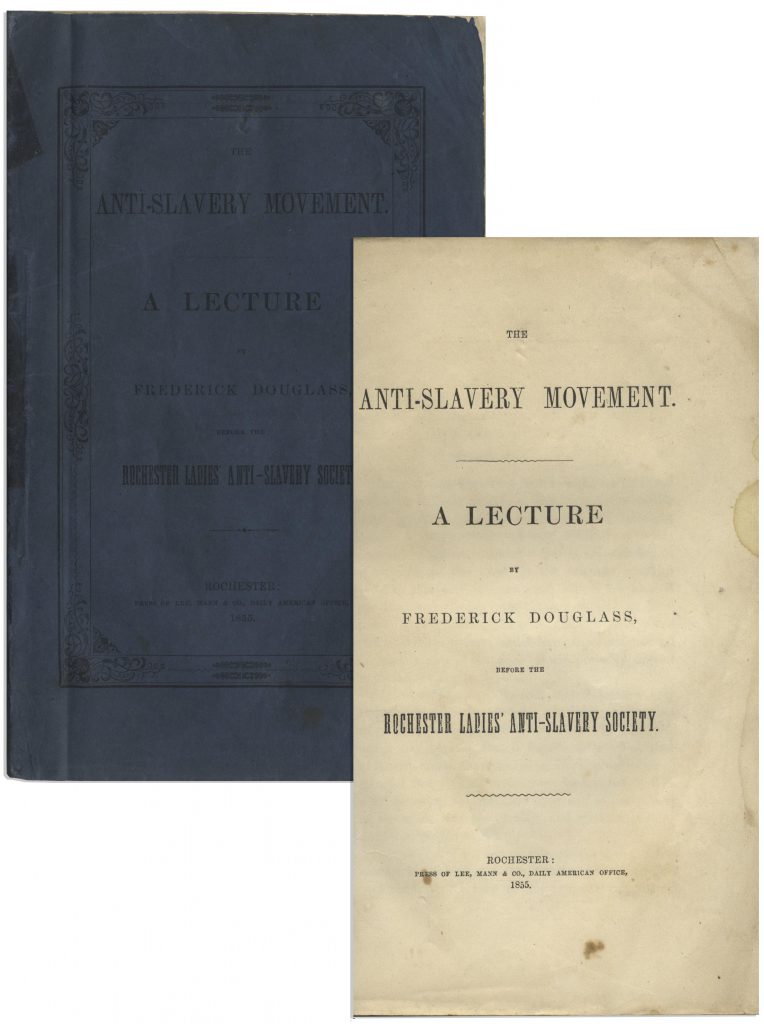
Anti-Slavery Movement, A Lecture, By Frederick Douglass
“The Anti-Slavery Movement, A Lecture, By Frederick Douglass, Before The Rochester Ladies Anti-Slavery Society.” Printed in 1855 in Rochester, New York, by the Press of Lee, Mann, and Co., Daily American Office. A name is written on the top of page 44. Measures 5 1/2″ x 8 13/16″. 48 pages. Restoration work on spine. Minor wear, foxing and staining on cover and interior pages and minor paper loss on the bottom of four pages. Very Good. Rare. Sold for $3,600.
FREE APPRAISAL. To buy, auction, sell or consign your Emancipation Proclamation circa January 5 1863 4th edition that is for sale, please email your description and photos to [email protected] of Nate D. Sanders Auctions (http://www.NateDSanders.com).
We offer the following services for your Emancipation Proclamation circa January 5 1863 4th edition:
- Appraise Emancipation Proclamation circa January 5 1863 4th edition.
- Auction Emancipation Proclamation circa January 5 1863 4th edition.
- Consign Emancipation Proclamation circa January 5 1863 4th edition.
- Estimate Emancipation Proclamation circa January 5 1863 4th edition.
- Sell Emancipation Proclamation circa January 5 1863 4th edition.
- Emancipation Proclamation circa January 5 1863 4th edition valuation.