
Sell or Auction Your William Gordon United States of America 1788 4 Vols for up to Over $10,000 or More at Nate D. Sanders Auctions
FREE VALUATION. To buy, auction, sell or consign your William Gordon United States of America 1788 4 vols that is for sale, please email your description and photos to [email protected] of Nate D. Sanders Auctions (http://www.NateDSanders.com).
Free Appraisal, Auction or Sell Your William Gordon United States of America 1788 4 Vols

Below is a recent realized price for a 4 volume set of William Gordon United States of America 1788. We at Nate D. Sanders Auctions can obtain up to this amount or more for you:
William Gordon United States of America 1788 4 Vols. Sold for Over $10,000.
Below are some related items we have sold:
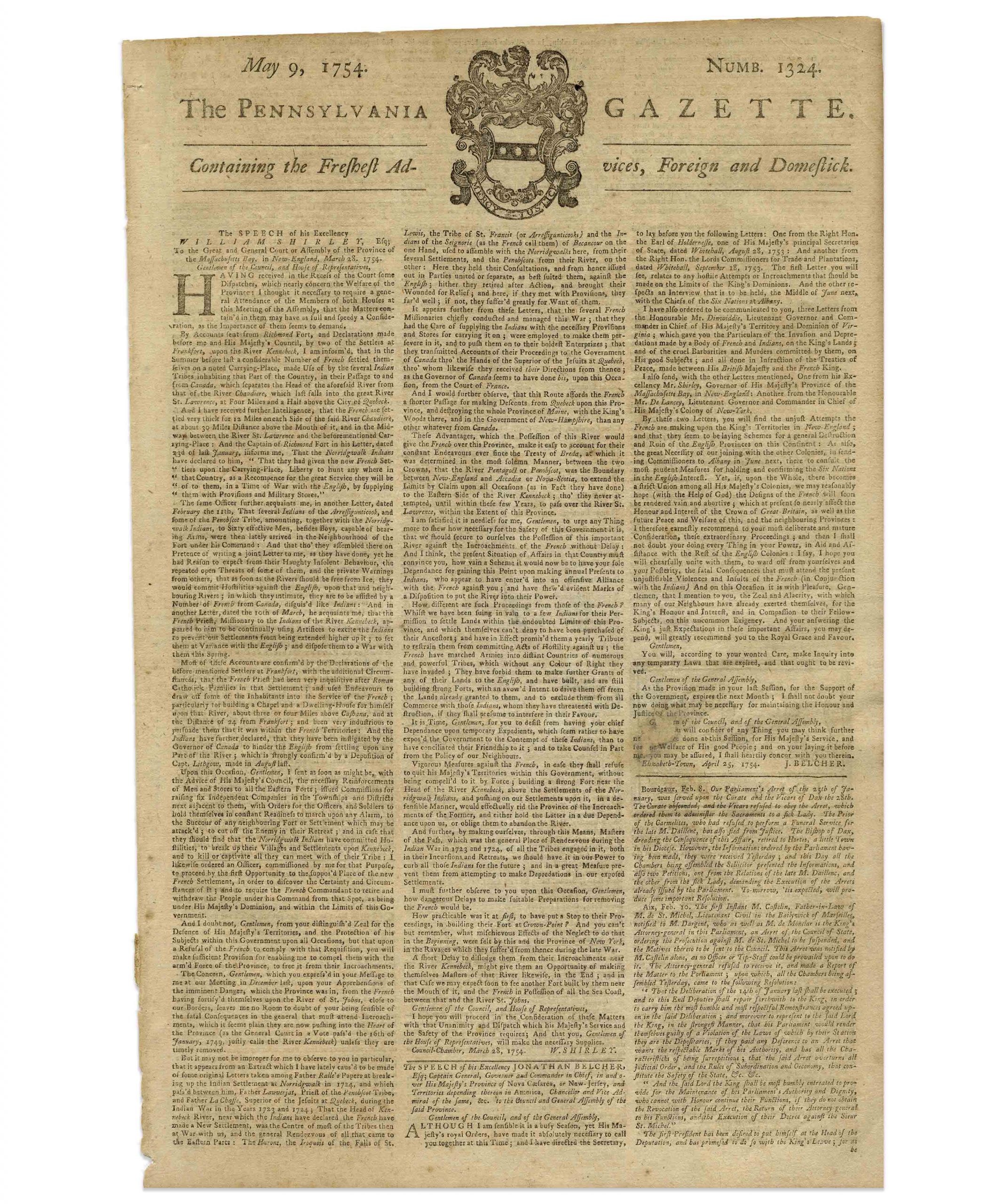
The most influential political cartoon in the history of America, the ”JOIN, or DIE” severed rattlesnake designed by Benjamin Franklin and published in his ”Pennsylvania Gazette” on 9 May 1754. This incredibly scarce newspaper is the very first printing of the ”JOIN, or DIE” cartoon, and the only known copy apart from one other housed in the permanent collection at the Library of Congress.
Frustrated by the colonists’ inability to join forces against westward expansion by the French, Franklin created this cartoon of a rattlesnake, cut into 8 pieces symbolizing the American colonies, to dramatically impart the effective message: join together as one cohesive body, or die. Along with the cartoon, Franklin published an editorial in the newspaper, urging the colonists to work together, reading in part, ”…The Confidence of the French in this Undertaking seems well-grounded on the present disunited State of the British Colonies…while our Enemies have the very great Advantage of being under one Direction, with one Council, and one Purse…”
Little did Franklin know at the time that his symbol of the dis-united rattlesnake would echo over twenty years later to inspire the colonists to unite against the British – Paul Revere added the ”JOIN, or DIE” cartoon to the nameplate of his paper, the ”Massachusetts Spy”, and even later, with the ”Don’t Tread on Me” flag, any individual or group whose personal liberty is threatened. The phrasing has also proved highly enduring, likely influencing John Stark, the Revolutionary War General from New Hampshire whose toast, ”Live free or die: Death is not the worst of evils”, inspired New Hampshire’s motto, and again suggests that personal liberty is one of the highest human values, and a founding tenet of the United States.
Franklin’s choice of a rattlesnake is curious for several reasons: as the timber rattlesnake was found throughout the colonies but not England, Franklin argued in an earlier 1751 editorial that the colonists should ship rattlesnakes to England in exchange for the criminals that England was sending to America. Franklin now, however, seems to fully embrace the rattlesnake as metaphor, and would argue, during the American Revolution, its virtues. Using a pseudonym to conceal his identity, he wrote in 1775, ”…she has no eye-lids-She may therefore be esteemed an emblem of vigilance.-She never begins an attack, nor, when once engaged, ever surrenders…to those who are unacquainted with her, she appears to be a most defenseless animal; and even when those weapons are shown and extended for her defense, they appear weak and contemptible; but their wounds however small, are decisive and fatal:-Conscious of this, she never wounds till she has generously given notice, even to her enemy, and cautioned him against the danger of stepping on her.-Was I wrong, Sir, in thinking this a strong picture of the temper and conduct of America?”
While the British loyalists played upon Franklin’s symbolism of the rattlesnake, arguing that the colonists were deceptive and cunning, Franklin turned the characterization on its head, skilled and interested as he was in the art of propaganda. Ultimately, the symbolism would prove highly enduring and compelling: both the idea of uniting to fight a greater, more powerful enemy, and the power of a sudden, deadly attack by an underestimated opponent.
Four page newspaper (without advertising) measures 9.75” x approximately 15”, with an irregularly trimmed top edge. Expert restoration to head of snake, and light uniform toning, consistent with age. Newspaper has been well-preserved, in very good to near fine condition. One of the most important newspapers in America’s colonial history and a cornerstone of her philosophical underpinnings. Sold for $50,000.
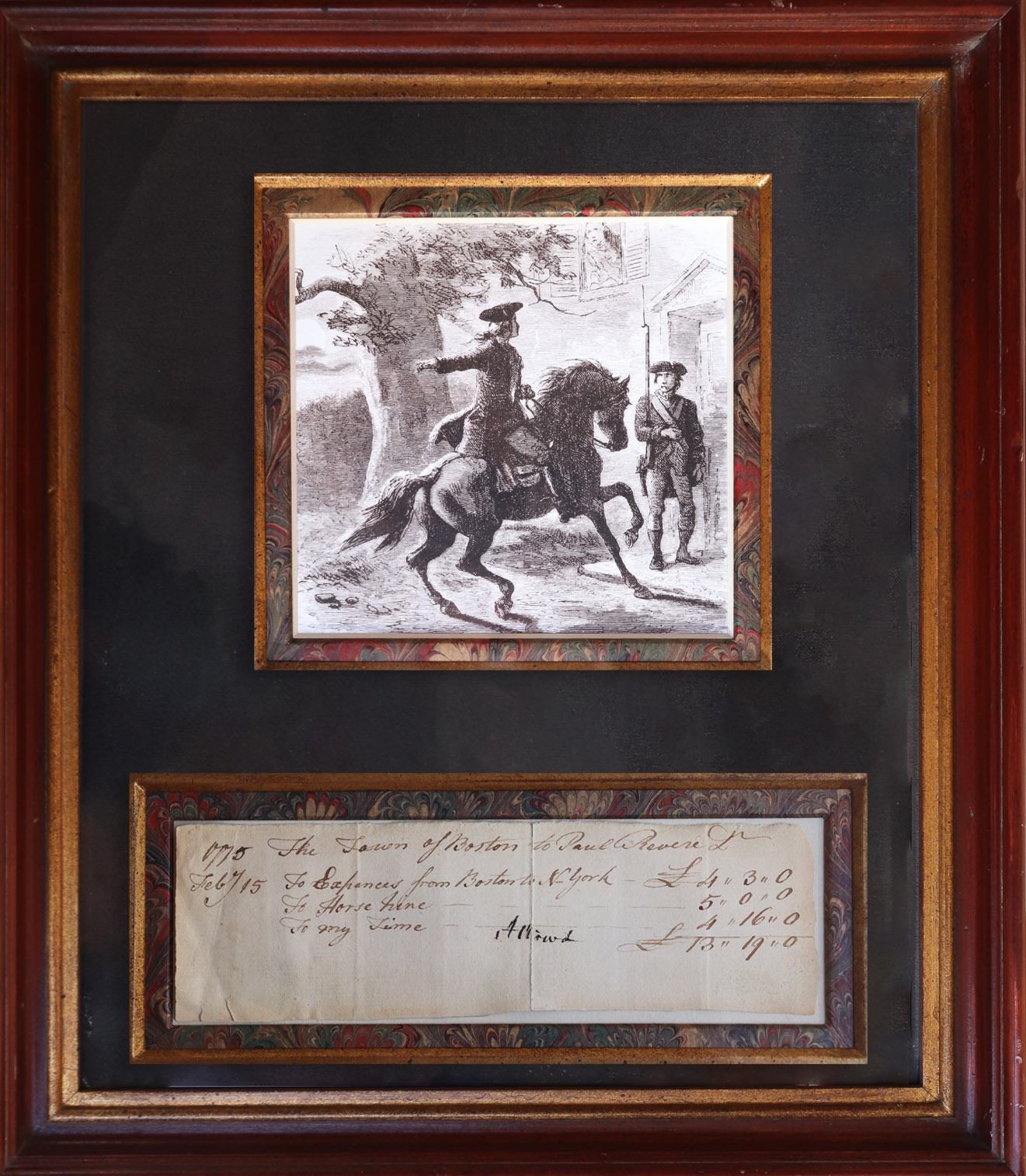
Very scarce receipt signed by Paul Revere regarding one of his famous horseback rides, dated 15 February 1775 just two months before his Midnight Ride warning colonists that ”The British Are Coming” before the Battle of Lexington & Concord. As official courier for the Boston Committee of Public Safety, Revere was tasked with riding from Boston to Philadelphia and New York, with historians documenting 18 such rides from December 1773 to November 1775. This was likely the last of the rides before the Revolutionary War began, and is only one of two receipts for the rides ever to appear at auction, with the other selling at Christie’s for $140,000 in 2002. Composed entirely in the hand of Revere, receipt documents expenses ”from Boston to N. York” in the amount of 4 pounds, 3 shillings, and additional expenses for his Horse, and his time, all totaling 13 pounds, 19 shillings. Dated 15 February 1775 by Revere. Document measures 7.5” x 2.25”, framed with an engraving of Revere on horseback to a size of 15.75” x 18”. Uneven edges, clean vertical separation and light chipping at lower left edge. Overall very good plus condition with legible and strong handwriting. With Profiles in History COA. Sold for $36,603.
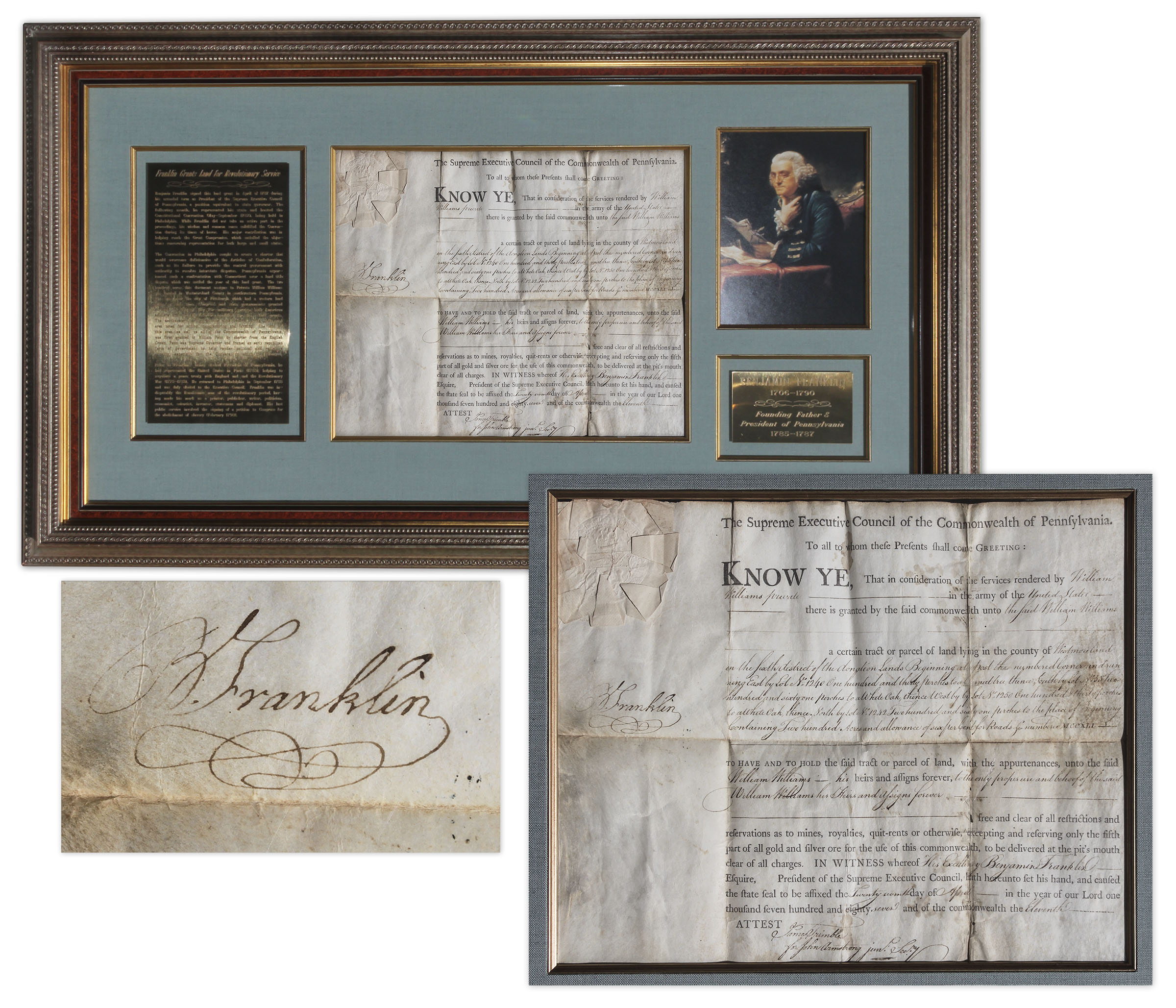
Benjamin Franklin land grant signed in Philadelphia on 27 April 1787, just one month before the start of the Constitutional Convention held in that city. Franklin served as President of Philadelphia’s Executive Council and signs ”B. Franklin” in that capacity, granting Private William Williams land in exchange for his service in the Revolutionary War. Document measures 15” x 12.5”, beautifully matted and framed to 40” x 23”. Weighs 14 lbs. Folds, toning and light staining throughout. Very good condition. Sold for $15,125.
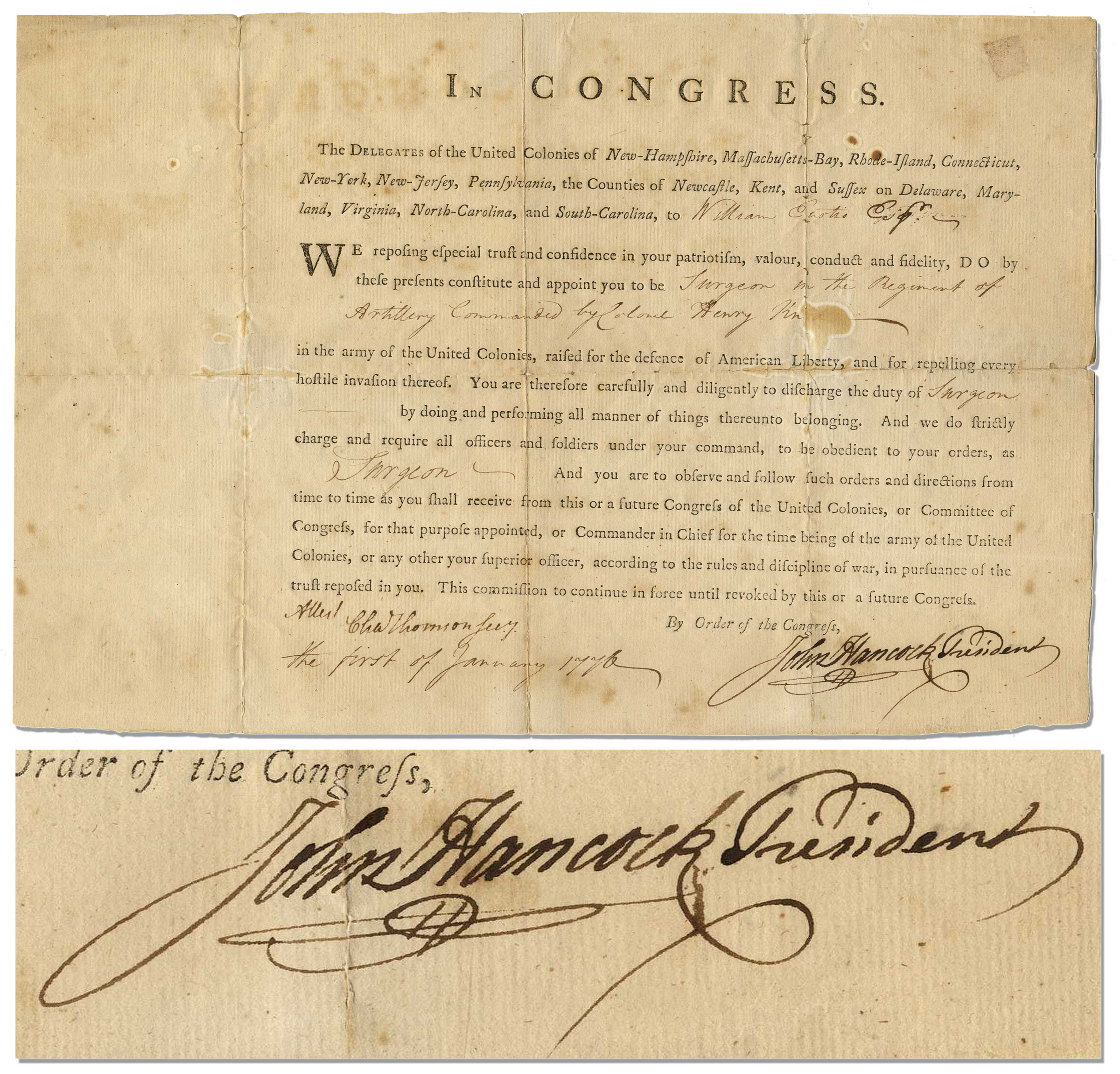
Terrific John Hancock Autograph 1776 Revolutionary War Document as President of the Second Continental Congress — Appointing Future Secretary of War, William Eustis, as “Surgeon” in the Continental Army
John Hancock autograph document, appointing William Eustis as “Surgeon”, dated 1 January 1776, with Hancock’s distinctive signature and paraph in bold black ink. Eustis would later serve as Secretary of War, Congressman and Massachusetts Governor. Appointment reads in part: “…The Delegates of the United Colonies of New-Hampshire, Massachusetts-Bay, Rhode-Island, Connecticut, New-York, New Jersey, Pennsylvania, the Counties of Newcastle, Kent, and Sussex on Delaware, Maryland, Virginia, North-Carolina, and South-Carolina, to William Eustis…We reposing special trust and confidence in your patriotism, valour, conduct and fidelity, DO by these present constitutes and appoint you to be Surgeon in the Regiment of Artillery Command by Colonel Henry Knox in the army of the United Colonies, raised for the defence of American Liberty, and for repelling every hostile invasion therof…” Signed “John Hancock / President”. Document measures 14.25″ x 9.5″, with light dampstaining and five small holes along folds. Dark John Hancock autograph. Very good condition. Sold for $9,500.
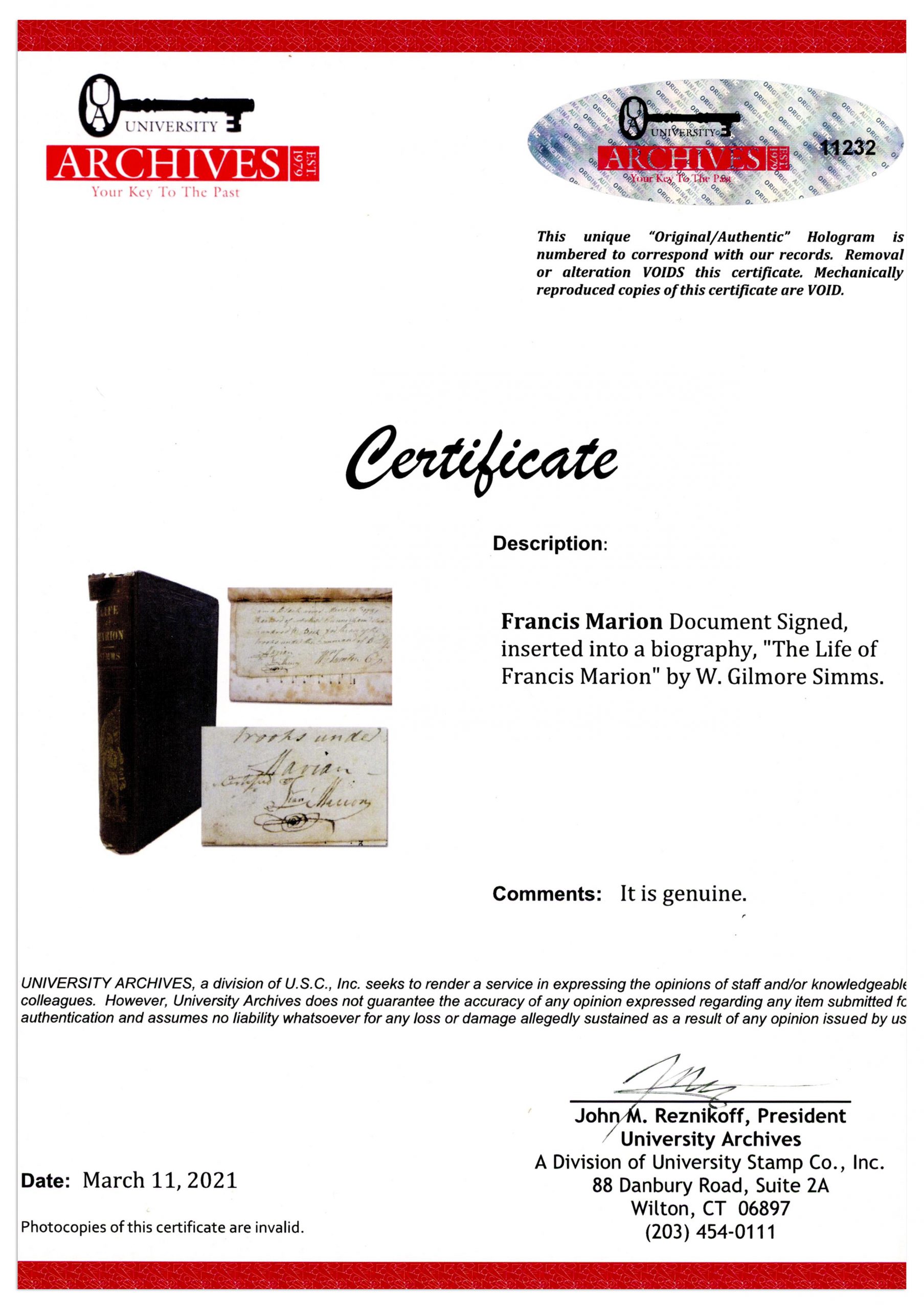
Revolutionary War Brigadier General Francis Marion, the “Swamp Fox”, Document Signed From 1781, the Day of the Black River Bridge Battle — With University Archives COA
Brigadier General Francis Marion document signed, dated 15 March 1781, the day of the battle of the Black River Bridge, where Marion’s men killed a dozen British soldiers under the command of Lt. Col. John Watson Tadwell-Watson. From “Camp Black river”, document reads, “Received of Arthur Cunningham six hundred [pounds?] for the use of the troops under the Command of BDG Marion”, under which Marion signs, “Certified Francis Marion”, with his distinctive paraph accentuating the signature. Nicknamed the “Swamp Fox”, Marion’s tactics of war not only earned him the distinction of a father of modern guerilla warfare, but also led to the creation of the U.S. Army Rangers. The character of Mel Gibson in “The Patriot” was also largely based on Marion. Document measures approximately 7″ x 3.25″, signed by Cunningham on verso in May 1783, likely when he was reimbursed. Irregular edges and folds, and affixed at top edge to the interior of the book, “The Life of Francis Marion”. Very good plus condition. A very rare Francis Marion signed Revolutionary War document, on the date of one of his battles. With University Archives COA. Sold for $8,925.

Long autograph letter signed by Richard Henry Lee, as Chair of the Marine Committee of Continental Congress, to Governor Patrick Henry of Virginia concerning Governor Henry’s interest in the exchange of naval prisoners. Retained draft is datelined Philadelphia, 3 March 1779. Lee explains how the congressional committee distinguishes between state and Continental prisoners, and how the British negotiate for each, adding that ”no cartel has ever been, or could be settled with the enemy for American prisoners in G.B., they being unwilling there to recognize us in such a light…and therefore these exchanges have been confined to prisoners in America only.” Given the enormous number of American prisoners of war who were dying in British prison ships, exchanges were a matter of great urgency, but were only rarely completed. Large single page letter measures 8” x 12.75”. Moderate dampstaining, paper repairs to separations at folds, verso reinforcement on bottom right of letter, two small ink burn holes, and numerous cross-outs and emendations. Very good condition. Published in Letters of Delegates to Congress, 12:142-3. Provenance: Freeman’s sale, 16 April 1928, lot 167. Sold for $7,199.

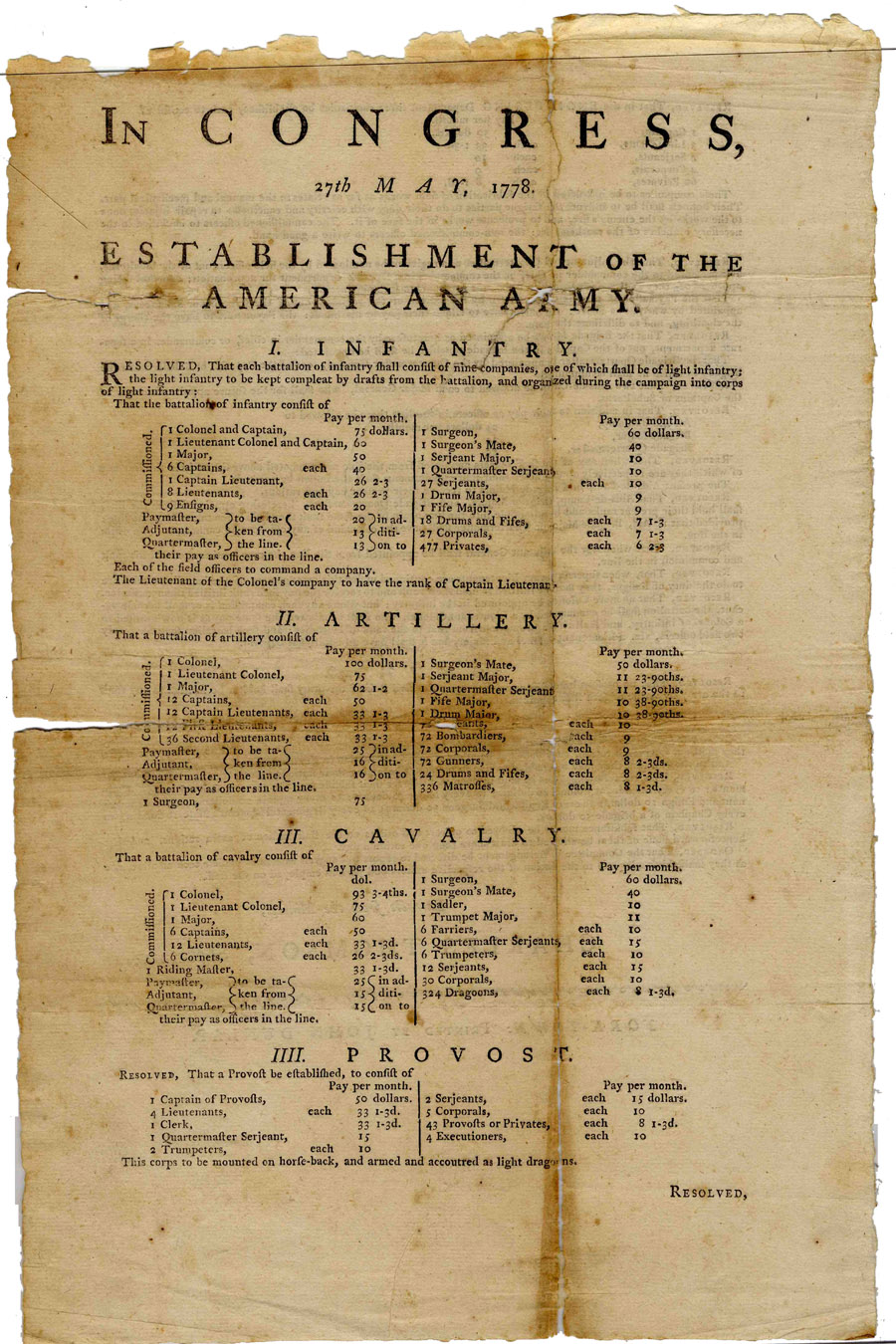
American Army Establishment Broadside
Scarce Revolutionary War “In Congress” broadside entitled, “Establishment of the American Army.” Printed by John Dunlap: York-Town. Dated 27 May 1778 document divides the American army into four parts; infantry, artillery, cavalry and provost and details positions and payments within each department. Further resolutions dated 29 May and 2nd June detail compensation and rations. In part, “…Resolved, That each battalion of infantry shall consist of nine-companies, one of which shall be of light infantry; the light infantry to be kept compleat by drafts from the battalion, and organized during the campaign into corps of light infantry: That the battalion of infantry consist of…Colonel and Captain [etc]…” 2pp. front and verso. Measures approximately 9.25″ x 14″. Fragile paper shows chipping and paper loss to edges and near complete separation at folds. Overall toning, wear and soiling, else good condition. Sold for $4,200.
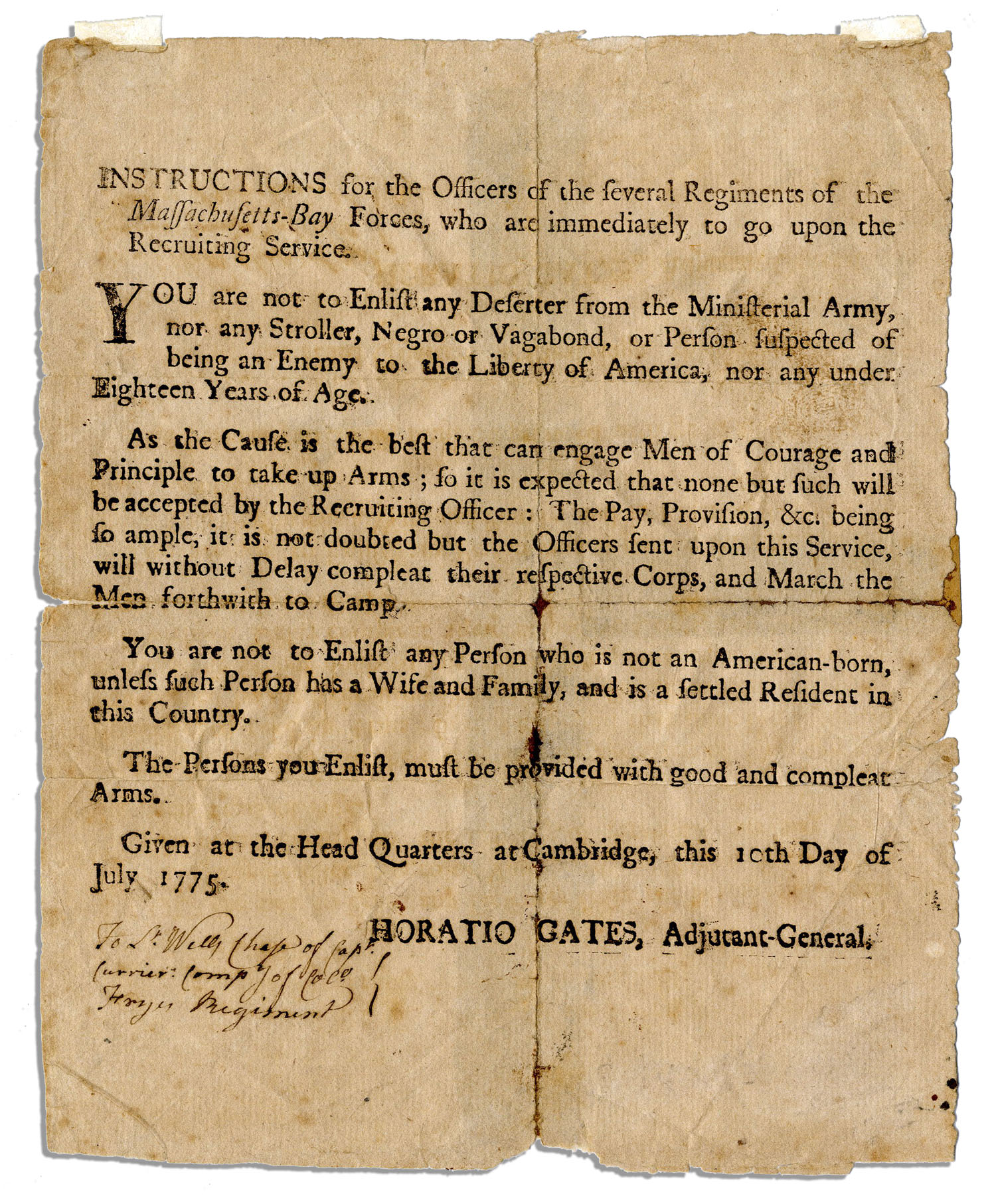
Broadside announces the recruitment of soldiers for the American Revolutionary War. The document, dated 1775 and signed in type by Horatio Gates as Adjutant General reads in full: ”Instructions for the Officers of the several Regiments of the Massachusetts Bay Forces, who are immediately to go upon the Recruiting Services. You are not to Enlist any Deserter from the Ministerial Army, nor any Stroller, Negro or Vagabond, or Person suspected of being an enemy to the Liberty of America, nor any under Eighteen Years of Age. As the cause is the best that can engage Men of Courage and Principle to take up Arms; so it is expected that non but such will be accepted by the Recruiting Officer: The Pay, Provision, etc. being so ample, it is not doubted but the Officers sent upon this Service will without Delay compleat their respective Corps, and March the Men forthwith to Camp. You are not to enlist any Person who is not American-born, unless such Person has a wife and Family, and is a settled Resident in this Country. The Persons you Enlist must be provided with good and compleat Arms. Given at the Head Quarters at Cambridge, this 10th Day of July, 1775. / Horatio Gates, Adjutant General”. Single-page broadside measures 6.5” x 8.25”. Toning, chipping and minor tears along edges, with separation to fold intersection from the left edge. Very good condition. Sold for $2,886.
FREE VALUATION. To buy, auction, sell or consign your William Gordon United States of America 1788 4 vols that is for sale, please email your description and photos to [email protected] of Nate D. Sanders Auctions (http://www.NateDSanders.com).
We offer the following services for your William Gordon United States of America 1788 4 vols:
- Appraise William Gordon United States of America 1788 4 vols.
- Auction William Gordon United States of America 1788 4 vols.
- Consign William Gordon United States of America 1788 4 vols.
- Estimate William Gordon United States of America 1788 4 vols.
- Sell William Gordon United States of America 1788 4 vols.
- William Gordon United States of America 1788 4 vols valuation.