
Sell or Auction Your John Josselyn New-Englands Rarities 1st Edition 1672 for up to Over $40,000 or More at Nate D. Sanders Auctions
FREE APPRAISAL. To buy, auction, sell or consign your John Josselyn New-Englands Rarities 1st edition 1672 that is for sale, please email your description and photos to [email protected] of Nate D. Sanders Auctions (http://www.NateDSanders.com).
Free Appraisal, Auction or Sell Your John Josselyn New-Englands Rarities 1st Edition 1672
John Josselyn (fl. 1638 – 1675) was a seventeenth-century English traveller to New England who wrote with credulity about what he saw and heard during his sojourn there before returning to England. Yet his books give some of the earliest and most complete information on New England flora and fauna in colonial times, and his outlook was later praised by Henry Thoreau, among others. Little is known about his life. Josselyn’s years of birth and death are not known, but he was born early in the seventeenth century to Sir Thomas Josselyn of Kent. He first visited New England in July 1638 when he presented his respects to Governor John Winthrop and to the Rev. John Cotton, to whom he delivered from Francis Quarles a translation of several psalms into English. He stayed in New England for 15 months, then visited again 24 years later, in 1663. Returning to England in 1671, Josselyn published New England’s Rarities, discovered in Birds, Beasts, Fishes, Serpents, and Plants of that Country (the book included a picture of Boston in 1663).
Below is a recent realized price for a John Josselyn New-Englands Rarities 1st edition 1672 item. We at Nate D. Sanders Auctions can obtain up to these amounts or more for you:
John Josselyn New-Englands Rarities 1st Edition 1672. Sold for over $40,000.
Here are some recent items that our auction house, Nate D. Sanders (http://www.NateDSanders.com) has sold:
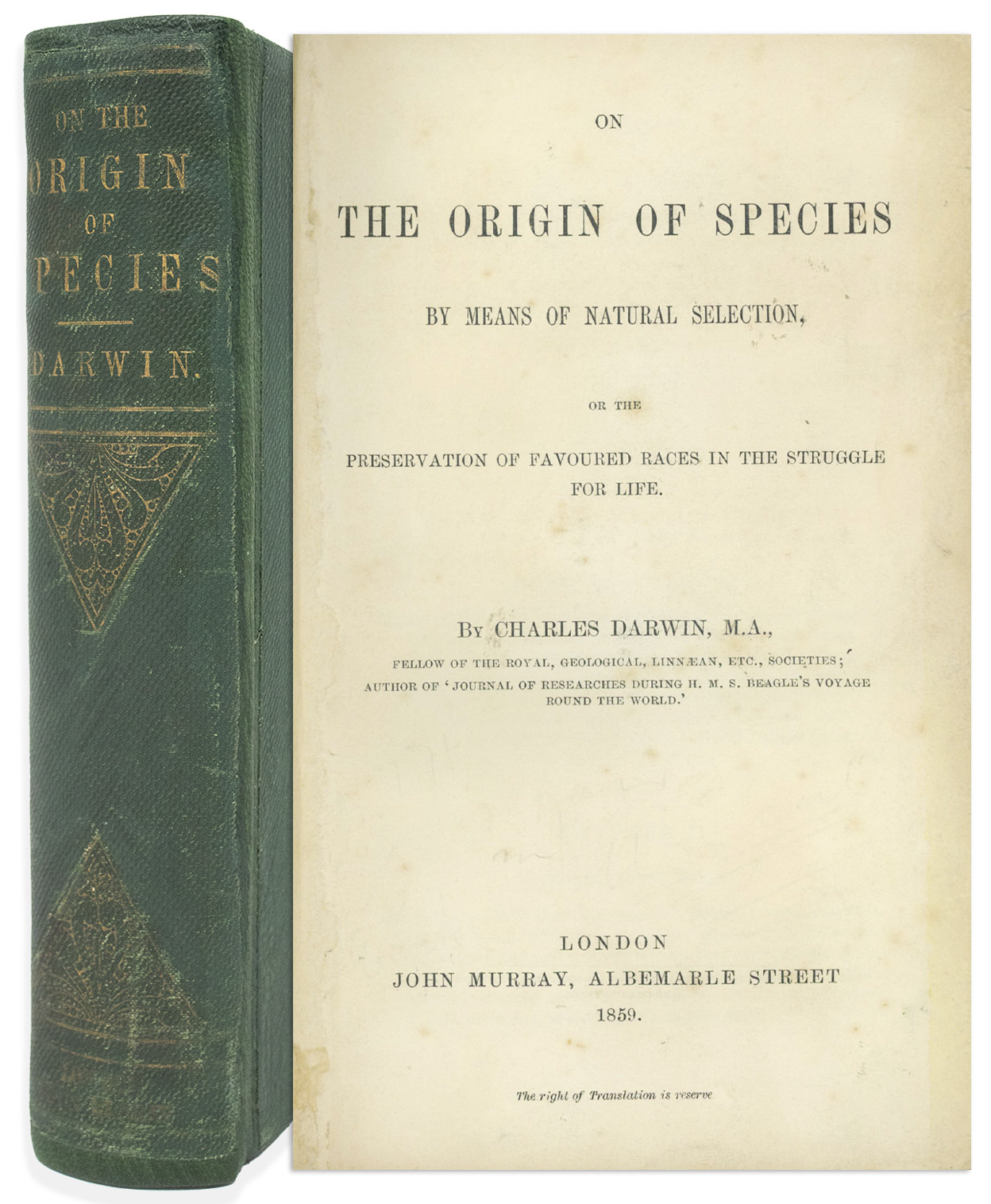
Charles Darwin On the Origin of Species 1st Edition
First edition, first printing of “On the Origin of Species” by Charles Darwin, one of the most important books in the scientific canon. London: John Murray, 1859. In this revolutionary book that upended man’s own view of himself, Darwin posits natural selection as the engine driving species’ evolution, an argument so persuasive that even 19th century religious leaders adjusted their teachings to allow for evolution to work in concert with divine planning. Its importance has only grown in the 150+ years since publication, with Freeman concluding it to be “the most important biological book ever written”. First released on 24 November 1859, its scarcity nearly matches its importance, with the first printing consisting of only 1,250 copies, and the number of extant copies now significantly fewer.
All first printing points are present, including original binding, variant B, title page with copyright information on verso, Table of Contents (pages v-ix) with binder instructions to verso, complete pages 1-502, and folding table present between pages 116-117. Bound in publisher’s full green boards, stamped and lettered in gilt. Overall in very good condition; ads at back of volume have been removed as has half-title page, and endpapers have been replaced. Volume is rebacked using morocco, with original spine laid down. Some shelf wear to boards. Light foxing throughout book, with some chipping, small closed tears with repairs to a few pages, and a few dogeared pages. One small mark on page 109, otherwise no internal writing or marks. Housed in a custom quarter-leather clamshell box. Overall in very good condition, a handsome, presentable copy of this scarce first printing. Sold for $68,250.
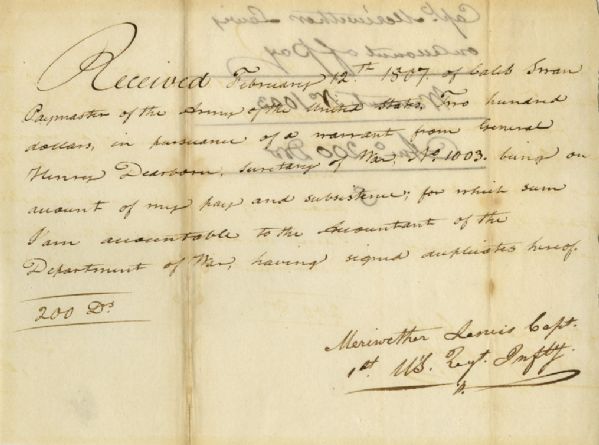
Very scarce Meriwether Lewis document signed ”Meriwether Lewis Capt. / 1st U’S. Regt. Infty.” Single octavo page, dated 12 February 1807 reads in full: ”Received February 12th 1807 of Caleb Swan Paymaster of the Army of the United States, Two hundred dollars, in pursuance of a warrant from General Henry Dearborn Secretary of War, No. 1003, being on account of my pay and subsistence, for which sum I am accountable to the Accountant of the Department of War, having signed duplicates hereof. 200 Drs.” In January 1803, President Thomas Jefferson sought to learn more about the far western territory, and appropriated the money from Congress for the proposed journey, to be led by the experienced explorer Meriwether Lewis. In his memoirs, Jefferson wrote of Lewis:
”Of courage undaunted; possessing a firmness and perseverance of purpose which nothing but impossibilities could divert from its direction; careful as a father of those committed to his charge, yet steady in the maintenance of order and discipline; intimate with the Indian characters, customs, and principles; habituated to the hunting life; guarded by exact observations of the vegetables and animals of his own country against losing time in the description of objects already possessed; honest, disinterested, liberal, of sound understanding, and a fidelity to truth so scrupulous that whatever he should report would be as certain as seen by ourselves…” (”History of the Expedition,” 1814). In the months immediately preceding the expedition, Lewis sought training in the use of astronomical instruments and in the art of map-making. He also chose a companion officer, William Clark of Louisville. While the expedition did not achieve the primary objective of finding the elusive Northwest Passage, it contributed significantly to the understanding of the geography of the Northwest and produced approximately 140 maps, the first accurate maps of the area. In addition, it documented 100 newly discovered species of animals, approximately 170 plants, and it also established friendly relations with three dozen Indian tribes. The knowledge they obtained sparked American interest in the west, and strengthened the nation’s claim to the area. Meriwether Lewis returned to Washington, D.C. from his three year journey in late December of 1806. After returning from the expedition, Lewis received a reward of 1,600 acres of land. In addition, Thomas Jefferson appointed him Governor of the Louisiana Territory. However, Lewis was not confirmed by the Senate until March 1807 and he remained a Captain in the interim. Base pay for Captains at this period was $40 per month so the present receipt would represent five months’ salary. A supremely rare document directly linking Meriwether Lewis to the Lewis & Clark Expedition. Items of Lewis & Clark related to the famed expedition are of the utmost rarity. Docketed on verso. Toning to folds and showthrough, otherwise near fine condition. Sold for $30,768.
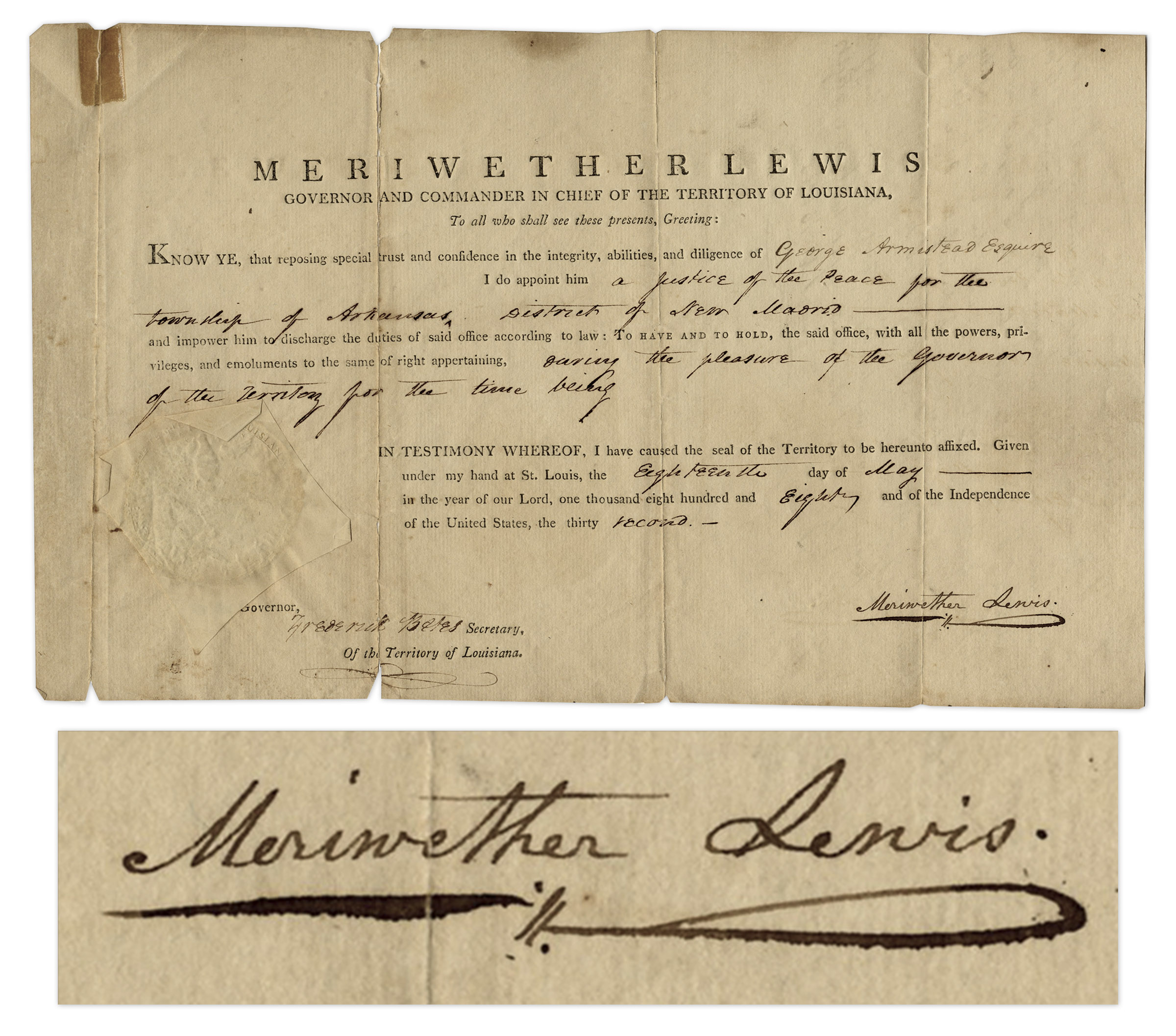
As Governor and Commander in Chief of Louisiana, Meriwether Lewis signs his full name in black ink to a document, appointing George Armistead to the position of ”Justice of the Peace for the township of Arkansas, District of New Madrid” on 18 May 1808. Armistead would later become the Commander of American forces during the bombardment of Fort McHenry in the War of 1812. Lewis’ signature is very scarce as he died of a gunshot wound in 1809, with few documents signed by him as Governor of Louisiana during his 2-year tenure. Document is also one of the few after his expedition from 1804-1806 with William Clark, which charted the newly acquired Louisiana Territory for the United States, a highly dangerous mission but successful mission. Document retains its paper-covered seal and is co-signed by Secretary Frederick Bates, who later became Governor of Missouri. A great Lewis and Clark autograph. Measures 12.5” x 7.75”. Document has been archivally repaired at left panel, small tears at edges of folds, tape to top of left panel, overall very good condition. Sold for $24,513.
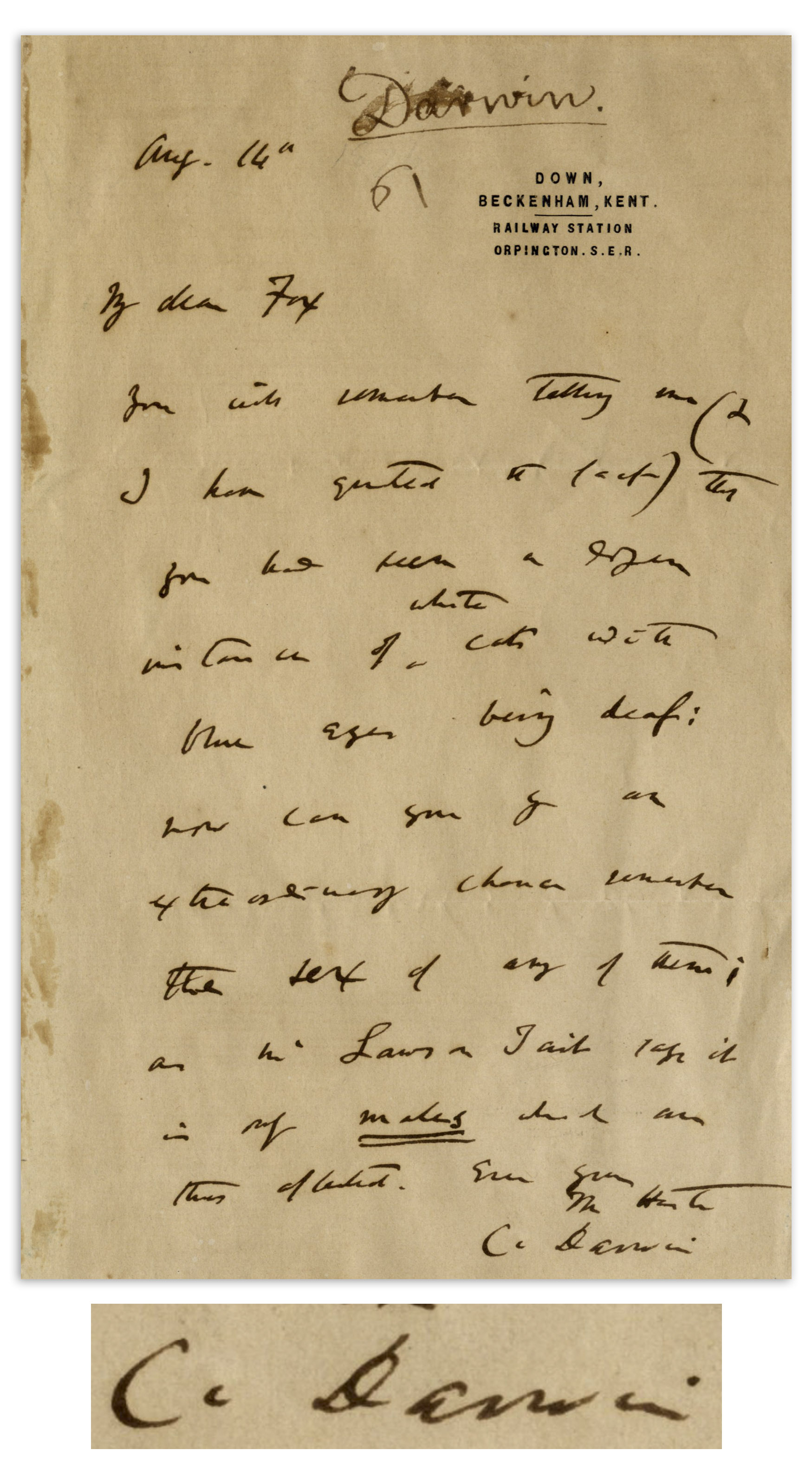
Charles Darwin autograph letter signed with evolution related content written shortly after ”On the Origin of Species” was published. Dated 16 August (1860 or 1861), Darwin writes to his second cousin William Darwin Fox, who introduced Charles Darwin to entomology. Upon Down, Kent stationery, Darwin writes in part, ”…you had seen a dozen instances of white cats with blue eyes being deaf: how can you by an extraordinary chance remember the sex of any of them…C. Darwin”. Fox’s reply to Darwin, giving additional details on the white, blue-eyed, blind cats, is archived in the Darwin Correspondence Project. Single page letter measures 5” x 8”, with an engraving of Darwin measuring 5.5” x 8”. Uniform toning, mounting tape remnants and writing at top not in Darwin’s hand, overall very good condition. Sold for $15,000.
Beautiful and scarce Pilgrim document from 17th century colonial America. Dated 1670, document confirms the sale of 50 acres of land in Marshfield, Plymouth County, Massachusetts by John Rogers to William Macomber. Document is signed by a veritable who’s-who of Pilgrim notables, including Rogers, Nathaniel Morton, Constant Southworth and James Toale (Towle). In addition to writing the first historical text published in the United States (about the settlement of the Plymouth Colony) Nathaniel Morton was the first to publish a list of signers of the Mayflower Compact and also wrote his account of the first Thanksgiving. He served for most of his life as Secretary of Plymouth Colony, where his careful record-keeping enabled him to compile New England’s Memorial, considered the first comprehensive history of the colony, published at Cambridge in 1669, and widely considered the first book of history published in the United States. In fact, ”The Wall Street Journal” has published an excerpt from Morton’s history of Plymouth Colony as an op-ed the Wednesday before Thanksgiving Day since 1961. Constant Southworth came to Plymouth in 1628 as a teenager, and held several prominent positions during his life, including Treasurer of the Colony. John Rogers was born in 1642 in Plymouth County, the son of a Mayflower passenger. Document measures approximately 15.5” x 12” with some paper loss to lower right. Some expected foxing and toning, small amount of paper loss and archival tape repair to verso. In very good condition considering age, with still bold writing. Sold for $10,000.

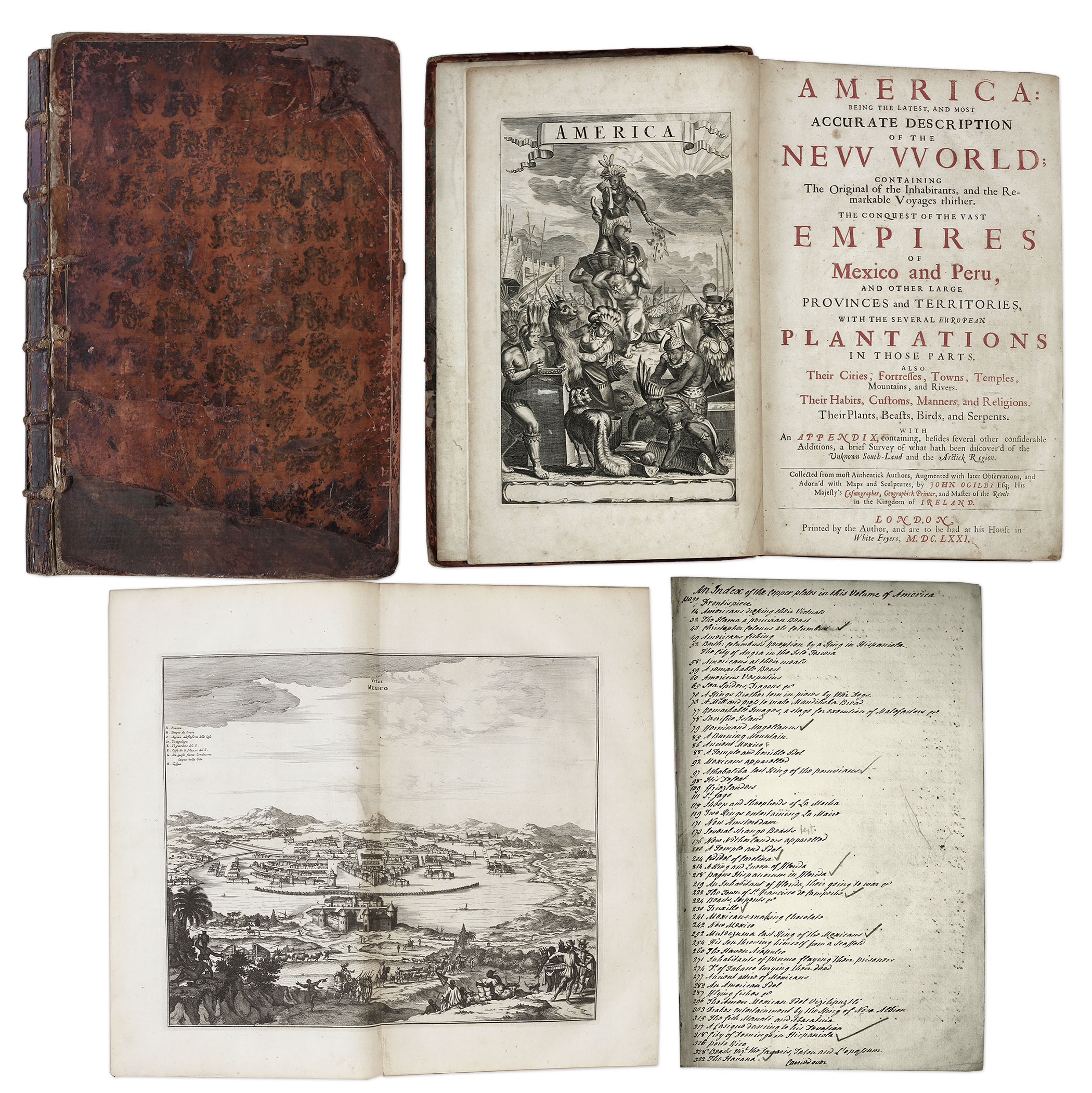
One of the most important books on the history of America (cited by Borba de Moraes, Howes, Sabin and Wing), the 1671 first edition of ”America: Being the Latest and Most Accurate Description of the New World”. Privately printed in London by the author, Arnoldus Montanus, and edited by John Ogilby. In ”America” Montanus goes into great detail of the new continents, with dozens of engravings of Native Americans, species of animals and reptiles, and the landscapes and settlements in the new world, accompanied by text. The book covers speculation regarding the earliest voyages to America, along with later recorded voyages and the settlements of New Netherlands/New York, New England, Hudson’s Bay, Labrador, Canada, Nova Scotia, Maryland, Virginia, (including Captain Smith’s capture and rescue by Pocahontas), Carolinas, Florida and California, plus accounts of Mexico and nearby islands, even including Australia and New Zealand. 674pp. book contains 75 original engravings (64 copper plates within the text and 9 plates throughout), lacking the maps and 28 engravings, which is typical as this edition is almost never found with all plates intact. All text is complete except for missing pages 445-446. Large format book measures 10” x 15”. Bound in original full leather boards, with some loss of leather to covers, cracking along spine and front board detached. Interior text is near fine and very readable. An important and fascinating addition to early knowledge of the American continent. Sold for $9,375.
Baltimore From Federal Hill Hand-Colored Folio Aquatint
Stunning hand-colored aquatint of “Baltimore From Federal Hill” by the “master of the aquatint view”, William James Bennett. During the 1830s, Bennett produced a series of 19 large, folio-sized aquatints of American cities, of which has been said, “constitute the crowning point of his career as an artist and printmaker…The aquatints, rightfully considered the finest collection of folio views of American cities, provide abundant evocation of nineteenth-century America with particular emphasis on cities that owed their existence and prosperity to the presence of water…Bennett’s Baltimore view, declared the Baltimore American on September 28, 1831, has been ‘pronounced by judges to be the best print of the kind ever published in the United States’”. Measuring 26.25″ x 20″, aquatint published by Henry I. Megarey in 1831 is the second state with printer’s name listed. Some closed tears at center of sky have been professionally repaired, barely visible upon close inspection, and some repair to trimmed margins. Mounted on a sheet of wove paper. Overall in very good plus condition with virtually no toning and still exceptionally bright colors. Sold for $6,825.

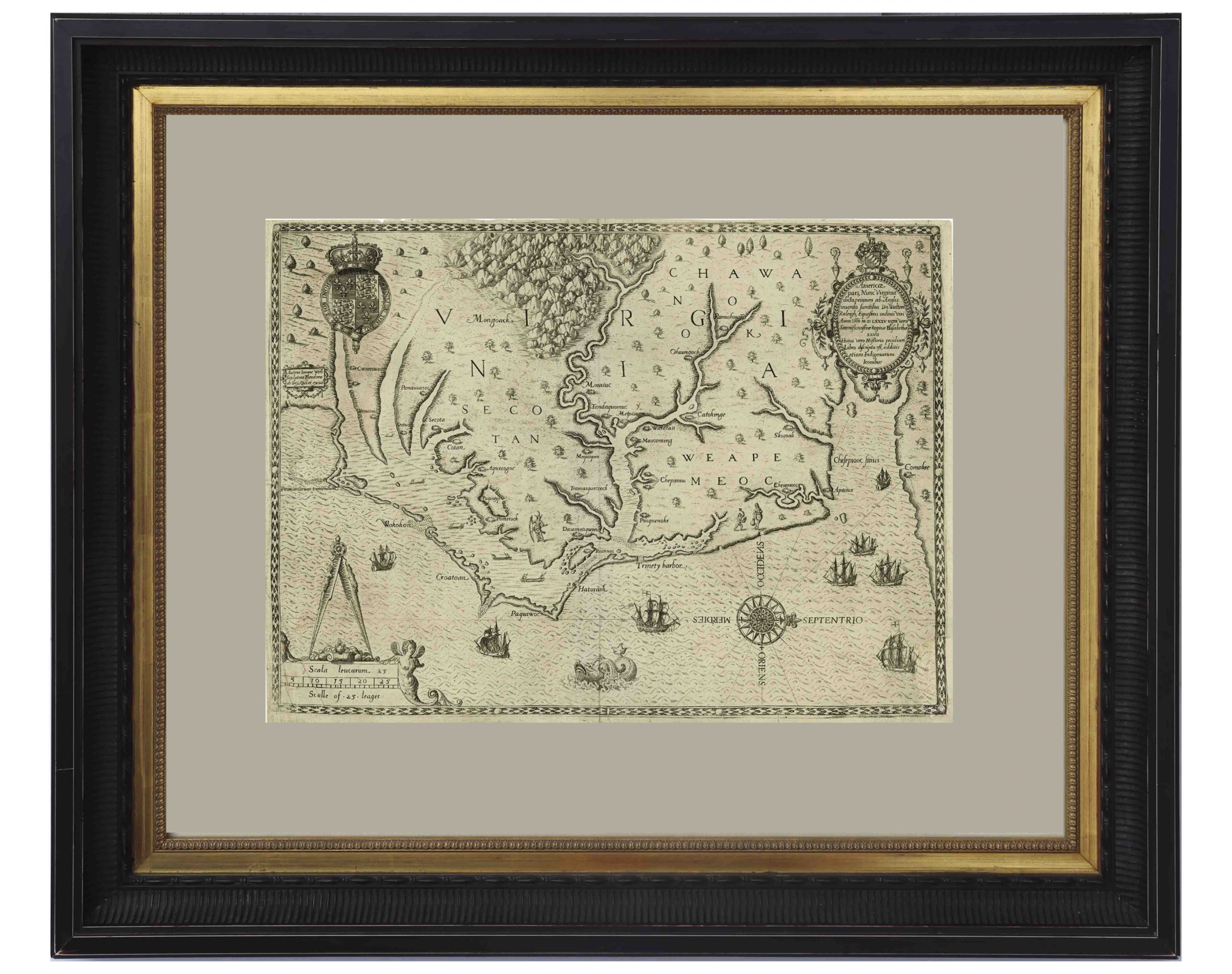
John White’s Map of Virginia From 1590 — The First Printed Map of Virginia and North Carolina
An important 16th century North American map known not only for its level of detail and accuracy, but also for its “firsts”: the first printed map of Virginia and North Carolina, the first to use Virginia in its title, the first to name the Chesapeake Bay, and also the first regional map showing the Roanoke Colony. Frankfurt: Theodor de Bry (engraver) for inclusion in his “Anglorum in Virginiam aduentus”, 1590.
Map is based on the work of cartographer, artist and explorer John White, one of the first settlers and Governor of the Roanoke Colony who, after sailing back to the Colony from England in 1587, had found all the colonists famously missing, their fate a mystery still unsolved. Philip Burden, who wrote the definitive reference book, “The Mapping of North America”, wrote of this map: “One of the most significant cartographical milestones in colonial North American history…the most accurate map drawn in the sixteenth century of any part of that continent.”
This full-sheet engraved map still retains its dark print, with the English Royal Arms at top left, and artistic touches throughout such as ships and sea monsters in the open ocean, and Native American canoeists in the inland waters. Map is the second state, with “C” laid over the “E” in Ehesepiooc. Map measures 16.675″ x 12.25″, nicely matted and framed to a size of 28″ x 23.5″. Expert repair to single vertical fold, and small area of repair to lower right corner, just touching the edge of the ship, where paper loss has been replaced. Overall in very good to near fine condition given age, displaying beautifully. Sold for $6,665.
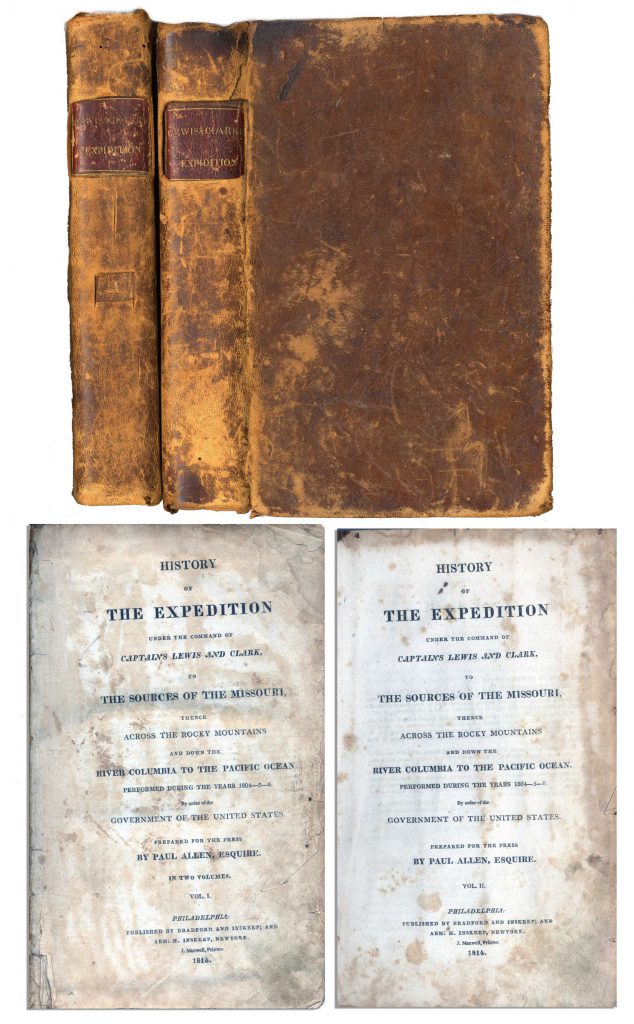
First edition, two-volume set of ”History of the Expedition under the Command of Captains Lewis and Clark to the source of the Missouri thence across the Rocky Mountains and down the river Columbia to the Pacific Ocean performed during the years 1804-05-06 by Meriwether Lewis and William Clark”. Published by Bradford and Inskeep: New York: 1814. Regarded as the definitive account of the first exhaustive, and most important Western exploration of America, which covered some eight thousand miles in slightly more than twenty-eight months. Lewis and Clark brought back the first reliable information about much of the area they traversed, made contact with the Native Americans as a prelude to the expansion of the fur trade, and advanced the geographical knowledge of the continent. This official account of the expedition is as much a landmark in Americana as the trip itself. Books, each measuring 5.5” x 8.75”, are bound in original marble-patterned leather boards and have five engraved, bound-in maps, missing the fold-out map found in some copies. Covers are worn and scuffed and the inside of covers have insect channels. Vol. I, 470pp., is missing the front free endpaper and has a chip out of the title page. Volume II runs 522pp. Light foxing and dampstaining throughout both volumes and some paper loss not affecting text. Overall in very good condition. An attractive set of America’s most important exploration narrative. Sold for $6,544.
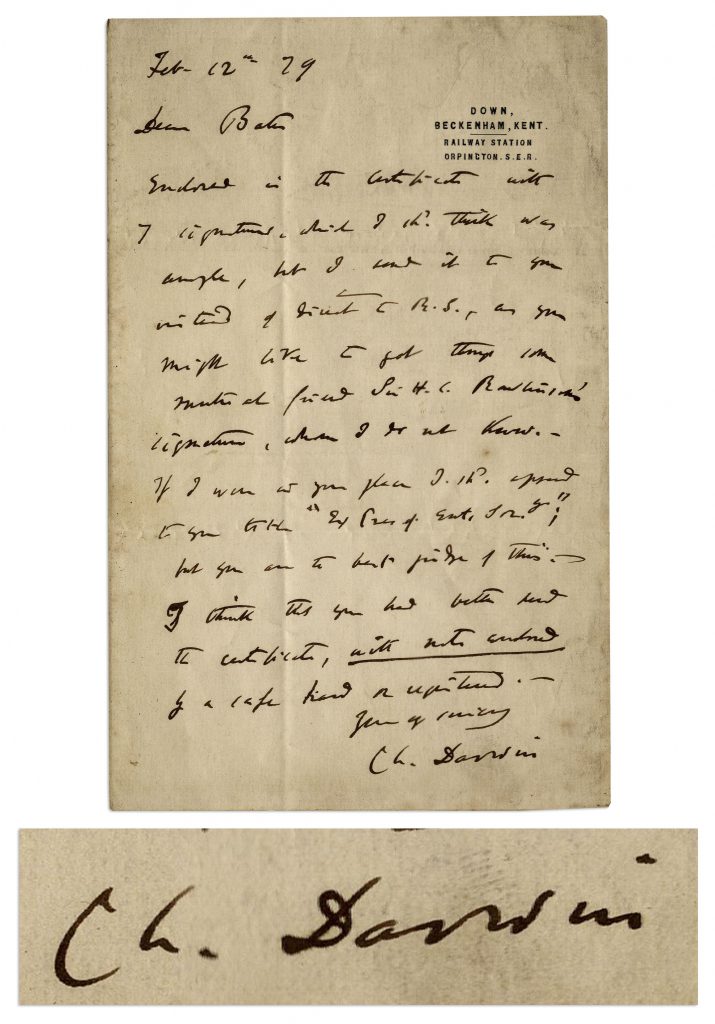
Charles Darwin autograph letter signed, dated 12 February 1879 shortly before his publication ”The Power of Movement in Plants”. Darwin writes fellow English naturalist and explorer Henry Walter Bates regarding a document to be sent to the Royal Society. Letter reads, ”Feb 12th 79 / Dear Bates / Enclosed is the certificate with 7 signatures, which I would think was ample, but I send it to you instead of direct to R.S. [Royal Society], as you might have to get stamps from Martin and friend Sir H.C. Rowlinson’s signature, whom I do not know. If I were in your place I would append to your title ‘Ex Pres [President] of Ent. [Entomological] Soc. [Society] Yr’; but you are the best judge of this. I think that you had better send the certificate, with note enclosed by a safe hand or [?]. Yours sincerely, Ch. Darwin”. Darwin had earlier praised Bates seminal work, ”The Naturalist on the River Amazons”, as the ”best book of Natural History Travels ever published in England”. Single page letter measures 5” x 8”. Light soiling and wear; overall in very good plus condition with very bold handwriting and signature. Sold for $6,250.
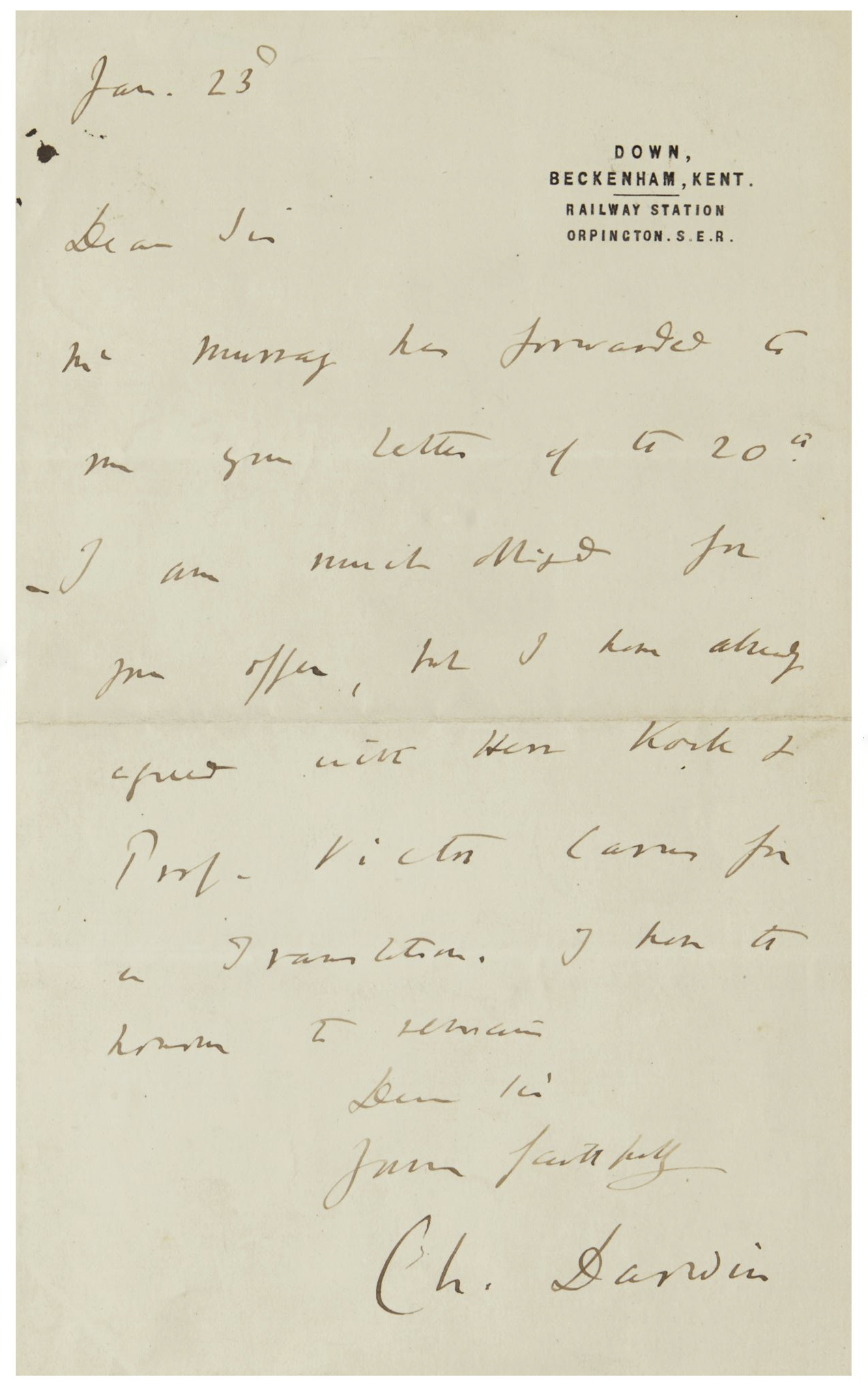
Charles Darwin Autograph Letter Signed — Regarding the German Translation for His Works
Charles Darwin autograph letter signed, with a large, bold signature ”Ch. Darwin” at conclusion. Writing on 23 January (no year, but sometime between 1875-1882) upon his stationery from Down House in Kent, letter reads, ”Dear Sir / Mr. [John] Murray has forwarded to me your letter of the 20th. I am much obliged for your offer, but I have already agreed with Herr Koch & Prof. Victor Carus for a Translation…Ch. Darwin”. Julius Victor Carus translated the third German edition of ”On the Origin of Species” in 1867 and several subsequent publications by Darwin. Single page letter measures 4.75” x 7.5”, beautifully framed with a photographic portrait of Darwin to a size of 15.5” x 13”. Fold and light creasing, otherwise near fine condition. Sold for $5,938.
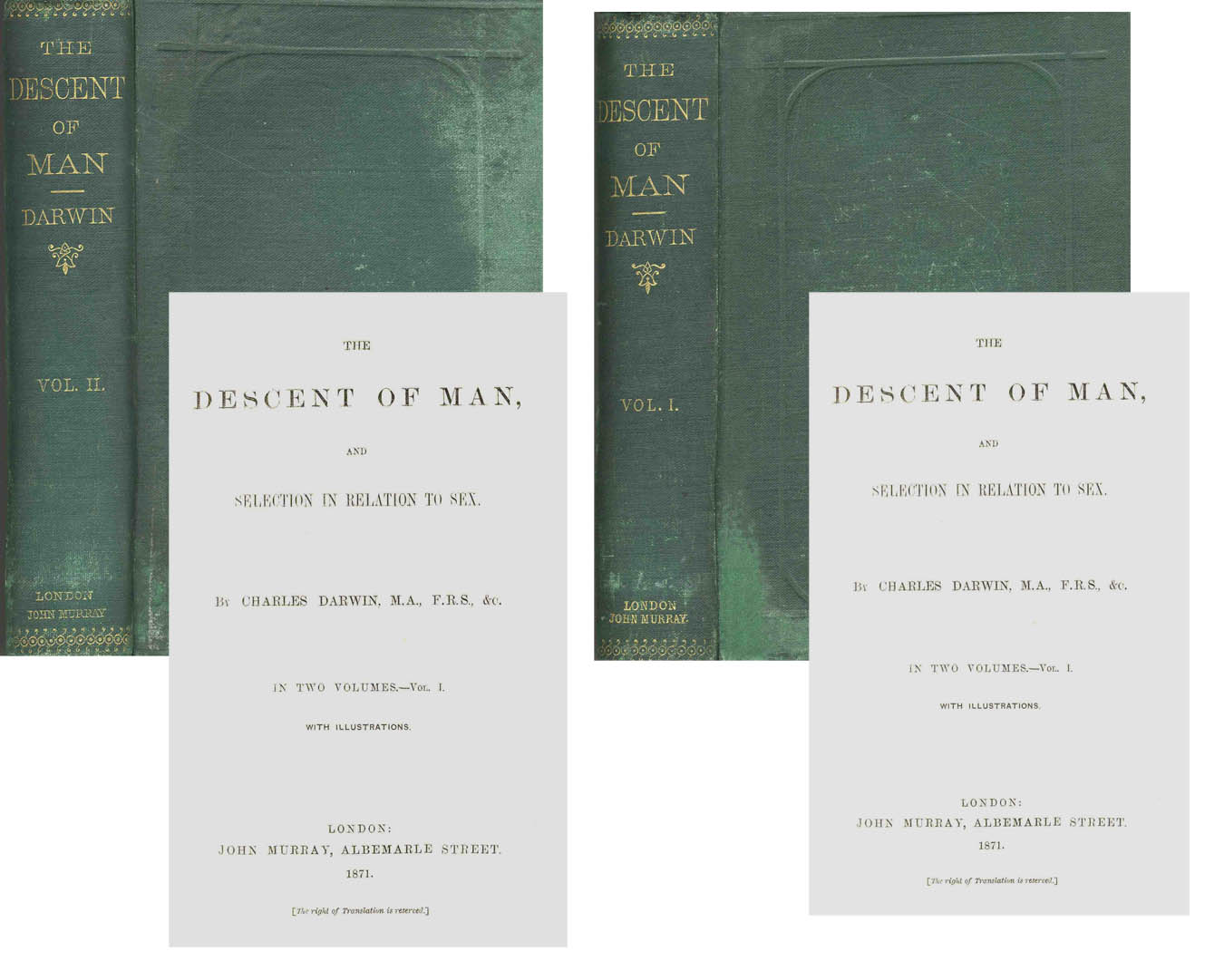
First Edition, First Printing of Charles Darwin’s 1871 Masterpiece, “The Descent of Man” — First Printing of the Controversial Word “Evolution”
First edition, first printing of “The Descent of Man and Selection in Relation to Sex” by Charles Darwin. London: John Murray: 1871. In two volumes with illustrations, “The Descent of Man” applies Darwin’s theory first conceived in “Origin of Species” to human evolution, and details his theory of sexual selection. Volume I of this set is the very first time in which the word evolution appears in print in any of Darwin’s works. All first issue points present including the errata on the verso of the title leaf of Volume II; seventeen errata for Volume I and eight for Volume II; the verso of the half title leaf of Volume II bears the printer’s note; present with note on a tipped-in leaf in Volume II, which refers to “a serious and unfortunate error” affecting pages 297-299 in Volume I, and pages 161 and 237 in Volume II; page 297 begins with the word “transmitted.” Publisher’s full green pictorial cloth, stamped and lettered in gilt. Covers have been re-backed with vintage cloth. Some fading to the cloth on the covers around edges. The binding in both volumes is very tight and secure with no loose pages or sections. Internally very good. The endpapers have been replaced with paper in keeping with the original dark navy ones. Signature by previous owner on the half-title of Volume I and the title page of Volume I. Overall a beautiful set in very good condition. Sold for $5,073.
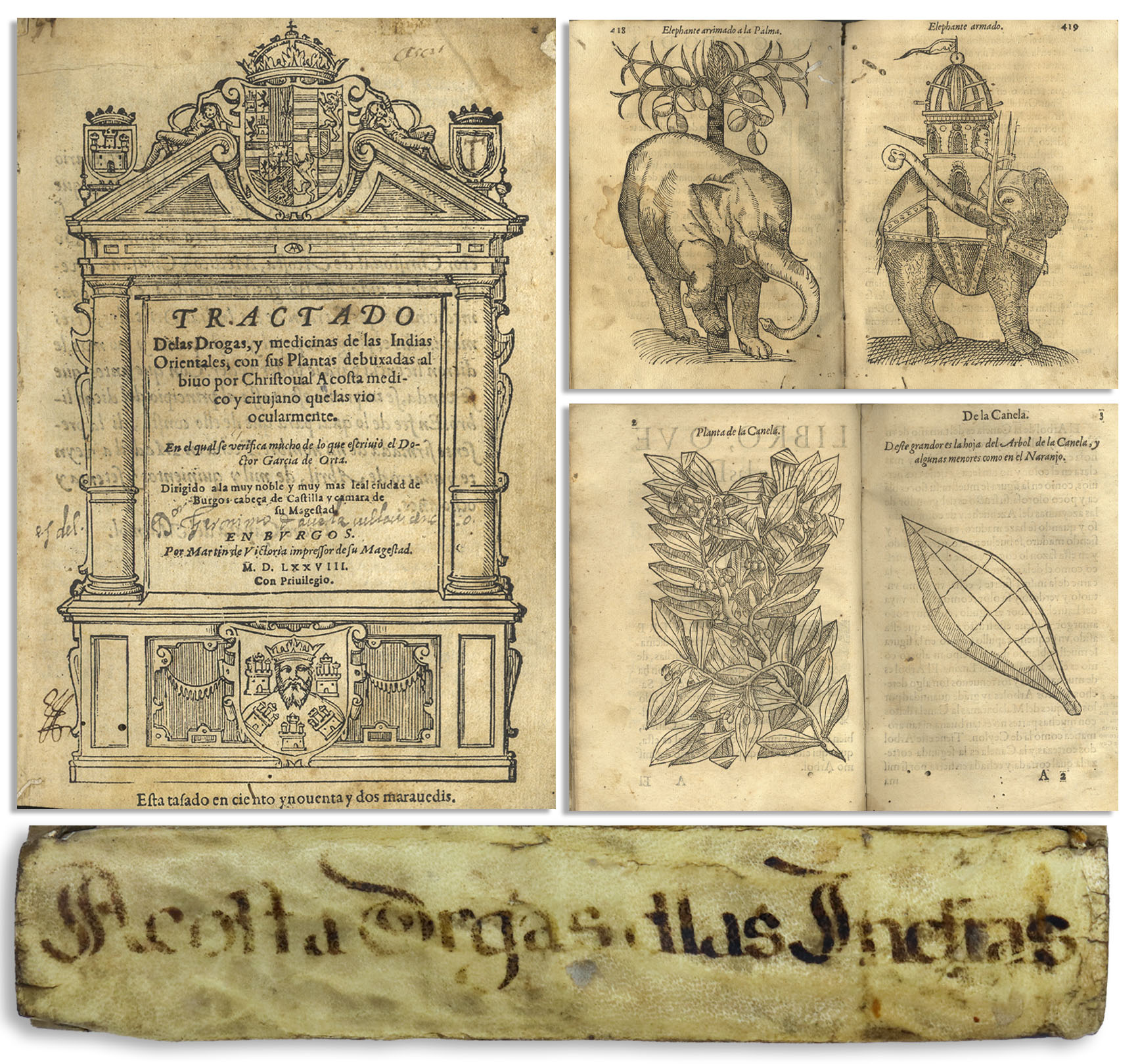
Tractado de las drogas, y medicinas de las Indias Orien
Rare 1578 first edition of “Tractado de las drogas, y medicinas de las Indias Orientales” (“Treatise of the drugs and medicines of the East Indies”) by physician and naturalist Cristobal Acosta. Burgos, Spain: Martin de Victoria, 1578. Bound in original vellum boards with leather ties, rare volume is complete with all woodcuts: title page featuring a portrait of the author, 45 pages of medicinal plants and herbs, and two pages of Asian elephants. Book also features woodcut initials heading each chapter. Acosta’s tomb of therapeutic botany was highly important in its day, giving illustration to exotic plants, animals, herbs and spices from the East Indies during the Age of Exploration, including cinnamon, garlic, nutmeg, coconut, sandalwood, and pineapple, all relatively unknown to Europe at the time. There is even a chapter on opium (“muy usual, y necessaria”), and a chapter on Asian elephants, then described for the first time in a scientific publication. Book measures 5.5″ x 7.375″. Some faint dampstaining, worming to several pages towards the end, and expected age wear. Overall very good plus condition. Sold for $3,900.
Carl Linnaeus document signed, acknowledging receipt of his salary as Professor of Medicine and Botany at the Royal Swedish Academy. Datelined Uppsala, 10 October 1757 in Swedish, elegantly signed ”Carl Linnaeus”. Named the ”Father of Modern Taxonomy” and the ”Prince of Botanists”, Linnaeus was one of the most renowned scientists and naturalists of his day, having published ”Systema Naturae” in 1735, which classified 4,400 animal species and 7,700 plant species. The publication was so important that people from all over the world sent their specimens to be included in subsequent editions, which reached its 12th edition in the second half of the 17th century. Document measures 8” x 4”. Mounting remnant to verso and vertical fold, otherwise near fine condition. Sold for $3,438.

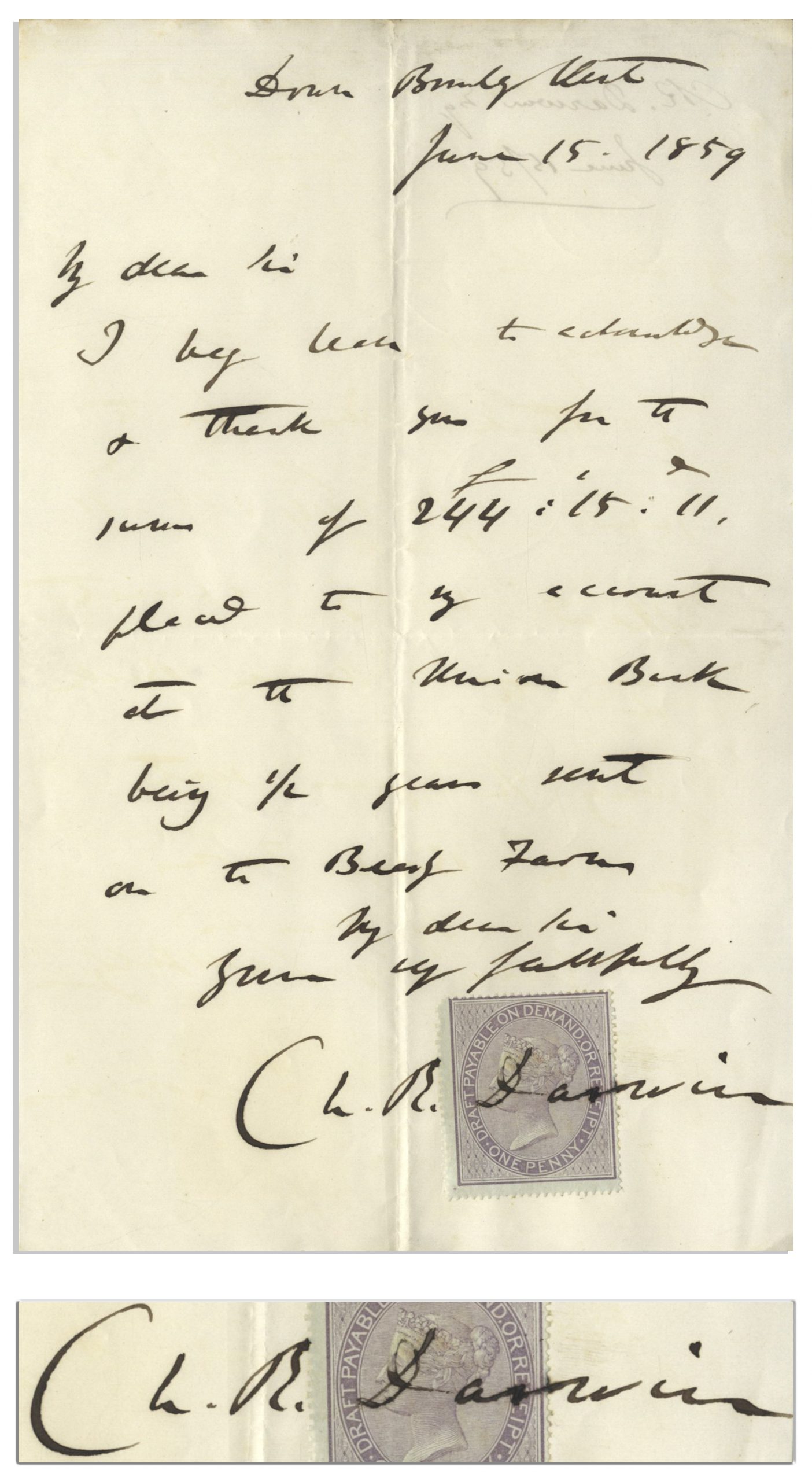
Charles Darwin autograph letter signed, dated 15 June 1859 just a few months before the publication of ”On the Origin of Species”. Darwin here writes to his land agent John Higgins, regarding rent collected from Darwin’s farm at Beesby. Writing from his home in Down Bromley Kent, letter reads in full, ”My dear Sir / I beg leave to acknowledge & thank you for the sum of 244: 15: 11, placed to my account at the Union Bank being 1/2 years rent on the Beesby Farm. / My dear Sir / Yours very faithfully. / Ch. R. Darwin”. Single page letter measures 5” x 8”. Folds and irregular left edge. Darwin purposely signs over a duty stamp at conclusion of letter. Near fine condition with exceptionally bold writing. Sold for $3,300.
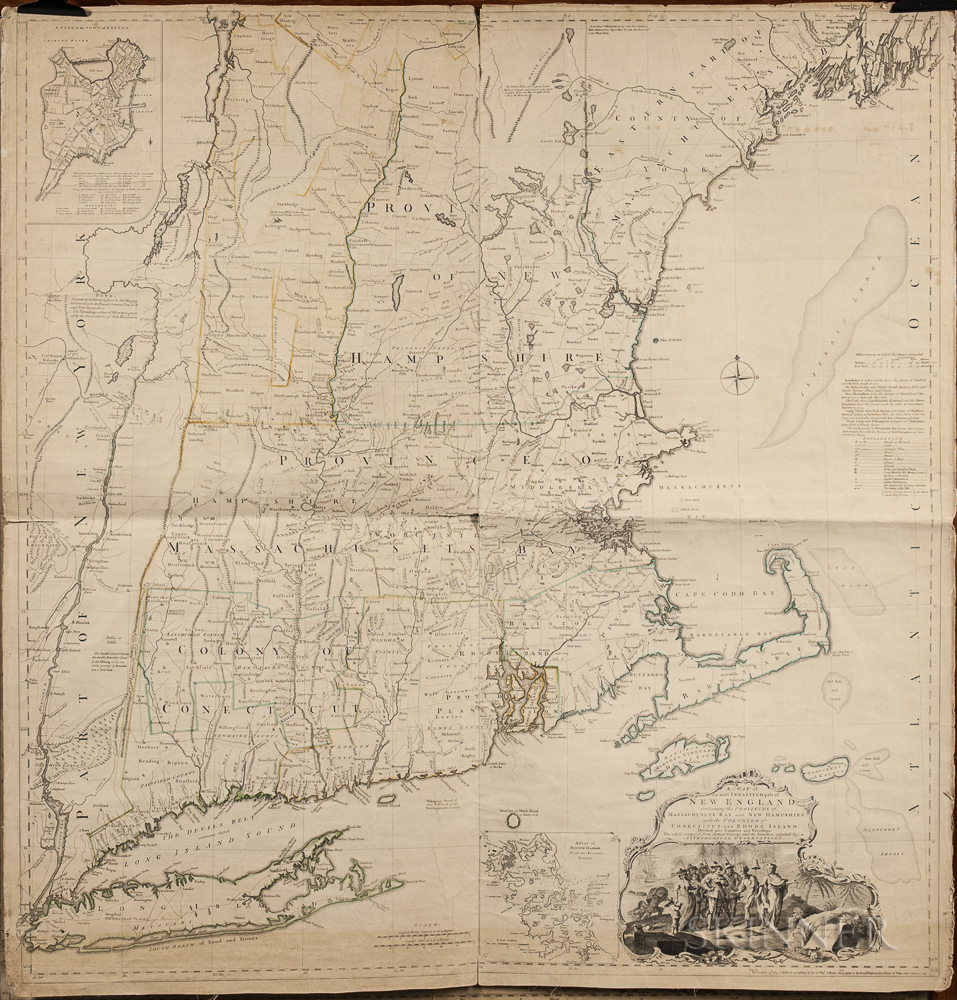
1774 Map of New England measuring over 40” square, the earliest large scale map of the New England colonies and used in the American Revolution. Drawn by Braddock Mead, and originally published in 1755, this copy was included in Thomas Jefferys’ ”American Atlas”, with hand-outlines. London: Printed and sold by R. Sayer and J. Bennett, 1776 (map dated 1774). Entitled in full, ”A Map of the Most Inhabited Part of New England Containing the Provinces of Massachusetts Bay and New Hampshire, with the Colonies of Connecticut and Rhode Island, Divided into Counties and Townships: The whole composed from Actual Surveys and its Situation adjusted by Astronomical Observations.” Measures 40” x 41.25”. Folded in fourths, as printed by copper-plate engraving on laid paper, mounted to linen. Light toning, chipping along margins and separation starting along folds. Overall in very good condition, a bright copy ideal for framing. Sold for $1,875.
John Speed Map of New England and New York 1676
The most famous 17th century map of New England, engraved by cartographer Francis Lamb with Anglican names for the first time reflecting the shift from Dutch to English rule, such as New York rather than New Amsterdam and “New Jarsey”. London: Basset and Chisswell, 1676, from the reissue of John Speed’s atlas, “The Theatre of the Empire of Great Britaine”, with new maps of the English colonies. Colorful double-page map entitled “A Map of New England and New York”, shows wildlife of the area in addition to topography and boundary lines. With English text on verso headlined, “The Description of New Neatherlands [sic] now called NEW-YORK” and “The Description of New England”. Engraved map measures 21″ x 17.125″, hinged at top to mat measuring 26.375″ x 21.375″. Slight offset along center fold, tape repair to verso, small separation at top center fold, and minute foxing. Overall very good plus condition. Sold for $1,800.

Clerk of Courts for the Salem Witch Trials, Stephen Sewall document signed in ink ”Steph Sewall” as recorder for Essex County. Twelve years prior, Sewall served as Clerk in the Court of ”Oyer & Terminer” in Salem Town, site of the most notorious of the collective ”Salem Witch Trials”. Lethal paranoia, accusations and trials swept three additional towns in colonial Massachusetts during the year of 1692-1693, during which nineteen people were ultimately executed for witchcraft. Handwritten document is dated 1705 and names Jonathan Woodman and Richard Bartlett Jr. as parties to a land sale contract. Sewall signs a panel to verso. Single-page document on card-style stationery is countersigned by Jonathan Woodman, Samuel Soyer, Philip Morss, Joseph Hoyt and Thomas Noyes. Remnants of a red wax seal appear to the lower right. Measures 7.5” x 11.75”. Foxing, toning, dampstaining and separation to folds. Good condition, especially given age. Sold for $938.

Consign your item at Nate D. Sanders Auctions. Send a description and images of your item to us at [email protected].
FREE APPRAISAL. To buy, auction, sell or consign your John Josselyn New-Englands Rarities 1st edition 1672 that is for sale, please email your description and photos to [email protected] of Nate D. Sanders Auctions (http://www.NateDSanders.com).