
Sell or Auction Your Alan Turing Chemical Basis of Morphogenesis Offprint for up to $10,000 or More at Nate D. Sanders
FREE ESTIMATE. To buy, auction, sell or consign your Alan Turing Chemical basis of morphogenesis offprint that is for sale, please email your description and photos to [email protected] of Nate D. Sanders Auctions (http://www.NateDSanders.com).
Sell Your Alan Turing Chemical Basis of Morphogenesis Offprint
Alan Mathison Turing OBE FRS (/ˈtjʊərɪŋ/; 23 June 1912 – 7 June 1954) was an English mathematician, computer scientist, logician, cryptanalyst, philosopher, and theoretical biologist. Turing was highly influential in the development of theoretical computer science, providing a formalisation of the concepts of algorithm and computation with the Turing machine, which can be considered a model of a general-purpose computer.Turing is widely considered to be the father of theoretical computer science and artificial intelligence.
Below is a recent realized price for an Alan Turing Chemical basis of morphogenesis offprint item. We at Nate D. Sanders Auctions an obtain up to this amount or more for you:
Alan Turing Chemical Basis of Morphogenesis Offprint. Sold for $10,000.

The following is some similar items we have sold:
The 1963 Nobel Prize in Physiology or Medicine, awarded to physiologist Alan Lloyd Hodgkin for establishing the propagation mechanism of nerve impulses called action potentials — consequently helping to understand the mechanism behind disorders such as multiple sclerosis, seizures and Parkinson’s disease. Hodgkin is also responsible for identifying the Hodgkin Cycle and, along with colleagues Andrew Fielding Huxley and John Carew Eccles, hypothesized the existence of ion channels on cell membranes, a concept which took over 20 years to confirm; that confirmation earned Erwin Neher and Bert Sakmann the 1991 Nobel Prize. This Nobel Prize medal is made of 23k gold and features the relief portrait of Alfred Nobel, with his name and the years of his birth and death. Verso features the words, ”INVENTAS VITAM JUVAT EXCOLUISSE PER ARTES”, which translates from Latin to, ”Inventions enhance life which is beautified through art”. A.L. Hodgkin’s name and the year 1963 in Roman numerals are engraved on a plaque below the relief, framed by the words, ”REG. UNIVERSITAS MED-CHIR-CAROL”. On the right side is the name ”E LINDBERG”, who designed the prize. Comes with 6 original photographs of Hodgkin (at least 4 of which are from the ceremony in Oslo on 10 December 1963), a New York Times article on Hodgkin dated 18 October 1963, a portion of a 1976 issue of ”The Journal of Physiology” featuring an essay by Hodgkin, and the official 1963 English edition of the Nobel Prize publication, featuring Hodgkin and partner Huxley on the cover. Medal is housed in the maroon leather presentation box with a white satin lining and Hodgkin’s name printed on the front. Box measures 5.5” x 5.5” x 1”. Medal measures 6.5 cm or 2.56” in diameter, and weighs 196 g or 6.9 oz, consistent with the original Nobel Prizes awarded in 1963. Presented in near fine condition. With an LOA from the daughter of Dr. Alan Hodgkin. Sold for $795,614.


The 1988 Nobel Prize in Physics, awarded to particle physicist Leon Lederman for his discovery of the muon neutrino, a particle 200 times the size of an electron. Lederman, along with colleagues Melvin Schwartz and Jack Steinberger, found the muon neutrino in 1962 while using a high energy particle accelerator. They discovered that in some cases a muon (rather than an electron) was produced, illuminating the existence of a new atomic particle. Lederman was also instrumental in the discovery of the bottom quark in 1977, and was the champion of the Superconducting Super Collider. His popular 1993 book ”The God Particle: If the Universe is The Answer, What is The Question” was released to critical acclaim. This Nobel Prize is made of 18kt gold, plated in 24k gold, as were all Nobel Prize medals awarded after 1980. Medal features the relief portrait of Alfred Nobel to front, with his name and the years of his birth and death. Verso features a relief of the Goddess Isis, whose veil is held up by a woman who represents the genius of science. Encircling the medal are the words ”Inventas vitam juvat excoluisse per artes”, translating to ”And they who bettered life on earth by their newly found mastery”. Lederman’s name and 1988 in Roman numerals are engraved on a plaque below the relief of the two women, with ”Reg. Acad. Scient. Suec.” also written, an abbreviation for The Royal Swedish Academy of Sciences. Etched upon the medal is the name of Erik Lindberg, designer of the Nobel medal. Housed in the original red leather case with Leon Lederman’s name gilt stamped. Medal weighs 173 grams or just over 6 oz. and measures 2.5” in diameter, consistent with the original Nobel Prize awarded in 1988. Case measures 5.5” x 5.5” x 1”. Presented in near fine condition, and with an LOA from Leon Lederman. Sold for $765,002.


Nobel Prize Won by Walter Kohn, One of the Children Saved by Kindertransport During World War II
Nobel Prize in Chemistry won by Walter Kohn in 1998, unique not only for the scientific impact of Kohn’s work, but also for his life experience as one of the children rescued from Nazi-occupied territories in World War II through the Kindertransport program. Kindertransport was established by the United Kingdom in 1938 immediately after the ”Night of Broken Glass” pogrom in Germany, authorizing the safe passage of almost 10,000 children into the UK. The children were placed in homes throughout the British empire, with Kohn ultimately finding a home in Canada after both his parents were killed in the Holocaust. In addition to his Nobel Prize, lot also includes three science books that Kohn purchased at the temporary internment camp in Canada, all still housed in their well-worn homemade dust jackets: ”A Course of Pure Mathematics”, ”Dent’s Modern Science Series”, and ”Properties of Matter”.
The books are a foreshadowing to the incredible achievements that Kohn made to the world through his Nobel Prize-winning work. As the architect of density functional theory (DFT), Kohn devised the computational quantum mechanical modelling system that has allowed scientists to understand the nuclear structure of microscopic matter. Though the underlying structure of NFT is complex, the actual equations are now commonplace among scientists, with countless practical results deriving from it – from discovering trace impurities in chemicals to modeling planetary systems.
Nobel Prize is made of 18kt gold, plated in 24kt gold, consistent with the 1998 medals. Medal features the relief portrait of Alfred Nobel to front, with his name and the years of his birth and death. Reverse features a relief of the Goddess Isis, whose veil is held up by a woman who represents the genius of science. Encircling the medal are the words ”Inventas vitam juvat excoluisse per artes”, translating to ”And they who bettered life on earth by their newly found mastery”. Kohn’s name and 1998 in Roman numerals are engraved on a plaque below the relief of the two women, with ”Reg. Acad. Scient. Suec.” also written, an abbreviation for The Royal Swedish Academy of Sciences. Etched upon the medal is the name of Erik Lindberg, who designed the Nobel medal. Medal weighs 173 grams or just over 6 oz. and measures 2.5” in diameter. Near fine condition. With an LOA from the Kohn family. Sold for $457,531.

The 1927 Nobel Prize in Chemistry, awarded to Dr. Heinrich Otto Wieland, considered the father of modern biochemistry. This Nobel is the only Prize in Chemistry to ever be auctioned. Wieland spent his life’s work investigating the oxidation processes in living cells, and has been credited with unifying the disciplines of organic chemistry and biochemistry, which had been split since the work of chemist Justus von Liebig in the 1870’s. Wieland’s research into bile acid was used as the basis for the manufacture of drugs for the treatment of a wide variety of cardiovascular diseases, underpinning his recognition as the founder of modern biochemistry. As a result of his groundbreaking work in the field of chemistry, the Heinrich Wieland Prize was established and endowed in his honor in 1964, awarded to leading scientists for their work in the fields of biochemistry, chemistry and physiology, and counting four Nobel Laureates among its recipients. Wieland was also a strident opponent of the Nazi party; he employed and hid several Jews and supporters of the White Rose Nazi resistance movement in his laboratory at the University of Munich, which was given the nickname ”The Ghetto Room”. Wieland even courageously defended his student Hans Leipelt in court, who was convicted for collecting money for the widow of Kurt Huber, Wieland’s colleague who moonlighted as a White Rose resistance leader. Huber and Leipelt were both tried and executed in 1943. This Nobel Prize is made of 23kt gold and features the relief portrait of Alfred Nobel to front, with his name and the years of his birth and death. Verso features a relief of the Goddess Isis, whose veil is held up by a woman who represents the genius of science. Encircling the medal are the words ”Inventas vitam juvat excoluisse per artes”, translating to ”And they who bettered life on earth by their newly found mastery”. Wieland’s name and 1928 in Roman numerals are engraved on a plaque below the relief of the two women, with ”Reg. Acad. Scient. Suec.” also written, an abbreviation for The Royal Swedish Academy of Sciences. Etched upon the medal is the name of Erik Lindberg, who designed the Nobel medal. Medal is housed in a green leather box with a pale blue felt bottom and white satin lining. Box measures 5” x 5”. Medal measures 66 mm or 2.5” in diameter, and weighs 206 g or 7.25 oz, consistent with the original Nobel Prizes awarded in 1928. Presented in near fine condition. With an LOA from the consignor, Dr. Heinrich Wieland’s grandson. Sold for $395,000.


Consign your Alan Turing Chemical basis of morphogenesis offprint at Nate D. Sanders Auctions. Send a description and images of your Alan Turing Chemical basis of morphogenesis offprint to us at [email protected].
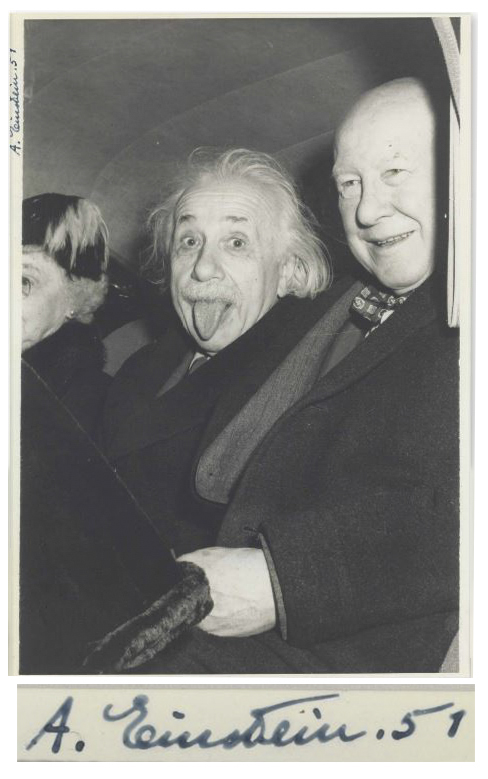
The Most Famous Photo of Albert Einstein, Playfully Sticking Out His Tongue — Extraordinarily Rare as Signed by Einstein
Very rare photo signed by Albert Einstein, on the occasion of the Nobel Prize winner playfully sticking out his tongue to a group of photographers on his 72nd birthday. Photo was snapped on 14 March 1951 by Arthur Sasse, a UPI photographer whose employers were at first hesitant about publishing the iconoclastic image of Einstein; when they did, Einstein was so amused by it that he ordered several prints to give out to close friends. This image is unlike most which crop the photo to show only Einstein. Here, the photo is shown in its full context with Einstein seated between Dr. Frank Aydelotte, head of the Institute of Advanced Study in Princeton, and Aydelotte’s wife, after celebrating his birthday at the Princeton Club. Photo is signed along the left margin ”A. Einstein .51”, indicating he signed the image shortly after it was taken. Photo measures 7” x 10”. Very good to near fine condition. Extraordinarily rare photo signed by Einstein, the most famous and beloved image of him. Sold for $125,000.
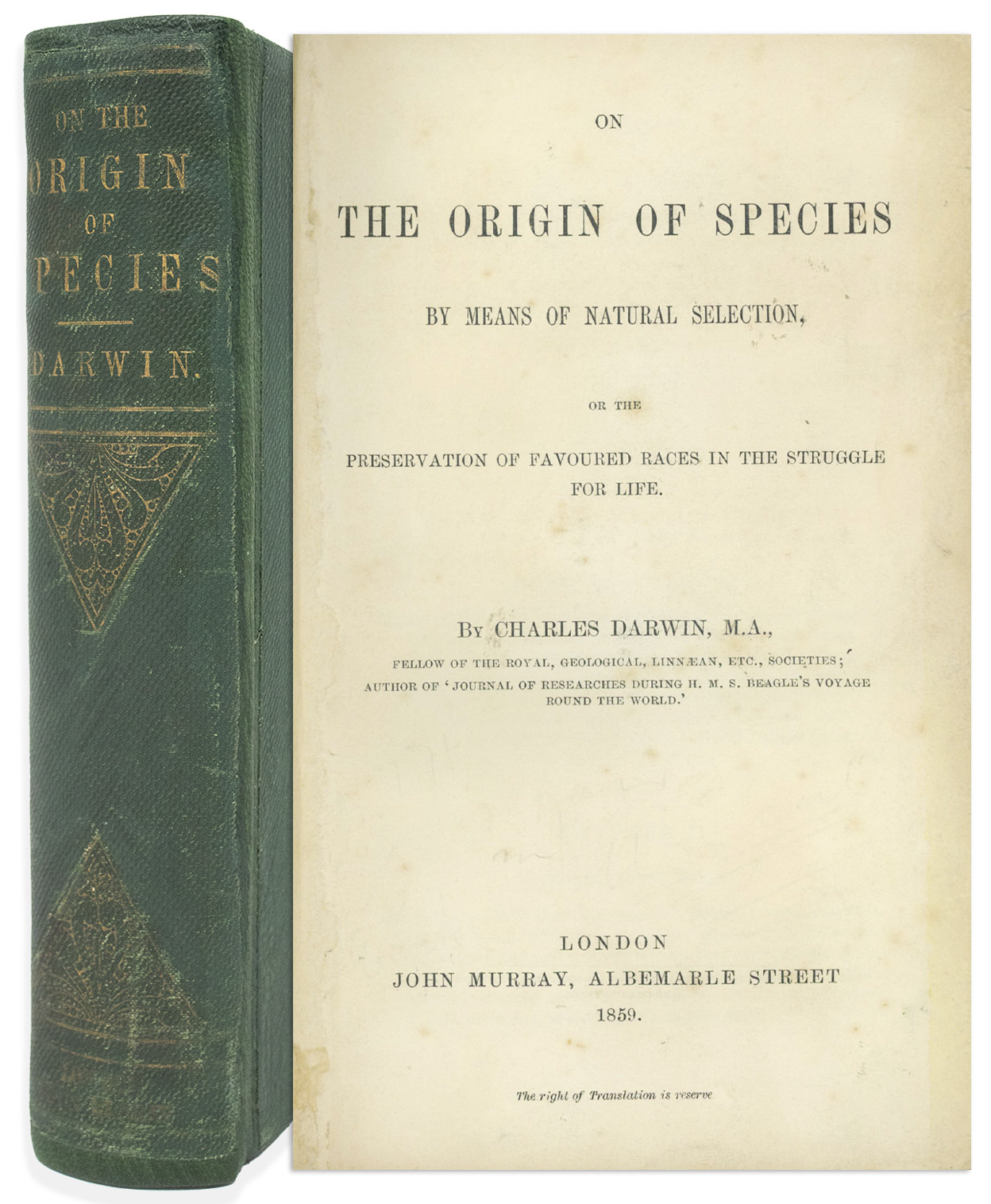
Charles Darwin On the Origin of Species 1st Edition
First edition, first printing of “On the Origin of Species” by Charles Darwin, one of the most important books in the scientific canon. London: John Murray, 1859. In this revolutionary book that upended man’s own view of himself, Darwin posits natural selection as the engine driving species’ evolution, an argument so persuasive that even 19th century religious leaders adjusted their teachings to allow for evolution to work in concert with divine planning. Its importance has only grown in the 150+ years since publication, with Freeman concluding it to be “the most important biological book ever written”. First released on 24 November 1859, its scarcity nearly matches its importance, with the first printing consisting of only 1,250 copies, and the number of extant copies now significantly fewer.
All first printing points are present, including original binding, variant B, title page with copyright information on verso, Table of Contents (pages v-ix) with binder instructions to verso, complete pages 1-502, and folding table present between pages 116-117. Bound in publisher’s full green boards, stamped and lettered in gilt. Overall in very good condition; ads at back of volume have been removed as has half-title page, and endpapers have been replaced. Volume is rebacked using morocco, with original spine laid down. Some shelf wear to boards. Light foxing throughout book, with some chipping, small closed tears with repairs to a few pages, and a few dogeared pages. One small mark on page 109, otherwise no internal writing or marks. Housed in a custom quarter-leather clamshell box. Overall in very good condition, a handsome, presentable copy of this scarce first printing. Sold for $68,250.
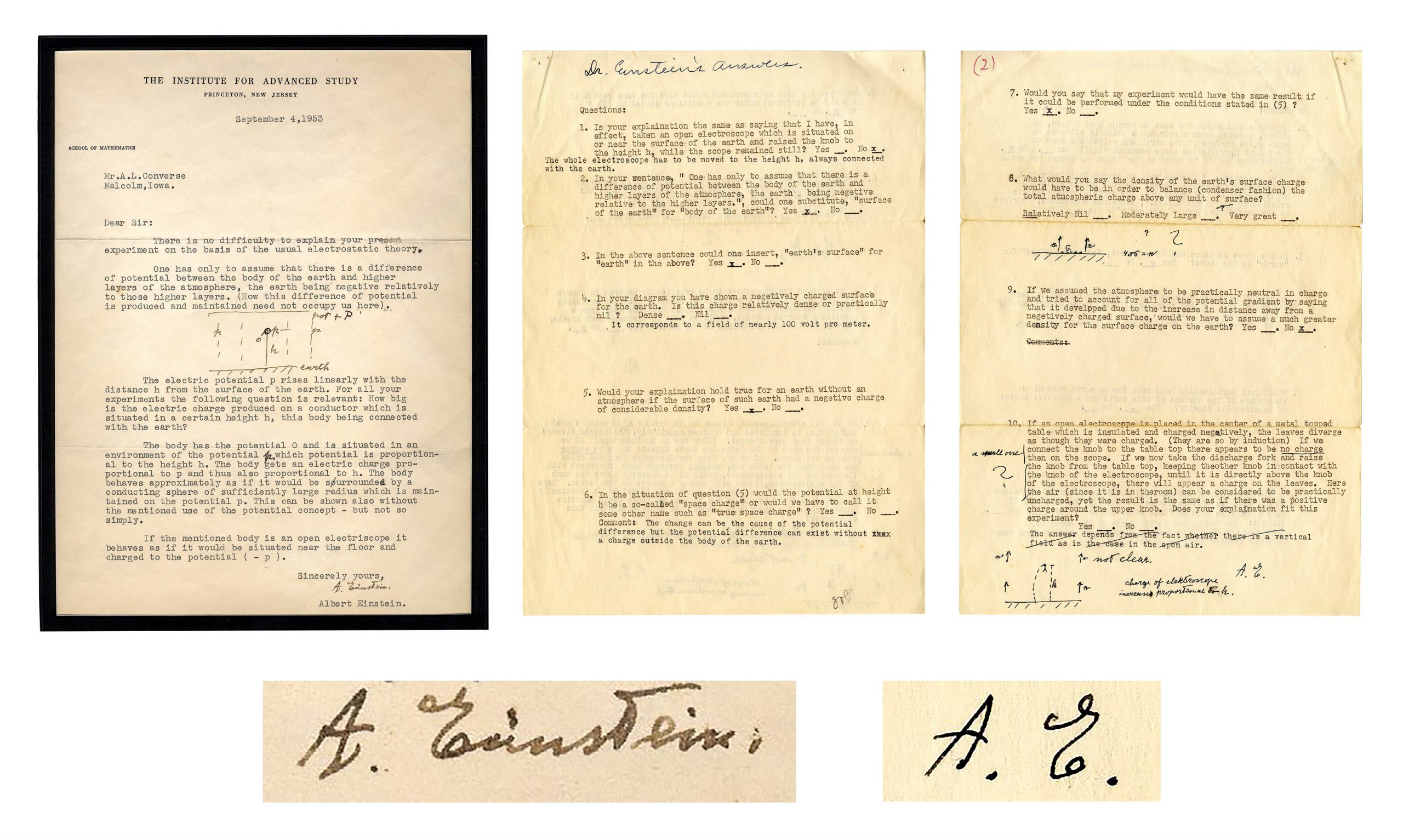
Albert Einstein letter signed with his hand drawings, elegantly explaining his electrostatic theory of special relativity to a physics teacher struggling to reconcile it with experiments he was conducting. In addition to the letter, which is new to the market, Einstein generously replies to a series of questions the teacher asks him on a questionnaire, providing additional drawings and calculations, initialed ”A.E.” at the conclusion. Dated 4 September 1953 on Princeton’s Institute for Advanced Study letterhead, Einstein writes to Arthur L. Converse, the teacher from Malcolm, Iowa, in part, ”There is no difficulty to explain your present experiment on the basis of the usual electrostatic theory. One has only to assume that there is a difference of potential between the body of the earth and higher layers of the atmosphere, the earth being negative relatively to those higher layers…[Einstein then draws Earth and the atmosphere, referring to it for clarification] The electric potential p rises linearly with the distance h from the surface of the earth…For all your experiments the following question is relevant: How big is the electric charge produced on a conductor which is situated in a certain height h, this body being connected with the earth…” Einstein then answers Converse’s questions on a two-page questionnaire. In one answer, Einstein seems to disagree with the question, providing both a diagram and mathematical equation and then a ”?” to try to aid understanding. He later writes ”not clear” to one answer along with a question mark and additional diagram with the notation ”charge of elektroscope increased proportional to h”. An extraordinary lot by Einstein showing the generosity of his time, with rare content on his theory of special relativity. Single page letter and two-page questionnaire each measures 8.5” x 11”. Also included is Einstein’s original mailing envelope from ”Room 115” of the Institute for Advanced Study, postmarked 7 September 1953 from Princeton. Folds and very light toning to letter, otherwise near fine. Questionnaire has folds, light toning and staple mark, otherwise near fine with bold handwriting by Einstein. With an LOA from the nephew of Arthur Converse and new to the market. Sold for $53,504.
Steve Jobs Signed Pixar Poster Featuring the ”Toy Story” Characters — Extraordinarily Scarce Pixar Item Signed by Jobs, With JSA COA
Extraordinarily scarce Pixar Animation Studios poster signed by its co-founder Steve Jobs, sometime after 1995 when ”Toy Story”, the first computer-animated feature film, debuted. Jobs’ legendary vision is evident in his backing of Pixar, whose potential was immediately realized in the success of ”Toy Story”, earning three Academy Award nominations, breaking box office records and securing its reputation as one of the finest animated movies of all time. Poster measures 24” x 36”, signed by Jobs in black fiber-tip marker. In near fine condition. With JSA COA. Sold for $31,250.


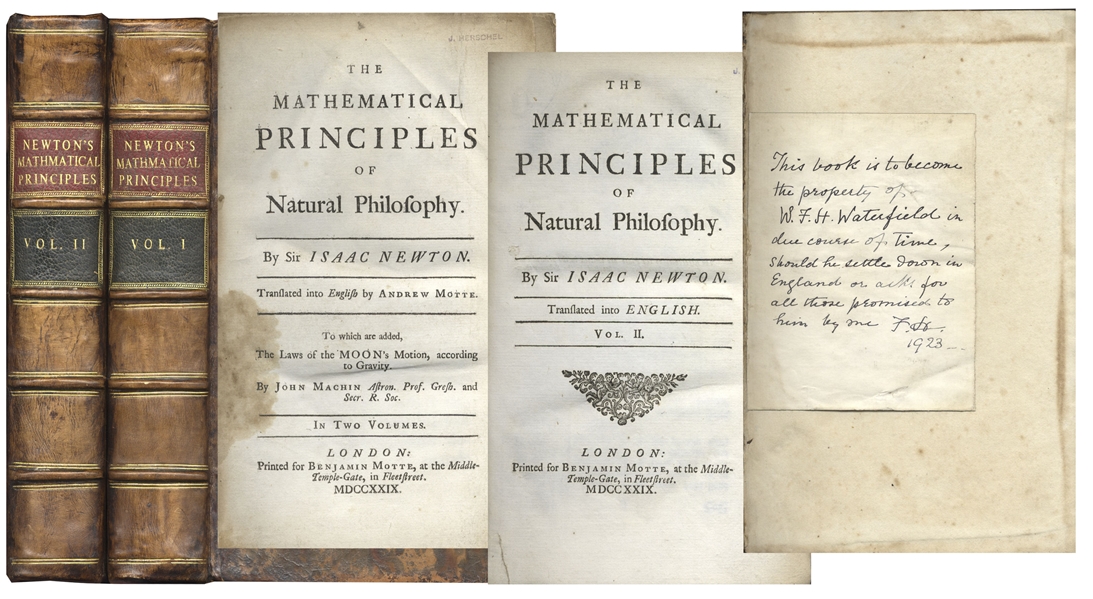
Rare First Edition of Sir Isaac Newton’s ”The Mathematical Principles of Natural Philosophy” — Two Volume Set From 1729
Rare Sir Isaac Newton first edition ”The Mathematical Principles of Natural Philosophy” in two volumes. London: Benjamin Motte, 1729. One of the most important works by the leading mind of the 18th century scientific revolution. Bound in contemporary tree calf, sympathetically rebacked, with gilt tooling to spines. Two octavo volumes measure 5.5” x 8.5” each. Volumes contain two folding letterpress tables and 47 folding engraved plates; the two frontispieces and pp. 385-393 and first 7pp. of index are replaced in facsimile, but hardly distinguishable from the original. The ”Laws of Moon’s Motion” usually found in Vol. II are here bound at end of Vol. I, and with errata for both volumes on verso of E4. Small stain to inner part of title in Vol. I, short tear to lower margin of G1, small section missing from lower margin of M3 and with lower corner cut away of A8 and C4 of ”Laws of Moon’s Motion” (no loss of text). Some marginal dampstaining and occasional soiling and spotting, overall in very good, clean condition with most edges untrimmed. Excellent Isaac Newton first edition. Sold for $22,500.
Steve Jobs Check Signed From 1988 — Jobs Handwrites a Check for $2,000 to His Girlfriend Tina Redse — Authenticated & Slabbed by PSA/DNA
Very scarce check signed by Steve Jobs, made out entirely in his hand to his girlfriend Tina Redse. Dated 11 March 1988, Jobs writes the check for $2,000 to Redse, singed ”steven jobs” on the signature line. At this time, Jobs was launching NeXT, and possibly engaged to Redse, who had a tumultuous relationship with the tech magnate throughout the 1980s before they broke off their engagement in 1989. Check measures 6” x 2.75”, with Jobs’ phone number and address listed at top. Endorsed by Redse on verso. Discreet bank stamp across check and vertical fold, otherwise near fine condition. Authenticated and slabbed by PSA/DNA. A scarce signature by one of the most important businessmen and inventors of the 20th and 21st centuries. Sold for $20,000.

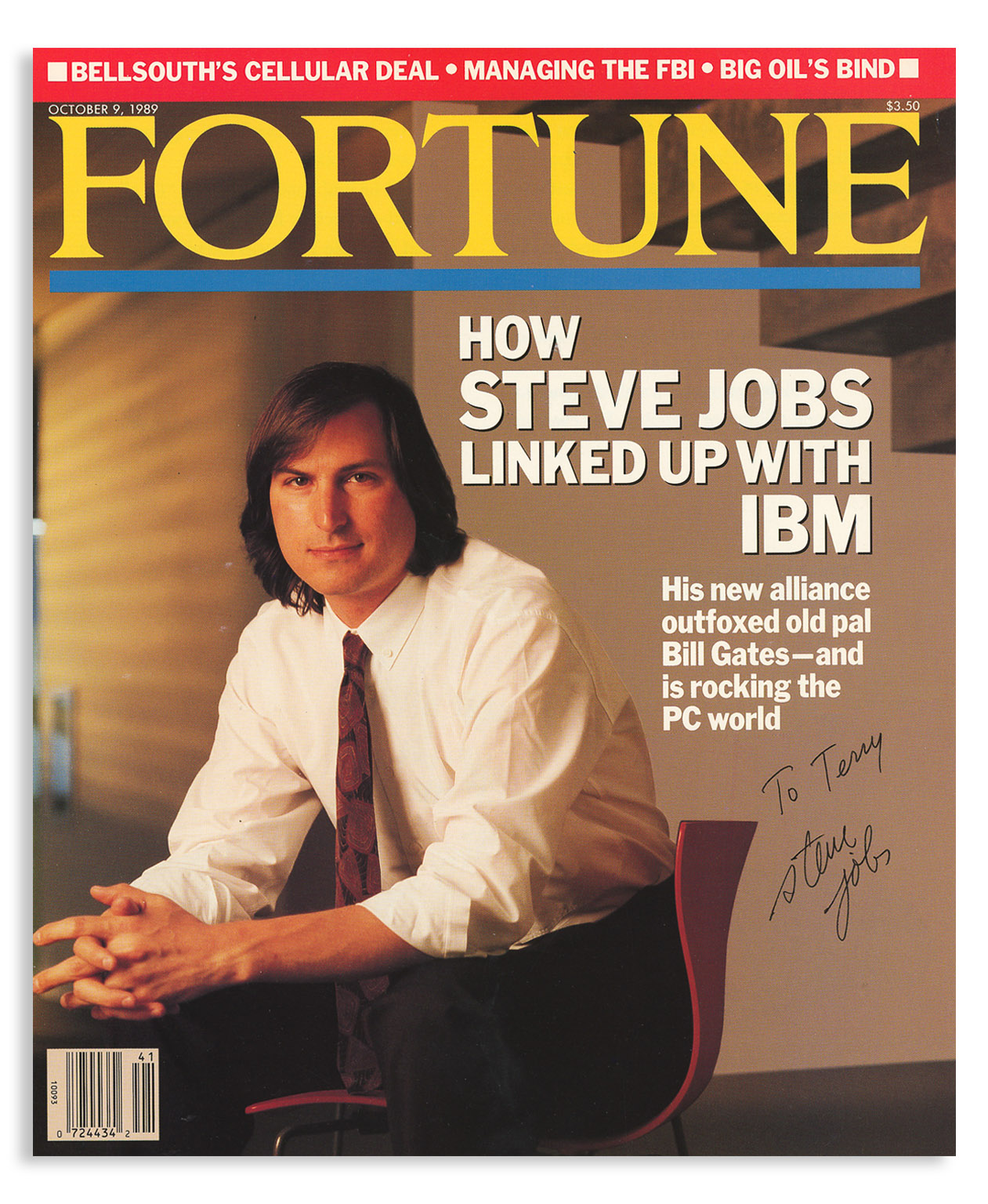
Steve Jobs Signed ”Fortune” Magazine Cover From 1989 — With an LOA From the Consignor, Jobs’ Limousine Driver — With JSA COA
Steve Jobs signed ”Fortune” magazine cover from its 9 October 1989 issue, published shortly after the launch of Jobs’ new company NeXT, Inc. Jobs signs in black ink, ”To Terry / steve jobs”, with his characteristic lower case signature, next to a photo of the charismatic technology icon. The recipient, Terry, was one of Jobs’ chauffeur drivers for several years before asking Jobs to sign this magazine, although Jobs subsequently called the limousine company to complain about the autograph request. Magazine cover measures 9” x 10.875”, without rest of the pages. Affixed to autograph album page, which could easily be professionally removed. Near fine condition with a bold signature. With a COA from JSA, as well as an LOA from Terry the consignor, and also Terry’s first year performance review from the limousine company. Sold for $16,638.


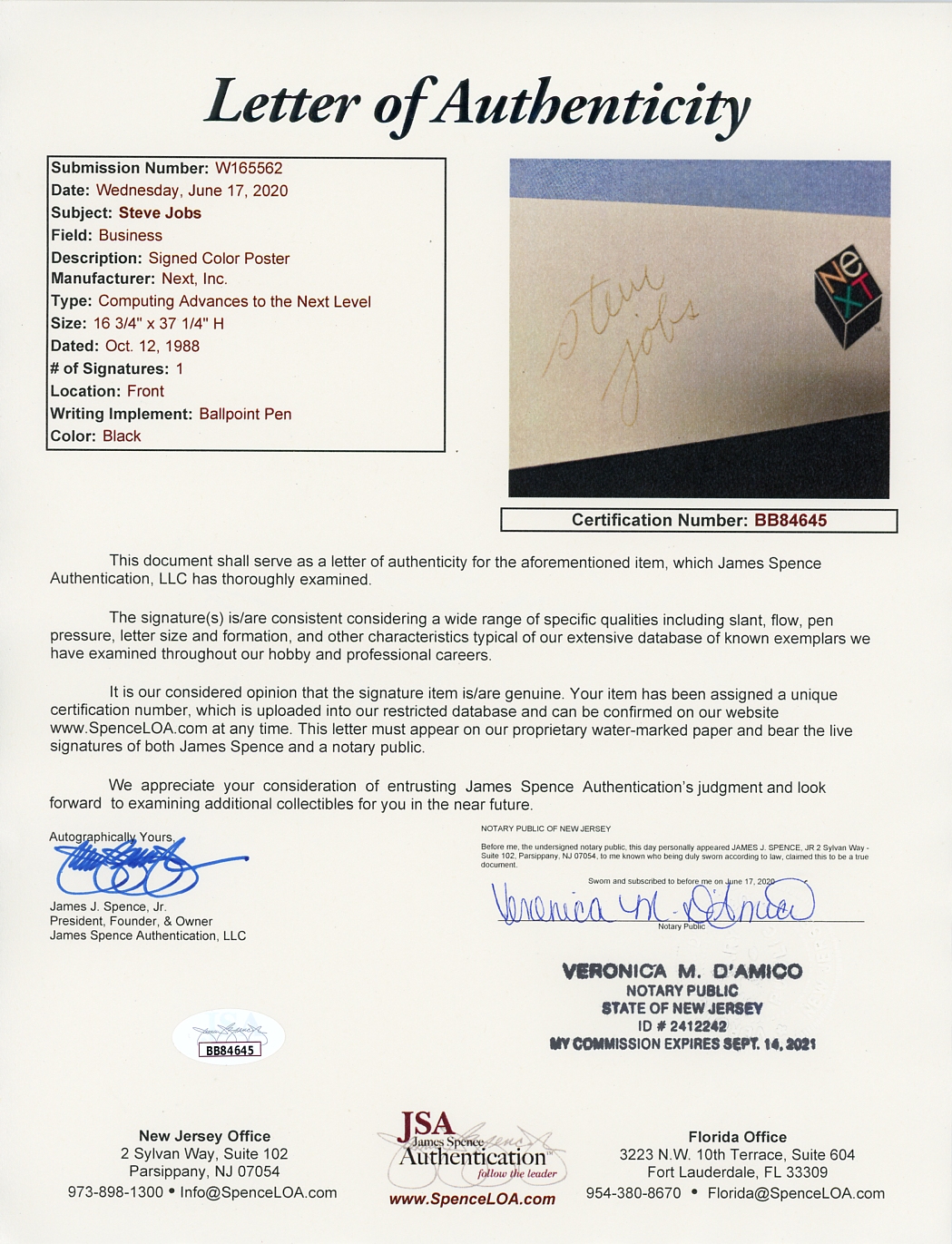
Steve Jobs Signed NeXT Computer Poster — Signed by Jobs at the NeXT Introduction Event on 12 October 1988 — With JSA COA
Scarce NeXT Computer poster signed by Steve Jobs, who founded NeXT in 1985 after he was forced out of Apple. The NeXT Computer System was the first line of products released by the company, which debuted to the world at the invitation-only NeXT Introduction on 12 October 1988, where this poster was displayed and signed by Jobs. In his first major public appearance since leaving Apple, he famously told the audience, “It’s great to be back.” Poster on foam board measures 37.25″ x 16.75″, signed by Jobs at lower right margin. Fading to signature, otherwise near fine condition. With an LOA from the consignor, who received the poster from her employer who worked directly with Jobs. With JSA COA. Sold for $12,974.

Consign your Alan Turing Chemical basis of morphogenesis offprint at Nate D. Sanders Auctions. Send a description and images of your item to us at [email protected].
FREE ESTIMATE. To buy, auction, sell or consign your Alan Turing Chemical basis of morphogenesis offprint that is for sale, please email your description and photos to [email protected] of Nate D. Sanders Auctions (http://www.NateDSanders.com).