Sell or Auction Your Ringo Starr Starkey Signed Receipt for up to Over $1,000 or More at Nate D. Sanders Auctions
FREE APPRAISAL. To buy, auction, sell or consign your Ringo Starr Starkey signed receipt that is for sale, please email your description and photos to [email protected] of Nate D. Sanders Auctions (http://www.NateDSanders.com).
Sell Your Ringo Starr Starkey Signed Receipt
Sir Richard Starkey MBE (born 7 July 1940), better known by his stage name Ringo Starr, is an English musician, singer, songwriter and actor who achieved international fame as the drummer for the Beatles. He occasionally sang lead vocals with the group, usually for one song on each album, including “Yellow Submarine”, “With a Little Help from My Friends” and “I Wanna Be Your Man”. He also wrote and sang the Beatles’ songs “Don’t Pass Me By” and “Octopus’s Garden”, and is credited as a co-writer of others.
Below is a recent realized price for a Ringo Starr Starkey signed receipt. We at Nate D. Sanders Auctions can obtain up to this amount or more for you:
Ringo Starr Starkey Signed Receipt. Sold for over $1,000.

Here are some related items that our auction house, Nate D. Sanders (http://www.NateDSanders.com), has sold:
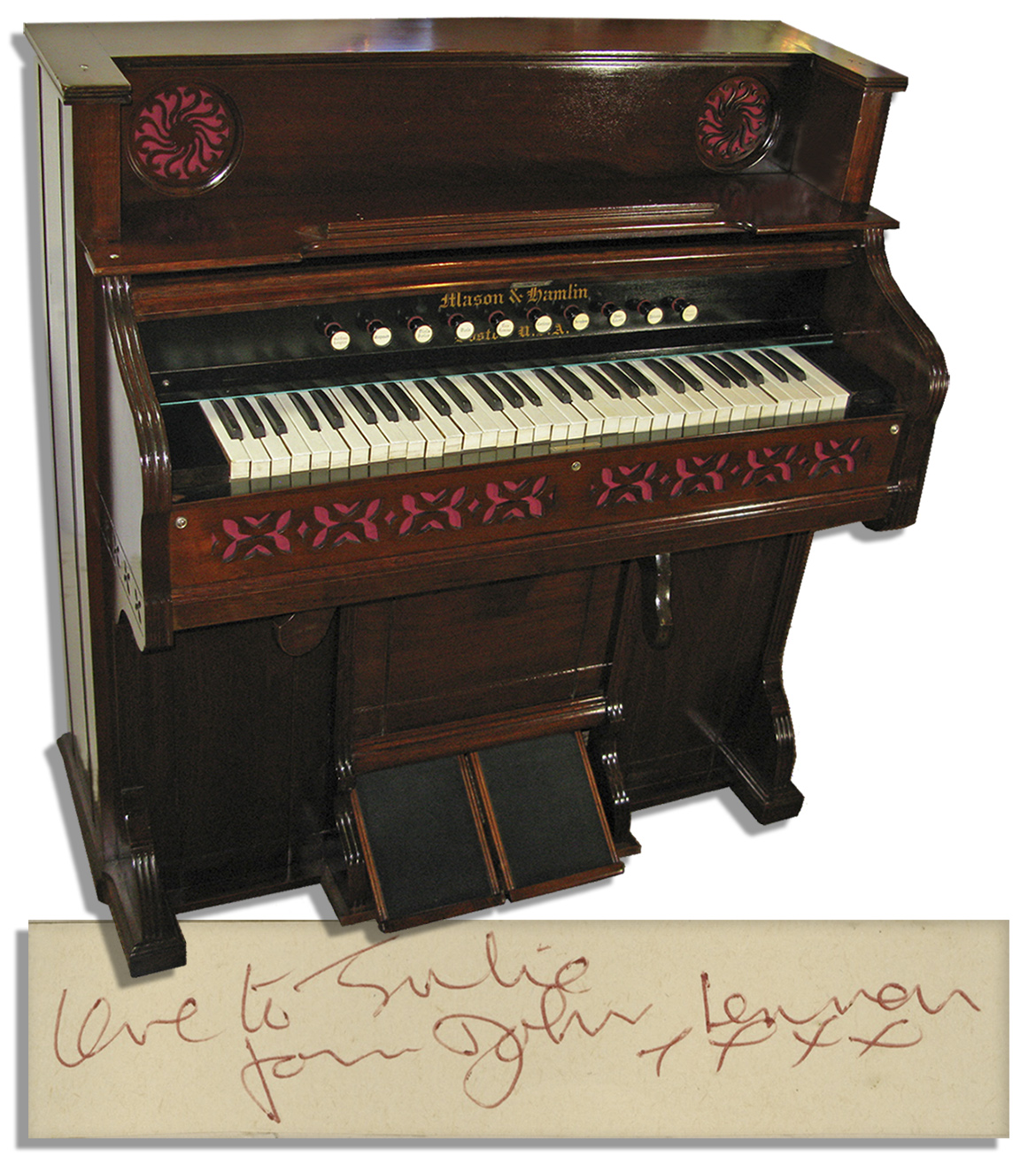
Coveted instrument personally owned and played by music legend and 1960’s cultural icon John Lennon. The first time Lennon played an instrument with a keyboard on a record was for his collaboration with McCartney on 1965’s ”I’m Down”, from the B-side to Beatles single ”Help!” Mason and Hamlin brand reed organ, or pump organ, is made of walnut wood and features a dark cherry finish. Accompanied by a slip inscribed, ”Love to Julie / From John Lennon / xxxx” in red ink. Rubber lining on pedals has been replaced. Near fine. A Steinway brand piano of Lennon’s sold at Sotheby’s in 2000 for $2.1 million. Replaced rubber on the foot pedals, else near fine. With provenance from Sotheby’s including original catalog and house-issued certificate of ownership signed by Yoko Ono. Sold for $74,535.
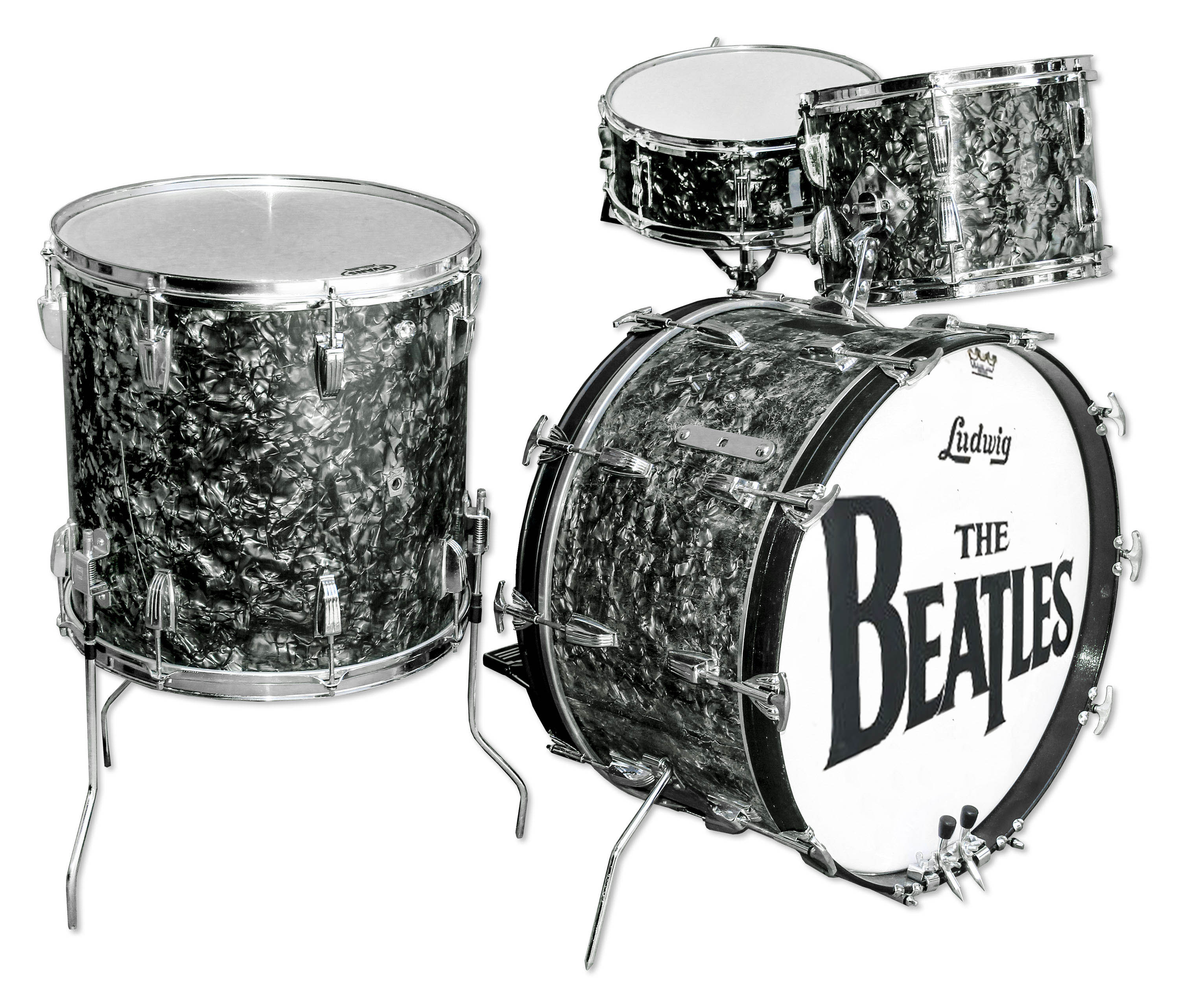
The original Ludwig drum kit used for the recording of ”Love Me Do”, The Beatles’ first single on their first album ”Please Please Me”, released on 22 March 1963 and ushering in Beatlemania. The session was recorded on 11 September 1962 at EMI London, with this recording of ”Love Me Do” used on the Beatles’ first album ”Please Please Me” as well as the first Beatles U.S. release of ”Love Me Do” and the 1982 re-release of the song. In addition to ”Love Me Do”, this Ludwig drum kit is also heard on ”P.S. I Love You”, which plays on the B-side of the British single and on the ”Please Please Me” album. The kit was played by Andy White during the recording session, who played with the Fab Four that day, with Ringo playing tambourine on ”Love Me Do”. Kit comprises a 14” x 22” bass drum, 16” x 16” floor tom, 9” x 13” tom-tom (which is date-stamped 1956 inside) and 5.5” x 14” snare. Drum head is new. The original Black Diamond Pearl wrapping is present and matches exactly the photo of White playing the drum kit. From the personal collection of Clive Edwards, who studied drum playing under Reg Weller, one of Andy White’s best friends. Weller procured the kit for Edwards after White secured an endorsement deal with Ajax drums. With an LOA from Thea White, the widow of Andy White. Sold for $67,500.
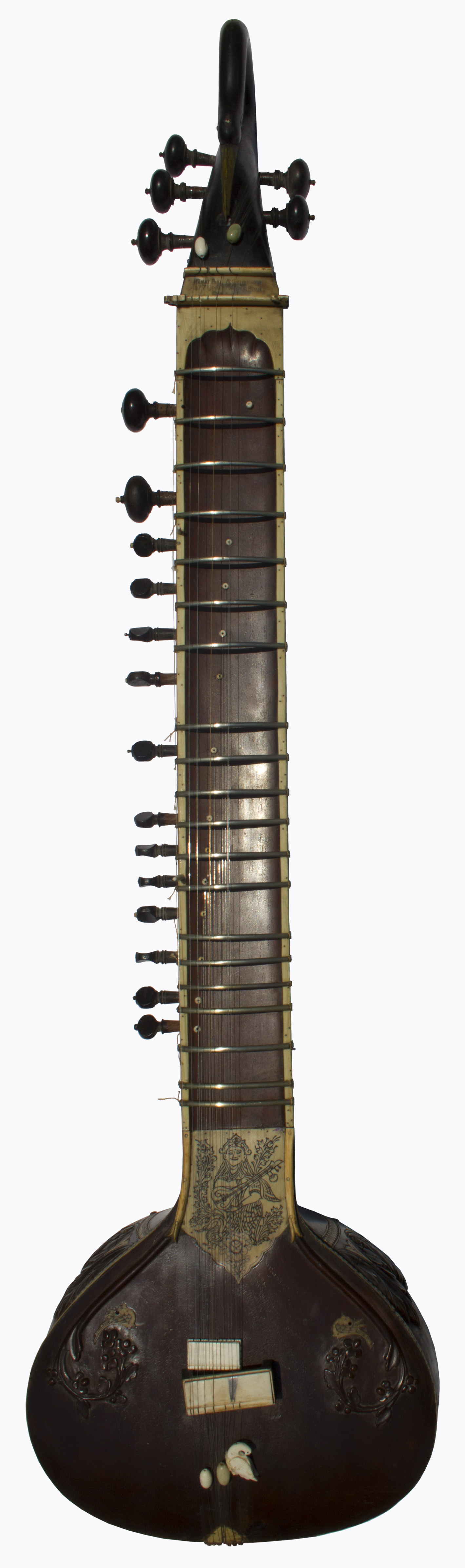
George Harrison’s sitar from 1965, almost certainly the one he used to record ”Norwegian Wood”, the Beatles song that not only launched ”The Great Sitar Explosion” in rock music, but also deepened Harrison’s involvement with Indian music, its culture and the Hindu religion that would shape the rest of his life. More than any guitar that Harrison used during his career with the Beatles and as a solo artist, the sitar is perhaps the instrument most closely associated with Harrison, who was first introduced to it in August of 1965 by David Crosby before buying his own and using it to record ”Norwegian Wood” on 12 October 1965.
Harrison’s purchase of his first sitar (sometime between August-October 1965) is best explained in his own words, from ”The Beatles Anthology”: ”I went and bought a sitar from a little shop at the top of Oxford Street called Indiacraft – it stocked little carvings, and incense. It was a real crummy-quality one, actually, but I bought it and mucked about with it a bit. Anyway, we were at the point where we’d recorded the Norwegian Wood backing track and it needed something. We would usually start looking through the cupboard to see if we could come up with something, a new sound, and I picked the sitar up – it was just lying around; I hadn’t really figured out what to do with it. It was quite spontaneous: I found the notes that played the lick. It fitted and it worked.” Over the next several months Harrison continued to play the sitar and decided to exchange his older-style ”crummy-quality one” with a more sophisticated style designed to play better into microphones.
In the meantime, Harrison married Pattie Boyd in January 1966 and left for Barbados with her for their honeymoon. While in Barbados, George and Pattie were hosted by Pattie’s friend, George Drummond, who lived on the island and to whom Harrison gave this sitar. Drummond, the Godson of King George VI whose full name is George Albert Harley de Vere Drummond, is featured in the book “Beatles ’66: The Revolutionary Year” by Steve Turner. Turner describes the events on the island leading up to the gift, ”During the days Pattie sunbathed and George practiced on his sitar. George even had a better sitar flown to Barbados for him, and when it arrived he gave his old one – probably the one he had bought from Indiacraft – to Drummond as a gift.”
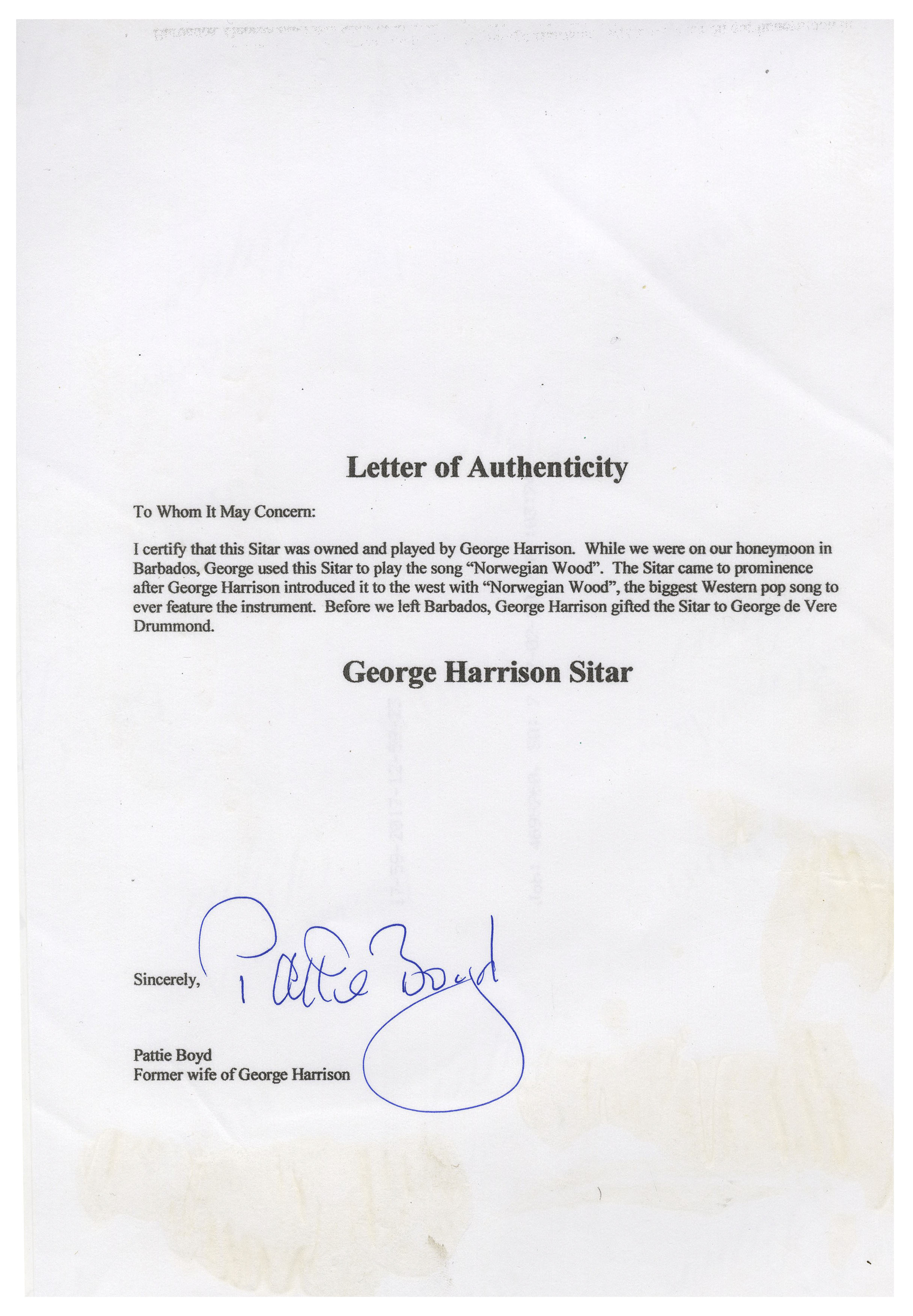
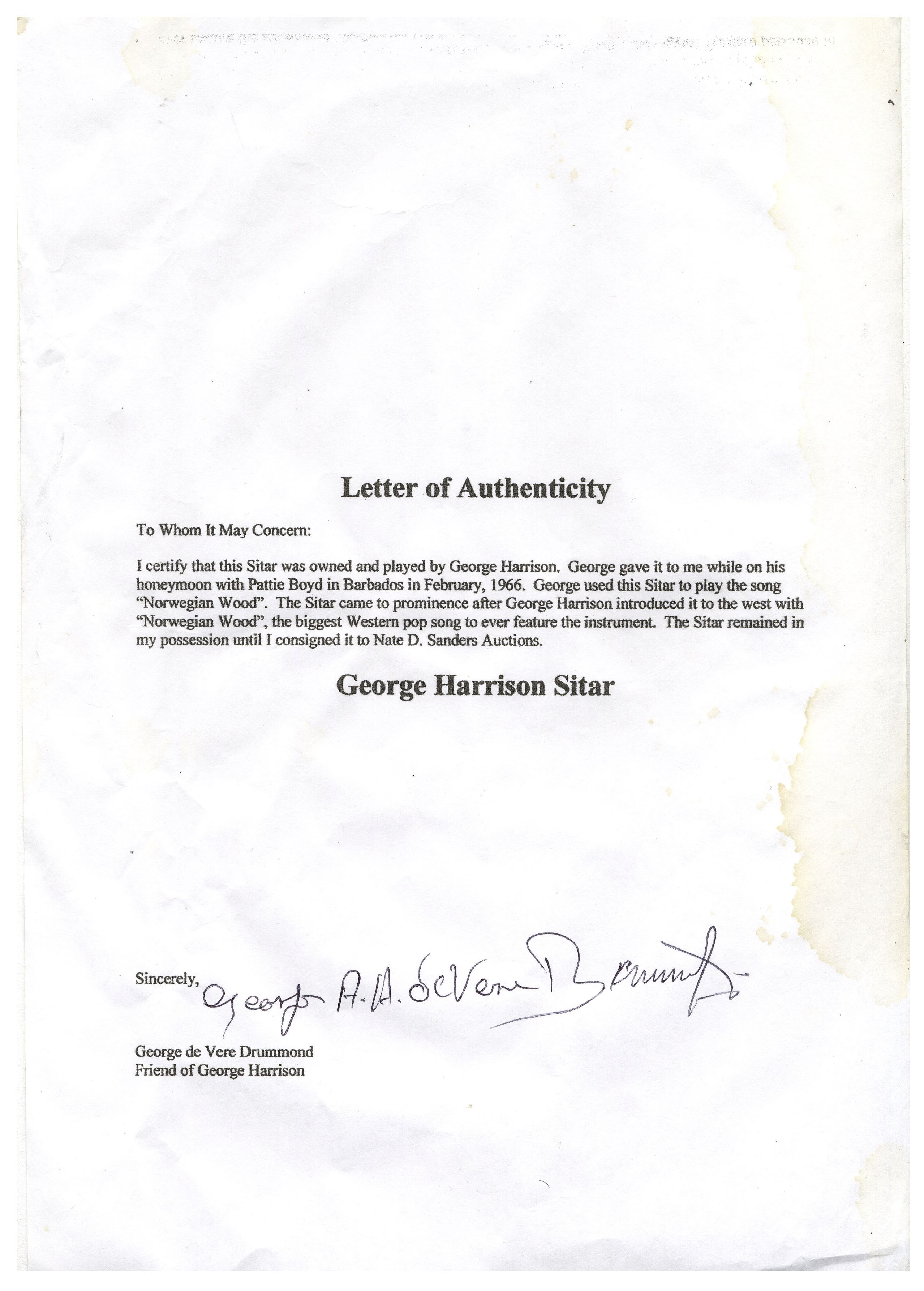
The sitar is accompanied by two letters of authenticity, one from Pattie Boyd and one from George Drummond. Pattie not only confirms the authenticity of the sitar, but writes that George used it to play ”Norwegian Wood” to her on their honeymoon. She writes, ”Before we left Barbados, George Harrison gifted the Sitar to George de Vere Drummond.” Drummond’s LOA likewise confirms that Harrison gave him this sitar in February 1966 and that it’s ”remained in my possession until I consigned it to Nate D. Sanders Auctions.”
Despite Harrison’s misgivings about its sound quality, visually the sitar is a stunning display of craftsmanship, made by the sitar company of Kanai Lal & Brother of Calcutta, and was approximately 10 years old – made in the late 1940s or 1950s – when Harrison played it. Elaborate wood carvings appear on the tumba and tabkandi (similar to the headstock and body of a guitar), with the tumba formed in the shape of a swan’s neck and head. A plaque below the tumba reads, ”Kanai Lal & Brother / 377 Upper Chitpur Road / Calcutta”. Ornamentation at the top of the tabkandi shows an ancient figure playing a sitar, below which wood carvings appear in relief. More elaborate wood carvings appear on the kaddu, a bulbous, gourd-shaped area on the back of the tabkandi which serves as a resonator for the sitar. The sitar measures 53” long, 13” at its widest point and 10” deep at the kaddu. At the top of the kaddu is a label attached by George Drummond, a photo of which is laminated to the back of Pattie Boyd’s LOA, matching her letter to this piece exactly. There are a few cracks to the kaddu, otherwise the sitar is in near fine condition, fully operable and a stunning piece to behold. Sold for $62,500.
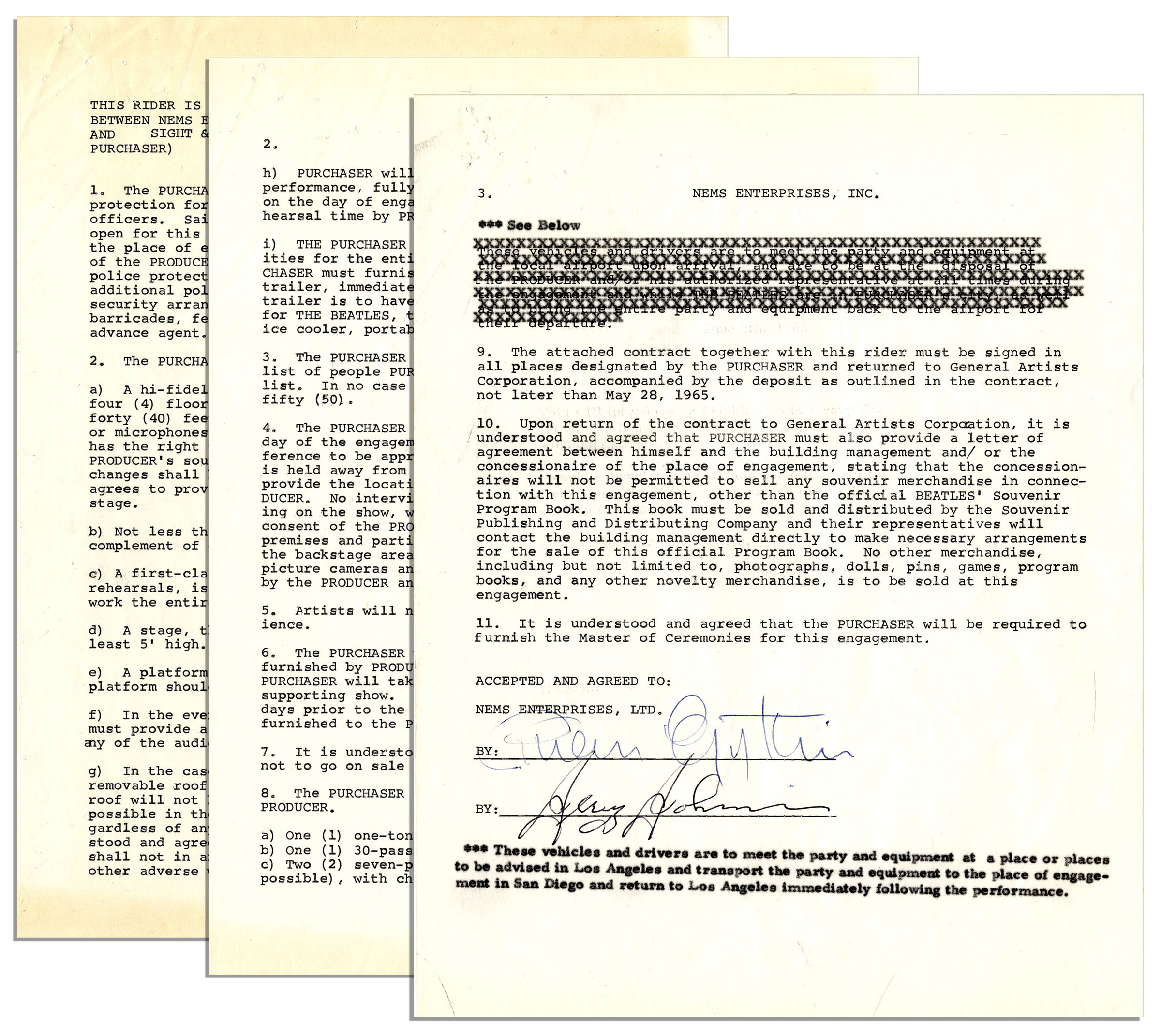
Contract rider for the Beatles 28 August 1965 concert in San Diego at Balboa Stadium, signed by the ”fifth Beatle,” their manager Brian Epstein. This concert was a particularly well-documented event in rock and roll history symbolizing Beatlemania; it was added last-minute to the itinerary of their 1965 North America tour in response to popular demand, and an incident immediately followed the show in which the Beatles’ tour bus broke down and was damaged by a frenzied mob of crazed fans. Typed rider is also signed by a representative from the event purchaser Sight and Sound Productions. The Beatles’ live performance requirements are spelled out in the eleven point rider, including security considerations and crowd control. Also present is their famous requirement that they not play before a segregated audience. Rider arranges for the Fab Four’s transportation from Los Angeles to San Diego for the concert and guarantees the following terms: ”not less than 150 uniformed officers” were to be provided and more if necessary; a ”strong fence or barrier…to prevent any of the audience from climbing over”; also a ”platform for Ringo Starr and his drums” and a high-fidelity sound system equipped with a ”first class sound engineer”; a dressing room with ”four cots, mirrors, an ice cooler, portable TV set and clean towels”; a guest list not to exceed 50 complimentary tickets; one press conference and no further media engagements at the event; prohibition of ticket sales in advance of 31 May 1965; transportation including ”Two seven-passenger Cadillac limousines (air-conditioned if possible) with chauffeurs” and prohibition of unauthorized merchandise sales and bootlegging at the show. Incidentally, the Beatles encountered transportation snafus both coming and going – the airline workers’ strike coincided with their planned flight to San Diego and a touring coach instead brought the band from LA via Highway 1. Three-page document on 3 sheets measures 8.5” x 11”. Toning, creasing and staple punctures to the upper left, else near fine. A scarce record of the Beatles. Sold for $10,780.
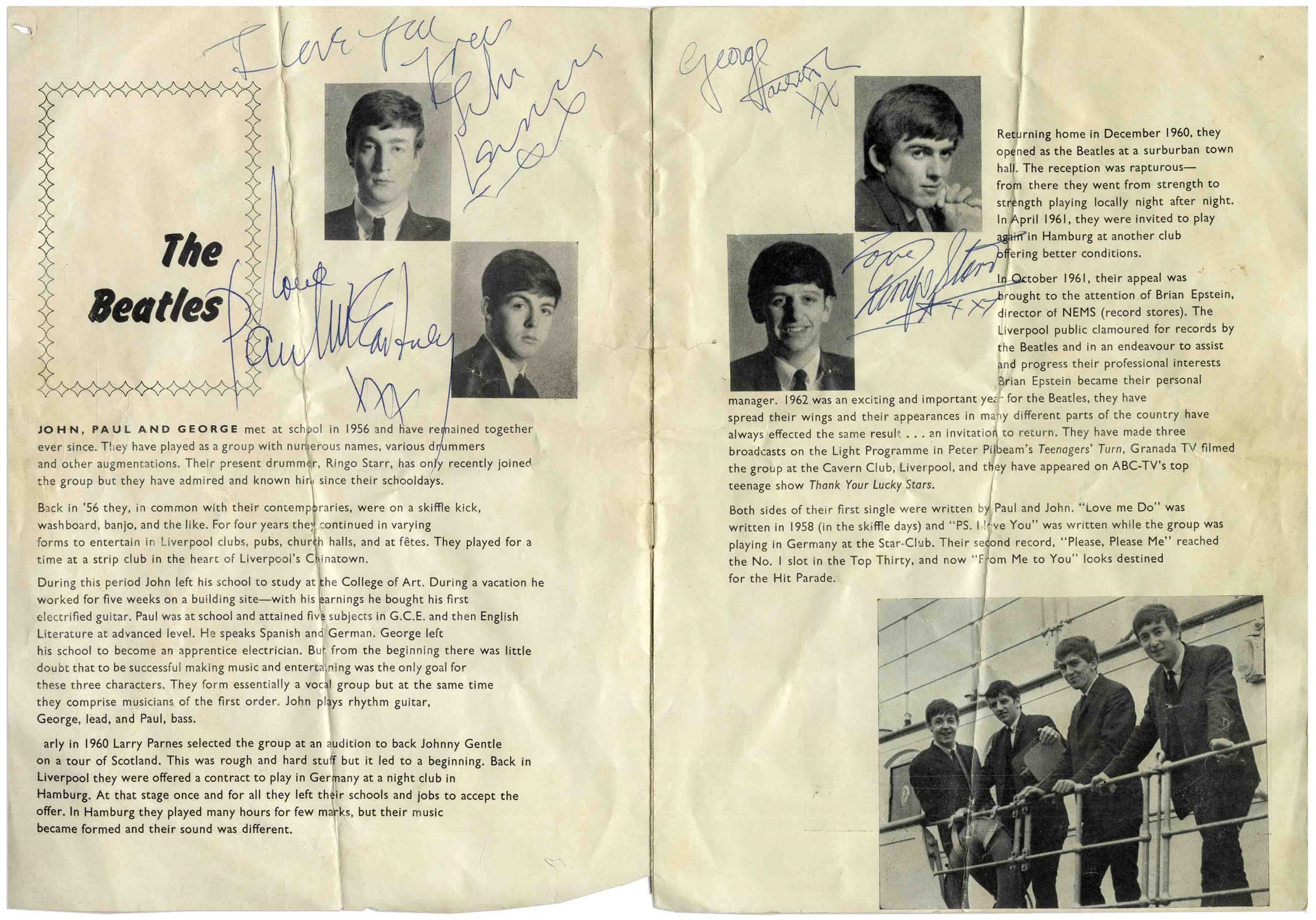
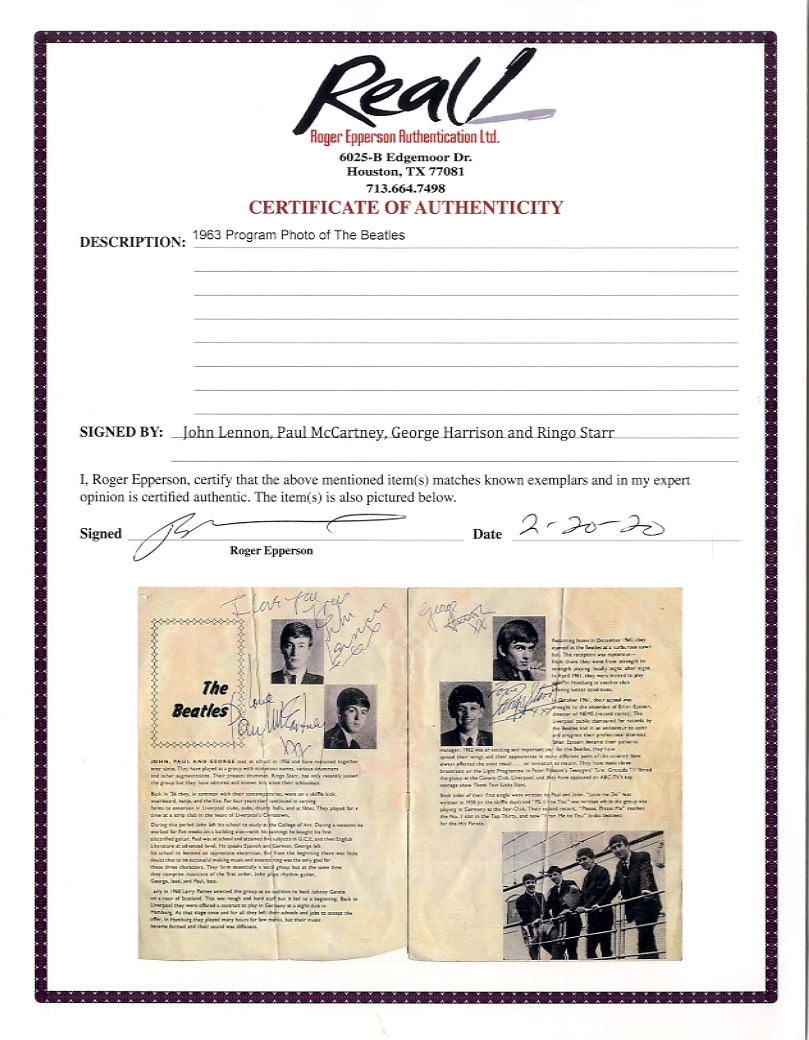
Excellent Beatles signed concert program – without inscription, for a concert held on 25 April 1963 at Fairfield Hall in Croydon, Surrey. On the two-page spread devoted to The Beatles, each of the Fab Four sign next to their photo in blue ballpoint, ”I Love You / Yours / John Lennon / xxx”, ”Love, / Paul McCartney / xxx”, ”George Harrison / xx” and ”Love / Ringo Starr / [star sign]xx”. The event was organized by London concert promoter John Smith, and also featured John Leyton (who cancelled his appearance), The Big Three, Billy Kramer, and several more acts, with The Beatles headlining. Orange program bound by two staples runs six pages and measures 6.875” x 9.5”. Separation starting along bottom seam, and creasing throughout. Small hole to top right of cover. Overall in very good condition. With Roger Epperson COA for all four signatures. A rare uninscribed Beatles concert program, signed at the cusp of their global fame. Sold for $9,375.
John Lennon, Paul McCartney and Ringo Starr signed slip, inscribed by Ringo on a Sheraton Hotel ”Guest Memo” note. Note reads ”To Susan / love from / Ringo Star xxx” to which ”Paul McCartney” and ”John Lennon” add their signatures. Measures 4” x 6.25”. Creasing, a few pinholes and tears to margins, and some discoloration from tape residue. Overall good condition. With a COA from Roger Epperson for all three Beatles signatures. Sold for $2,750.


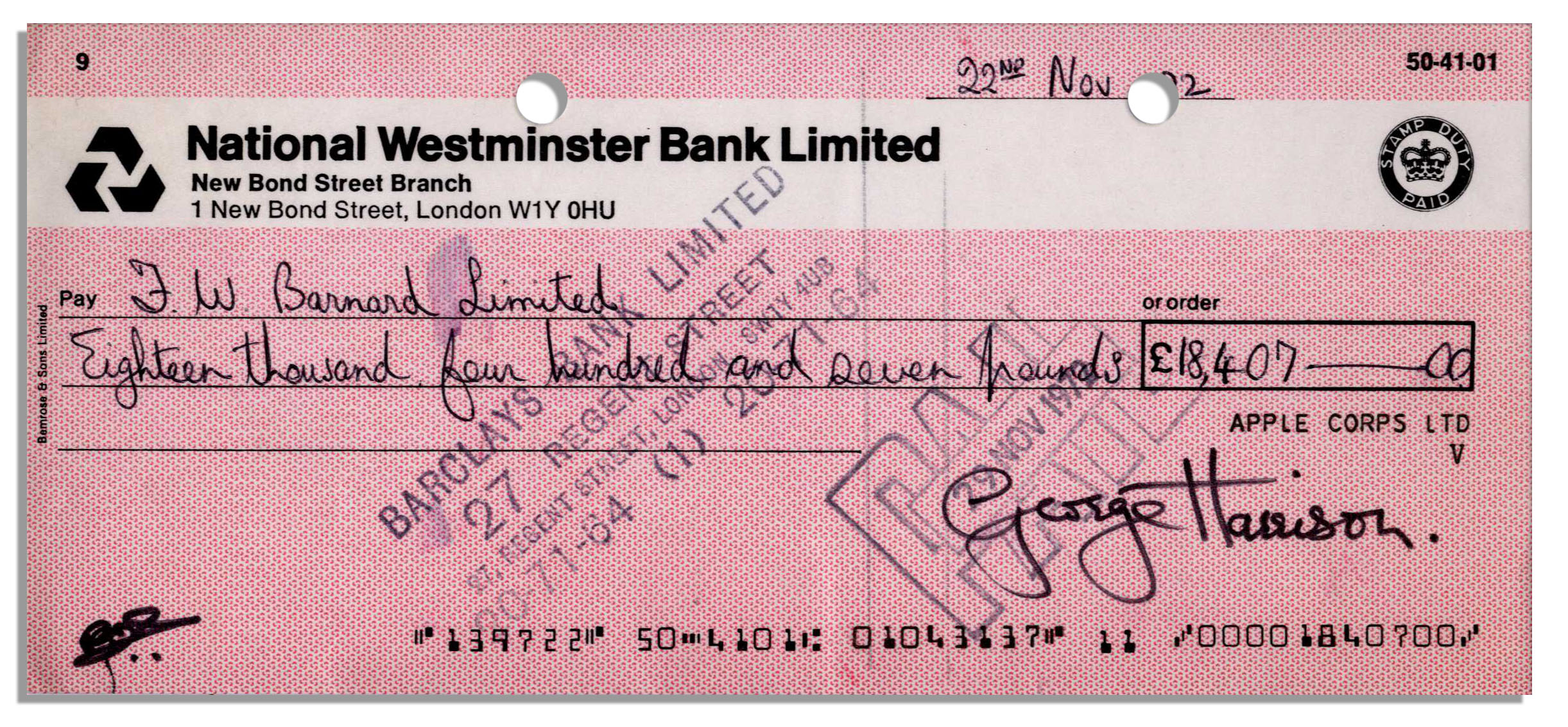
George Harrison Signed Check — Dated November 1972
Beatle “George Harrison” check signed in black felt tip. Sizable 18,407 pound check is payable to F.W. Barnard Ltd. and dated 22 November 1972, when Harrison was finishing up the Bangladesh concert series and recording his third solo album, “Living in the Material World.” Measures 8″ x 3.5″. Standard bank cancellations and filing hole punched through date at top, else near fine. Sold for $1,072.
FREE APPRAISAL. To buy, auction, sell or consign your Ringo Starr Starkey signed receipt that is for sale, please email your description and photos to [email protected] of Nate D. Sanders Auctions (http://www.NateDSanders.com).