
Sell or Auction Your William Harvey De Motu Cordis 1639 2nd Complete Edition 3rd Overall for up to Over $20,000 or More at Nate D. Sanders Auctions
FREE ESTIMATE. To buy, auction, sell or consign your William Harvey De Motu Cordis 1639 2nd complete edition 3rd overall that is for sale, please email your description and photos to [email protected] of Nate D. Sanders Auctions (http://www.NateDSanders.com).
Sell Your William Harvey De Motu Cordis 1639 2nd Complete Edition 3rd Overall
Consign your item at Nate D. Sanders Auctions. Send a description and images of your item to us at [email protected].
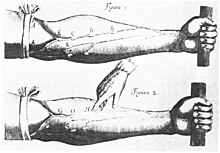
Exercitatio Anatomica de Motu Cordis et Sanguinis in Animalibus (Latin, ‘An Anatomical Exercise on the Motion of the Heart and Blood in Living Beings’), commonly called De Motu Cordis, is the best-known work of the physician William Harvey, which was first published in 1628 and established the circulation of blood throughout the body. It is a landmark in the history of physiology, with Harvey combining observations, experiments, measurements, and hypotheses in an extraordinary fashion to arrive at his doctrine. His work is a model of its kind and had an immediate and far-reaching influence on Harvey’s contemporaries; Thomas Hobbes said that Harvey was the only modern author whose doctrines were taught in his lifetime.
Below is a recent realized price for a William Harvey De Motu Cordis 1639 2nd complete edition 3rd overall item. We at Nate D. Sanders Auctions can obtain up to these amounts or more for you:
William Harvey De Motu Cordis 1639 2nd Complete Edition 3rd Overall. Sold for over $20,000.
Here are some recent items that our auction house, Nate D. Sanders (http://www.NateDSanders.com) has sold:
The 1963 Nobel Prize in Physiology or Medicine, awarded to physiologist Alan Lloyd Hodgkin for establishing the propagation mechanism of nerve impulses called action potentials — consequently helping to understand the mechanism behind disorders such as multiple sclerosis, seizures and Parkinson’s disease. Hodgkin is also responsible for identifying the Hodgkin Cycle and, along with colleagues Andrew Fielding Huxley and John Carew Eccles, hypothesized the existence of ion channels on cell membranes, a concept which took over 20 years to confirm; that confirmation earned Erwin Neher and Bert Sakmann the 1991 Nobel Prize. This Nobel Prize medal is made of 23k gold and features the relief portrait of Alfred Nobel, with his name and the years of his birth and death. Verso features the words, ”INVENTAS VITAM JUVAT EXCOLUISSE PER ARTES”, which translates from Latin to, ”Inventions enhance life which is beautified through art”. A.L. Hodgkin’s name and the year 1963 in Roman numerals are engraved on a plaque below the relief, framed by the words, ”REG. UNIVERSITAS MED-CHIR-CAROL”. On the right side is the name ”E LINDBERG”, who designed the prize. Comes with 6 original photographs of Hodgkin (at least 4 of which are from the ceremony in Oslo on 10 December 1963), a New York Times article on Hodgkin dated 18 October 1963, a portion of a 1976 issue of ”The Journal of Physiology” featuring an essay by Hodgkin, and the official 1963 English edition of the Nobel Prize publication, featuring Hodgkin and partner Huxley on the cover. Medal is housed in the maroon leather presentation box with a white satin lining and Hodgkin’s name printed on the front. Box measures 5.5” x 5.5” x 1”. Medal measures 6.5 cm or 2.56” in diameter, and weighs 196 g or 6.9 oz, consistent with the original Nobel Prizes awarded in 1963. Presented in near fine condition. With an LOA from the daughter of Dr. Alan Hodgkin. Sold for $795,614.


Consign your item at Nate D. Sanders Auctions. Send a description and images of your item to us at [email protected].
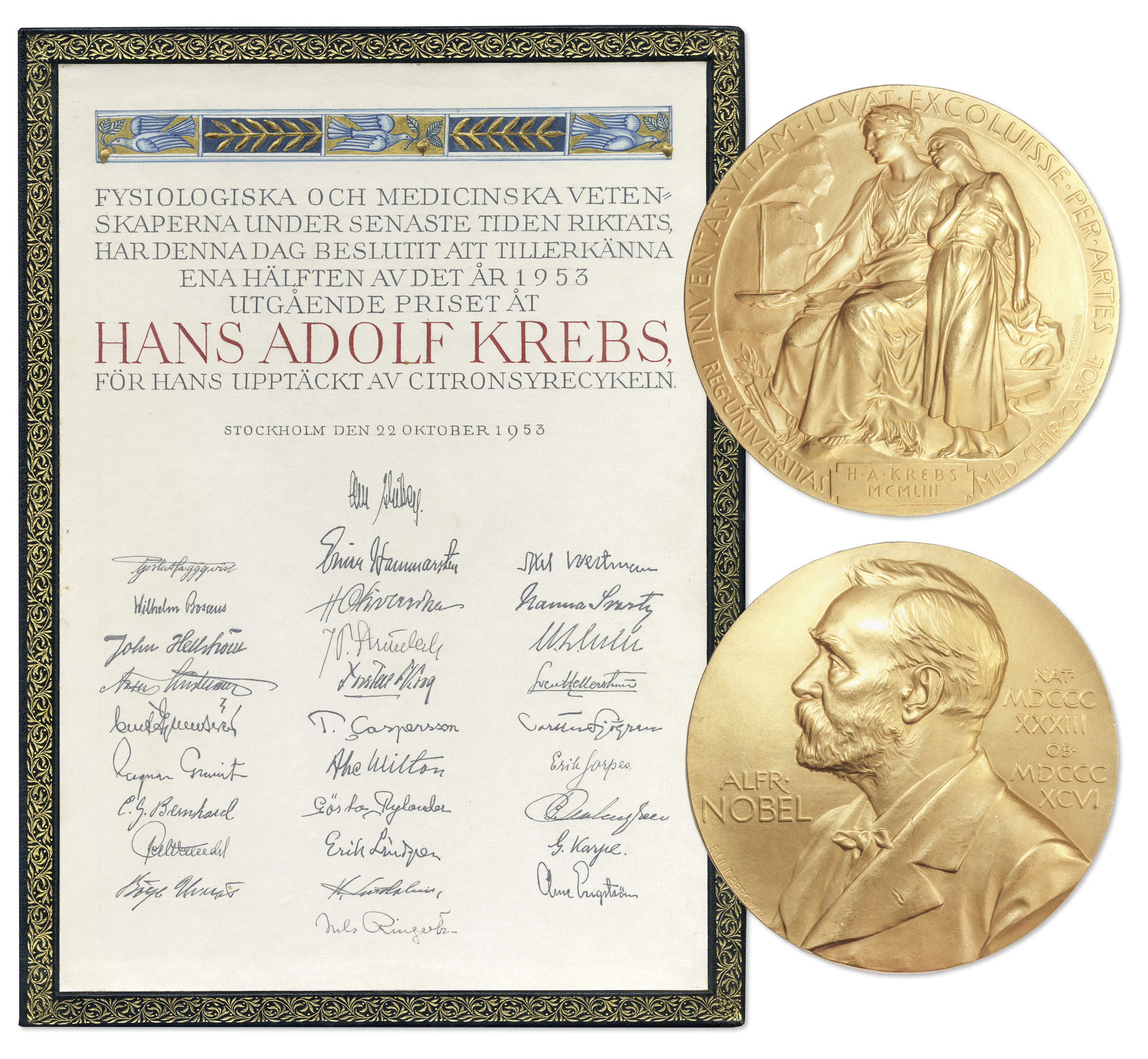
Nobel Prize Awarded to Scientist Hans Krebs in 1953, Won for His Discovery of the Famous Krebs Cycle — With Krebs’ Nobel Prize Diploma
The 1953 Nobel Prize in Physiology or Medicine, awarded to physician and biochemist Hans Krebs for the discovery of the citric acid cycle (later named the Krebs cycle) and the urea cycle, the metabolic process by which all multi-cellular organisms convert food into energy. This Nobel Prize medal is made of 23k gold and features the relief portrait of Alfred Nobel, with his name and the years of his birth and death. Verso features the words, ”INVENTAS VITAM JUVAT EXCOLUISSE PER ARTES”, which translates from Latin to, ”Inventions enhance life which is beautified through art”. H.A. Krebs’ name and the year 1953 in Roman numerals are engraved on a plaque below the relief, framed by the words, ”REG. UNIVERSITAS MED-CHIR-CAROL”. On the right side is the name ”E LINDBERG”, who designed the prize. Comes with the Nobel Prize diploma which contains calligraphy printed on 2 vellum sheets, with signatures from 29 members of the Royal Swedish Academy of Science, housed in a beautiful blue case with Krebs’ initials “HAK” printed in gilt; sheets each measure 13.5″ x 19.5″. Medal is housed in the 5.5″ square red leather presentation box with Krebs’ name printed on the front. Medal measures 6.5 cm or 2.56” in diameter, and weighs 196 g or 6.9 oz, consistent with the original Nobel Prizes awarded in 1953. Presented in near fine condition. Sold for $269,000.
Consign your item at Nate D. Sanders Auctions. Send a description and images of your item to us at [email protected].
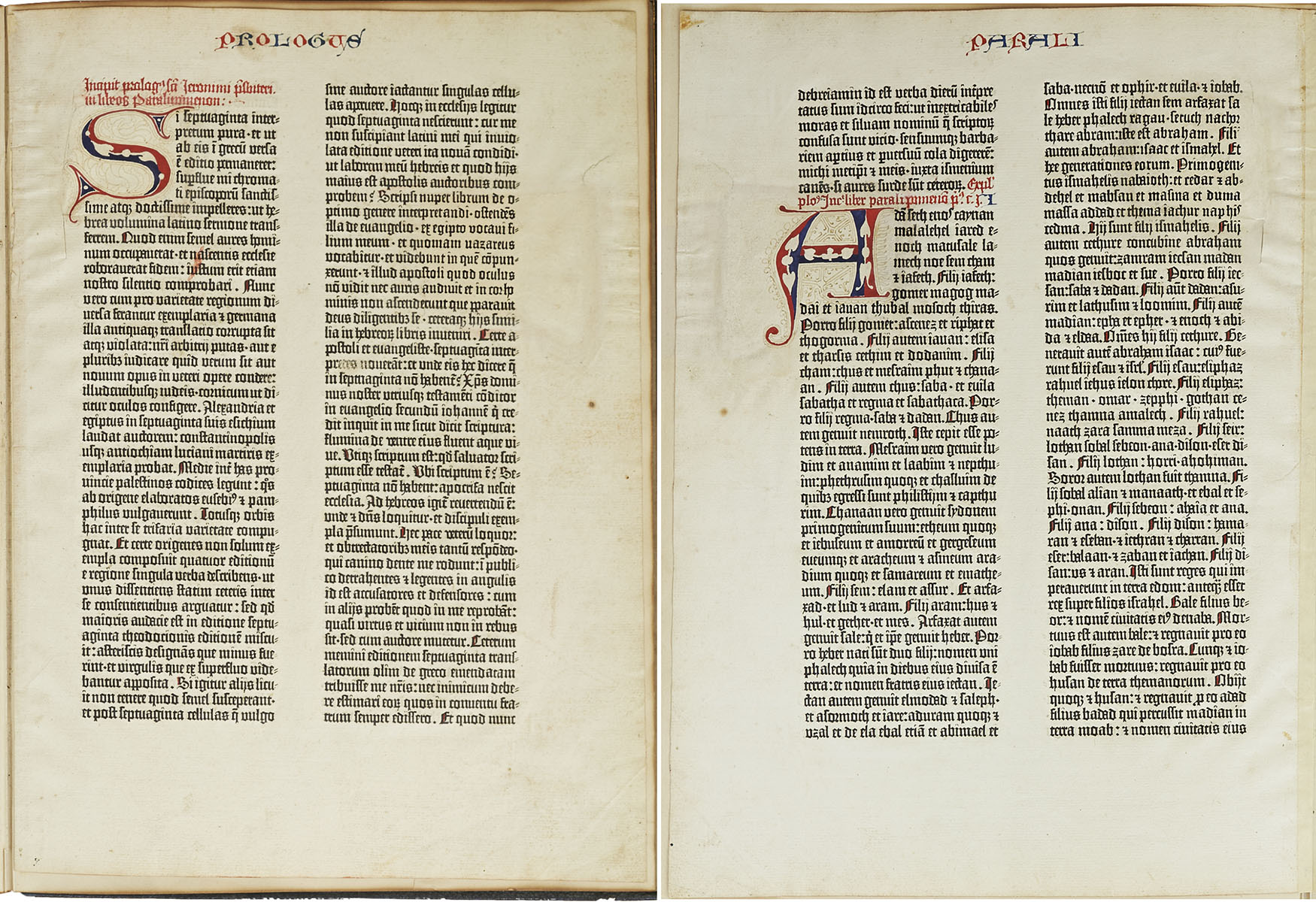
Gutenberg Bible Leaf 193 Chronicles of Old Testament
Scarce leaf from the Gutenberg Bible, one of the earliest major books printed from moveable metal type, the invention that ushered in the Age of Enlightenment by democratizing knowledge through mass production of literature. Printed by Johannes Gutenberg in Mainz, Germany from 1450-1455, less than 50 complete or near-complete copies of the Gutenberg Bible are now extant, with nearly all those housed in public institutions. Singular leaves are also scarce, with the leaf presented here having been acquired by bookseller Gabriel Wells, whose purchase of an incomplete Bible in 1920 gave way to selling the individual leaves alongside an essay by A. Edward Newton entitled “A Noble Fragment”. Leaf is number 193 of the full Latin Bible, with the recto being the Prologue to 1 Chronicles of the Old Testament, and the verso the first part of Chapter 1 of 1 Chronicles. Each page features two columns of 42 lines in dark black Gothic type, accented by red and blue rubrication. Each copy of the Gutenberg Bible differs in its rubrication and illumination, with buyers at the time deciding upon these embellishments after the Bible was printed. The six-line rubricated letters of this leaf were likely added later, restored to match the original style. Leaf measures 11.125″ x 15.375″, bound on edge to portfolio measuring 11.75″ x 16″. Paper quality is still bright with very little foxing or discoloration compared to other examples. A stunning example from the book that changed the course of history. Sold for $136,500.
Consign your item at Nate D. Sanders Auctions. Send a description and images of your item to us at [email protected].
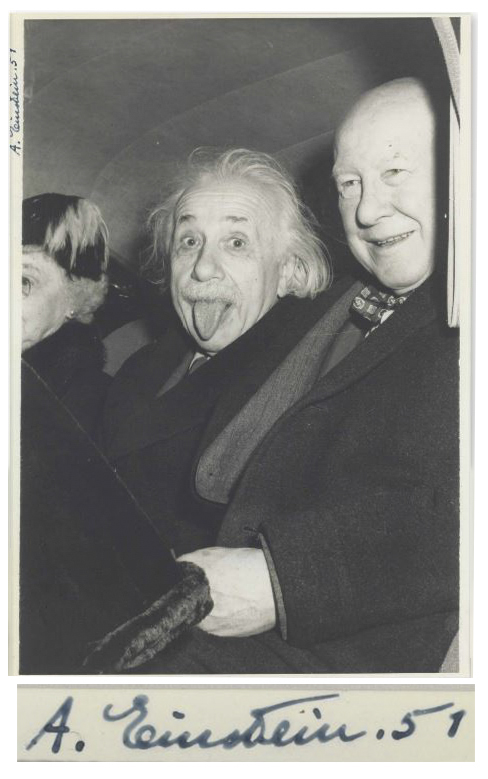
The Most Famous Photo of Albert Einstein, Playfully Sticking Out His Tongue — Extraordinarily Rare as Signed by Einstein
Very rare photo signed by Albert Einstein, on the occasion of the Nobel Prize winner playfully sticking out his tongue to a group of photographers on his 72nd birthday. Photo was snapped on 14 March 1951 by Arthur Sasse, a UPI photographer whose employers were at first hesitant about publishing the iconoclastic image of Einstein; when they did, Einstein was so amused by it that he ordered several prints to give out to close friends. This image is unlike most which crop the photo to show only Einstein. Here, the photo is shown in its full context with Einstein seated between Dr. Frank Aydelotte, head of the Institute of Advanced Study in Princeton, and Aydelotte’s wife, after celebrating his birthday at the Princeton Club. Photo is signed along the left margin ”A. Einstein .51”, indicating he signed the image shortly after it was taken. Photo measures 7” x 10”. Very good to near fine condition. Extraordinarily rare photo signed by Einstein, the most famous and beloved image of him. Sold for $125,000.
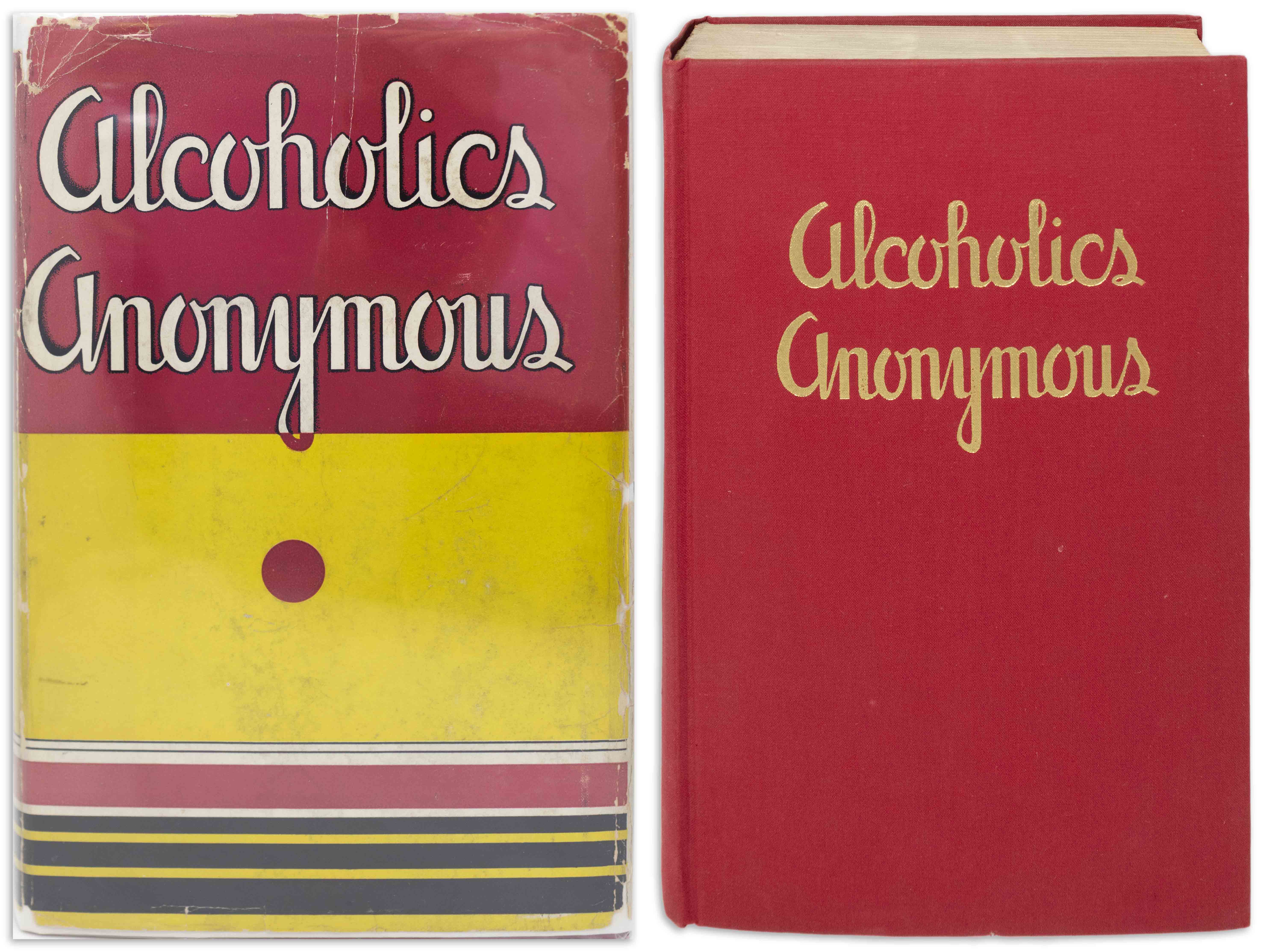
Housed in its original dust jacket, the first edition, first printing of ”Alcoholics Anonymous: The Story of How More Than One Hundred Men Have Recovered From Alcoholism” in beautiful, near fine condition. New York: Works Publishing Company, 1939. One of just approximately 1,900 surviving copies from the 4,860 first printed in April of 1939, before becoming one of the most influential books of the 20th century, and certainly one of the best preserved. All first printing points are present: Half-title page is followed by the title page and pages v-viii, with another half-title page before the text begins; complete text is followed by three blank leaves. Runs 400pp. and measures 6.25” x 9.25” x 2” thick, bound in original red cloth boards with gilt lettering, both of which are bright and prominent. Some toning to interior pages and previous owner’s inscription, dated 1939, on front free endpaper. Near fine condition. Original very good dust jacket is also included, which are almost always absent for this book. Jacket has some creasing, light soiling, and small amount of paper loss, mostly on backstrip. Book and jacket are housed in a custom quarter-leather red clamshell case. Sold for $18,750.
Tractado de las drogas, y medicinas de las Indias Orien
Cristóvão da Costa or Cristóbal Acosta and Latinized as Christophorus Acosta Africanus (c. 1525 – c. 1594) was a Portuguese doctor and natural historian. He is considered a pioneer in the study of plants from the Orient, especially their use in pharmacology. Together with the apothecary Tomé Pires and the physician Garcia de Orta he was one of the pioneers of Indo-Portuguese medicine.
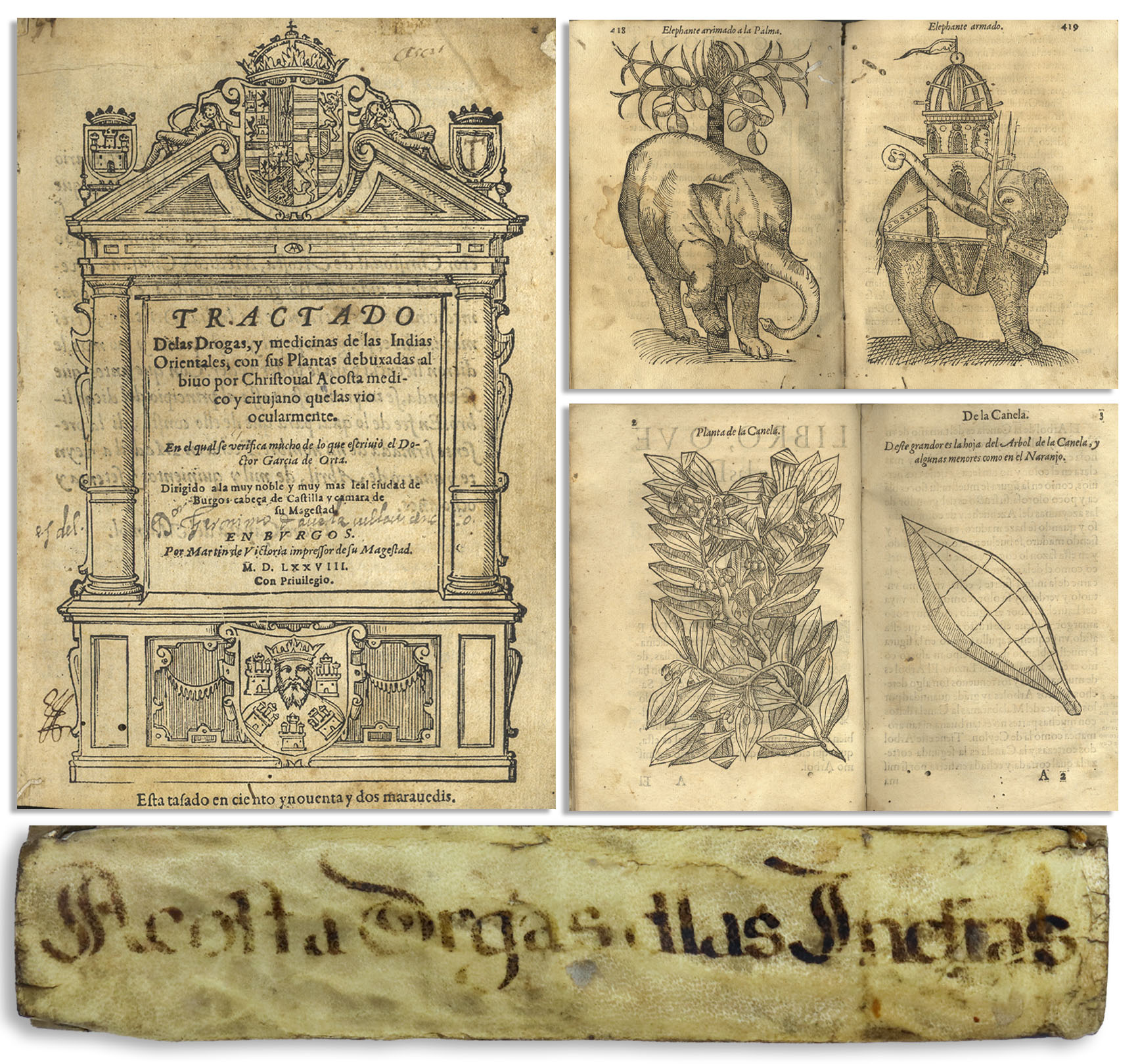
Rare 1578 first edition of “Tractado de las drogas, y medicinas de las Indias Orientales” (“Treatise of the drugs and medicines of the East Indies”) by physician and naturalist Cristobal Acosta. Burgos, Spain: Martin de Victoria, 1578. Bound in original vellum boards with leather ties, rare volume is complete with all woodcuts: title page featuring a portrait of the author, 45 pages of medicinal plants and herbs, and two pages of Asian elephants. Book also features woodcut initials heading each chapter. Acosta’s tomb of therapeutic botany was highly important in its day, giving illustration to exotic plants, animals, herbs and spices from the East Indies during the Age of Exploration, including cinnamon, garlic, nutmeg, coconut, sandalwood, and pineapple, all relatively unknown to Europe at the time. There is even a chapter on opium (“muy usual, y necessaria”), and a chapter on Asian elephants, then described for the first time in a scientific publication. Book measures 5.5″ x 7.375″. Some faint dampstaining, worming to several pages towards the end, and expected age wear. Overall very good plus condition. Sold for $3,900.
Consign your item at Nate D. Sanders Auctions. Send a description and images of your item to us at [email protected].
Harvey Cushing / W. Osler Signed Rare Book
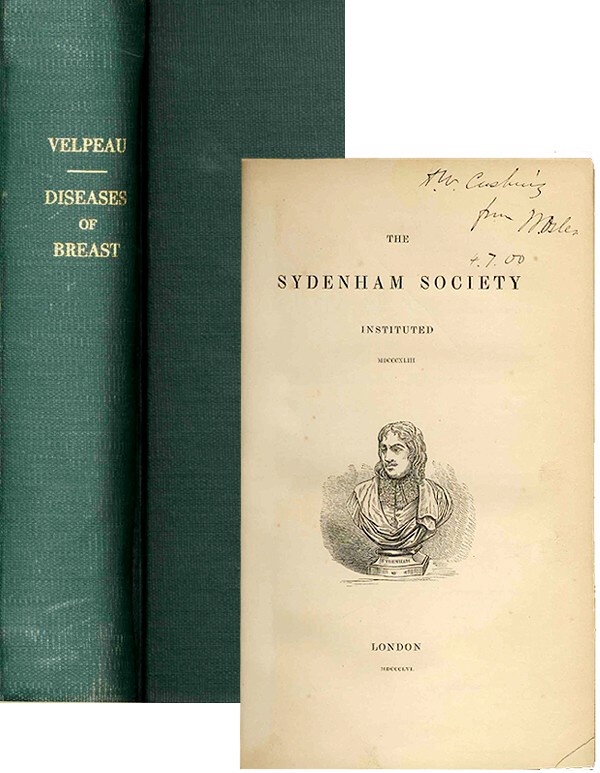
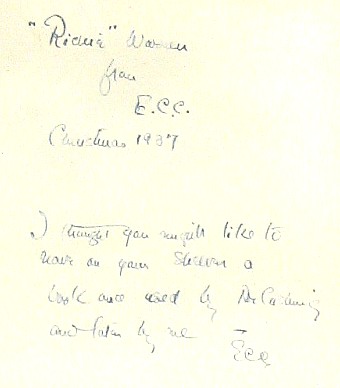
Well-known 19th century French surgeon, Alfred-Armand-Louis-Marie Velpeau’s, “A Treatise on The Diseases of the Breast and Mammory Region.” London: Printed for the Sydenham Society: 1756. Rare book translated from French by Mitchell Henry. Dedicated from esteemed diagnostician Sir William Osler to Harvey Cushing. Cushing, mentored by Osler, won the 1926 Pulitzer Prize for his book on Osler. He passed the edition onto successor Elliot Cutler, who forwarded it to Richard Warren. All were Harvard doctors. Rare Osler-to-Cushing dedication. Sold for $1,353.
FREE APPRAISAL. To buy, auction, sell or consign your item that is for sale, please email your description and photos to [email protected] of Nate D. Sanders Auctions (http://www.NateDSanders.com).
Consign your item at Nate D. Sanders Auctions. Send a description and images of your item to us at [email protected].