
Sell or Auction Your Walter Burley De Vita et Moribus Philosophorum 1470s for up to Over $10,000 or More at Nate D. Sanders Auctions
FREE APPRAISAL. To buy, auction, sell or consign your Walter Burley De vita et moribus philosophorum 1470s that is for sale, please email your description and photos to [email protected] of Nate D. Sanders Auctions (http://www.NateDSanders.com).
Sell Your Walter Burley De Vita et Moribus Philosophorum 1470s
Walter Burley (or Burleigh; c. 1275 – 1344/45) was an English scholastic philosopher and logician with at least 50 works attributed to him. He studied under Thomas Wilton and received his Master of Arts degree in 1301, and was a fellow of Merton College, Oxford until about 1310. He then spent sixteen years in Paris, becoming a fellow of the Sorbonne by 1324, before spending 17 years as a clerical courtier in England and Avignon. Burley disagreed with William of Ockham on a number of points concerning logic and natural philosophy. He was known as the Doctor Planus and Perspicuus.
Below is a recent realized price for a Walter Burley De vita et moribus philosophorum 1470s item. We at Nate D. Sanders Auctions can obtain up to these amounts or more for you:
Walter Burley De vita et Moribus Philosophorum 1470s. Sold for over $10,000.
Here is an example of Walter Burley’s work:

Here are some recent items that our auction house, Nate D. Sanders (http://www.NateDSanders.com) has sold:
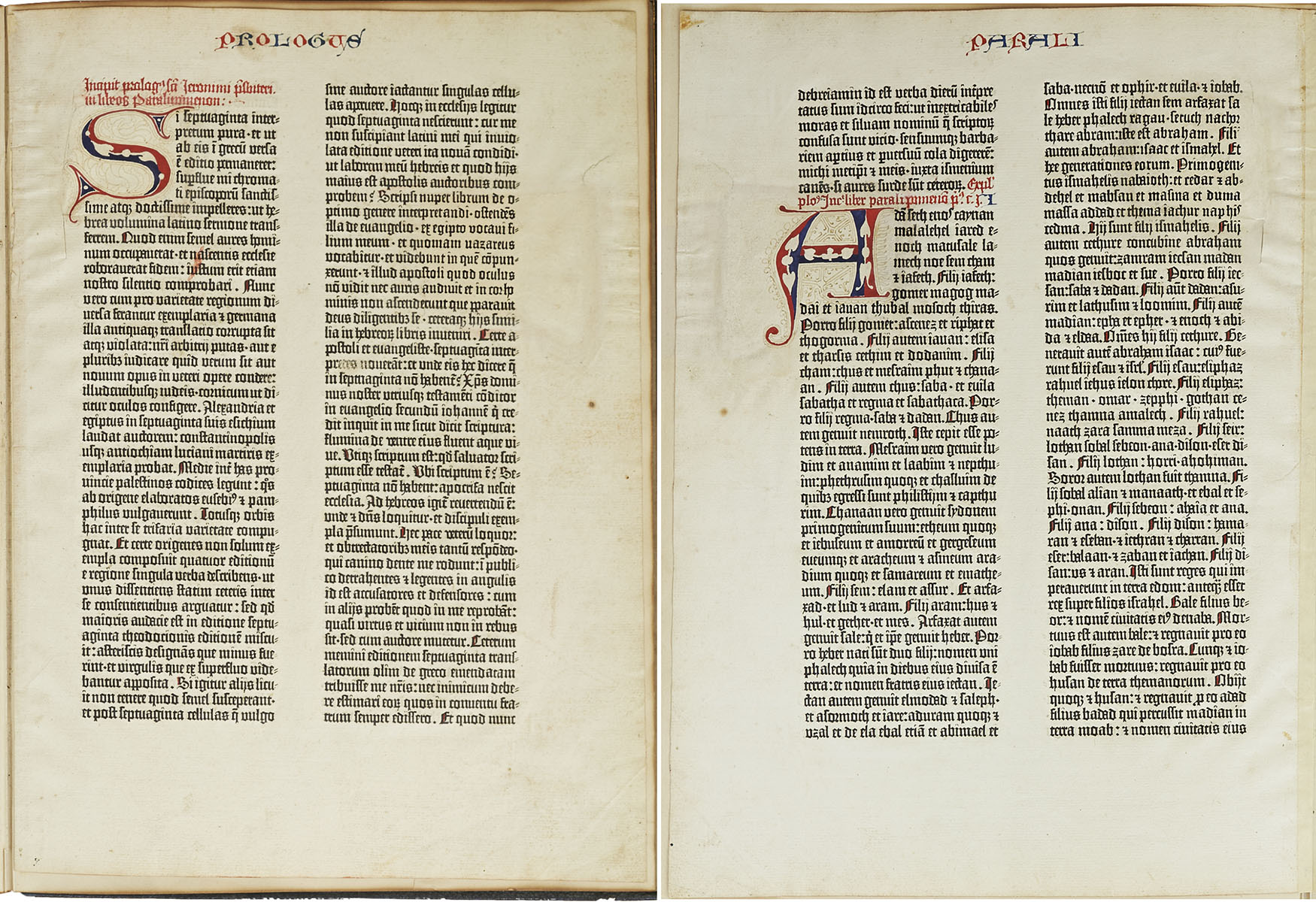
Gutenberg Bible Leaf 193 Chronicles of Old Testament
Scarce leaf from the Gutenberg Bible, one of the earliest major books printed from moveable metal type, the invention that ushered in the Age of Enlightenment by democratizing knowledge through mass production of literature. Printed by Johannes Gutenberg in Mainz, Germany from 1450-1455, less than 50 complete or near-complete copies of the Gutenberg Bible are now extant, with nearly all those housed in public institutions. Singular leaves are also scarce, with the leaf presented here having been acquired by bookseller Gabriel Wells, whose purchase of an incomplete Bible in 1920 gave way to selling the individual leaves alongside an essay by A. Edward Newton entitled “A Noble Fragment”. Leaf is number 193 of the full Latin Bible, with the recto being the Prologue to 1 Chronicles of the Old Testament, and the verso the first part of Chapter 1 of 1 Chronicles. Each page features two columns of 42 lines in dark black Gothic type, accented by red and blue rubrication. Each copy of the Gutenberg Bible differs in its rubrication and illumination, with buyers at the time deciding upon these embellishments after the Bible was printed. The six-line rubricated letters of this leaf were likely added later, restored to match the original style. Leaf measures 11.125″ x 15.375″, bound on edge to portfolio measuring 11.75″ x 16″. Paper quality is still bright with very little foxing or discoloration compared to other examples. A stunning example from the book that changed the course of history. Sold for $136,500.
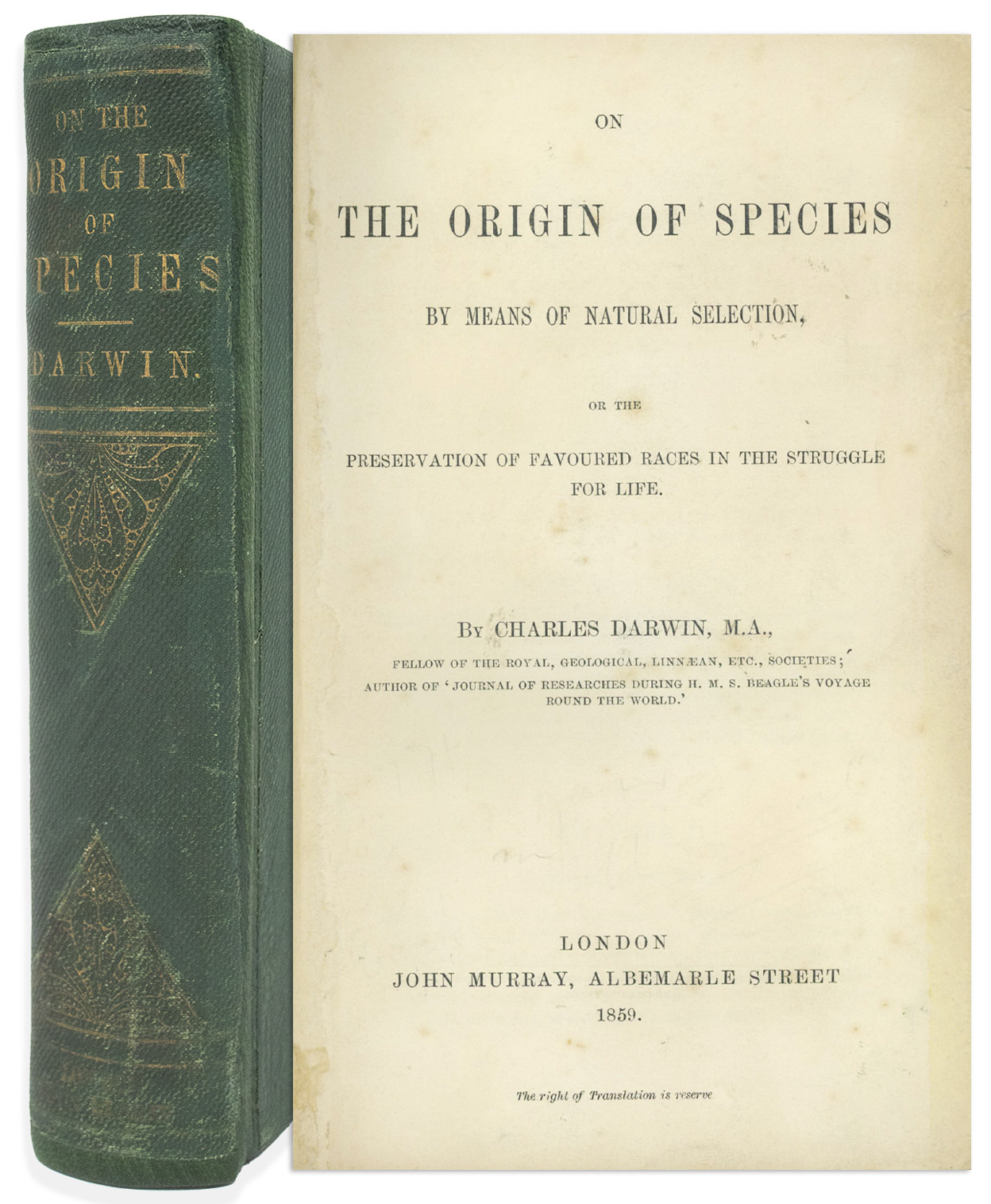
Charles Darwin On the Origin of Species 1st Edition
First edition, first printing of “On the Origin of Species” by Charles Darwin, one of the most important books in the scientific canon. London: John Murray, 1859. In this revolutionary book that upended man’s own view of himself, Darwin posits natural selection as the engine driving species’ evolution, an argument so persuasive that even 19th century religious leaders adjusted their teachings to allow for evolution to work in concert with divine planning. Its importance has only grown in the 150+ years since publication, with Freeman concluding it to be “the most important biological book ever written”. First released on 24 November 1859, its scarcity nearly matches its importance, with the first printing consisting of only 1,250 copies, and the number of extant copies now significantly fewer.
All first printing points are present, including original binding, variant B, title page with copyright information on verso, Table of Contents (pages v-ix) with binder instructions to verso, complete pages 1-502, and folding table present between pages 116-117. Bound in publisher’s full green boards, stamped and lettered in gilt. Overall in very good condition; ads at back of volume have been removed as has half-title page, and endpapers have been replaced. Volume is rebacked using morocco, with original spine laid down. Some shelf wear to boards. Light foxing throughout book, with some chipping, small closed tears with repairs to a few pages, and a few dogeared pages. One small mark on page 109, otherwise no internal writing or marks. Housed in a custom quarter-leather clamshell box. Overall in very good condition, a handsome, presentable copy of this scarce first printing. Sold for $68,250.
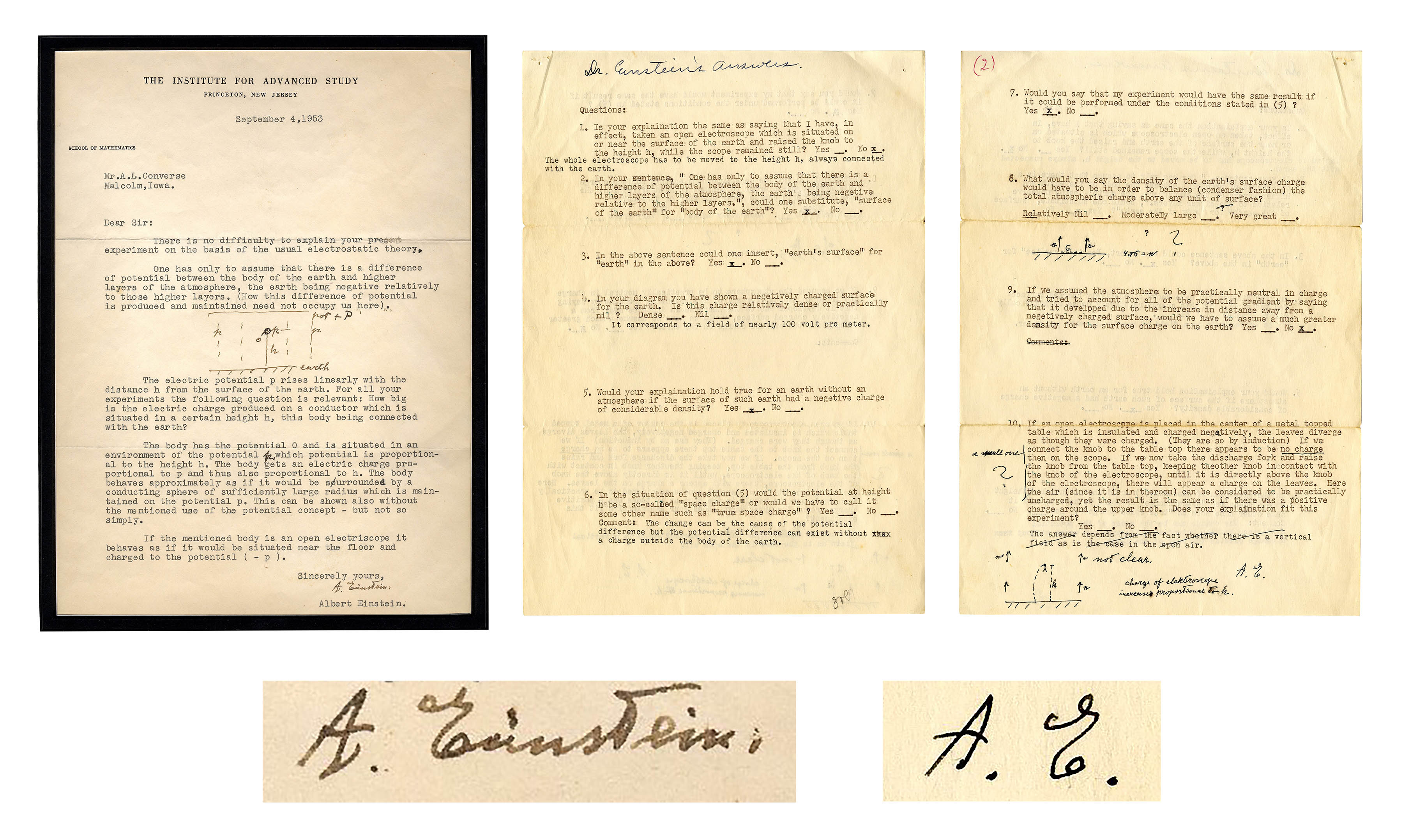
Remarkable Albert Einstein Autograph Letter Signed, Along With His Initialed Drawings — Explaining the Science Behind His Groundbreaking Work on Electrostatic Theory and Special Relativity
Albert Einstein autograph letter signed with his hand drawings, elegantly explaining his electrostatic theory of special relativity to a physics teacher struggling to reconcile it with experiments he was conducting. In addition to the letter, which is new to the market, Einstein generously replies to a series of questions the teacher asks him on a questionnaire, providing additional drawings and calculations, initialed ”A.E.” at the conclusion. Dated 4 September 1953 on Princeton’s Institute for Advanced Study letterhead, Einstein writes to Arthur L. Converse, the teacher from Malcolm, Iowa, in part, ”There is no difficulty to explain your present experiment on the basis of the usual electrostatic theory. One has only to assume that there is a difference of potential between the body of the earth and higher layers of the atmosphere, the earth being negative relatively to those higher layers…[Einstein then draws Earth and the atmosphere, referring to it for clarification] The electric potential p rises linearly with the distance h from the surface of the earth…For all your experiments the following question is relevant: How big is the electric charge produced on a conductor which is situated in a certain height h, this body being connected with the earth…” Einstein then answers Converse’s questions on a two-page questionnaire. In one answer, Einstein seems to disagree with the question, providing both a diagram and mathematical equation and then a ”?” to try to aid understanding. He later writes ”not clear” to one answer along with a question mark and additional diagram with the notation ”charge of elektroscope increased proportional to h”. An extraordinary lot by Einstein showing the generosity of his time, with rare content on his theory of special relativity. Single page letter and two-page questionnaire each measures 8.5” x 11”. Also included is Einstein’s original mailing envelope from ”Room 115” of the Institute for Advanced Study, postmarked 7 September 1953 from Princeton. Folds and very light toning to letter, otherwise near fine. Questionnaire has folds, light toning and staple mark, otherwise near fine with bold handwriting by Einstein. Dark Albert Einstein autograph. With an LOA from the nephew of Arthur Converse and new to the market.Sold for $53,504.
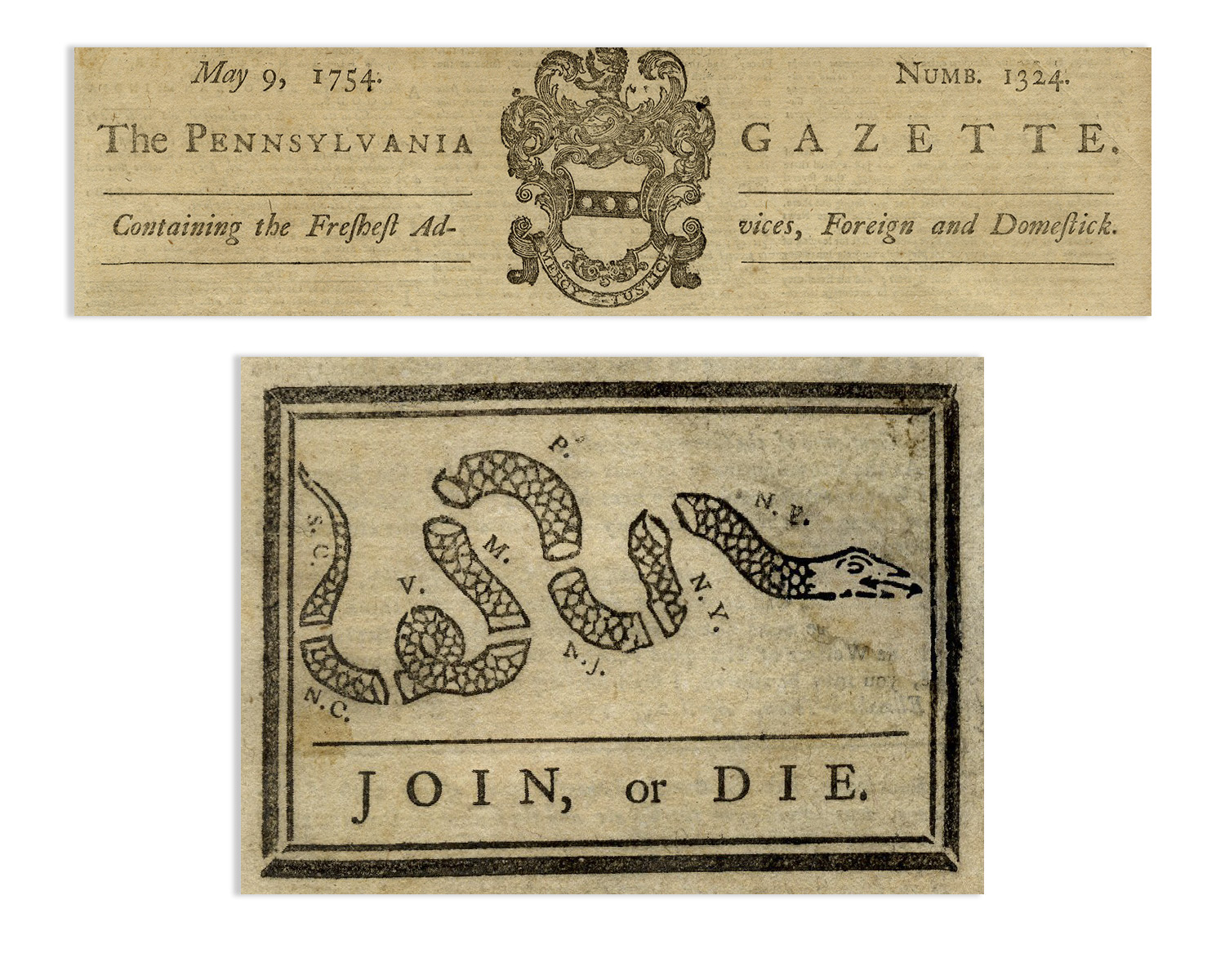
”JOIN, or DIE” Newspaper From Benjamin Franklin’s ”Pennsylvania Gazette” in 1754 — The Most Influential Political Cartoon in America’s History & Only Known Copy Apart From the Library of Congress
The most influential political cartoon in the history of America, the ”JOIN, or DIE” severed rattlesnake designed by Benjamin Franklin and published in his ”Pennsylvania Gazette” on 9 May 1754. This incredibly scarce newspaper is the very first printing of the ”JOIN, or DIE” cartoon, and the only known copy apart from one other housed in the permanent collection at the Library of Congress. Sold for $50,000.
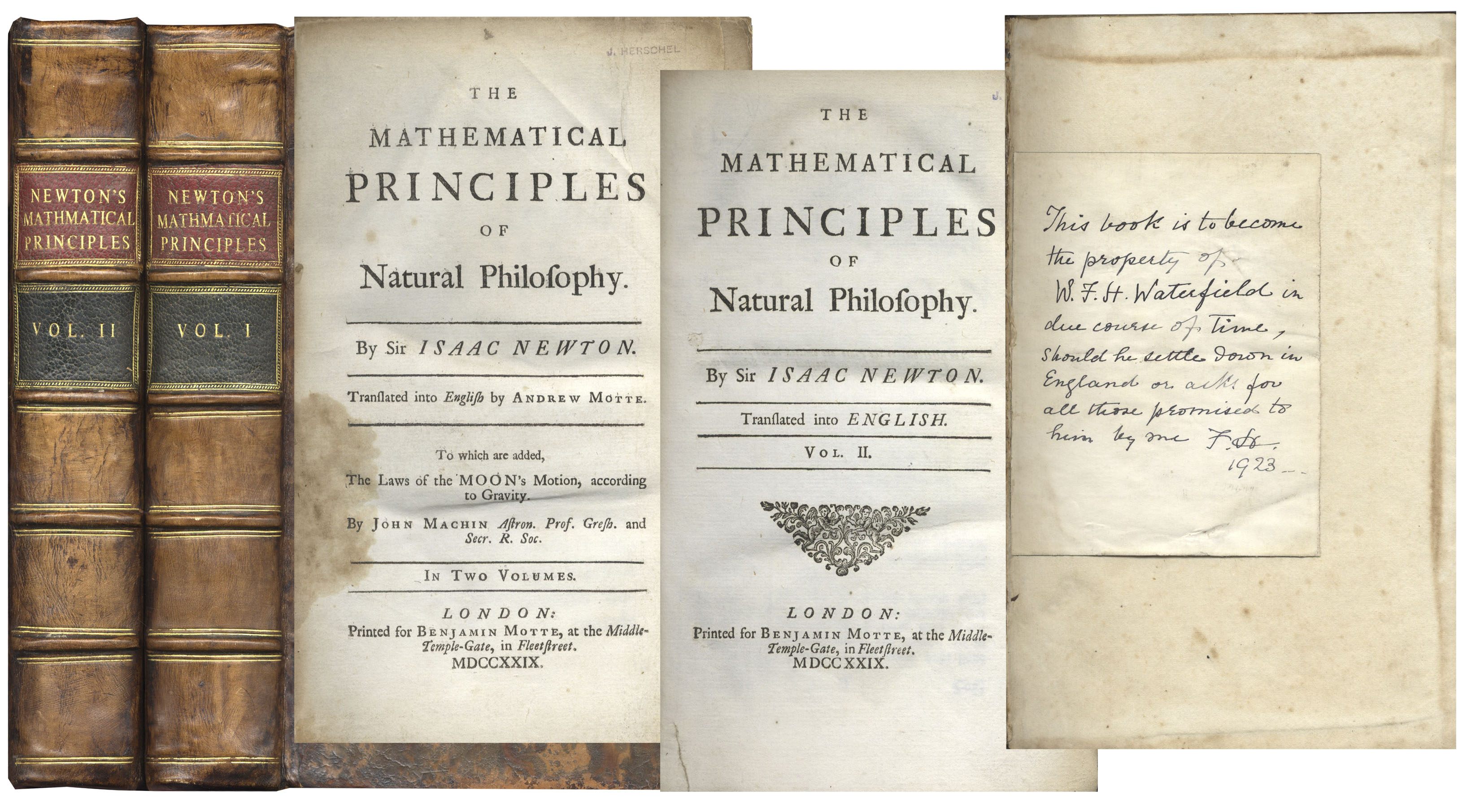
First edition of Sir Isaac Newton’s ”The Mathematical Principles of Natural Philosophy” in two volumes. London: Benjamin Motte, 1729. One of the most important works by the leading mind of the 18th century scientific revolution. Bound in contemporary tree calf, sympathetically rebacked, with gilt tooling to spines. Two octavo volumes measure 5.5” x 8.5” each. Volumes contain two folding letterpress tables and 47 folding engraved plates; the two frontispieces and pp. 385-393 and first 7pp. of index are replaced in facsimile, but hardly distinguishable from the original. The ”Laws of Moon’s Motion” usually found in Vol. II are here bound at end of Vol. I, and with errata for both volumes on verso of E4. Small stain to inner part of title in Vol. I, short tear to lower margin of G1, small section missing from lower margin of M3 and with lower corner cut away of A8 and C4 of ”Laws of Moon’s Motion” (no loss of text). Some marginal dampstaining and occasional soiling and spotting, overall in very good, clean condition with most edges untrimmed. Sold for $22,500.
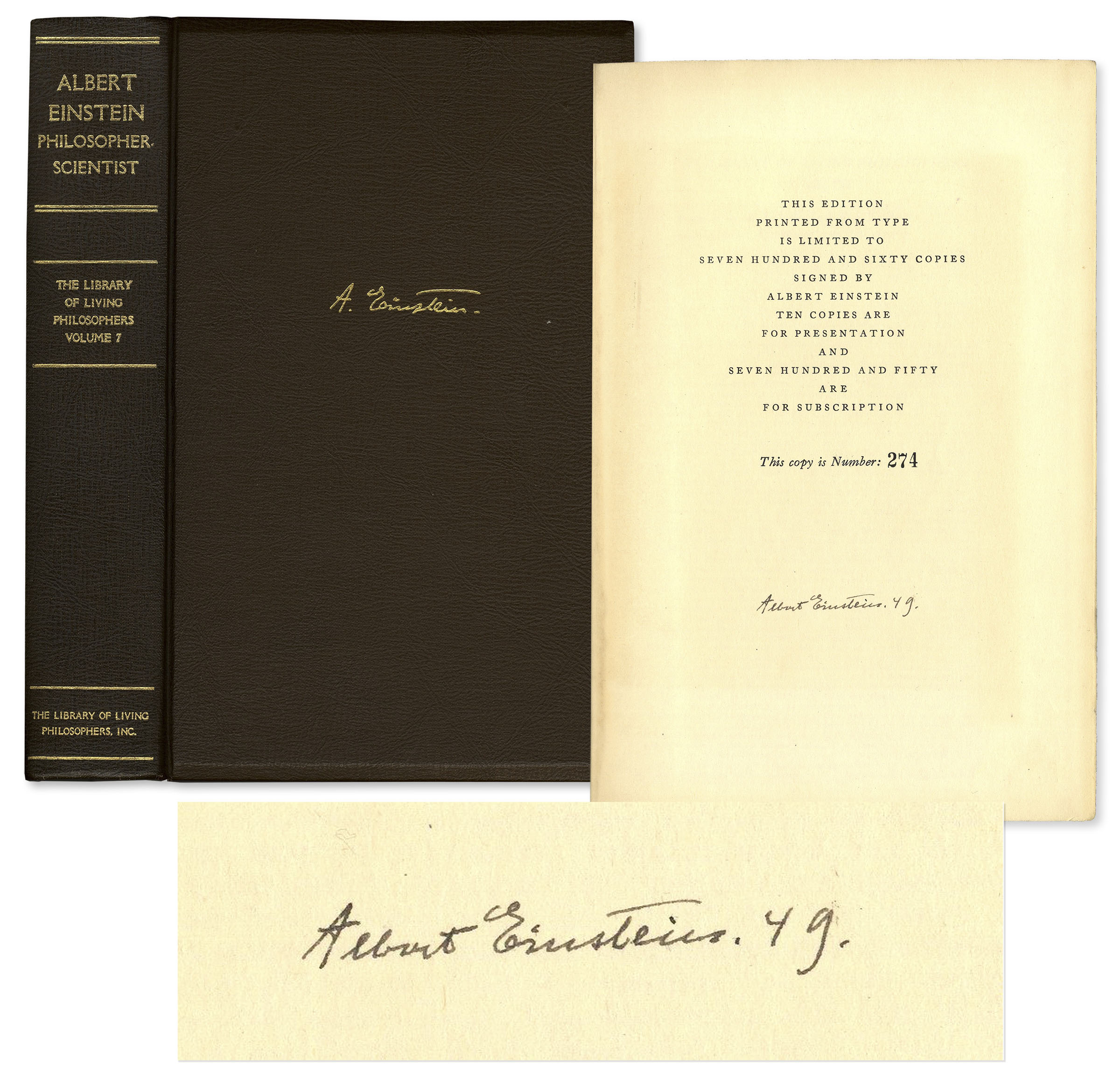
Albert Einstein signed limited edition of ”Albert Einstein: Philosopher Scientist”. Published by The Library of Living Philosophers Inc: Evanston, Illinois: 1949. Einstein signs ”Albert Einstein. 49.” upon the limitation page, underneath its identification as #274 of 760 copies. Bound in brown leather boards, with a gold facsimile of Einstein’s signature on the front. Runs 781pp. and measures 6.5” x 9.5”. Very slight toning. Near fine. Sold for $4,688.
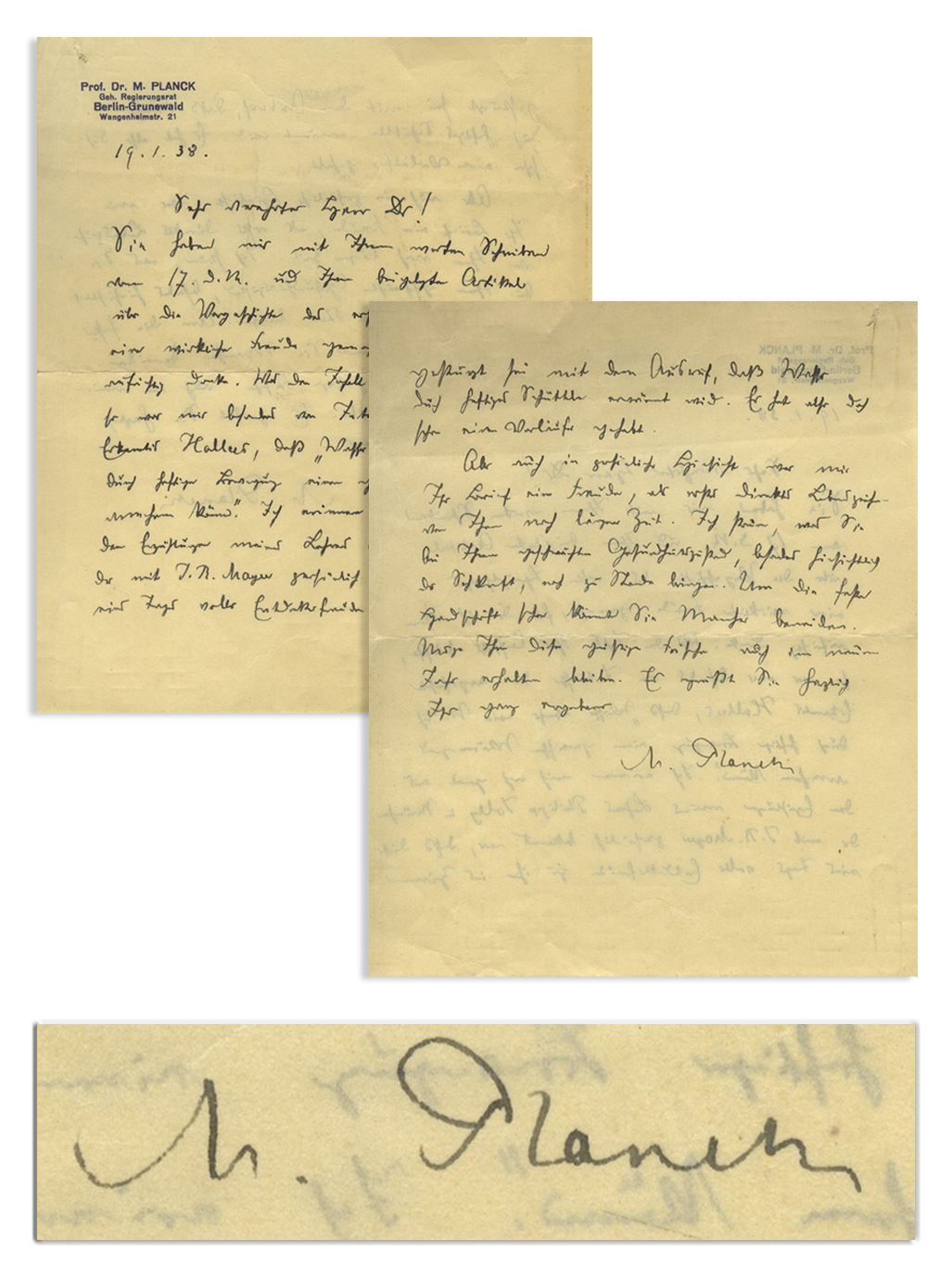
Max Planck Autograph Letter Signed, Musing on the First Law of Thermodynamics — ”…Mayer had burst into his room exclaiming…that water could be warmed by means of vigorous shaking…”
Lively autograph letter signed by Nobel winning quantum physicist pioneer Max Planck, who writes to fellow physicist Paul Epstein. Dated 19 January 1938, Planck muses on the first law of thermodynamics (before it was recognized as such), responding to Epstein’s mention of the 18th century scientist Albrecht von Haller learning that liquid warms by shaking. On Planck’s personal stationery, letter in German reads in full, ”Dear Doctor! / Your kind letter of the 17th of this month and the attached article on the background of the first fundamental theorem gave me great pleasure, for which I thank you sincerely. Concerning the content of your essay, your mentioning of [Albrecht von] Haller’s finding that ‘water, as well as milk, when moved vigorously, could reach a certain degree of warmth,’ was of particular interest to me. I remember exactly one of the stories told by my teacher in Munich, Philipp [von] Jolly, who was personally acquainted with J. R. [Julius Robert von] Mayer, relating that one day Mayer had burst into his room exclaiming, full of a discoverer’s joy, that water could be warmed by means of vigorous shaking. So someone else had already arrived there first after all. / But your letter made me happy in personal terms as well, since it was the first direct sign of life from you after some time. I am in awe about how much, considering your weakened physical condition, particularly with respect to your vision, you are still able to achieve. Many would envy even your firm handwriting. May this mental acuity remain with you during the new year as well. Very warm regards. / Yours respectfully, / M. Planck”. Two page letter on a single sheet measures 5.875” x 7”. Single fold, staple puncture and light toning. Very good condition. Sold for $2,500.
Consign your Walter Burley De vita et moribus philosophorum 1470s at Nate D. Sanders Auctions. Send a description and images of your item to us at [email protected].
FREE APPRAISAL. To buy, auction, sell or consign your Walter Burley De vita et moribus philosophorum 1470s that is for sale, please email your description and photos of yourJohn of Walter Burley De vita et moribus philosophorum 1470s to [email protected] of Nate D. Sanders Auctions (http://www.NateDSanders.com).