
Sell or Auction Your Saturn Apollo Applications Cluster Configuration Model for up to Nearly $12,500 or More at Nate D. Sanders Auctions
FREE ESTIMATE. To buy, auction, sell or consign your Saturn Apollo Applications Cluster Configuration Model that is for sale, please email your description and photos to [email protected] of Nate D. Sanders Auctions (http://www.NateDSanders.com).
Below are some recent realized prices for a Saturn Apollo Applications Cluster Configuration Model. We at Nate D. Sanders Auctions can obtain up to these amounts or more for you:
- Saturn Apollo Applications Cluster Configuration Model Circa Late 1960s. Sold for Nearly $12,500.
- Saturn Apollo Applications Cluster Configuration Model Circa Late 1960s. Sold for Nearly $8,000.
We have sold the following space memorabilia:
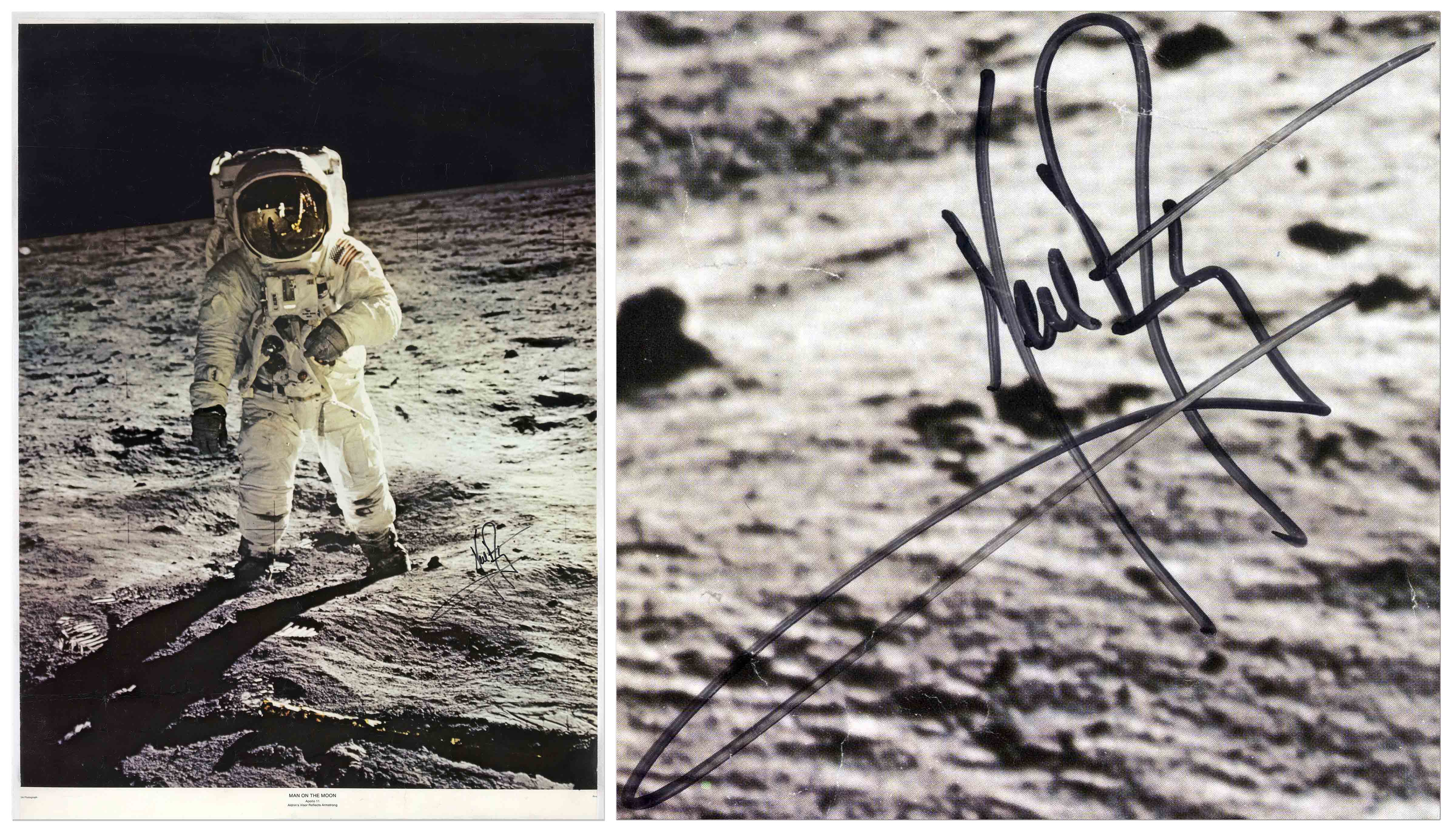
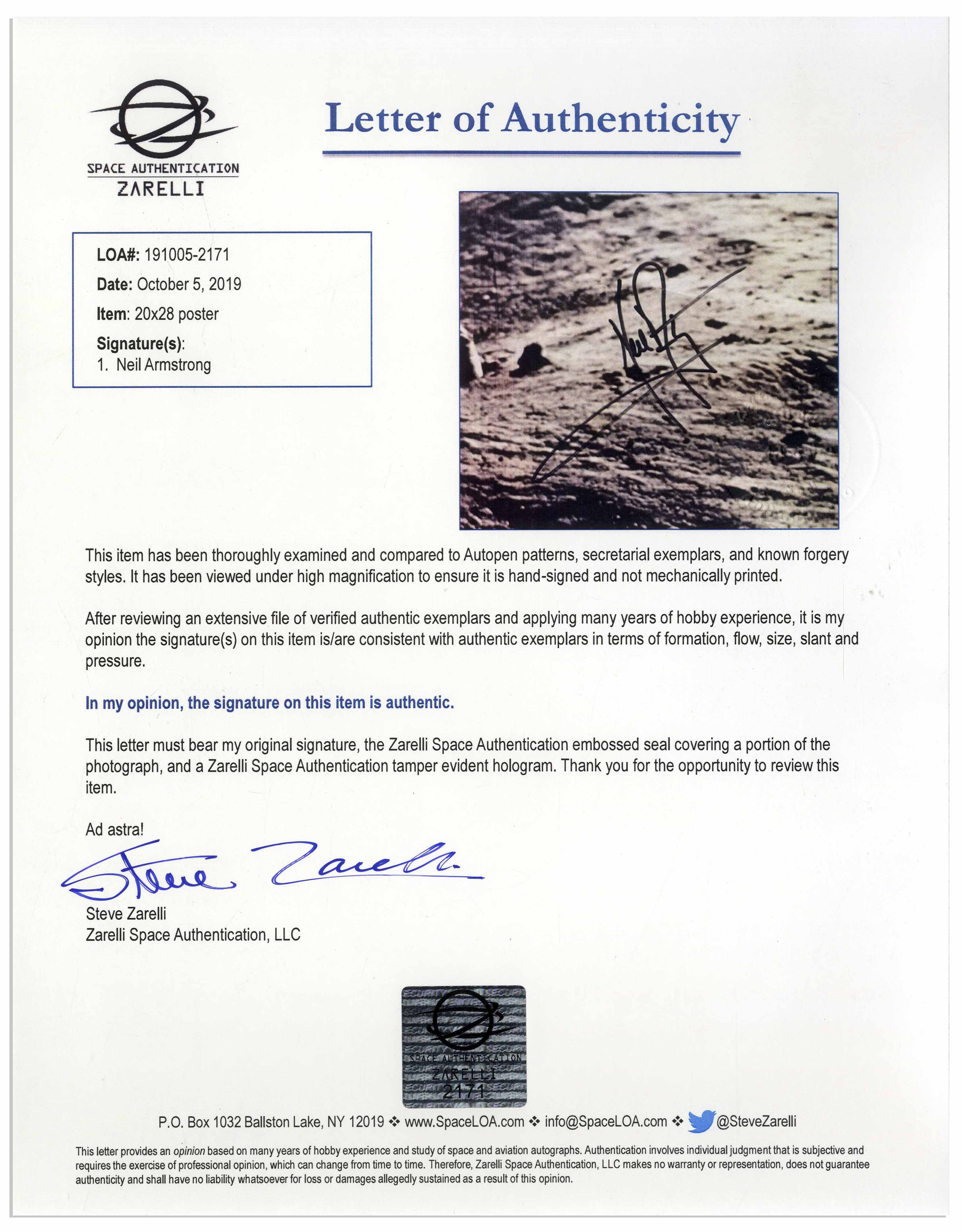
Exceptionally Rare Neil Armstrong Signed Poster, Measuring 20.25” x 27.75” — With Steve Zarelli COA
Scarce Neil Armstrong signed poster entitled ”Man on the Moon”, the famous photograph taken by Armstrong showing Buzz Aldrin on the moon with Armstrong reflected in Aldrin’s visor. Armstrong boldly signs the poster in black marker, providing a stunning presentation measuring 20.25” x 27.75”. Poster is archivally paper backed, with creasing smoothed and indiscernible closed tear repaired at top. Very good plus condition. With a COA from Steve Zarelli Space Authentication. Sold for $18,750.
Lot of 6 Space Flown Patches From Apollo 13 With a Letter of Provenance in the Hand of Jack Swigert
Lot of 6 official patches flown in space on the near-disastrous Apollo 13 mission in 1970. Round patches are embroidered with mission slogan ”Ex Luna, Scienta”, meaning ”from the moon, knowledge” surrounding dynamic mission insignia: a trio of horses galloping over the moon. Five are identical, with embroidery in orange, yellow, brown, black, white and blue with sparkly silver border. The remaining patch is the same design but crafted in muted earth tones. Accompanied by a handwritten authenticity note in Swigert’s hand on U.S. House of Representatives Committee on Science and Technology letterhead. Each patch measures just over 4” in diameter. Fine. With an LOA from Jack Swigert’s estate. Sold for $8,438.

Model Vanguard 1 satellite from the Navy Research Laboratory, the firm that built the satellites of Project Vanguard. Vanguard 1 was launched on 17 March 1958, shortly after the Soviet launch of Sputnik kicked off the Space Race. The United State’s first successful satellite launch after Explorer, Vanguard 1 remains in orbit today, holding the record for longest-orbiting satellite made by man. Model satellite features a spherical shell, with one half made of metal and the other half rendered in clear plastic to reveal the mechanics within. Secured at the center, a clear cylinder which contains seven numbered layers of colored sponges represents the hermetically sealed mercury cell battery container and radio transmitter machinery used in the space-bound version. Wires connect the payload to six terminals on the exterior that represent the six solar cell clusters by which the satellite was powered as the first ever satellite to employ solar power. With a 22” diameter, model satellite is much larger in scale than its counterpart in orbit, which was nicknamed by Kruschev the ”grapefruit satellite” for its petite size. Model is mounted to a 2” tall transparent base that contains a plaque reading in full, ”Full Scale Model / Scientific Earth Satellite / Designed and Built by Project Vanguard / US Naval Research Laboratory / Washington D.C.” An important piece of pre-NASA space history in near fine condition. With provenance from the family of Howard Tihila, Office of International Science Activities for the National Science Board, the government agency that backed Project Vanguard. Sold for $5,530.

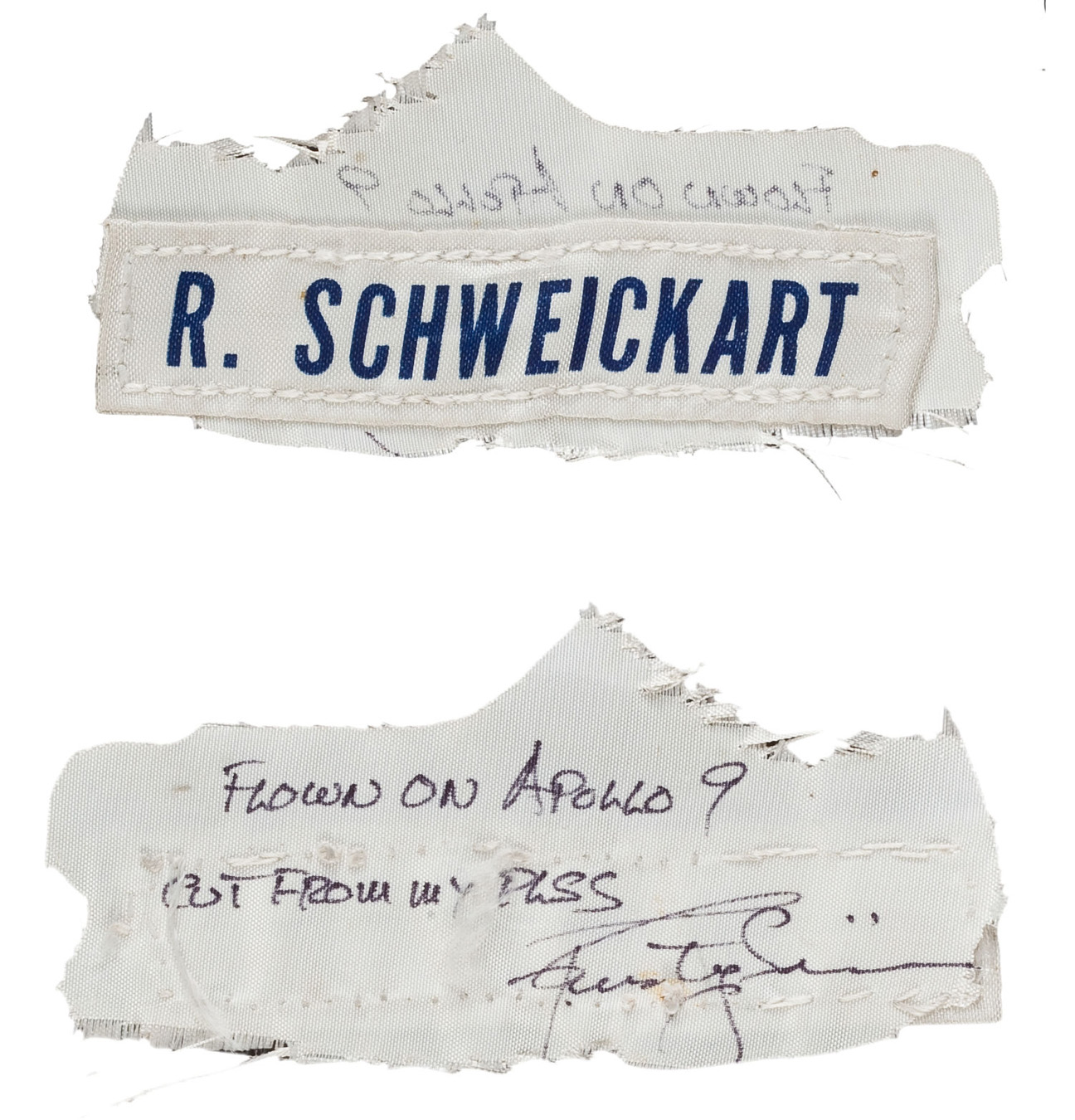
Apollo 9 flown name tag patch from astronaut Rusty Schweickart’s PLSS. Schweickart signs on the verso, ”Flown on Apollo 9 / Cut from my PLSS / Rusty Schweickart”. This patch was just below the NASA insignia. The portable life support system (PLSS) is the backpack of the spacesuit, providing essentially the same functions as the spacecraft life support system in a smaller, wearable package. The 6 March 1969 Apollo 9 mission tested several aspects critical to landing on the moon, including the lunar module engines, backpack life support systems, navigation systems and docking maneuvers. It was the first flight of the Command/Service Module with the Lunar Module. Schweickart piloted the Lunar Module and tested the PLSS for the first time when he left the Lunar Module Spider untethered for a space walk. This was the first (and only) time the PLSS was tested in space before an actual lunar landing. The 4.25” x 1” ”R. SCHWEICKART” name tag patch is sewn onto a slightly larger, irregularly cut swatch. Both are Beta cloth, a fabric fireproof up to 650 degrees Celsius used in Apollo spacesuits after the fatal 1967 Apollo 1 fire. Fine condition. Sold for $4,229.
FREE ESTIMATE. To buy, auction, sell or consign your Saturn Apollo Applications Cluster Configuration Model that is for sale, please email your description and photos to [email protected] of Nate D. Sanders Auctions (http://www.NateDSanders.com).
We offer the following services for your Saturn Apollo Applications Cluster Configuration Model:
- Appraise Saturn Apollo Applications Cluster Configuration Model.
- Auction Saturn Apollo Applications Cluster Configuration Model.
- Consign Saturn Apollo Applications Cluster Configuration Model.
- Sell Saturn Apollo Applications Cluster Configuration Model.