
How to Sell Your WWII Memorabilia
To auction, sell or consign your WWII memorabilia, please email your description and photos to [email protected] of Nate D. Sanders Auctions (http://www.NateDSanders.com).
Here Are Some WWII Items We’ve Sold:
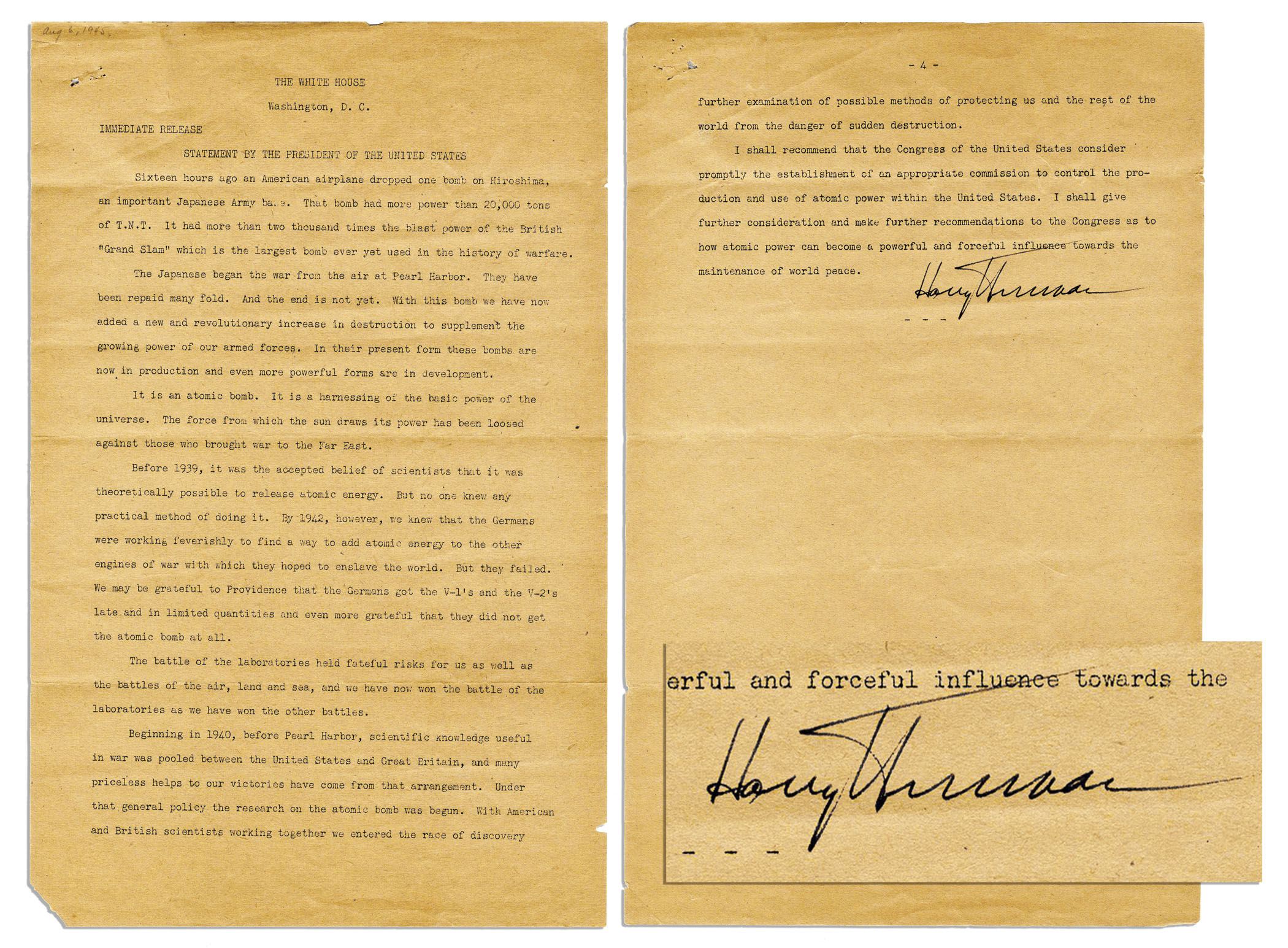
President Harry Truman Hiroshima Signed the Original Press Release Announcing the First Use of Atomic Weaponry — “…Hiroshima…may expect a rain of ruin from the air…”
Harry Truman Hiroshima signed press release, publicly announcing the very first use of the nuclear bomb, dropped upon Hiroshima on 6 August 1945. Document signed “Harry Truman” is the press release of Truman’s announcement, the gravest and most controversial decision of his Presidency, perhaps of any 20th century President. Four page press release reads in part, “Sixteen hours ago an American airplane dropped one bomb on Hiroshima, an important Japanese army base. That bomb had more power than 20,000 tons of T.N.T. It had more than two thousand times the blast power of the British ‘Grand Slam’ which is the largest bomb ever yet used in the history of warfare. The Japanese began the war from the air at Pearl Harbor. They have been repaid many fold. And the end is not yet. With this bomb we have now added a new and revolutionary increase in destruction to supplement the growing power of our armed forces. In their present form these bombs are now in production and even more powerful forms are in development. It is an atomic bomb. It is a harnessing of the basic power of the universe. The force from which the sun draws its power has been loosed against those who brought war to the Far East. Before 1939, it was the accepted belief of scientists that it was theoretically possible to release atomic energy. But no one knew any practical method of doing it. By 1942, however, we knew that the Germans were working feverishly to find a way to add atomic energy to the other engines of war with which they hoped to enslave the world. But they failed. We may be grateful to Providence that the Germans got the V-1’s and the V-2’s late and in limited quantities and even more grateful that they did not get the atomic bomb at all. The battle of the laboratories held fateful risks for us as well as the battles of the air, land and sea, and we have now won the battle of the laboratories as we have won the other battles. Beginning in 1940, before Pearl Harbor, scientific knowledge useful in war was pooled between the United States and Great Britain and many priceless helps to our victories have come from that arrangement. Under that general policy the research on the atomic bomb was begun. With American and British scientists working together we entered the race of discovery against the Germans…We have spent two billion dollars on the greatest scientific gamble in history – and won…What has been done is the greatest achievement of organized science in history. It was done under high pressure and without failure…We are now prepared to obliterate more rapidly and completely every productive enterprise the Japanese have above ground in any city. We shall destroy their docks, their factories, and their communications. Let there be no mistake; we shall completely destroy Japan’s power to make war. It was to spare the Japanese people from utter destruction that the ultimatum of July 26 was issued at Potsdam. Their leaders promptly rejected that ultimatum. If they do not now accept our terms they may expect a rain of ruin from the air, the like of which has never been seen on this earth…It has never been the habit of the scientists of this country or the policy of this Government to withhold from the world scientific knowledge…But under present circumstances it is not intended to divulge the technical processes of production of production or all the military applications, pending further examination of possible methods of protecting us and the rest of the world from the danger of sudden destruction. I shall recommend that the Congress of the United States consider promptly the establishment of an appropriate commission to control the production and use of atomic power within the United States. I shall give further consideration and make further recommendations to the Congress as to how atomic power can become a powerful and forceful influence towards the maintenance of world peace.”
Boldly signed “Harry Truman” on fourth and last page of document which measures 8″ x 12.5″. Some toning, staple mark to upper left corner, folds and small tears to edge. Overall in very good condition, housed in a blue cloth clamshell box. With a typed cover letter signed “S. Tucker” on National Press Club letterhead, presenting the document. Sold for $54,000.
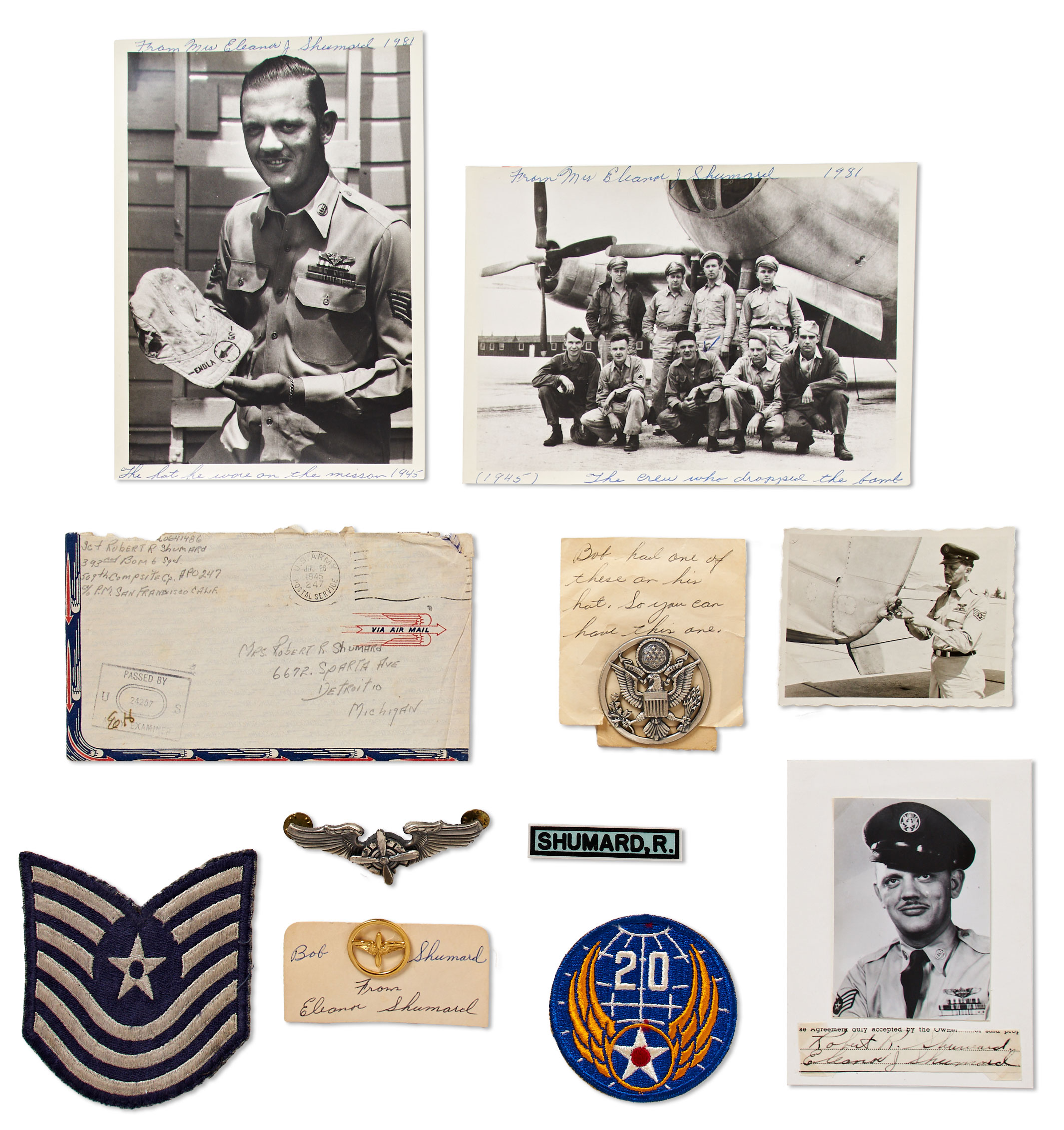
Rare personally owned archive from Robert Shumard, one of the nine men aboard the Enola Gay during the first atomic bombing on Hiroshima on 6 August 1945. Items owned or signed by Shumard are quite scarce, as he passed away from stem-cell leukemia in 1967, discovered to be related to his radiation exposure during his service.
Several of Shumard’s military insignia are included in the lot: his 20th Air Force shoulder patch, the arm of the Air Force responsible for the operational functionality of the Manhattan Project; Air Force Master Sergeant shoulder patch; Air Force Flight Engineer Aircrew Badge, in the form of wings with propeller and radial engine; Air Force enlisted dress hat pin; Air Force collar insignia pin; Air Force name tag.
Lot also includes 20 photos, most of Shumard and his wife Eleanor, with several identified from Wendover, Utah in 1945, where the 509th Composite Group trained prior to the bombing missions. One photo measuring 7” x 5” shows the crew of the Enola Gay, notated as ”(1945) The crew who dropped the bomb”. Other photos show Shumard holding the hat he wore during the Enola Gay mission, working on an Air Force plane, and in military uniform (with his clipped signature below).
Other items include a postal cover twice signed by Shumard, postmarked 26 July 1945 from San Francisco, just days before the mission, and a funeral mass booklet from Shumard’s funeral. Archive remains in very good to near fine condition. Sold for $7,500.
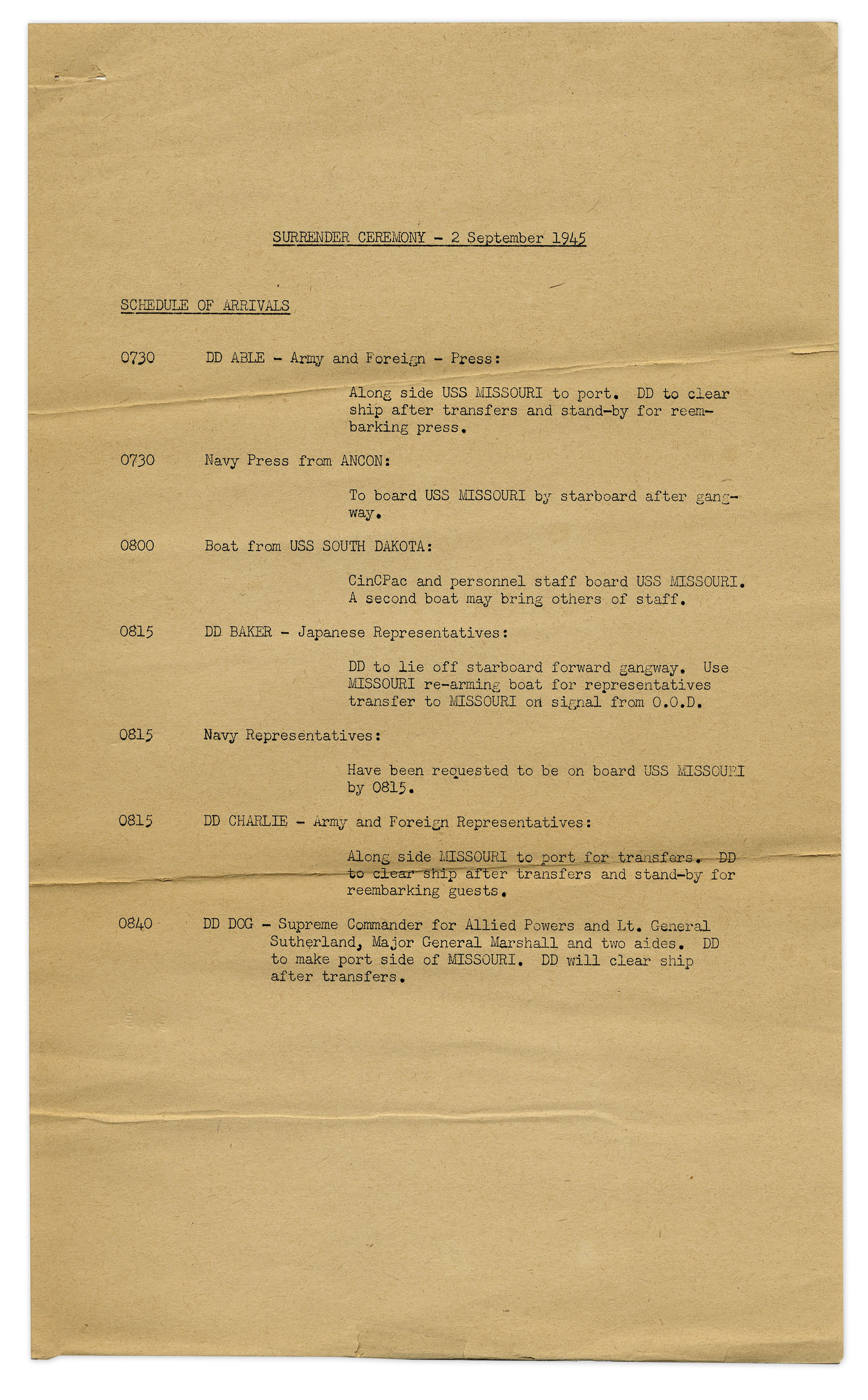
Original Program From the WWII Japanese Surrender Ceremony — 2 September 1945 on the USS Missouri
Informal ”Surrender Ceremony” program from the WWII Japanese surrender, listing the ”Schedule of Arrivals” and protocol for the military officers attending the event aboard the USS Missouri. Typed one page document is dated 2 September 1945, and features detailed activities from the hours of 0730 to 0840. Measures 8” x 13”. Toning and folds as well as staple holes and various small closed tears. Very good. From the estate of U.S. Naval Commodore Jasper Acuff, who attended the event. Sold for $6,250.
WWII Japanese Surrender ceremony document owned by Commodore Jasper Acuff, who was aboard the USS Missouri during the ceremony. Five-page document lists the schedule of arrivals and protocol for military representatives, as well as a schedule of events and changes in the event of rain. Internal military document is dated 2 September 1945. Pages measure 8” x 13”, stapled together. Toning and folds as well as slight creasing and small tears to edges. Very good. From the estate of WWII Commodore Jasper Acuff. Sold for $4,868.

Original ceremony card from the formal Japanese surrender ceremony on 2 September 1945. Card certifies the presence of Commodore Jasper T. Acuff, who was aboard the USS Missouri during the ceremony. Card interestingly bears the symbol of the Japanese empire, and features facsimile signatures of Captain Stuart S. Murray, General Douglas MacArthur, Fleet Admiral Chester W. Nimitz and Admiral William F. Halsey. Lot also includes a copy of the Instrument of Surrender, possibly from the day, printed on glossy white paper. Card measures 3.75” x 2.5”. Toning, otherwise near fine. Sold for $3,750.


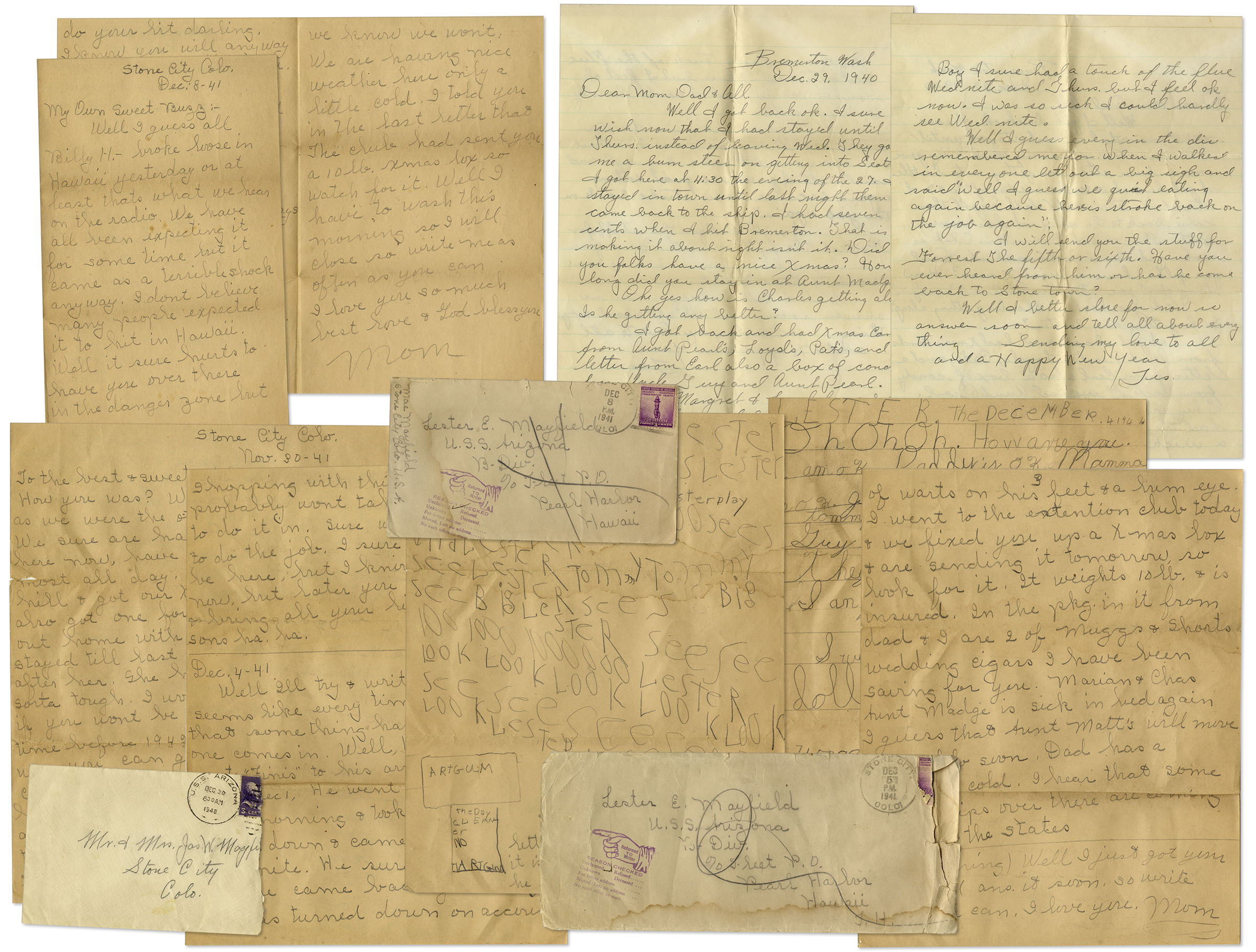
1940 Letter Aboard the U.S.S. Arizona, Sunk in Pearl Harbor Attack — With U.S.S. Arizona Postmark on Envelope — Also Includes 2 Letters Addressed to Ship, One the Day After Pearl Harbor
Lot of 3 letters and envelopes from and to Lester E. Mayfield, a First Class Navyman who was killed on 7 December 1941 on the U.S.S. Arizona, which was sunk during the attack on Pearl Harbor. One letter is from Mayfield aboard the U.S.S. Arizona in December 1940 and two are from his family to him, dated 5 & 8 December 1941, 2 days before Pearl Harbor and the day after. Both these letters are addressed to Mayfield on the U.S.S. Arizona. The letter by Mayfield to his family is housed in its envelope, postmarked 30 December 1940 aboard the U.S.S. Arizona. Letter reads in part, “Well I got back ok. I sure wish now that I had stayed until Thurs. instead of leaving Wed. They gave me a bum steer on getting into Seattle. I got here at 4:30 the evening of the 27. I stayed in town until last night then came back to the ship. I had seven cents when I hit Bremerton. That is making it about right isn’t it. Did you folk have a nice Xmas? How long did you stay in at Aunt Madges? Oh yes how is Charles getting along? Is he getting any better? I got back and had Xmas cards from Aunt Pearl’s, Loyd’s, Pat’s, and a letter from Earl also a box of candy from Uncle Guy and Aunt Pearl. They said Margaret & Loyd have both had the flue and been in be[d] for a week but both are better now. Boy I sure had a touch of the flue Wed. nite and Thurs. but I feel ok now. I was so sick I could barely see Wed. nite. Well I guess every in the div. [B Division] remembered me for when I walked in every one let out a big sigh and said ‘Well I guess we quit eating again because here is stroke back on the job again.’ I will send you the stuff for Forrest the fifth or sixth. Have you ever heard from him or has he come back to Stone Town? Well I better close for now so answer soon and tell all about every thing. Sending my love to all and a Happy New Year. Les.” Two page letter measures 8″ x 10.5″. Written in pencil with light toning, else near fine. Of the 2 letters to Mayfield, one is a poignant letter from Mayfield’s mom, dated one day after Pearl Harbor on 8 December 1941. She clearly doesn’t know that the U.S.S. Arizona was destroyed in the attack and believes he is still alive. Letter reads in part, “My own sweet Buzz– Well I guess all Billy H. broke loose in Hawaii yesterday or at least that’s what we hear on the radio. We have all been expecting it for some time but it came as a terrible shock anyway. I don’t believe many people expected it to be hit in Hawaii. Well it sure hurts to have you over there in the danger zone but do your bit darling. I know you will anyway with out me telling you. Jimmie says he is going as soon as he is old enough…Sure is going to be a blue Xmas in the Old U.S.A. this year but not because we feel we will lose because we know we won’t…I love you so much best love and God bless you / Mom”. Envelope includes returned to writer stamp as the U.S.S. Arizona was no longer a legitimate address. 3pp. letter is written in pencil on brown card-style paper. Measures 5.5″ x 8.5″. Folds and toning, very good condition. Final letter postmarked 5 December 1941, 2 days prior to the attack on Pearl Harbor, was also sent from Lester’s mother in Stone City, Colorado. 5pp. letter written in pencil on brown paper reads in part, “To the best and sweetest boy in the Navy…We went up the hill and got our Xmas tree today…Chas. sure is anxious for you to come home…I sure wish you could be here, but I know it is impossible now…” Last 2 pages are written by Madge and Tiny Tim, presumably Lester’s younger siblings. Envelope includes return to writer stamp, as it was ostensibly received in Hawaii after the attack on Pearl Harbor. Measures 8.75″ x 11″, in very good condition. Sold for $3,414.
Winston Churchill Signed “The Second World War” — Volume I: “The Gathering Storm”
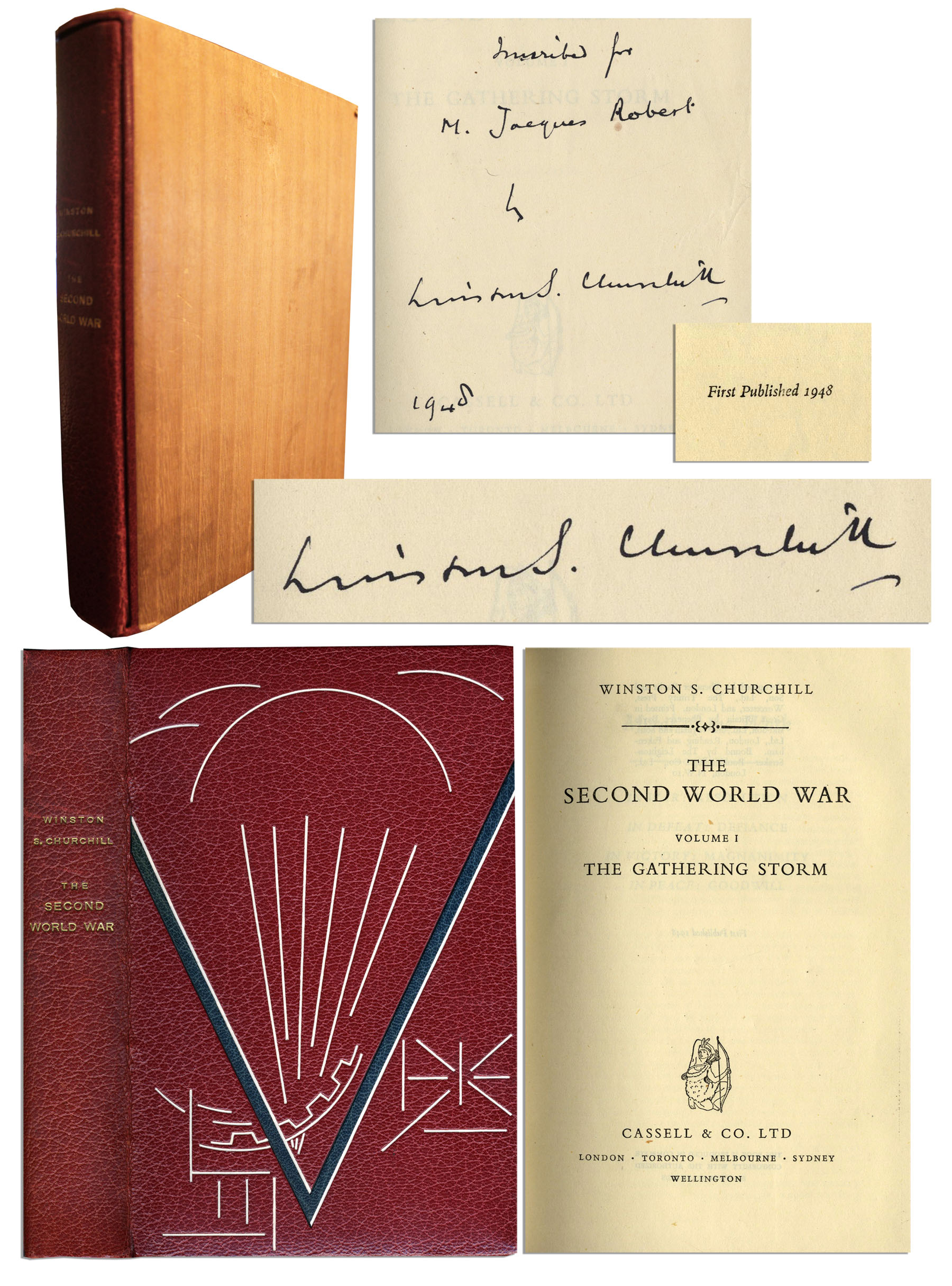
Winston Churchill signs a copy of Volume I of his memoir “The Second World War.” Cassell & Co. Ltd: London: 1948. The volume, entitled “The Gathering Storm,” is signed upon the half title page: “Inscribed for M. Jacques Robert by Winston S. Churchill / 1948”. The theme of the book, covering the years from WWI to 1940, is “how the English-speaking peoples through their unwisdom, carelessness and good nature allowed the wicked to rearm.” Churchill was no longer Prime Minister when he wrote his six volume memoir, and controversy erupted over his use of official records to write his book. He was, however, granted special access by Prime Minister Clement Attlee because of Churchill’s exceptional status. The elegantly bound volume with 5.5″ x 8.25″ red boards and gold edges is housed in its original wooden slipcase. Overall in very good condition. A riveting signed account of WWII signed by England’s tireless guardian. Sold for $2,756.
World War II Pearl Harbor Diary — “…Hurriedly I put on my clothing and ran outside to see the air full of 50 cal. Machine gun shells and anti-aircraft shells exploding in the air. The sky was literally full of exploding shells and diving Japanese planes. The planes they flew were carrying the Japanese insignia of the Rising Sun…”
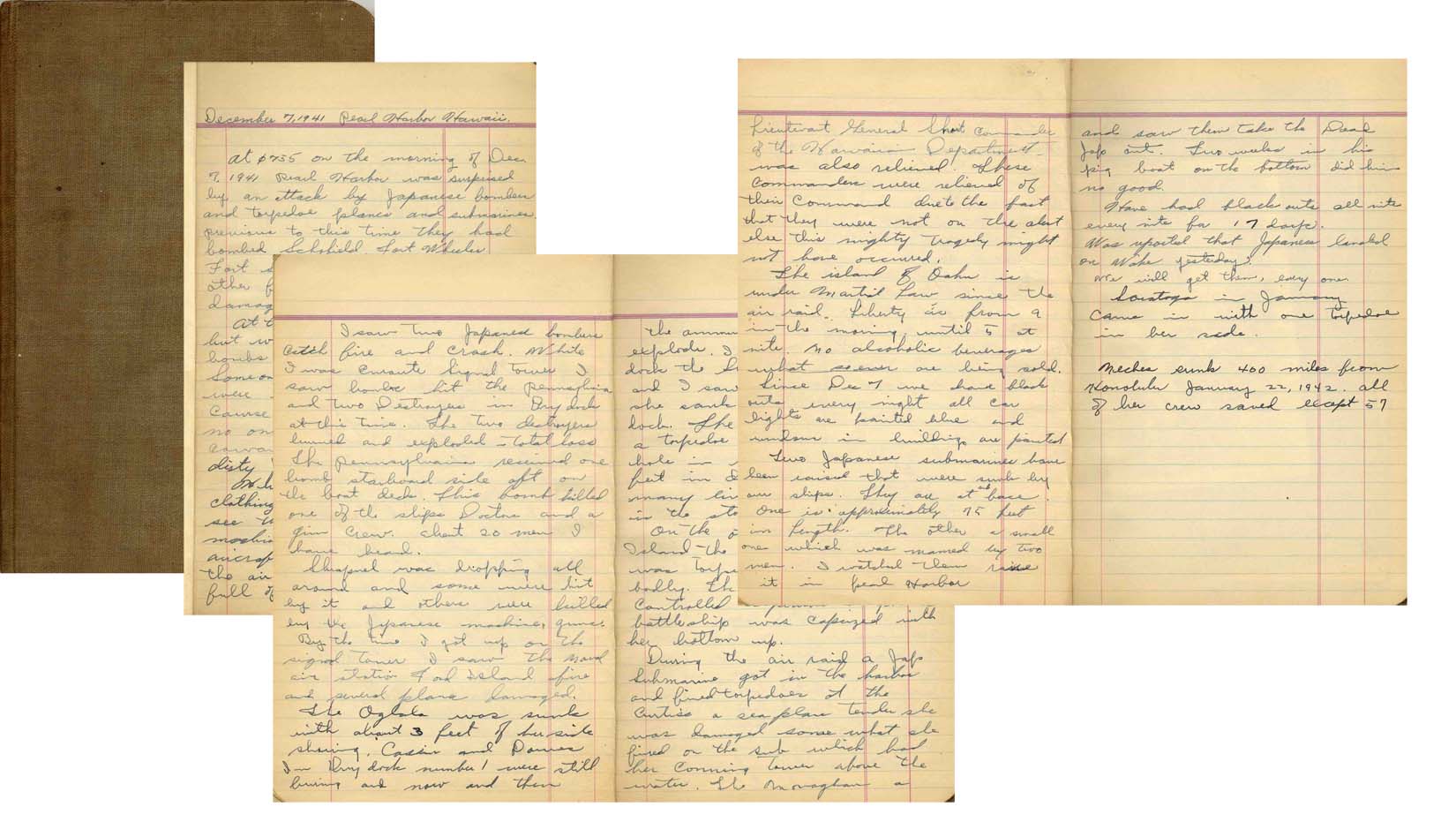
Pearl Harbor nine page battle diary written by 3rd Class Signalman Gerald H. Conrad from the USS Pennsylvania, approximately two weeks after the 7 December 1941 attack. This personal account, handwritten in cursive, reads in part, “…At 7:55 on the morning of Dec. 7, 1941, Pearl Harbor was surprised by an attack by Japanese bomber and torpedo planes and submarines. Previous to this time they had bombed Schofield, Fort Wheeler, Fort Shafter, Honolulu, and other fields. Doing considerable damage to Hickam Field. At this time I was in bed but was awoken by exploding bombs and roaring plane motors. Someone mentioned that we were being attacked. This of course I didn’t believe as no one expected such a cowardly attack by the dirty Japs. Hurriedly I put on my clothing and ran outside to see the air full of 50 cal. Machine gun shells and anti-aircraft shells exploding in the air. The sky was literally full of exploding shells and diving Japanese planes. The planes they flew were carrying the Japanese insignia of the Rising Sun. Soon the planes had left but were back again in no time. Overhead I saw a formation of seven planes (Jap) as I watched them I saw them release as many bombs. These bombs were dropped from a very high altitude directed at our battleships which were moored to the quarries in Pearl Harbor. Soon another formation was sited high overhead. They too dropped bombs on the battleships. At this time, 3 of the 7 battleships were in flames: Oklahoma laying on her side, Arizona filling the sky with black smoke, and the West Virginia on fire, too. These ships were damaged heavily and sunk to the bottom with the super structure showing…The ships that were sunk are as follows: Utah — total loss, California, West Virginia, Arizona — total loss, Oklahoma, Nevada, Oglala — total loss, Cassina — total loss, Downes — total loss, Shaw — total loss…Every effort is being made to raise the sunken ships except the ones marked total loss. The Arizona burned for 36 hours before they could get her out. Thousands of lives were lost, how many hasn’t as yet been disclosed for sure. Last report I heard was 2,800. I have every reason to believe there is many more…As soon as the Secretary of the Navy heard of the tragedy here, he came to inspect the damage. Ten days later Admiral Kimmel was relieved of the CINC [Commander-in-Chief] and reduced to the rank of Rear Admiral. Admiral Rye Commander of Battleships is CINC now until Admiral Nimitz arrives here to take command of the U.S. Fleet as CINCUS…These Commanders were relieved of their command due to the fact that they were not on the alert else this mighty tragedy might not have occurred. The Island of Oahu is under Marshall Law since the air-raid. Liberty is from 9 in the morning until 5 at night. No alcoholic beverages whatsoever are being sold. Since Dec. 7 we have blackouts every night. All car lights are painted blue and windows in buildings are painted…Two Japanese submarines have been raised that were sunk by our ships. They are at the Sub Base. One is approximately 75 feet in length. The other a small one which was manned by two men. I watched them raise it in Pearl Harbor and saw them take the dead Jap out. Two weeks in his pig boat on the bottom did him no good…Have had blackouts all nite, every nite for 17 days. Was reported that Japanese landed on Wake yesterday. We will get them, every one…” Diary, measuring 5.25″ x 8″, was manufactured by the U.S. Government printing office and is in very good condition. Includes typed transcription of the diary account, as well as four family photos and several “copy” photos of the Signal Tower at Pearl Harbor where Gerald was stationed during the actual attack, a couple “copy” documents (Census records and military transfers) and miscellaneous research material. An excellent, detailed first-hand account. Sold for $2,126.
General Douglas MacArthur Signed 8″ x 10″ Photo
General Douglas MacArthur signed 8″ x 10″ photo, showing the World War II General in U.S. Army uniform. Signed “Douglas MacArthur” in black fountain pen. Matte photo is near fine save for circular crease at upper right and light wear along margins. With R&R COA. Sold for $1,470.

Unique Collection of World War II Items Including a Full Uniform Worn by a Corporal in the 3rd Army — Lot Includes Badges, Pins & a Personal Photo Owned by the Soldier
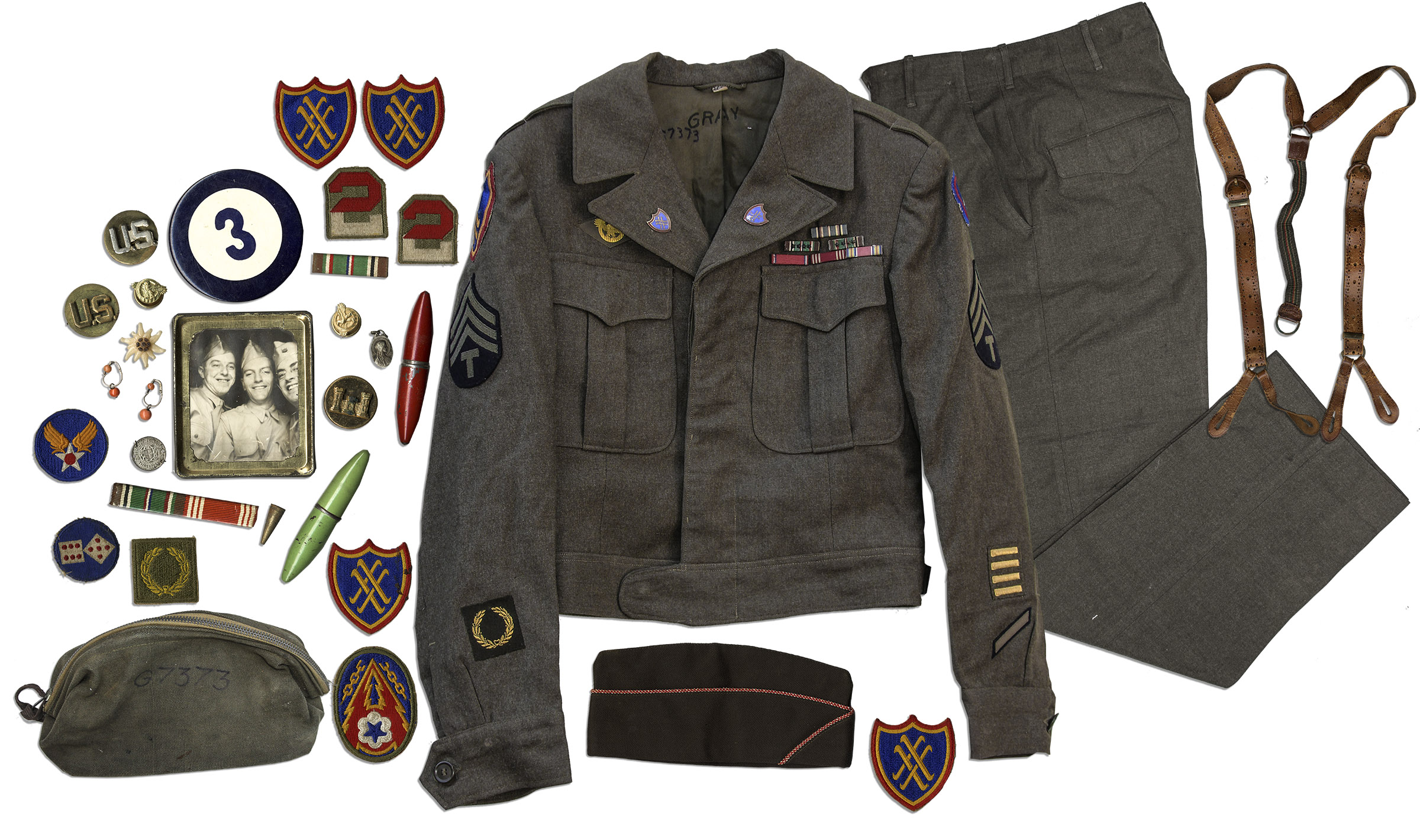
Collection of official-issue items owned by a World War II soldier, including a full uniform, badges and pins. Fascinating lot comprises: (1) olive green wool uniform consisting of jacket, pants and suspenders. The jacket contains a badge indicating that it was worn by a Corporal in the 3rd Army division; an additional badge in black and green with the letter “T” indicates the uniform was owned by a fourth grade technician in the U.S. army. Also affixed is the famous “ugly duckling” badge, which was given to members of the Army who received an honorable discharge. Many soldiers continued to wear their uniforms upon their return home due to the clothing shortage, and the badge distinguished them from active duty soldiers. The soldier’s name, “Gray”, is written on the inside of the pants and in the collar of the jacket. Jacket is size 36R. Pants are size 30 x 33; (2) olive green canvas zippered pouch; (3) brown wool garrison cap with red and white stripe running down the center; (4) 10 uniform patches including the famous “ADSEC” badge, which contains a red, blue and yellow lightning bolt; (5) snapshot photograph depicting three soldiers in uniform smiling together; (6) 11 pins with some showing U.S. insignia; (7) pair of ladies’ earrings; (8) two “bullet-style” cigarette lighters; (9) a single detached suspender strap. All items are in very good to near fine condition. Sold for $971.
To auction, sell or consign your WWII memorabilia, please email your description and photos to [email protected] of Nate D. Sanders Auctions (http://www.NateDSanders.com).
FAQs
How do I consign or sell my WWII memorabilia?
It’s never been easier to sell your WWII memorabilia at Nate D. Sanders Auctions. Email a description and photos of your item to [email protected] and we’ll get back to you as soon as possible with a free appraisal.
This sounds great and I’d like to move forward. What’s the consignment process like at Nate D. Sanders Auctions?
We’ll send you more information about our auction house along with an agreement to review. Your item will appear in our next auction. Unlike many auction houses, we hold monthly auctions and pay you within an industry-leading 45 days following the auction.
What elements determine the value of WWII memorabilia?
The value of your memorabilia can vary based on condition and subject matter of the item.