
Sell or Auction Your 1st United States Sharpshooters Letters Archive for up to $37,500 or More at Nate D. Sanders Auctions
FREE APPRAISAL. To buy, auction, sell or consign your 1st United States Sharpshooters letters archive that is for sale, please email your description and photos to [email protected] of Nate D. Sanders Auctions (http://www.NateDSanders.com).
Free Appraisal, Auction or Sell Your 1st United States Sharpshooters Letters Archive
We at Nate D. Sanders Auctions recently sold a letters archives from the 1st United States Sharpshooters for $37,500. Please see details below:
144 Civil War Letter Archive from One of the Top Marksmen in the 1st U.S. Sharpshooters — With Gettysburg, Yorktown, Malvern Hill, 2nd Bull Run, Fredericksburg, Manassas Gap, Etc. Battle Content
Extraordinary archive from a soldier in the 1st U.S. Sharpshooters Infantry, Co. D, organized by Colonel Hiram Berdan, inventor of the Berdan rifle. “Berdan’s Sharpshooters,” as they were called, were expert marksmen who were required to pass a test to enlist in the regiment: each man had to land ten shots in a 10″ circle from 200 yards away, with the average distance of each shot no more than 5″ from the bullseye. Our soldier, Cyrus J. Hardaway, was one of the most proficient men in this regiment, not only chosen as one of the top 10 men of his company in February 1862 to quell a mutiny in the 2nd U.S. Sharpshooters, but also chosen as one of the top 10 men in the entire regiment to accompany General Fitz-John Porter on a scouting expedition.
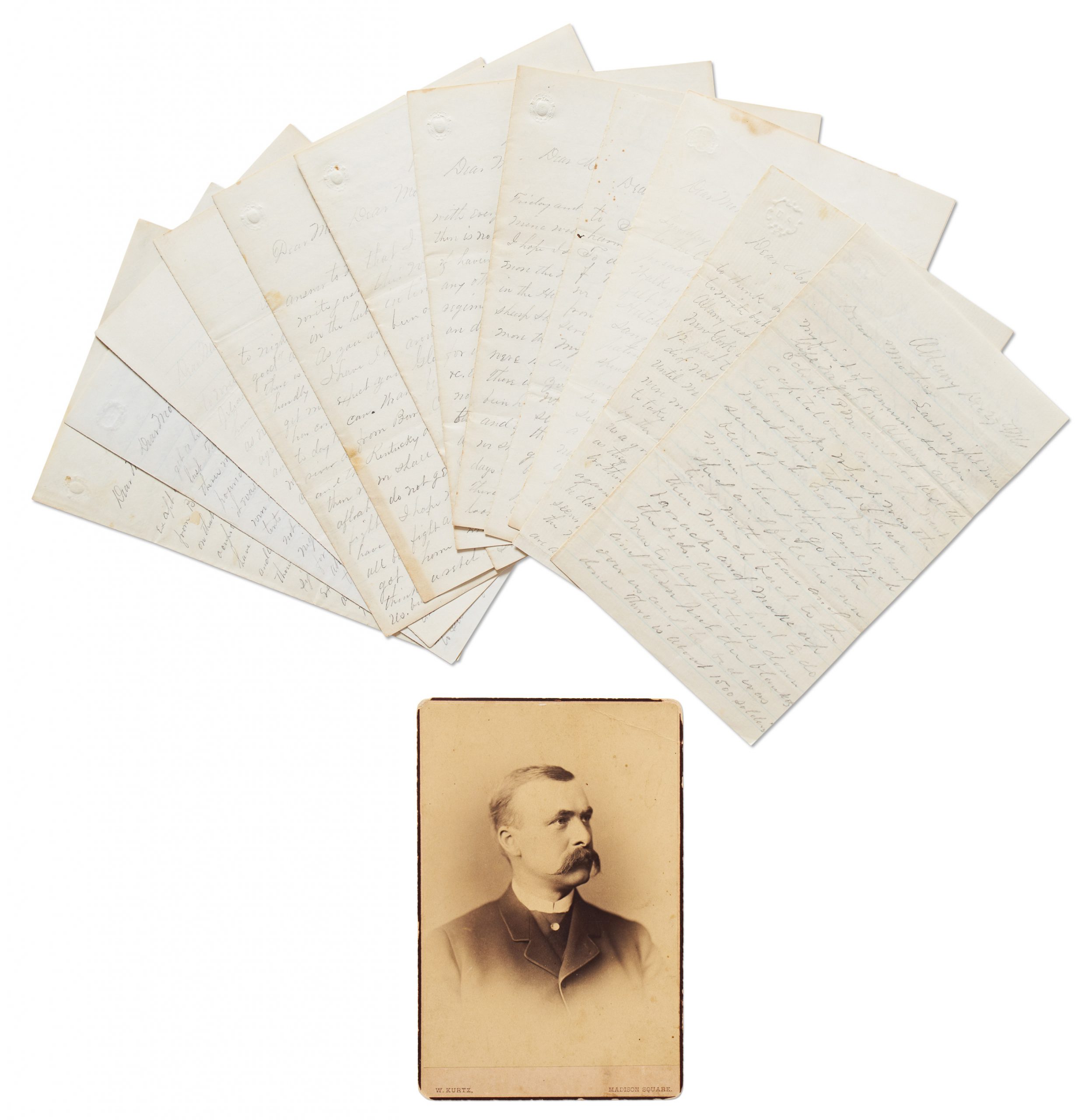
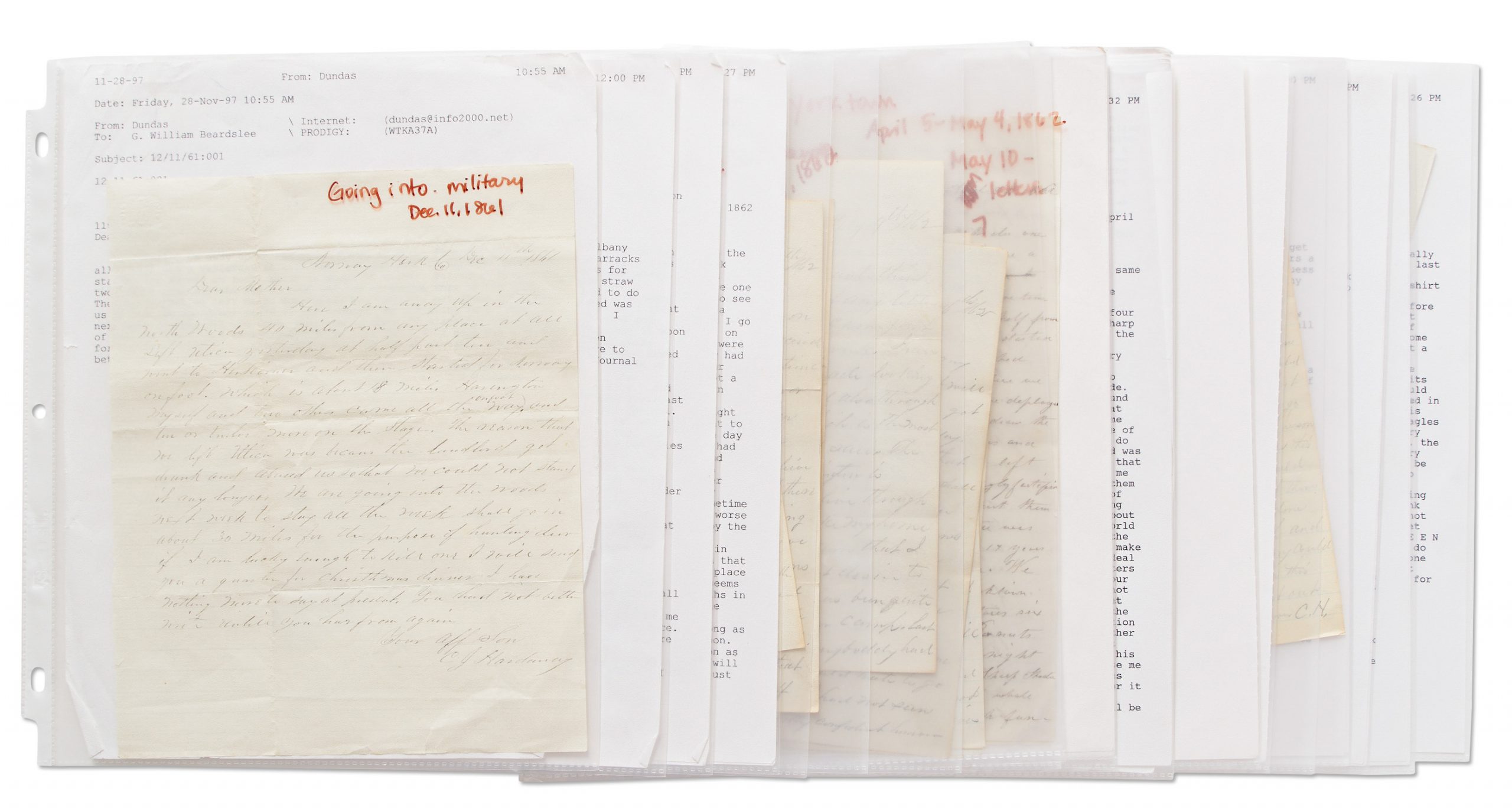
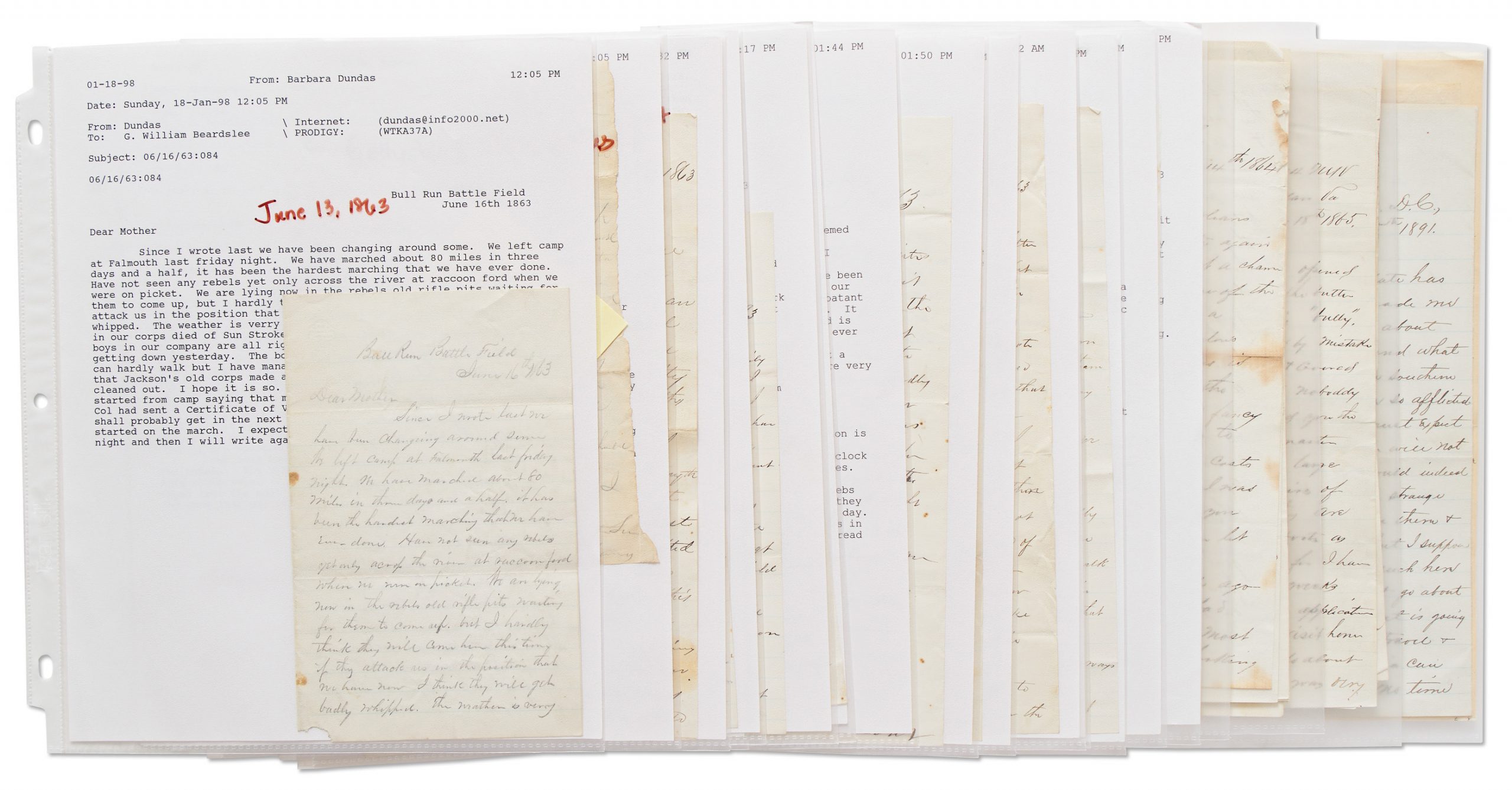
In addition to a cabinet card photo of Hardaway, lot is comprised of 144 letters written by Hardaway, describing a sharpshooter’s life including the numerous battles he fought in, the most prominent being Gettysburg. Most letters are written to his mother, with some also written to other family members such as his brother. In the first letter, dated 11 December 1861, we meet Hardaway while deer hunting, no doubt where he perfected his rifle skills. All other letters (143) are written during his Civil War enlistment. The regiment faced almost immediate action in April 1862 during the Siege and Battle of Yorktown. In two letters dated 8 April, Hardaway describes the initial advance on Yorktown. Letter reads in part, “In Front of Yorktown…We started from camp at Hampton last Friday and marched about four miles this side of Big Bethel where we found the first battery. The Sharp Shooters were deployed as skirmishers and marched for the fort to draw the fire of their guns. They fired two shots at us and then our batteries opened on them and they left about as quick as possible, they were very strongly fortified then but did not have guns enough to support them against a heavy force the only booty there was a few blankets and two prison boys about 17 years old Gen’l Porter has one of them for a guide…The Sharp Shooters were started in the morning in the advance of the whole army as scouts and skirmishers, which is not much fun as you do not know what you are going to run into. The first introduction we had was a canon ball whistling over our heads from a fort about a mile from us that we had not heard of. The next was a shell bursting within ten rods of me but did not hurt any one, our Artillery then came up and engaged with them and we went on under cover of our guns. We crawled up within 80 rods of their guns and got behind a rail fence and began to fire on them picking off the gunners very fast we succeeded in stoping their fire after about an hours firing…We were placed right between our cannon and the fort so that they both fired exactly over our heads, and those shells make the most horrible noise that I ever heard…The Rebels had their Sharp Shooters just the same as ours only they were firing at us and did not trouble our gunners any. I got quite used to the whistle of a rifle ball and did not care much about them after I had heard them a while, but I never can get used to the whistle of a shell and hope that I shall not have to take the same position that I had Saturday while I am in the service…I had quite a compliment paid me yesterday by the Colonel. General Porter sent to him for ten of his best shots to go with him on a scouting expedition and the Colonel Chose me as one of the ten to go. Professor Lowe is here with his balloon and has been up several times so we have shows here without paying a quarter for it. The Rebels are verry strong here and there will be a terrible battle before we ever get possesion of Yorktown but I think the most of it will be done with artillery for it would be impossible to get them out with the bayonett. They have got 80 or 100 guns within a circle of about three miles and could shell us out of camp now if they wished to but I guess they have not any more ammunition then they want for they will have a hot time in a few days…”
On 28 April Hardaway writes about almost being killed by a Rebel sharpshooter while on picket duty, “…Yesterday it did not seem like Sunday I was lying behind four rails all day dodging rifle bullets and some of them came rather to close for comfort. My hand was lying on one of the rails and a ball struck the rail about two inches from my hand. I made up my mind then that I had no bussiness showing any part of my boddy for it was shure to be a mark. We lay so close to the forts that we could hear the rebels call the roll night and morning…When I first began doing picket duty I liked it verry much, but I have changed my mind and must say that I had rather stay in camp and only go when it comes my turn which is twice a week. I was out last Wednesday and came near being frightened out of my boots, the rebels fired twenty or thirty rounds of shell and grape at the pickets and a party of men at work just back of us they opened so sudden and fired so fast that when the firing was over I found myself about half burried up in the sand. I think if they had fired a few shots more I should have been in out of sight. The rebels may think it a good joke to fire those things at us, but I cant see where the laugh comes in. Our batteries threw a few shell into their breast works yesterday and I had the fun of seeing them run so I shall considder myself partly paid for the fright that they gave me the other day…”
On 4 May 1862 Hardaway declares, “Yorktown is ours”, describing the taking of the Yorktown and also getting a Sharp’s rifle, issued to the regiment on order of President Lincoln based on their speed and accuracy: “…Lieut Chace was out with the pickets and brought in a large rebel flag which the boys are now draging in the dust behind the Stars and Stripes…The rebels before leaving had filled the ground with torpedoes which would have blown up thousands of our men if they had not been told of it by one of their men that staid behind…Our Sharps rifles are here and we shall get them tomorrow they are the best I ever saw…” In his next letter, dated 10 May 1862, Hardaway describes the aftermath of the Battle of Eltham’s Landing and the effectiveness of his new rifle: “…some fifty or sixty of our men killed. They were just burying the dead as we landed. It looks rather hard to see them put in trenches without any coffin but I suppose it is just as well so as any way. I have talked with a number of wounded men that were in the fight and they say that the niggers are the worst men in the rebel army. They cut two or three of our mens throats after they were wounded from ear to ear. The pickets have orders now to shoot every nigger they see outside of the lines. I think the order will be obeyed too the mark. Every man here swears vengeance on the black devils. We have had our Sharps rifles nearly a week now. They are the most beautiful piece I ever saw. They are shure of a rebel anytime at half a mile…”
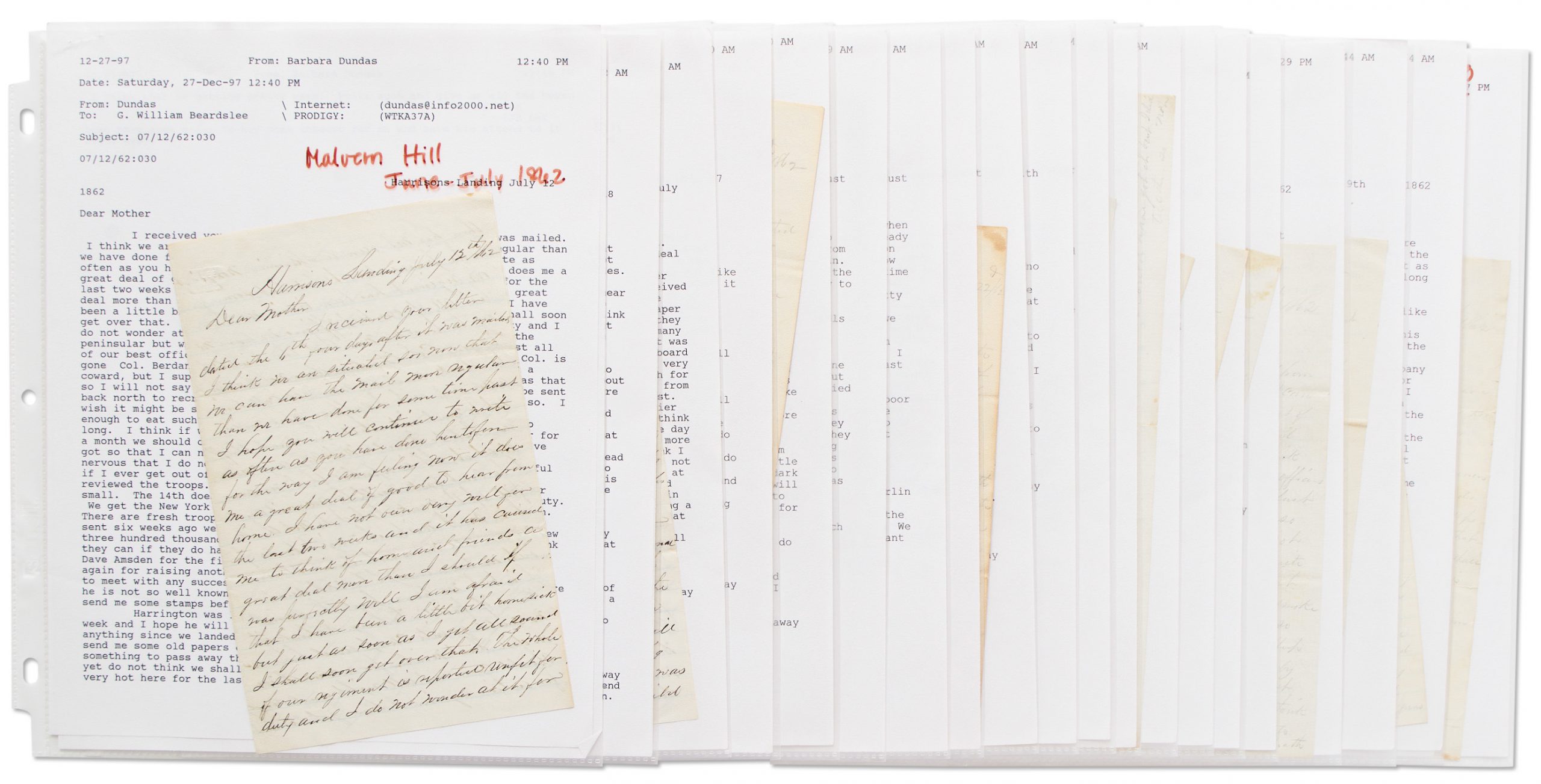
On 4 July 1862 Hardaway describes the Battle of Malvern Hill, “…thank God that I am alive…I have been through some terrible scenes within the past week. We have been marching for the last Eight days what little time we have not been fighting. We began our march on Thursday. Marched to Mechanicsville to help McCall staid there over night and then marched back to camp and by the time we got our things packed up the enemy was in sight. We marched back about a mile where we found the whole of Porters corps drawn up in lines of battle. We left our knapsacks back of the line and then went out as skirmishers. We laid there and waited there about an hour before the Enemy made his appearance. We had some splendid shots for a little while but they began to see that they were loosing to many men so they made a rush on our right wing and drove in our skirmishers and opened the battle. They were repulsed there with heavy loss and then they tried the left wing where I was posted they drove us in at double quick and opened fire on us at the same time. After we got in the woods we were ordered behind the line that was formed and got behind the trees and shoot. The regiment that we fell behind was the Michigan 4th which is a splendid regiment. They were lying behind some rails and bales of hay which had been brought there for that purpose. They did not fire untill the rebs got within three rods and then they poured in a volley that mowed them down like grass at the same time there was two cannon pouring grape and canister into them so that after they fell back the ground was covered with their dead and wounded.”
He continues, “Our men fought like old heroes that day but were outnumbered three to one they were driven back in short distance when the Irish brigade came up fresh and drove the enemy back on their own side of the fence we laid on the battle field untill two oclock in the morning. When we got up and crossed the river we marched part of the day saturday and part of Sunday and most all night. We got down to the James river about noon Monday where we staid about an hour and then we marched back about a mile and formed in line of battle. We laid there untill morning when our regiment was sent out again to skirmish and did skirmish untill we brought on the general battle. There was not so much musketry as there was in the battle before but such Artillery firing I never heard before I should think that we had fifty pieces of cannon in the field and they were assisted by the gunboats. The Enemy was driven from the field that night and at two o’clock the army began to moove back. We now lay in a large field of about four hundred acres which is one solid mass of mud about six inches deep. George Crawford was killed in the first days fight he was doing his duty nobly…”
In a series of letters throughout July, Hardaway confesses his regiment has been ravaged by recent battles, “…The regiment is very badly cut up and so is the whole brigade. We have lost our Lieut. Col. the only good officer that we had in the regiment, our company has been very fortunate so far we have only lost one man but perhaps we are saved to be cut up in the next battle. I hope however that we shall not have to go into battle again it makes me shudder when I think what we have passed through already it does not seem possible for men to be alive after being in such showers of bullets as we were in the last two battles, but thank God I am yet alive and safe…” He continues, “…The whole of our regiment is reported unfit for duty and I do not wonder at it for there has not been a skirmish nor fight on the peninsular but what some of our regiment has been in it. We have lost all of our best officers We have no one to lead us now that the Lieut. Col. is gone Col. Berdan does not amount to shucks and the men all call him a coward…I have got so that I can not bear to hear the report of a gun it makes me so nervous that I do not know what to do half the time. I shall be thankful if I ever get out of this. The President was here the other day and reviewed the troops. I guess he must thought the regiment looked rather small. The 1st does not turn out over one hundred and fifty men for duty…”
On 16 September 1862, Hardaway describes the Battle of Second Bull Run. Writing to his brother, “…We had pritty gay times at the battle of bull run (No. 2). I would like to of had you there to take some of the chances with us just for the fun of the thing providing you could have come out all right the same as I did. I could not tell you in three weeks so that you could appreciate the thing A person wants to go through with it once before he can have any idea of it at all and then he can not make it seem like reality. We lost our Lieut and his brother out of our company. The Lieuts brother was shot within two feet of me. He was right by my side…” On 5 October 1862, while recuperating from an injury, Hardaway writes his mother, “I got news yesterday that my old tent mate was dead. He died in Philadelphia his name was Ferguson from Cherry Valley. He was the best friend I had in the Company and it seems almost like loosing a brother. He and Harrington and myself commenced the campaign together last spring and I am the only one left that makes six that has died out of our Company. There are only twelve sound ones left the rest are all in hospitals and discharged. I went to look at our old camp ground yesterday. It seemed a good deal like getting home. I should have cried and tried to have been sentimental if there had been anyboddy to look at me but as there was not, I passed along without making any fuss…” He rejoined the regiment on 15 October, writing, “I feel more at home than I did away from it…Harpers Ferry is the queerest looking place I ever saw. Everything looks so wild and ragged that it almost frightens a person to look up the mountains…”
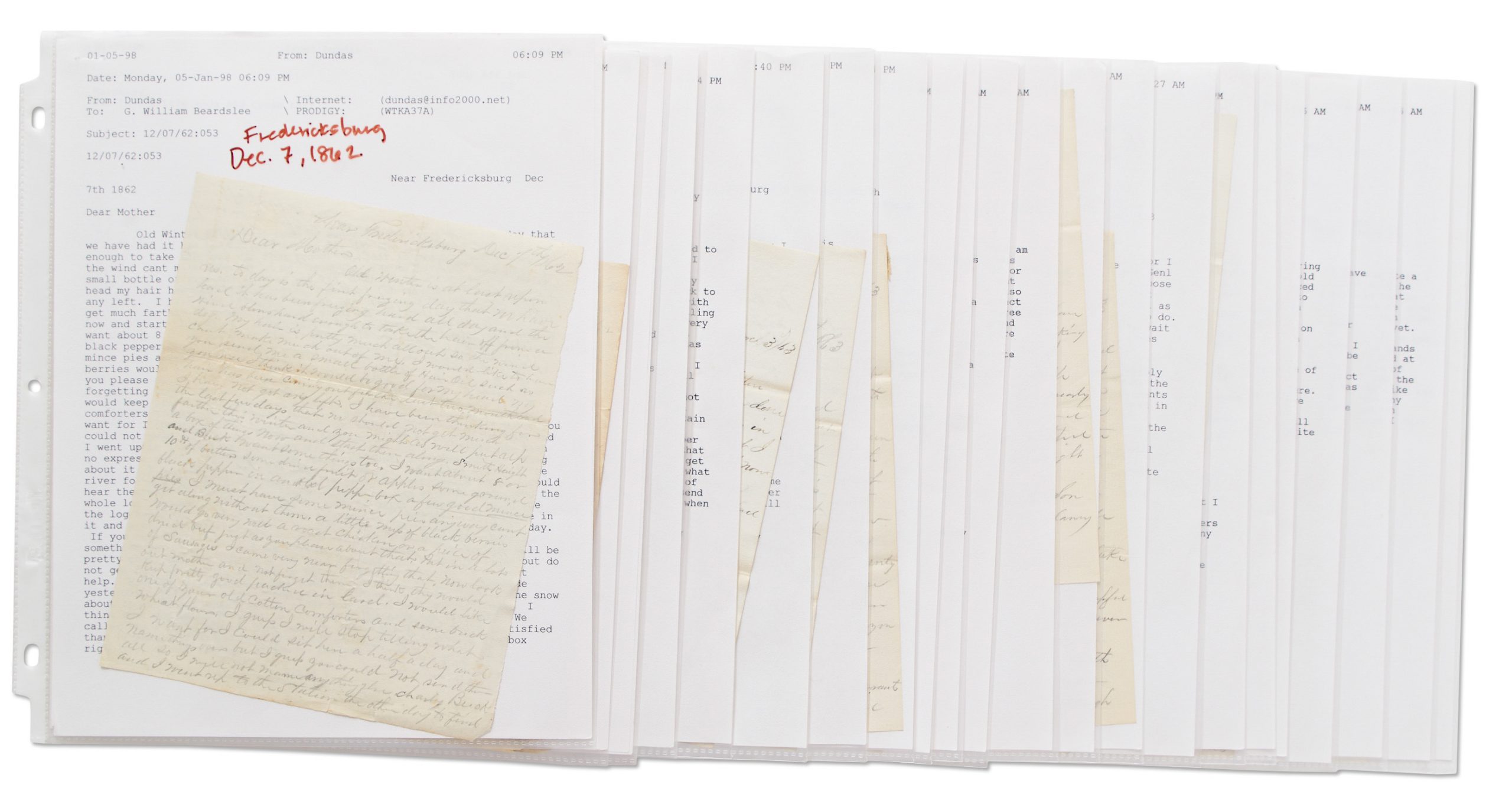
On 15 December 1862, Hardaway reports on the Battle of Fredericksburg, after having been promoted to Sergeant. He writes, “…The battle began here last Thursday. The first shots were fired a long time before daylight but we had been up getting breakfast some time when they opened. Our regiment was the last one of the division to break camp, which we did at sun rise. We marched up and took our position on the field in line of battle, laid there untill sundown and then went back on picket in the rear of our old camps. Were ordered up the next day to cross the river but did not that night. Our division crossed at noon on the next day Saturday but our regt did not cross untill yesterday morning…it is the first time that we have been behind when there was any fighting going on. Capt McLean was ordered to report to Genl Griffin yesterday afternoon with the company. The Genl set us to cleaning up a house for his headquarters. We cleaned up two rooms nicely for him and arranged the furniture and then he had us fix up three rooms for the Company so we are to stay with him as long as his headquarters are here…I think by the time that we get the rebs out of the breast works on the hills there will not be much left of the city. It is a pity to destroy the buildings for it is a beautiful place…They are firing some shell pretty close to us now…” He continues on 17 December, “…We have done gone and took Fredericksburg and got back again without any damage to our regiment which is quite a wonder to me…All of the regiment was on picket except our Company and we were on guard for the Genls Headquarters. The firing was very heavy on picket and a good many bullets came whistling down the street where we were but did not happen to hit anyboddy. One of the Genls aids woke us up yesterday morning about three oclock and told us that we had got to cross the river again…I have read of towns being sacked but never saw it done before and cant say that I want to again. I looked in two houses and I presume I saw six hundred thousand dollars worth of property destroyed. I could not bear to look any farther. It is a shame and disgrace to our Generals to allow such things…”
On 1 January 1863, Hardaway recounts a funny story about the Sharpshooters concealing themselves from a Rebel cavalry regiment on the other side of the river, “…We marched until 2 o’clock that night, laid down all wet and in the rain. They would not let us make any fire for fear of being seen by the rebs which they wished to avoid if possible…When day light came we discovered about fifty rebel cavalry on the opposite bank. They did not see us and we perfectly contentive. Our men pretty well concealed by bushes and they did not discover us for nearly an hour. About the time they saw us some of our cavalry came down and began crossing. After they got into the water, the rebs fired on them, but they did not have chance, only once for the same time that they find our regiment opened on them. The firing did not last more than two minutes but it was ‘right smart’ which did last but such skidaddling as those fellows did I never saw before. They made better time than any of the fast horses up north can do. I have not enjoyed myself so much before since I have been a soldier. It did me more good than a good meal of victuals would. I do not know how many of them got hit but I guess not a great many for the men were too busy laughing to shoot very straight…”
On 8 January 1863, Hardaway tells his mother that the regiment got their new uniforms, the forest green color to camouflage the Sharpshooters: “…Our regiment is getting new uniforms throughout, green coats, green pants, and green caps. When we all got them on I guess we will be a pretty green lot of fellows…” In February he tells his mother that he hopes “they will send us down to Texas or somewhere else for I have been in Virginia long enough…”
The regiment would stay in Virginia, next fighting in the Second Battle of Fredericksburg. In a letter dated 4-5 May 1863, he writes, “…I have heard a number of reports from our division and they say that nearly all of the officers are killed wounded or missing. Col Berdan is reported killed. Our troops took the heights back of Fredericksburg yesterday morning and captured three batteries, but I see this morning that they the rebs have got back there with more guns and have opened fire again. I saw our men make three splendid charges yesterday on three different batteries. They were successful every time. Our men on the right wing were driven back about six miles the other day. Caused by a panic created in Segils old corps. The dutchmen, they are not good for anything. One good Yankee is better than forty dutchman. Is is just a year ago today that the rebels left Yorktown. They may leave here but I do not think they will…Things look rather dark this morning. There was a general engagement last night just before dark and I think that our men were repulsed. Longstreet has reinforced the rebels with his whole force, but I do not think we have had any fresh troops yet. Our regiment has done nobly. They Captured 3 pieces of Artillery and nearly a thousand prisoners in one day. Col. Berdan is not killed but is all right…” He also writes on 11 May, “…Our regiment did nobly in the last battle. They have won a name that will not be forgotten soon. There has been a good deal of humbug about them, but no more humbug now. It is the genuine article…”
Two days after the Battle of Gettysburg, where the regiment lost over 30 in killed and wounded, Hardaway writes to his mother, “…I have been through one more terrible battle and thank God I am still safe and sound. But not so with the rest of my companions. Smith Haight is dead and Edwin Nelson is I am afraid mortally wounded. Also our captain is dead. James Reed is a prisoner with one more of our company named Kipp from Milford. We brought Haight and Nelson off from the field more than a mile. Smith died before we got him to the hospital. We gave him a verry deacent burial and had a chaplain to read the burial Service. That is a great deal better than I have seen done by thousands of others for the last two days. We have whipped the Rebels badly this time and have held the field every night, but I hope that I shall never be obliged to lay on another battle field as long as we have lain here. The burial parties have been at work faithfully all the while but have not got near all the dead burried yet. The Enemy has fallen back and we followed them up this morning at day light. We found Reed and our other men in a hospital taking care of the wounded.” He continues, “Our loss has been very heavy in general officers and so it has with the rebels. The rebel Cavalry has captured our mail so we do not get any more right away. I cant write any more now it is getting so dark. The Enemy left the most of their small arms on the field I should think from the guns that are left.”
He writes on 17 July from Knoxville, MD while on the march, “…We have been on the tramp all the time for the last Six weeks. I wrote to you just after the battle of Gettysburg and have not had time to write since or else I have not felt like it. (I guess thats the reason.)…We laid in position for making or receiving an attack for four days. I think that Genl. Mead did well in not making an attack on them in the position that they had. He would have got served worse than he served Lee at Gettysburg…” In the same letter from Snicker’s Gap on 19 July he continues, “…Once more back in Virginnia. They say that old Virginnia never tires and I guess she never will. When I began this letter I supposed that we should stay in Maryland a few days, but we had to start before I could finish it. We began crossing at Harpers Ferry just at dark on the 17th. Our Corps is in the advance as usual…”
Only a few days later, on 26 July 1863, Hardaway describes the Battle of Manassas Gap, “…After leaving Snickers Gap we kept down the mountains to Ashbys Gap, and from there we went to Manassas Gap where we found the rebels in pretty good force. There had been a cavalry fight there the day we got there and our cavalry had been whipped and driven back. We laid down at night without any supper and got up and started in the morning without any breakfast marched about two miles, stopped and made a little coffee and then went out and began skirmishing. Our whole regiment was deployed as skirmishers and it made a pretty long line. We found the Enemy posted in a high hill with a stone wall in front of them. We were a little afraid to fight them there so we laid down out of sight but we soon got orders to drive them away from the wall. So at it we went with a pretty good will. We had to fire about half an hour before we could start them, but when they did start they went like sheep and we after them and got possession of the wall. We drove them more than a mile taking quite a number of prisoners. They finally got lodged behind another fence and our amunition being used up we had to stop another regiment taking our place…”
At this point in his military career, Hardaway transfers to the 114th New York Infantry, Co. F, mustering in as a 2nd Lieutenant, although his heart remains with the 1st Sharpshooters, writing in one of his first letters, “I almost wish some times that I was back again with the old army. I never knew how much I thought of that army untill I left it.” Again, he rises to the top of his regiment, also writing, “I have got the right side of the Colonel. He paid me quite a Compliment to [Lieutenant Adrian] Foote the other day, & Foote was ‘highly tickeled.'”
On 12 April 1864, Hardaway writes about the Battles of Mansfield and Pleasant Hill, “…We left Natchitoches which is 4 miles from this place just a week ago this morning. Marched 50 miles in the woods, fought two days, got badly whipped, & got back here last night. We were on the road 2 days & 2 nights with the train & did not get a chance to sleep a wink. Our regt did not loose but a few men. Lt. Col Morse was wounded in the arm & will probably have to lost it. The 13th army corps came near being all captured but the 19th corps saved them…” In May 1864, he writes of long marches, “Since we have started from Franklin last spring we have marched 680 miles, had some fighting, got whipped, & lived on short rations for the last three weeks. I think that is the correct history of the company in a very few words. I saw George Foote the other day on the battle field attending to the wounded.”
On 22 September Hardaway writes of the Third Battle of Winchester, where his regiment lost nearly 200 in killed and wounded, “…Well we have had a battle here & a pretty heave one too. Especially for our regt. The loss in the regt. Is about two hundred killed & wounded. Only one officer killed but nearly all the rest are wounded. Charly Brown was very slightly wounded. He is on duty. The ball just grazed the top of his skull taking off some of the hair. The colonel is badly hurt in two places, shot in the throat with a bullet & hit in the side with a piece of shell. Charles Mattison’s son is shot in the neck, but not badly hurt. Deming’s son is wounded in the leg, but feels good. I have seen so many from the regt to day that I can hardly tell who is hurt. The troops are about 25 miles beyond here & are fighting to day, very hard I hear.” He continues, “In the fight on Monday we got about 4000 prisoners & last night they brought in about 1500 more & eight battle flags. This is the first time the rebs have ever been whipped in this valley & they got a good one this time…”
On 23 October 1864 Hardaway writes two letters about the Battle of Cedar Creek. The first to his mother reads, “…we had a heavy battle here on the 19th inst in which our loss was very heavy. The loss in our regt is 104 killed & wounded & nine prisoners. Ike Burch was killed & Thurber is mortally wounded in the right thigh with a piece of shell passing through & shattering the bone badly. I wish you would tell Mrs. Burch that her son died without a struggle but seemed to be very much grieved that he had not followed her instructions more strictly in regards to religion. Our army in the morning was surprised & completely routed & lost some prisoners & 24 pieces of artillery & a great quantity of other plunder besides…”
In the letter to his brother Gust, he writes, “Enclosed I send my vote, a straight democratic ticket all the way…We have had another heavy battle & the losses in our regt are 104 killed & wounded & nine prisoners. Capt. Knowlton & Lieut. Ike Burch are killed & Thurber is mortally wounded. The doctors say that he can not live. I sent a telegraph dispatch to his father & wrote to his wife yesterday. We have only 85 men left now. Our army was surprised & completely routed at daylight in the morning & lost 24 pieces of artillery & about 1000 prisoners. But in the afternoon Gen’l Sheridan came up & gave the word forward & away they went capturing 54 pieces of artillery, 10 stands of colors, 1500 prisoners, & a great quantity of horses, mules, ambulances, & wagons. I know this to be so, for I have seen the plunder…”
Hardaway’s letters are filled with interesting stories and observations apart from the prolific battle content. He was a soldier that marched to the beat of his own drum, not afraid to admit that he’s only one of two Democrats in his regiment, who wanted Lincoln to compromise (“Old Abraham has got his hands full and the quicker he makes a compromise the better it will be for him. You never can lick the buggers out. Thats a sure thing.”) His choice of words is also descriptive, writing that “we lay violent hands on every pig that comes in the way” while foraging. He has a high code of honor, proud of putting up a good fight in battle and not shirking one’s duty. He gives thanks for having such a good mother, but chastises her once for giving him a “lecture” rather than a letter concerning religion, writing that “I can not pray for my heart is not in it and I do not propose to make a hypocrite of myself in that way. I am doing as well as I can and I do not think lectures will help me any.” He writes several funny observations, such seeing the President and First Lady, “I saw Abraham and his wife riding in their carriage yesterday they looked very well. I think she is the best looking man of the two.” Overall, it’s clear that he can’t be bullied into taking a popular position, with his own internal compass guiding his actions. He’s also one of the most accurate and steady shooters in the 1st U.S. Sharpshooters, a regiment filled with the best marksmen in the country.
Most letters measure 5.25″ x 8″ on bifolium stationery, and span four pages, written in both pencil and ink. Cabinet card, identified in pencil on verso as “Uncle Cyrus Hardaway” measures 4.25″ x 6.5″. Letters are quite legible, in very good condition. Accompanied by near complete transcriptions. Sold for $37,500.
Consign your 1st United States Sharpshooters letters archive at Nate D. Sanders Auctions. Emails photos & a description of your 1st United States Sharpshooters letters archive to [email protected]
Here are some additional Civil War letters we sold:
200+ Letters With Exceptional & Relentless Battle Content From WIA Soldier Who Fought at Antietam, Cold Harbor & the Siege of Petersburg: “…Poor Budd was shot through the bowels…he replied ‘Such is the fortune of war’…” & “…West was shot in the mouth and must have died instantly…As he lay dead, his face covered with blood…he was as noble a sight for a dead soldier as a painter could wish…I could not tell who he was until I poured water on his face to wash off the blood…”
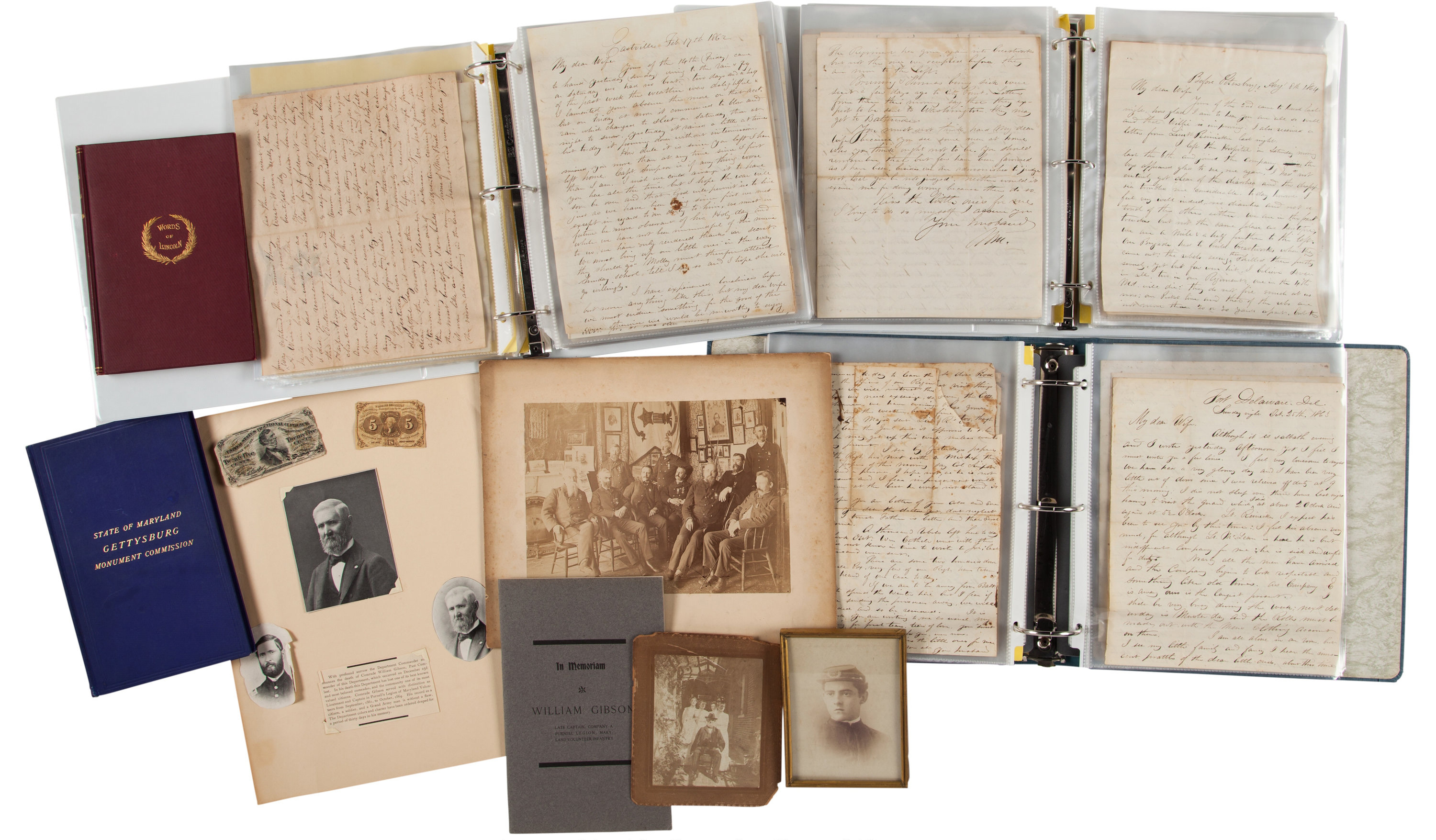
Really exceptional and large Civil War archive of 208 letters by 1st Lieutenant William Gibson of the Purnell Legion Maryland Infantry, Co. A, who was wounded at the Battle of Globe Tavern during the Petersburg Siege. Lot also includes four war-dated and post-war photographs of Gibon. Gibson writes to his wife during his three year enlistment, with interesting and detailed battle content, most notably at Antietam, Cold Harbor, and the entire Siege of Petersburg, as well as at Harper’s Ferry, Cedar Mountain, Catlett’s Station and Chantilly, in addition to colorful content regarding his regiment and locals he encountered, including sharpshooting secesh women. With much more content, including an officer being court-martialed for sexual relations with young girls and interesting stories about Confederate women in Winchester killing soldiers. Letters are in very good condition, very readable with only light soiling and toning to most. With near complete transcriptions. Sold for $38,000.
200+ Letter Lot by Soldier in the 76th Illinois Infantry — With Battle Content From Vicksburg, Jackson & Fort Blakely: “…it Seems Like A hard thing to Shoot A Man But when you Are Shot At All you think of is to Shoot. Well i Shot Sixty four times during the Battle…when we were Retreating there was one officer that was urging on his Men And Some of our Boys Caled to Me Shoot him. Well i Stoped turned And fired And he went head formost out of his Saddle…”
Ingalls gets his first taste of fighting in November 1862, detailed in his letter dated 22 November about a skirmish against the Confederate General Sterling Price: “…had to March for Holly Springs [Mississippi] wel we had one hard days March when we were halted our Advance having come up to the Enemy. We were drawn up in line of Battle. Our Advance had A Skirmish with prices [Price’s] out posts And we captured one hundred prisoners…” On 9 December Ingalls writes to his wife from Camp Cowan, Mississippi about General Grant. “Mary the News is glorious from grant [General Grant]. He is the Man to push things. He has gave Brag [General Bragg] what he needed A good thrashing. They think the Rebs will Come here And try to take this place Again…well let them come they will Receive A warm Reception here for the Boys Are highly Elated with the Success of their old Commander And they will first just As well As if he was here…we All think that grant is the Right Man in the Right place And if they will let him Alone he will Soon finish the Job…” Other excerpts from this time period include “…[General] Price is Completely Cleaned out. They whipped him At Corinth And he Started to Retreat this way And general hurlbert left this place And Met him And whipped him Again. And general Rosecrans is After him yet. And we got news this Morning that he had taken Eight thousand More prisoners. We have About Seven hundred of them here And looking for More this Evening…we Are whiping them on Every Side And Because they have not Much to Eat…” Ingalls also writes of his intention after the war to seek revenge on officers who have wronged him: “…what i do now they Might have drafted Me But i never would have went of My own Acord But then the thing is done And it Cant Bee helped. But Mary it is A Shame the way we Are treated By our officers. But we will Remember them when we get home. Some of them May want Some favor And then we will See who has Command…”
Quickly, the 76th was moving on Vicksburg, of which Ingalls writes on 17 May 1863, “…We had a fine view of our gun Boats Shelling the City last knight. We had A Bought trip down the river the first knight. We had to Anchor out in the River on Acount of the fog And the next knight we were the hind Most Boat And were Running very nice when we Run Close to Shore And the first thing we knew we were fired into By the Rebs on Shore. Well Mary you had Better Believe the Balls flew thick i was laying on the upper deck i had My gun By Me And i went to Shooting But i Could not See only when the Rebels would fire AT us…our Boat unshiped her ruder And then we Could not do Any thing with her So we had to Signal of distress And it was not long till one of the gunboats came to our Relief…” On 8 July 1863, Ingalls writes to his wife Mary about the successful end to the Siege at Vicksburg: “…We have Been forty seven days in front of this place And we have Been toiling incesantly day And knight. At knight we would Advance our lines And dig new Rifle pits And through the day it would Bee death to the Reb that would Show his head And we Advanced in that way till we got So Close that we could throw over in to their forts…So on the third they Sent out A flag of truce to General grant And wanted to Surrender on Conditions But general grant told them that it Must Bee An unconditional Surrender And gave them till 9 o Clock the fourth to give up the place…At 9 o Clock the white flags went up And their flag Came down And then Mary Sick Shouts As Rent the Air And the glorious fourth…” A week later Ingalls writes of the desperation of the Confederate prisoners in their camp. “…Thousands of the prisoners here Say they will never fight Against the old flag Again And i think they Ment what they Said. Why Mary they Acted like hogs After they surendred. They Came to our Camp And Just to See them go Round And gather up ole Crackers that we had thrown Away And Eat them. They Said it was A luxury to get officers Bread for they Said that was the kind of Bread their officers get. The Bread they had was Made of Beans And Rice ground together…”
In two letters dated 5-7 March 1864, Ingalls describes his regiment’s destruction of towns, skirmishing, and a sad scene of the execution of a woman, killed in front of her children, “…We have Marched About four hundred Miles Since we left And destroyed About Sixty Miles of Railroad Besides Burning About ten or twelve towns…[O]ne of the Sadest things of the trip hapened the Rebs got Behind A house And there was A woman And Six Children in the house. They kept Shooting out from Behind the house And of Course we kept firing Back And just At this time the woman opened the door And She was Shot dead in the door And it was A Sad Sight to See her laying there And her Little Children Around her…”
In a series of letters from July 1864, Ingalls writes of intense skirmishing at Jackson, Mississippi, where the 76th Illinois lost 40 in killed and wounded on 7 July, and where Ingalls coolly kills a Rebel soldier: “…in the hot Sun…we got to Clinton on the Evening of the fourth and Commenced Skirmishing But it did not Amount to Much for the Rebs Soon fell Back. The next Morning there was Another Slight Skirmish they did not trouble us Any More till in the next After noon when they gave us Some More trouble But we got to Jackson that Evening. We Staid there till the next Evening and Started Back And got About three Miles from Jackson when the Rebs Came out in force And we were pushed A head to Support A Batery. Well we Lay under fire for About two hours till darkness put a Stop to the fighting…the next Morning we Are Brought out in Line Again And Are pushed to the front And kept there for five hours And then we had to Retreat. Our Regiment was Left with out Any Support And had to hold three times our number So As to Save our train And we did it But oh My god what a Storm of Balls And Shells we had to face Mary…thank god we Are Safe…The Loss in the Regiment is 105 kiled wounded And Missing…” Dated 20 July, Ingalls writes, “…Mary it Seems Like A hard thing to Shoot A Man But when you Are Shot At All you think of is to Shoot. Well i Shot Sixty four times during the Battle And i Emtied one Saddle for when we were Retreating there was one officer that was urging on his Men And Some of our Boys Caled to Me Shoot him. Well i Stoped turned And fired And he went head formost out of his Saddle…”
In one of the last battles of the war, the 76th was unfortunate enough to lose over 50 men in killed and wounded at the Battle of Fort Blakely from 2-9 April 1865. On 5 April, Ingalls writes to Mary, “…My dear here we Are in the Midst of death Sieging this place. The Shells and Balls Are flying As think As hale But thank god there has none of our Company Been hirt yet. We have Been here four days we drove the Rebs in to their forts the first day And now we have got to Siege them out. This is one of the Main defenses to Mobile…And we have them Surrounded only on the River Side And our fleet is coming…” Soon after the Battle, the regiment moved to Galveston, Texas, and were ultimately mustered out in August 1865. Two letters from Galveston are included in the lot.
Other interesting content in Ingalls’ letters includes his views on slaves, and the suspicions of a traitor in camp at the highest levels. On 17 September 1862, Ingalls writes to his wife about the degradation of working in front of idle blacks and of runaway slaves: “…There is About nine hundred negroes in this place And more coming in Every day. And i tell you what it is they have. A great deal More privilege than we do for they Can Come And go when And where they please. And if one of the Soldiers is Caught down town without A pass he is put in the guard house. And that is not the worst for our Men Are detailed Every day to do fateague duty which is to go to the river And unload Boats And the negroes Stand And look on. It is degrading in the Extreme…” In a 22 April 1863 letter, Ingalls writes about suspicions that General Elias Dennis was a Southern sympathizer: “…You need not Bee Surprised if you hear of our All Being taken prisoners Some of these Mornings for i Believe the Man that has Command of this part is A Rebel At hart And i will tell you why i think So. He Lets the Rebs Come in here to Buy provisions. Why Mary there will Bee As Many As A hundred Men And women Come in of A day And not only that But he Lets Rebel officers Come in under A flag of truce. He takes them to his head quarters And they have high times i Believe they would Come in with out A flag of truce if they were not Afraid of the pickets But he has not got them under his thumb. He make the Men take them too and fro Across the River in A Boat…There is A Store here where they trade At And the Boys went to him And told him if he did not quit Selling to the Rebels they would tear his house down But he paid no Attention…So the other knight there was About one thousand of them went over And cleaned him out. The guards tried Stop them But they Could not do any thing with them And then they told general dennis if he did not Stop the Rebs from Coming over here they would hang him…”
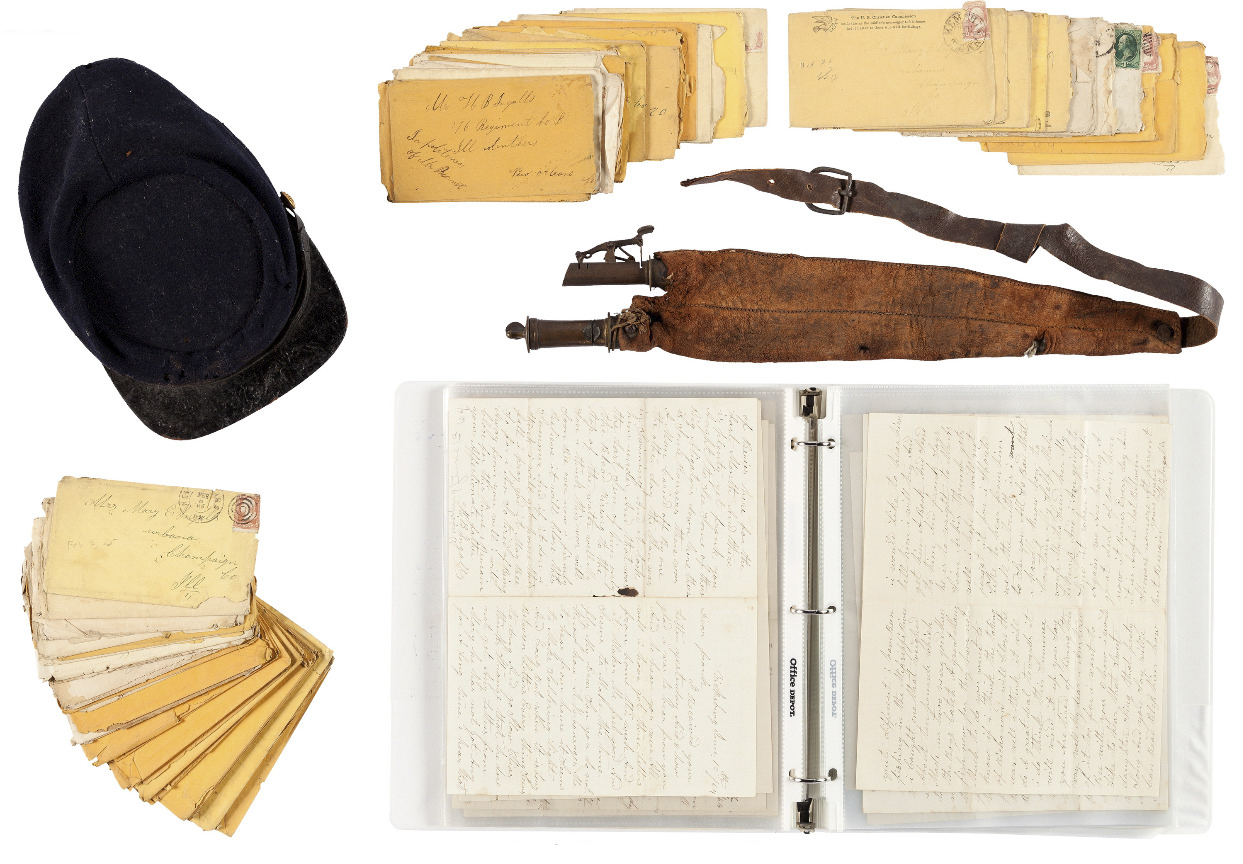
Lot is accompanied by a post-war kepi and shot bag, with Ingalls’ initials “H I” stitched in the lining of the kepi. Letters are very legible with most running 3-4 pages, and with covers for approximately half. Overall in very good condition. A fascinating lot, with an unusually prodigious number of Illinois Civil War Letters covering Ingalls’ entire service in the war. Sold for $25,000.
Consign your 1st United States Sharpshooters letters archive at Nate D. Sanders Auctions. Emails photos & a description of your 1st United States Sharpshooters letters archive to [email protected]
KIA Soldier Jacob Lander Letter Archive, of the 148th Pennsylvania Infantry — With Battle Content From Spotsylvania C.H. & Anna River — “…Lt. Col. Fairbanks received a wound through the arm…but refused to be helped off the field saying he had lost his arm, but he were not ready to go yet. This is the last he has been heard from…the rebels fight like men driven to desperation and nothing but bulldog tenacity will overcome them…” & “…The ball entered the forehead and came out the back part of the head killing him almost instantly…”
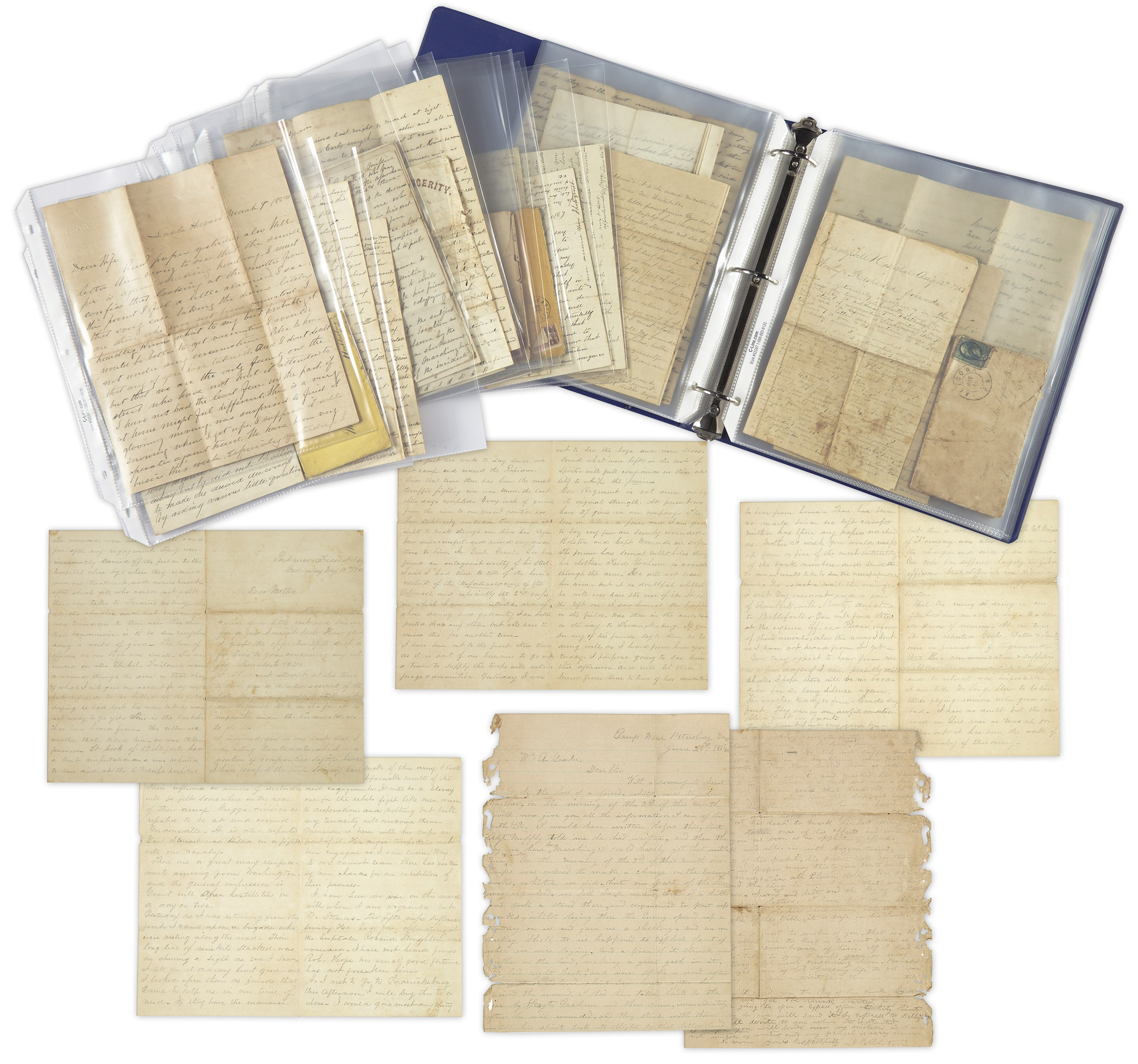
18 letter archive by KIA 1st Lt. Jacob S. Lander of the 148 Pennsylvania Infantry, Co. C, plus a letter by his Captain informing his family of his death at Cold Harbor. Before fighting at Cold Harbor, Lander fought with his regiment heavily throughout 1863-64, which he writes about in these 18 lengthy letters to his family. Of particular note are the letters penned just after the Battles of Spotsylvania Court House and Anna River. An excellent group of letters by an articulate soldier, most running 4-8 pages, legible and in very good condition. Sold for $6,000.
FREE APPRAISAL. To buy, auction, sell or consign your 1st United States Sharpshooters letters archive that is for sale, please email your description and photos to [email protected] of Nate D. Sanders Auctions (http://www.NateDSanders.com). Top dollar obtained for your 1st United States Sharpshooters letters archive.
We offer the following services for your 1st United States Sharpshooters letters archive:
- Appraise 1st United States Sharpshooters letters archive.
- Auction 1st United States Sharpshooters letters archive.
- Consign 1st United States Sharpshooters letters archive.
- Estimate 1st United States Sharpshooters letters archive.
- Sell 1st United States Sharpshooters letters archive.
- 1st United States Sharpshooters letters archive valuation.