
How to Sell Your “Citizen Kane” and Orson Welles Memorabilia
To auction, sell or consign your Citizen Kane memorabilia, please email your description and photos to [email protected] of Nate D. Sanders Auctions (http://www.NateDSanders.com).
What Is Citizen Kane?
Citizen Kane is a 1941 American drama film by Orson Welles, its producer, co-screenwriter, director and star. The picture was Welles’s first feature film. Nominated for Academy Awards in nine categories, it won an Academy Award for Best Writing (Original Screenplay) by Herman J. Mankiewicz and Welles. Considered by many critics, filmmakers, and fans to be the greatest film ever made, Citizen Kane was voted as such in five consecutive British Film Institute Sight & Sound polls of critics, and it topped the American Film Institute’s 100 Years … 100 Movies list in 1998, as well as its 2007 update. Citizen Kane is particularly praised for Gregg Toland’s cinematography, Robert Wise’s editing, Bernard Herrmann’s music, and its narrative structure, all of which have been considered innovative and precedent-setting.
Here’s Some Citizen Kane Memorabilia We’ve Sold:
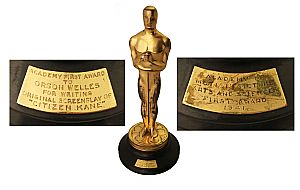
The finest and most desirable item in Hollywood collecting — the original Oscar awarded to Orson Welles for best “Original Screenplay” for “Citizen Kane.” This Oscar statue, awarded by The American Academy of Motion Picture Arts and Sciences, is the very same statue presented to Orson Welles on 26 February 1942 at the Biltmore Hotel. Now widely accepted as the greatest motion picture in the history of cinema the world over, “Citizen Kane” was nominated in nine categories at the 14th Academy Awards, though this was the masterpiece’s singular win. It is also the only Oscar for a Welles film, won by the first-time director who was able to execute his vision for the film with unheard-of final cut privilege granted by RKO Pictures.
Two engraved plaques are placed on opposite sides of the Belgian marble pedestal. One reads, “Academy of Motion Picture Arts and Sciences / First Award / 1941”. The other reads, “Academy First Award To Orson Welles / For Writing / Original Screenplay of ‘Citizen Kane’”. The figure and film reel, composed of gold-plated britannium measuring 10.5″ tall, top the pedestal, bringing the total height to 12″. The pedestal’s diameter measures 5.25″. The award weighs 7 pounds, 5 ounces. Some tarnishing to statue, primarily to the leg area of the figure. The green felt backing under the pedestal is worn away around the edge. Overall in very good condition. Sold for $861,542.
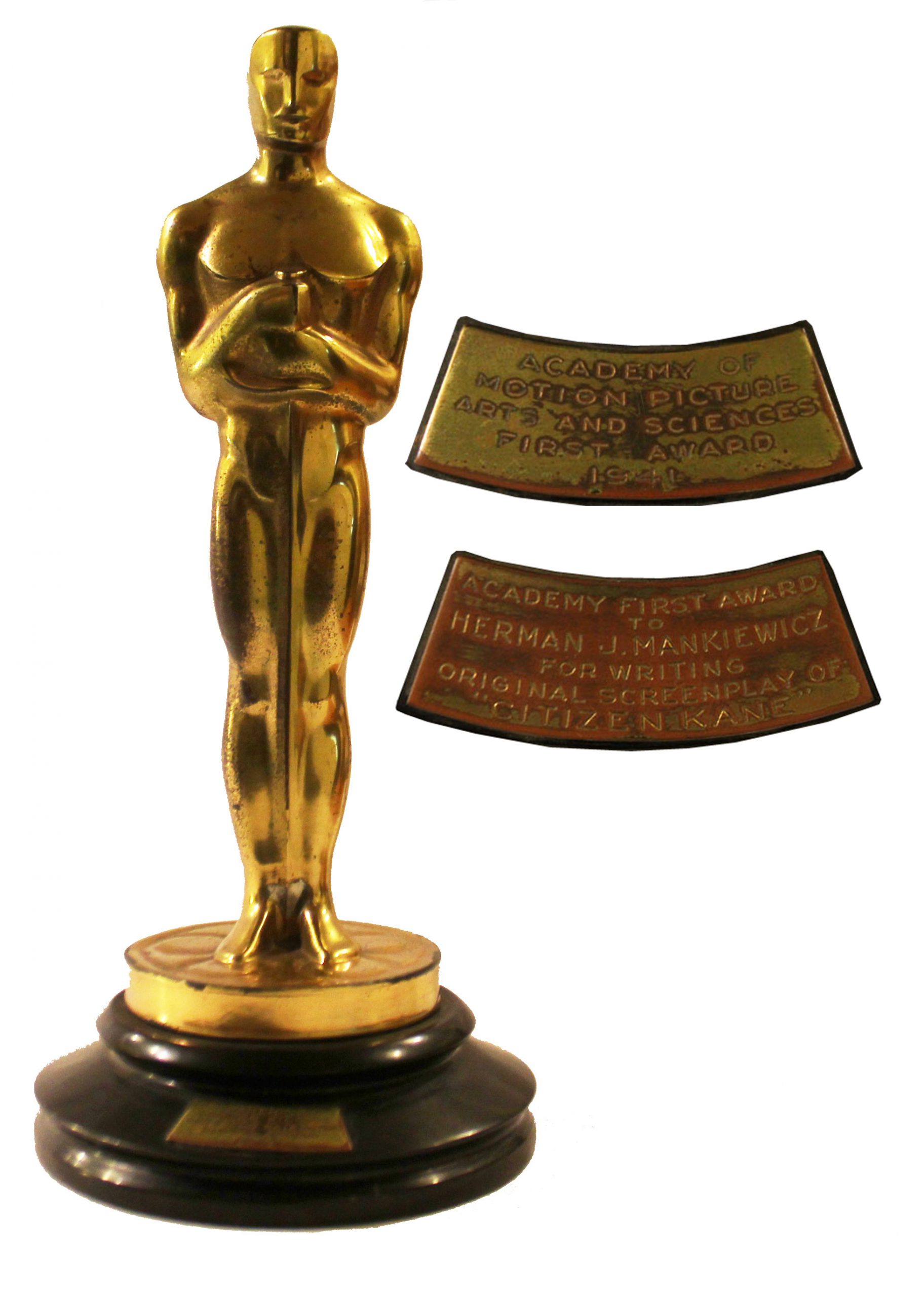
An incredible piece of Hollywood history and memorabilia. The only Oscar won by “Citizen Kane,” voted the greatest American film of all-time by the American Film Institute. Mankiewicz received the award for best original screenplay with the visionary director, writer and actor, Orson Welles, on 26 February 1942 at the Biltmore Hotel. The duel credit to Welles and Mankiewicz would be hotly disputed by both parties, critics and their peers. Influential film critic Pauline Kael attributed Kane’s screenplay to Mankiewicz, particularly offensive to the “one man band” credit Welles was receiving for the film. Rumors materialized publicly that Welles had tried to pay Mankiewicz off, in exchange for Welles to take all the credit for himself. Mankiewicz stated in a letter to his father, “The fact is that there isn’t one single line in the picture that wasn’t in writing – writing from and by me – before ever a camera turned.” The Screen Writers Guild ended the initial debate by decreeing a joint credit on the film but historians still debate whose hand penned which lines of the seminal 1941 masterpiece. Two engraved plaques are placed on opposite sides of the Belgian marble pedestal. One reads, “Academy of / Motion Picture / Arts and Sciences / First Award / 1941”. The other reads, “Academy First Award / To / Herman J. Mankiewicz / For Writing / Original Screenplay of / ‘Citizen Kane'”. The figure and film reel, composed of gold-plated britannium measuring 10.5″ tall, top the pedestal, bringing the total height to 12″. The pedestal’s diameter measures 5.25″. The award weighs 7 pounds, 5 ounces. Some tarnishing to statue, primarily to the leg area of the figure. The green felt backing under the pedestal is slightly wearing away around the edge. Overall in very good condition. Sold for $588,455.
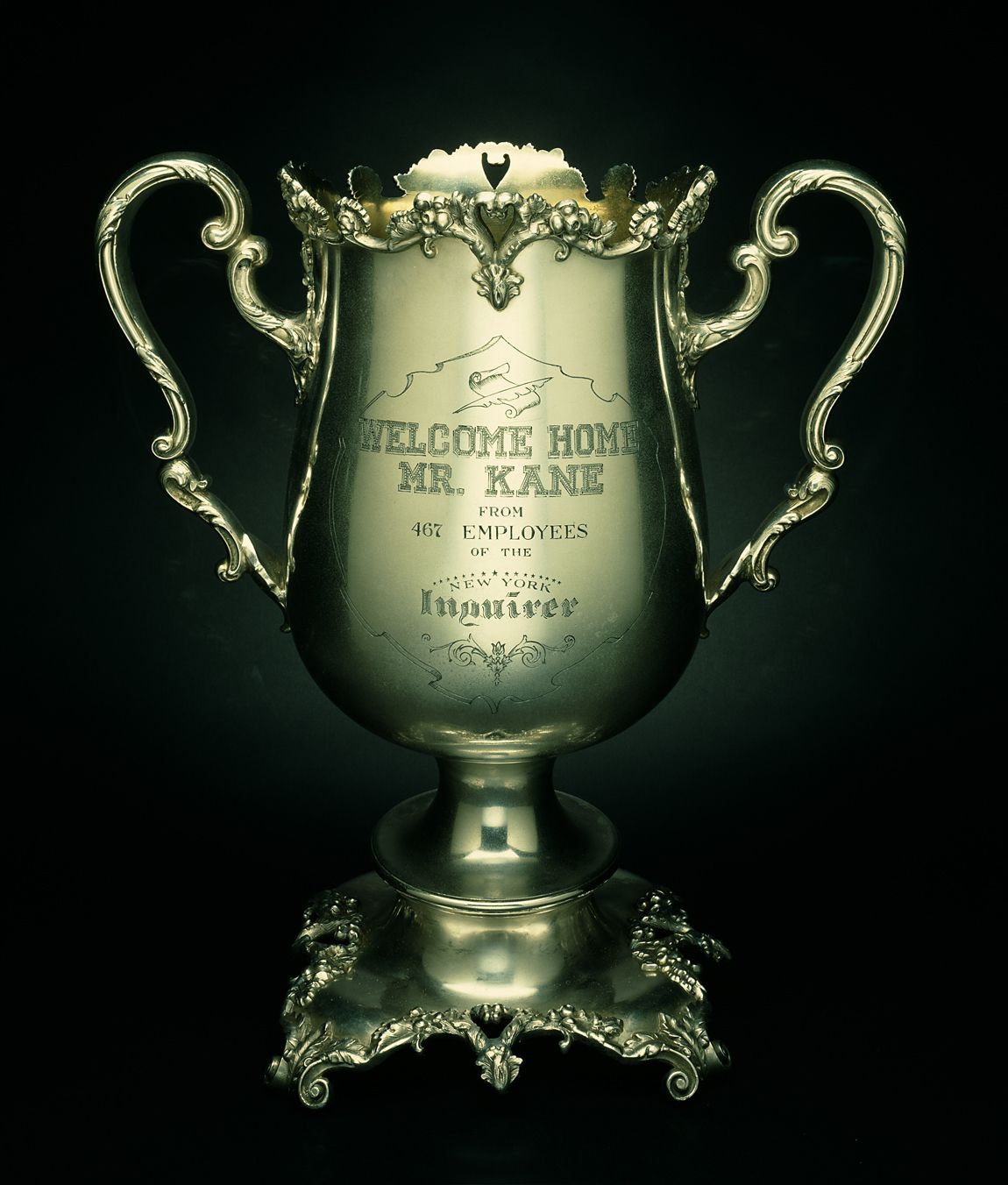
The rarest and most spectacular of all “Citizen Kane” props, the silver-plated trophy presented to Orson Welles as Charles Foster Kane, which he holds in the critical scene upon his return from Europe, flush from acquiring diamonds and his first wife. This trophy is the singular one manufactured for the film (unlike the Rosebud sled, of which three were made), thus guaranteeing its use in the film, held by Welles himself as Kane. The trophy was given to Kane by the employees of his newspaper, which grew from a handful when Kane acquired the near-bankrupt “Inquirer,” to 467 at this point in the film. Trophy is engraved, “Welcome Home / Mr. Kane / From / 467 Employees / of the / New York / Inquirer”. Of course, this trophy also highlights the lack of real journalistic achievement by Kane’s tabloid newspaper, and rather the heaps of praise bestowed upon him by employees and sycophants. The scene in which it first appeared was considered so crucial to the film and so difficult to execute that Gregg Toland, “Citizen Kane’s” Oscar-winning cinematographer, considered it the proudest achievement of his career. The trophy appears once more in the film, at the end with Kane’s other possessions at Xanadu. In this scene, Jerry Thompson, the reporter, and Raymond, Kane’s butler, talk about the meaning of Rosebud while standing over the trophy; they even read the wording on the trophy during this scene. Silver-plated loving cup trophy measures a very impressive 17.5″ tall and 16.75″ wide, with scrolling leaf-clad handles and scrolling base, manufactured by the Barbour Silver Company. Though “Citizen Kane” is widely considered the greatest film of all time (having won “Best Film of the Decade” for two decades by both the AFI and BFI), it only won one Academy Award for screenwriting — a consequence of William Randolph Hearst’s blacklisting in his theatres. Its popularity and significance has steadily risen since its release in 1941, a time when movie studios retained very few of their movie props. As a result, only a handful of “Citizen Kane” props have come to market, with almost all of them from the final warehouse scene at Xanadu and having no significance to the film’s plot. This trophy, along with the Rosebud sleds and the snow globe (which has never been available and is considered lost or broken) are the handful of important props in the film. It is truly the most magnificent “Citizen Kane” screen-used prop one could ever hope to own, from the Golden Age of Hollywood that included such films as “Casablanca” and “Gone With the Wind.” Previous Christie’s auction provenance is also included. Some silver tarnishing to the trophy, and light wear, but overall in near fine condition. Sold for $275,544.
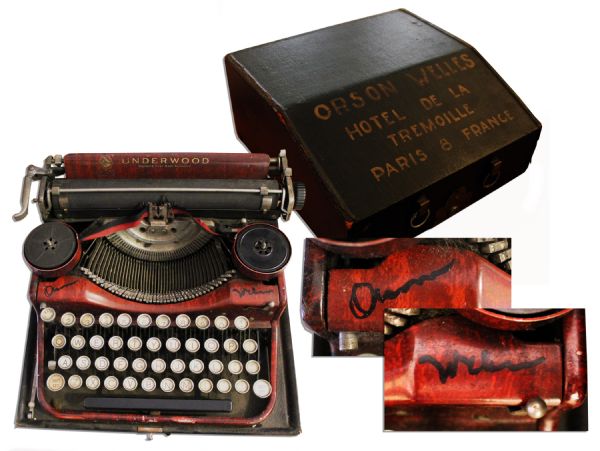
American cultural icon Orson Welles’ personal typewriter signed. Fully functional Underwood Standard Portable Typewriter is signed in black marker ”Orson” on the left side of the front board, and ”Welles” on the right side. This is an early Underwood four-bank model dating to the year of its debut in 1926, and was likely used by Welles during the 1930’s and 40’s, at which time he wrote ”Citizen Kane” for which he won 1941’s ”Best Original Screenplay” Oscar. Also during this time Welles wrote a controversial Hollywood column in the ”New York Post” and a plethora of adaptations of literary works, including ”Around the World in 80 Days” for radio broadcast and the infamous hoax he perpetrated by means of his adaptation of H.G. Wells’ ”The War of the Worlds.” He also wrote the screenplays for ”The Magnificent Ambersons,” ”The Lady From Shanghai” and ”Journey Into Fear” during this time. Early model points of the typewriter include: 1) the shift lock is a nickel-plated lever, not a glass key; 2) the ribbon reversal is controlled by a lever at the top right of the front plate, not a knob on the bottom; 3) the paper table bears a label that reads, ”Standard Four Bank Keyboard” in gilt lettering beneath the large ”Underwood” brand name; and 4) the patents listed on the back end at 8 December 1925. Measures 11.5” wide at the carriage, 10.5” deep, and 4.25” at its highest point. Some loss of finish, else near fine. Included is the original case labeled: ”Orson Welles / Hotel de la / Tremoille / Paris 8 France”, the Parisian hotel where he was known as a frequent guest. The case measures 12.25” wide by 12” deep by 5.5” high. Cracking to edges and loss of material to corners; very good. The signed Underwood typewriter and its case were originally acquired from Orson Welles’ February 1992 estate sale. An incredible item from an architect of modern theatrical art. An excellent item of Orson Welles memorabilia from Citizen Kane. Sold for $33,378.
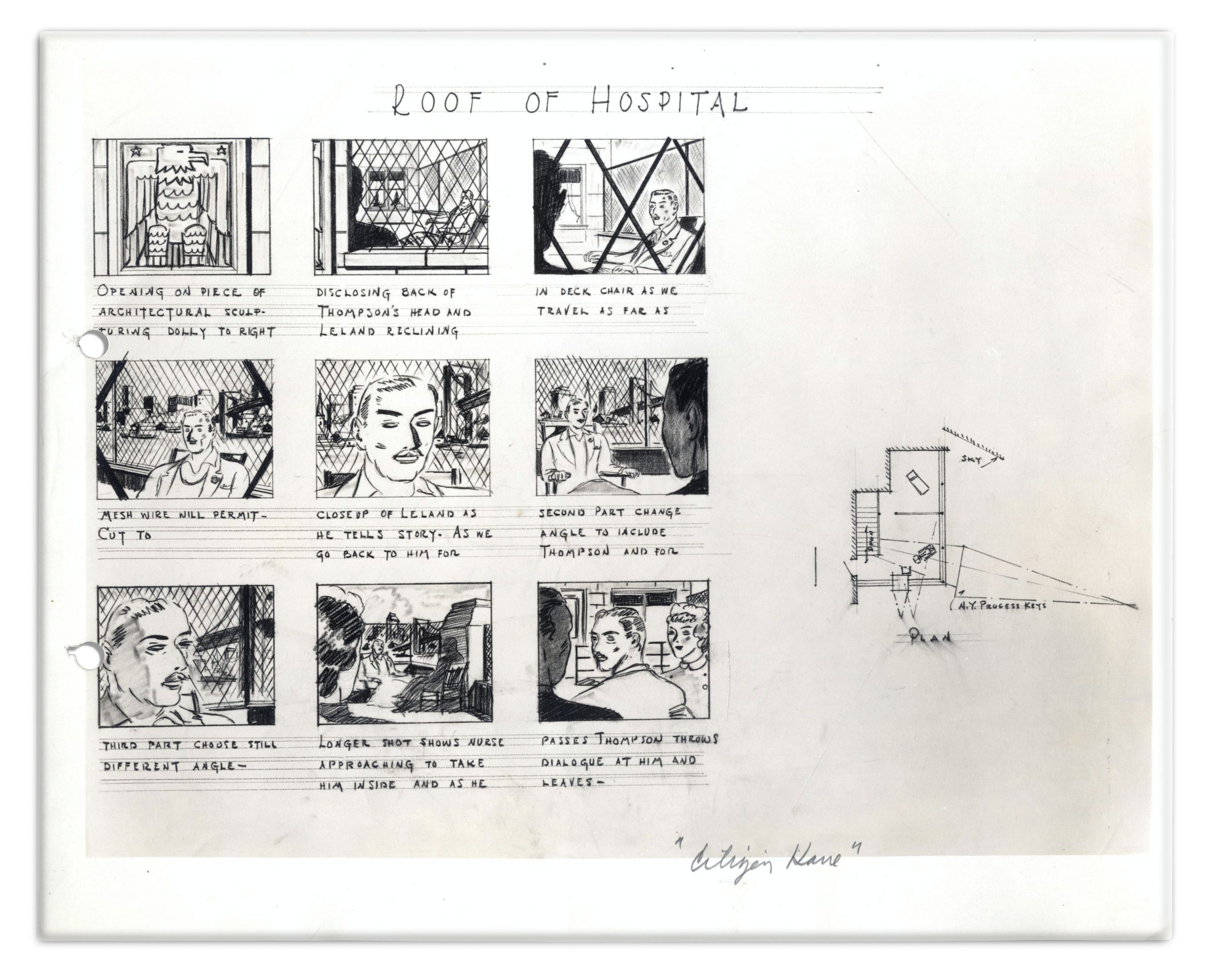
Vintage Print of Original Storyboard Art for ”Citizen Kane” — With Camera Instructions
Vintage print of the storyboard used in the production of one of the greatest movies of all time, 1941’s ”Citizen Kane.” This graphic contains a surprising amount of direction in the nine frames which illustrate the ”Roof Of Hospital” scene in which Thompson, the reporter, interviews Jedediah Leland, Kane’s former best friend. A schematic diagram for the scene’s set design is included. Some of the captions read, ”Opening on a piece of architectural sculpturing Dolly to Right / Disclosing back of Thompson’s head and Leland reclining / in deck chair as we travel as far as / mesh wire will permit – Cut to…” and ” …As we go back to him for / second part change angle to include Thompson and for / third part choose still different angle…” Print measures 10” x 8”. In pencil, ”Citizen Kane” is handwritten near the bottom edge and two punch holes appear along left edge. Near fine. A rare artifact from ”Citizen Kane”’s conceptual stage. Sold for $2,623.
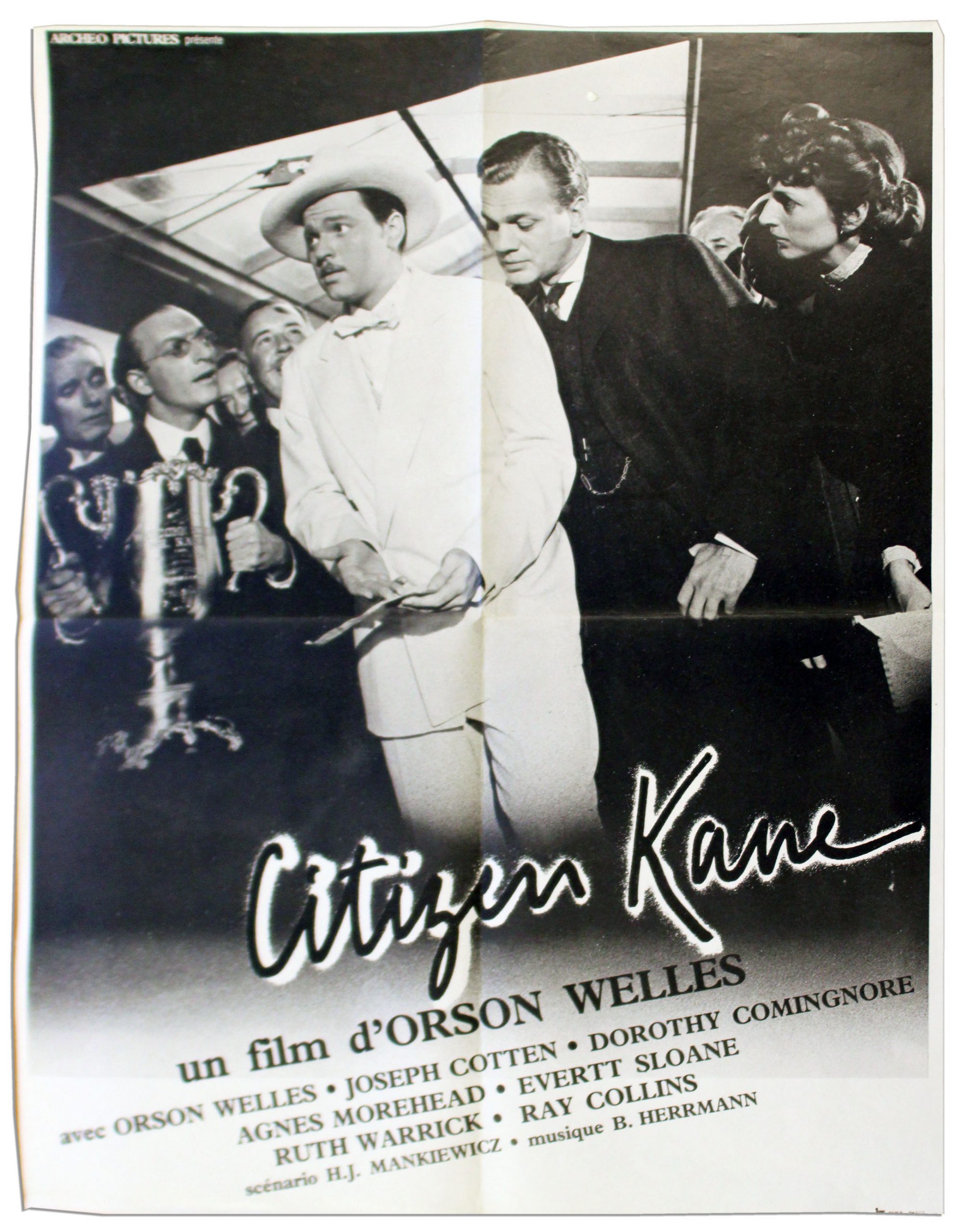
Poster promoting 1941’s ”Citizen Kane” with French titles. French film critics saw the brilliance of ”Citizen Kane” early, and helped solidify its reputation as the greatest film of all time. Fine print to the border reads: ”iPac 443 99 33 Visa 9213”. Measures 22.5” x 28”. Creasing, else near fine. Sold for $1,109.
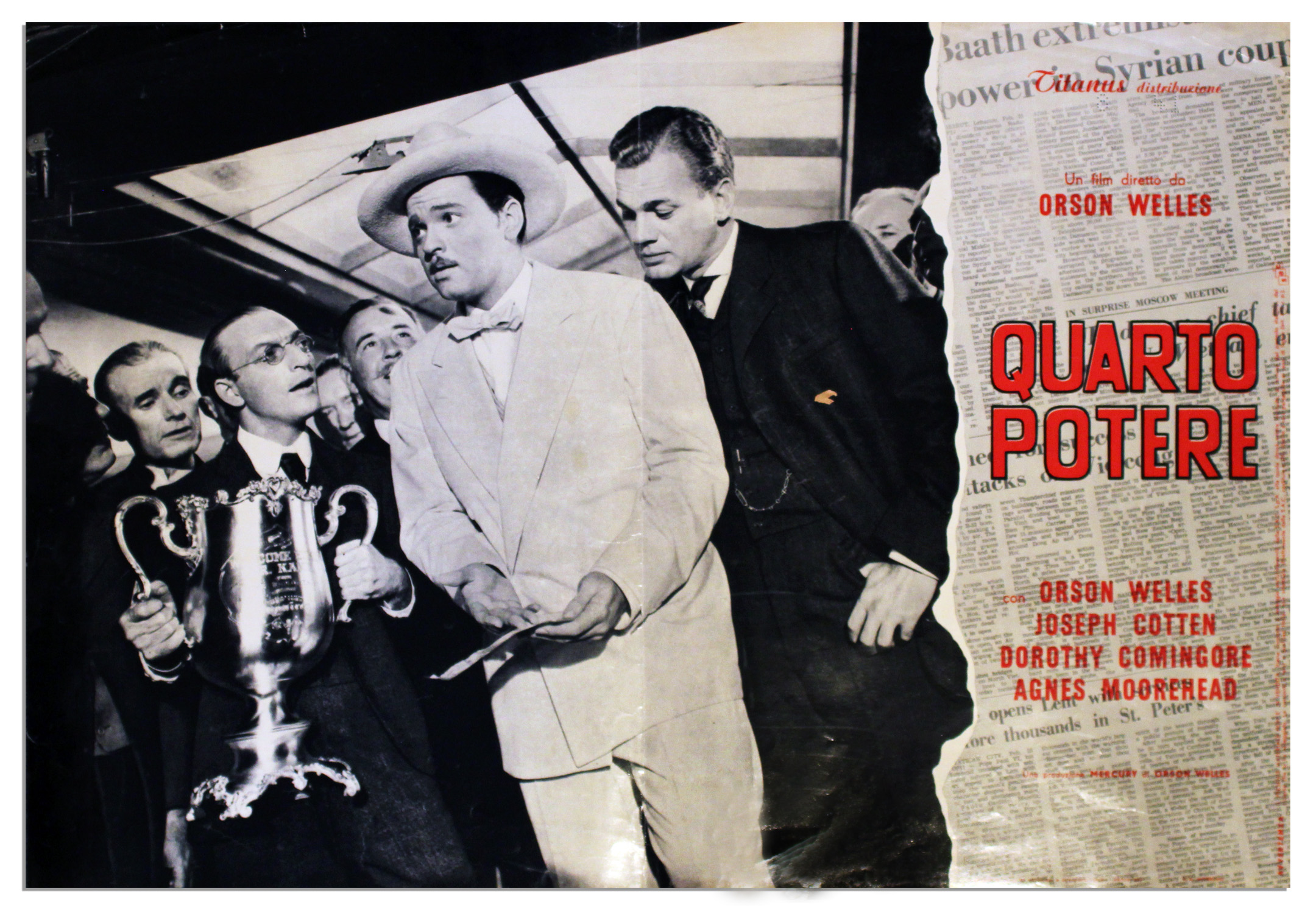
”Citizen Kane” Italian Poster — Featuring the Trophy Cup Prop
”Citizen Kane” poster with titles in Italian. A famous still from the movie showcases Welles as Kane receiving the silver trophy cup, a scene cited frequently as a prime example of the use of deep focus, the groundbreaking cinematography technique for which ”Citizen Kane” is known. Glossy poster measures 24.5” x 16.75”. The numbers 8 and 14 are perforated into the upper right corner. Creasing, with tiny tears scattered along edges and tape to verso behind a corner tear. Very good. Sold for $1,109.
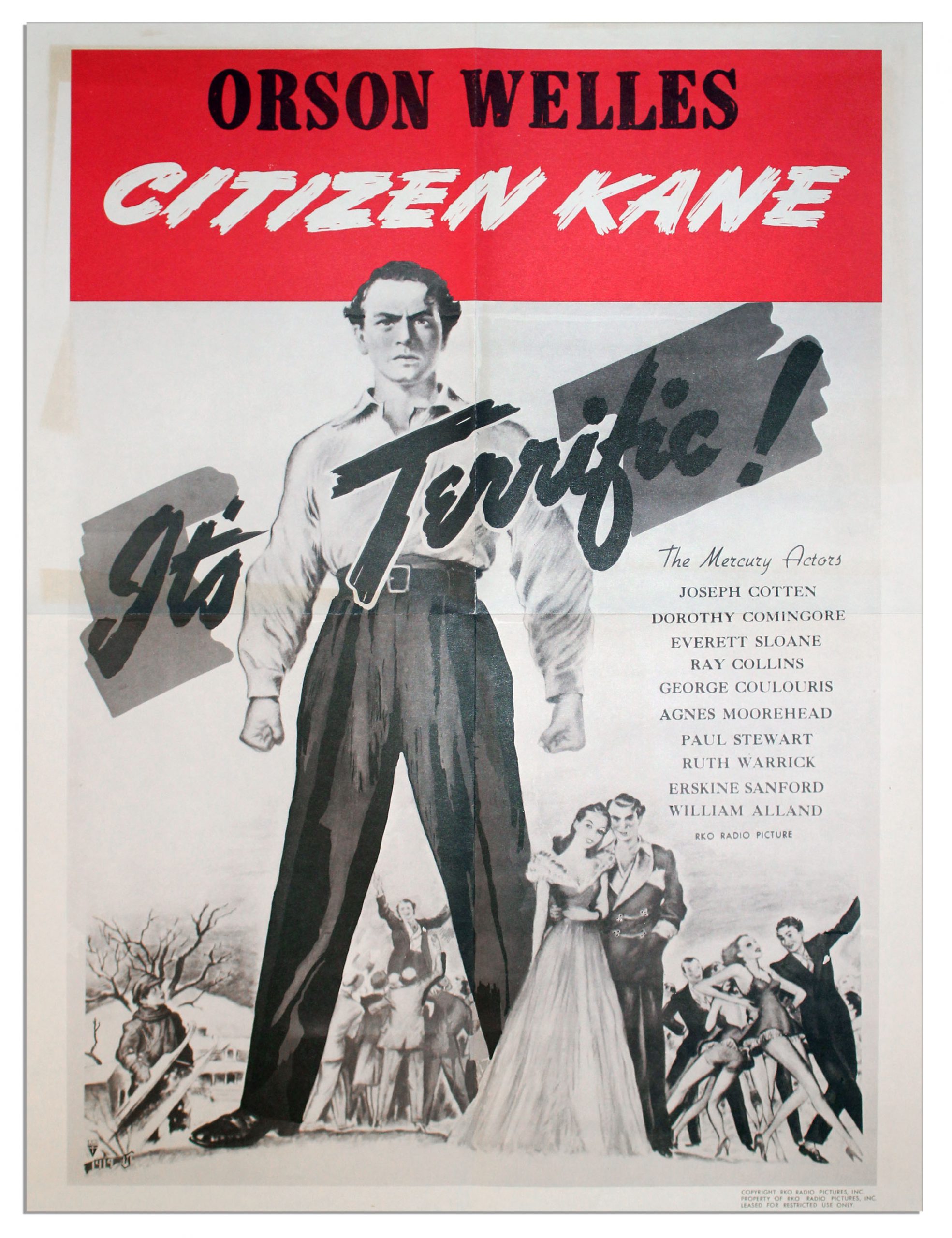
Original 1941 ”Citizen Kane” Poster
Original RKO Productions poster for 1941’s ”Citizen Kane.” The eye-catching copy raves: ”It’s Terrific!” above a list of the top-billed cast that Welles assembled from his Mercury Players theater company. Measures 18.5” x 24.5”. Creasing, with miniscule points of surface loss to folds, else near fine. Sold for $916.
Thanks for viewing some of the Citizen Kane memorabilia we’ve sold! Our monthly auctions can be browsed at NateDSanders.com.
FAQs
How do I consign or sell my Citizen Kane memorabilia?
It’s never been easier to sell your movie memorabilia at Nate D. Sanders Auctions. Email a description and images of your item to [email protected] and we’ll get back to you as soon as we can with a free appraisal.
This sounds great and I’d like to move forward. What’s the consignment process like at Nate D. Sanders Auctions?
We’ll send you more information about our auction house along with an agreement to review. Your item will appear in our next auction. Unlike many auction houses, we hold monthly auctions and pay you within an industry-leading 45 days following the auction.
What factors determine the value of Citizen Kane memorabilia?
The value of your item can vary based on condition and subject matter.